2023 Elections: Kano politics so far…
By Salisu Uba Kofar-Wambai
By Mohammed Zayyad
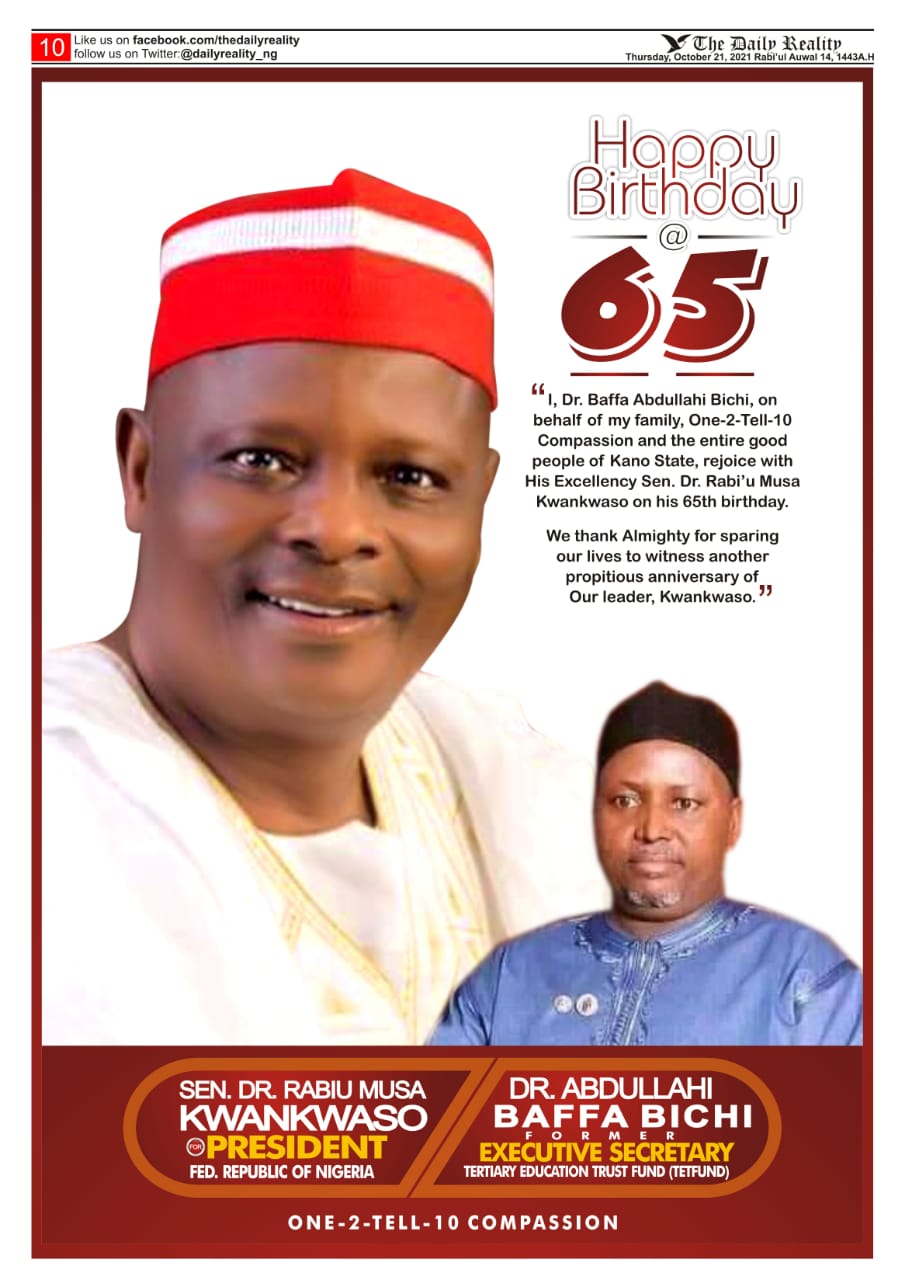
The debate that the presidency moves to the South in 2023 has gained momentum. Also, presidential hopefuls from the North, like Atiku Abukar, Sule Lamido, Senator Bala Mohammed, Senator Rabiu Musa Kwankwaso, are also effectively playing their games.
The calls for power to shift to the South have further triggered permutations and realignments in the polity. Both the Peoples Democratic Party (PDP) and the All Progressive Congress (APC) have strong candidates from the South. But these candidates have their respective baggage, and the parties have internal squabbles that must be resolved.
The APC has its stronghold in the Northwest, Southwest, Northeast and Northcentral – four of the nation’s six geopolitical zones. The PDP has strong structures in the six zones with a stronghold in the Southeast and Southsouth. However, the APC has moved into the Southeast in full force. Before the 2015 elections, nobody had ever thought that the APC would someday have even a ward councillor in the Southeast. But, today, the party has two state governors, senators, House of Representatives members, state house of assembly members, local council chairmen, councillors and formidable party structures in all the five southeastern states.
Come 2023, the APC has no reasons to retain power in the North, but there is strong politicking by some governors and other bigwigs to maintain power. This will mean the APC contravening the unwritten agreement between the North and the South on power rotation. In any case, the APC does not have a strong presidential candidate from the North. This is a big plus to the presidential hopefuls from the South, or Southeast, in particular. Furthermore, the Southeast has a strong case to present based on a plank that the Southeast is the only geopolitical zone in the South that has not produced a President or vice president on any political party platform since 1999.
If APC picks its presidential candidate from the South, especially Southwest, the PDP may attempt to outwit this by looking to the North for its presidential candidate. This, as well, will put the PDP in a catch-22 situation on how to explain this to the South, especially the Southeast and the South-South, why the North again, after eight years of the North being in power.
PDP has good candidates in their own ‘rights’ from the Southeast and South-South. Enugu State Governor Ifeanyi Ugwuanyi, Peter Obi from Southeast and Governor Nyesom Wike from the South-South. Obi does not have friends in the North and has never tried to pull an appeal from the region, directly or by proxy. His deportation of other Nigerians to their states when he was governor of Anambra state was used against him in the North during the 2019 campaign, and it worked.
For Wike, his words, ‘Rivers is a Christian state’ will be used against him in the North like Governor El-Rufai’s Muslim-Muslim ticket in Kaduna can be used against him (El-Rufai). This is how local politics impact a candidate’s wider political opportunities. Some young people in the north are also campaigning for Enugu State Governor Ifeanyi Ugwuanyi. Still, the IPOB issue will be a significant hindrance in the North, but it is not insurmountable. Advocates of secession appear not to understand Nigeria. There are massive inter-marriage, friendships, business links and political alliances, among other ties, between many northerners and many Igbos.
Some nationalistic politicians from the Southeast have started to convince other Nigerians to support the region to produce the Nigeria president of Southeast extraction in 2023. The bigwigs’ forefront presidential hopefuls are Governor David Umahi, Orji Uzor Kalu, Governor Ifeanyi Ugwuanyi, Rochas Okorocha, Chris Baywood Ibe, Ken Nnamani, Minister of State for Education, Dr Chinedu Nwajiuba, Sen Osita Izunaso and many others. Of course, these politicians have their political baggage and controversies. However, people like Chris Baywood Ibe are new faces without any political baggage and controversy-free.
A thorough understanding of how Nigerian politics works is paramount in achieving the political goals of a group, a region, or individuals. There are so many conflicting interests in Nigeria. Still, there are always windows for alliances, give-and-take, a hand of friendship, and convincing others to support a particular political cause or an individual’s.
For the 2023 presidency, the Southeast should present a candidate with a new face, no controversies, no political baggage and who has friends and is well-known across the Niger. For both the APC and the PDP, it will be an opportunity to reunite Nigeria and rekindle the historical political alliance between the north and the southeast while maintaining the partys’ current national. The Igbo presidency is possible through the spirit of one Nigeria.
Zayyad I. Muhammad writes from Abuja. He can be reached via zaymohd@yahoo.com.
By Abdulrazak Iliyasu Sansani
By Abdulhaleem Ishaq Ringim
By Ibrahim Siraj
There are indications that Nigeria’s main opposition party, the Peoples’ Democratic Party (PDP), would zone its presidential ticket to the Southern part of the country. This follows the decision of the party to zone the national chairmanship seat to the North ahead of its national convention coming up later this month.
Although the party is yet to formally decide on the zone that will produce its flagbearer in the 2023 presidential election, the latest decision provides some clue because, based on convention, the party has never zoned the two coveted offices to the same region.
Announcing the decision Thursday, Governor Ifeanyi Ugwuanyi of Enugu State, who is also the Chairman of the party’s zoning committee, said the decision was arrived at at the end of his committee’s meeting.
He said his committee was not mandated to zone the presidential ticket. According to him, “The mandate of the committee does not include zoning of the president, vice president and other executive and legislative offices of the Federal Republic of Nigeria”.
The decision of the party to zone the offices, the Governor adds, “is in line with the constitution of the party on zoning and rotation of party and national offices in the interest of justice, equity and fairness”.
By implication, the decision by PDP to push the national chairmanship seat to the North is likely to dash the hope of politicians eyeing the party’s presidential ticket from the North. Going by tradition, it is almost impossible for the party’s national chairman and presidential candidate to come from one zone.
Prominent among those affected by the party’s decision are former vice president Atiku Abubakar, former Senate President Bukola Saraki, Governor of Sokoto State Aminu Tambuwal and former Kano State Governor Rabi’u Musa Kwankwaso. These four politicians are among many others of Northern extraction who dominated the party’s presidential convention in 2019, with Atiku Abubakar eventually emerging as the winner. However, Mr Atiku was defeated by President Muhammadu Buhari of the ruling APC to win reelection.
Atiku unperturbed – Campaign Group
Speaking to The Daily Reality on the development, Alhaji Abdullahi Abdulkarim Gama, leader of Atiku Arewa Reporters, a campaign group rooting for the candidature of the former vice president, said his principal remains unperturbed. He said as far as they are concerned, the decision of the zoning committee is not final and only reflects the position of PDP governors. Moreso, he said, the Governor Ahmad Fintiri-led Convention committee is yet to conclude its assignment and submit its report regarding the party’s convention. He maintained that scheming for the party’s presidential ticket would continue until the last minute.
Situation sceptical yet no cause for alarm – Kwankwasiyya leader
On his part, Dr Aliyu Isa Aliyu, a leading Kwankwasiyya member in Kano, warned that the situation remains sceptical even though no cause for alarm as far as Kwankwaso’s presidential ambition is concerned given that the party has not formally taken a final position on the matter. He cited a situation in 2007 wherein late President YarAdua emerged as PDP’s presidential candidate and went ahead to win the presidency even though the national chairman at the time, Col Ahmadu Ali (Rtd), was also a Northerner. Col. Ali was replaced in 2008 by Chief Vincent Ogbulafor following the zoning of the position to the South.
Agitation for power rotation not in the interest of Nigerian masses – Don
PDP’s decisions came when the North and the South are deeply entangled in a heated agitation for power rotation. The Southern governors have, on several occasions, made it utterly clear that power must shift to their region, and the North must shelve any thought of retaining the presidency beyond 2023. This position was, however, countered by Northern governors who consider it as “foolish”, “unconstitutional”, and “undemocratic” any attempt to dictate to the North who to vote for as president.
At the end of the governors’ meeting earlier this week which other leaders from the region also attended, the governors advised their Southern counterparts to explore dialogue and compromise as against confrontation and undemocratic tendencies if they are really interested in securing the support of the North for power to shift to the South.
As the political tug of war between the North and the South continues over the zone that produces the next president, a university don has warned that the rotational presidency is undemocratic and thus has no place in Nigeria’s Constitution. Answering enquiry from TDR, Dr Riyauddeen Zubairu Maitama of the Department of Political Science, Bayero Univerisity, Kano, explains that although so much importance has been attached to the issue of power rotation, what should be more significant for the citizens is justice and development. Of utmost importance to Nigerians, he said, is choosing a leader who will tackle corruption, poverty and widespread insecurity irrespective of the political party or the region such a leader comes from.
Dr Riyauddeen further lamented how politicians from both divides are becoming more preoccupied with zoning and power rotation at the expense of the welfare of the Nigerian masses who voted for them. He described the agitation for secession championed by the likes of Sunday Igboho as Southern Nigeria’s gimmick to harass the North and to exact political concession ahead of the presidential election.
Crucial months ahead
With less than a year and a half to Nigeria’s 2023 presidential election, the next few months will be crucial as zoning, and other issues are expected to dominate the discourse on the political scene. While the major political parties continue to gear up for their separate national conventions to choose national officers, Nigerians will continue to observe with keen interest how political events will unfold in search of President Buhari’s successor in 2023. The pertinent question for now is: can zoning succeed in ultimately sealing the fate of those presidential hopefuls from the North, or would they be able to come up with something dramatic to turn things around? Only time will tell!
By Mohammed Zayyad
By Mallam Musbahu Magayaki
The political calculation of the All Progressives Congress (APC) may likely lead the party to oversight if they fail to set their house to order. There is a rumour that the party is romancing former President Goodluck Ebele Jonathan. APC reportedly declared that they will allow him to recontest for the presidential race in the 2023 general elections if he joins the party.
Lo and behold! Despite this rumour, one Jonathan supporter joined the party after spending many years criticising the party on social media fiercely. Thus, Jonathan’s supporters are defecting to the APC. Will this signal his presidential ambition?
Let’s assume the presidential ticket goes to the south-south; what is the fate of the Southwest that has been promised the presidential ticket in a zoning agreement? Even though the zoning policy is not democratically based on the constitution in the country that is practising democracy.
Meanwhile, a candidate for president and his running mate from the same region sounds too odd. That is, you can not pick a president from the southeast and a vice president from the southwest. In addition, the recent party local government congress elections hindered the party, leading to factions in some states. However, this may cause the party to lose its members if decisive actions are not taken promptly while confronting the party’s national convention elections.
Any political party that gives a glimpse into the Party’s instability will eventually experience its entire tendency to fail. A few weeks ago, in the opposition PDP, the leading crisis crumbled. Many political analysts argued that the party lost its spirit as a real opposition party since there would be no political party prospering in the conflicts.
Nevertheless, when the ticket goes to the South-south, the Southwest may not vote for the party because the national leader of the party’s presidential ambitions would not realise his ambition. As a result, even though he has not declared his interest in the race yet, the APC may lose Lagos, Kano, and many other northern states.
Mallam Musbahu Magayaki writes from Sabon Fegi, Azare. He can be reached via musbahumuhammad258@gmail.com.
By Muhammad Abdurrahman
Professor Umar Farouk of the Department of Mass Communication, Bayero University, Kano and a former Kano State Commissioner of Information during the second tenure of Dr Rabi’u Musa Kwankwaso spoke with The Daily Reality on the possibility of Malam Ibrahim Shekarau’s return to the Peoples’ Democratic Party (PDP) and the possible emergence of the Third Force before 2023 elections.
Prof. Farouk said that “Mal. Ibrahim Shekarau’s decamping to APC didn’t help him. They don’t respect him. Someone as eloquent as Shekarau is now missing in the headline tells you there is a problem in APC. His silence tells you he is not happy with the manner he is treated. He is just waiting for an opportunity to break his silence.”
“When he was at PDP, Dr Rabi’u Musa Kwankwaso visited him, sought for his support and made him many promises when they form a government. But Shekarau thought differently and decamped to APC. Even though people see him as our arch-rival, look at how Kwankwasiyya supporters received him at the airport without any hard feelings. Look at how they escorted him to his car, and also those at Nassarawa Local Government look at their pictures with him. This is the discipline instilled in them by our “Jagora” [Kwankwaso].”
A similar incident brought Senator Kwankwaso and the Minister of Communication, Dr Isa Aliyu Pantami, at the same Malam Aminu Kano Airport in 2019. At that time, some Kwankwasiyya supporters shouted at the latter, a few others attempted to wrestle him. Recalling this regrettable incident, Prof. Farouk responded, “Dr Isa Pantami was only unlucky because of the political climate at that time. And that brawl was mainly premeditated by a lot of issues.”
Since 2003, supporters of Kwankwaso and Shekarau dominated political programmes on Kano radio stations with talks and counter talks on the two political giants. But it seems that is no longer the case.
Prof. Farouk argued, “To the best of my knowledge, it is infrequent now, that is if even it happens to see a bona fide Kwankwasiya supporter criticising Shekarau on both social media and conventional media. Considering how the leadership of APC in Kano and at the national level treats him, we sympathise with him. A Kano State governor for eight years; a former minister and presently a senator of Kano Central, but his party, APC, doesn’t see his worthiness. He is not contacted about the party’s activities in most cases as he was not considered in the previous local government elections.”
“There is a possibility that both Shekarau and Kwankwaso will forget their differences and form a formidable alliance to bring the change people have been aspiring for because we all tested the bitterness of APC’s administration. Shekarau was from PDP, and certainly, he will return. We, the Kwankwasiyya bloc, have an existing structure that is waiting for him. It is not a shame if he comes back to his home, PDP. His return will certainly boost the strength of PDP,” said Prof. Farouk.
The Third Force is not a new phenomenon in Nigeria’s politics, especially when there are crises in the ruling party and things are not faring well. Both politicians and the governed look for an alternative. Prof. Farouk added, “Though it is a bit late, Third Force is inevitable considering the political unrests in the country. Both APC and PDP have internal crises with many cases in the court about the leadership structure and other issues.”
“There would be a lot of movements to and from both parties depending on where the wind blows. Therefore, governors, senators, and state and federal representatives need to be the third force to cause any change. Without these people, it is a futile exercise to talk about the third force. This is the reason why, often, some people stay in the ruling party because it has the resources to win elections, legitimately or otherwise.”
“But naturally, there must be an opposition. Those members who stay and nurse their ambition to fruition will win. This is what President Muhammadu Buhari did for many years, and in the end, APC won. So you must be patient,” Prof. concluded.