Northern Nigeria

Skills Beyond School (II)

By Najib Ahmad, PhD

Some remote jobs require intermediate or advanced skills, such as machine learning, computer vision, and natural language processing. These need you to have a good understanding of some areas in mathematics to solve computational problems. Design and analysis skills in Electrical, Mechanical, Civil, Building and Architectural disciplines also require one to have adequate skill in learning-related software such as Matlab, Simulink, Ansys, Autodesk AutoCAD, StormCAD and ArcGIS, 3D Studio Max, Blender, among others. Besides all these, adequate knowledge of computer programming skills is essential. Always utilise the opportunity for an internship or industrial training or student industrial work experience schemes assigned by the school because they are good places for learning and engagement.

Skills acquisition does not only stop in science and tech-related areas, as I earlier mentioned. Whatever major you study in school, there is a skill to gain in it! So grab the opportunity while you still can. Everyone you admire now started somewhere. For instance, if you major in social sciences or arts and related disciplines, acquiring effective communication skills, excellent writing skills, and outstanding data analysis skills can take you to places you never anticipated.

And most importantly, from any discipline, you need to possess sound knowledge synthesis and critical thinking skills. There are good websites to look for a job that matches your skills, such as www.fiverr.com, www.upwork.com, www.freelancer.com, and www.flexjobs.com. The point is: whatever you study, there is a skill to add to it! Just be damn good! The ways to learn them are lengthy yet straightforward. For some, you may need up to six months of dedication or even a year or more to master a particular skill. What matters is, put your best effort as you usually do to pass your university/school courses exams.

In some cases, some people want to advance their careers, and these are all for you. And always remember that age does not matter in this journey. Even if you find yourself somewhere in mid-life, it’s not too late. So many people have had a rethink about their choices and goals in life much later and still make it.

Earlier I remarked that these skills are for everybody who wants to do good for himself. School education (higher education) and skills acquisition are not mutually exclusive; you can blend and achieve both at once. You may have seen that some people argue about which is better between the two, especially in times of uncertainty like now when jobs are scarce. Their point can only be substantiated when the goal was to compare learning a particular skill for a single purpose through extensive training or vocational training education and the school education system in Nigeria. However, you can begin to craft different skills at any level of your study because the current curriculum limits and is not in tune with the current reality about jobs. Hence, I titled this piece ‘Skills Beyond School’.

Arguably, most people wrongly perceive that skills, perhaps largely if not all, are intended only to be technical (Tech skills), and it is for technical people. That is a wrong, misleading impression. ANYONE can learn and master a skill in (or out of) their field of study. It is not rocket science. The energy you use elsewhere – or on social media – can be channelled to where you would surely benefit, even if not for financial gain, but knowledge gain.

For instance, anyone can learn entrepreneurial skills. But, in this case, do not seek short-term rewards! Even the owners of Microsoft, Google, Tesla, and Apple and most likely other ‘big names’ in this field you hear in your locality started their entrepreneurship journey by learning computer programming and other skills. So, begin something somewhere; no matter how little it might be, the change would surprise you one day.

And as you are reading this, I know you are thinking about the possibility of acquiring the skill desirable to get these kinds of jobs and finally be able to work for someone who didn’t even know you, especially outside Nigeria. The fear is normal – many people have shared this doubt at the beginning. I have friends (yes, my friends) who are currently doing remote jobs and cashing out monetary rewards in different fields of skills! Huh, I sound very promising. Because I believe you can also do it. One of these friends is managing a big project remotely. Isn’t that interesting? Imagine in this economic phase, and you have an extra job that provides you with additional benefits, considering that they are all employees of other sectors. FYI, students or graduates like you in southern Nigeria have been enjoying these remote jobs for ages. So, wake up.

What if you believe that everyone doing an online remote job is a potential criminal? In that case, the thing is, you are deceiving yourself. It is particularly irritating for me to see that we like to excuse our premeditated and comforting laziness (pardon the word). Besides, learning some skills can even give you an upper hand in applying for a master’s or PhD scholarship worldwide.

Finally, to reduce the gap or, in other words, to balance the economic growth between men and women, particularly in the North, we need to encourage girls to join the do-it-yourself kinds of skills acquisitions right from secondary school. If I am to be candid, I would tell you that we are left behind in everything. However, it is not too late for us to change the situation for the better. Don’t forget that life goes on even if you do nothing, and it is up to you to catch up. Just wake up!

Dr Najib Ahmad is a Postdoctoral Researcher at Shandong University, China. He can be contacted via namuhammad03@gmail.com.

Skills Beyond School (I)

By Najib Ahmad, PhD

Thanks to the existing curriculum in Nigerian schools (its directions, objectives, and preferences), students who wholly rely on this system hardly possess any tangible skill, which would prepare them to become self-directed or independent or job providers. They can also barely avoid queueing the assembly of youths whose over-dependence on the government-provided jobs is noticeable countrywide. Any thoughtful country that cannot provide jobs for its youth population knows the gravity of its future, which may be bleak. Fortunately, this is not a lonesome fight for Nigeria. It is a common challenge bedevilling the world today from the Far East, West to the far South Mediterranean countries, including developed and developing parts of the world.

There is a lack of adequate jobs everywhere, possibly for several divergent reasons. It is shared treachery, especially with the continuing world’s economic meltdown due to many seen and unseen factors. So, as a Nigerian, please do not take it hard or shudder; imbibe water and relax a trifle because we are not alone in this mess. There may be an advantage to every saddle moment.

Since the beginning of Covid-19, some countries have imposed total or partial lockdown–longer or shorter. These changes in our lives have handicapped the economy of nations and shattered peoples’ economic stability. On and off, many countries are still struggling with lockdown, which eventually forces people to work from home. From reports, you can say that the pandemic exposes the profound weaknesses and causes alarming panic in many countries previously seen as organised and the superpowers (aka God’s own nations). As a result, many people lost their jobs even in those powerful countries. Schools, universities, laboratories, markets, factories, and businesses were all closed, places of work and worship across the world were abruptly shut.

Consequently, different governments and policymakers have realised how vulnerable conventional job systems are. Thus, they are implementing strategies and gradually understanding the need for robust, better approaches to tackle these unprecedented changes. Policymakers have recommended and implemented novel ideas to impact schools, business owners, and entrepreneurs in countries affected by this negative development to make the economy viable and uphold the economic stability of their citizens.

For instance, several schools and universities have switched to remote instruction, in other words, digital learning. Due to the compelling need for endurance, human beings are social creatures who resiliently adapt and quickly learn to familiarise themselves with any given circumstances. People with different essential skills grabbed advantages from the emergent changes. They include but are not limited to computer skills that allow you to carry out remote jobs–working from non-typical office space. Besides, they are the kinds of do-it-yourself skills; they are not the specific skills you can learn from the traditional vocational training school. Suppose the government has plans to train people in such specialisation through vocational training school. In that case, it is a potential task and could easily invigorate people’s economic stability and prepare youth for the path of independence.

Here are a few examples of remote jobs that you can do from any place: (a) Computer programming/Coding; (b) Web development/design and Android or iOS developer; (c) Data science; (d) Content writing, copywriting, copyediting, transcription, and translation; (e) Graphic design; (f) Digital marketing; (g) Video editing; and Virtual assistant, and so forth. Of course, these jobs existed before COVID-19. However, they took a new turn and became enormously popular since the onset of the outbreak, thanks to their necessity and worth in our everyday lives. Thus, the everlasting need cannot be trammelled.

And every person who has no prior computer science/technology diploma or degree can master these skills. It does not matter whether or not one is from science or non-science-based disciplines. All you need is an android/iOS phone, while some require a desktop or laptop computer. Above all, you also require determination in learning and mastering any of these skills. And the good thing is, they are now taught in many online learning platforms for free or for a cost as either certified short courses or nano-degree programs.

The paid access courses are not very expensive if you compare them with the value of what you will learn and its advantages afterwards. Sponsored by the tech giant companies and other government sectors like Microsoft, Google, European Commission, and Universities, platforms such as Udacity, Udemy, FutureLearn, and Coursera offer massive open online courses (free).

YouTube is similarly often graded as the best platform for learning anything; you can use the platform to learn any skill you wish. So if you are a book person, look for the best ones in your field, learn, and practice. Even some establishments from Nigeria are taking part in this skills acquisition training program for the youths, but you hardly see these opportunities discussed in northern Nigeria’s cyberspace. Recently, I encountered another scholarship announcement for a Nanodegree scholarship in many essential skills in varieties of disciplines, which Access Bank, Nigeria will sponsor.

Dr Najib Ahmad is a Postdoctoral Researcher at Shandong University, China. He can be contacted via namuhammad03@gmail.com.

Are Funtua communities this vulnerable?

By Umar Haruna Tami

We have already lost count of how many times kidnappers came and abducted people from different locations in Funtua. Still, the ease with which they carry out their operations day by day is alarming. The two successful kidnappings that occurred in the past weekend – Saturday’s in a single house near GRA, Sunday’s in mass in Sabuwar Abuja – symbolise the fragility of the security agents that are meant to protect the town and its people from these monsters.

The security agents and the residents of almost every community have already been defeated through fear. Even a rumour of kidnappers’ presence sends fear around the town and that with a single gunshot, everyone would end up running for their life. Even the “‘Yan Karota” volunteers’ confidence to confront the monsters has since been defeated upon realising that the machine guns the kidnappers carry cannot, in any way, match the plug-bulleted ones they have. Thus, they too run for their lives, even though what they do defines good citizenship.

So a city as big as Funtua, with routes linking it to many towns and villages from East, West, South and North, is under security threat. These links make it easier for the kidnappers to make away with whoever they have successfully carried with little chance of being tracked and attacked. This also makes their operations tricky to thwart in poor-populated areas.

They failed to conduct only two operations that targeted Rabe Sale’s children and that of NAK’s family. But the abortions of these two kidnap attempts have anything to do with the connection between the would-have-been victims and the reserved soldiers brought to the town for special operations simply because they are aristocrats.

But what would be the fate of community members that have already been defeated by the fear of being potential victims of kidnappers even when they shut and lock their doors but have no connection to the soldiers for emergency aid and one of those elites happens to not live among them? The latest kidnap of over ten people in Sabuwar Abuja at only 10 pm — thank God that the captors released them — signifies nothing bolder than the community’s vulnerability and the limited chances the sophisticated security agents have to abort their operations or exchange fire with them. But, on the other hand, they now have the assurance that it wouldn’t cost them much to do whatever they want and at any time!

What Funtua communities need now, just as the other Northern communities need, is making available the reachable lines of those special forces for emergencies. Second is the provision of more of these agents—both the soldiers and policemen — with weapons they can use to repel the kidnappers’ attacks in areas not far from where their help could be needed in time. Third we, the community members, need to reduce the extent of our collective fear for the kidnappers that we can stand up to them, not always run away. It is time for us to start being responsible for where our political choice has landed us.

Umar Haruna Tami wrote from Funtua, Katsina State. He can be reached via umartami1996@gmail.com.

Kaduna: Government to conduct competency test for primary school teachers

By Sumayyah Auwal Usman

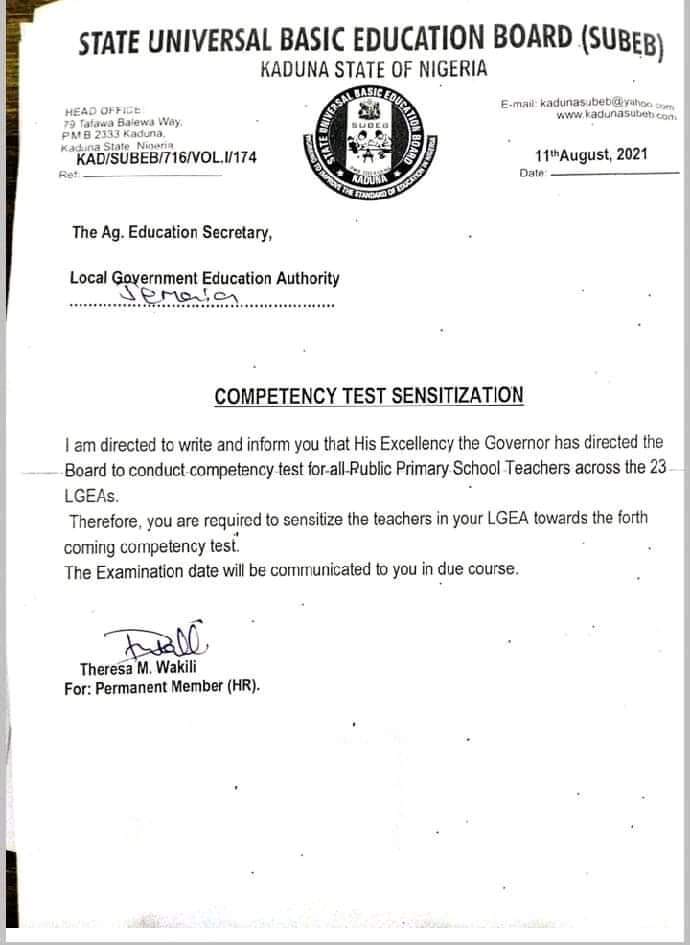
The Kaduna State Government says it will conduct another competency test for all public primary school teachers across the 23 Local Government Areas in the state.

The State Universal Basic Education Board (SUBEB) Permanent Member, Human Resource Management, Christy Alademerin, announced this through a memo to the Local Government Education Authorities (LGEAs) in the state.

It will be recalled that the state government had in September 2017 conducted a similar test for the over 30,000 primary school teachers in the state, following which 21,780 who failed to obtain 70% pass mark were sacked and replaced with newly recruited 25,000 teachers.

The date for the competency test has not been slated, but LGEA’s were urged to sensitise teachers in their local governments about the forthcoming exercise.

What Nigerian government should do about blasphemy

By Abdul-Hamid Abubakar Zubair

The ungovernability, which is crystal clear, toward the act of showing contempt and lack of reverence to sacred religious deity/deities is imminent and very alarming. If not seriously challenged and tackled by the constituted authorities, especially at the federal level, that may, unfortunately, aggravate severe tension even to the dogmatical secular democratic doctrine, believed to be a workable formula that has an answer to all national issues. 

It holds true, you like it or not, the fact that religion matters in Nigeria. Most people are firmly bound to one of the two major faiths, Islam or Christianity, and thus, it is a duty call for any person in power to uphold, respect, and support people’s various beliefs. The people have the right to practice their religion. Blasphemy is unacceptable and is punishable even according to national laws in the criminal codes as enshrined by both customary and Shariah laws. You can’t shift secularism to this place – at least, it is not yet the time.

Observing closely how cascades of blasphemous thoughtlessness and rashness have been unravelling in recent times, you can sense new dimensions and order of hidden treacherous agenda, purportedly insinuated by servile demonic elements. It is not by mere serendipity but a carefully thought out and planned memorandum.

In the North, there are more than four blasphemy suits filed in courts. The two trending cases include Yahaya Shariff Aminu, 22, a musician, and Umar Faruk, 16, both in Kano. The latter has been overturned and acquitted, and the former has been sent for a retrial by the Court of Appeal.

Another classic take-away example was the just concluded dialogue that features the controversial Shiite scholar, Abdul-Jabbar Nasiru Kabara, following his deliberate inciteful utterances and wrong interpretation and exegesis of Sunnatic traditions (Hadith), and after his request to the Kano State government to do justice and convene a physical dialogue with other Kano Islamic Clerics from the Salaf, Tijjaniya and Qadiriyya Sects. The aftermath of the conversation proved the bitter truth that was heavy and unfavourable to the eccentric Shiite cleric. 

I heard of a similar ordeal from Sokoto. A man allegedly made similar blasphemous utterances against the Prophet Muhammad (PBUH). However, we were supposed to be brainwashed by the excuse that he was suffering from temporal madness. Meanwhile, dementia was his alibi.

Taking a close look at these, one may ruminate over some questions and conclude that all these are not coincidental but planned.

Insecurity is a current social issue at hand. It has perturbed the entire nation. A lot of societal menaces are happening.  This trending problem of blasphemy coupled with insecurity will produce a severe stale. If it finds a place to stay, it will add salt to an injury, and the pain will be intolerably excruciating. 

There should be no room for apology for a deliberate blasphemous act. Anyone found guilty must be seriously punished and his actions thoroughly condemned. The same thing goes for all media outfits. Through that only, peace can prevail. 

Some personalities and deities are insurmountable, untouchable in major religions that should be demarcated by the power authorities and declared as a “no-go” zone. In strong terms, it should be stipulated that anything the Christians, Muslims, or any other religion recognised by the authority; within the Nigerian Province, which is considered alien or goes against the standard teachings – especially blasphemous utterances must be punishable. The government should get a grip on these with a strong and clenched fist.

The government should seize the day while it’s still dawn and make hay while the sun shines before things turned out of hand.

Abdul-Hamid Abubakar Zubair
Federal University Gashua, Nigeria.
E-mail: ibntaimiyya@fugashua.edu.ng
Phone no.: +2348138171001

After The Daily Reality’s article, Netflix Naija considers Kannywood filmmakers

By Muhammadu Sabiu

Barely thirty hours after The Daily Reality online newspaper published an article on the need to include Kannywood filmmakers in the Netflix Naija written by one of its editors, Muhsin Ibrahim, the streaming service has finally considered the adjuration made in the said article.

Muhsin Ibrahim, a PhD student at the University of Cologne, Germany and a teacher at the same institution, wrote an article titled “Dear Netflix Naija, there are films and filmmakers in northern Nigeria.” It was a reminder to the streaming service that Nigeria is of different cultures and religions. Therefore, according to him, it should not be treated in such a way that only films from a section of the country would be included in the streaming giant.

“Nigeria’s diversity cuts across many things, chiefly cultures, ethnicities, religions and regions. […] Due to these complexities, the country is a house to two significant film industries—Kannywood and Nollywood—with many smaller ones operating under these brands,” Ibrahim wrote.

Making his plea on behalf of the Kannywood filmmakers, the PhD candidate added, “I am not an agent of division, not at all. I am, instead, an advocate of fairness and inclusion of all, regardless of their culture, ethnicity, region, religion, among other diversities. Therefore, northern Nigerian filmmakers and their films should equally be aboard the ship Netflix captains in Nigeria.”

What were Kannywood filmmakers’ reactions?

A few hours after this newspaper published the article, Falalu A. Dorayi, a famous Kannywood member, took the entire article’s screenshots to his Instagram account, with the caption“A very good write up! Thank you very much for speaking on our behalf. @muhsin2008 Ibrahim”. The screenshots generated about 2.3k likes and over a hundred comments.

Also, Ali Nuhu, another prominent member of the Kannywood film industry, posted screenshots of the whole article with the same caption, under which several other members of the industry commented, including this:

@rahamasadau: “Hmmm, I wish I can [sic] add to this article…🤔👀”.

Acceptance of the Adjuration by Netflix Naija

Confirming the acceptance of the adjuration made in the article, Mr Ibrahim wrote on Facebook, “Sequel to the publication of my article on The Daily Reality last Saturday, Netflix Naija contacted a Kannywood director whose work they ignored for nearly a year. Thus, we shall soon watch a Kannywood production on Netflix. Nothing is more delightful to a budding writer.

“My informant, a Kannywood heavyweight, expressed his happiness, adding that “see the impact of writing”! He doesn’t know that I am probably happier. The Daily Reality is here to make a difference.

“May Allah help us, bring back peace to our region and country at large, amin.”

Kannywood, a predominantly Hausa-Muslim, Kano-based film industry, produces movies mainly in the Hausa language. The cinema has been facing tough challenges that revolve around its members’ handling of religion, culture and the likes.

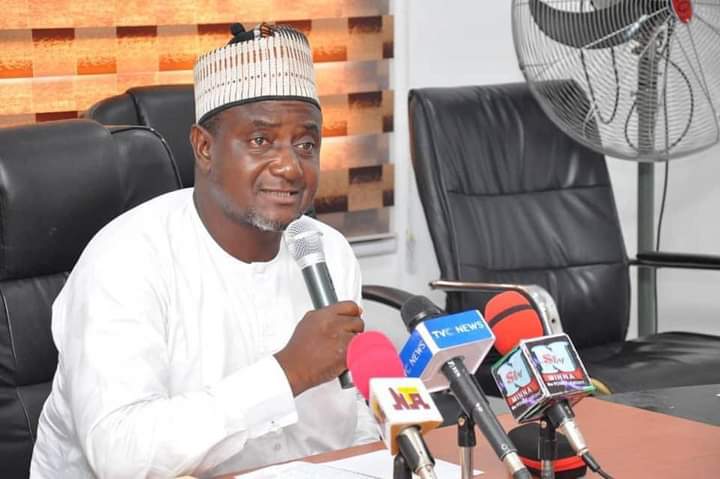
Niger State confirms abduction of commissioner for information

Niger State Government has confirmed the kidnap of the Commissioner for Information, Mohammed Sani Idris.

The Commissioner was said to have been kidnaped by bandits at about one o’clock in the early hours of today from his home at Baban Tunga village in Tafa local government of the State.

Security agencies are however already on the trail of the bandits to hoping to apprehend them.

Mary Noel-Berje
Chief Press Secretary
to the Governor of Niger State.

Boko Haram: hundreds of fighters surrender

By Muhammad Sabiu

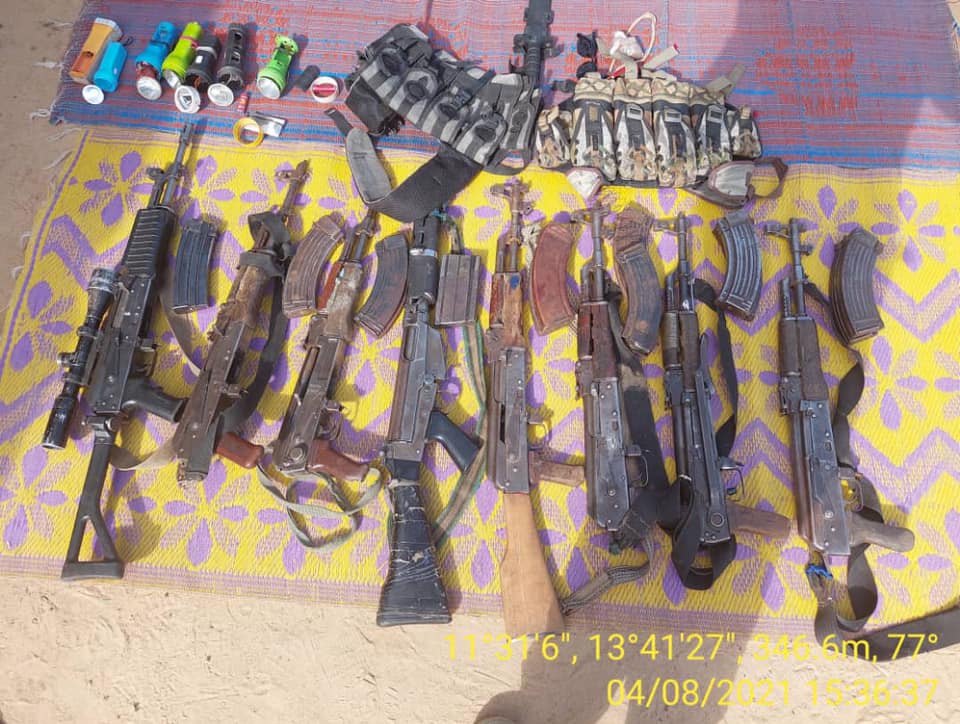
Reports have indicated that about 605 repentant Boko Haram members have laid down their arms and surrendered to the Nigerian military in recent weeks.

According to PRNigeria, a top intelligence officer in the know of the issue said that the exercise for the repentant terrorists and their families conforms with the “international laws and best practices, relating to enemies willing to surrender.”

The senior officer said that some of the repentant terrorists were afraid they could be eliminated if they “surrendered but were persuaded by their spouses and parents.”

“Surprisingly, their parents and wives gave them encouragement that they would stand by them if they surrender to troops.

“The intelligence efforts are invisible but manifesting in current outcomes. The Chief of Army Staff, Lt. Gen Faruk Yahaya, encourages a mixed technique of kinetic and non-kinetic operations that are humane in nature as he instructed that while we accept those willing to surrender, we should not spare the stubborn one by sending them to where they belong.

“The sustained and well-coordinated military operation has exerted pressure on the terrorists who have deserted their various hideouts and camps, while their members who felt being misled are surrendering with their families to the Nigerian troops.

“During profiling, some of the Commanders who surrendered to troops admitted that their various enclaves are bedevilled by hunger, disease, and the perpetual fear of military offensives.

“The media are key to shaping the troops’ resolve to continue their aggressive posture, while the citizens maintain their confidence on the military efforts on Counter-Terrorism,” the officer said.

The Boko Haram insurgency has led to the killing of thousands of people and the displacement of many in the northeastern part of Nigeria.

Let’s avoid reckless driving in wet weather

It is no longer news that ghastly car accidents have led to the death of innumerable people, which could be attributed to improper driving in the rainy season. However, you may find out that the primary factor that caused some accidents is driving in wet weather without abiding by safety precautions like exceeding the speed limit in the rain.

However, driving in the rain, whether a sprinkle or a heavy downpour, can be one of the most challenging driving situations which some, if not all, drivers encounter. Rainy conditions are directly associated with higher accidents rates. No matter what part of the country you live in, it is almost certain that you would be required to drive your vehicle in the rain at some point. Knowing how wet roads and reduced visibility affects how your vehicle handles will help you drive safely in rainy conditions.

More so, drivers should be reminded that reducing their speed limit and turning on their headlamps are two of the simplest and most effective ways of reducing the chances and prospects of an accident caused by wet weather. Likewise, maintaining a safe distance between your vehicle and the car in front of you. Stopping your vehicle will be more difficult when driving in the rain. Therefore, maintain a distance of several car lengths between your car and another.

Regarding car equipment, make sure that your car’s equipment is in working order before encountering rainy weather. For example, check your headlights, taillights, and windshield wipers to ensure that they will work well when needed. Also, check the tread of your vehicle’s tires. Balding tires can severely reduce traction on wet roadways.

Furthermore, most states require drivers to turn on their vehicles’ lights while driving in the rain. Even if it is only misting, turning on your vehicle’s headlights will increase both your visibility and other drivers’ ability to see your car on the road.

Conclusively, concerning the above driving etiquettes, while raining, private and commercial drivers should whack their possible best to meticulously ensure that they follow all driving instructions provided to them to prevent the risk of being crushed.

Staying safe while driving in the rain is simple if you make a conscious effort to employ these safety precautions.


Mallam Musbahu Magayaki writes from Sabon Fegi, Azare.Bauchi State. He can be contacted via musbahumuhammad258@gmail.com.

The North, the Media and the Way Out

By Ahmad Shehu, PhD.

In recent years, Nigeria, particularly the northern part of the country, has gone through a series of debilitating crises that have become existential threats to the region and the entire country and even the West African sub-region to some extent. The Boko Haram insurgency in the northeast, the herder/farmer crises in the north-central, the kidnapping and banditry in the northwest, the ethnic clashes in the middle-belt have all spilt over across other regions of the country, causing chaos, social instability and economic devastation.

Governments at all levels have tried hard to contain these menaces through conflicting policies, strategies and approaches. But, evidently, none of these has succeeded, yet, as these crises grow and engulf more Nigerian lives and properties daily. With the troubles raging, the regional economic and social fabrics go down the slope. Farmers have abandoned their farmlands; herders are on the run, business people are on a massive exodus to urban centres. Schools, hospitals, and other social services are no longer obtainable in many places across the region. These are serious but not insurmountable challenges.

Despite its effects on livelihoods, physical destruction can easily be reversed in a relatively short period. The political history around the world teaches us this basic fact, with Germany, Poland, Russia and even Rwanda as cases in point. Left in rumbles decades ago, these countries provide development models for the world to follow today.

On the contrary, a society whose social fabrics are destroyed is more difficult to rebuild, for a nation grows in and flourishes from the minds of its citizens – their beliefs, dispositions, attitudes, education, etc. Sadly, the proud, significant historical antecedents of northern Nigeria are maliciously challenged on all fronts, with destructive narratives, or what my friend Dr Samaila Yandaki calls “falsification of history” being pushed against the people, culture and sociopolitical freedom of the region. This, as far as statecraft is concerned, is more dangerous to the corporate existence of the area and indeed Nigeria in the long run than the physical challenges we are currently battling. Here is why.  

For many decades, northern Nigeria and its people have endured a consistent assault on their historiography, heritage and sociopolitical status. At the expense of sounding conspiratorial, I believe it is safe to state that the constant ethnic and regional profiling of the North and its people is a deliberate, well-planned assault aimed at breaking the very social fabric that held people together. The orchestrators fully understand the natural advantages and disadvantages of the region at equal proportions.

In today’s Nigeria, the North has been stereotyped in the most dangerous way. In the Nigerian sociopolitical scheme, northern leaders have been systematically stigmatised, with all the evils and ills of the country being falsely but persistently attributed to the failures of the North, even though history proves to the contrary. Some people propagate this antagonism without equal acknowledgement of the good tidings, sacrifices, patriotism and contributions of northern leaders and northerners in the Nigerian project. The bitter, unbiased truth is that the problems and prospects of the Nigerian state are Nigerian, with all regions, ethnicities and religious identities contribute their fair share in making or marring the country.

Similarly, the Nigerian media has worked hard to regionalise or ethnicise all kinds of human criminalities against the North. The media ascribe all sorts of criminal acts to northern folks or, precisely, Fulani, without recourse to the dangers these kinds of ethnic and regional profiling pose to the ordinary northerner. Conversely, criminal gangs, armed robbers in all southern states, notorious kidnappers, internet fraudsters and corrupt public officials would pass as mere criminals if, at all, they get reported. There won’t be a mention of the regional, ethnic or religious identities of those criminals. Unlike the former, we all share the criminal’s misdemeanour as humans and Nigerians. They are now “Nigerians”, not southerners, Igbo, Yoruba, Ijaw, etc. The hypocrisy is stinking.

Furthermore, today’s public discourse in, about and on Nigeria is a mere comparison between a supposedly ‘wealthy, educated’ south versus a supposedly ‘poor, illiterate’ north. This narrative gained traction by consistent and persistent reportage, which went unchallenged for too long. It is indeed true that all you need to validate a narrative is to keep saying it. While the ills caused by the utterly disgusting failure of the Nigerian leadership obtained in the North are reported or tagged as northern, the similar or worse scenarios obtained in the south will not belong to the southern region but the Nigerian federation. For the common audience, this kind of deliberate misrepresentation of information has caused deep-rooted mischief and hatred against northerners.

The dangers this stereotyping portend for the region’s future is, in the long run, worse than its current physical challenges. For one, the political leadership required to solve the physical problems will be entirely messed up in ways never seen before. Secondly, the communal consensus that gave the region the upper hand in the political scheme of the country will be dismantled, leading to distrust, disharmony and possible internal disintegration. Thirdly, young Nigerians constantly fed these venomous, hate-filled narratives are prepared to antagonise their northern counterparts, a situation that will affect their participation in the Nigerian project. The tail end of this debacle is not a story I would like to predict. We have seen examples in Nazi Germany and Rwanda.

The good news, however, is that the solutions to this seemingly intractable problem are not farfetched. It has been said that if you want to use a mirror, buy your own. People are made by their history; their minds are shaped by their stories; while their future is dependent on their world views, their dignity and respect depend on how others view them.

Indeed, the animosity and distrust between the major ethnic and religious groups in Nigeria are as old as the country itself. Among the major culprits in fanning the embers of this powerful but devilish attempt to demonise the North is the Nigerian media which has deliberately and consistently pushed stereotypical narratives against the region.

However, one of the reasons the campaign is succeeding is the total lack of counter-narratives that would eventually challenge the misinformation churned out by the Nigerian media against the region. If this is the case, then the only way out for the North is to speak out, provide content and information, counter-narratives and reliable, factual evidence that will eventually challenge the calculated attempts to demonise its history and hamper its progress. To do this, the region’s intelligentsia, political and economic leaders must be dedicated to and invest heavily in the media. It is only then that the North and its people will be fairly represented.

PS:

I celebrate the courage and dedication of the young men and women who started this medium, The Daily Reality. It is indeed one of the success stories of the North in 2021. Congratulations.

Ahmadu Shehu is an Assistant Professor at the American University of Nigeria, Yola. He writes from Yola, the capital of Adamawa State.