Nepotism

Former Senate President Deletes DIA Recruitment Post After Nepotism Backlash

By Hadiza Abdulkadir

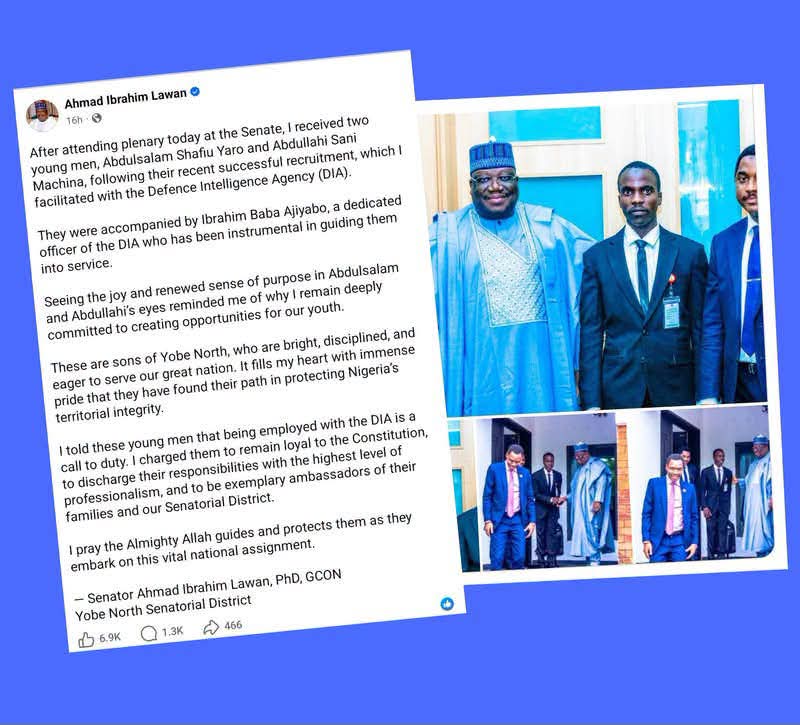
Former Nigerian Senate President Ahmad Ibrahim Lawan has deleted a social media post announcing that he facilitated the recruitment of two young men into the Defense Intelligence Agency (DIA) after it sparked widespread criticism online.

In the now-deleted post, Lawan said he received the two recruits after a Senate plenary and congratulated them on their successful employment, stating that he had facilitated their recruitment into the intelligence agency. He described the appointments as part of his commitment to creating opportunities for young people from Yobe North Senatorial District.

However, the post quickly drew criticism on social media, with many Nigerians accusing the former Senate President of promoting nepotism and favoritism in public sector recruitment. Critics argued that his remarks appeared to suggest political influence played a role in securing the jobs, raising concerns about fairness and merit-based employment in government institutions.

Following the backlash, the post was removed from his verified Facebook page. As of the time of reporting, Lawan has not publicly explained why the post was deleted or responded to the criticism.

For family and friends: Nigeria’s nepotism culture

By Muhammed Bello Umar

Nepotism is a long-standing problem in Nigeria that has plagued the country for several years. It is the practice of favouring family or friends over others, typically without regard for their qualifications or abilities. This practice is widespread in Nigeria and has manifested in various sectors of the economy, including politics, education, and the job market.

Nepotism is common in the political arena, as politicians appoint their relatives or friends to positions of power or influence, regardless of merit or qualifications. This practice has resulted in appointing unqualified individuals to high-level positions, leading to the underdevelopment and poor performance of many sectors in the country.

Nepotism also exists in the education sector, as students are often admitted into universities based on connections rather than merit. This practice has led to a decline in the quality of education and has hindered the sector’s growth.

Similarly, nepotism is widespread in the job market, and family or friends of employers are often given preferential treatment over more qualified candidates, resulting in high unemployment rates and low job opportunities for deserving individuals.

Overall, nepotism undermines Nigeria’s growth and development by promoting mediocrity over meritocracy. Nigerian leaders must prioritise meritocracy and ensure that positions of power and influence are given to the most qualified individuals, irrespective of their connections. Only then can Nigeria progress towards prosperity and sustainable development.

Muhammed Bello Umar wrote via princemub28@gmail.com

Nepotism in Nigerian politics: A tale of two governors

By Umar Sani

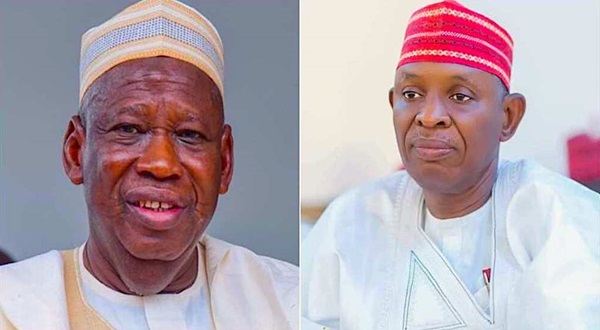
In the intricate tapestry of Nigerian politics, nepotism is often woven deep into the fabric of governance. Recent events surrounding Engr. Abba Kabir Yusuf, popularly known as “Abba Gida Gida,” and Dr Abdullahi Umar Ganduje illuminate a troubling pattern of favouritism and cronyism that continues to plague the nation’s political landscape.

In a move reminiscent of his predecessor, Abba Kabir Yusuf has nominated Mustapha Kwankwaso, the son of his godfather Engr. Rabiu Kwankwaso, for a commissioner position. This decision raises eyebrows, echoing past criticisms of Ganduje’s administration, where appointments seemed to prioritise personal connections over merit.

Such actions underscore a disturbing reality: the entrenched culture of nepotism in Nigerian politics, where loyalty to political dynasties often outweighs competence and merit. While the faces may change, the playbook remains eerily similar, perpetuating a cycle of patronage that undermines the principles of accountability and good governance.

The parallels between Abba Kabir Yusuf and Abdullahi Umar Ganduje serve as a sobering reminder of the challenges facing Nigeria’s democracy. Despite differing affiliations, both governors have succumbed to the temptation of nepotism, prioritising the interests of elites and families over the welfare of the broader populace.

This nepotistic trend erodes public trust in the political system and exacerbates social and economic inequalities. When positions of power are monopolised by a select few, talented individuals from marginalised communities are denied opportunities for advancement, further entrenching the status quo of privilege and exclusion.

As the nation navigates its democratic journey, it is imperative to confront and address the scourge of nepotism head-on. Transparent and merit-based governance systems must be championed, where appointments are made based on qualifications rather than personal relationships.

Moreover, robust mechanisms for accountability and oversight are essential to ensure public officials are held accountable for their actions. Civil society organisations, independent media, and vigilant citizens play a crucial role in exposing and challenging instances of nepotism and corruption, fostering a culture of transparency and accountability in governance.

Ultimately, the fate of Nigerian politics rests in the hands of its citizens. By demanding accountability, transparency, and a commitment to the common good, Nigerians can pave the way for a brighter and more equitable future, free from the shackles of nepotism that have privileged few.

Umar Sani Adamu (Kawun Baba) wrote via umarhashidu1994@gmail.com.