Nepal Flood Death Toll Rises to 95 as Hundreds Remain Missing
By Sabiu Abdullahi
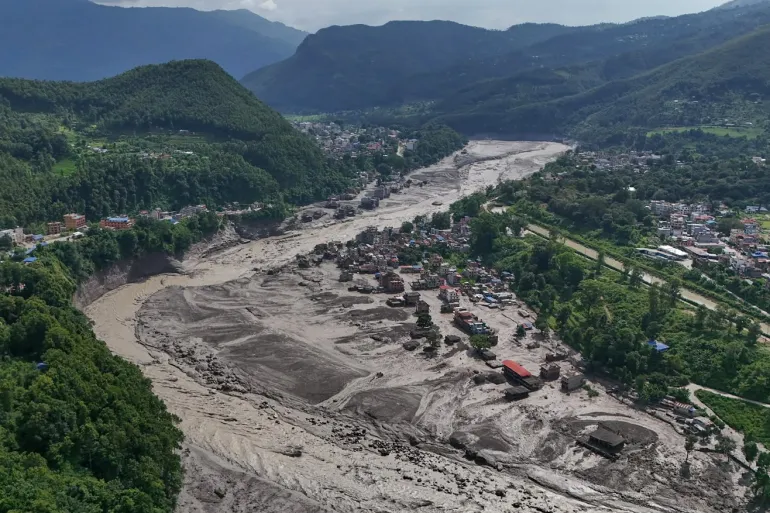
At least 95 people have died after a flash flood swept through parts of Nepal near the border with Tibet, destroying homes, roads, bridges and power infrastructure, according to Nepalese authorities.
Police spokesman Abi Narayan Kafle said 28 police officers were among those reported missing. Authorities also said 384 tourists, including 291 foreigners from countries such as the United Kingdom, United States, India and Malaysia, were missing after the disaster.
“So far 95 deaths have been reported,” Kafle said.
The disaster also affected areas across the border in Tibet, where Chinese authorities reported at least three deaths and 265 missing people in Gyirong county. State broadcaster CCTV said the figures were still being verified.
Nepalese Prime Minister Balendra Shah called for unity as rescue operations continued.
“Please be patient. The government takes full responsibility for your rescue, treatment, food and shelter. In times of such a disaster, we all need to stand together,” Shah said in a statement shared on social media.
Authorities said the floodwaters were too high for helicopters to land in Syapru Besi and Timure, in the mountainous Rasuwa district, which has a population of about 50,000.
District administrator Narendra Pariyar urged residents living along the Bhote Koshi River to move to higher ground after reports that villages and infrastructure project sites had been swept away.
“We have asked both India and China to help us with the rescue efforts,” said Sasmit Pokharel, a Nepali government spokesperson.
In Tibet, China’s official Xinhua news agency reported “major casualties” and missing people after a mudslide struck a border crossing between China and Nepal. The incident at Gyirong port disrupted roads, communications and electricity supplies in the Shigatse region.
Chinese President Xi Jinping ordered “all-out” efforts to locate missing people and called for stronger monitoring and early warning systems to reduce the risk of further disasters.
Prayash Adhikari, a climate justice activist in Nepal, described the flooding as “devastating” and said it had destroyed “whole villages”.
“Hundreds of people are missing,” Adhikari told Al Jazeera from Kathmandu, adding that buildings, schools, bridges and highways had also been destroyed.
The flooding also prompted authorities in India’s Bihar state to begin evacuations in six districts amid concerns that floodwaters could spread into the area.
Videos released by Nepal Police and other sources showed large volumes of muddy water rushing through mountain valleys. Kosh Raj Koirala, an editor of Republica Daily, said many residents were caught by surprise because there had been no heavy rainfall before the flash flood.
“[People] were at home … several houses have been washed away, swept away by the river,” Koirala told Al Jazeera.
Prime Minister Shah also held an emergency meeting with the National Disaster Risk Reduction and Management Authority to assess the impact of the disaster.
“Work has started to take necessary steps in coordination with the medical team, scouts, and Red Cross,” Shah said in a social media post.
The Nepal Army deployed helicopters and disaster response personnel to affected locations as rescue and assessment efforts continued.
“The work of collecting details of the damage is under way,” the army said in a statement.
The Nepal Electricity Authority said about 430 megawatts of electricity generation capacity from hydropower and solar facilities had been affected.
“The disaster has damaged the production, transmission and distribution facilities of the Authority … resulting in disruption of electricity supply,” it said.
Eight South Korean workers employed at a hydropower project were also reported missing, while another 10 were stranded, according to South Korea’s Ministry of Foreign Affairs.
The ministry said Nepal had sent a rescue team to the area. South Korea has also formed a task force led by its foreign minister and plans to send a rapid-response team made up of government officials, firefighters and police personnel.
Avalanche Suspected In Flood
The immediate cause of the flash flood remained unclear. Climate experts at the International Centre for Integrated Mountain Development in Nepal said an avalanche from a glacier was likely responsible.
According to the experts, the Lhende Khola River, a tributary of the Bhote Koshi River, experienced severe flooding on Wednesday.
“The Lhende Khola has flooded twice in 14 months, this time triggered by an ice-rock avalanche from a glacier on the Nepal side that blocked the river and released a sudden surge downstream,” said Saswata Sanyal, a disaster risk reduction specialist at the climate research group.
Adhikari said stronger early warning systems could help reduce the impact of such disasters.
“This can’t be completely turned around because we are on the verge of climate catastrophe, but still we can protect our communities,” he said.
The Bhote Koshi River begins in Tibet before flowing into Nepal’s Trishuli River, which later enters India as the Gandak River.
A similar flood in the Bhote Koshi River last year killed nine people and left 24 missing. It also destroyed the Friendship Bridge between Nepal and China, disrupting transportation and trade for several months.
The earlier flood was linked to the sudden release of water from a supraglacial lake in Tibet, according to a regional climate monitoring organisation.
Floods and landslides are common across South Asia during the June-to-September monsoon season. Scientists have warned that climate change is contributing to more frequent and severe extreme weather events in the region.

