NDC

Nigeria’s Security Funds Must Be Transparent, ADC Tells Tinubu

By Uzair Adam

The African Democratic Congress (ADC) has called on President Bola Tinubu to establish a transparent system for monitoring and auditing the use of federal security funds across the country.

This position was made known by the party’s National Publicity Secretary, Bolaji Abdullahi, while reacting to the president’s recent visit to Plateau State and his remarks at the Church of Christ in Nations (COCIN) in Jos.

The party stressed the need for heightened security alertness through improved coordination between military and police forces, with active participation from local and state security structures.

It also urged the president to adopt a culture of accountability by providing regular public updates on security incidents and the measures taken to address them.

Referencing the persistent security challenges in states such as Plateau, Zamfara, Benue, Niger, Kaduna and Kwara, the ADC further advised the president to engage directly with affected communities, local governments and state authorities, listen to their concerns and explore their suggestions for lasting solutions.

Bello El-Rufai, Four Others Dump APC, PDP for ADC, NDC


By Anwar Usman

Fresh political realignments rocked the House of Representatives on Thursday as five lawmakers abandoned the All Progressives Congress and the Peoples Democratic Party for the Nigeria Democratic Congress and the African Democratic Congress ahead of the 2027 general elections.

Among those who switched parties were Muhammed El-Rufai, son of former Kaduna State Governor Nasir El-Rufai, who represents Kaduna North Federal Constituency.

Muhammed El-Rufai defected from the APC to the NDC, a development political observers view as a strong indication of the deepening rift between his father and the ruling party.

The political realignment was contained in a statement read by the Speaker of the House, Tajudeen Abbas, during plenary on Thursday.

‎Muhammed El-Rufai’s exit came months after speculations over his political future following the increasing criticism of President Bola Tinubu’s administration by his father, Nasir El-Rufai.

‎The former governor, once a key ally of Tinubu and a prominent APC figure, has in recent months openly accused the ruling party of abandoning internal democracy and sidelining loyal stakeholders.

‎Joshua Obika, representing Abaji/Gwagwalada/Kuje/Kwali Federal Constituency of the Federal Capital Territory also joined the NDC.

In the same vein, Abdulhakeem Kamilu, representing Wudil/Garko Federal Constituency of Kano State, dumped the ADC for the NDC, citing what he described as unresolved leadership issues within the party.

In another development, two lawmakers from Kaduna State, Suleiman Richifa and Umar Ajilo, defected from the PDP to the ADC.

‎The lawmakers linked their defection to the lingering crisis within the PDP at both the state and national levels.

‎The latest defections came barely days after 17 lawmakers reportedly aligned with the NDC, underscoring growing efforts by opposition politicians to build a coalition capable of challenging the APC in the 2027 elections.

‎The development further altered the political composition of the House and fuelled speculations that more defections may occur in the coming months as political consultations intensify ahead of the next election cycle.

Kwankwaso Meets Kano NDC Chairman Over Party Crisis


By Uzair Adam

A former Kano State Governor, Rabiu Musa Kwankwaso, on Tuesday held a crucial meeting with the Kano State Chairman of the Nigeria Democratic Congress, Hussaini Mairiga, to resolve the lingering crisis within the party.

The Daily Reality reports that Mairiga confirmed the meeting in an interview with journalists on Tuesday, explaining that it brought together key party stakeholders at the state level.

He said the engagement focused on addressing disagreements surrounding the party’s structure and leadership in Kano State.

Following the meeting, Mairiga announced that the crisis had been resolved and pledged support for Kwankwaso’s leadership.

He said, “We had a fruitful discussion with Sen. Kwankwaso and other critical stakeholders of our great party. All lingering issues have been amicably resolved in the interest of unity and progress.

“As a party, we have agreed to move forward together, and we recognise Sen. Rabiu Musa Kwankwaso as our leader in Kano State.”

Mairiga further urged party members to remain calm and committed to the party’s ideals, stressing that unity would be crucial for future electoral success.

“I call on all our members to remain steadfast and work collectively for the growth of the party. This resolution marks a new beginning for the NDC in Kano,” he added.

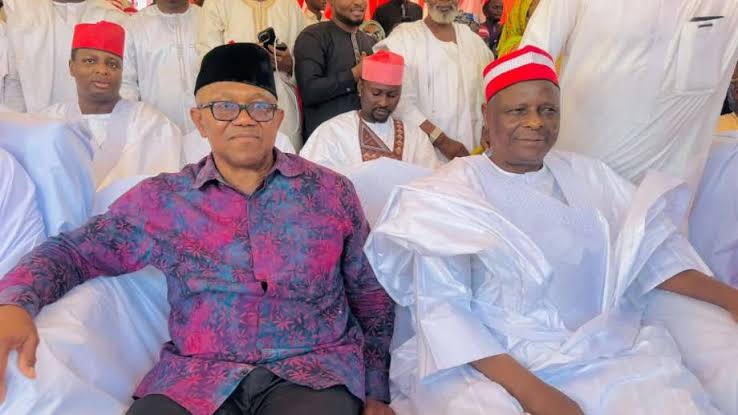
The development followed days of tension within the Kano chapter of the party after Kwankwaso’s defection to the NDC alongside Peter Obi, a move that raised concerns over control of the party structure.

The crisis had deepened earlier after the state chairman rejected alleged moves to hand over the party’s leadership to the former governor, insisting that the existing executives would not relinquish control.

He also disclosed that initial attempts to integrate Kwankwaso into the party stalled due to disagreements over leadership arrangements, with both sides holding separate meetings that failed to produce a consensus.

Tensions escalated further amid claims that the party’s planned state congress was suspended, fuelling suspicions among some members over possible moves to restructure the party leadership in Kano.

Obi, Kwankwaso and the Politics of Movement: Strategy, Survival, or a Leap into the Unknown?

By Usman Muhammad Salihu

In Nigerian politics, defections are no longer surprising. What is surprising now is how quickly they happen and how easily political actors move from one platform to another.

The recent defection of Peter Obi and Rabiu Musa Kwankwaso from the African Democratic Congress (ADC) to the Nigeria Democratic Congress (NDC) is not just another political adjustment. It is a bold move. But bold does not always mean safe.

At first glance, the decision appears strategic. Internal crises within the ADC, legal uncertainties, and the pressure of electoral timelines make stability a priority. From that angle, shifting to a new platform may seem like a necessary step, an attempt to secure political ground ahead of a highly competitive 2027.

There is also strength in the alliance itself. The coming together of Obi and Kwankwaso brings national attention, regional balance, and an existing base of supporters. On paper, that is not just movement; it is potential consolidation.

But politics is not played on paper. It is played among the people. And this is where the real challenge begins.

The Nigeria Democratic Congress is still largely unfamiliar to many Nigerians. Beyond political circles and elite discussions, its presence at the grassroots remains limited. For a significant number of voters, especially at the lower levels, NDC is not yet a known political identity.

And in Nigerian elections, familiarity matters. Voters do not just choose candidates. They choose what they recognise. They choose what they trust. They choose what they understand. That is the gap this move must overcome.

Beyond visibility, there are emerging concerns about the platform’s stability. Reports suggest that the Nigerian Democratic Congress may be grappling with internal legal disputes. If proven true, this introduces an even more delicate risk. Moving from one troubled platform to another does not resolve instability; it simply transfers it. And in politics, uncertainty is a cost few can afford at this level.

Because this is no longer just about transferring political influence, it is about building voter awareness from the ground up within a limited time frame. That is not a small task. It is one thing to move with loyalists. It is another thing to move with the electorate. And history has shown that the two do not always align.

There is also a deeper concern. Frequent political movement, no matter how strategic, raises questions of consistency. When platforms change too often, voters begin to look beyond the movement itself and ask a more difficult question: What exactly is constant? Is it ideology? Is it vision? Or is it simply positioning?

These questions matter because today’s voter is less passive than before. There is growing awareness, scrutiny, and an expectation for clarity. So while this move may be necessary from a political standpoint, it is also risky from a public perception angle.

Because speed in politics can be a double-edged sword. Move too slowly, and you lose relevance. Move too quickly, and you lose trust. And right now, this move feels fast. Perhaps calculated. Perhaps unavoidable. But still fast.

So, is this a strategy or a survival tactic? It is arguably both. Strategy, because the timing aligns with political realities. Survival, because unstable platforms leave little room for hesitation.

From another angle, this move is not just a strategy or a matter of survival; it is a gamble. A calculated one, no doubt, but a gamble, nonetheless. It rests on the assumption that political influence can be transferred faster than voter trust can be built. And in a system where recognition often shapes voting decisions, that assumption may prove too optimistic.

But beyond both lies a more uncomfortable possibility: That this could be a leap into a platform that has yet to fully exist in the minds of the people. Because, in the end, political strength is not measured by alliances alone, but by acceptance. And acceptance cannot be transferred overnight.

So, while the move may look bold in Abuja, its real test will come far away from strategy rooms, in markets, in villages, and at the polling units. Where names are remembered, where symbols are recognised, and where unfamiliar platforms are often rejected.

And if that gap is not closed in time, what appears today as a strategy may tomorrow be seen as a miscalculation. Because in Nigerian politics, you can move ahead of the system, but you cannot move ahead of the people. And when that gap exists, even the most calculated move can quickly turn into a costly gamble.

Ultimately, this move will be judged by one metric: conversion rate. How many Obidients and Kwankwasiyya become NDC members, not just in spirit but on the ballot? If the answer is “most,” then history will call it strategy. If the answer is “some,” then it was survival. If the answer is “few,” then it was a miscalculation dressed as ambition. The voters are watching, and their silence right now is louder than any endorsement. For Obi and Kwankwaso, the real campaign did not start in Abuja. It starts the day a trader in Aba and a farmer in Gaya can point to the NDC logo and say, “That is us.”

Usman Muhammad Salihu was among the pioneer fellows of PRNigeria and writes from Jos.

muhammadu5363@gmail.com.

Kwankwaso Urges Nigerians to Back NDC For Democratic Reforms

By Uzair Adam

A former Kano State governor, Rabiu Musa Kwankwaso, has called on Nigerians to support the Nigeria Democratic Congress (NDC), describing it as a platform committed to promoting good governance and strengthening democracy.

Kwankwaso made the appeal on Monday through his X (formerly Twitter) account, where he emphasised the importance of a credible political movement capable of delivering democratic dividends and improving the welfare of citizens.

He stated that the NDC is determined to create an environment where Nigerians can thrive and achieve their full potential.

He explained that his position is driven by a strong belief in democratic principles, noting that citizens deserve a system that prioritises their needs and aspirations.

According to him, the call is part of a broader effort to build a political structure that truly serves the people.

Kwankwaso further urged his supporters and other well-meaning Nigerians to align with the NDC, stressing that the movement represents a renewed effort to entrench accountability, expand opportunities, and reinforce democratic institutions across the country.

2027 and the Opposition Dilemma: Unity or Another Gift to APC?

By Abdulhamid Abdullahi Aliyu

As Nigeria moves gradually toward the 2027 general election, the most consequential political drama may not be unfolding within the ruling party, but among those seeking to unseat it. Across the opposition space, there is visible movement: coalition talks, strategic meetings, defections, counter-defections, legal disputes and renewed ambitions. Yet beneath all the activity lies an old and stubborn question: can Nigeria’s opposition finally unite around a credible alternative, or will familiar rivalries once again deliver victory to the incumbent?

The latest controversy surrounding Senator Rabiu Musa Kwankwaso’s political future has brought that question sharply into focus. Reports recently circulated that the former Kano State governor and his political associates were considering leaving the African Democratic Congress (ADC) for another platform, the Nigeria Democratic Congress (NDC), citing fears that the ADC had become vulnerable to legal complications and possible political sabotage. The speculation intensified after statements from individuals linked to the Kwankwasiyya movement suggested fresh political calculations were underway.

Kwankwaso himself later issued a clarification. He stated that no final decision had been taken regarding his political future or that of his associates, while confirming that consultations were ongoing with stakeholders across multiple parties. It was a carefully worded intervention. It neither closed the door to the ADC nor ruled out future movement elsewhere. In effect, it confirmed what many political observers already suspected: Nigeria’s opposition remains in a season of negotiation rather than consolidation.

For many Nigerians dissatisfied with the current direction of governance, the ADC had recently emerged as a possible umbrella for a broad anti-incumbent coalition. With the Peoples Democratic Party weakened by years of internal crisis and the Labour Party still struggling to convert popularity into a nationwide structure, the ADC appeared to offer something useful: a relatively fresh platform around which major opposition actors could gather.

But Nigerian political history offers a warning. Coalitions are easiest to announce and hardest to sustain.

The challenge before the ADC was never simply about attracting prominent names. It was always about managing them. Once major political figures occupy the same platform, difficult questions naturally arise. Who gets the presidential ticket? Which region should produce the candidate? Who controls party machinery? Who funds mobilisation? Who steps down for whom? These are not procedural details. They are often the very fault lines that break apart coalitions.

Kwankwaso’s position illustrates this reality. He remains one of the most significant opposition actors in northern Nigeria, with a loyal political base that has survived multiple party transitions. The Kwankwasiyya movement has demonstrated unusual cohesion and emotional commitment over the years. That makes him valuable to any coalition seeking national competitiveness.

Yet his role also generates tension. Admirers see him as experienced, disciplined and electorally relevant. Critics see him as a strategic power broker whose bargaining posture can complicate broader unity efforts. Social media reactions to the latest controversy reflect this divide. Some accuse him of prioritising leverage over coalition stability. Others argue that he is merely refusing to lead his supporters into another uncertain political arrangement.

Both arguments contain elements of truth. No serious opposition coalition can ignore Kwankwaso’s political weight. But no coalition can thrive if every major actor insists on maximum personal advantage.

Peter Obi presents a different but equally important dimension of the opposition equation. He commands strong youth enthusiasm, urban support and reform-minded voters who remain deeply invested in his message. His appeal extends beyond conventional party structures and taps into a wider demand for cleaner governance and fiscal discipline.

But Obi’s popularity also raises difficult coalition questions. Can a politician with genuine national momentum agree to play a subordinate role in a unity arrangement? Can rival blocs accept him as lead candidate? Can supporters who see him as a transformative figure embrace compromise for strategic reasons?

This is where opposition politics in Nigeria repeatedly encounters its greatest obstacle. Many leaders endorse unity in theory, but hesitate when unity demands sacrifice in practice.

Perhaps the most revealing aspect of Kwankwaso’s recent statement was the emphasis on legal uncertainty. He referenced court rulings, disputes over party legitimacy and fears that political platforms could be weakened through prolonged litigation. Whether one accepts that interpretation or not, the perception itself is politically significant.

In politics, uncertainty can be as damaging as defeat. If opposition actors begin to believe that party platforms are unstable or vulnerable, they will spend more time shopping for alternatives than building durable institutions. Time that should be used to mobilise voters gets consumed by legal consultations. Energy that should be spent presenting policy alternatives is diverted into internal survival battles.

While opposition figures debate platforms and personalities, the ruling All Progressives Congress quietly benefits from something often underestimated in Nigerian politics: structure. Incumbency provides access to nationwide networks, state-level influence, mobilisation machinery and the psychological confidence that comes with power.

The APC does not necessarily need the opposition to disappear. It only needs the opposition to remain divided.

That is why many analysts argue that the greatest ally of incumbency is not popularity, but fragmentation among rivals. If 2027 becomes a contest between one organised ruling machine and several competing opposition ambitions, the arithmetic naturally favours the government. If it becomes a disciplined one-on-one contest built around a credible coalition, the political equation changes considerably.

The decline of the PDP has made this moment even more significant. Once the dominant national platform for anti-government sentiment, the party now appears burdened by unresolved disputes, declining elite confidence and repeated internal turbulence. That vacuum created the opening for newer coalition experiments such as the ADC.

But replacing the PDP as a headline platform is easier than replacing it as an electoral structure. National parties are built ward by ward, polling unit by polling unit, not merely through high-profile defections and conference-room agreements. The opposition still lacks a clearly dominant institutional vehicle.

If opposition leaders are serious about challenging the APC in 2027, three urgent tasks stand before them. First, they must settle on a credible platform early and avoid endless migration between parties. Constant movement signals instability to voters. Second, they must resolve leadership questions through transparent negotiation rather than ego-driven public contests. Third, they must move beyond elite arithmetic and present a practical agenda on inflation, jobs, insecurity, electricity and governance reform.

Many Nigerians are frustrated with present realities. But frustration alone does not automatically translate into votes for the opposition. Citizens may desire change and still distrust the alternatives before them.

The latest Kwankwaso controversy is therefore not merely about one politician considering another party. It is about a deeper truth in Nigerian politics: opposition forces often agree on what they oppose, but struggle to agree on what they want to build.

That remains the central dilemma of 2027.

If unity prevails, the election could become genuinely competitive. If ambition prevails, the ruling party may receive another gift from its opponents—without having to ask for one.

Abdulhamid Abdullahi Aliyu is a journalist and syndicate writer based in Abuja.

AI key to combating insecurity – NDC Commandant 

By Uzair Adam Imam

The National Defence College (NDC) said Nigeria’s insecurity is not inevitable if only magic technologies like artificial intelligence are to be used in the nation.

The NDC commandant, Rear Adm. Murtala Bashir, stated this on Tuesday in Abuja, adding that the military needs to be ahead of the violent non-state actors to address the security challenges ravaging the country.

Over a decade, insecurity has been one of the major issues facing Nigeria and has claimed the lives of thousands of innocent people, leading to the displacement of several others in the country.

The activities of bandits have badly affected the economic growth of the nation as farmers and businessmen fear the atrocious attack by the bandits who either kidnap or slaughter any misfortune individual they encounter.

However, the NDC Commandant identified measures he believed could have been used to defeat terrorists and terrorism in the country.

He said, “Technologies like artificial intelligence and others are the much-needed game changers that will enhance the effectiveness and efficiency of the military’s responses to the challenges facing Nigeria.

“If we’re to also avoid the experiences of the past, where Nigeria has to beg foreigners to prosecute legitimate internal security challenges against militancy, terrorism and insurgency, then we need to reappraise our research and development efforts in technology acquisition and innovation.

“We need to also revamp our military industrial complex, and these efforts must be of national outlook and driven by research and development,” he said.