Muhsin Ibrahim

He Chased the Bandits So Nigerians Could Sleep: A Tribute to Muslim Abdurrazak (1994-2026)

By Muhsin Ibrahim

Inna lillaahi wa innaa ilaihi raaji’un

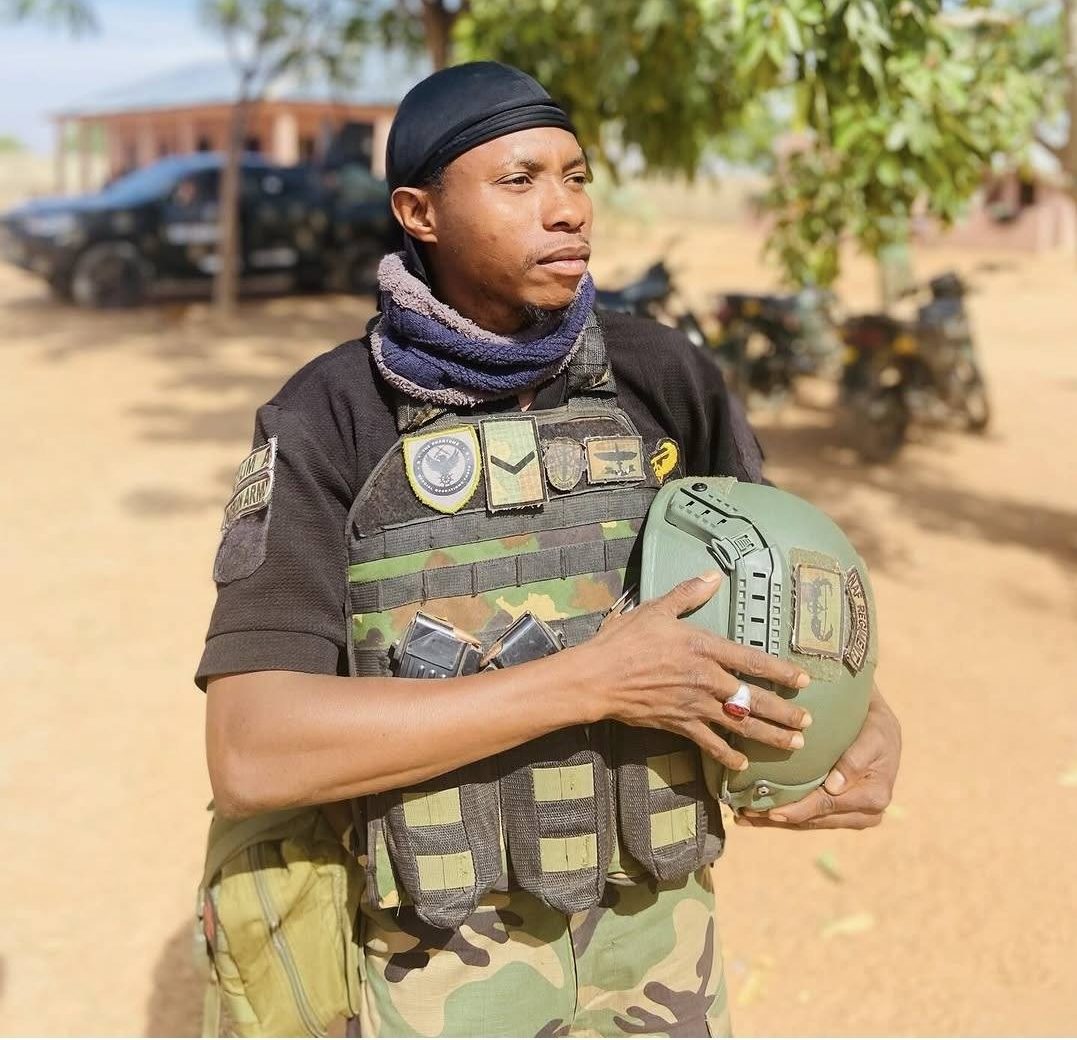
There is a particular cruelty in the timing of some deaths, a cruelty that refuses to be explained away. Muslim Abdurrazak Ibrahim, 31, died on a Friday. Every Friday without fail, he would send a Jumu’at Mubarak message, a small ritual of love and faith that connected him to family and friends across the distance between a soldier’s post and the world back home. On this Friday, he sent nothing. He could not. He had already gone.

Muslim was the firstborn son of Abdurrazak, who named him after his uncle — a tribute to my older brother, Muslim. Abdurrazak, a retired soldier, had fought in battles inside and outside Nigeria and had returned home carrying the weight of friends lost in the trenches of Liberia, Sierra Leone, and beyond. His children, Muslim and his brother Bilal, would both join the Nigerian Army.

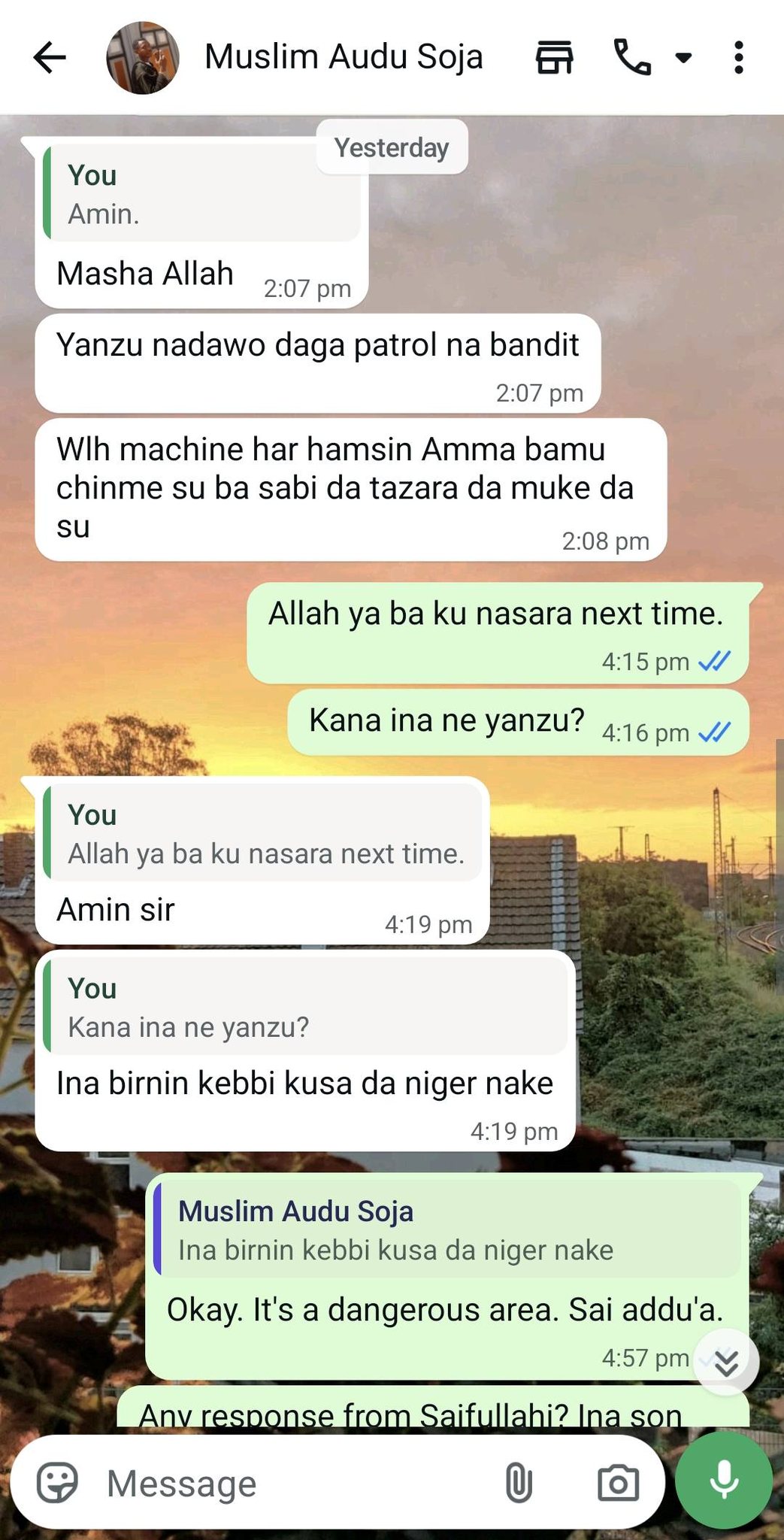
The week of his death was, without either of us knowing it, a week of farewells. On Wednesday, my busiest day, Muslim asked to speak with me, which was unusual in itself. We compromised, exchanging texts and voice notes instead. What followed was the most intimate conversation we had ever shared. 

Muslim spoke about his family, including his brother Buhari, who also wanted to join the Army. He spoke at unusual length and with unusual openness. For instance, he did not want Buhari to abandon his education to join the military. He had wanted a video or audio call for more direct contact, as he wanted to leave a wasiya, a will. We did not manage the call. But something was transmitted all the same.

On Thursday evening, he told me he was exhausted after the patrol. He and his colleagues had been chasing armed men on more than fifty motorbikes across the terrain of Kebbi State. They escaped. I prayed for better fortune next time. On Friday, there was no next time. He was killed in combat!

Just hours before his death, he had asked about obtaining a permit to travel home on the 20th of May to celebrate Eid al-Adha with his family in Kano. He had been looking forward to the feast and planning a homecoming.

He had also been planning a wedding. His betrothed, Nana, his girlfriend, his intended, was waiting. The arrangements were underway. He was thirty-one years old, at the beginning of the life he had been building, and then he was gone.

Muslim was a caring son to his parents, a devoted brother to his siblings, and a warm presence in the lives of friends, colleagues, and acquaintances alike. Those who knew him speak of his bravery on the battlefield, his attentiveness during training, his faithfulness in small gestures, such as the weekly Jumu’at message, among many other qualities. He was consistent. He was present. He was the kind of person who, even from a military post in the field, remembered to reach out.

This is the quiet tragedy within the larger one: that Nigeria loses sons and daughters like Muslim regularly, and the country has grown so accustomed to the loss that it barely flinches. The skirmishes, the patrols, the ambushes — they occur on the margins of the national conversation, and the brave men and women who fall in them are sometimes mourned only by their families, in private, without the acknowledgement their sacrifice demands. 

Muslim was not a statistic. He was a person who sent Jumu’at greetings and wanted to come home for Eid to meet family and friends. He had dreams and plans for the future. None of this would now happen.

I was, to my knowledge, the last family member to speak with him. That knowledge sits heavily. But I am also grateful that he reached out, that we spoke at length about family for the first time, and that something of what he wanted to say was said. He left, in those voice notes and texts, a presence that words can only approximate.

Against all odds, we pray for Nigeria’s prosperity. May the sacrifices of these gallant soldiers not be in vain. May Allah (SWT) forgive their shortcomings, accept their martyrdom, and grant their families and loved ones the strength to bear this loss.

May Muslim Abdurrazak Ibrahim rest in the mercy and peace of his Creator. May Nana be comforted. May his parents and siblings find strength. May his name be remembered — not only by those who loved him, but by a country that owes its soldiers more than silence, amin summa amin.

Inna lillaahi wa innaa ilaihi raaji’un — Indeed, to Allah we belong, and to Him we shall return.
Jürgen Habermas | A Tribute

By Prof. Abdalla Uba Adamu 

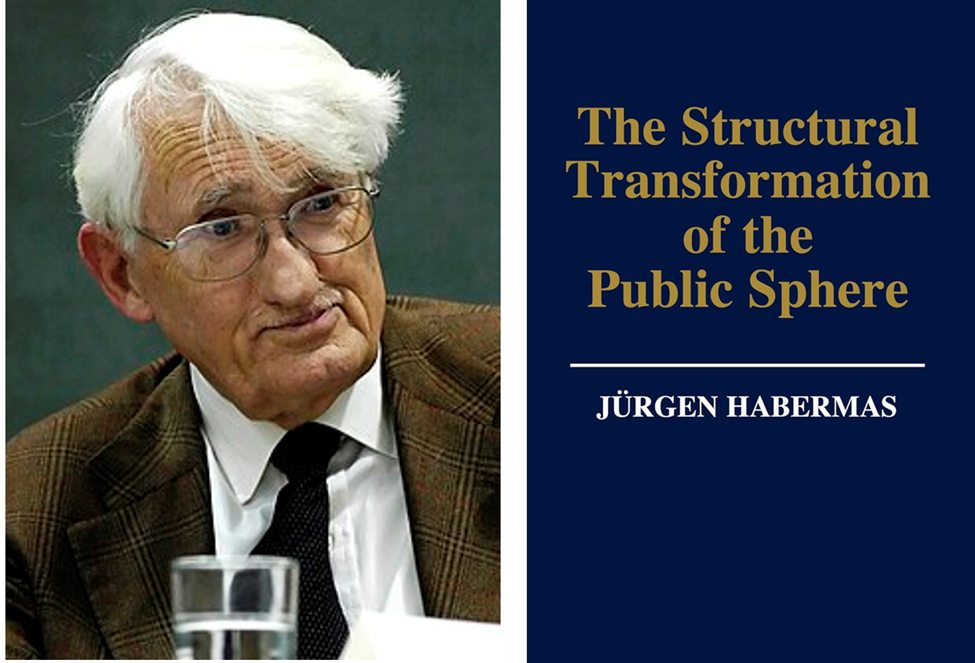
On Saturday, March 14, 2026, Dr Muhsin Ibrahim shared a newspaper report with me announcing the passing of Jürgen Habermas. The German philosopher died at the age of ninety-six in Starnberg, an affluent town in Upper Bavaria. Muhsin was well aware of how deeply I had drawn on Habermas’s theory of the structural transformation of the public sphere in my research on Muslim Hausa media cultures. 

His passing marks the end of an era in critical social theory. Habermas’s work on communication, rationality, and society made him one of the most influential philosophers of the late twentieth and early twenty-first centuries, as well as a major intellectual figure in postwar Germany.

Many Africanists did not initially read Habermas directly. Rather, they encountered his ideas through mediated theoretical engagements in the writings of scholars such as Brian Larkin. I myself first became aware of the public–private sphere debate as part of the broader Frankfurt School theoretical repertoire in Larkin’s studies of media culture in northern Nigeria. His work contributed significantly to later “post-public sphere” discussions by demonstrating how Habermasian insights could be adapted to different social, cultural, and technological environments.

Of Habermas’s many publications, the one that proved most decisive for me was The Structural Transformation of the Public Sphere: An Inquiry into a Category of Bourgeois Society. Originally published in German in 1962 and translated into English by Thomas Burger (with the assistance of Frederick Lawrence) in 1989, it is an extraordinarily dense text. One often needs the guidance of someone already conversant with its arguments to appreciate its analytical elegance. 

I was fortunate to own a copy—purchased for me in the pre-digital era by Gillian Belben, then Director of the British Council in Kano. I read it several times before fully grasping how powerfully it provided a framework for understanding public reactions to Hausa films and the emergence of censorship debates.

Habermas’s study retraces the historical emergence of the bourgeois public sphere as a communicative domain distinct from the state, in which private individuals could assemble to discuss matters of common concern. By analysing the transformations of this sphere, he recovered a concept of enduring importance for social and political theory. In simplified terms, the argument draws attention to differentiated social spaces—those of the home and those of the wider public—and to the ways in which each structures particular forms of discussion and social interaction.

I relied heavily on this analytical distinction when I presented my first international seminar at the Institut für Afrikanistik, University of Cologne, on November 15, 2004. Titled “Enter the Dragon: Shari’a, Popular Culture and Film Censorship in Northern Nigeria,” the seminar explored how Hausa films often rendered visible aspects of domestic life traditionally regarded as private, thereby provoking moral anxieties and regulatory responses. By destabilising the boundary between the two spheres, Hausa cinema helped produce new forms of mediated public debate. A dramatic illustration of this dynamic emerged in the widely discussed Hiyana scandal of 2007, in which a private act became publicly circulated, with far-reaching cultural consequences.

The communicative arena that Habermas conceptualised as the bourgeois public sphere appears today in a historically transformed guise within the networked environments of social media. In Muslim societies such as those of northern Nigeria, digital platforms have intensified the long-standing negotiation between domestic moral order and public cultural expression. 

Conversations once confined to living rooms, mosque courtyards, or informal viewing gatherings now unfold in algorithmically structured yet widely accessible communicative spaces. These interactions do not reproduce Habermas’s ideal of rational-critical debate in any straightforward manner. Rather, they reveal plural, affective, and technologically mediated publics in which questions of religious legitimacy, gendered visibility, and cultural authority are continually contested. Social media, therefore, represent not the revival of the bourgeois public sphere but a new phase in its structural transformation — what might tentatively be described as a “third space.”

The world of critical social theory will undoubtedly feel the loss of Jürgen Habermas. Yet his conceptualisation of the public–private divide will continue to shape scholarly reflections on media, communication, and cultural change for years to come.

Readers interested in further discussions of the public–private debate in Islamic contexts may consult:

Kadivar, Mohsen. 2003. An Introduction to the Public and Private Debate in Islam. Social Research 70 (3): 659–680.

Nigerian academic dismisses Trump’s claim of Christian persecution in Nigeria

By Sabiu Abdullahi

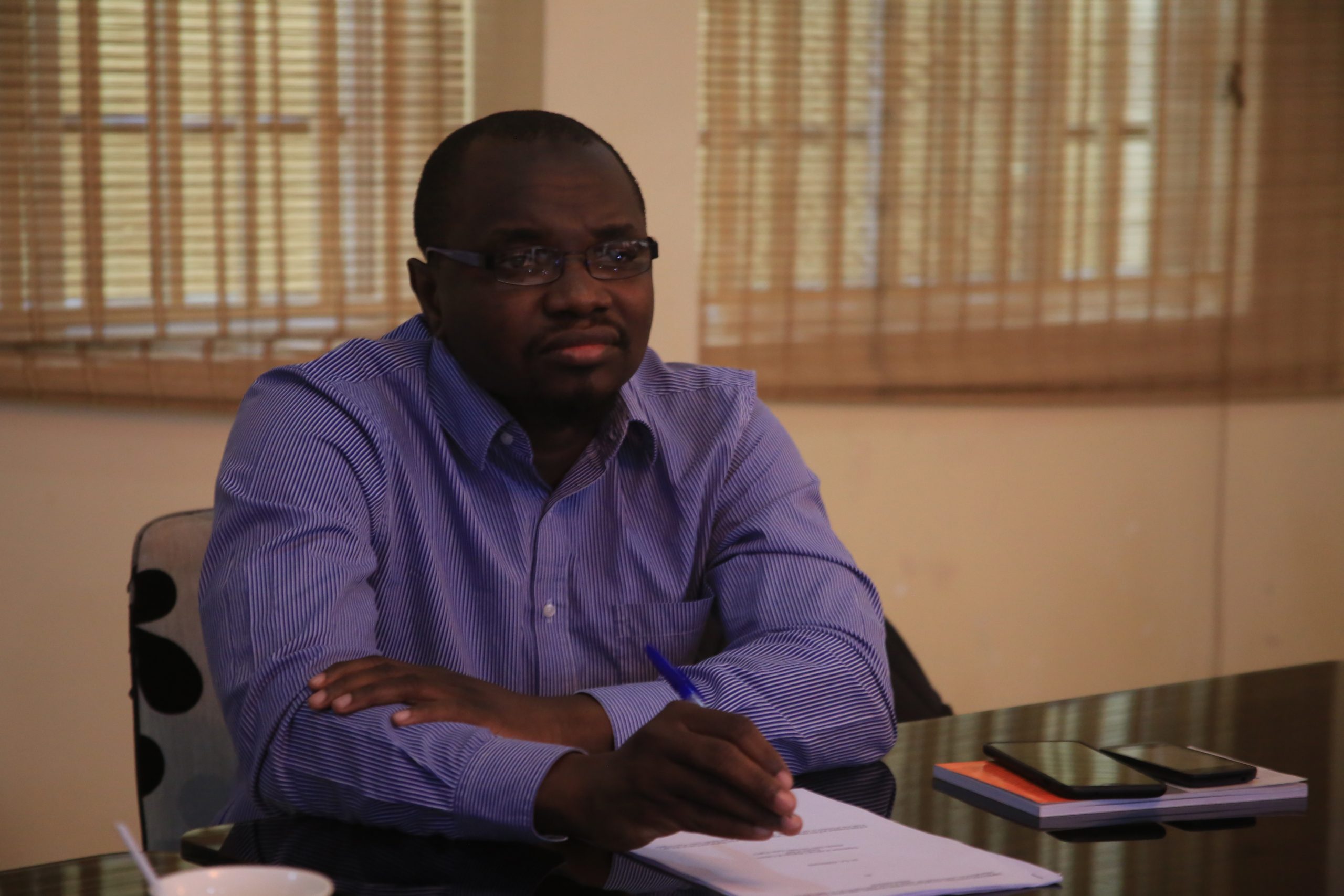
A Nigerian academic, Dr Muhsin Ibrahim, a lecturer at the University of Cologne, Germany, has refuted claims made by United States President Donald Trump that Christians are being persecuted in Nigeria.

In an article published recently on his Facebook handle, Dr Ibrahim said that framing Nigeria’s insecurity as a case of religious persecution is “a very simplistic narrative” that ignores the complex realities behind the country’s crises.

He expressed satisfaction that several Christian leaders, associations, and public figures had publicly rejected Trump’s claim.

He also commended Nigerian activist Omoyele Sowore for putting aside his opposition to the current administration and “saying the truth” about the issue.

According to Dr Ibrahim, terrorist groups such as Boko Haram and violent bandits do not discriminate between Muslims and Christians in their attacks.

“Boko Haram’s bullets do not differentiate between Muslims and Christians,” he wrote, noting that the extremist group has “killed more Muslims than non-Muslims,” including during their deadly assault on the Kano Central Mosque.

He further pointed out that victims of banditry in states such as Zamfara, Katsina, and Niger are mostly Muslims and that many mosques and worshippers have been attacked without anyone framing it as religious persecution.

Regarding the recurring clashes between farmers and herders in parts of the Middle Belt, Dr Ibrahim argued that the conflicts are primarily driven by territorial, ethnic, and resource-based disputes, rather than religion.

Dr Ibrahim also warned that any sanctions the U.S. might impose on Nigeria over Trump’s claims would likely worsen the country’s situation.

“The sanctions, or some aid withdrawal, will eventually impact everyone, just as the violence does not spare anyone,” he said.

He urged Nigerians not to celebrate Trump’s statements, describing them as politically motivated rather than a genuine concern for human rights.

“It’s about politics, not genuine concern for humanity,” he wrote, questioning Trump’s silence on humanitarian crises in Gaza, South Sudan, Congo, and Haiti.

The academic concluded by expressing hope for peace in Nigeria and across the world, writing: “May there be more peace in our fatherland, Nigeria, and everywhere else, amin.”