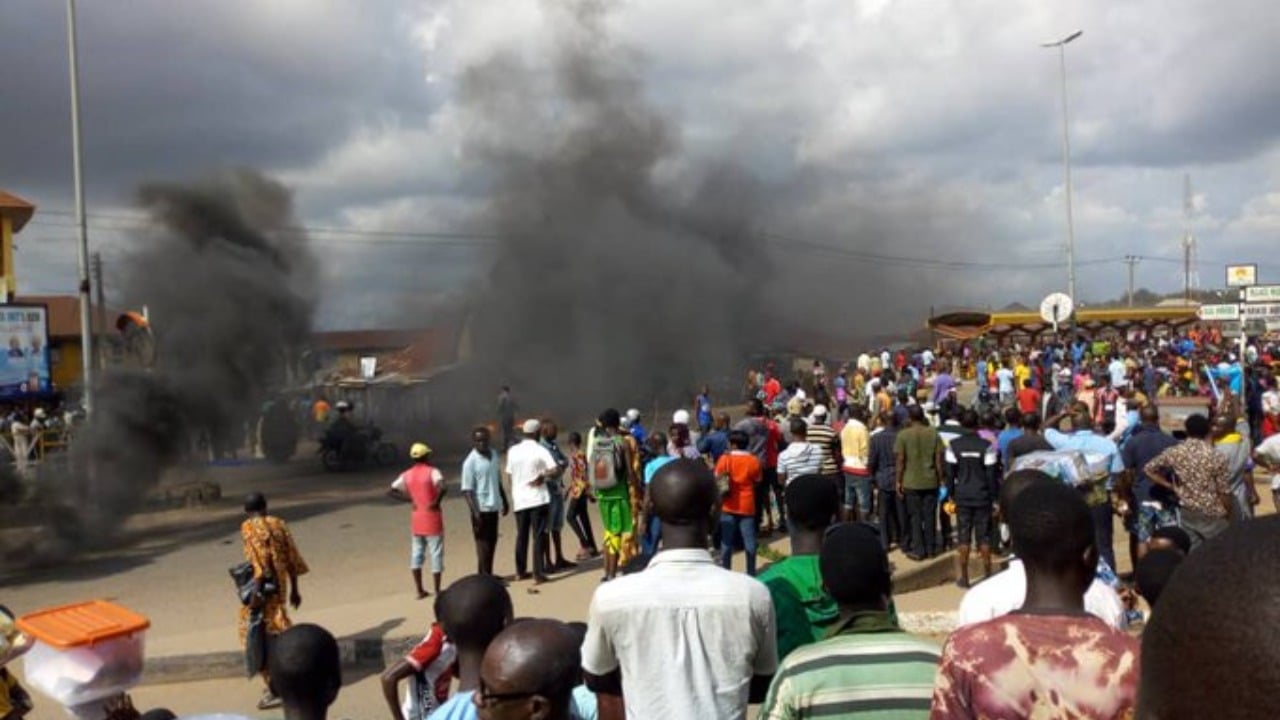
Mob action

MOB JUSTICE: When Crowd Becomes Jury, Judge and Executioner  

‎By Fatih Lawal-Garu  

‎Across Nigeria today, an allegation can become a death sentence long before any investigation begins. Increasingly, crowds, not courts, decide who lives and who dies. Whether the accusation is theft, blasphemy, kidnapping, or even a perceived cultural offence, many Nigerians are willing to dispense instant “justice,” replacing the rule of law with the rule of the mob.  

‎On December 28, 2025, filmmaker Don Pedro Obaseki was abducted, beaten, stripped naked, and publicly paraded through the streets of Benin City over allegations that he had insulted the Oba of Benin while abroad. He survived the ordeal and later filed a ₦500 million fundamental rights suit, which he withdrew after receiving a public apology. Barely three months later, on March 19, 2026, during the Alue-Do Festival in Ozoro, Delta State, viral videos showed coordinated sexual assaults on women. Large groups of men chased, groped, and tore the clothes of women in broad daylight under the guise of an ancient fertility rite. In Maraban Jos, Kaduna State, an Islamiyya school teacher named Ummulkhair was lynched and burnt alive after being accused of kidnapping a child. Four years earlier, Deborah Samuel Yakubu, a student of Shehu Shagari College of Education in Sokoto, was beaten, stoned, and burnt alive by fellow students over allegations of blasphemy.  

‎These incidents reveal that mob violence is neither regional nor confined to a single grievance. It cuts across Nigeria’s geopolitical zones, religions, cultures, ethnicities, and genders. Crowds arrogate to themselves the powers of the police, the courts, and the executioner without evidence, due process, or regard for human life. Amnesty International documented 555 victims of mob violence between 2012 and 2023, averaging about 55 deaths annually.

A Daily Trust editorial reported that between June and December 2025 alone, 60 people were killed while 20 others were brutally assaulted by mobs. From January 2026 to date, another 27 people have reportedly lost their lives to jungle justice. These victims were not killed by bandits, terrorists, armed robbers, or even security agencies. They were ordinary Nigerians killed by fellow Nigerians over allegations of theft, kidnapping, blasphemy, cultural violations, ethnic prejudice, unverified suspicions, and deliberate mischief.  

‎There was a time when the cry of “thief!” prompted citizens to alert the police. Today, shouts of “Ole,” “gbomo gbomo,” or “barawo” often signal the beginning of a public execution. Within minutes, a crowd gathers, accusations replace evidence, and an alleged offender is beaten, stoned, or burnt alive. The rise of jungle justice reflects a growing loss of confidence in Nigeria’s criminal justice system. Many citizens believe suspects handed over to the police will regain their freedom through bribery, political influence, or endless judicial delays. Although these concerns are genuine, they cannot justify abandoning the law. Ironically, many Nigerians now fear jungle justice almost as much as they fear criminals or even state policing. A misunderstanding or mistaken identity can be enough to trigger a murderous crowd.  

‎Equally disturbing is the erosion of human dignity. Jungle justice has become less about punishing alleged offenders than humiliating them. Victims are stripped naked, tortured, filmed, mocked, and sometimes burnt alive while spectators cheer or record videos. The spectacle suggests that many participants are motivated not merely by anger but by an opportunity to humiliate another human being. Social media has become an accomplice to this violence. Videos of lynchings and public humiliation are often recorded, shared, and circulated within minutes, turning human suffering into entertainment. Rather than provoking outrage, such videos frequently attract applause, jokes, or calls for even harsher punishment, encouraging copycat violence and further normalising mob justice.  

‎‎The mob is also deeply hypocritical. Petty thieves often help lynch suspected thieves. Political thugs, extortionists, and habitual lawbreakers suddenly become defenders of public morality. Those whose daily lives violate the law frequently present themselves as its most passionate enforcers. Jungle justice, therefore, is often less about justice than the intoxicating feeling of exercising unchecked power. Crowds also create a dangerous sense of anonymity. Individuals who would never assault another person on their own often participate in extreme violence once responsibility is diluted among hundreds of people. Protected by numbers, ordinary people can become willing participants in acts they would otherwise condemn.  

‎This hypocrisy reflects a broader national habit of rationalising wrongdoing. Nigerians often seek excuses for actions they already wish to commit. Ask a Yahoo boy why he engages in cybercrime, and he may invoke colonial exploitation or slavery. Ask a voter why he sells his vote, and he may describe it as his chance to “eat from the national cake.” Ask a supporter of jungle justice why he approves of mob executions, and he will likely argue that the suspect would simply bribe the police and walk free. While these grievances expose genuine institutional failures, they cannot excuse criminality or justify replacing the justice system with mob rule. Corruption in public institutions should inspire reform, not lawlessness.  

‎Fear sustains this culture. Witnesses seldom identify perpetrators because they fear violent reprisals. Authorities, meanwhile, often conduct weak investigations that end without meaningful prosecutions. This silence emboldens future attacks and creates the impression that mob violence carries little or no consequence. The long-term consequences extend beyond the victims themselves. Every lynching weakens confidence in state institutions, deepens public fear, and normalises violence as a legitimate means of resolving disputes. Communities become less trusting, public spaces feel increasingly unsafe, and every stranger becomes vulnerable to suspicion.  

‎Nigeria’s Constitution guarantees the right to life, fair hearing, and protection from cruel, inhuman, or degrading treatment. No citizen or crowd possesses the legal authority to arrest, prosecute, convict, and execute another person. The criminal justice system is founded upon the presumption of innocence until guilt is proven beyond a reasonable doubt. It is better that guilty persons occasionally escape punishment than that innocent people are condemned without trial. Nigeria cannot build a just society upon instant punishment and collective vengeance. Restoring public confidence in the police and the judiciary, ensuring swift and impartial justice, prosecuting those responsible for mob violence, and rejecting vigilantism are essential to reversing this dangerous trend.  

‎Until jungle justice is condemned not only in speeches but also through consistent enforcement of the law, the cry of “thief!” will continue to signify not the pursuit of justice, but the beginning of another preventable tragedy. When a crowd becomes judge, jury, and executioner, no Nigerian is truly safe, not even those cheering from the sidelines. 

Fatih Lawal-Garu is a Mass Communication graduate from Bayero University, Kano, and writes at ibnkamilgaru1@gmail.com.

Kaduna Husband Accuses Nigeria’s Police of Handing Wife to Mob

By Sabiu Abdullahi

A Kaduna-based mechanic, Aliyu Muhammed, has accused police officers of handing his wife, Ummulkhairi Muhammed, over to an angry mob that allegedly lynched and burnt her to death after accusations of child trafficking.

Muhammed, 42, said the incident happened in Mararaban Jos area of Igabi Local Government Area of Kaduna State after his wife was accused by some women of attempting to traffic children.

Speaking about the incident, he explained that his wife left home on the day of the attack for an Islamiya school in a neighbouring community while he travelled to Kaduna town for work.

According to him, he later received a call from his wife’s phone around 11:21 a.m., but a man answered and informed him that she had been accused of attempted child trafficking.

“He told me that some women had accused her of attempting to traffic children but added that it was only an allegation that had not been confirmed,” Muhammed said.

He said the caller asked him to contact someone who could quickly reach the location where his wife was being held. Muhammed said he immediately contacted a friend, Suleiman, who later informed him that a large crowd had gathered at the scene.

The mechanic said his friend contacted the Divisional Police Officer and requested security officers to move his wife safely to a police station.

Muhammed explained that he informed family members and rushed back to Mararaban Jos with his elder brother after receiving the distress call.

He said while approaching the area, he noticed smoke rising from a distance before receiving another call from his second wife.

“Shortly afterwards, my second wife, who was crying, called me and told me they had killed her,” he said.

According to him, residents stopped him from rushing to the scene because they feared the mob might attack him as well if they discovered he was the victim’s husband.

He said he later saw his wife’s burnt body on the road after the Commissioner of Police arrived at the scene.

Muhammed alleged that his wife had earlier been rescued and taken to a police station before officers allegedly released her to the mob.

“My elder sister was with my wife at the police station after she was rescued. While they were inside the station, the Divisional Police Officer came in and asked where the suspect was. My sister replied that my wife was not a criminal,” he said.

He further alleged that the DPO dragged his wife out of the station despite pleas from family members.

“The DPO held my wife’s hand and started dragging her towards the station gate. My sister asked where he was taking her and pleaded with him not to take her outside because the mob would kill her,” he stated.

“She tried to pull my wife back into the station, but another police officer allegedly struck her hand, allowing the DPO to drag her outside. Once my wife was pushed outside by the DPO, the mob descended on her, beat her, placed her motorcycle on top of her, and set both her and the motorcycle ablaze.”

The grieving husband said the tragedy has left his family devastated, especially their four children who lost their mother.

“Since that incident, I have not been myself. I have been sick. I hardly sleep because I keep thinking about what happened and crying over the tragedy that has befallen my family,” he said.

He added that he was unable to speak with the Commissioner of Police at the scene because of the emotional trauma.

“Neither the Commissioner of Police nor the DPO spoke to me. The police only provided two vehicles to convey my wife’s body for burial,” he added.

Muhammed also claimed that some suspects had been arrested in connection with the incident, although he had not received official confirmation from the authorities.

“I heard that about 22 people are in custody, but I have not been officially informed or shown those who were arrested,” he said.

The mechanic demanded a full investigation into the role played by the DPO and questioned why his wife was allegedly released to the mob after she had already been rescued.

“I want the DPO to be thoroughly investigated. Even if my wife had been guilty of the allegation against her, does the law permit a police officer to drag her outside and allow a mob to kill her?” he asked.

He also urged the public to avoid jungle justice and allow security agencies and courts to handle criminal allegations through due process.

“The public should learn that when someone is accused of an offence, people have no right to take the law into their own hands,” he said.

Muhammed said he wants his late wife to be remembered for her care for her children and peaceful relationship with members of the community.

“I also want the Mararaban Jos Bridge to be renamed in her honour. That would preserve her memory and serve as a reminder to future generations of what happened to her when she was only 35 years old,” he added.

Police Arraign 24 Over Mob Killing of Woman in Kaduna

By Sabiu Abdullahi

The Kaduna State Police Command has arraigned 24 suspects in connection with the killing of a woman accused of child theft in the Maraban Jos area of the state.

The suspects appeared before a magistrate court sitting at the NDA Junction in Kaduna, according to a statement issued on Tuesday by the police spokesperson, Mansir Hassan.

The incident occurred on Sunday after a mob allegedly attacked the woman over claims that she stole a child.

Hassan said the police received a distress call about the attack despite the absence of evidence to support the allegation against the victim.

According to him, the divisional police officer in the area led a team of officers to the scene and rescued the woman before taking her to the police station for protection and investigation.

He, however, said the mob later stormed the station, overpowered officers on duty and forcefully took the woman away before killing her and setting her body ablaze.

The police spokesperson said the suspects are facing charges that include criminal conspiracy, inciting public disturbance, destruction of public and police property, mischief and culpable homicide.

Hassan added that the court adjourned the matter until July 21 for further hearing. He said the suspects were remanded in a correctional facility pending the outcome of the case.

Meanwhile, the Kaduna State Government described the arraignment as a positive move toward justice and respect for the rule of law.

In a statement, the Commissioner for Information, Ahmed Maiyaki, praised the Kaduna police command for what he called swift action in prosecuting those linked to the incident.

“Governor Uba Sani’s administration will not tolerate any form of mob action or jungle justice. We urge residents to always report suspected criminal activities to security agencies and allow the law to take its course,” the commissioner said.

“Anyone found taking the law into their own hands will face the full consequences of the law, regardless of status or affiliation.”

Mob lynches bike snatcher in Bauchi community 

By Muhammad Sabiu

Reports reaching The Daily Reality have indicated an angry mob in Chinade town, Bauchi State’s Katagum Local Government Area, set fire to a suspected motorcycle thief.

According to a source in Chinade, the crime occurred on Sunday, and the suspect took the motorcycle from Hardawa Market in the state’s Misau LGA.

He said the suspect fled with the motorcycle but was apprehended and beaten to a pulp before being set ablaze in Chinade town.

Ahmed Wakil, a Superintendent of Police for the state police, confirmed the homicide in a statement and stated the investigation was still on.

“The Commissioner of Police, Bauchi State Command, Umar Mamman Sanda, has ordered a thorough investigation into the barbaric and dehumanising act of jungle justice meted out to the suspect by some irate youths in Chinade.

“While reacting to the ugly incident, the CP frowned on the action of the irate youths, who, instead of taking the suspect to the police for proper investigation and prosecution, mobbed him to death for allegedly stealing a motorcycle without any recourse to the law,” the statement of the police commissioner read.

Communities in Bauchi State State have for over a long time been badly affected by the activities of motorcycle thieves, who, in many cases, would gruesomely murder the owner of the bike before snatching it.

Considering what reports have indicated, the Bauchi metropolis could be the most affected place in the state with respect to such criminal acts.