
Migration

Viral Video Sparks Debate Over Racism and Perfume in China

By Hadiza Abdulkadir 

A viral video showing Chinese passengers covering their noses around an African woman has triggered a heated debate online over racism, cultural differences and the use of perfume.

The woman, identified on X as Teebebe (@Acupoftii_), appeared to interpret the passengers’ reaction as racist. The video has since attracted widespread attention, with social media users offering competing explanations for the behaviour.

One of those responding was X user Zhao DaShuai, who argued that the incident may have had less to do with race and more to do with the strength of the woman’s perfume.

“It’s your perfume,” Zhao wrote.

He said many East Asians carry a variant of the ABCC11 gene linked to reduced production of certain compounds associated with underarm odour. According to Zhao, this may mean people in East Asia are less accustomed to strong fragrances.

The claim has prompted further debate, with some users questioning whether covering one’s nose should be interpreted as evidence of racial discrimination, while others argue that the gesture could have been a simple reaction to an unfamiliar smell.

Scientists have established a relationship between variations in the ABCC11 gene and differences in underarm odour, although the prevalence of the relevant variants varies considerably between populations.

The genetic explanation, however, does not establish why the passengers in the video covered their noses. Nor does the video, by itself, provide enough context to determine whether the behaviour was motivated by racism, discomfort with a strong fragrance, or another reason.

The incident has nevertheless revived an online conversation about race, personal fragrance and cultural differences in perceptions of smell, highlighting how an apparently ordinary gesture can carry very different meanings across cultural and racial contexts.
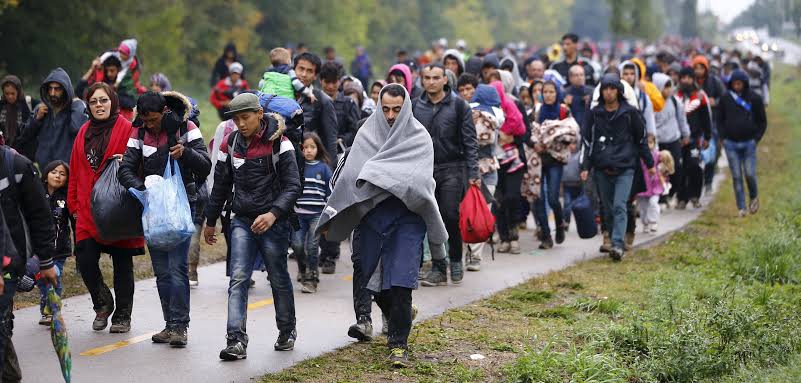
Spain moves to legalise 500,000 undocumented migrants as other Western nations tighten borders

By Sabiu Abdullahi

Spain has announced plans to grant legal status to about 500,000 undocumented migrants, a move officials describe as a recognition of the economic and social value of migration, even as other Western countries adopt stricter immigration policies, Aaljazeera has reported.

For Joel Caceda, a 30-year-old migrant from Peru, the decision offers long-awaited relief. After losing his left arm in a farming accident, he now struggles to earn a living through delivery work, a situation common among migrants who arrive in Spain without legal documents.

Caceda welcomed the government’s plan, which stands in contrast to tougher approaches in parts of Europe, including Denmark, Germany and Austria, as well as in the United States.

“This is good for me and many others. It will mean the chance to become legal after six years working here without any official papers,” he told Al Jazeera from his home in Barcelona.

“It will give me the chance to get a flat with my partner and her daughter and live a better life.”

His experience reflects that of thousands of migrants who survive through Spain’s informal economy while navigating lengthy and complex administrative processes in pursuit of residency papers.

Speaking at a news conference on Tuesday, Spanish Migration Minister Elma Saiz said those covered by the policy would have the right to work “in any sector, in any part of the country,” while stressing “the positive impact” of migration on Spain.

“We are talking about estimations, probably more or less the figures may be around half a million people,” she said, adding that the government was “recognising” migrants already living in the country and restoring dignity to their lives.

Prime Minister Pedro Sanchez has repeatedly argued that migration remains essential to Spain’s economy. He has said the country needs foreign workers to fill labour shortages and to balance the effects of an ageing population that places pressure on pensions and social services.

Civil society groups have also welcomed the decision. Laetitia Van der Vennet of the Platform for Undocumented Immigrants described the policy as a sharp contrast to rising hostility toward migrants in Europe and North America.

“At a time when a hostile environment against migrants is spreading on both sides of the Atlantic, this move shows both humanity and common sense,” she said.

Ousman Umar, a Ghanaian migrant and founder of the NASCO Feeding Minds NGO, said the policy would benefit Spain as much as migrants themselves. Umar spent five years attempting to reach Europe and survived extreme hardship before arriving in Spain, where he once lived on the streets.

“This is not only going to be good for migrants but the whole society. It will mean that these people can start working legally, pay taxes and social security,” he told Al Jazeera.

“This will mean that all these people pay into the pension system in a country where the birthrate is low and there is a growing number of older people.”

Lamine Sar, who came to Spain from Senegal 18 years ago and now works with the Top Manta fashion label, echoed similar views. The brand highlights the reality faced by migrants who sell goods on blankets, known as mantas, in city streets.

“This is a huge step forward, not just for migrants in Spain but for everyone. It will mean these people contribute to society instead of being used in a kind of slavery in the black economy,” he said.

Under the new rules, the regularisation will cover migrants who have lived in Spain for at least five months and who applied for international protection before December 31, 2025. Children of eligible applicants who already reside in Spain will also be included. Applications will open in April and close in June.

The government approved the measure through a decree, which avoids a parliamentary vote. The Socialist-led coalition lacks a majority and could have faced strong resistance from the conservative People’s Party and the far-right Vox party.

Vox leader Santiago Abascal criticised the move, warning of serious consequences. “The invasion kills. The arrival of half a million migrants will be a call to another half million migrants and put under strain on our health system, social security and security,” he wrote in an online post.

Despite such opposition, official figures show that irregular migration to Spain dropped by more than 40 percent last year. Authorities attribute the decline largely to agreements with Morocco and several West African countries that focus on security and cooperation.