Lagos State

NNPC mobilises trucks to Dangote Refinery for petrol distribution

By Uzair Adam 

The Nigerian National Petroleum Company (NNPC) Ltd. has deployed over 100 trucks to the Dangote Refinery in preparation for petrol loading, scheduled to begin on Sunday, September 15, 2024. 

According to a post by NNPC on its official X handle, the trucks were dispatched to the refinery’s fuel loading gantry in Ibeju-Lekki on Saturday, with more expected to arrive. 

“As of Saturday afternoon, more than 100 trucks had been mobilised, and by the end of the day, up to 300 trucks are expected to be stationed at the gantry,” the company said.

The deployment marks a significant step toward ensuring timely petrol distribution from the Dangote Refinery, which is expected to enhance fuel availability nationwide.

Army hands over suspected killer of FUNAAB student to police

By Uzair Adam

The Nigerian Army has apprehended 23-year-old Adeleye Ayomide, suspected of being the killer of Christiana Idowu, a 300-level student of the Federal University of Agriculture, Abeokuta (FUNAAB), who was abducted in Lagos State.

The Lagos State Police Command confirmed the handover of the suspect on Thursday, following an investigation into the incident.

According to Lagos Police spokesperson Benjamin Hundeyin, Ayomide was handed over by the Nigerian Army’s 9 Brigade at about 2 p.m. on September 5.

The late Christiana was kidnapped along the Ikorodu-Yaba Road on August 19, sparking public outrage, especially on social media.

The hashtag #JusticeForChristianah has gained traction, with many Nigerians calling for justice.

A user on social media, going by “Man of Letters,” shared details of how the suspect, who was reportedly in a close relationship with Christiana based on their interactions on Instagram, was tracked down.

Security operatives traced Ayomide through his mobile phone, leading to his arrest at his parents’ house in Ikorodu.

Among the evidence recovered from the suspect was the victim’s blue ITEL A56 phone.

The investigation is ongoing as authorities work to bring justice for the slain student.

Policeman rejects N150m bribe, honoured for integrity

By Uzair Adam Imam 

Superintendent of Police, Ibrahim Sini, has been honoured for rejecting an N150m bribe from a Lagos-based businessman, Akintoye Akindele. 

Akindele was arraigned in August 2023 for allegedly diverting $5.6m and N73.5m belonging to Summit Oil International Ltd. Sini led the investigation team and was offered the bribe to permit Akindele’s escape abroad and write a favourable report.

Sini said, “I am very happy to be here and I want to appreciate the organisers of this programme. They have beat my imagination and added more grease to my elbow.”

He recalled the incident: “The person in question asked me, ‘Do you want to be rich?’ He said this is an opportunity for you to be rich. So, what I said was that it depends on the kind of riches. 

“I would like to have money so that I can lay my head down and sleep at night. I don’t want to have something that will make me think twice and be running from one hole to another. 

“So, I decided to do the right thing so that I can have peace of mind and also stand to do what is right for myself, for my organisation, that is, the Nigeria Police, and also for the country at large,” he added.

Sini advised youths not to trade their integrity for anything, stating that he would like to have money that would allow him to sleep at night and have peace of mind.

Presenting Sini with the document of the land, the Federal Capital Territory Commissioner of Police, Benneth Igweh, said Sini’s conduct has brought pride to the Nigerian Police Force.

The charge sheet revealed that Akindele and his company, Duport Midstream Company Limited, were accused of conspiring to commit a felony, stealing, and dishonest conversion of the sum of $5,636,397.01 and N73,543,763.25 belonging to Summit Oil International Limited.

Waste to wealth: An introduction for students 

By Bilyamin Abdulmumin

A couple of days ago, the Lagos State government officially entered into an agreement with the Netherlands government to establish a waste-to-energy firm. 

The initiative was said to get rid of heaps of waste across the Lagos metropolitan area (about 2250 tons daily) and generate between 60 and 75 megawatts of electricity annually, providing some 40,000 homes. 

In addition, the Lagos State Governor Sanwo-Olu said the project will help cut down the country’s carbon footprint, as about 550,000 metric tons of carbon dioxide and other greenhouse gasses emitted daily from the dumpsite will be addressed. 

Singapore is one of the countries that is an embodiment of waste to energy. Singapore is said to have zero waste, thanks to its waste-to-wealth program. They completely convert their waste, partly into energy and other parts into recycling.  

Trust developed nations; they always think ahead. In Denmark, an innovative twist was added to this technology. Due to the extensive space occupied by the conversion centre, the top area of this facility would be transformed into a game reserve and tourist attraction. Who said you can’t kill two birds with one stone?

As Sanwo-Olu highlighted, the world is currently grappling with climate change, so several countries have been resorting to generating energy from biomass. This includes food crops (maize, sugarcane, cassava, etc.), lignocellulosic materials (e.g., woods), and waste (a mixture of biomass, petroleum products, and metals), the latest being the most expensive for conversion. By using waste to generate energy, countries would not only clean the environment but also cut down their carbon budget, hence mitigating the effect of the looming climate change. 

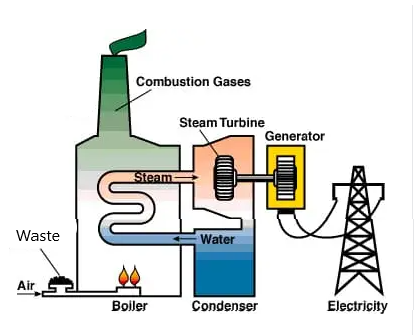
The most widely used technology for waste-to-electricity conversion is the combustion integration into steam turbines. In this process, the waste is burned in the boiler unit to generate steam, which generates steam channels to power the turbine and the movement of turbine generic electricity. But that is not all; the exhaust steam is channelled into a condenser unit, where the steam is converted back to the water, then finally the water is pumped to the boiler to complete the cycle.  

Applications of the laws of thermodynamics in each unit allow the energy usage analyses to make each step more efficient, that is, reduce energy waste in each section (boiler, turbine condenser, and pump). This technology is known as a steam turbine, one of the heat engines based on the principle of the Rankine cycle. A closely related heat engine is a locomotive rail or refrigeration and Air conditioning system based on Rankine cycles. 

 The second way to convert waste to energy is pyrolysis. In pyrolysis, waste is converted to oil instead of directly burning them. As mentioned above, these oils can then be burned in a boiler to generate steam and the cycle proceeds. Catalysts like zeolite can be used to upgrade the oil for use, such as petroleum.  The difference between pyrolysis and combustion is that in the former, oxygen is not allowed; in fact, pyrolysis means a lack of oxygen. In the former, oxygen is necessary; without oxygen, combustion will not occur, or there will be incomplete combustion if it is inadequate. 

The last category of technology for waste conversion is gasification; in this process, waste is converted to carbon monoxide and hydrogen (syngas); these gasses can be burned in a boiler to generate steam, and the process proceeds just as mentioned. Similarly, the syngas can be upgraded to synthetic fuels using metal catalysts like iron through popular technology known as Fischer-Tropsch. Depending on the quality, synthetic fuels produced may be used as petroleum, too. Gasification differs in combustion in the oxygen usage; in the former, oxygen is meticulously controlled.

Wise students will check out abundant videos on YouTube demonstrating these three categories of biomass conversion: combustion, pyrolysis, and gasification, the principles of Steam Turbines, Heat Engines, the Rankine cycle, and the Carnot Cycle, the applications of the laws of thermodynamics, and the catalysis involved in the bio-oil upgrade and the Fischer-Tropsch process.

If you are in the secondary or early years of a degree program and already aware of this information, then you are a step ahead, and you are not only fortunate than your peers but most of us at your level.

Bilyamin Abdulmumin wrote via bilal4riid13@gmail.com.

Transforming the identity of the northern woman… honouring intelligence and beauty

By Kamal Buba Danladi

Amina Buba is the first female urologic surgeon from Northern Nigeria, and we got the opportunity to have a quick chat with her after achieving another milestone by being awarded the Mbonu/Anugwu prize as the best candidate in the West African College of Surgeons Urology Fellowship Examinations. This also makes her the third female urologist to be awarded the Urology prize in the college’s nearly 60-year history. 

Can you share some insights into your journey to becoming a urology specialist?

Interestingly, my journey into Urology was never planned. In fact, throughout medical school, I never contemplated specialising in Urology. I wanted to become a gynaecologist. I attended conferences and even won a prize for my work in obstetrics and gynaecology as a medical student. However, when I qualified as a doctor and did a rotation in gynaecology, I quickly realised that the surgery attracted me to that speciality. I also didn’t quite enjoy the immense pressure that obstetricians faced (with respect to my O&G colleagues). Long story short, I began my surgical training by writing the Membership examinations of the Royal College of Surgeons, England. Then, I returned home to start my residency at the University of Abuja Teaching Hospital, Gwagwalada, to become a Breast/Oncoplastic surgeon.  

My first rotation as a surgical trainee was in Urology, and I fell in love with this speciality. I worked in a team where, despite the challenges of practising in Nigeria, people gave their best care to patients. I love that there are so many subspecialties in Urology and that it is constantly evolving. I owe a lot of my success to the people who taught and inspired me at the University of Abuja Teaching Hospital, where I started and completed my surgical training.

 What challenges did you encounter during your urology fellowship preparation, and how did you overcome them?

Training to become a fellow is a lengthy process that requires tenacity, physical and mental strength, and God’s guidance. It is also a great lesson in the power of patience and perseverance. Willpower and unshakeable faith are what got me through. I always “prayed like I didn’t work hard and worked like I didn’t pray.” I am so thankful to God for His continuous grace, mercy, and guidance.

Throughout my training, I was very fortunate to have had a solid support system, which superseded the noise of the few people who tried to discourage me. I always give credit to my family, friends and bosses. My parents never questioned my decision to specialise in a male-dominated speciality; instead, they constantly motivated me. My mum is a nurse by profession, so she understands medical terminology. Sometimes, I would sit her down and explain what I have studied during my exam preparation. She would ask me questions and challenge me.

My mum would surprise me with study desks and chairs when she noticed my posture changed because of long study hours. My dad would sometimes stay up late to wake me up to study, and my two older sisters are priceless! They were always at the other end of the phone, full of encouraging words. I also have a very small but close network of friends on speed dial. I cannot even begin to speak about the immense support I had from certain colleagues and bosses. There are too many names to mention, but I am sure they’ll know I am talking about them when they read this.

I found studying for a major examination difficult while still working full-time. I would sometimes function on 4 hours of sleep at night. I quickly learnt how to utilise every single minute of the day. I also learnt that the fellowship examination tests cumulative surgical knowledge gained over several years of training. Preparing for the fellowship exams starts on day 1 of surgical residency. I think I calmed down a bit with “burning the midnight oil” when I recognised this.

 How does it feel to be recognised as the Best Candidate in Urology by the West African College of Surgeons?

It’s very humbling! I feel deeply honoured, and I don’t think words can adequately capture how it feels to have one’s work recognised like this.

 As the third woman to win the Urology prize in the West African College of Surgeons history, what message do you have for other aspiring female surgeons?

Do not be blinded by the ‘female surgeon’ title. As my colleagues would say, ‘We are all surgeons, and there is no woman in surgery’. Your patients depend on you just as they do your male colleagues, so do not expect any special treatment because of your gender. After all, when you are standing in the operating room, knife in hand, those bleeding blood vessels do not bleed less ‘because the surgeon is a woman’. However, they bleed less in the hands of a skilled surgeon who dissects with care and sticks to the right surgical planes. Surgery is an apprenticeship; mastery is key, so work hard, and your work will speak for itself by God’s grace. I am still a work in progress, and I am constantly learning. I believe the only way to achieve prowess is through hard work. There are no shortcuts in surgery. Strive for excellence and do not accept mediocrity.

What advice would you give to medical students or young professionals interested in pursuing a career in urology?

Believe in yourself. I do not have two heads. If I can do it, so can you. Remember, dishonesty is the greatest disservice you can do to yourself, so be honest with yourself. And carefully introspect – why do you want to do this? Do you enjoy helping people? Do you have the tenacity? Can you work under stress and pressure? If yes – then go for it and give it your best. Maintain a good work-life balance whilst at it. Make sure you have a life outside of Surgery, identify good mentors, work hard and pray hard.

How do you plan to continue contributing to the urology and surgical education field in West Africa?

I plan to assume clinical, teaching and managerial roles in shaa Allah. I would like to see universal health coverage in Nigeria being established in my lifetime. Like I always say, our leaders ought to focus more on healthcare. The knock-on effects of neglecting healthcare systems are numerous. For example, regarding surgical training, you need patients to train appropriately. Patients are unwell and need to be treated whilst surgeons need to operate. The more surgeries a surgeon performs, the better they get. Where will you get the caseload/volume from if people are too poor to go to hospitals because they cannot afford to pay out of pocket, as seen today in most parts of the country? Let’s not even talk about the detrimental human, personal and economic effects of a lack of universal health coverage.

 What role do you see for women in urology in the future, both in West Africa and globally?

Globally, women are doing great things in Urology. For example, one of the global experts in Holmium laser enucleation of the prostate is an American female urologist called Amy Krambeck. Canadian and Swedish studies published in reputable journals have found patient outcomes to be better when operated on by female surgeons. As stated by Prof McNally in an article published recently, “Those women who have gone through the extraordinarily complex, difficult hurdles to become surgeons are the best of the best”.

Here in West Africa, we slowly embrace the idea that women in surgery are here to stay and that we can only grow from strength to strength. I soon saw women in urology become experts in their chosen subspecialties, delivering world-class surgical care and taking on teaching, leadership, and managerial roles as they changed the narrative and inspired future generations. Remember that women are natural multi-taskers!       

The crisis of godfatherism 

By Bilyamin Abdulmumin

Since 2007, when the two-term tenure of Fourth Republic governors ended, one godfather crisis or another has occurred. The outgoing clung on to the anointing for several reasons: influence in godson administration, protection from their misgovernance, or, last and least for many godfathers, continuity (although it is the most important factor for good governance). 

The surprising succession crisis brewing recently involved Uba Sani and Nasir El-Rufai. It was unexpected because El-Rufai did not appear to be interfering with the Kaduna government. Unlike Wike, El-Rufai, known for reading and writing books, might have learned the lesson from previous cases, but Sani took the fight to his door. 

Uba Sani shook the table when, in a town hall meeting (apparently held to burst the bubble), he lamented the burden of loans he inherited and decried the lack of money not only for infrastructure development but also for threatening the state’s ability to meet its current expenditures.

That outburst was followed by mixed reactions. Some commentators point to hindsight, stating that it was their prophecy that came to pass. But for some, it was a big trouble for Uba Sani because, according to this category, he was given the green light to become a senator for one thing: to pave the way for getting the loan. So, this category sees Uba Sani as an accomplice rather than a victim. They unearthed his videos eulogising El-Rufai, which trended. 

The double trouble for Sani was that the effect of the loss was visible in Kaduna state, so wowing the public became an uphill task. However, the current dollar-to-naira exchange rate compared to when the loan was secured is rather unfortunate.

 One primary beneficiary of this situation is Shehu Sani. The former senator of Kaduna Central used the situation to settle scores. He took the case on social media, profiling himself vindicated. 

On the contrary, a Nigerian figure who will be taken aback by the looming political crisis in Kaduna state is his eminent Sanusi Lamido Sanusi. During the KADINVEST 7.0, SLM extols marvellous achievements in Lagos state thanks to the continuity. 

Bola Ahmed Tinubu laid the foundation for the modern Lagos state, which Fashola built upon. When Ambode came continued, but when he wanted to digress, it cost him his second term ticket (this can happen in Lagos, where a serving governor failed a primary election); the fruit of continuity is just bearing fruit in Lagos state under Babajide Sonwo-Olu. 

Uba Sani was shown nodding his head in belief during the SLS lecture. I told myself that Kaduna is lucky because if Uba Sani could only service the debt and continue with some uncompleted buildings, Kaduna would be great. 

El-Rufai remained quiet in the saga, unlike his disquieted son Bashir El-Rufai, who was a junior to Bello El-Rufai. Several commentators confuse Bashir with Bello- the current serving house Rep. The latter was cut between the devil and the deep blue sea, he recently gave an interview in which he eulogised Uba Sani as his mentor, mentioning how Sani paved the way for him, not his father. He even mentioned something philosophical: if anyone wants to go far, he can’t dare join issues with his master; someone aware of this philosophy must be tied down between supporting his father or his boss.

A theory explaining Sani’s outburst with El-Rufai was that the former was being cajoled by the presidency. With no love lost between El-Rufai and the presidency, he must part ways with his boss.  

Apart from the godfather himself, loyalties are a major factor fanning the flames of discord. The outgoing lieutenant’s influence will be hanging in the balance while the new government loyalties stampede to establish their loyalty to the new government. It becomes a struggle for survival. 

In the reactionary salvo that Kaduna state women leaders fire on Uba Sani, reading in-between the line, one could easily figure out self-serving because she decried how Sani has not been responding to her requests.

 The leaders involved in such a situation are in a delicate balance. They need deliberate effort to piece together the puzzle (provided that it is not too late); otherwise, the matter will blow out of proportion.

Bilyamin Abdulmumin wrote via bilal4riid13@gmail.com.

The Federal Republic of Lagosia

By Muhammad Sulaiman Abdullahi

The Bola Ahmed Tinubu-led government’s effort to forcibly uplift and upgrade Lagos State shouldn’t surprise anyone who knew or read about Nigeria’s history. The military initiated the idea of the creation of Abuja as the Federal Capital Territory of Nigeria in the late 20th century, precisely in the late 70th. The idea was well thought out, well planned and well executed in good faith by successive military governments. 

The actualisation of Abuja as the capital city of the federation was one of the few tasks inherited and continued by more than one regime of governance. A Wikipedia article says that; “it is a planned city built mainly in the 1980s based on a master plan by International Planning Associates (IPA), a consortium of three American planning and architecture firms made up of Wallace, Roberts, McHarg & Todd (WRMT – a group of architects) as the lead, Archi systems International (a subsidiary of the Howard Hughes Corporation), and Planning Research Corporation. The Central Business District of Abuja was designed by Japanese architect Kenzo Tange. It replaced Lagos, the country’s most populous city, as the capital on 12 December 1991.”

It is one of the fastest-growing cities in the whole world, not only in Nigeria or in Africa. “According to the United Nations, Abuja grew by 139.7% between 2000 and 2010, making it the fastest-growing city in the world. As of 2015, the city is experiencing an annual growth of at least 35%, retaining its position as the fastest-growing city on the African continent and one of the fastest-growing in the world.” This is Abuja for you. 

Everything about Abuja was well-planned by intellectuals of repute in the world. Its strategic location, terrain, weather and, above all, compatibility to all, comfort and suitability as the capital city of this complex combination. There are so many planned cities in the world, and they are done for a purpose. Right from the beginning of the amalgamation, those who perpetrated it had known that it would be so complex to manage. They, therefore, according to their expectation, helped in realising where the leadership would be easier for all. Thus, the idea behind the planned city of Abuja. And this shows how disciplined and committed the military were to the general development and progress of the country. If it were these set of politicians of today, such a momentous task would never be accomplished.

History recorded that the Yorubas vehemently rejected the idea of Abuja’s formation. The “biggest” opposition to the formation of Abuja was the then Yoruba chieftain and presidential candidate, Chief Obafemi Awolowo. Awo pledged and promised to his people that if elected, he would hire the American Walf Disney Corporation – an American multinational mass media and entertainment conglomerate, to convert the current site of Abuja into an amusement park. Perhaps Chief Awo’s dream is quickly becoming a reality under Tinubu’s administration.

Awo lost the election, and it was reported that one of the first works of Alhaji Shehu Shagari, when he assumed power, was to accelerate and lay the foundation of Abuja and push for its early completion. Successive governments took over from him, and the trend continues until these days when we see the reversal in quick gears.

I contested the supremacy of Lagos over Kano a long time ago, but later, when I visited the state in 2013, I concurred and agreed that Lagos state is so blessed and looks like other well-developed foreign cities, if not because of the roughness and ruggedness of some its people. The state is both naturally and artificially endowed. Its intellectuals also support it at the expense of all others. They are the kind of people who love themselves more than anyone else. We started seeing the manifestation of this love so early in this Tinubu-led government.

It is undoubtedly clear to anyone who pokes his nose into Nigeria’s issues that Lagos is by far more prosperous than all the 36 federation states combined. You may not be wrong if you call Lagos a country of its own. That’s why I find it weird when public structures are shamelessly moved to Lagos in the name of convenience, proximity and all other silly excuses. These flimsy excuses can look strong from the surface, but some hidden weaknesses may be uncovered after a deep X-ray.

I once asked a knowledgeable friend about the issue of population between Kano and Lagos. Those who promote Lagos promote it even where others are better. Almost all the time, I see conflicting and contradictory reports on the issue of population. He explained to me in layman’s language that Kano is the most populous city in Nigeria, and there is no doubt about this. But Kano’s population is a dispersed population while that of Lagos is the most densely populated city in Nigeria. 

Then, in the actual number of people living in the two states combined together, Kano is the most populous state in Nigeria. Even this, many people do not care to know. Back to the Federal Republic of Lagosia! The state has been leading in terms of infrastructural development, IGR, investment, inventions, entrepreneurship, companies and all that the world counts as the indices of development. This, no one can deny. Maybe Kano can only be ahead of Lagos in terms of decorum, legitimate earnings and legal dealings. But Kano, being the Centre of commerce, has for long been hijacked by many powers beyond an ordinary imagination to comprehend.

Recently, the Central Bank of Nigeria (CBN) has been reported to have moved some of its key departments to Lagos. Why? It was said that close to 60 per cent of Nigeria’s wealth revolves around Lagos state only. Then, why should CBN sit far away from the Center of money? In this respect, one should salute the courage and foresight of CBN to relocate. Those of you shouting, what do you bring to the CBN’s table to make the CBN move the headquarters to your state? 

FAAN also moved its key offices and officers and even issued a statement that they have done so for the good of the country. It was said that the former aviation minister, Hadi Sirika, was the one who forced them to be in Abuja. 

In the statement issued by FAAN, its PRO Obiageli, it is said that they don’t have enough space/offices to accommodate their personnel in Abuja. Whether this is true or false should not matter, as truth is so expensive in Nigeria, and lies are so cheap. Whatever may happen, they moved out, pending when there would be enough space for them. They would form a committee to start looking for whether they could move back to Abuja. But one important thing that Obiageli mentioned was the issue of 60% of Nigeria’s flights hovering around Lagos. This singular statement is heavier than all the other flimsy and silly excuses given. This holds water!

Abuja was not ordinarily built without any thinking. It was strategically chosen, located and designed. Abuja was one of the purposely well-planned cities in Africa, as explained. It was designed to be in the centre to ease everything for everyone. When it was established, as is the norm, many companies, government agencies, embassies, foreign establishments and above all, the seat of the government were all transferred to the location. This is how Abuja was made.

Today, under the Asiwaju’s government, silly excuses are forwarded, and some government agencies headed by Yorubas are taken back to Abuja without even consulting the two houses of assemblies. I thought such a decision must be backed by law. They should first take the issue to the National Assembly for consent. But even the movement is systematic. They started by saying we are moving “some offices”, maybe to outsmart Nigerians. Many other movements might have been shrouded in secrecy.

The preferential treatment given to Lagos state sends terrible signals to the remaining states. Yes, Lagos generates revenue, but don’t forget that many of Nigeria’s population resides in the North. Lagos is made to be a necessary location for all Northerners or their goods to pass through. To compound issues and systematically actualise this, the Northern land borders are shut. Therefore, everyone is systematically forced to carry his fate, money and energy to Lagos. The import and export solely rely on Lagos. Why all this centralisation? Something is fishy here. Are Yoruba’s up to something? Only time will tell.

Lagos state is rich enough to have its own Central Bank. It shouldn’t take everything away from the rest of Nigerians with the support of the president. Already through the shrewdness of its technocrats, more than half of what is supposed to be shared by all Nigerians is given to her alone, in the name of its ports and other cover-ups. If we go by the statement of proximity and suitability as issued by FAAN and CBN, then the Ministry of Defense should be relocated to Zamfara or Borno, NNPC to Rivers or Bayelsa, Mining and Solid Minerals to Zamfara, Borno or Yobe, among many others. 

Let Abuja be either disbanded for all Nigerians to take their share or be retained as it is. Developmental projects should be distributed evenly throughout the country. You have already forced so much of Lagos on all at the expense of all. Lagos has snatched away the lion’s share of the country’s earnings, and no one says anything. It is another country in Nigeria, so everything about her is different. The train, the power, the companies, and now Nigeria’s CBN, FAAN, among many others. Haba! Why all these? A stitch in time…

Mohbad: Police declare Primeboy wanted, offer ₦1m for helpful info 

By Abdurrahman Muhammad

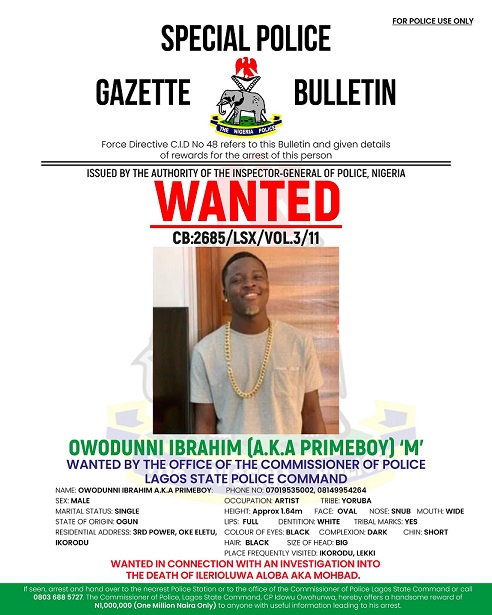
Following his failure to honour the police invitation successfully sent to him since the commencement of investigation into the circumstances leading to the death of Mr Ilerioluwa Aloba, aka Mohbad, the Lagos State Police Command, via its PRO, SP Benjamin Hundeyin, now declares wanted Owodunni Ibrahim aka Primeboy.

Ibrahim is approximately 1.64-m tall, dark-complexioned, with tribal marks and Yoruba by tribe. His last known address is 3rd Power, Oke Eletu, Ikorodu.

If seen, contact the nearest police station or call 0803 688 5727. The Commissioner of Police, Lagos State Command, CP Idowu Owohunwa, hereby offers a handsome reward of N1,000,000 (One Million Naira Only) to anyone with useful information leading to his arrest.

Who is watering the Nigerian grass?

By Bello Hussein Adoto

A few days after someone glibly told me that the grass was greener in Nigeria, a young medical doctor Dr Diaso Vwaere was crushed to death in an elevator accident at the General Hospital in Odan, Lagos State.

Netizens and other persons who have worked at the hospital said they complained about the malfunctioning elevator for years, but the management did nothing tangible to address it. So the young female doctor, with two weeks to complete her housemanship, took the elevator to retrieve a dispatch—a food package—on the ground floor. She never made it.

I imagine her in the elevator anticipating the food she ordered, salivating, getting ready to devour her food, and returning to her busy schedule as a house officer. I imagine her standing on the elevator, weightless, as it moves.

Then it snapped. Suddenly, the metal box is crashing down from the 10th floor all the way to the ground. Imagine her now in the elevator, weightless, as it falls freely. Imagine her grasp at everything and anything, something to break her fall. Then, bam, it crashed. Imagine her now.

What do you think she would have felt? She was trapped in the rubble. The package she was going to retrieve was less of a worry. Her call can wait. The world can wait. Now, she needed freedom, a way out of the rubble. She needed air. The wreckage is choking.

While in the rubble, time trickled. Seconds must have felt like a decade, minutes like forever. Time trickled. One, two, three… 40 minutes. She was there for 40 minutes before help came. She was out, finally. Ahhh, some relief.

Anyone could have been in that elevator. It could have been a patient, doctor, nurse, relative, or even you, my reader. It could have been a visitor, like the state governor or the CMD. Would this incident have made any difference? I wonder.

A consultant once said it’s better to have a heart attack on the streets of London than in the corridors of a teaching hospital in Nigeria, and I thought that was ridiculous. From what I have seen in recent times, he was not wrong. It is not impossible. We are all at our own’s risk.

Those who should provide the basic oversight at the hospital, from government officials to the hospital management and staff, seem to have other businesses than their jobs. That’s why the elevator could be so bad as to take a life before they consider fixing it. Do we need the president, governor, or minister of health to come and fix it too? What happened to the hospital management?

The elevator accident happened at a hospital big enough to have house officers, ten floors, and elevators. It is a big hospital, indeed, by every standard. Yet there was no blood to rescue Dr Diaso. Some said there was no morphine, emergency supplies, or cotton wool. The last part could have been a stretch, but I have seen resident doctors protest that there was no normal saline, which should be as common as sachet water. Yet…

When patients come to hospitals, and these supplies are not available, and they cannot afford them, they turn on the doctors and nurses that are equally helpless. A soldier beat my friend’s wife, a nurse at Sobi Specialist Hospital, some time ago because she asked him to get delivery packs for his wife’s delivery. Last December, patient relatives at the University of Ilorin Teaching Hospital pinned a doctor to the wall. They beat him because they thought their father was dying and he wasn’t helping. Meanwhile, they were asked to do a test they had yet to do.

These incidents happened in tertiary hospitals where we should expect—sorry, hope—that things are better, where supplies were available for patients to use and pay later. But they aren’t. What is the hope of someone in a rural area?

I wonder what would happen if someone fell off a storey building in Obehira, where I grew up, or Ikuehi, my hometown. What would be their fates? They may have to be referred to the recently built Reference Hospital in Okene. Will they fare any better there?

Back to Dr Diaso, the doctor in the elevator accident. She survived the crash but not the injuries she sustained. She was severely injured and needed blood. “There was no blood available for resuscitation,” wrote the Lagos branch of the Nigerian Medical Association. There she was in the hospital. She had spent 11 months and two weeks on calls, attending to patients, saving lives, unable to be resuscitated because there was no blood. She died. She died in the institution where she served.

They say the grass is greener here. Who is watering the grass?

Bello Hussein sent this piece via bellohussein210@gmail.com.

Police arrest man over attempt to use son for money ritual in Lagos

By Uzair Adam Imam

The Nigeria Police Force (NPF) in Lagos State have arrested a fifty-one year-old man, Mr. Poni Bada, for attempting to use his son for ritual.

The man recounted how he lured his 9-year-old child and took him before a habalist to be sacrificed for money rituals because of the rising inflation which resulted to a bitting economic hardship in the country.

The man said he had ten children from three wives but he can not feed himself, let alone feeding them.

He stated that looking at the way things kept changing from bad to worse, he decided to use the 9-year-old kid, Agbe, who is his last child for a money ritual so that he could train the other children and have better living conditions.

However, the child was rescued when a team of policemen from the Zone 2 Command, Onikan Lagos, who acted on intelligence, stormed the herbalist’s shrine and arrested the man and other suspects.

Explaining how he came up with the idea of using his son for money rituals, the father of the boy, Bada, said: “I have 10 children from three wives.

“The situation of things kept going from bad to worse. I could not feed my children. I then decided to use my last child, Agbe, for a money ritual, so that I could train the other children and have better living conditions.

“In May 2023, I left my home town in Jakotome, Benin Republic for Nigeria, to visit my brother, Benjamin Balobi, at Ilaro, Ogun State, who earlier told me he was doing well as a farmer and that the owner of a farmland was looking for labourers.

“That was how I brought Agbe to Nigeria to work. But the thought of using him for a money ritual came up when I realized that the money paid as salary to my son was very poor.

“I told Balobi to help me get a herbalist that would help me with the money rituals; he said he knew no one but promised to help me find a herbalist who might have information on it.

“He informed Ige Koshelu (one of the suspects) who found someone that promised to take us to the herbalist’s place in Sango.

“But we were taken to another herbalist’s place in Owode, where we were arrested,” he stated.