Kano State

Days of Future Past: Creativity, Technology and Challenges of Film Policy in Kano (II)

By Prof. Abdalla Uba Adamu

Being a keynote at the Kannywood Foundation film training workshop, on 2nd October 2022, Kano

Opportunities of Digital Technology

By 2012 the Hausa film industry has entered into the doldrums I have just described. There was a lot of head-scratching about the next moves. In the meantime, many individuals had formed YouTube channels and were uploading Hausa films with or without the knowledge and consent of the producers. Most of the films were old and were subscribed by internet newbies who had just acquired Smartphones and taking advantage of the cut-throat competition among Nigeria’s main service provers (MTN, 9Mobile, Airtel, Glo) were buying data and watching films on their phones. The DVD and CD players faded away, and although kids were still selling what were clearly outdated CDs at traffic junctions in the city of Kano, the process of watching free films on YouTube made the CD market non-viable. Then Arewa24 came along.

An initiative of the US Government, Arewa24 was part of the anti-terror and anti-radicalization program of the US State Department’s Bureau of Counterterrorism. The task was contracted to Equal Access International (EAI), which eventually established Arewa24, the first Hausa language satellite station rooted in peacebuilding and entertainment, in 2013. One of the ways the station revolutionized Hausa cinema – and thus succeeded beyond its expectations was the introduction of TV shows, hitherto a neglected entertainment segment in Hausa cinema. Broken into seasons and episodes, the first TV show on Arewa24 was Daɗin Kowa, a weekly drama about a melting pot city somewhere in the north of Nigeria containing a diversity of ethnicities, religions, languages and social classes. Of course, there are actual Daɗin Kowa settlements in Gombe and Kaduna State, but that did not deter the Series filmmakers. It was massively successful on multiple fronts.

First, it deconstructed the then-current Hausa cinema based on Hindi cinema with a lot of choreographed singing and dancing as well as romantic storylines, which was tiring to Hausa audiences. Second, it reconstructs Hausa TV shows of the 1970s, so beloved by cultural purists of Hausa storytelling. Third, as VOD (video on demand), Arewa24’s Daɗin Kowa blazed a new digital trail in film marketing for Hausa filmmakers. Being heavily subsidized, the producers can afford to load the entire series on an easily available platform of YouTube.

Yet, the second TV show on Arewa24, interestingly, was by an independent studio, Saira Movies, and the series was Labarina, made a year before Arewa24 took off in 2015. The novelty of Labarina as a series had a massive impact on online viewing of Hausa communities. Armed with Smartphones and cheap data from competing ISPs, millions tuned to Arewa24 to watch the series and later download it when it shifted to YouTube. It was the success of Labarina as a TV show that provided a backstory to the audience receptivity of Daɗin Kowa.

YouTube is an American online video sharing and social media platform headquartered in San Bruno, California. It was launched in 2005 and has become the main avenue for African cinema distribution. It is important to emphasize its American roots and origins to draw attention to the fact that the censorship regulations in any country do not apply to it. The Google-owned video service is also a major tool for self-distribution, as illustrated by the proliferation of web series in local languages in countries such as Ethiopia, Kenya, Rwanda, Senegal and Nigeria.

Kano filmmakers were quick to jump on the TV show bandwagon by cloning the success of Daɗin Kowa as a series broken up into episodes. Not only are the story arcs captivating, but they also provide a deeper script philosophy that is often critical analysis of the anthropology of contemporary Hausa societies. Although coming earlier than Labarina, Daɗin Kowa was more successful than Labarina, which was based on basically Bollywood soap operas. Daɗin Kowa was an authentic reflection of the contemporary realities of Hausa communities.

Other YouTube channels quickly followed. Table 1 shows a few of the channels and their overall viewership.

S/NSeriesChannelSubscribersDateChannel Views
 Izzar SoBakori TV969,0002014119,764,682
 Kwana Casa’inArewa24469,000201484,222,468
 LabarinaSaira Movies468,000201348,726,390
 AduniyaZinariya TV413,000201838,632,116

Bakori TV, which hosts Izzar So, has the highest number of channel views followed by Arewa24, then Saira Movies and Zinariya. These metrics, as indicated, reflect the overall channel views rather than the series – but provide an idea of the popularity of the series hosted by the channels.

Izzar So is a very popular TV show, judging by the audience metrics of each episode. Yet it was hard to determine its overall playlist metrics on YouTube. This was because the channel is so poorly organized that it does not even shift its individual episodes into an effective Playlist grouping. The channel has only two Izzar So playlists; Season 1 with 13 videos and Season 2 with 3. This, of course, is inaccurate since in the main listing of videos, the Channel listed episode 100 in the series at the end of September 2022, although it is unclear which season it was. The average views for the latter episodes are slightly over one million. Even their Facebook page does not promote the series in the light of providing information about the series, the stars or the stories.

Similarly, while Aduniya has a playlist, it only listed 33 videos in the list, whereas the list of videos with the episodes has the latest episode being number 73 with over half-million views. Labarina did not fare much better, with three playlists listing less than 30 episodes, when Season 5 EP1 was released in late September 2022.

While most of the TV shows streaming on either Hausa VOD or YouTube are romantic soap operas, Aduniya stood out because of its focus on the gritty urban life of a Kano city – exposing what I call ‘corruption from below’. It competes only with Daɗin Kowa but surpasses it in its presentation of the harsh, tough and ruthless social culture that operates below the radar of public spaces.

It is clear, therefore, that Hausa filmmakers are gradually favouring the TV show format, but their lack of digital skills to effectively present the contents limits their appeal. Further, with millions of views, the TV show filmmakers have not been able to provide adequate information on either the series or the synopsis of the episodes anywhere on a dedicated website (for which there is none, except Arewa24) or even Wikipedia entry.

Besides the challenges of poor digital marketing skills of the TV shows, filmmakers in Kano also faced the problems of censorship from the Kano State Censorship Board. In a bizarre revenue-driven focus, the Kano State Censorship Board demands that TV show series must be submitted to it for censoring before being uploaded to YouTube. Yet the servers are not based in Kano nor under Nigerian government control, so it is difficult to see how the Board will have authority over the contents on a server located in California.

Towards a Cultural Film Policy

The key objectives of film policy are to promote new artists, create new jobs, increase investments in film production, attract foreign producers and enhance the outward-looking character of Hausa cinema. So far, the only film policy available in the country is the policy of regulation from both the National Film and Video Censors Board (NFVCB) for the nation and the Kano State Censorship Board for Kano State.

The regulatory focus of these bodies was to ensure cultural specificity in film production in whatever language it is produced. The usual focus was on avoidance of foul language, nudity, and reproducible behaviour, especially for impressionable viewers and religious sensitivity. It would appear, therefore, that any policy would have to revolve around the cultural and religious frameworks of the audiences.

This issue had been a sore point with Hausa filmmakers right from the halcyon days of the industry from 1998 till its eclipse in 2007. Market-driven Hausa filmmakers are focused on commercial rather than an artistic success. Arthouse films like Kazar Sayan Baki, and Ibtila’i, did not sell because they had no commercial motifs of singing and dancing. And once the studio feels it is not selling enough to remain afloat, it simply closes shop and moves to selling essential commodities.

This is where the Kannywood Foundation comes in. A training program such as this will pave the way to the future after emerging from a cloudy and rocky past. I will not presume to give a policy here because it is a group effort. However, while thinking about the policy directions of Hausa cinema, the following might be points to ponder:

  1. Move away from commercialization to professionalization. Other professions include specific, targeted and focused entry points and exits. You don’t wake up one day and claim to be a doctor. One has to go through a rigorous process of certification. This should be the same with the film industry. It is not to say, ‘I am creative, and I have money’. You have to demonstrate competency since what you do is representation.
  2. Seeking storylines in community arcs. A policy should demote the idea of transnational copying of films that focus on blindly copying Indian or Western films. It should focus on the anthropology of our experiences – of which there are myriad ways of getting story arcs. A policy can, therefore, effectively reward those ethnographically based films, through additional funding, rather than ineffective ‘film awards’, most of which were bought by the filmmakers
  3. Any training program that would be part of a policy should include cultural studies. Scriptwriters, directors, actors and production designers must know what constitutes public culture – beyond what they experience. They need to be aware of it from the structural perspective of a research process. Production designs, therefore, must be not only accurate enough to the period being recorded but also aesthetic enough to convey a sense of elegance and pride in cultural tradition
  4. A greater focus of the policy and training should be on digital marketing. It is not enough to simply open a YouTube channel and upload films. Practitioners need to be aware of how to drive traffic to their channels and organize their content in a structured and easily accessible form.
  5. Reaching out to the larger world. While it is pleasing that many Hausa TV shows are now flooding YouTube, most have no subtitles in an international language that will communicate to international audiences. This is clearly a misuse of the social media platform – where although open to the world, Hausa TV shows are restricted to Hausa audiences. If there is anything to copy from Hindi cinema, it should be its marketing strategy. With their subtitles, their films are seen and accepted as cultural products worldwide – for language is the best representation of culture.
  6. Careful attention must be given to Hausa VOD services, particularly Northflix and Kallo. While still in their early stages, these VOD streaming services effectively show the way to the future.

Cultural commodities – whether tourism-related or popular culture – are marketed with the assumptions of their impact on the daily lives of their consumers. Marketing determines the success of especially media industries, often with a disregard for the content. The commodification of the Hausa popular cultural industries was premised on profitability motives, not art or aesthetics. Financiers are ready to continue investing in the industries as long as they can make effective profits. It is this profit motive that commoditizes art and elegance to common supermarket products with a short shelf life.

Prof. Abdalla Uba Adamu wrote from the Department of Information and Media Studies, Bayero University Kano, Nigeria. He is, among many other things, the former Vice-Chancellor of the National Open University of Nigeria (NOUN). He can be reached via auadamu@yahoo.com.
Days of Future Past: Creativity, technology and challenges of film policy in Kano (I)

By Prof. Abdalla Uba Adamu

Being a keynote at the Kannywood Foundation film training workshop, on 2nd October 2022, Kano

A Tale of Two Cinemas

In November 2007, I was privileged to participate at the African Film Conference held at the University of Illinois, Urbana-Champaign, United States. It was a stellar gathering of what I call the ‘Nollywood Mafia’. The outcome of the conference was reflected in the publishing of selected papers in Viewing African cinema in the twenty-first century: FESCAPO art films and the Nollywood video revolution, published by the Ohio University Press in 2007. At the tail-end of the conference, a session called The SIU Nollywood Project Brainstorming was held on Sunday, 11th November 2007. Containing well-known Nollywood scholars such as Jonathan Haynes and Onookome Okome, as well as Nollywood stars such as Joke Silver, Francis Onwochei and Madu Chikwendu, among others (including those who study Nollywood from the fringes such as Brian Larkin and Birgit Meyer), the session sought to determine funding for research on Nollywood from the US National Endowment for the Humanities. A critical point of discussion during the session was the name ‘Nollywood’.

While discussions were on course for the funding mechanism, there was a feeling from the participants that the term Nollywood should be used to reflect all films from Africa, regardless of region, to create a unified view of African cinema. As the only northern Nigerian with a focus (and paper earlier presented) on Hausa cinema, I objected and spent time arguing why the term Nollywood cannot be used as a blanket term for African cinema. Continentally, films from north Africa from Egypt, Tunisia, Morocco, Algeria and Mauritania are radically different from those produced by Nigerian Nollywood. Similarly, filmmakers from Chad, Burkina Faso, Senegal Cote d’Ivoire are more ethnographic to their cultures, which makes them required viewing for film and cultural studies across the world.

Even back in Nigeria, there is a radical difference between Hausa language cinema and the type of films produced and promoted by Nollywood. Labelling all African films as Nollywood is to cancel the identity of the portrayals of the films by different cultural groupings in the continent and project Nollywood as the only ‘African voice’. I am unsure whether the funding was obtained, but I know that the idea of labelling all African films as ‘Nollywood,’ regardless of cultural point of origin, was dropped.

***

By 2012 the Hausa film industry had literally crashed. The major marketers-cum-producers had all pulled out of the industry. Their shops in the major video markets in Kano were subsequently filled with clothing—particularly blouses and football jerseys; for these make more money than selling films. Others took to selling Smartphone accessories, while others returned to the farm and became serious farmers. The few Hausa megastar actors took to commercial advertising of noodles, milk and other household commodities – often moving from house to house with products’ marketers – relying on their faces and voices (making sure they introduce themselves in all the commercial jingles) to sell to increasingly hungry population caught in the vortex of economic depression. The frequency of releasing films drastically dropped because no one was buying. International Satellite channels like the Indian Zee World, especially their English-dubbed TV series, caught Hausa urban attention more than recycled Hindi film clones that were the hallmarks of Hausa video films. Consequently, many reasons combine to lead to the crash of the Hausa film industry towards the end of 2016. 

Market congestion

The popular cultural industries in Kano were marketed into market hubs. The Bata market at the edge of Sabon Gari controlled the predominantly foreign films and music sales and the main distribution centre to other parts of Nigeria and Africa, where a sizeable market existed in Niger, Burkina Faso, Ghana, Togo, Cameroon, Chad and Congos.

When the Hausa video film arrived in 1990, it found a ready template to attach itself. The other was Kasuwar Ƙofar Wambai, located at the edge of the walls of Kano city and near a cluster of old colonial cinemas. The Wambai market focuses mainly on leather, textile and plastics. However, it was also the hub of audio tape sales – with marketers doing brisk business pirating old EMI, Polydor and HMV tapes of traditional Hausa musicians recorded in the 1960s. Road construction work at Bata in about 2003 created unfavourable conditions for many of the stall owners, and some decided to shift to the Wambai market. By 2005 the video film market had moved entirely to Wambai, which now became the new Bata.

The Wambai market, hitherto occupied by cassette dealers who ignored the Hausa film industry, suddenly became a virgin territory for film marketers and producers, with each opening a stall. In less than five years, it had reached its ascendency and crashed due to the massive congestion of producers and marketers – all selling the same thing. When I visited the market in May 2017, I counted less than ten stalls selling either videos or audio; contrasted to some five years ago when it was bursting at the seams with these products. The stalls have now been taken over by stocks of cheap blouses, football jerseys and cloned Smartphone accessories.

Lack of new or captivating scripts

By 2005 the Hausa video film industry had become fully established, with over 1,600 officially censored releases. With an extremely few exceptions of less than 0.5%, they all revolve around a pastiche of Hindi films in one form or other aimed, as the video filmmakers themselves kept insisting, at urban Hausa children, youth and housewives. Yet, most Hindi films could be classified as musicals, especially due to their reliance on a strong dosage of song and dance sequences blended with a melodramatic storyline, which employs formulaic ingredients such as star-crossed lovers and angry parents, love triangles, corrupt politicians, kidnappers, conniving villains, courtesans with hearts of gold, long-lost relatives and siblings separated by fate, dramatic reversals of fortune, and convenient coincidences.

This stylistic technique provides a vehicle for echoing a fundamental Hausa emotional tapestry in three main creative motifs: auren dole (forced marriage, the love triangle, and the obligatory song and dance sequences—with an average of about six songs in a two-part video. With every producer trying to outwit everyone with more love triangles, song and dance routines, the market became saturated, and audiences got bored – and indicated this by refusing to buy the films.

Monopoly by Megastars

Those actors lucky enough to be accepted early enough in the film industry came to dominate the system. This was actually imposed by the marketers who insisted on a particular actor appearing in a film they would sponsor or market because such actors were more bankable and guaranteed quick sales of their films. With this economic force behind them, such few (perhaps less than five) came to dominate almost every ‘big’ budget Hausa film. By 2017 their stars had started fading; audiences became tired of seeing them in nearly the same film with different names, and marketers dropped them. While still making films, they diversified their faces and voices to commercial advertising for major telephone service providers and essential commodities such as chicken noodles and milk and soup seasoning.

The fading of the fortunes of the megastars became evident with the ascendency and popularity of relatively unknown stars of a TV series, Daɗin Kowa, shown on Arewa24 satellite TV that began on 21st January 2015. Daɗin Kowa (pleasant to everyone) is an imaginary town that serves as a melting pot, housing Nigerians of various ethnicities and religions and yet living peacefully. In 2016 it won Africa Magic Awards over Sarki Jatau, an expensive lavish, traditionally cultural Hausa period drama.

The coming of Arewa24, initially conceived and funded by the United States State Department’s Bureau of Counterterrorism to counteract insurgency in 2014, merely placed another nail in the coffin of the Hausa video film market. Transnational in its outlook, the Arewa24 TV series provide a level of script sophistication unheard of in the Hausa film industry. Other Satellite TV stations, such as StarTimes, and Hausa Channels on Africa Magic DStv, including GoTV, became increasingly affordable. Showing a massive amount of Hausa films, they eclipsed the purchase of CDs and DVDs of Hausa films. Audiences prefer to watch for free than to go through the hassle of purchasing DVDs that often do not work and requiring DVD players, mostly Chinese knock-offs of international brands that often turn out dodgy.

New Media, New Poverty

The Internet provided the biggest blow to the decline of Hausa video films. With telecommunication companies competing for customers and undercutting each other in offering data plans, Hausa youth have more access to social media sites such as Instagram and YouTube. The latter, in particular, provided them with opportunities to upload hundreds of Hausa films for all to see. While this has increased the visibility of Hausa films worldwide, such popularity does not translate to return on investment, as most of the films were illegally uploaded to YouTube.

Another dimension of the new media political economy was the proliferation of Download Centers in northern Nigeria, with the largest groups in Kano. Operators of these Centers rip the CD of DVDs of Hausa films and convert them into 3gp formats and make them available to customers at N50 per film—with discounts given for volume purchase. A 1GB microSD card can pack as many as 20 films. The 3gp format makes it possible for people to watch the films on their Smartphones, which readily and rapidly replaced DVD players, which require a TV and electricity – something not always guaranteed in Nigeria. Often the Downloaders ‘lease’ the films from street vendors – children hawking the CDs and DVDs at traffic lights – for N100 per film, rip them off, and return back to the hawker who simply puts them back into its pristine cellophane wrapper and eventually sells it – thus gaining double profit. Both the various Associations of Hausa filmmakers and the Kano State Government’s Censorship Board had tried to stamp out the Downloaders, but without success, as the latter had become so powerful and organized that they formed various Associations. The punitive steps were usually to arrest them, fine them, and order them to delete the illegal ripped-off films from their computers. These measures proved so ineffective that a deal was worked out in 2017 between the filmmakers and the Downloaders to ‘officially’ lease the films to the Downloaders for a fee in the form of a ‘legal license’. However, these measures did not work because the Downloaders prefer to obtain their films cheaply rather than being registered with the Government as licensing the films. On the other hand, the Kano State Censorship Board simply asks them to register their business and charge them fees, regardless of their downloading bootleg business.

Southern Indian Competition

A final factor in the decline of the Hausa film industry by 2012 was the massive popularity of ‘Indiya-Hausa’ films. These were Telugu and other southern Indian films dubbed into the Hausa language by, first, Algaita Studios in Kano. When the marketers at Wambai market noted the popularity of these dubs, they also moved in and commissioned their own dubbed translations.

The original Telugu films were brought to Kano by an Indian national with full license to translate into local African languages. The first film translated by Algaita Studios was the Bhojpuri film, Hukumat Ki Jung (dir. S.S. Rajamouli, 2008). It was translated as ‘Yaƙi da Rashin Adalci’ (Fighting Injustice). Others that followed included Dabangg (dir. Abhinav Kashyap, 2010), Racha (dir. Sampath Nandi, 2012) and Nayak: The Real Hero (dir. S. Shankar, 2001). In an interactive session in June 2016, Buzo Ɗanfillo, the CEO of Algaita Studios and whose voice is used in the translations, told me that the Algaita Studio had translated 93 films by 2016. They were paid ₦80,000 by the Indian licensee of the films.

The first few films that appeared from the Algaita Studio from 2012 were considered novelties, providing relief from watching complete remakes of Hindi films by Hausa filmmakers or even the originals themselves. What made them more attractive, however, was the translation of the titles of the films in a single powerfully expressed word, or a couple of words, that seems to take a life of their own and communicate either adventure, danger or defiance. For instance, Nayak: The Real Hero (dir. S. Shankar, 2001) was translated as ‘Namijin Duniya’ (lit. Brave); Indirajeet (dir. K.V. Raju, 1991) as ‘Fargaba’ (Fear), and Velayudham (dir. Mohan Raja, 2011) as ‘Mai Adda’ (Machete). Referred to as ‘India-Hausa’ (Hausa versions of Indian films), they quickly became the new form of transcultural expression in the Hausa entertainment industry.

The Indiya-Hausa translations were massively successful and attracted audiences not attuned to Indian films in the first place. This can be deduced from the numerous comments on the Facebook pages of the Algaita Dub Studio (https://www.facebook.com/algaitadub/).

Their success created a public debate, mainly online on social networks, about their cultural impact. In the first instance, there does not seem to be any attempt by the translators to mute some of the bawdier dialogues of the originals – translating the dialogue directly into Hausa. Kannywood filmmakers latch on to this as an indication of cultural impropriety of the translated films. Additionally, the often-romantic scenes revealing inter-gender sexuality were not edited out by the translators since their focus is not the visuals but the voices. This, again, was pointed out by Hausa filmmakers as a direct attack on Hausa cultural sensibilities. Kannywood filmmakers accept that they appropriate Hindi films but argue that they culturally adapt the stories to reflect Muslim Hausa sensibilities.

Prof. Abdalla Uba Adamu wrote from the Department of Information and Media Studies, Bayero University Kano, Nigeria. He is, among many other things, the former Vice-Chancellor of the National Open University of Nigeria (NOUN). He can be reached via auadamu@yahoo.com.
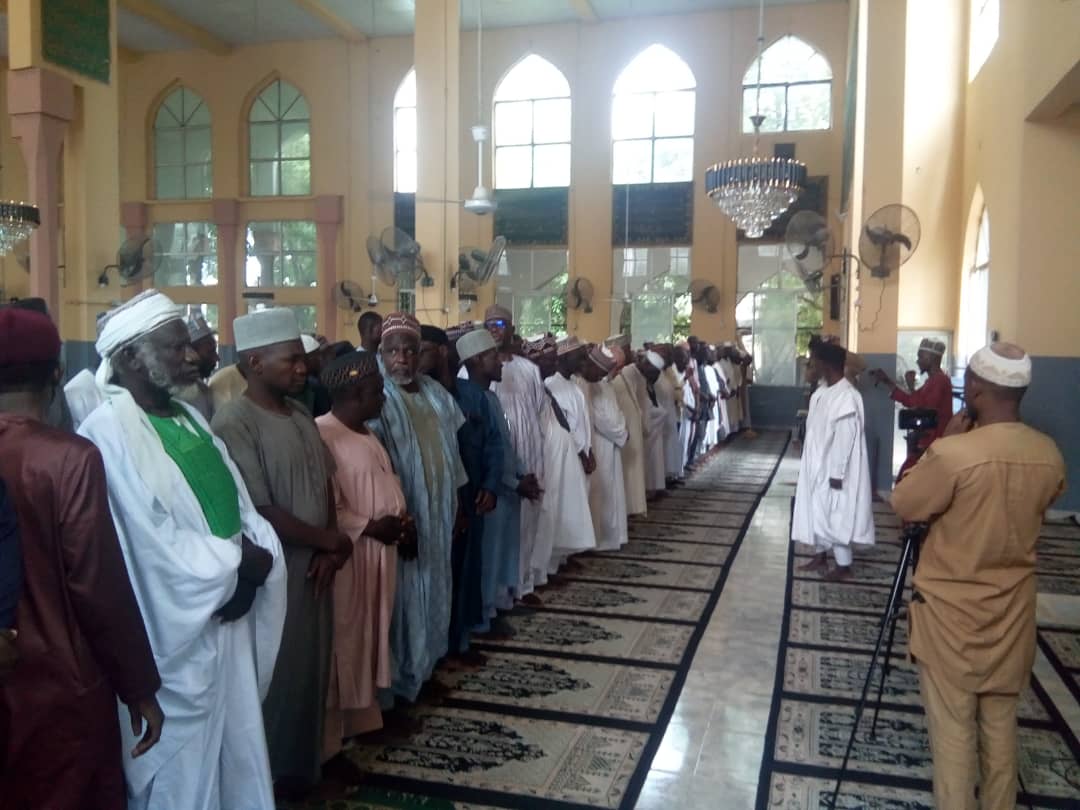
Kano: Muslims observe distant funeral prayer (Salatul Gha’ib) for Late Sheikh Yusuf Al-Qardawi

By Isa Muhammad Inuwa


Thousands of Muslims in Kano, Nigeria, had Thursday converged at the Umar Bin Al-Khattab mosque, where they offered funeral prayer in absentia for the repose of the soul of the deceased Sheikh Youssef Al-Qardawi, who passed on in Doha, Qatar, recently.

Leading the congregation, Imam Sheikh Yahaya Tanko delivered the prayer interluded with four Takbirs (Allahu Akbar! chants) and supplications.

Addressing the crowd shortly after, Sheikh Tanko recalled that the distant funeral prayer was first conducted by the Prophet Muhammad (SAW), in Medina, for the soul of Al-Najjashi, the then late Emperor of Abyssinia (present Ethiopia). Al-Najjashi was deemed to have converted from Christianity to Islam before his death.

Also speaking to the gathering, Professor Muhammad Babangida of Bayero University, Kano, announced that the late Sheikh Al-Qardawi was “a famous Islamic scholar of international standing, who spent the largest part of his life contributing to Islamic knowledge, through his teachings, writings and extracting solutions to religious matters (Fatwa)”.

He added that the late Al-Qardawi authored no less than 170 books, some of which consisted of several volumes. He said he was head of numerous Islamic bodies and that he migrated from his home country Egypt to Qatar because of threats to his life by anti-Islamic forces.

He described the deceased as a moderate jurist who maintained a middle course in proposing solutions on matters of Islamic jurisprudence. “He neither swerved to the extreme nor tilted to the most lenient side”, adding that he was very apt in addressing current issues arising in modern life in his publications and jurisdictions.

The scholar also described Al-Qardawi’s death as a significant loss to the entire Muslim World, whose replacement is difficult to find. He then asked God to forgive the deceased and rest his soul in the highest abode of Paradise. 

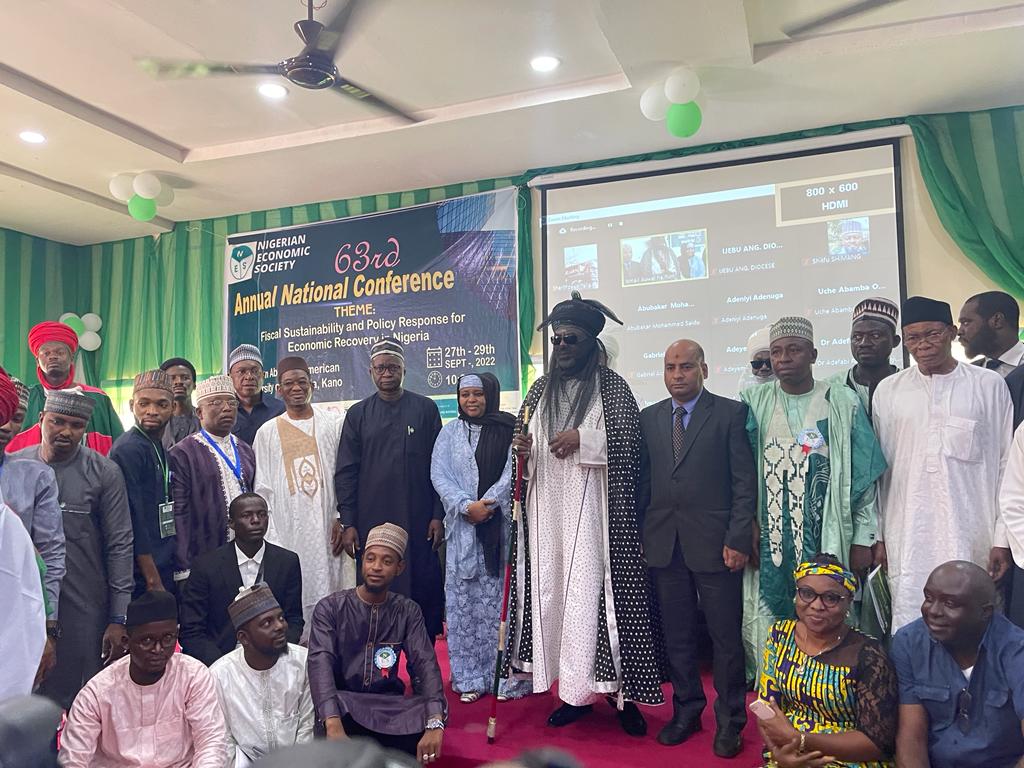
Academics, politicians, traditional rulers converge in Kano to discuss Nigeria’s economy

By Uzair Adam Imam

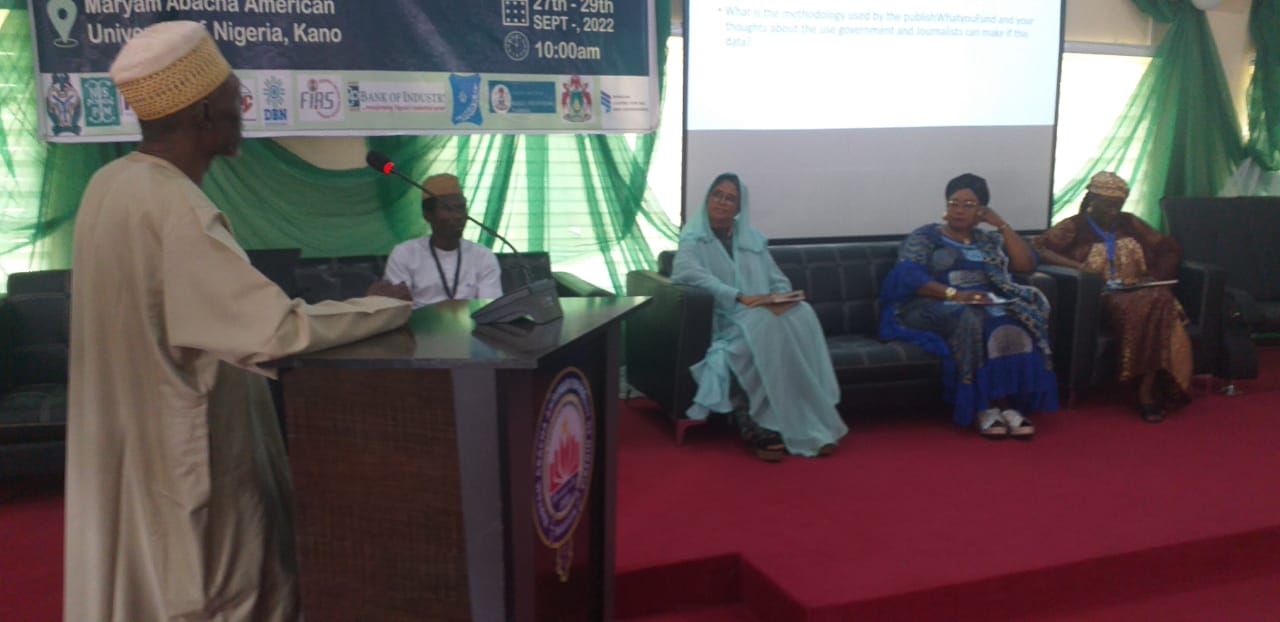
A 2022 and the 63rd annual national conference of the Nigerian Economic Society (NES) ended successfully Thursday, September 29, 2022.

The conference, which started Tuesday, was aimed at providing possible ways to enhance fiscal sustainability in Nigeria as the country ranks fifth on the list of ten countries with the highest debt exposure.

The event hosted academics, politicians and traditional rulers from all parts of the country to grace the event held in Maryam Abacha American University of Nigeria, Kano.

Speaking at the closing ceremony, Prof. Umma Ahmad Jalingo, the second woman president of NES and the first one from the north in 63 years, commended the successful completion of the event.

She said the past three days had been very impactful, adding, “Today, September 29, has marked the culmination of this program with yet an important component.”

His royal highness, the Emir of Kano, Alhaji Aminu Ado Bayero, commended the organisers for holding the conference in Kano.

The emir said the conference was relevant, looking at Nigeria’s current economic situation. He also commended all the papers presented.

Some of the papers presented included “Impact of Fiscal Policy on Financial Inclusion and Development in Nigeria” by Taiwo A. Segun, “Fiscal Policy Options and Poverty Reduction in Nigeria” by Muhammad B. Ado and “Public Debt and Poverty in Nigeria: The Role of Governance Quality” by Omowuwi O. Idowu, among others.

NES was founded in 1957, three years before Nigeria’s independence, and aims to provide intellectual leadership in understanding and to manage economic, social and political changes in Nigeria.

High debt will burden future generations – Dr Hassan Mahmud

By Uzair Adam Imam

The Director, Monetary Policy Development, Central Bank of Nigeria, Dr Hassan Mahmud, said the high debt would be a burden on future generations in the country.

Dr Hassan Mahmud disclosed this on Wednesday at the 63rd National Conference of the Nigerian Economic Society (NES). 

The 3-day conference, which started on Tuesday at the Maryam Abacha American University of Nigeria, Kano, was themed “Fiscal Sustainability and Policy Response for Economic Recovery in Nigeria”.

It was gathered that the country’s public debt in the first quarter of 2022 had risen to N41.6 trillion from N39.56 trillion recorded in December 2021.

However, the debt by the Federal Government has continued to throw a big threat to future generations as it may impinge on the country’s economic growth.

He said, “When debt is high, it becomes a burden on future generations as it leaves no room for borrowing when there is a shock.

“High debt can increase the cost of private sector borrowing, crowding out viable private sector investment and high servicing requirements.” 

Mahmud said despite the challenges, the public debt is an important instrument for the economy, adding that the country’s borrowing plan is guided by debt sustainability.

He added, “Nigerian borrowing plan is guided by the debt sustainability threshold to ensure debt carrying capacity does not impinge on growth.”

The event hosted many academicians and politicians from all over the country, many of whom also commended the conference and its organisers.

Nigeria’s economy in chain since the start of Ukraine war – Minister

By Uzair Adam Imam

The Federal Government has said that the adverse effects of the war in Ukraine and the ongoing security challenge in Nigeria have contributed to the aggravation of the fragile economic situation in the country.

At the start of the war, the Organisation for Economic Cooperation and Development (OECD) warned that the world economy would pay a “hefty price” for the war in Ukraine, encompassing weaker growth, stronger inflation and potentially long-lasting damage to supply chains.

In Nigeria, inflation is already hitting living standards and reducing consumer spending as business owners become less optimistic about production.

The Minister of State, Budget and National Planning, Prince Clem Ikande Agba, disclosed this Tuesday at the 63rd National Conference of Nigerian Economic Society. 

The 3-day conference, which started Tuesday at the Maryam Abacha American University of Nigeria, Kano, was themed “Fiscal Sustainability and Policy Response for Economic Recovery in Nigeria”.

The Minister, represented by the Director Macro Economic, Mr Felix Okonkwo, said fiscal discipline is what Nigeria needs to build a stable and inclusive economy.

Agba stated that the Federal Government is focused on addressing the revenue issues, which it considers essential to the economic and financial health of the country.

He added that insufficient revenue was why Nigeria could not contain its fiscal deficit after the recession, meaning that the country’s capacity to continue to support and raise capital expenditure has not been improved.

He said, “The adverse effect of the War in Ukraine, insecurity, global food crisis, oil theft in the Niger Delta, rising energy prices, massive depreciation of the naira exchange rate, high fuel subsidy and increasing inflation as well as insufficient fiscal buffer aggravated the fragile economic situation in the country.”

The chairman of the occasion, Shamsuddeen Usman, said the conference aimed at providing possible ways to restore the country’s economic stability through enhancing fiscal policies.

The President of the Nigerian Economic Society, Prof. Umma Jalingo, who organized the event, said the association was founded three years before Nigeria’s independence and was aimed at enhancing the country’s economy.

The trend of bleaching among Kano people

By Usman Usman Garba

Taking good care of the skin among females has been an age-old desire and culture for years. Consequently, they develop various skin care practices to look beautiful and attractive. Girls of all generations, past and present, have been involved in this art, in which one area of focus recently may be skin bleaching, which seems to have become trendy among Kano ladies.

Skin bleaching is considered purposefully and deliberately an act of changing one’s skin colour by applying substances or solutions on the skin, with the sole intent of making the skin colour look lighter and brighter.

Research has shown that the idea of “Fara ko mayya ce“, which literary means “even if a lady is a witch”, by Kano male citizens has drastically driven females into the habit of bleaching their skin to look more attractive, fashionable, elegant and adorable.

According to some, women bleach their skin to remove skin imperfections such as rashes, dark spots and pimples and make or maintain softer skin. Some can meet the westernized standard of beauty, make themselves look “more attractive” in the eyes of their potential partners, and impress or meet their friends’ approval.

It is hard within Kano today to see a group of females without seeing one or some of them bleaching her or their skin. Unfortunately, it has become a tradition that even light-skin females bleach themselves in the sense that their bride price will be high or their class will increase in courtship or marriage.

Wives, too, are not left behind in this act. They engage in it to maintain their husbands out of fear that those ladies that bleach might snatch them away and in another way round, to help them maintain their marriages.

Men, too, are not excluded. They engage in it to become attractive to their female counterparts and celebrities or to copy local and western musicians and actors.

Before, when a male person bleached his skin, he did so because he was effeminate, but today, he does so to become a celebrity or popular and respected.

Others use pills to steam themselves while others use steaming drugs which remove their skin to be light as society considers white as beauty. They ignore that bleaching, as research has shown, has no benefits but harm.

Economically, instead of spending their hard-earned income on something beneficial, they end up squandering it on harmful bleaching products. 

The situation has become so bad that many women now have disturbing discolouration, contrasting colours and dark spots. The knuckles, knee caps and elbows are not spared as they carry different colours.

As disclosed by Dr Shamsudden Haladu, a dermatologist at Yadakunya General Hospital known as Bela Hospital, skin bleaching creates significant health problems for the users. Sadly, in Kano, its use had become widespread due to easy access to various brands of bleaching creams at multiple markets and shops.

A body that has been bleached becomes very light, fragile and tears quickly. Bleaching also leaves spots on the skin after being scratched or hard hit by an object. Such spots make the skin look rough and unattractive.

The doctor reveals that people differ in colour based on the five layers that human beings have: stratum corneum, stratum lucidum, stratum granulosum, stratum spinosum and stratum basale.

The basale layer, which is the last, has some cells called melanocytes, which make melanin and give our skin a dark colour.

All human beings have the same melanocytes. The only difference is the amount of melanin that melanocytes produce.

Skin bleaching has been established to have severe side effects. It has also been identified as the source of serious health-related issues among users, especially those who subject their bodies to creams formulated without proper safety precautions regarding chemical contents used in their production. 

The use of skin bleaching has also been reported to be responsible for skin cancers, skin discolouration, and depression among users leading to negative outcomes. Other risks include skin damage and severe depigmentation.

According to Dr Haladu, one should contact a dermatologist or visit a hospital before using any bleaching cream or soap. If possible, one should eat fruits as they contribute more to treating and whiting skin than any cream product.

Usman Usman Garba wrote from Kano via usmangarba100@gmail.com.

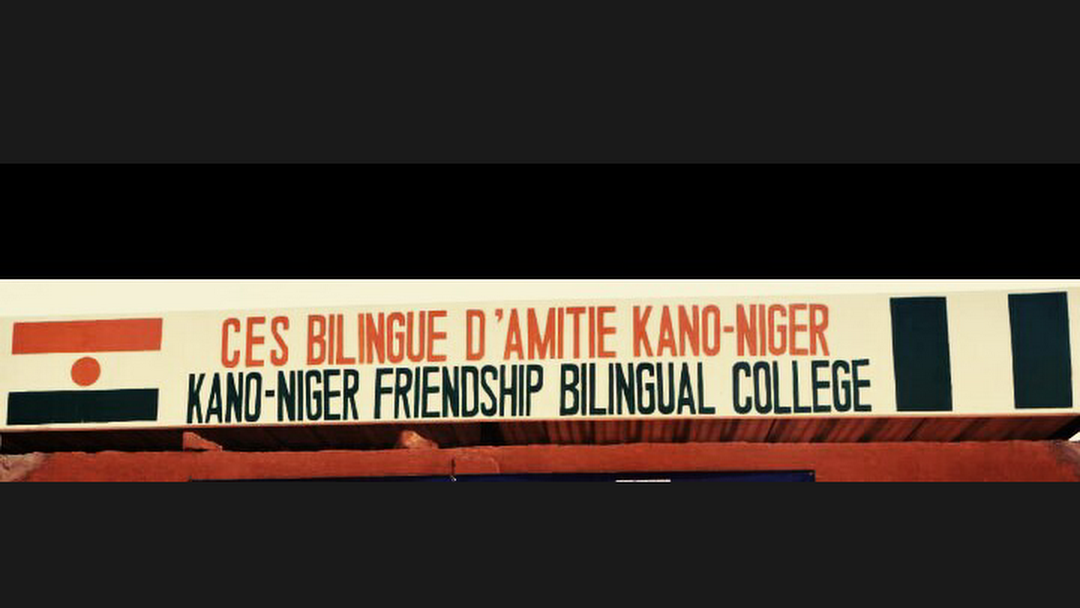
Kano Ministry of Education conducts entry exam into Bilingual College Niamey

By Uzair Adam Imam

The Kano State Ministry of Education on Saturday conducted a screening test for the state’s candidates that would be sponsored to study in Bilingual College, Niamey, the capital city of the Niger Republic.

A statement Saturday by the Director Public Enlightenment, Ministry of Education Kano state, Aliyu Yusuf, said the test was in preparation for the 2021/2022 admission exercise.

Bilingual College is a joint initiative between the Kano State Government and the Government of Niger Republic to groom students in French and English languages.

The statement read in part, “The Screening test which was conducted across the 3 senatorial zones of the state was aimed at selecting 1 best candidate each from the 44 local government council areas of the state to study at the college.

“Similarly, another selection exercise will be conducted among the remaining candidates that have attended the screening test for the Bilingual College, with a view to admitting them into various Unity  Schools across 18 northern states that runs  Students exchange programme.

“In the same vein, the ministry has also facilitated the movement of another set of Kano state students that conducted an entry examination into Gifted Academy, Bamaina in Jigawa.

“The Successful students at the end of the examination will be sponsored to study at the Gifted Academy Bamaina by the Jigawa state Government,” the statement added.

INVESTIGATION: Inside abandoned Muslim converts’ house in Kano

By Uzair Adam Imam

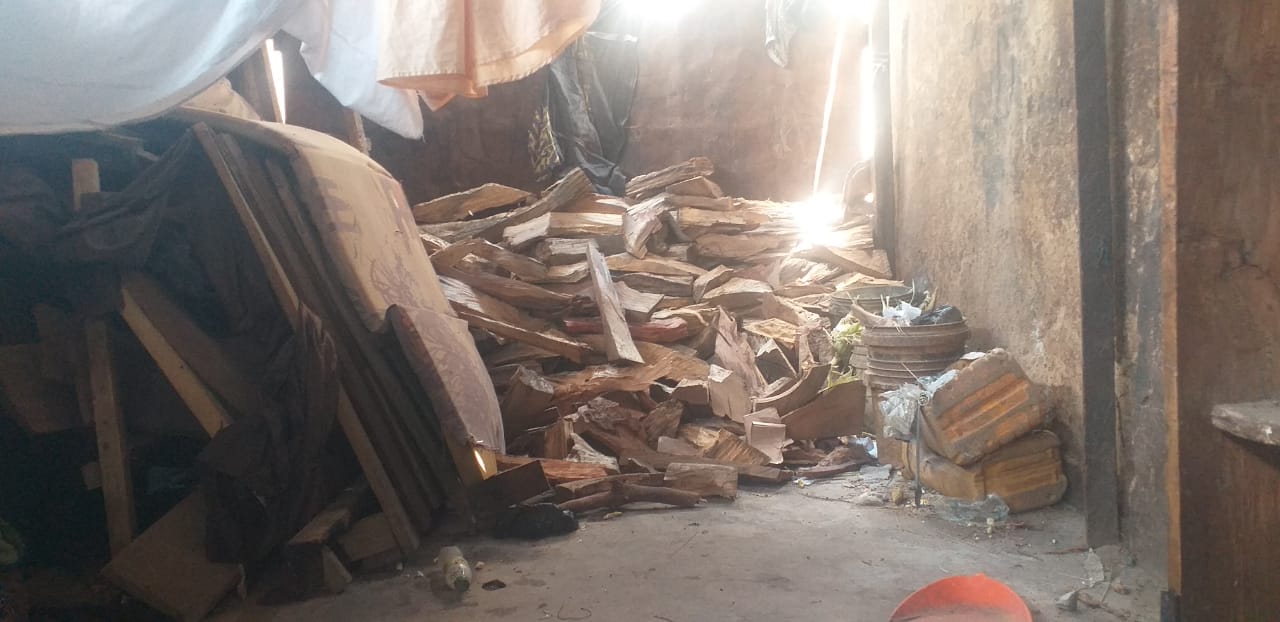
A man diligently taking care of a house meant for Muslim converts in Gwale LGA, Kano State, has opened up on the tough times the people are going through.

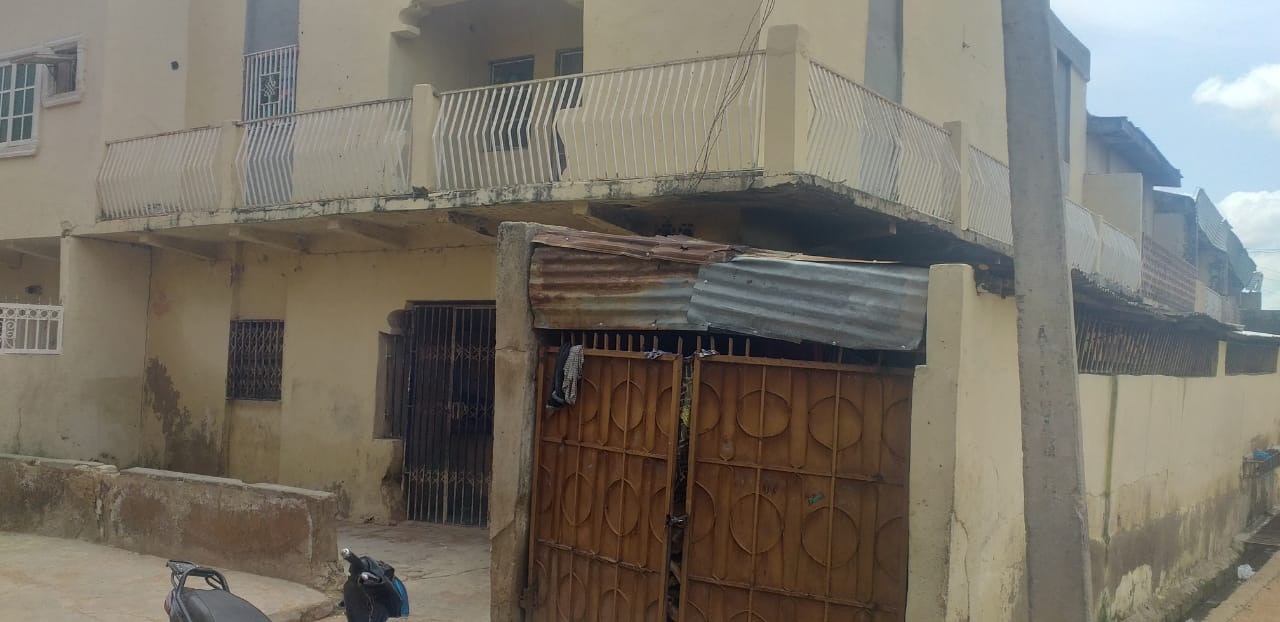
Malam Hassan Tela described to The Daily Reality how the Kano State Government had abandoned the house located at Hauren Wanki, Gwale LGA, without food and basic necessities for over 11 years amidst the biting economic hardship in Nigeria.

Hassan Tela said that the forsaken converts are now under the care of a few individuals who shoulder their responsibilities since the government had turned its back on them.

He stated that the house is under the Kano State Shari’ah Commission, founded by the former governor of the state, Malam Ibrahim Shekarau, in his first tenure in 2004.

The Daily Reality gathered that during the Shekarau administration, the converts were well taken care of and had their foodstuffs provided every month, including soaps and detergents to wash their clothes.

The end of Shekarau’s tenure throws converts into a dilemma

However, the end of Shekarau’s term opened the door of hardship and hunger for these abandoned converts for over a decade, leaving them stranded and, sometimes, starved.

Tela said, “During Shekarau administration, the governor provided foodstuffs such as rice, beans, maize, yam and other items to the converts, including the pocket money.

“The government also sponsored the children to continue their studies from primary to tertiary institutions. Books, shoes, bags, and uniforms were also provided for them. Life then was smooth. I also had my N15,000 allowance every month.”

However, when Engineer Rabi’u Musa Kwankwaso was elected as Kano state governor in 2011, he stopped the feeding and the allowance. Likewise, Governor Ganduje, whose administration has marked its 7th year.

Our reporters gathered that despite all the pleas by Tela and his Da’awa preaching colleagues, the government turned a deaf ear to the plight of the converts and those taking care of them. This development has forced many of the converts to drop out of school.

‘We sell our preaching bus to feed converts’ – Tela

“Because we cannot keep human beings without food, and the converts numbering thirty-seven, we had to sell our bus we used to go for preaching to sustain this activity.

“Some people that came to our rescue purchased a tricycle (Adaidaita Sahu) for us. After spending some years and the machine was old enough to work, because it broke down almost every day and we didn’t save anything because we used the money for our daily shopping, we had to sell it too to buy foodstuffs.

“In those days, when goods and services were cheap, N2500 was enough for me to do all the shopping, but now, I spend N5000, and we are still managing.

“But Alhamdulillah, the founding fathers of Hanan and Abu Hanifa schools, including the current deputy governor of Kano State and a few others, have lent us their helping hands.”

It’s difficult for us – converts

Some of the converts that spoke to The Daily Reality have voiced a passionate plea to the government to come to their aid.

A convert, Aisha Hassan, pleaded with the government to come to their aid, saying, “Sometimes we would wake up, and we have no money to shop.”

A convert, Ummu-Salma Musa, said, “Some of us are in school, but we don’t have reading materials such as books and bags, and we also need some clothes to wear.”

Another convert who identified herself as Hafsat, and has completed her diploma programme, said, “We really face many challenges including lack of soaps, detergents, slippers and sandals for our younger ones going to primary and secondary schools. We also hope to further our education.”

Aisha Danjuma said, “We also need to learn some skills as some of us are not going to school.”

When contacted, the Director Public Enlightenment of Kano State Shari’ah Commission, Malam Aminu Musa, said he could not comment on the allegations.

He said, “I know of the issue. But as of now, honestly speaking, I cannot say anything about it. In addition, there have been changes and appointments in the commission, and I am one of those appointed that assumed duty on Monday.”

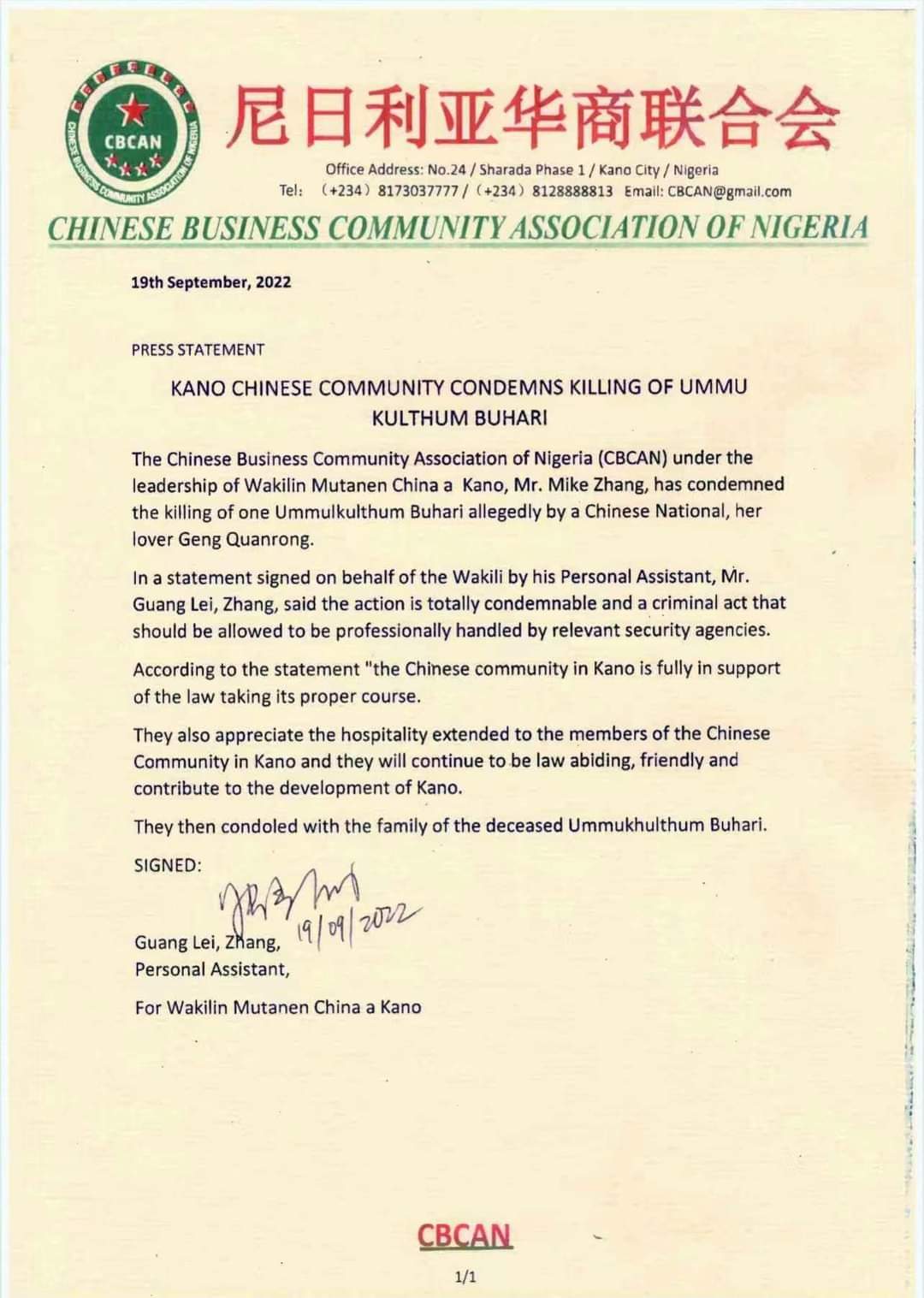
Kano: Chinese Business Community condemns murder of Ummita

By Ahmad Deedat Zakari

The Chinese Business Community Association of Nigeria, CBCAN, has condemned the murder of Ummu Khulthum Buhari, alias Ummita, in Kano.

This was made known through a statement released on behalf of the Wakilin Mutanen China a Kano by his personal assistant, Ghuan Lei Zhan on Monday.

“The Chinese Business Community Association of Nigeria (CBCAN) under the leadership of Wakilin Mutanen China a Kano, Mr Zike Zhang, has condemned the Killing of Ummukuthum Buhari allegedly by a Chinese National, her lover Geng Quarong” Part of the statement reads.

The Chinese Business Community also said it supports law to take its proper course.

Ummukuthum was allegedly murdered by her Chinese lover on Friday night. Her murder has generated outrage on social media. Many people expressed concern over crimes allegedly committed by Chinese nationals working in Nigeria.