Kano APC

Kano’s Red Pants Controversy and the Cost of Political Spectacle

By Abdulhamid Abdullahi Aliyu

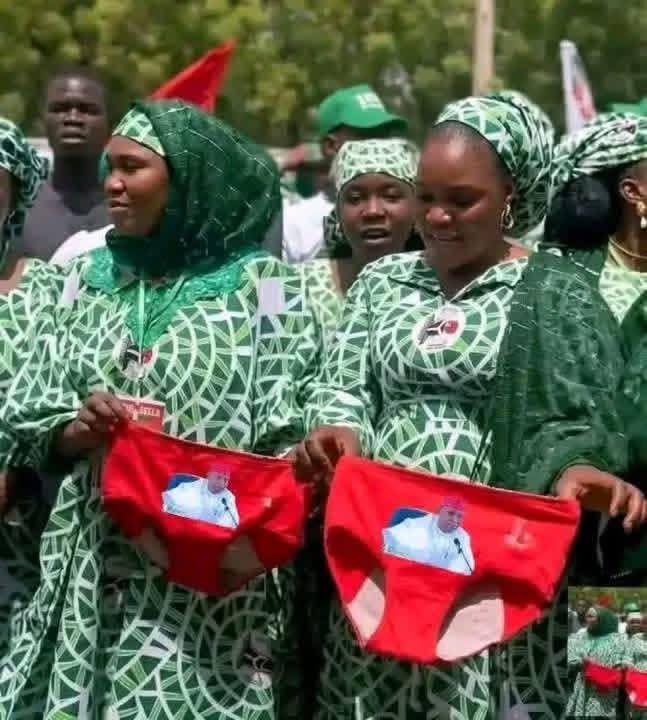
Politics often produces strange moments, but every now and then a controversy emerges that says more about a society than it first appears. The recent uproar in Kano over viral images of women displaying red underwear allegedly linked to supporters of the state government is one such moment. What began as social media comedy quickly evolved into a serious conversation about political culture, digital misinformation, public dignity and the growing danger of supporter excesses in Nigeria’s democracy.

At the centre of the controversy are competing narratives. One version claims the act was staged by enthusiastic supporters seeking to mock the red symbolism associated with Senator Rabiu Musa Kwankwaso and the Kwankwasiyya movement. Another insists no government official procured or distributed such items, and that the women involved purchased them independently as a form of protest. A third line of argument points to manipulated or AI-generated images, especially those showing Governor Abba Kabir Yusuf’s photograph printed on the underwear.

Whichever version one believes, the broader lesson lies elsewhere. In the age of instant virality, perception often outruns fact. Once provocative visuals hit the internet, they begin to live independent lives. By the time clarifications arrive, opinions are already formed, jokes already shared, and reputations already bruised. That is the brutal logic of modern information warfare.

This is why the Kano episode should not be dismissed as mere comedy. It highlights how politics in Nigeria is increasingly shifting from policy contests to symbolic warfare. Rather than debates over education, healthcare, water supply, youth unemployment or urban planning, public attention is hijacked by spectacles designed to humiliate opponents and energise online loyalists. The result is a shrinking space for serious governance discourse.

Kano is especially vulnerable to this kind of politics because of its unique political history. The state is one of Nigeria’s most politically conscious arenas, where colours, slogans, movements and personalities carry deep emotional weight. The red cap is not merely fashion; it represents a political identity. Any attempt to ridicule that identity will naturally provoke backlash. Supporters may consider such mockery clever mobilisation, but politics rooted in humiliation often boomerangs.

There is also an uncomfortable gender dimension to the saga. Across Nigeria, women are too often reduced to props in political performances—assembled for rallies, tokenised for optics, or used to dramatise partisan messages. Whether voluntary or orchestrated, any political theatre that places women at the centre of ridicule or sensationalism raises ethical questions. Political communication should elevate citizens, not use them as instruments of mockery.

For the Kano State Government, the greater challenge may not be the incident itself but how it is managed. Governments today do not only govern roads and budgets; they govern narratives. Silence can sometimes be wise, but in a digital environment, prolonged silence can also create a vacuum into which falsehood rushes. A vacuum of credible information often becomes fertile ground for stereotypes.

That is why communication experts increasingly advise a strategy of rapid clarification and narrative replacement. Rather than angrily chasing every rumour, a government can calmly provide facts, support independent fact-checking, and then redirect public attention to measurable achievements. If the public conversation is trapped on underwear for days, then governance has already lost valuable oxygen.

There is wisdom in the suggestion that the state should flood the public space with verifiable stories of schools rehabilitated, hospitals improved, roads completed, youth programmes launched, and social interventions delivered. This is not propaganda when the facts are genuine. It is simply the discipline of agenda-setting: ensuring governance performance is louder than viral nonsense.

Equally important is internal message control among supporters. Many governments underestimate the damage their unofficial defenders can cause. Overzealous loyalists often believe they are helping, while in reality, they create liabilities. Mockery, coded insults and reckless satire may thrill partisan circles, but they alienate undecided citizens and embarrass the leaders they claim to defend.

This is not a Kano problem alone. Across Nigeria, politicians increasingly face a paradox: their strongest online supporters can also become their biggest reputational risk. In a hyperconnected society, one foolish stunt can overshadow months of policy work. That reality demands more disciplined political engagement from parties and movements nationwide.

The final lesson is simple. Leadership should be measured by competence, compassion and delivery—not by who wins the latest viral skirmish. Kano deserves national attention for industrial revival, educational progress, urban reform and social development, not for underwear controversies. If this episode prompts a rethink of political conduct, media literacy and supporter behaviour, then an embarrassing moment may yet produce a useful correction.

Democracy is serious business. When politics becomes a permanent performance, everyone eventually loses.

Abdulhamid Abdullahi Aliyu is a journalist and syndicate writer based in Abuja.

Two NNPP lawmakers defect to APC over internal party crisis

By Uzair Adam 

Two federal legislators from Kano State have left the New Nigeria People’s Party (NNPP) and joined the ruling All Progressives Congress (APC), citing unresolved internal issues within their former party.

The defection of Kabiru Alhassan Rurum, representing Rano/Bunkure/Kibiya, and Abdullahi Sani Rogo of Karaye/Rogo federal constituency, was formally announced by the Speaker of the House of Representatives, Tajudeen Abbas, during Thursday’s plenary.

Their move adds to the recent wave of defections to the APC, with Oluwole Oke, a lawmaker from Osun State, also officially joining the party during the same session.

The sitting was attended by APC National Chairman Abdullahi Ganduje and other top party members, who were in the green chamber to receive the new members.

The House has recently witnessed a series of defections, many of which have strengthened the numerical advantage of the APC.

Kwankwaso’s move to APC: a Trojan horse that could destroy Tinubu’s 2027 dreams

By Abdurrahman Musa

As political fireworks ignite across Nigeria ahead of the 2027 general elections, one looming move threatens to shake the very foundations of the ruling All Progressives Congress (APC): the speculated defection of Senator Rabiu Musa Kwankwaso—former Kano State Governor and NNPP national leader.

To some within the APC ranks, welcoming Kwankwaso appears to be a masterstroke, but others are warning because, his entry could ignite a political inferno that burns the APC’s fragile peace in Kano, upends Tinubu’s re-election ambitions, and hands the opposition [which he might later join] a golden ticket to power.

Here is why:

Kano could explode as a factional earthquake looms

It is a known fact that Kwankwaso is no ordinary politician. He is a master strategist who always thinks for himself and what would favour him. Therefore, for him to join the APC, people should know that he will not just come with followers—he commands a powerful political cult – the fiery Kwankwasiyya movement that stands in direct confrontation with the Ganduje-led APC structure in Kano. Welcoming him is like inviting a hurricane into a house of cards. The party risks a full-blown internal war, splintering into rival factions, parallel commands, and electoral sabotage that could spell doom in 2027. APC’s strength in the North’s largest voting bloc may shatter into chaos.

Collapsing NNPP could be the PDP’s resurrection.

They said politics is a game of chess. When you think in a rush and make a wrong move, you woefully lose the game. Here’s the twist: dissolving the NNPP doesn’t automatically benefit the APC. In fact, it might just revive the PDP from the political coma. Kwankwaso’s defection could enrage his loyal base, pushing them straight into the waiting arms of Alhaji Atiku Abubakar and the PDP.

Mr President, do you remember 2023? The fragmented opposition in the North gifted Tinubu an edge. Destroy that balance and the pendulum swings possibly against you. Therefore, a fractured NNPP doesn’t guarantee APC victory—it may instead restore Atiku’s Northern stronghold.

A clash of presidential titans between President Tinubu vs. Senator Kwankwaso

Let us be honest—Kwankwaso isn’t joining to play a backup singer. His presidential ambition is loud, clear, and relentless. He might demand a Tinubu-Kwankwaso 2027 ticket or insist on a powerful stake in the party. If denied, he could turn against the APC from within—just like in 2019, when he was accused of deliberately undermining Atiku’s campaign in Kano while funneling resources into his gubernatorial candidate. If welcomed, Kwankwaso could shake the APC from the inside. If sidelined, he could sabotage it. History could repeat itself – this time inside the APC.

Kano youths might revolt against you

History has shown that youths are the vanguard of Kano politics. They are the ones that win you election. Currently, the streets of Kano pulse with the energy of Kwankwasiyya youth. Integrating them into the APC is not a handshake—it’s a negotiation with a volatile base. Mismanage it, and the backlash could be swift: boycotts, protests, or backing a rival candidate. The APC risks alienating the very people who once delivered it millions of votes. One misstep, the youth quake could be catastrophic.

Ganduje is the pillar—don’t shake it

In my own opinion, instead of importing instability, the APC should solidify Ganduje’s party leadership and Kano political camp. It guarantees a winning formula. Furthermore, consolidate strategic allies like Senator Barau Jibrin from Kano North and Senator Kawu Sumaila from Kano South, this offers a more convincing future and gradually win over NNPP supporters. With this, APC can present a united, formidable front—without the drama.

The ball is in your court, Mr President

Mr President, the choice is yours—so are the consequences This is no time for political gambling. The illusion of short-term gains from the Kwankwaso’s defection may cost you the presidency itself. The NNPP’s demise must not become PDP’s rebirth. The APC must learn from the PDP’s collapse—a tale of chaotic mergers and unchecked egos, in which Kwankwaso played a starring role. The hunger for Kwankwaso’s two million Kano votes is strong—but deceptive. It’s a honey trap. What looks like a prize could become a poison pill that wrecks the APC from within and opens the floodgates for a PDP resurgence.

Mr President, it’s your turn: “Emilokan“. But only if you don’t blow it. Listen to Kano. Consult the real stakeholders. Do not gamble away your second chance on a political wild card with a history of wrecking alliances from within. This is not just a political move—it’s a potential crisis in the making. Mr President don’t repeat PDP’s mistake. The voice of reason is calling. Will you listen?

Abdurrahman Musa writes from Kano. He’s a political analyst and APC stakeholder.

On the arrest of Dan Bello

By Zailani Bappa

The Sahara Reporters reports that the Kano All Progressive Congress (APC) has called for the arrest of Bello Galadanchi, popularly known as Dan Bello, “for inciting violence.” This comes after his smash video, released two days ago on his X handle.

On the special skit, he alleged an unwholesome practice by a former Commissioner for Local Government Affiars under the Governorship of Abdullahi Ganduje. He backed his claims with evidence, though.

Now, instead of going to court, the APC in the state has gone completely off balance (as the former Commissioner was its Deputy Governor-Candidate), forgot about the Nigerian Judicial System, and done the unthinkable. 

If I may ask, how can Dan Bello be arrested for this allegation, please? He does not live in Nigeria, where the APC rules; he lives and teaches English in China. Moreover, he is a United States Citizen, and the US is known to fiercely protect its citizens’ rights, lives, and property anywhere in the World.

If it is true that the APC is poised for a battle with this young man, someone should advise the Party to take it easy because this guy is equipped with everything it takes to do damage to its members and its Government, not only in Kano but beyond.

I say he is equipped because he has the required knowledge, intelligence, and journalistic acumen to dig; he has excellent film and skit facilities to make his messages appealing to anyone; and he has the protection he deserves to stay safe (especially if all his messages are true).

What is remarkable about Dan Bello so far is that, unlike most of our so-called investigative journalists in Nigeria, whose findings are often hijacked and promoted by equally corrupt politicians, he appears to be highly balanced in his presentations.

For those politicians who gloat over his recent searchlight on the Kano APC politician, they should be advised to keep off Dan Bello as their turn will surely come. 

May God protect the efforts of this young man and all his likes on social media.

A Rejoinder to Binta Spikin’s article “Protest Votes.”

By Auwal Umar

One of the most onerous tasks before anyone though seems so easy is to see things as they are. That squarely sums up the essential job of criticism with the actual sense of the term. We are all subjects therefore, we are all predisposed to certain inclinations that tempt us to be subjective. Truth, no matter how opinionated one seems to be, can be separated from falsity. Against this background, I write this to the rejoinder written by one Binta Spikin titled: “Protest Votes” as a rejoinder to my article “Protest Votes: Abban Kanawa and the Sins of the Kano APC” published on 6th March 2023 by The Daily Reality.

Having had the conviction that even the points are raised cannot be easily refuted without wreaking havoc on the feeble reputation of the Kano APC led government. I really feel sense of pity seeing how Miss Spikin tried to defend her boss at all cost. I cannot reproach her for doing her job but when that shall deter the truth to prevail.

The meaning of criticism has nothing to do with condemnation but to simply point out both the strengths and weaknesses of the situation. The writer went ahead to rate Ganduje as one of the best performing governors especially on security which I equitably agree with no question. However, many questions still left unanswered on whether he is the best in handling the affairs of the state being comfortably positioned as statistically one of the worst performing in transparency which has nothing to do with the writer’s poor attempt as you described it to predict the possible scenarios that might unfold at the gubernatorial election as you called it, you really understood my piece but you skilfully evaded going squarely to disprove the points I raised but unfortunately you keep dangling between the facts and your newly self-appointed job of being a generous spokesperson instead of addressing them directly.

For the record, in the tail end of 2013 as reported by The Vanguard,  Nigerian Union of Journalists (NUJ) decorated Governor Musa Kwankwaso of Kano State as the best Nigerian Governor in the area of Fiscal Responsibility – a concept which refers to openness, discipline and accountability in governance unlike your self rating to please the power. On the other hand, Kano state under the stewardship of His Excellency Dr Abdullahi Umar Ganduje and Malam Nasiru Gawuna have performed woefully that is substantial enough to raise questions rather than answers. This means a lot to any one that is conversant with the art of governance, because lack of transparency signifies absence of financial accountability which culminated into unspeakable corruption allegations and embezzlement of public fund.

It is quite unfortunate to hear the writer chanting a sonorous songs that the governor has done his best with regard to education and health. This kind of “best” is enough to tell you that they have nothing to offer as one cannot give what he does not have. It was the best thing Ganduje could have done to education to close down schools established by his former boss as if they were meant for the children of Kwankwaso not for Kano citizens. He did his best by not constructing new one and recruit competent and qualified teachers in primary and secondary schools across the state. He did a commendable job to the health sector by his lackadaisical attitude to let the medical doctors of Kano extraction to get employed in Katsina and Jigawa with many of them securing juicy jobs abroad while the generous governor’s last attempt was to employ them as volunteers during Covid-19 pandemic.

It is very laughably shameful to describe protest of the frustrated and stranded scholars as indoctrination unlike Rimi’s era. For your information, Dr Abdullahi Umar Ganduje was the main brain behind it, if you even assumed it were. I heard Ganduje’s voice bashing them for even complaining. Those students were rendered like beggars close to importuning for alms to sustain them. Instead for their governor to treat them as his sons, he treated them as his archenemies. When did the heated political atmosphere should transferrable to the innocent people instead of being aimed at your opposite numbers? If you blame this to be indoctrination, you boss is the first culpable. No doubt, we don’t have much problem with Kwankwaso-Rimi political tussle as long as it did not affect the citizens, it was their interest. Had the incumbent governor adopted this style of opposition as that of Shekarau and Kwankwaso, he would not have been so much greeted with blows.

On the rerun, the zig-zag style detected in your writing is very funny. First you did not talk about the perpetrators and the implications of it. But I’m glad you admittedly come to terms with how it has come so much an issue and wonder this bespeaks how deeply it itched and still irking the Kano citizens. It is in order to have a rerun but it is not in tandem with the law of the land to be robbed of your mandate before the whole world by having a recourse to the thuggish force instead of votes. Put up with me! Kanawa will definitely give the right answer on 18th March seeing how the perpetrators are fielded as candidates. How I wish you had denied it but you didn’t.

On sponsoring the Kano state indigenes to attend the Law School the excuse is so frail and obvious. You first associated the failure with the dwindling oil revenue from 2015 to date, it is okay. Even though I cannot blame you for the upward and downward nature of the oil price curve in the world. Despite the dwindling oil revenue of Kano State has the guts to abandon education, health, science and technology, and many other critical sectors in favour of the bridges and underpasses. Wow! The governor is so concerned about these humanitarian projects that he even went further to see for billions of loans to go on with the projects yet the dwindling oil revenue impede the payment of Law school fees for the poor sons and daughters of Kano. One could praise the governor’s audacity to seek for ten billion Naira loan for the installation of CCTV cameras for the security of the state but not meagre amount can be sacrificed for our law graduates. It is very difficult to be one spokesperson but I cannot blame this honourable writer for her job.

In your last point, I respectfully take the different route which maintains that Ganduje is unmatched as he instituted continuity in governance partly true but not that true. Kwankwaso’s laid foundations for many projects  that are left in deplorable condition. Many schools are still close, not to talk of improving them and establishing new ones. Northwest University renamed as Maitama Sule University left in the mercy TETFUND. The training Institutes Kwankwaso established to bridge the wide gap in the rural areas are still part of the unanswered questions.

In conclusion, with much sense of respect, I admire your effort for doing your job as SA Research and Documentation but unfortunately you here got some of your records wrong and fail to do serious research about the points I expressed in my article.

Thank you.

Auwal Umar writes from Kano and can be reached via auwaluumar9@gmail.com

Ganduje’s commissioner, Kura, resigns, defects to NNPP

By Uzair Adam Imam

The Kano State Commissioner for Finance and Economic Development, Shehu Na’Allah Kura, has resigned to join the New Nigeria People’s Party (NNPP).

A statement signed Thursday, March 19, 2022, by the state commissioner for Information, Malam Muhammadu Garba, disclosed.

The NNPP has continued to record success as other party members, particularly APC, who felt slighted, flooded to join the party (NNPP).

The statement reads, “One of the commissioners nominated for appointment by Senator Ibrahim Shekarau into the administration of Governor Abdullahi Umar Ganduje in the lucrative ministry of finance and economic development, Shehu Na’Allah Kura, has resigned and joined his boss.”

Although Kura has yet to publicly announce his defection from the APC to NNPP, he is believed to have joined his boss, Malam Ibrahim Shekarau.

Senator Ibrahim Shekarau officially joined NNPP on March 18, 2022.