Insecurity In Nigeria

Nigeria must turn to modern technology to defeat insecurity

By Aminu Babayo Shehu

Nigeria is facing one of its toughest internal security battles in decades. From the kidnapping of schoolchildren in Kebbi and Niger states to the killing of senior military officers, including a Brigadier General, criminal groups continue to operate with increasing boldness. Bandits, kidnappers and terror cells now openly upload videos on platforms like TikTok and WhatsApp, displaying weapons, hostages and propaganda with little fear of consequences.

This is no longer an era where outdated tactics can secure the nation. Criminal groups are becoming more technologically aware, while the state still relies heavily on manual intelligence and slow-response systems. Countries facing similar threats have adopted advanced tools and strategies. Nigeria must follow the same path.

The United States and Israel use drones, satellite intelligence and geolocation trackers to disrupt hostile organisations long before they strike. Rwanda has established a modern drone command system to enhance surveillance and national security. India employs mobile tracing, SIM mapping and digital pattern analysis to dismantle kidnapping networks. These examples show that even in challenging environments, technology can expose criminal movements, reduce their operational freedom and strengthen national response.

Nigeria can apply the same approach effectively.

Real-time aerial surveillance remains one of the most critical gaps in Nigeria’s security architecture. High-altitude drones equipped with night-vision cameras and thermal sensors can monitor large forest areas where bandits hide. Such drones transmit live data to command centres, enabling tracking of movements and coordination of precision strikes. In many cases, soldiers need not be deployed on foot into ambush-prone areas; operations can be guided or executed remotely.

Mobile intelligence is another powerful asset. Every phone, even when switched off, leaves digital traces. With firm collaboration between telecom operators and security agencies, criminals can be located through cell-site analysis, call patterns and movement anomalies. India has successfully used these tools to reduce large-scale kidnapping syndicates.

Satellite imaging, when paired with artificial intelligence, can detect camps, vehicles, and human movement in remote areas. Modern software can analyse thousands of images within minutes and flag suspicious activity such as heat signatures, makeshift shelters, or recently cleared land. This drastically improves early detection and reduces operational delays.

State governments can also invest in early-warning technologies. Community CCTV networks, automated alarm systems and remote-sensor alerts can shorten response times. Local initiatives that once existed in a few states need consistent funding and national integration.

At the federal level, the Presidency should coordinate a national security technology blueprint. This would bring together drones, cyber-intelligence tools, biometric systems, satellite monitoring, and geospatial-analysis platforms into a single central command. Strategic partnerships with technologically advanced nations can reduce costs and strengthen capacity.

Nigeria’s security forces have courage and dedication, but courage alone cannot defeat modern criminals who rely on speed, shock and terrain mastery. Technology is the equaliser. It exposes hideouts, cuts communication lines and allows the state to strike before criminals mobilise.

The tools exist. They are affordable. They have worked in other nations. What Nigeria needs now is clear political will, long-term investment and an understanding that 21st-century threats demand 21st-century solutions.

If embraced, technology can save lives, disrupt kidnappers and terrorists, and restore the confidence of millions of Nigerians who deserve safety.

Aminu Babayo Shehu is a Software Engineer and Mobile Developer with experience building technology-driven solutions, including systems for logistics, telecommunications, e-commerce, and security-focused applications. He writes on technology, national development and digital transformation.

Kwankwaso blames Nigeria’s insecurity on lack of political will

By Uzair Adam

Former Kano State governor and 2023 presidential candidate of the New Nigeria People’s Party (NNPP), Senator Rabiu Musa Kwankwaso, has attributed the persistent insecurity in Nigeria to what he described as a lack of political will by the President Bola Tinubu-led Federal Government.

Kwankwaso made the assertion on Tuesday while serving as the special guest of honour at the passing-out parade of 2,000 newly recruited personnel of the Kano State Neighbourhood Watch Corps.

Drawing from his experience as a former Minister of Defence, the NNPP leader said Nigerian troops have consistently demonstrated professionalism and effectiveness during international peacekeeping missions but face difficulties in tackling insecurity at home due to inadequate political backing.

According to him, the capacity of Nigeria’s security personnel is not in doubt, stressing that what is missing is firm commitment at the highest level of leadership.

He said the Commander-in-Chief must ensure adequate training, recruitment, equipment, arms and ammunition for the military and other security agencies to enable them to confront security challenges effectively.

Kwankwaso also called on the federal government to integrate trained personnel from northern states such as Kano, Katsina, Sokoto, Kebbi and Zamfara into national security operations.

He argued that Nigeria needs no fewer than one million military personnel to effectively address both internal and regional security threats.

He further noted that beyond the North-West, the country requires additional armed security forces to complement the efforts of the military and other agencies, adding that the protection of lives and property remains the primary responsibility of the federal government.

Despite his criticism, Kwankwaso expressed optimism that the Kano State Neighbourhood Watch Corps initiative would contribute significantly to restoring peace in border and vulnerable communities grappling with insecurity.

Saving Nigeria starts with honest self-reflection

By Suleiman Usman Yusuf 


Right now, I am deeply pained and genuinely confused, perhaps like many other well-meaning Nigerians who still believe this country can rise above its failures. If all I have to offer is my voice and my pen, then I will continue writing about Nigeria’s lingering security crisis until my last strength fades. Silence is no longer an option when the nation is bleeding this profusely.

This country is bruised. Every week, the news reminds us that Nigeria is fighting for its own life, not in theory but in blood and dust. Yet we move on too quickly, as if these tragedies belong to someone else.

The death of Brigadier General M. Uba should stop us in our tracks.

Not just because he was a senior officer. Not because his story is more important than the stories of countless others who fell before him. But because his final hours reveal both the extraordinary courage of the men defending this country and the painful weaknesses of the institutions meant to protect them.

Two days ago, Nigerians were told he was alive and safe. Today, the truth arrived from insurgent propaganda channels rather than from the State he served. That alone should trouble every citizen who still believes this country can be redeemed.

But beyond the misinformation, beyond the chaos of battle and the failures of communication, there was a man. A man who fought through one ambush, shielded his men, and kept talking on the radio even as danger closed in from every direction. A man who understood the terrain, the risks, and the meaning of service in a way many of us never will.

His killers did not find him by magic. They found him because insurgent groups in the North-East have evolved into highly adaptive, intelligence-driven networks. They have spotters, informants, trackers, and a familiarity with the terrain that gives them dangerous advantages. Our troops face that reality every day with limited resources and uneven institutional support. Yet they still go out, still patrol, still hold their ground.

Brigadier General Uba died in uniform, under a harsh Borno sky, in the service of a country that has not yet learned how to protect its defenders fully. His death is not just a battlefield loss. It is a national failure.

But this is where our story must change.

Nigeria cannot survive if we continue pretending that insecurity is a Northern problem, or a Christian problem, or a Muslim problem, or a regional competition in suffering. Nigeria is bleeding in too many places for that false comfort.

This is a Nigerian problem. All of us are inside this fire.

If we want to save this country, we must begin by admitting the truth.

We have an overburdened military fighting a war that politicians treat like background noise. We have intelligence agencies that do not always speak to each other. We have a society more invested in ethnic debates than national survival. We have families quietly burying soldiers while the rest of us argue online. We have institutions that hide failures rather than learn from them.

But we also have something else. We have citizens who still believe in Nigeria. We have communities ready to cooperate when trust is restored. We have young officers and men who refuse to give up on this country, even when this country sometimes gives up on them. We have people like Brigadier General Uba, whose courage reminds us of the Nigeria that is still possible.

If his death is to mean anything, it must push us toward a national rebuilding rooted in truth, accountability, and collective responsibility. It must force us to demand better communication protocols, better extraction procedures, better intelligence coordination, and better welfare for every man and woman who carries a rifle for this country.

Saving Nigeria is not a slogan. It is a long, disciplined, painful process that requires leadership, honesty, citizen cooperation, and institutional courage.

Brigadier General Uba has paid his share in full. The account is now with us.

Suleiman Usman Yusuf, a Governance, Security, and Development Consultant, AI Policy and Governance Advocate, and a Shaper of Africa’s Tech Future, wrote via suleimanusmanbac@gmail.com.

Bandits and Betrayal: Why negotiation is not the answer

By Muhammad Isyaku Malumfashi

There are people within this government who support negotiations with bandits, and this piece aims to address them. I wrote against former Governor Masari’s governance when he had negotiated with bandits in an article published by The Daily Reality newspaper, titled “How Governor Masari is Wrongly Governing Katsina State.” I’m doing the same to refute any move to negotiate with bandits at the expense of the government’s power.

Meanwhile, apart from the government’s “data boys,” the problem we now have is the “negotiation lawyers” who protect the government from criticism of negotiating with terrorists. As I have been saying, it is a failure of the government to negotiate with terrorists.

Not only I, but many security experts have opined that negotiating with bandits is futile. In fact, the governor himselfDr Dikko Umaru Radda, admitted during a call-in interview with Channels Television that he wouldn’t negotiate with bandits at their weakest point. We all applauded, as they have no justifiable reason for their actions and hence no grievances to present to the government for it to listen to. They should either surrender and cease fire, or the government should use force to wipe them out.

We’ve seen many such negotiations with bandits in both the previous administration and the present that have not borne fruit. Perhaps the Fulani terrorists breached the truce by breaking the agreement, thereby continuing to commit crimes against innocent citizens. 

The biggest problem is that they will come into town with weapons, as we’ve seen in the Kankara Local Government area, until people become accustomed to seeing them. Then, some will start to befriend them, so they, too, can get the opportunity to handle weapons. Thus, the country might become like Libya – God forbid – where arms became available to citizens as a result of government carelessness in the name of self-defence, and subsequently turns into a lawless state.

Because in Libya today, one with more sophisticated arms is the most feared and powerful being, just like a government. They can do and undo as they want. Nigeria, particularly Arewa, might face a similar fate, but I believe God will embarrass them. The worst thing about this negotiation is that even if there is negotiation, these Fulani bandits won’t take up any job that will earn them money. Instead, they’ll move to another town where there’s no security problem and continue their terrorist activities. If there’s another negotiation, they’ll move forward.

They wanted to pursue an agenda of conquest with great force, as in the 1804 Jihad. I know historians among us will relate better, though I’m not one; I’m a history enthusiast and studied it in secondary school. Thus, we’re not ignorant of the past. If we don’t forget, those Fulani bandits camped at the Kankara forest under the notorious bandit leader Babaru, aka, had to negotiate with the people of Yar Goje town, before they could target some villages.

Then, they got the opportunity to attack the Mantau village in Malumfashi, where they killed many worshippers during dawn prayers in the mosque and thereafter kidnapped many residents and took them to their camps. Although they later released them, the government claimed the release was due to a firefight with troops, but Zuma Times reported the opposite. We believe the latter, as the government didn’t present any evidence of casualties.

The Mantau village has been a headache for the bandits for years. They’re well-prepared and gallant, and on many occasions, they’ve hidden at routes where bandits pass by to attack and kill them. The village was a no-nonsense and fearful place for bandits. Even the day they attacked them, it was a raid, not face-to-face, which shows an act of cowardice. Therefore, the Fulani won’t stop terrorising; they’ll move forward until they’ve conquered the Hausa land entirely, as captured and masterminded by their ancestors for centuries.

Negotiation with bandits, even though it has never happened at the state level but at the local governments’ level, as seen in Jibia, Batsari, Kurfi, Kankara, and others, makes us suspect that even those that happened at the local governments’ level were with the governor’s consent. He doesn’t want to admit his failure or is afraid of reversing his stance on non-negotiation with bandits.

The idea is totally archaic and reckless because not everybody will sit down and watch people who killed their loved ones or bankrupted them through ransom payments be forgiven and allowed to roam freely, while the people they killed are no more. The properties destroyed or collected for ransom are not compensated.

Even the government’s careless move to empower repented bandits is not welcoming because they have enough money collected from ransom payments. Why should the government empower them with our money? I think the best approach is to empower the victims, not the repentant bandits. The government should also reintensify its security approach, especially given the recent surge in banditry attacks in eastern and southern Malumfashi over the past two days. May Allah restore absolute peace and stability in our towns, states, and the country at large.

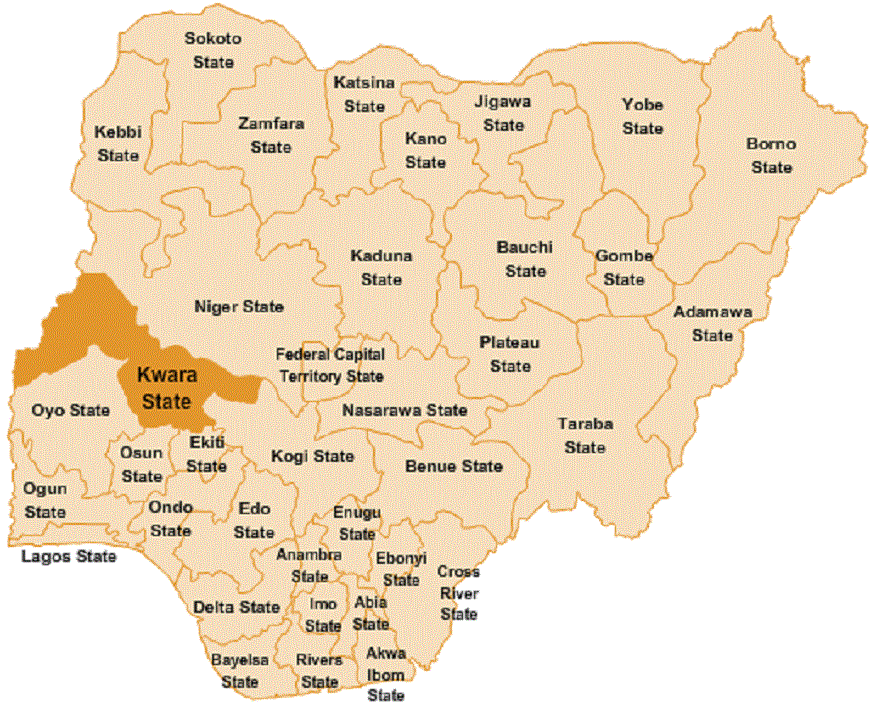
Kwara’s false sense of security: How complacency risks a regional catastrophe

By Iranloye Sofiu Taiye

The crackle of gunfire shattered the night’s calm in Patigi Local Government Area last August. For hours, residents hid in terror as militants believed to be linked to the Mahmuda terrorist faction ransacked homes and farms, leaving behind a trail of displacement and despair. This wasn’t in conflict-ridden Zamfara or Borno. This was Kwara State, Nigeria’s so-called “State of Harmony”, now facing the brutal reality of spillover violence from neighbouring conflicts.

For years, Kwara has been regarded as an oasis of peace. While northern states battled insurgencies and northwestern states negotiated with bandits, Kwara’s security strategy primarily relied on these measures. This complacency is now our greatest vulnerability. As armed groups face increasing pressure in Nigeria’s northwest and the Sahel, they are seeking new territories and routes, and Kwara’s under-protected border communities present the perfect opportunity.

The data reveals an alarming trend: while Kwara recorded 70 violent incidents in 2024, representing a sharp increase from previous years, with ACLED data showing 21 fatalities signalling emerging threats. Meanwhile, neighbouring Niger State suffered 179 incidents with 514 deaths, over 2.5 times Kwara’s rate. This disparity highlights both Kwara’s relative peace and its growing exposure. Nigeria’s overall security situation has deteriorated dramatically, with the country dropping to 148th on the 2025 Global Peace Index and suffering over 2,266 deaths from banditry and insurgency in just the first half of 2025, exceeding the entire 2024 total.

The False Comfort of “Relative Peace”

Kwara’s peaceful reputation has created a dangerous paradox: the state appears secure compared to Nigeria’s raging conflicts, yet this very perception has led to critical underinvestment in security preparedness. With a meagre ₦350 million (approximately $230,000) security vote in its 2025 budget, Kwara has insufficient resources for basic border surveillance, let alone comprehensive counterinsurgency measures. This budgetary neglect reflects a fundamental misreading of the evolving threat landscape.

The nature of modern conflict doesn’t respect artificial boundaries. Militant groups operate across porous borders, exploiting governance vacuums and ethnic kinship. The emergence of groups like Mahmuda around the Kainji Lake area demonstrates how terrorist organisations establish footholds in perceived “safe havens” before expanding their operations. As security reports have noted, there have been at least 13 ISIS-Sahel-linked attacks in central Nigeria in 2025 alone, indicating a strategic southward expansion.

The situation mirrors concerning patterns elsewhere in West Africa, where jihadist insurgency has spread from the Sahel toward coastal states. The southward spillover alarmingly threatens countries like Benin, Togo, Ghana, and Côte d’Ivoire, which until recently had been mostly spared jihadist violence. Kwara now faces precisely this dynamic, compounded by the added vulnerability of having dismissed the threat until it arrived at its doorstep.

Recommendation: A Community-Based Solution

Some advocate for a traditional security response: deploying additional military forces along border areas, establishing checkpoints, and implementing drone surveillance. While these measures have short-term deterrent effects, they come with significant tradeoffs: escalating tensions with communities, straining federal-state relations, and diverting scarce resources from development needs.

A more effective approach combines strategic security presence with community empowerment. I recommend that Kwara State immediately establish a Community-Led Early Warning and Resilience Program (CLEWRP) to train and equip more than 5,000 local volunteers in conflict mediation, digital reporting, and response coordination. This approach recognises that security is not merely about repelling attacks but about building resilient communities capable of preventing, withstanding, and recovering from violence.

The evidence supporting community-based security is compelling. When local populations are empowered as first responders, they provide hyperlocal intelligence that external forces cannot access. They understand the terrain, recognise outsiders, and can distinguish between legitimate herders and criminal elements. As the tragic incidents in Kwara’s south communities have shown, top-down security responses often arrive too late after attacks have occurred and perpetrators have vanished into the forest corridors connecting Kwara, Niger, and Kogi states.

The proposed CLEWRP program would unfold in three phases: planning and stakeholder consultations across Kwara’s 16 LGAs; pilot implementation in high-risk areas; and statewide scaling, with continuous evaluation. The Kwara State Ministry of Homeland Security and Vigilante Affairs would lead implementation, partnering with the National Emergency Management Agency for federal coordination, local governments for ground implementation, and international organisations for training expertise.

Financing the $3-5 million USD program would require a blended approach: 60% from the state budget and 40% from federal security grants and humanitarian NGO partnerships.

A National Security Imperative

Kwara’s security crisis represents a microcosm of Nigeria’s broader challenges. The federal government’s 2025 budget allocated ₦4.91 trillion to defence and security, about 8.9% of total expenditure, recognising that without security, economic development is impossible.

The national security strategy must therefore prioritise preventing the southward spread of violence in states such as Kwara. This requires both regional cooperation and smarter resource allocation. The Accra Initiative, which promotes intelligence-sharing among coastal West African states, offers a promising model that should be expanded to include central Nigerian states facing spillover threats.

Furthermore, security funding should incentivise preventive approaches rather than merely funding reactive measures. The federal government could establish a matching-grant program for states that develop community-based security initiatives, thereby encouraging locally adapted solutions rather than one-size-fits-all approaches.

The Time for Action Is Now

Kwara stands at a precipice. The state can continue its complacent approach, hoping that violence will spare its territories, or it can acknowledge the changing threat environment and build resilient systems before the crisis becomes a catastrophe. The choice is stark: invest modestly in prevention now, or pay enormously for response later.

The CLEWRP program offers a practical, cost-effective solution that aligns with Kwara’s cultural traditions of community cooperation while incorporating modern technology and coordination methods. It acknowledges that security is not solely the government’s responsibility but a shared undertaking between authorities and citizens.

History shows that complacency amid spreading instability is a recipe for disaster. West Africa’s security landscape has deteriorated dramatically in recent years, with jihadist groups expanding their operations. Kwara cannot assume it will remain immune.

The phrase “State of Harmony” should not be a relic of Kwara’s past but a promise for its future. Preserving this harmony requires honest acknowledgement of emerging threats, courageous investment in preventive measures, and collaborative implementation across government and communities. The time for action is now, before the next attack becomes a full-blown crisis.

Iranloye Sofiu Taiye is a Policy Analyst specialising in Peace Building and Conflict Resolution, Digital Governance, and Service Delivery, and can be contacted via iranloye100@gmail.com.
The dilemma of negotiating with bandits: A path built on ashes?

By Aliyu Ya’u

His Excellency, Dikko Umar Radda’s position on rural banditry has provoked considerable reactions, with some questioning his resolve to confront bandits rather than seek a peace agreement.

Given that he lacks control over the paramilitary and armed forces present in the state, it is fair to say that he has taken commendable steps by establishing the state’s community policing group and encouraging the civilian population to engage in self-defence. 

I fully empathise with his frustration, especially in light of the constant criticisms and pleas from victims suffering due to the terror of rural banditry. Understandably, his excellency may feel disheartened and powerless to prevent these criminals from continuing their activities. 

Further, everyone, especially the civilian population, would welcome a peace accord in a real conflict situation. In such situations, all parties’ demands are tabled and deliberated, and sustainable solutions are found and implemented. 

However, in the case of an unorganised and unregulated group like rural bandits of the North-western and North-central Nigeria, who wreak havoc daily without reasonable justification. 

The question lies not in the society respecting the peace accord, but in the modalities employed to guide the peace settlement. Another question is whether the peace accord is sustainable, using historical parameters to assess the credibility and reliability of the commitment of the violent party involved. 

Any peace accord between a government, society, and an armed group should be based on disarmament, demobilisation, and reintegration (DDR). 

According to the United Nations Peacekeeping operation unit, DDR is “a process of removing weapons from the hands of members of armed groups, taking these combatants out of their groups and helping them to reintegrate as civilians into society.”

The question is whether the militias or bandits are ready to surrender all their weapons, demobilise from their dens, and reintegrate into the larger society. Unless the government can confirm these terms with the bandits’ leaders, mediators, and sureties, it will not be obligated to build a wall of ash blocks. 

Other questions include, How strong and convincing are the commitments laid down or presented by the militias? How committed is the leadership to the pact? What are the demands? How cogent and soluble are they? Do they have a unified command structure? Is the command structure capable of issuing an effective directive that will be respected by various dens and groups committing heinous bandit crimes? 

These armed groups are often small; in most cases, a group comprises 10 or fewer bandits who act autonomously, unless they need to cooperate against a sedentary enemy community. The absence of a centralised governing body makes it difficult to build an effective peace agreement with the groups. How could a peace accord with hundreds of bandit groups roaming the regions’ thick and interconnected forests that span hundreds of kilometres and access many states be possible? 

Another aspect deserving the government’s focus is the scope of Katsina state’s peace accord. What areas will it encompass? Will the armed bandits responsible for heinous crimes in Katsina state prevent others from neighbouring states from crossing into the area to commit banditry? It’s crucial to recognise that we are not dealing with an insurgent group, a separatist movement, or an ideological terror organisation; rather, the state is confronting multiple disorganised criminal entities. 

The focus should be on the following: The state’s primary concern is achieving lasting peace, not a temporary ceasefire. The bandits should establish a reliable leadership structure that is known and accessible, and willing to take full responsibility if they breach the agreement. They should clearly specify what sets their current commitments apart from those made with previous governments. Additionally, they should submit their complaints for the state’s review and assessment. The sureties must first confiscate or disarm the bandits before any peace accord is signed.

Aliyu Yau holds an M.Sc. in Defence and Strategic Studies and is a public policy and conflict analyst based in Kaduna.

Trump’s threat and the wave of abductions in Nigeria

By Zayyad I. Muhammad

On Saturday, November 1, 2025, U.S. President Donald J. Trump made his famous “guns-a-blazing” remark and described Nigeria as “the now disgraced country.”

On Sunday, November 2, he repeated that the United States could deploy troops to Nigeria or launch airstrikes to stop alleged killings.

In what appears to be a reaction to Trump’s comments, terrorists and bandits in Nigeria have intensified attacks, especially the mass abduction of pupils, students, and worshippers.

On November 17, bandits abducted 25 female students from Government Girls’ Comprehensive Secondary School, Maga, Kebbi State.

On November 18, daredevil gunmen attacked Christ Apostolic Church, Oke-Isegba, Eruku, kidnapping 38 worshippers during an evening service.

On Friday, November 21, gunmen raided St. Mary’s School in the Papiri community of Niger State’s Agwara District, abducting 215 pupils and 12 teachers.

That same day, after Trump appeared on Fox News and declared, “I think Nigeria is a disgrace,” reports emerged that ISWAP fighters had abducted 13 teenage girls working on farmlands in Askira-Uba, Borno State.

Armed groups across Nigeria have long understood the symbolic power of their targets. But the timing and composition of these attacks suggest deeper motives:

Three separate days. Four mass kidnappings. Hundreds of victims. Mostly female victims. This is not a coincidence. This is a strategy.

Observers cite four major reasons:

1.  To escalate the situation and attract international attention. Nothing provokes global outrage like the mass abduction of schoolgirls or worshippers. Terrorists crave visibility, especially when a powerful international figure has threatened intervention.

2.  To instil fear and embarrass the government , psychological warfare, so to speak. Targeting female students and worshippers strikes directly at the heart of communities. Schools and places of worship are supposed to be sanctuaries; when they are violated, society trembles.

3.  To use abducted victims, especially girls, as human shields. If the U.S. were ever to conduct air strikes, the bandits and terrorists understand the protective value of having dozens of young female hostages in their custody.

4.  Ransom opportunities: To exploit heightened international interest as leverage for ransom or negotiation. Heightened American interest increases the “value” of hostages. Criminal groups see an opportunity to negotiate for large payouts.

President Trump’s threats have become a local weapon for the terrorists. To be fair to President Trump, he may not intend it, but his sensational remarks have become ammunition in the arsenal of Nigeria’s armed groups. They interpret his words as an opportunity or a provocation and recalibrate their tactics accordingly.

Also, to be fair to President Asiwaju Bola Ahmed Tinubu, he or his government cannot control the statements made by foreign leaders. Still, they can control how prepared the country is for the consequences. This moment demands urgency. The Nigerian delegation to the US, led by Mallam Nuhu Ribadu, is engaged in sterling diplomatic work. Thus, apart from local efforts, this visit indicates to the Nigerian leadership that a well-planned diplomatic strategy can prevent reckless foreign commentary from escalating domestic crises.

Local and international efforts must work together!

Zayyad I. Muhammad writes from Abuja via zaymohd@yahoo.com.

A letter to Nicki Minaj

Dear Nicki Minaj,

As the latest spokesperson in America speaking on Nigeria, I must clarify that the script provided to you by internal actors back home in Nigeria and their collaborators in the United States is biased and one-sided. You might not fully understand the complexities of insecurity in my country, and you have been fed false lies about fictitious claims of ongoing Christian genocidal attacks.

Here is the reality:

1. In North West Nigeria, banditry devastates the region, with Muslims frequently killing fellow Muslims.

2. In North East Nigeria, Boko Haram and ISWAP, both Muslim terrorist groups, mainly kill fellow Muslims in Borno and Yobe.

3. In North Central Nigeria—Plateau, Southern Kaduna, Taraba, Benue—farmer-herder conflicts, caused by land disputes, are often wrongly seen as religious wars. These conflicts affect both Christians (farmers) and Muslims (Hausa-Fulani herders).

4. In South East Nigeria—Anambra, Enugu, Ebonyi, Abia—IPOB terrorists, who are Igbo Christians, are killing fellow Igbo Christians in their bid for secession.

Dear Nicki, insecurity in Nigeria impacts Muslims, Christians, traditionalists, and atheists equally. The narrative you received is incomplete and misleading.

Nicki Minaj, the Muslims being killed in Nigeria, and other heinous crimes being perpetrated against them do not get to the headlines of international media for you and others to see and understand. The Muslims back home in my country bury their loved ones killed in silence, for they do not believe in using dead bodies for propaganda or to attract sympathy or donations from international organisations.

If you care about speaking for Nigerian Christians, I urge you also to speak for Black Americans facing police brutality. Just as you highlighted Nigeria’s challenges, you can bring the reality of racial injustice in the US to global attention.

Just like you are calling for global international attention on what has been tagged as ongoing Christians’ genocidal attacks in Nigeria, kindly also call global attention to the silent, ongoing police brutality against your fellow Black Americans and the racial discrimination they are facing.

If Nigerian Christians’ lives matter to you, then let the lives of your fellow Black Americans matter as well.

Thanks.

Mustapha Gembu is a Nigerian citizen and a proud advocate for peace, unity, and harmonious coexistence among my fellow Nigerians.

How careless news and posts shaped the fate of Brig. Gen. Uba

By Lawan Bukar Maigana 

The growing hunger among media organisations and young people to publish exclusive news has created a climate where speed is valued more than truth and its consequences. Many rush to break stories without verifying details, flooding the digital space with noise and carelessness.

This reckless chase is more dangerous than it appears. Insurgents and criminal groups quietly monitor social media ecosystems. They sit behind screens, study posts, and gather intelligence that was never meant for them. A single careless update becomes an open door for those who wish to harm the nation.

The tragedy of Brigadier General Mohammed Uba stands as a painful reminder of how information can be weaponised. His initial capture, his escape, and the later recapture that ended with his execution reveal how ruthless these criminal networks have become. While many sympathised with his ordeal, few understood how online chatter influenced the events.

These groups constantly scan conversations, comments, and reactions. They interpret patterns and extract clues from citizens who treat every issue as content. The story of General Uba should teach the country a life-saving lesson. Silence is sometimes safer than speed. Enemies are listening and active online, and every careless post strengthens their hand.

They learned from social media chatter that he was still in the bush after escaping. Thoughtless updates provided them with clues. They mobilised fighters, tracked him again, recaptured him, and executed him. This is the heavy cost of posting without restraint.

Security matters require silence more than spectacle. Media organisations must recognise that operational secrecy protects lives. Sensational updates during crises do not inform, but they endanger. The right to know cannot outweigh the need to safeguard ongoing operations. 

This protection is not just for soldiers but also for citizens. Insurgents study community movements, market patterns, celebrations, and tragedies. Careless information helps them identify the weakest points. 

If anyone must share information during sensitive times, the only safe place to do so is with the authorities. Security spokespeople exist to process information responsibly. They verify claims, filter sensitive information, and ensure that outsiders cannot track anything that could compromise national security.

Despite these realities, many still chase virality with reckless boldness. A recent incident exposed this trend when a fabricated story circulated about a young lady in  Gubio Local Government Area of Borno State, who allegedly took her life because she was forced into marriage. Influencers shared it widely without verifying a single detail from her family or the authorities.

The emotional weight of the story carried it across timelines. People blamed parents, culture, and religion. The story was false, yet the damage was already done. The truth moved more slowly than the lie. Later, those who invented the news were arrested, and they confessed that they had shared the information without any verification after a whole LGA had been demonised.

This incident reflects a troubling social habit. People now prefer drama to accuracy. They prefer emotional reactions to factual clarity. They prefer virality to responsibility, at the expense of people’s lives, especially among northern netizens. 

This culture feeds insecurity and weakens the nation’s sense of truth. When false alarms dominate the digital space, real warnings become harder to identify. When emotion overshadows fact, society becomes vulnerable.

Young people must understand that social media is no longer a playground; it is a battlefield for attention and a monitoring ground for criminals, organisations, and individuals with exclusive access who read everything posted online.

Editors and influencers must rise above the chaos and set a standard. They must insist on verification before publication and accuracy before speed. Their platforms should become places where truth is valued and rumours are filtered out. If they uphold responsible reporting, their followers will learn to do the same.

They must also use their influence to educate the public. People should understand that clicks are not worth the life of a soldier or a citizen, and shares are not worth the shame of an innocent family. Only through responsible reporting can society rebuild trust, strengthen security, and protect the dignity of those whose stories are too important to be mistreated or used to strengthen news agencies’ visibility.

Lawan Bukar Maigana wrote via lawanbukarmaigana@gmail.com.

Nigeria’s border checkpoints plagued by extortion, not security — Witness

By Muhammad Sulaiman

Security experts have long warned that Nigeria’s porous borders are a major threat to national stability. This concern was echoed again when Dr Bulama Bukarti, a security researcher, lamented how almost anything can be smuggled into the country due to ineffective border control.

In reaction to Bukarti’s remarks, Dr Aliyu Yakubu Yusuf of Bayero University, Kano, shared a firsthand account that underscores the depth of the problem.

Dr Yusuf narrated that on a trip from Damagaran in the Niger Republic to Kano earlier this week, he sat in the front seat of a commercial bus and witnessed what he described as “a chain of extortion masquerading as security.”

According to him, as the bus approached the Babban Mutum border on the way to Ɓaɓura, he observed “so many annoying checkpoints,” sometimes only a few meters apart. Police officers, soldiers, immigration officials, road safety personnel, and customs operatives were all stationed along the route. Yet, none conducted any meaningful inspection.

“Each time we reached a checkpoint, the driver would simply pull out a one-thousand-naira note and hand it to an officer, then we would move on,” he said. Some officers even addressed the driver by name, apparently familiar with him as a regular traveller.

Dr Yusuf said the driver disclosed that there are 35 checkpoints between Damagaran and Kano, and at each one, he must part with between ₦500 and ₦2000, depending on the officials present. He estimated that drivers spend at least ₦30,000 during a single trip.

“Throughout the four-hour journey, not a single officer asked the driver to open his boot,” he added, expressing disbelief that such laxity exists despite Nigeria’s ongoing fight against insecurity.

His account reinforces concerns that many checkpoints serve as avenues for bribe collection rather than effective security screening—leaving the country vulnerable while motorists bear the financial burden.

“We are jokers, wallahi,” Dr. Yusuf concluded.