In case you’re too lazy to read the book, it is all about the time when Islam was the dominant ruling religion in the Indian subcontinent from the sociopolitical, economic and military perspectives.
This is a very interesting book that, according to the author, challenges some preconceived narratives and stereotypes on the complex interactions between India and the Persian-speaking world during the medieval period.
The book takes a long view of the political dynamics of the Persianate age, discussing the emergence of the Mughal empire, its spread and culmination, and its interplay with other contemporary gunpowder empires: the Ottoman and the Safavid.
Naturally, any discussion on the emergence of the Mughal Empire must include a historical look at Timur, a controversial figure whom I believe many Western authors, unfairly criticize. Of course, there was an entire chapter dedicated to Abu al-Muzaffar Muhi-ad-Din Muhammad Bahadur Alamgir Aurangzeb Badshah al-Ghazi, under whose 49-year reign the Mughal empire reached its peak in terms of glory and geographical extent.
The author builds the bulk of his arguments upon a very deep historical background, and he closely examines the role of Persianate age in shaping religious and intellectual developments in India.
He also discusses the impact of Sufism on Indian society and explores how Persian texts played a crucial role in the spread of Islamic mysticism across the subcontinent. This way, the book provides insights into the assimilation of Persianate cultural practices into Indian religious traditions, such as the development of Persian-influenced styles of devotional poetry in languages like Urdu.
The author, Richard Eaton is an American historian at the University of Arizona.
Years ago, when visiting a prominent Hindu temple in Himachal Pradesh, India, an Indian coursemate became excited at the sight of a white man worshipping there. I asked why. She told me it was pretty reassuring to see someone you didn’t expect to share your belief practising it.
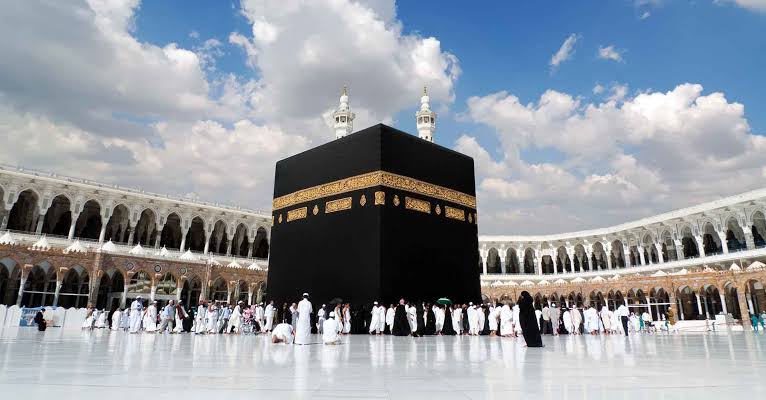
As I walk through sites in Madina, including the Prophet’s mosque, I see the faces of people from far and near, dressed differently and speaking various languages. People from all nooks and crannies of the world visit this holy city. I couldn’t help but recall and, somehow, share my friend’s feelings.
Without a doubt, Islam and Christianity, unlike and above many other religions, have universal appeal. I have also been to several parts of the world. However, seeing a sea of people of different skin colours, heights, and sizes worshipping in unison is stunning and soothing.
There is inflation globally, and poverty is also on the increase. Still, people troop to Mecca and Madina to perform Umrah, the lesser Hajj, as if it were free. For many Muslims, especially those who have never come here before, nothing is expensive.
Although the feeling is indescribable, I can mention just one: visualizing what you have (very likely) heard about all your life about Prophet Muhammad (SAW) and his companions feels distinct and unique. It’s so serene and serendipitous – ma sha Allah.
May Allah accept our prayers and rescue our country, continent, and all that is beyond.
Dr. Muhsin Ibrahim, who is a Nigerian working in Germany, is currently on lesser hajj in Saudi Arabia.
An Islamic human rights organisation, the Muslim Rights Concern (MURIC), has warned those calling for the arrest of Dr Zakir Naik to mind their business. The organisation insists that the Islamic preacher is exercising his Allah-given fundamental human right of freedom of movement under international law. MURIC further warned that anybody found embarrassing to the Sultan’s guest would face the wrath of Nigerian Muslims.
The warning was handed down on Sunday, 5th November 2023, by the Executive Director of MURIC, Professor Ishaq Akintola.
The full statement reads:
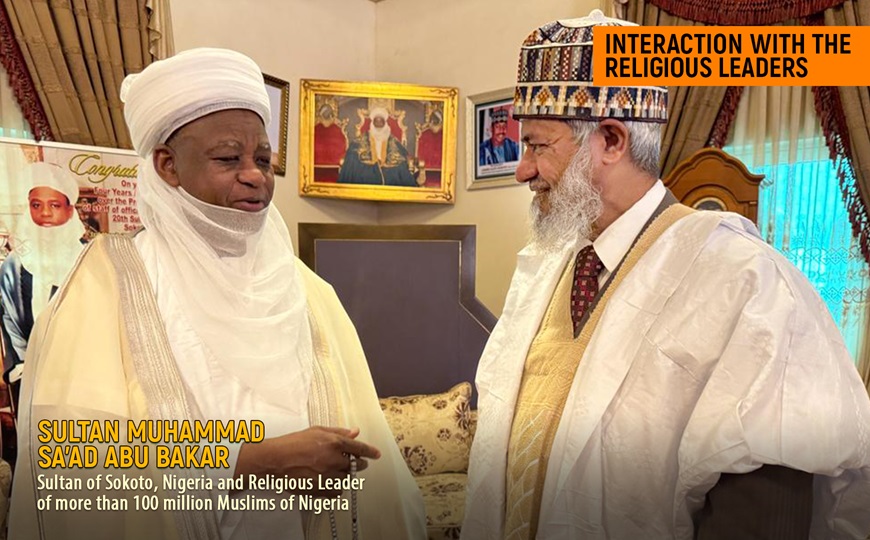
“A campaign of calumny and religious hatred has been unleashed on an international Islamic figure, Dr Zakir Naik, who is currently in Nigeria. Dr Zakir Naik is in the country on the invitation of the Sultan of Sokoto and President General of the Nigerian Supreme Council for Islamic Affairs (NSCIA), Alhaji Muhammad Sa’ad Abubakar.
“The campaign is being sponsored by Christians who are jittery. They are aware of the visitor’s oratory, intellectual prowess and amazing ability to convince his audience with indubitable facts. We remind these overzealous interlopers that Dr Zakir Naik is exercising his Allah-given fundamental human right of freedom of movement.
“Article 13 of the Universal Declaration of Human Rights of the United Nations guarantees the right to freedom of movement around the globe without interference. It says, ‘Everyone has the right to freedom of movement and residence within the borders of each state. Everyone has the right to leave any country, including his own, and to return to his country.
“Those behind this shameful exercise are meddlesome interlopers and Muslim haters disguising themselves as public commentators. They are motivated by hate, ignorance and gymnastic religiosity.
“For the avoidance of doubt, we warn that anybody found embarrassing an official guest of His Eminence the Sultan and head of more than 150 million Nigerian Muslims will face the wrath of Muslims in this country.
“Why are our Christian neighbours so intolerant? How many times have Muslims raised objections when Christians invite foreign preachers? Several Christian preachers have toured this country without any Muslim protesting.
“We recall the way Louis Farrakhan, the black American Muslim leader, was disallowed from giving a lecture in Nigeria in 1986. That ugly and disgraceful incident was engineered by the same set of people. It must not happen again.
“To those who are pursuing this ignoble goal, we say, ‘Take notice that Dr Zakir Naik is not Louis Farrakhan and Nigeria of 1986 is different from Nigeria in 2023. Nigerian Muslims of today, under a dynamic and visionary leadership, can give measure for measure.’
“The whole world knows the Indian government for what it is when it comes to religious tolerance. The crimes of the Indian state against its Muslim population of 204 million Muslims are legendary. Muslim haters in Nigeria should allow the Indian government to convince Interpol to do its dirty work for it.
“India has failed to involve Interpol because its allegations against Dr Zakir Naik are religiously motivated. How did the Islamic scholar travel across several countries without Interpol arresting him if, indeed, he is a wanted person? Let the Indian government convince Interpol first.
“As far as we are concerned, Dr Zakir Naik has not broken any known law of Nigeria. He is, therefore, innocent and free to move around and deliver lectures. We remind the law enforcement agencies of their duty to ensure the safety and security of this Islamic scholar. Nothing must happen to him. It is needless to assert that any guest of the Sultan is a guest of all Nigerian Muslims.”
The Minister of Industry, Trade and Investment, Dr Doris Uzoka-Anite, has said that Nigeria is exploring ways to improve trade and investment relations with India.
She said that Nigeria was making efforts to woo various Indian entrepreneurs who are already doing business in Nigeria.
The minister stated this during a bilateral meeting with the Indian Minister of Commerce and Industry, Piyush Goyal, in the ongoing G-20 Summit in India.
In a statement, Uzoka-Anite said: “Our trip here has so far been fruitful and Nigerians should be proud of our achievement here. We signed an agreement on Infrastructure Corporation of Nigeria Limited (InfraCorp) and Invest India.
“We also signed another agreement between the Nigerian Ministry of Communication, Innovation and Digital Economy and the Indian Ministry of Electronics and Information Technology. We have also secured investment commitments from multinationals like; SkipperSeil Group, Jindal Steel and Power Limited, Bharti Enterprises, Indorama Petrochemical Limited amounting to several billions of dollars.”
She further stated: “We have more than 130 Indian companies that are active in Nigeria from manufacturing to hospitality to oil and gas, and healthcare sector.”
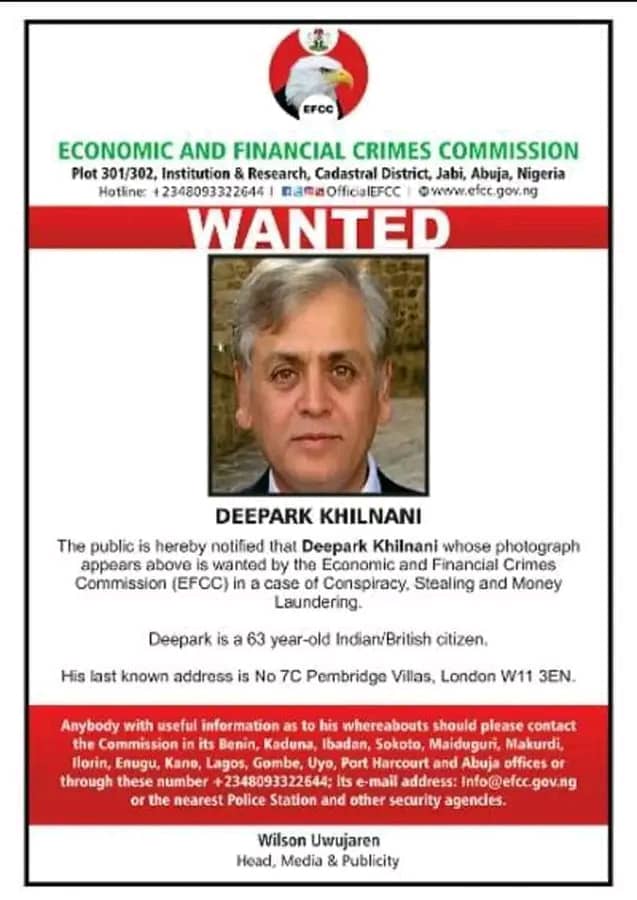
The Economic Financial Crimes Commission, EFCC, has declared a British and Indian citizen, Deepark Khilnani, wanted on the ground of fraudulent activities.
The Commission in a post on their verified social media accounts disclosed on Wednesday that Mr Khilnani is wanted for conspiracy, stealing and money laundry.
The Commission gave his brief details and requested that persons with information that could lead to his arrest should not hesitate to contact the EFCC.
“Deepark Khilnani, 63, Indian/British citizen is wanted by the EFCC for Conspiracy and Money Laundering. If you have any information that could lead to his arrest, please do not hesitate to contact the EFCC immediately”, they posted.
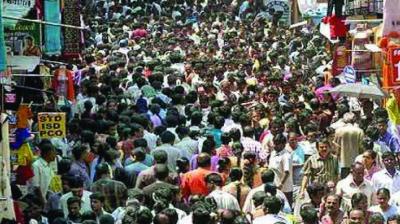
India is soon to overtake China as the world’s most populated country, according to the United Nations Population Division.
John Wilmoth, the director of the UN Population Division, stated this at a press conference held on Monday at the UN’s New York headquarters.
Wilmoth asserted that the fertility rates in the two countries were the primary cause of this trend, stating that China and India together made up more than one-third of the world’s eight billion people.
Wilmoth was quoted as saying, “By the end of April, India’s population is expected to reach 1,425,775,850 people, with projections indicating further growth for several decades more.
“That’s slightly higher than China’s global record of 1.4 billion in 2022.
“China’s population reached its peak size in 2022 and has begun to decline.
“Projections indicate that the size of the Chinese population could drop below one billion before the end of the century.”
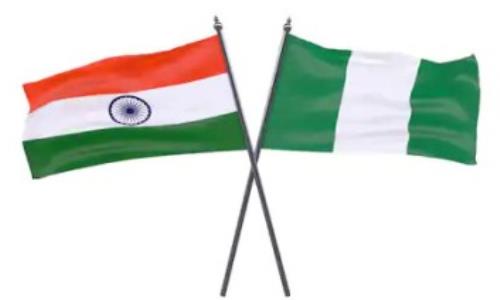
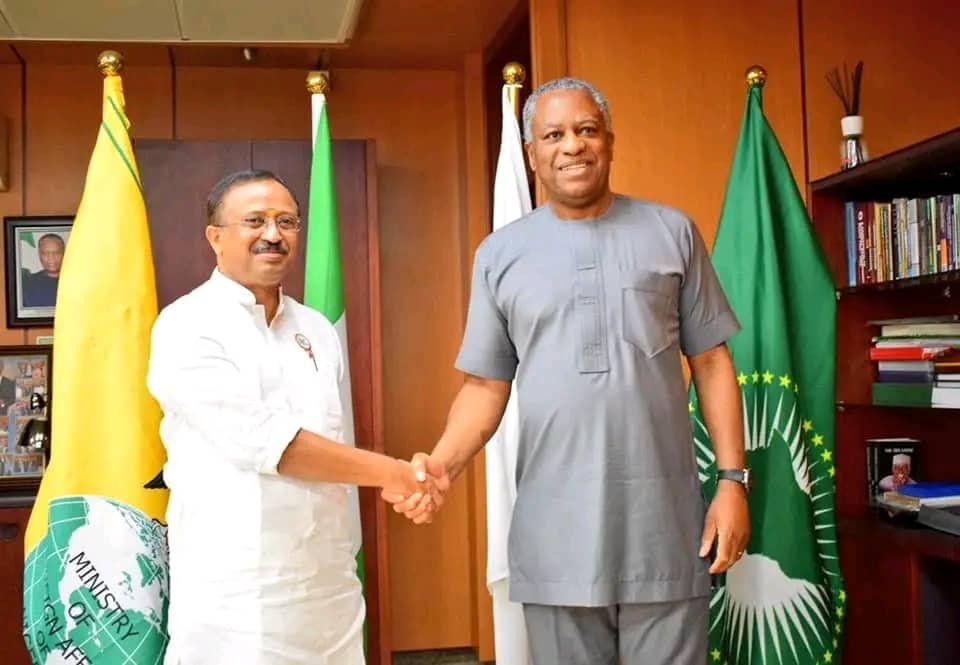
Nigeria and India are looking for strategies to enhance their mutually beneficial and robust bilateral ties.
Geoffrey Onyeama, the minister of foreign affairs, revealed this on Monday when meeting Shri V. Muraleedharan, the state minister for external affairs of India.
Muraleedharan is in Nigeria to attend the Nigeria-India Business Council’s opening (NIBC). Nigeria, according to Onyeama, is attempting to benefit from India’s expertise in the fields of information, communication, and technology.
India is one of the biggest investors in Nigeria and one of the biggest consumers of Nigerian crude, he pointed out.
In the context of the Solar Alliance and Conference of the Parties on Renewable Energy, Onyeama acknowledged India as the primary instigator.
“On Defence cooperation, there is a joint initiative with some of our Defence institutions on the development of detection of Improvised Explosive Devices which we are working on.
“Of course, that will be an important addition to the armoury of our security forces”, he added.
Muraleedharan stated that the bilateral relationship between India and Nigeria is excellent and that the meeting covered topics such as commerce, consular matters, education, etc.
The minister expressed confidence that the NIBC would enhance bilateral trade and investment in a number of industries.
Muraleedharan indicated that his nation was prepared to lend soft credit to Nigeria so that it might construct solar power facilities.
“On Power, Nigeria is part of the International Solar which is the global alliance to ensure that sustainable power is there across the world”, he noted.
Looking at the reality and how uncertain the future of education is in this country, you, as a Nigerian, should get a solution for yourself. But unfortunately, even though education is a right, not a privilege, the biggest stakeholders (read: government) are not ready to facilitate smooth learning for the sons and daughters of the “common people.”
In Nigeria, public university teachers, otherwise known as ASUU members, have been on strike for over half a year, thanks to the government’s failure to listen to their demands. Don’t you think this could make some students forget the names of their respective departments after someday the industrial action is suspended?
In light of these, I honestly feel the urge to share the Indian Government online scholarship with every serious-minded Nigerian who studies—or wishes to study—at any of our strike-ravaged public universities here. The last date for the application for the scholarship is August 15.
Here are five quick reasons why you should apply for the scholarship as follows:
1. Unlike other scholarship schemes, this scholarship—which you can apply for via https://www.ilearn.gov.in/—is fully-funded. This means you do not have to pay even a dime as tuition or a part of it. In addition, you don’t have to know anyone to apply or get it.
2. You only need a good mobile device (preferably a computer) with a good Internet connection to study. This indicates that you do not have to undergo the stress of boarding a flight from Nigeria to India, although it would be a pleasure to go overseas for your study.
3. The word “strike” might not exist in the dictionary of Indian universities. Therefore, one will have hitch-free academic sessions and most likely graduate on time. Moreover, the duration of some bachelor’s degree programs, as indicated on the application portal, is three years.
4. If you are one of the successful applicants, you will get the opportunity to study at some of the best universities in India, like Lovely Professional University, the Indira Gandhi National Open University and so on. The certificates to be obtained will be widely recognised. So, don’t panic over the recognisability of your results after graduation.
5. Unlike here in Nigeria, where you cannot apply for two or more different courses in one university when registering for the Unified Tertiary Matriculation Examination (UTME), there are universities on the list of eligible institutions for the scholarship that okay an applicant to apply for more than one course. An example of such a university is the Indira Gandhi National Open University.
Please hurry up and apply before the deadline, as this is an opportunity that should never escape your notice.
Muhammad Sabiu is a reporter for The Daily Reality and lives in Bauchi State. He can be reached via sabiucnd@gmail.com.
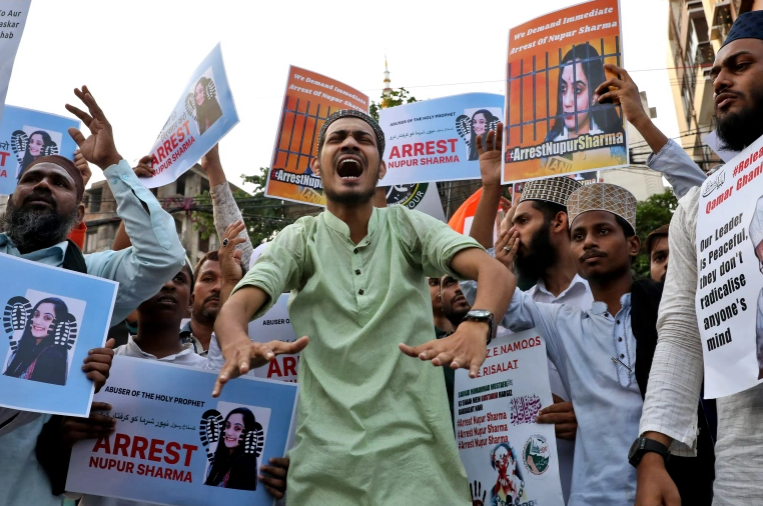
Throughout this week there is a heavy tension in the Muslim world, as one lady called Nupur Sharma, who is the spokeswoman of the Indian Hindu party, BJP, spewed insults on the prophet of Islam. Many commentators around the world accused Modi’s government of complicity in such crimes as there is so much increase in attacks and humiliation of Muslims and Islam in India right from the beginning of his reign. This time around, the Muslims worldwide, are outraged and condemned the barbaric act of Sharma and called upon the Indian government to act against such transgression.
Indian women protesting against the ignorant Nupur Sharma’s madness
According to Aljazeera, leaders “of India’s Hindu nationalist ruling party have instructed officials to be “extremely cautious” when talking about religion on public platforms after derogatory remarks about the Prophet Muhammad drew protests from Muslim nations.
Two leaders of Prime Minister Narendra Modi’s Bharatiya Janata Party (BJP) said verbal instructions were given to more than 30 senior officials and some federal ministers who are authorised to take part in debates hosted by Indian news channels often broadcast live to millions of viewers, the Reuters news agency reported on Tuesday.
“We don’t want party officials to speak in a way that hurts the religious sentiments of any community … They must ensure the party’s doctrine gets shared in a sophisticated manner,” said a senior BJP leader and federal minister in New Delhi, according to the report.
With about 110 million members, mainly Hindus, the BJP is the world’s largest political party, while Muslims comprise about 13 percent of India’s 1.35 billion population.
Last week, the BJP suspended its spokeswoman Nupur Sharma and expelled Delhi media cell head Naveen Kumar Jindal after Muslim nations demanded apologies from the Indian government and summoned diplomats to protest against anti-Islamic remarks made during a TV debate.
Qatar, Saudi Arabia, Oman, the United Arab Emirates, Indonesia, Afghanistan, Pakistan and Iran were among the nations that made their complaints public.
The influential 57-member Organisation of Islamic Cooperation (OIC) said in a statement that the insults came in the context of an increasingly intense atmosphere of hatred towards Islam in India and systematic harassment of Muslims.
On Wednesday, Iranian foreign minister Hossein Amirabdollahian arrived in New Delhi for bilateral talks with India – the first visit by a senior minister of an OIC member nation after remarks on the prophet triggered outrage in the Arab world and other Muslim-majority countries.
Iran had summoned the Indian envoy in Tehran to lodge its protest against the anti-Islam remarks made by Sharma and Jindal.
BJP youth leader arrested
Meanwhile, police in northern Indian state of Uttar Pradesh arrested a BJP youth leader for posting anti-Muslim comments on social media, officials said on Wednesday.
Harshit Srivastava was arrested in Kanpur city following communal tensions last week during a protest by Muslims to denounce the anti-Islam comments.
“We arrested the local politician for making inflammatory remarks against Muslims,” said Prashant Kumar, a senior police official, adding that at least 50 people were taken into custody following the tensions in Kanpur.
Srivastava’s lawyer was not available for a comment.
Sporadic unrest was reported in other parts of the country over the anti-Islam comments by the BJP’s Sharma.
Members of Muslim groups in India said it was the first time influential foreign leaders had spoken out against what they called the humiliation experienced by the minority community.
“Our voices have finally been heard, only world leaders can nudge Modi’s government and his party to change their attitude towards Muslims,” said Ali Asghar Mohammed, who runs a voluntary rights group for Muslims in Mumbai city.
India’s Muslims have felt more pressure on everything from freedom of worship to wearing the hijab (head scarves) under Modi’s BJP. There were Hindu-Muslim clashes during religious processions recently, following deadly riots in 2019 and 2020.
Although the party has denied any rise in communal tensions during Modi’s reign, the BJP rule has emboldened hardline Hindu groups in recent years to take up causes they say defend their faith, stoking a rise in anti-Muslim sentiment.
The US State Department, in an annual report on international religious freedom released last week, said that attacks on members of minority communities, including killings, assaults and intimidation, took place in India throughout 2021. India’s foreign ministry said on Monday the offensive tweets and comments did not in any way reflect the government’s views.
“We are not barred from speaking on sensitive religious issues, but we must never insult the basic tenets of any religion,” said senior BJP spokesperson Gopal Krishna Agarwal.
Modi in recent years has improved economic ties with energy-rich Muslim nations, the main source for India’s fuel imports, but relations have come under stress from the anti-Islamic comments by the two BJP members, foreign policy experts said.@
A Nigerian based Islamic organisation, Ulama Forum, has called on the Prime Minister Narendra Modi of India to rescind his Neo-Nazi ideology and embrace democracy as envisioned by India’s founding fathers.
The forum urged Modi and other stakeholders in the country to take concrete action to mitigate violence against Muslims to promote peaceful coexistence.
This was contained in a release jointly signed and issued Tuesday by the forum secretary, Engineer Basheer Adamu Aliyu, and its convener, Aminu Inuwa Muhammad.
The Daily Reality gathered that Muslims in several Indian states had been terrorised as mobs came out in processions, making hate speeches and attacking their properties during the Hindu festival of Ram Navmi.
The escalation of violence against the minority communities, particularly Muslims, has recently seen a steep increment, making it hard for the Ulama Forum to believe India is a democratic secular country.
The statement also called on the Indian Muslims to hold on to their faith and avail the rest of the Indian population of the benefits of Islamic justice.
The statement reads: “They should hold on to their faith and avail the rest of the Indian population with the benefits of Islamic justice, which restrains Muslims from overreacting against all provocations.”
“Indian Muslims should use every constitutional window available to them to seek redress on the excesses committed against them by Hindu extremists.”
“Indian press, especially those who believe in democracy and universal human values and who are immune to sectarian tendencies, should continue with the good works of fair and truthful reportage, which will promote justice and fairness to all,” the statement added.
Muslims at knifepoint in India
The statement also lamented that India has been witnessing sporadic violence targeted at its large number of Muslims promoted by the Neo-Nazi BJP Government for the past decade.
It stated that “The most recent of which is during a Hindu religious ceremony which was marked by thousands of youth marching into Muslim dominated areas, brandishing guns and swords, using public address system to prevent Muslims from concentrating in worship inside their mosques.”
“Whenever Muslims react in any way, a combined disproportionate force is used on them with Hindu citizens using guns and the India Police arresting mostly Muslims who are the victims of the violence.”
You cannot eliminate Islam
The statement taunted that it is unwise for any Indian to think of eliminating Muslims in the country, let alone Islam.
India has over 200 million Muslims, ranking the country as having the second-largest number of Muslims globally.
“It is, therefore, perplexing how anyone can think of eliminating such,” the statement concluded.