Hausa-Fulani

Dutse gets new Emir

By Ahmad Deedat Zakari

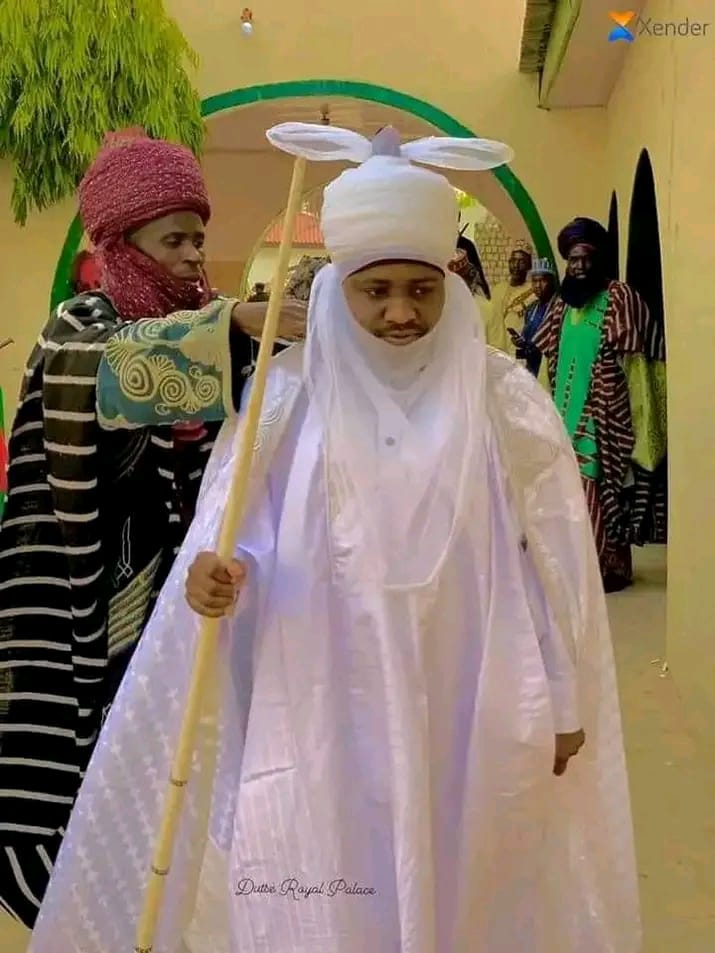
The Governor of Jigawa State, Muhammad Badaru Abubakar, has approved the appointment of Haneem Muhammad Sanusi as the new Emir of Dutse.

Governor Badaru’s approval was sequel to the recommendation of the Dutse Emirates kingmakers.

According to a statement made available to journalists on Sunday, three persons contested for the royal seat. However, the seven kingmakers had unanimously voted for Sanusi’s emergence.

The new Emir succeeded his father, Nuhu Muhammad Sunusi who passed away in an Abuja hospital last week.

Hali Abokin Tafiya: A Tribute to Late Sarkin Dutse

By Ahmad Muhammad Ahmad

I was thinking of a befitting title for this short tribute when I stumbled upon the adage above. It loosely translates to ‘character is a life companion’ and aptly summarises the thoughts running through my mind seeing the pool of praises resulting from the death of His Highness Sarkin Dutse, Alhaji Nuhu Muhammad Sanusi.

The life and times of great men teach subsequent generations about the true essence of life. Eulogies and tributes from equally great people are a testament of honour and moral eminence. The late Sarkin Dutse is a quintessence of nobility and magnanimity, a monarch with so much panache yet full of humility.

If the most beautiful ones amongst us would stay longer or forever, death would never have approached this epitome of scholarship and royalty. But immortality remains a characteristic of our Creator, the Lord of the worlds and to whom we shall all return.

I recently learnt that purpose and passion mean different things. Purpose revolves around using your passion for impacting the lives of others. The life of the late Sarkin Dutse exemplifies this to a great extent. He used his passion for philanthropy to create a rather better world far and wide. His life and leadership are true symbols of purpose, benevolence and contentment.

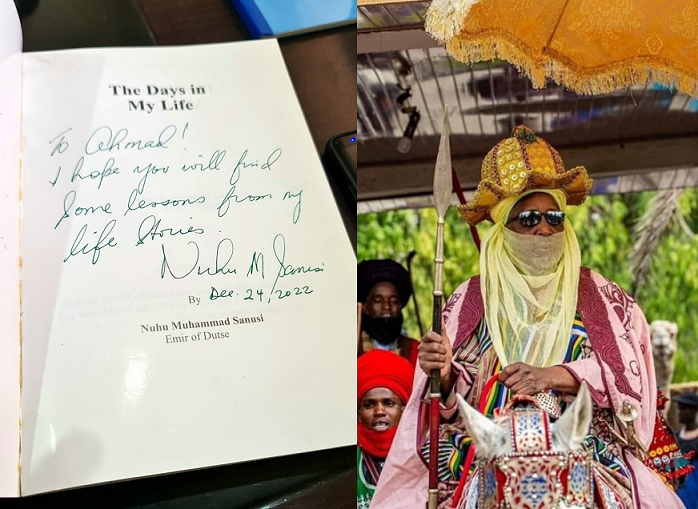
Late last year, I received a generous gift of his book (autographed by himself), which captures his experience growing up and memoirs from his several travels and encounters. I could not contain the joy of seeing my name handwritten by the Emir himself. I was meant to meet him after finishing the book, but as God would have it, it was never destined to be.

The second page of this book carries the following, which is also a summary of how he lived his life: “When you were born, you cried, and the whole world rejoiced. Live your life so that when you die, the world cries and you rejoice”. Sarkin Dutse truly lived up to these words. We can hear cries from beyond Dutse. The world has yet again lost one of its finest.

The praises and prayers we hear give us hope that the reward of the beauty he created in this world is awaiting him in his afterlife. Navigating through the pain of the lost, we can only hope and pray that God almighty will count him among those He has bestowed His favours upon from amongst the prophets, the steadfast affirmers of truth, the martyrs and the righteous. May all the good he has done forebear him from every torment of the afterlife.

Allah Ya jikan Sarki!

Ahmad Muhammad Ahmad wrote from Kano, Nigeria.

This thing called “Lefe” and its danger to marriages in Arewa

By Lawan Bukar Maigana 

To say that I was bemused reading a story of a young lady whose parents influenced her to reject a guy she truly loved because of “Lefe” (trousseau) would be a gross understatement.

Unsatisfied with what her soon-to-be husband had offered, the lady asked him to change the lefe items with expensive ones or abandon the thought of marrying her. He asked why and she explained that the things he brought were not up to her taste because she was about to graduate and deserved better. Nevertheless, she insisted that he had to come and pick up his boxes. Respectfully, his friend went to her house and picked them up. 

After the above encounter, he stopped calling her. She became worried and asked him why did he stop calling her. He told her there was no point in calling someone who didn’t love him, and that was the end of their conversation. After that, he sold all the boxes, started a business, and happily got married after three years. 

This story happened 13 years ago. The lady is now a graduate and still unmarried. Unfortunately, she came out to share her experience with the public because the same aunties that influenced her to reject the man because of his inability to fill the boxes with pricy things are the same people asking to be the fourth wife to an elderly man who perhaps she doesn’t like. 

She is 32 and regrets her decision to side with her mother and aunties. She desperately wants to know his whereabouts and apologize to him. I think there are a lot of lessons in her story. Her last words: “Ladies, not all that glitters is gold. Lefe isn’t important; dowry isn’t important…”

Even though Islam is not in conflict with our native culture, parents must make it easy for their children to get married to avoid them becoming promiscuous. But, more importantly, now is the time to abolish the culture of offering lefe, as a necessity for our Muslim youths, especially the ones in the North, to become couples. It is one JIHAD that must be fought.

Lawan Bukar Maigana writes from Maiduguri, Borno State, and can be reached via lawanbukarmaigana@gmail.com.

The roadside discussions

By Abdussamad Ahmad Yusuf

It was Wednesday evening, and the clock was ticking to 6:00 pm. Alongside two friends, we were joined by another friend’s friend reminiscing my 44 days stay in Abuja, the Federal Capital — the longest I have stayed off Kano.

It’s a roadside discussion, and all topics have the freedom to cross our minds. So we present, discuss, argue and analyze. We sometimes even pass verdicts and judgments.

In Kano, it is Majalisar Bakin Titi, the roadside parley. It is a local gathering of men. In the local roadside parleys, unless in some exceptional circumstances, there is segregation of age, group, social and even economic status. While there is Majalisar Attajirai, the wealthy’s parley, there is that of the humbles, nobles to that of ‘Yan caca, the gamblers’. Men branched in the majalisa after work or after market hours in the evening. For the youth, joblessness and idle-mindedness have made their conversation almost an all-day affair.

It’s easy when you talk of youth or a range of bachelors, rest assured, women and girls have to find a way to dominate the discussions.

Habu would begin showing the girl in blue that her Atampa cost six thousand, the bag two, her veil eight hundred; putting everything she wore averagely kept at Fifteen thousand. She was of humble background and not suitable to be “settled with”, he concluded. Marrying her means you have to struggle all your life to satisfy your needs and hers’ and expect nothing from her side or her parents. Is it crass materialism or the new normal? Anyway, it’s a roadside parley, not an academic or intellectual forum.

Until the beginning of the 1990s, marriage is contracted on the mutual friendship between two families of the intending couples, for settling disputes, generally to stiff bonds or forge new ones. Therefore, the material benefit does not count as much, even at the community, not a familial level, where crowd-achievement due to communal lifestyle is more prevalent than the individualist materialism in prevalence today. 

This permeation of a materialistic viewpoint of life has degraded the standard of familial life seen manifest in roadside discussions, more unfortunately, stemming from the Manyan Gobe, leaders of tomorrow who are nurturing an ignorant standpoint for the nucleus of society: the family.

The Habu thesis painted above shows the complexity of young man’s  ‘misthinking’ wealth, status and rank for fancy and expensive dress and accoutrements. Sadly, it has reduced young girls of marriageable ages to racing for material possessions; an iPhone – the latest in the market, expensive ‘Vatik’ Atampa, posh shoes for kece raini, ‘being above equals’.

These are the ‘yan mata Roadside Discussions extolled to the high heaven, and about-to-marry young men internalize as the best description of a woman to seek her marriage. It is no longer about the Ladabi (obedience, and I am not being apologetic to the ‘alpha’ men), kunya (modesty and good manner), hankali (sobriety), mutumci (humanity toward others) and  Karamci (generosity), in addition to what zamani, current dynamic brings; industriousness, economic dexterity, education (in the western sense or the karatun boko) and may be tech-friendliness.

The Roadside parleys are a hub to discuss which girl has the curviest hip, who has a bosom chest and who walks beguiling, and identifying who has Girman kai, ego in the community. The one egoistic, closely when interrogated, one would discover she is the one who is not trading her teeth for beautiful smiles at any of these near-jobless men, what they will turn out to brand Rashin kamun kai, not modest. The best of the times, if any,  is one that discusses, often prejudicial perspectives, who is mutuniyar kirki, a good girl and who is not.

Many girls dodge passing by roadsides parley to skip their topic brought up unsolicited and to evade the roadside social appraisals and analyses of their lives.

What I will not close, however, without telling you; beautiful marriages have been tied from Roadside Discussions, even though, one may argue equally, many have been dissolved thanks to Roadside Discussions. But, the paradox notwithstanding should not deter young men and women from being the best they can be so that the best comes their way.

Abdussamad wrote in from Kano and can be reached at Abdussamadahmad69@gmail.com

Nigeria at 62: Which way forward?

By Habibu Maaruf Abdu

Nigeria gained independence from Britain in 1960. That’s 62 years ago. Unfortunately, however, the country has made no significant advances since then. In my opinion, it takes the collective efforts of all Nigerians to change the story. Nigeria’s ethnically diverse people must agree to unite and develop a sense of working together to move the country forward. In other words, Nigeria must first be united to reach its destined greatness.

To achieve a united Nigeria, the government of the federation must endeavour to command a ‘national loyalty.’ That is, to get support from the people of every part of the country. The government could get this if it gives members of all the parts an equal opportunity in the government and its agencies. This will send a sense of belonging and satisfaction to them. The government should also treat all Nigerians equally, regardless of their regions, religions, tribes, and political affiliations.

Another thing that can bring Nigeria together is leadership rotation across the six geo-political zones. This should be regarded considering the reality in the southeast today. There are grumblings, and even mass agitations, from the southeasterners, mainly because they have never produced a president since the second republic. This fact makes them feel as though they are treated as outcasts in the country and therefore agitate. When leadership rotation is implemented correctly, such agitations will unlikely arise again. Also, the federal government should ensure that no region is envious of the other by making fair zoning of capital projects and equal distribution of resources across every part of the country.

For the peaceful coexistence of ethnically and religiously diverse Nigerians, all ethnic and religious groups must reject their prejudices against one another. They must also understand their differences genuinely. This is necessary for them to have a common ground for respecting and tolerating their differences (cultural, ethnic and religious). It will also help them to live in harmony and build a society with strong human potential and economic progress.

‘Discipline’ and ‘patriotism’ are also areas of emphasis. No nation can be great without these values instilled in the psyche of its citizens. This is why many countries, like china, have a whole ministry for national orientation. Nigeria should copy these countries and launch a massive and consistent campaign for the ethos of civic behaviours and responsibilities in Nigeria. This will help to build discipline, respect and love of the country, as well as national pride, in the society. When these values are present in society, the people will uphold discipline and patriotism. They will reject corruption and all other harmful habits that could cripple their dreams and inhibit their country’s development.

On another side, economic diversification should be considered to put Nigeria on the right track. The country’s economy is, at present, heavily reliant on the revenue derived from the export of crude oil. This leads to low economic growth, which, in turn, favours poverty as there is no room for massive job creation. But the diversification of the economy will certainly change the story. Therefore, Nigeria should diversify into areas like agriculture and industrialization. The agricultural sector, which was the mainstay of the country’s economy before the discovery of oil, has a long value chain. And a firm industrialization policy can create thousands of manufacturing jobs for people.

Nigeria should also make policies that will attract more foreign investors, especially those who produce different kinds of products and machines. This, together with reasonable provisions for private enterprises, will go a long way in reducing unemployment and alleviating poverty in the country.

Notwithstanding the above, Nigeria should do better for the education sector. The saying, “No country can really develop unless its citizens are educated,” cannot be more correct. Unfortunately, Nigeria spends very little on education (less than 8% of its total GDP). The number of out-of-school children is high, and universities remain closed for over seven months due to an indefinite strike by the Academic Staff Union of Universities (ASUU). To save education from this mess, Nigeria should increase its expenditure on the education sector; map out a plan for revamping it, and see the plan through with maximum commitment.

At this juncture, I want my fellow Nigerians to remember that; all the developed countries we currently admire have, at some point, been where Nigeria is today. It’s therefore valid to believe that Nigeria can equally develop. Fortunately, the country is blessed with both material and human resources to facilitate the process. However, it is rightly said that Rome wasn’t built in a day. Progress is made with sustained effort over time. Therefore, we need to unite, do our patriotic duties, uphold discipline and get professional and morally upright leaders to drive the country.

I will conclude by quoting Chinua Achebe in his book The Trouble with Nigeria, published in 1983, where he opined that “Nigeria can change today if she discovers leaders who have the will, the ability and the vision. Such people are rare in any time or place. But it’s the duty of enlightened citizens to lead the way to their discovery and to create an atmosphere conducive to their emergence. If this conscious effort is not made, good leaders, like good money, will be driven out by bad.”

It takes our collective efforts to move Nigeria forward.

Habibu Maaruf Abdu wrote from Kano, Nigeria, via habibumaaruf11@gmail.com.

Can we see people beyond their looks?

By Aisha Musa Auyo

Perhaps the only group of people that see women beyond their looks are the blind. They judge us based on our character and attitude and, with time, our intellect and intelligence.

I often get judged based on my looks, which pisses me off. It took time, patience, and convincing to come to terms with the reality that people will always judge one by his looks. I want us to ponder that our looks have nothing to do with our intelligence and demeanour.

Personality psychologists have argued that physical appearance is a significant factor in personality development because people form opinions by what they see in a person physically and respond to that person accordingly. In turn, people tend to fulfil the expectations they believe others have for them. 

For example, short people are said to be too aggressive or demand too much respect, or tall people are foolish. And in our society, it’s believed that rich people are evil and will go to hell, while poor people are good people. So they say, “Ku ci a nan, ma ci a can”, meaning “You enjoy this life, and we – the poor – will enjoy in the hereafter”. 

Other common myths that align personality with looks are: slim girls tend to be arrogant and lack patience, while chubby girls are easygoing and humble. Looking good and dressing well makes you arrogant automatically, or driving an expensive car is a showoff. 

Please, let’s study people before we pass judgement, as people’s behaviour evolves with time, education and experiences (these are what make and shape us) regardless of their physical traits. Let’s not allow people’s expectations or comments to shape our thinking. I know it’s easier said than done, but can we try?

I can remember some years back when I went to write a Senior Secondary School entrance aptitude test. After greeting the panels, one of them said, “Miss, I hope you have something to bring to the table beside your good looks. I was 13 years then, and his rhetorical question sent a doubt in my mind that I may not pass the exams. It took convincing myself that if I couldn’t do it, I wouldn’t be illegally adopted as a mercenary for someone else, implying that if I had allowed his comment get me, I might probably fail the exams. This is an example of how people’s expectations shape our thinking.

After the general exams, we were to go for another test, this time one by one with the examiners. I was given a mathematics exercise to solve fractions and square roots. God helped me solve that equation in less than a minute, and the judges were awed. It happened that I was the first one to solve that particular question since they started the test that very day. That man asked me again, which school are you attending? To him, it must be the school that is good, not me. 

A similar incident happened recently during my PhD coursework. I was doing statistics tutorials for my cluster, and the news spread that a tutorial was going on. Some groups of women decided to join. As they entered the class and saw me at the board with a marker, one of the women said, “so there’s a brain inside that fine face”. 

I retorted. My brain is finer than my face, in my mind, of course, as this woman is old enough to be my mom. But this time around, I didn’t let her statement intimidate me. All thanks to age and experience. I just pretended not to hear and continued with the class: If I’d allowed that to get through me and said what came to my mind aloud, it would prove that slim ladies are arrogant.

These cases should sound like compliments, but they’re an insult. Why do people believe that beauty and brains are mutually exclusive? What does our look have to do with our brain? My best friend, the best in mathematics in our class, is one of the most beautiful people I’ve met. She’s a civil engineer now.

My other best friend, a tall, fair, beautiful Fulani lady, is now a medical doctor. I have also met short people who are soft-hearted and humble. I’ve met wealthy people who are down-to-earth, simple and have a kind heart. I’ve met not so good looking people who are also not so brilliant but have strength in kindness, empathy, and excellent marketing skills. 

Each person has strengths, so also weaknesses. For example, a blind person may have superpowers that someone with eyes may not. I’ve seen disabled people do things with their only leg or hand that are humanly impossible. 

This debate of physical traits and how they manifest in our personality is beyond human comprehension, for it involves genetics, life experiences, grit, tenacity, and willpower. This unending nature-nurture debate could only be laid to rest if we agree that these matters are beyond us.

A perspective on the resurgence of interest in Hausa identity on social media

By Aliyu A. Ammani

Those following happenings in social media could not have missed the debates and controversies generated by the rise in tribal identity consciousness among the Hausa in Nigeria. Identity among the Hausa has been suppressed by the mischievous use of the tag “Bamaguje”, masked by “Hausa-Fulani” and “Arewa” labels, and tacitly put into question over the years. Many people see in this increasing consciousness a threat to the coexistence between the Hausa and the Fulani, two tribes living together for centuries in Hausaland.

A series of conspiracy theories are churned to explain the genesis of this resurgence on social media, most of which sound somewhat ridiculous. The conspiracy theorists appeared not to see the wood for the trees. There are two primary reasons behind the resurgence of interest in Hausa identity in Nigeria today.

First, the Bororo Fulani banditry in mainstream Hausaland on populations that are essentially Hausa, and its attendant destruction of lives and properties, maiming, looting, raping of women, kidnapping for ransom etc. Thousands of towns and villages across Hausaland have been sacked. Communities of free law-abiding citizens are forced back to the dark age of slavery; abled-bodied men are attacked and abducted, sometimes right inside mosques on Fridays. The perpetrators of these heinous crimes are always willing to tell the world they are Fulani, fighting for Fulani against the Hausa. The reader can hear from the Horse’s Mouth in the following audio-visual documentaries available on YouTube: (i) BBC Africa Eye Documentary “The Bandit Warlords of Zamfara”, (ii) Trust TV’s “Nigeria’s Banditry ‘The Inside Story” and. (iii) video coverage of Dr Ahmad Gumi’s meeting with Zamfara Bandits at Shinkafi.

Second, and most importantly, the attitude of city-dwelling Fulani, including some notable traditional and religious leaders in Hausaland, in the face of Bororo banditry. Instead of publicly dissociating themselves from the atrocities or publicly declaring that terrorists like Bello Turji, Dogo Gide and Ado Aleru do not represent the Fulani, they seem more comfortable fabricating excuses for the bandits in tongue-in-cheek statements.

The leaders say, “their cattle were rustled”, “traditional cattle routes were blocked by new farmlands and settlements”, “the Fulani are not in it alone, there are other tribes including the Hausa aiding and supporting them”, and “the governments neglect the Fulani, …” etc. Not a single traditional ruler in mainstream Hausaland came out to publicly take an impartial stand, as did the emir of Muri. Even Miyetti Allah, the Fulani association that is always quick to cry blue murder whenever the interest of the Bororo appeared threatened, appeared to lose its voice. Thus, projecting an impression that while Bororo Fulani are busy terrorising and destroying Hausa populations and settlements, city Fulani are busy manufacturing and propagating excuses and justifications for the atrocities.

Can one sincerely justify banditry or rebellion by Fulani in Hausaland, a land that is practically a Fulani territory? The most important traditional rulers in Hausaland are Fulani. The key political figures and public officials in Hausaland are Fulani. The most notable Islamic clerics and religious leaders are Fulani. Even in Hausa settlements outside Hausaland, the heads of the communities, known as “Sarakunan Hausawa” (singl. Sarkin Hausawa) majority are Fulani. Therefore, the Fulani should be the last to rebel in Hausaland!

The Hausa, hitherto feeling that he has ‘his back covered’ by the Fulani, feels betrayed. With the scales falling off his eyes, he began to see the writing on the wall: “You are on your own”. This ignites the process that sparked the chain of reactions that we now see on social media as the resurgence of interest in Hausa identity, what others see as the dissociation of Hausawa from the Fulani.

There is indeed the tendency that a reawakening of identity consciousness among the Hausa is capable of igniting an equal spark in Fulani identity among the almost “hausanised” Fulani in Hausaland. This could lead to an upsurge in identity politics among both groups, leading to extremism where elements from both tribes could begin to see and interpret processes and events on a “we versus them’ basis. Traces of such extremism are already visible. However, the possibility of such a tendency should not be reason enough to deny the Hausa of their rights to tribal identity, association and aspirations for the simple reason that other Nigerian tribes have been enjoying such rights without posing any threat to their coexistence with other tribes in Nigeria.

The upsurge in Hausa identity revival has started and cannot be stifled or halted. The genie is already out of the bottle. The question that begs an answer is, “which way forward”? The way forward is not in the identification and clamping down on the persons or group managing pro-Hausa identity revival social media handles as is being suggested by some Islamic clerics across Northern Nigeria. This is more likely to compound rather than solve the problem.

The solution is for the ‘organised Fulani front’ to confront and respectfully address the fears of the Hausa people (of a conspiracy to annihilate them). They should also give them their assurance and publicly dissociate the Fulani from the activities of terrorists like Bello Turji & Co, and commence the process of rebuilding mutual trust and respect between the Hausa and Fulani.

Aliyu A. Ammani wrote via aaammani@yahoo.co.uk fromU/Shanu, Kaduna, Nigeria.

The North is at war with itself

By Abdulrahman Yunusa 

Entire my life, I have never seen Nigeria more divided than this time under President Muhammadu Buhari. Even those who share the same geographical location, history and ancestral background at some point are fighting each other today. 

To be precise, the current tussle between Hausa and Fulani disturbs my psyche. Who really curses us? Are we used to such trivialities before, or just by accident, we found ourselves in this predicament overnight?

How can we convince the upcoming generation that the North used to be peaceful, where the inhabitants peacefully mingle with each other irrespective of tribal affiliation or identity? After all, the gleaming narratives have been bitterly coloured into ugly ones.

Perhaps, the crisis of identity was a thing of obscure in the North in those days. Nevertheless, for over several decades, the ethnics group have been romancing each other as if they were of the same origin, although they are to some degree. Hence they even succeeded in burying the ethnic difference by making social unions among themselves.

Sadly, today we are talking about another issue. Things have changed over time. We bow down and take a different dimension which goes in contrary to that of our great-grandfathers. The rising hostility is out this world today among the major ethnic groups in the North.

Honestly, this man may be the worst leader Nigeria has ever had. His advent into the corridor of power is a curse to the then two harmonious ethnic groups, who are fighting each other fiercely under the curtain of politics and other politically related issues. 

It’s unbecoming for the conflictual parties to shun the history of their peaceful relation to some cheap matters that don’t worth their attention, let alone consuming their long, everlasting, and marvellous cordial relationship. However, attached to any upheaval, there is a lesson to learn for the future.

On a lighter note, I sense some suspicious plan meant and orchestrated by some intruders to get this everlasting combo broken down. Sadly, soon chicken will come back home to roast. The invisible hands igniting the fire of hatred among the interrelated parties would bury their face in shame.

North would never be divided, in sha Allah. May North and Nigeria proper, amin.

Abdulrahman Yunusa is a political and social affairs analyst. He writes from Bauchi and can be reached via abdulrahmanyunusa10@gmail.com.

On the emerging narratives of Hausa/Fulani animus in the Northwest

By Dr Raji Bello

The past few years have witnessed a gradual emergence of references in public commentary and social media to a potential or actual rupture of relations between Hausa and Fulani groups in the Northwest geopolitical zone of Nigeria. Prior to this, the two groups had enjoyed a largely harmonious relationship for much of their history which was only punctuated during the period of the establishment of the Sokoto Caliphate.

Since Nigeria came into being at the turn of the 20th century, conflict between the two groups was limited to occasional farmer/herder disputes. While the region has distinct Hausa (majority) and Fulani (minority) communities in the rural areas, the urban centres tend to have mostly mixed populations united by the Hausa language and Islam, which eliminates the possibility of ethnic conflict.

The idea of Hausa/Fulani antagonism began to emerge several years ago in the commentaries of individuals from outside the North like Femi Fani-Kayode and Nnamdi Kanu who relished in promoting it as a potential tool for undermining northern hegemony, as they saw it. But recent developments in the Northwest like the emirship succession in Kano and Zazzau, and the violent conflict between rural Fulani and Hausa vigilante groups as well as the wave of banditry against local communities by Fulani elements has created narratives of Hausa/Fulani conflict among northerners themselves.

As we acknowledge this new reality, it is also important to recognise that there are two strands of these narratives out there and the motives of those who articulate each of them are different. I will group them into non-extremist and extremist narratives.

Non-extremist narratives

These are propagated by ordinary Hausa citizens who are concerned by what they see as the continued suppression of Hausa identity and prestige as well as threats to the security of Hausa communities in parts of the Northwest as a result of banditry. They hold an unfavourable view of the existence of exclusively Fulani traditional ruling dynasties in Hausa-dominated emirates like Kano, Katsina, and Zazzau which were established when the Sokoto Caliphate came into being over 200 years ago. They object to the references that are often made to the Fulani heritage of the emirs (although I believe that this is not done out of ethnic chauvinism but because of a need for historical accuracy). These are concerns that the state governments in the Northwest can engage, with a view to introducing reforms that would assuage negative feelings and lead to a more harmonious society.

Traditional institutions play a vital role in preserving our heritage but for some segments of society, they may also be permanent reminders of an unpalatable past. It is the responsibility of modern day governments to ensure that they strike a balance between the two i.e. preserving heritage while not alienating some segments of society.

Reforms could be introduced that would formally recognise and integrate the legacies of the pre-Caliphate Hausa emirs. Like a contributor Aliyu Ammani has suggested in a Daily Trust article, Hausa ruling houses could be included as contenders during succession to the emirships; our governors are fond of creating new emirates where they didn’t exist before and therefore, they should not find it difficult to create new ruling houses within the existing emirates. The Sokoto state government may also consider elevating the status of the Sarkin Gobir of Sabon Birni – the ancient Hausa kingdom of Gobir being the epicentre of the Sokoto Jihad.

Governments have a duty to recognise and preserve heritage holistically; the heritage of some segments of society should not be elevated over those of others in a post-Caliphate and post-colonial nation state. This is a recipe for entrenching communal tension and possible conflict. The Northwest governments should collectively nip these emerging issues in the bud and not allow them to fester and grow into major problems in the future.

I expect some readers to either say that these suggestions are too radical or that they will be impossible to implement. I’m used to hearing this from reform-shy Nigerians who like things to remain just as they are even when the existing situation is pushing us towards the edge of the cliff.

The second cause for concern is, of course, the ongoing wave of banditry against local Hausa communities in many parts of the Northwest in which Fulani elements are major actors. However, this is not primarily an ethnic conflict; if communities that have lived in peace for generations are now locked in violent conflict we need to scratch below the surface to find the actual causes.

The banditry is a symptom of the failure of governance at various levels. Even a report commissioned by the Zamfara state government (the MD Abubakar-led committee) has alluded to that by indicting former governors, top government officials, traditional rulers and members of the security services. There are chronic issues with agricultural land management, law enforcement capacity, corruption and maladministration by local officials and traditional rulers.

The lack of a long term plan by successive federal and state governments for transitioning nomadic pastoralists to modern and sustainable livelihoods is itself an evidence of leadership failure. While people are entitled to show concern about the apparent ethnic divide in the conflict, it is clear that it is not fundamentally an ethnic one.

Extremist narratives

These are deeply inciting and apocalyptic portrayals of the state of Hausa/Fulani relations in the Northwest which are propagated on the internet by people with no apparent desire for peaceful co-existence. Their aim seems to be to incite a major upheaval in order to undermine the fabric of society. They are a faceless mix of anarchists, genocide entrepreneurs and probably, people with a religious agenda. They often start their narratives by depicting the arrival of the Fulani in Hausa land hundreds of years ago as an invasion, then portray Usman Danfodio as the original Fulani bandit leader before dwelling on their favourite topic of interrogating the validity of Hausa-Fulani as a descriptive term for a segment of the population of the Northwest. They hide behind a veneer of seductive Hausa ethnic nationalism but their true agenda is to engineer maximum disruption in the Northwest which they hope would serve their interests.

There is a YouTube site and a Facebook page dedicated to the project (yes, it does appear to be a well-funded project) and I have viewed a few of their videos. Some of the voices on the videos bear distinct Nigerien accents (with French-influenced pronunciations) and some of their messages give a hint that they are non-Muslim Hausas. One of the voices called for unity among Hausa people of all faiths – Muslim, Christian and pagan to confront the Fulani threat, as they saw it. From my knowledge of northern Nigerians, it is very unlikely that a Hausa Muslim Nigerian would call for unity between Hausa Muslims and Hausa pagans considering how paganism is viewed in Islam. A Hausa individual who makes this call is likely to be a non-Muslim. And if those behind the extremist messages on the internet are non-Muslim Hausas, the question arises about whether they are working for a religious agenda or not. By saying “non-Muslim Hausas” I’m not necessarily alluding to the Hausa Christian community; there are also a small but assertive number of Hausa atheists and modern day pagans who are not necessarily enamoured of the prevailing order in Northwest society. If anyone feels that I’m being alarmist here, they should visit the YouTube channel of Jaruma Hausa Tv and listen to the messages themselves.

Conclusion

Authorities in the Northwest need to face the new reality of tension and misgivings between the hitherto harmonious communities of Hausa and Fulani. There are issues that are germane (the exclusivist Caliphate traditional dynasties in some of the Northwest emirates and the ongoing banditry) behind the new unease in ethnic relations which need to be actively addressed, in order to re-establish harmony. But it should also be recognised that not all those who are currently pushing narratives of Hausa/Fulani conflict or Hausa nationalism on the internet are working for peaceful co-existence. Some of them are merely exploiting contemporary issues in the Northwest to achieve their own dark agenda.

Women’s education and socio-cultural injustice

By Ismaila Academician

Day in, day out, one will come across discriminatory remarks deadlier than plasmasonic missiles against educated women nowhere but in Northern Nigeria and, narrowly, among Hausa and Fulani people.

To begin with, every human deserves a better life that comes through development that comes through a civilisation that comes through education or knowledge. Like the solar system, our life as a system is made up of some fragments that are an integral part of the whole system syntagmatically. After existing in form and soul, education is the second most important thing. It provides us with other parts health, food, shelter etc.

In this regard, life at the superordinate level is the same as the sun, supporting the entire system. Education at the ordinate level is the same as oxygen on earth, our planet. Without life or the sun and education or the oxygen, we cannot survive. This emphasises the importance of education in human life.

However, 21st century is considered the age of information. This is to say there’s no time more prevailing for one to get educated than now. Internet brings whole lots of information to our doorstep. Thus, knowledge becomes much easier to acquire. Probably, there is no field of inquiry that is yet to be digitalised. And, it seems this is just the beginning of things.

The above picture baffles me to see people, some of whom are educated, chastising women for being educated. And that is coming in a prime time when people worldwide are benefiting from products and by-products of education.

The theatre of operation

Now, coming to the bone of contention, Western Education, it’s apparent that these pseudo-critics, feeling dissatisfied with the autonomy women achieved by attainment of knowledge, and out of their chauvinistic attitudes to over-dominate the women-dome, keep barking up the wrong tree. They draw a series of comics that only reveal their disengagement with logic. Whether one is liberal, religious or inadvertent, I don’t think any law or logic is denying and limiting women from getting an education. Education is not gender-specific; it’s for all. It’s one of our distinctive features as humans to acquire knowledge.

A woman can be described as a permanent secretary in her matrimonial home. A secretary is someone entrusted with a secret; he is a confidant to the head of a government department or household. There is nothing worth protecting and entrusting than life and property. Man risks his life and property to his wife, both in his presence and absence.

 A woman is a manager that manages all the resources needed to run the organisation, her matrimonial home. She alone knows the input and output of the house family members that drive the house’s affairs forward. A manager is a person whose job is to manage something, such as a business, a restaurant, a house etc.

A woman is a human resources manager. An HRM is a person responsible for developing employees (or children) so that they become more valuable to the organisation (or family and society in general). She manages the entire people in the house, including the husband. For example, she assigns who to cook, go shopping, tidy the home, etc. At the end of this, the house becomes a real home.

Now, come one come all. Let’s think about this: for one to have a sound and efficient secretary overseeing the activity of his home, life and property, he needs an educated wife. For instance, children return home after school with lots of homework, assignments etc. And with the increasing rate of child abuse, sexual abuse and domestic violence, the best and safest extra teacher your children can get is your wife, their first and best teacher ever.

Additionally, take this scenario as a case study: you work in Abuja, and your family live in Kano or Katsina. Definitely, your wife is in charge of the entire household, raising your children to the moral standards, making sure children attend school, and providing and taking care of their needs. She settles school fees; pays water, power, DSTV bills etc., on your behalf. Yes, that will best be carried out efficiently only if one is educated.

Clear of all doubts, we need more educated women than men since they are that vital pillar supporting our homes – by and large, our life entirely, because men move from the custody of their mothers to the custody of their wives.

Lastly, I am in no way downgrading the good image of uneducated women to the detriment of the educated ones, no and never!!!

May we get the best spouses, amen.

Ismaila Academician wrote via ismailaacademician@gmail.com.