eNaira

The currency change in Nigeria: Balancing progress and people’s interests

By Yakubu Sani Wudil, PhD

The Central Bank of Nigeria’s announcement that some of the country’s old notes will cease to be legal tender by the end of January 2023 has caused significant concerns among citizens and businesses. While the move towards a cashless economy has its merits, such as increased security and transparency of monetary transactions, it is crucial to consider the potential negative consequences and ensure that proper measures are implemented to mitigate them.

One of the most pressing concerns is the availability of the new Naira notes. Many citizens have reported difficulties in exchanging their old notes for the new currency, and banks have been dispensing the old notes until only a few days ago. This has led to confusion and frustration among citizens, particularly those in rural areas who may not be as familiar with bank procedures. Therefore, the government should mandate banks to release the new notes in abundance to prevent any shortage or hoarding of the new currency.

Another primary concern is the impact on small businesses. Many small businesses have already shut down because they can no longer accept the old Naira note while the new Naira is scarcely inadequate. This has resulted in job loss and financial hardship for small business owners and created artificial inflation. To mitigate this, the apex bank should consider extending the deadline for the old notes to cease being legal tender to give citizens and businesses more time to adjust and exchange their old notes.

Policymakers need to consider the well-being of the citizens when implementing such a critical change to the country’s monetary system. The decision to cease the old notes as legal tender could disproportionately affect low-income and rural citizens who may not have access to the necessary technology or banking services to conduct electronic transactions.

To address this, the government must provide support and education on the benefits of a cashless economy, especially in rural areas. Such sensitisations should involve traditional and religious leaders because they are respected and trusted figures in their communities. They can help explain the system’s benefits and dispel any misconceptions or fears that people may have about the change. It is also important to note that the success of this transition will depend on the cooperation and participation of the public. Therefore, the government must provide adequate education and support to ensure that everyone can easily navigate the new system.

Undoubtedly, the cashless economic system constitutes the model of transactions embraced by all technologically advanced nations. With most transactions being conducted electronically, it becomes easier for the government to monitor and detect illicit activities such as money laundering or tax evasion. Additionally, a cashless economy can help reduce the risk of kidnapping for ransom, as there would be limited cash in circulation. It would also help curb buying political votes in the forthcoming general elections.

However, the sudden transition to a cashless regime also has its drawbacks. One of the most notable concerns is the potential decline in the value of the currency. The Naira has been facing significant inflationary pressures in recent years, and the cessation of the old notes could exacerbate this problem. Furthermore, the change in the currency and the scarcity of new notes may halt economic activities, which will hurt the economy and the well-being of the people.

It is important for the apex bank to consider the challenges people face and adjust accordingly. The deadline for the transition to a cashless economy should be reconsidered, and more time should be given for proper planning and implementation. The banks should also be mandated to release the new notes in abundance and ensure they are readily available to the public. The policymakers should also consider the impact of this change on small businesses so that the economy and livelihoods of the people are not negatively affected. The purpose of government is to develop policies that would improve the well-being of its citizens and not burden them with unnecessary hardships.

Dr Yakubu Wudil writes from King Fahd University of Petroleum and Minerals, Saudi Arabia, and can be reached via yswudil@yahoo.com.
eNaira: Changing the narrative of financial transactions in Nigeria

By Abbas Badmus

The idea of eNaira comes from the ever-expanding developments in digitalization and the need for a secured means of effecting transactions across borders. 

eNaira is a central bank digital currency issued and regulated by the Central Bank of Nigeria (CBN). As a compliment to the existing forms of CBN-issued legal tender currency, the eNaira serves as both a store of value and a medium of exchange, offering efficiency in Nigeria’s payment ecosystem.

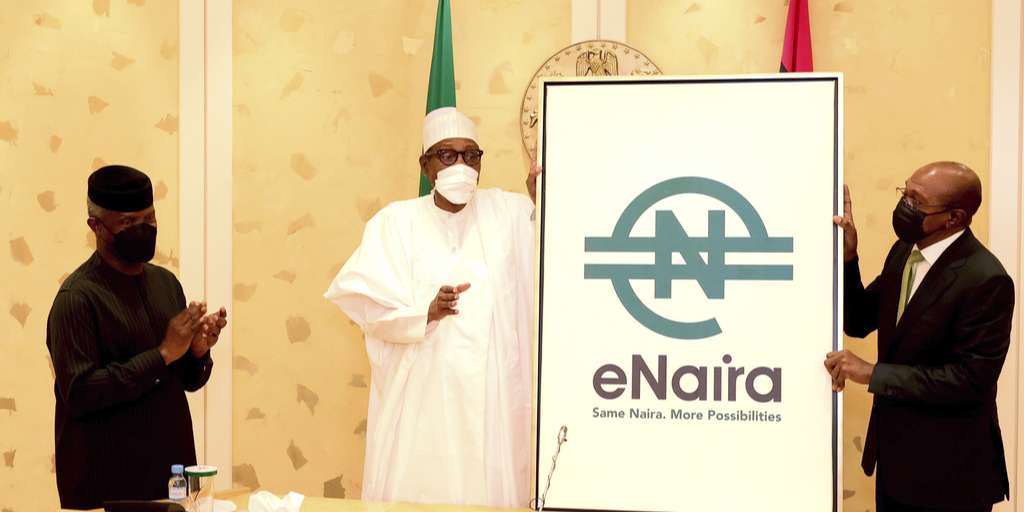
President Muhammad Buhari launched the eNaira on 25 October 2021, under the slogan: “Same Naira, More Possibilities”.

The introduction of the eNaira by the CBN immediately put Nigeria in the global spotlight as the first African country to launch the Central Bank Digital Currency (CBDC).

If fully embraced, there are several benefits for Nigerians and the business community, thereby eradicating many issues surrounding cash transactions.

Some benefits include speedy delivery, safe, simple trading and transactional opportunities for customers and end-users.

More specifically, the benefits to the merchants and business owners include reduced cash handling cost, elimination of failed transactions, instant settlement, increased speed of transactions, improvement in records keeping and elimination of Challenges associated with giving change to customers, amongst others.

Recently, CBN Deputy Governor, Economy Policy, Dr Kingsley Obiora, made it known in the just-concluded Abuja eNaira Merchants Mega Events held at Abuja Chambers of Commerce and industry that there is a reward scheme for merchants and business owners using the eNaira platform.

“I am pleased to inform you that the central bank of Nigeria approved a reward scheme for merchants and other users of the eNaira.

“This reward scheme includes providing merchants with the required scheme includes providing merchants with the required promotional (marketing) materials, subsidizing the current merchant service charge by 50% and activation of a nationwide sensitization which early business adopters of eNaira can leverage on to market its wider adoption “.

It is also important to note that the eNaira platform can now facilitate payments using QR codes, USSD, Wallet ID and eNaira wallet tag. Value-added services on the platform include branch or sub-wallets, employee management, and interoperability with other enterprise applications. Furthermore, these services are provided in a secure environment as the eNaira platform was built using a secure security protocol.

Ample opportunities for increasing business income abound through the adoption of eNaira. For instance, the availability of the eNaira payment option on e-commerce merchant platforms such as Remita is expected to complement the existing digital payment system, translating to about 50% increments in e-commerce transactions at a lower cost.

Going by the innovations and advantages of the eNaira, and the greater understanding that the relaunch is expected to build, it is most likely that the eNaira will, in no distance time, be embraced to enhance financial inclusion further.

Abbas Badmus is with TechDigest Abuja and can be reached via abbasbadamasi946@gmail.com.

CBN set to enlighten Kano business owners about its policies and programmes

By Muhammad Sabiu

The Kano branch of the Central Bank of Nigeria (CBN) has set to educate business owners in December on its policies and how they can venture into various programmes initiated by the apex bank.

This is contained in a letter dated November 25, 2021, and signed by H.S. Mohammed on behalf of the Branch Controller, CBN Kano.

The letter was addressed to the Students’ Union Government president of Bayero University Kano, requesting the student leader to mobilise 50 of his union members at the sensitisation event.

The letter partly reads: “The Central Bank of Nigeria intends to sensitise manufacturers, traders, farmers, banks, artisans, cooperatives and the general public on the various policies and programmes of the Bank which they can key into.

“Consequently, the Bank is cordially inviting you and your members to in-depth presentations from 9:00 a.m daily on Wednesday, 1” and Thursday, 24 December 2021 at Afficent Event Centre, No. 4 Magajin Rumfa Road, Opposite DTSV Office Nassarawa, Kano.”

Explaining what the event is all about, the Bank wrote, “The ‘CBN Fair’ is a harmonised sensitisation program on all the Central Bank of Nigeria’s initiatives (Real Sector Financing and Interventions, Payment Systems Initiatives, Consumer Protection, Clean Naira Note Policy, Financial Inclusion and Consumer Rights) with a focus on the recent e-Naira initiative.”

CBN’s eNaira and the common man

By Zayyad I. Muhammad

On October 25, 2021, President Muhammadu Buhari officially launched the much-awaited Central Bank of Nigeria (CBN) digital currency, the eNaira. The launch of the eNaira is a good and commendable initiative. The CBN said, “As technology evolves and advances, it is critical that Central Banks also evolve to continue to play their roles and the Central Bank Money adapts to take advantage of these opportunities provided by new technologies. Today is one of those moments where new technology offers the Central Bank an enormous opportunity to play its role even better, thereby improving the society and economy of the nation.”

The CBN is right in taking advantage of new technologies. However, there is a problem – many ordinary Nigerians are not aware of the eNaira and its benefits. The CBN has done well in enlightening the already-informed segment of the society on the advantages of the eNaira. The CBN boasts that the eNaira is secured, tamper-proof, processes verifiable transactions, simple and reduces the cost of transactions. But the majority of the common people are not aware of the eNaira and its advantages. So the big question is: What are the innovative approaches through which the CBN can enhance the acceptance and usage of the eNaira and e-transactions, generally among common people in Nigeria?

First, the radio. Radio plays a vital role in enlightening people, especially in rural and peri-urban areas. It is a significant source of information and news. The CBN can take advantage of the radio to create awareness on the benefits of the eNaira. Secondly, telecommunication service providers, with over 80 million users in Nigeria, the GSM creates a platform for the CBN to reach nearly half of Nigeria’s population on the advantages of the eNaira.

The CBN can collaborate with the Ministry of Humanitarian Affairs, Disaster Management and Social Development (FMHDSD) to create an e-wallet for all Federal Government social investment programme beneficiaries. Most of the beneficiaries are poor with prior low financial inclusion. The FMHDSD have ensured these people have bank accounts. Recently, through the Ministry, the Federal Government announced the launch of the Mobile Money Agent Programme and the commencement of training for 1,850 beneficiaries in Nigeria. These are viable means for the CBN to disseminate the advantages of the eNaira.

The CBN may collaborate with businesses that have daily interactions with common people. For example, collaboration with filling stations, market associations and transport unions to use eNaira in their transactions will help integrate more common people on the eNaira platform, as the people can use it with phones that are not internet-enabled. The eNaira should also be enhanced to allow banks to transfer it into a regular bank account automatically.

Bringing ordinary people on board will undoubtedly assist the CBN, and the government boosts the use and acceptance of the e-Naira. A columnist, Gimba Kakanda, wrote, “CBN needs to offer a layman’s explanation of the eNaira and break it down in various local languages to justify its usefulness, difference from cryptocurrency and what sets it apart from the electronic transactions Nigerians are used to.”

To bring millions of common Nigerians on the platform of the eNaira, the CBN should seek the help of experts in media, communication and public relations (PR) to develop programmes and models that will promote the acceptance of the eNaira.

Zayyad I. Muhammad writes from Abuja. He can be reached via zaymohd@yahoo.com.

Buhari unveils eNaira Monday

By Muhammad Sabiu

President Muhammadu will tomorrow Monday unveil the Central Bank Digital Currency (CBD), also known as eNaira, at the State House in Abuja.

Nigeria’s apex bank, in a statement by its spokesperson, Osita Nwasinobi, said this is part of the efforts to ease financial transactions among Nigerians

“The launch of the eNaira is a culmination of several years of research work by the Central Bank of Nigeria in advancing the boundaries of [the] payments system in order to make financial transactions easier and seamless for every strata of the society.

“Following a series of engagements with relevant stakeholders including the banking community, fintech operators, merchants, and indeed, a cross-section of Nigerians, the CBN designed the digital currency, which shall be activated on Monday, October 25, 2021.

“The eNaira, therefore, marks a major step forward in the evolution of money and the CBN is committed to ensuring that the eNaira, like the physical Naira, is accessible by everyone.

“Given that the eNaira is a journey, the unveiling marks the first step in that journey, which will continue with a series of further modifications, capabilities, and enhancements to the platforms,” Mr Nwasinobi said in the statement.

Recall that the launch of the eNaira was early on announced to be held on October 1, but the bank later rescheduled it, citing events to be observed in the celebration of the country’s independence as the reason.