Ekiti State

Forest critical to Ekiti food security agenda – Oyebanji

By Hadiza Abdulkadir

Ekiti State Governor Mr Biodun Oyebanji has described sustainable forests as critical to his administration’s food security agenda.

Speaking in Ado Ekiti at the 2025 International Day of Forests, the Governor reaffirmed his commitment to sustainable forest management and environmental conservation.

Oyebanji, represented by the State Head of Service, Dr. Folakemi Olomojobi, spoke on the theme “Forests and Food” and emphasized the crucial role of forests in biodiversity conservation, climate change mitigation, and food security. 

The Governor stated that forests are not only sources of timber but also sustain livelihoods, ensuring food security for millions of people.

He urged a unified commitment to preserving the state’s forest resources to ensure the sector significantly contributes to the economic development of the state.

In his remarks, the Vice Chairman of the State House of Assembly Committee on Environment, Hon. Oladele Ogunsakin, hailed the inclusion of environmental sustainability as a sub-agenda in the 6-pillar of the Oyebanji-led administration.

Ogunsakin emphasised the importance of enhancing afforestation efforts, urging all stakeholders to engage actively in forest conservation.

Additionally, the Commissioner for Environment and Natural Resources, Erelu Tosin Aluko-Ajisafe, praised the Governor Oyebanji-led administration for its dedication to forest preservation aimed at enhancing food production.

Aluko-Ajisafe, represented by the Ministry’s Permanent Secretary Mr. Tunde Balogun, praised the courage of Non-Governmental Organizations for raising awareness about the importance of discouraging deforestation and bush burning.

Earlier, the Chairman of the State Forestry Commission, Mr. Idowu Akinlabi, stated that the annual celebration aims to highlight the various values of forests and to share experiences on how forests and trees enrich lives and theenvironment.

Akinlabi, who noted that preserving the forest was necessary for food security, called on communities and individuals to support the government in protecting the ecosystem.

In his remarks, the Executive Secretary of Ekiti State Forestry Commission, Mr. Sunday Adekunle, thanked the governor for his steadfast support of forestry initiatives in the state. 

Adekunle raised concerns about deforestation and overlogging in some communities in the northern part of the state, warning that this could lead to environmental degradation.

While urging collaborative efforts to combat deforestation in the state, the Executive Secretary announced the distribution of 100 seedlings to each participating school to foster a culture of environmental conservation among young people.

The event was attended by key government officials, including the Commissioner for Information, Rt. Hon. Taiwo Olatunbosun; the Permanent Secretary in the Ministry of Agriculture and Food Security, Mr. Babatope Ojo; and his counterpart in the Ministry of Environment and Natural Resources, among others.

SSG Adubiaro urges Muslims to continue charitable acts beyond Ramadan

By Muhammad Abubakar

The Secretary to  Ekiti State Government, Prof. Habibat Adubiaro, has called on Muslim faithful to sustain the spirit of giving and compassion beyond the holy month of Ramadan.

Speaking on Sunday during the Sallah prayer at the Central Mosque Eid Praying Ground in Odo Ado, Ado-Ekiti, Prof. Adubiaro emphasized that acts of kindness and generosity should not be limited to the fasting period alone.

She urged Muslims to make charity a continuous practice, extending support to the less privileged throughout the year. 

According to her, the essence of Ramadan encompasses self-discipline, piety, generosity, and values that should be upheld even after the fasting season concludes.

“Our obligations to humanity do not stop after Ramadan. Giving to the needy should not be seasonal but a lifelong commitment. Let us continue to support one another and uplift the less privileged in our communities,” she stated.

Prof. Adubiaro also commended the Muslim community for their dedication to prayers, fasting, and charitable acts during Ramadan. She urged them to uphold the principles of peace, love, and unity, which are essential to Islam.

The annual fasting prayers at the Central Mosque Eid Ground attracted a large gathering of Muslim faithful, clerics, and community leaders who came together to seek divine blessings and guidance. The event featured fervent prayers for the state and the nation as a whole.

Ekiti: Man seen in viral video discharging waste in stream arrested

By Maryam Ahmad

The Ekiti State Ministry of Environment and Natural Resources, in collaboration with the Ekiti State Waste Management Authority (EKSWMA) enforcement team, has arrested a man seen in a viral video discharging liquid waste with an offensive odour into a stream in the Bashiri area of Ado-Ekiti, the state capital.

A statement from the State Ministry of Environment and Natural Resources, Chief Mrs Tosin Aluko- was made available to reporters in Ado-Ekiti. She said, “Following swift action by the Ministry’s enforcement team, the perpetrator was apprehended, and his vehicle  impounded.”

She said the suspect claimed during interrogation that he was discharging dirty water, not sewage, into the stream.

The Commissioner announced that to prevent any potential health hazards from the dumped waste, the samples from the affected site have been taken to analyze the chemical and microbiological material contained in material discharged in the stream. At the same time, the entire area will be thoroughly fumigated to safeguard the health and well-being of residents.

She said thorough investigations involving officials of her Ministry and the Ekiti State Waste Management Authority were ongoing to prevent future occurrences and maintain a cleaner, safer environment in Ekiti State.

The Commissioner emphasized that the state government has zero tolerance for illegal waste handling and disposal and stressed that the offender would soon be prosecuted. 

“The law will take its full course. Acts like this endanger public health and the environment. We must protect our communities,” she said.

Erelu Aluko-Ajisafe urged residents to remain vigilant and report any acts of environmental violation to the appropriate authorities. 

She encouraged the public to continue “blowing the whistle” on activities that threaten environmental safety.

MURIC congratulates new Ekiti governor, SSG

By News Desk

An Islamic human rights organisation, the Muslim Rights Concern (MURIC), has congratulated the new governor of Ekiti State, Biodun Abayomi Oyebanji (BAO), on his assumption of office. The group also felicitated with the newly appointed Secretary to the State Government (SSG), Dr Habibat Omolara Adubiaro.

The statement, which was issued on Monday, 17th October 2022, was signed by the group’s director, Professor Ishaq Akintola.

MURIC recalled that Muslims in the state had been politically marginalised in the past. It commended the new governor for deeming it fit to pick a Muslim as his SSG. The group, therefore, described the Oyebanji administration as one which prepared to herald a new dawn. It urged the governor to strengthen his position further by running an inclusive government.

The statement added that both Muslims and Christians have a lot in common as adherents of the Abrahamic faith. It, therefore, advised Governor Oyebanji to appoint more Muslims into his cabinet in order to draw Muslims in the state closer to his administration. Finally, we implore citizens of Ekiti State to cooperate with the new governor in order to take the state to new heights.

2023 polls will be best ever in Nigeria – INEC chairman 

By Uzair Adam Imam 

Prof. Mahmood Yakubu, the Chairman of the Independent Electoral Commission (INEC), has vowed that the come 2023 general election will be the best ever in Nigeria’s history.

Yakubu said this Tuesday, July 19th 2022, in Abuja, when he received delegations of the International Republican Institute (IRI) and that of the National Democratic Institute (NDI).

He also assured that INEC would improve on its successes in subsequent elections to come.

The Daily Reality gathered that the meeting was the first that INEC was hosting after Saturday’s governorship election in Osun State.

Yakubu was quoted as saying, “We assure you that we will continue to work not only hard but even harder to deliver the 2023 general elections.

“As for the preparation for the 2023 general elections, I want to assure you that we promised Nigerians that Ekiti was going to be good, and Ekiti was a good election.

“We promised that Osun was going to be better; Osun was a better election. We are promising that the 2023 general elections will be our best election ever, and we are committed to delivering the best election ever,’’ Yakubu said.

Speaking earlier, Secretary of State for Ohio, United States and leader of the delegations, Mr Frank LaRose, had commended INEC over on its successes.

He, however, commended INEC for its various efforts to improve the conduct of elections in Nigeria.

He states, “we took the opportunity to visit Osun because that was only the second time election has been conducted under the new Electoral Law. 

“We met with the Resident Electoral Commissioner (REC) in Osun, and we observed many different polling locations on Election Day,” he stated. 

APC beats PDP, SDP, others to win Ekiti governorship election

B Muhammad Sabiu

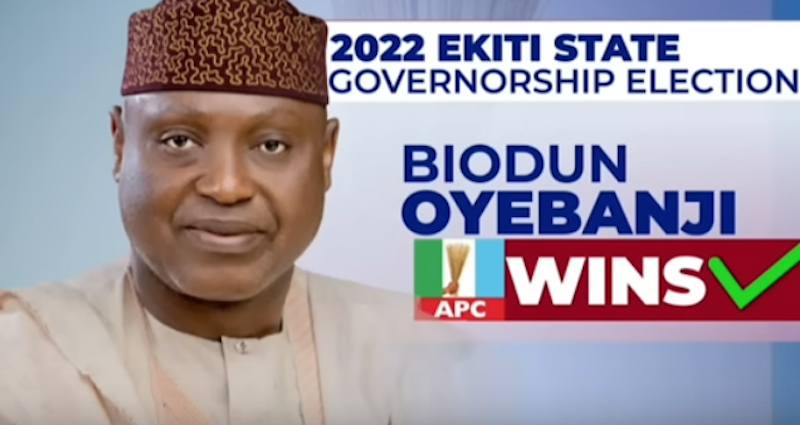
In the early hours of today (Sunday), the All Progressives Congress in Ekiti State emerged triumphant after the results of Saturday’s governorship election indicated that the party’s candidate, Mr Biodun Oyebanji, defeated the 15 other contestants that took part in the race.

Oyebanji, the state’s immediate past Secretary to the Government, won in 15 of the state’s 16 Local Government Areas after receiving 187,057 votes in the election.

His nearest rival, Mr Segun Oni of the Social Democratic Party, polled 82,211 votes, while Bisi Kolawole of the Peoples Democratic Party received 67,457 votes.

Kolawole won his LGA, Efon, with a total of 6,303 votes, beating the APC’s 4,012 votes and the SDP’s 339 votes.

However, Chief Segun Oni, the Social Democratic Party’s candidate, who voted in his home town of Ifaki-Ward Ekiti’s 2, Unit 6, accused the other parties of vote-buying in Ado Ekiti and Oye Ekiti.

He was reported to have said, “I have been told that selling and buying of votes are going on in Ado and Oye. This is not allowed by the law. I want security agents to move in and stop those doing that.”

Vote buying isn’t an unusual practice in the Nigerian political space since the rebirth of democracy in 1999 when former President Olusegun Obasanjo took over power.

IGR, VAT controversies: a bright future for northern Nigeria

By Muhammad Sagir Bauchi

Adam Smith, in “Wealth of Nations”, while discussing what he tagged as “Canon of Taxation”, outlines some principles he describes as “Principles of Good Taxation”. These principles include fairness, certainty, convenience and efficiency. By the principle of fairness, he meant that the taxpayer’s condition should be considered before enforcing tax on him; this is in addition to the ability of the taxpayer to pay the tax. By certainty, the taxpayer should be informed on why he needs to pay his tax and how such taxes are levied on him. By the convenience, he refers to how the taxpayer finds the process of paying the tax as easy as it is. The final principle of efficiency described how the tax payment should have no negative effect on the distribution of resources in the economy.

In a short story, a man came to someone and asked him, “what should I be giving you every day?” He replied: “Sand”. So, as requested, whenever he meets that person, he picks up sand on the ground and hands it over to him. 

One day, that man came to him to collect the sand, but he looked at him abruptly and said, “Why can’t you bend down and fetch it by yourself? Why should I be giving you what you can have if you work hard?”

Recently, there has been an uproar between Federal Inland Revenue Services (FIRS) and Ekiti State Government. As a result, the state government came up with a law regulating Value Added Tax (VAT) collection. With the new law, the Ekiti state government will have absolute power to utilise the VAT generated from that state instead of the usual remittance to the Federation Account! Ab initio, a State high court granted an order to the Ekiti government to move on with their new VAT policy since they have already enacted a law to that effect. Still, a move by the FIRS through the Appeal Court blocked Ekiti State Government from putting the law into effect.

In the beginning, the will to challenge the Federal Government on VAT collection by the states was spearheaded by a single state. Still, by looking at the fruition that may come out from the success of such a legal battle, some states from the South-South joined Ekiti in the suit, thereby sending their representative to the Appellate Court.

Before going further, we need to understand what VAT refers to; for that, we will shed more light on the desperation and motives of these states to have the right to deduct VAT within the economy of their states.

According to FIRS, VAT is “a consumption tax paid when goods are purchased and services rendered“  to this, “all goods produced within or imported into the country are taxable except those specifically exempted by the VAT act”.The authorities responsible for the deduction of the VAT are; indigenous companies with non-resident companies within the country; government ministries, statutory bodies and other agencies of government; and companies operating in the oil and gas sector. These are the statutory bodies saddled with the responsibility of deducting the VAT in Nigeria.

From 2016-2020, Nigeria recorded more than five trillion naira from VAT deduction, but surprising, about three point nine trillion of that amount came from Ekiti and Lagos State. And as usual, the whole amount was shared between the three tiers of government with some amount given to the FIRS for its VAT deduction services! Naturally, human beings are similar to those two people mentioned that one gives sand and the other received, which at the end one expressed tiredness. 

Sentiment aside, it is hard to imagine how a state or region would work diligently harnessing such a hefty amount, in which, in the end, it will be shared with others that contributed little out of it.

Before discovering oil in commercial quantity, the Northern Region of Nigeria was the main contributor to GDP growth, which means that the agricultural sector was the primary source of foreign exchange to the country. But today, despite the contribution of agriculture to the GDP, Northern States rely primarily on what is given from the federation account. Today, it is no longer a secret that only some few Northern states can stand on their own to pay their workers salaries and wages, fulfil their financial commitments, not to mention financing their annual budgets. Most of them would go broke and insolvent if the federal government decided to withhold their monthly allocation for a single month!

To some analysts, the action of Ekiti and Lagos State Governments is nothing but a display of absolute selfishness. Still, to me, it is nothing but expressing their worth and importance to their counterparts.

Amidst this VAT controversy, a new statistical report on Internally Generated Revenue (IGR) of the 36 states of the federation for the fiscal year of 2020 was released. Lagos State is topping the list with about 418bn, Rivers with 117bn and Delta as the third. The report stated that only two Northern States are among the top 10 states with highest IGR, that’s Kaduna and Kano State. And it is not surprising since Kano is the commercial hub of the North. But, surprisingly, even the commercial nerve of the North is generating less IGR than Kaduna. Are commercial activities taking place in Kaduna greater than that of Kano? This shows that there’s transparency and accountability in Kaduna state more than that of Kano.

If one analyses that IGR statistical report and the five-year VAT table, he will weep for the sorry state of the northern states! And the implications of the possible ruling favouring those two states (Ekiti and Lagos) by the Appellate Court against the federal tier, then not only the northern states, but the remaining 34 states would find themselves in deep economic crises.

Then, what should the Northern policymakers do to improve their IGR and move away from dependence on monthly federal allocation?

I foresee a bright future for the northern states out of this development if only their policymakers pursue policies with a serious positive impact on the income of its majority (who are peasant farmers) other than policies that could only favour the wealthy and those in the government. For instance, if the agricultural sector will be given proper attention, thereby coming up with policies that could boost commercial farming through accessibility to quick/soft agro related loans, hybrid seeds with the ability to stand these ever-changing climatic conditions, mechanised farming equipment, setting up subsidised agro-allied chemical industries in the region, provision of good accessible roads connecting all the remote areas, all year round farming and a fair export zones, with these, its unemployed youths will surely seize that opportunity and venture into agro-businesses without looking up to the government for job opportunities in the government sector. But imagine an agricultural intervention program meant to cushion farmers difficulties is deeply flawed in I don’t care attitude of government officials, deliberate delays and nepotism, in the end, such interventions may not meet the majority of farmers on time!

Other regions in Nigeria cannot feed themselves without the support of the Northern farmers. So, why should we be panicking when they try to withhold their money? Why can’t the North stand up and bring out those opportunities? 

Despite the insecurity in almost all parts of the Northern region, one fact that can never be denied is that the area is blessed with arable land, enough for cultivating in dry and rainy seasons. Therefore, adequate farming inputs and machinery should be provided, either in loans or at a subsidised rate by the Northern states governments.

Curbing insecurity is another point that all the governors of the 19 northern states should work hand-in-hand to achieve.

Senators, Representatives and States Assembly members should focus on things that harmonise them with their governors to formulate policies that will boost their states IGR, rather than engage in their usual political war, which deprives millions of citizens of opportunities that may bring development to their livelihood and the region at large.

The impact of Small and Medium Enterprises (SMEs) in boasting every economy can never be neglected in every sound economy. But in northern Nigeria, those SMEs are either forced to shut down due to unfriendly tax policies or poor environment to carry out their activities. So, those SMEs should be given more reason to be alive than to seize to exist, thereby granting them soft loans with zero interest or a low interest rate and a friendly environment to carry out their activities.

Most of those states with high IGR have different means of gathering or sourcing revenue within their states. But in the North, both the tax collectors and taxpayers are not up to their responsibility. Therefore, a transparent and professional agency should be enacted in every state with the sole aim of creating awareness on the importance of paying tax, why they should be taxed and the transparent manner in which their tax is utilised.

Lastly, the principle of fairness, certainty, convenience and efficiency should be put into practice to generate more tax to boost IGR for those states.

Sagir writes from Bauchi State and can be reached via ibrahimsagir1227@gmail.com and 07019718681.