Coup

‘We Want Peace, Not Change of Govt’ – Protesters Tell FG


By Abdullahi Mukhtar Algasgaini

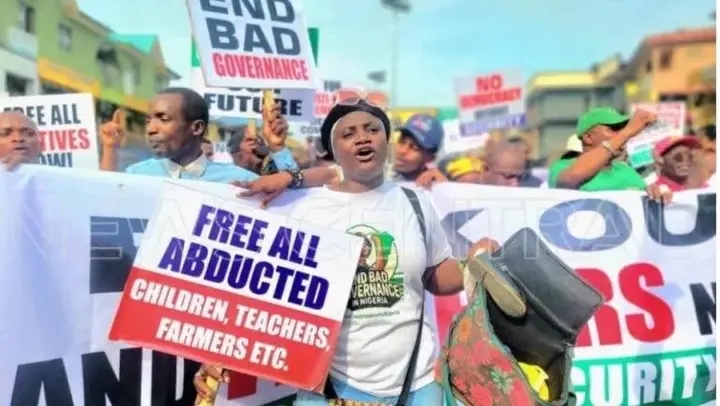
Protesters under the Nigeria Unite Against Terrorism banner marched through Abuja on Democracy Day, June 12, 2026, demanding urgent action against insecurity while distancing themselves from calls for President Bola Tinubu’s removal.

As Nigeria marked the 2026 Democracy Day anniversary, scores of demonstrators gathered in parts of Abuja on Friday, insisting their movement was solely about restoring peace and security, not unseating the current administration.

The protest came amid rising concern over worsening insecurity across the country, and followed a separate demonstration led by social media activist Martins Vincent Otse, known as VeryDarkMan (VDM), whose supporters had called for President Tinubu’s resignation.

Organisers of Nigeria Unite Against Terrorism were quick to draw a clear line. “We are not asking anybody to leave government. We are not saying an end to any government. What we are saying is that Nigeria should live in peace,” one protest leader declared.

Addressing journalists in Abuja, organisers said Nigerians had reached a breaking point as terrorism, banditry and kidnapping spread across different regions.

“Nigerian citizens, enough is enough. Thank God Mr President in his speech this morning has told us that there is time to end plea bargains and other subtle approaches towards terrorism in Nigeria. This gives us hope that we are moving forward in the fight against terrorism,” the speaker said.

He traced the expansion of insecurity over the years: “In 2012, it was the North-East. By 2015, the North-West was engaged. Before we got to 2019, North-Central Nigeria was affected. Now this is 2026, the South-West is feeling the bite.”

He warned that failure to act decisively could leave the country vulnerable to non-state actors. “If we fold our arms and watch, Nigeria is about to be taken over by non-state actors… One day we will start paying taxes to bandits and deriving protection from those who seek to destroy us.”

According to organisers, the movement was initiated weeks ago to alert both government and citizens to the growing security emergency. “We have decided to make this move to bring to the notice of government and people in power that Nigerians are tired. Nigerians are making their voices known. Nigerians are saying that we are no longer comfortable with the trend of terrorism.”

Another speaker described the campaign as a non-partisan national movement uniting Nigerians across political, religious and ethnic lines. “We are not political. We are a sovereign nation called the Federal Republic of Nigeria. Everyone is now a victim of insecurity.”

He argued that successive governments have failed to permanently address the problem. “Government comes, government goes, but the insecurity is still on. We acknowledge the efforts of our security operatives, but something is missing.”

The protesters called on Nigerians to set aside partisan interests and unite against what they described as the country’s common enemy. “It is now that we suspend our political differences. It is now that we suspend our religious beliefs and regional interests. We must promote a sovereign Nigeria that is safe from banditry, kidnapping and Boko Haram.”

They appealed to civil society organisations, religious groups, academics and ordinary citizens to join the campaign from the North to the West, from the South-East to the South-South — Muslims, Christians, pagans, free thinkers and the academic community.

The organisers urged the federal government to remain open to citizen suggestions on tackling insecurity and encouraged Nigerians to provide timely intelligence to security agencies. “When you see something, say something. And when you say something, the government should do something,” they said.

They also cautioned against sympathising with criminal groups. “Don’t be loyal to bandits. Don’t be loyal to kidnappers. Don’t be loyal to Boko Haram,” they added.

Reiterating that their campaign is not politically motivated but driven by a collective desire for peace, one organiser quoted British philosopher Edmund Burke: “When the bad men combine, the good must associate, else they will fall one by one, an unpitied sacrifice in a contemptible struggle.”

Attempted coup thwarted in Benin Republic, senior commander, ex-minister arrested

By Uzair Adam

Authorities in the Benin Republic have foiled an attempted coup, leading to the arrest of a former sports minister and a senior military commander.

The plot was allegedly scheduled for Friday, according to a statement from Elonm Metonou, the special prosecutor at Benin’s financial crimes and terrorism court.

On Tuesday night, Oswald Homeky, the former sports minister, was apprehended while handing over six bags of cash, totaling 1.5 billion West African CFA francs (approximately $2.5 million), to Djimon Dieudonne Tevoedjre, the commander of the republican guard and head of security for President Patrice Talon.

The transaction occurred around 1:00 am, and the cash was reportedly transported in Homeky’s Toyota Prado, which bore fake license plates.Prosecutors revealed that the funds were part of a broader conspiracy involving Homeky and Olivier Boko, a businessman and longtime friend of President Talon.

Boko, who was separately arrested on Monday in Cotonou, had recently signaled his intentions to run for the presidency in 2026, when Talon’s second term concludes.

Investigations indicate that Homeky and Boko paid the military commander to ensure no resistance from the republican guard during the planned coup.

Authorities also uncovered that the suspects had opened a bank account under the commander’s name in Côte d’Ivoire on August 6, as part of their preparation.

The arrests come amidst increasing criticism of President Talon’s administration, with detractors accusing him of undermining democratic institutions.

Investigations are ongoing as authorities work to apprehend other individuals involved in the conspiracy.

Since 2020, West Africa has witnessed a wave of military coups and attempts, with Benin now joining the list of nations grappling with threats to its political stability.

Metonou emphasized that efforts are underway to ensure justice is served and to prevent future attempts at destabilizing the country.

Breaking News: Military coup in Sudan

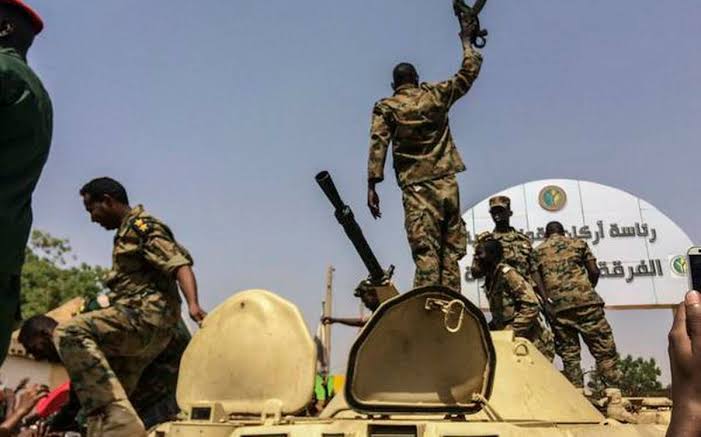
Through out last week, there were rising fears among the Sudanese as the military were about to intrude into the civilian spaces. Tension was so high, a situation that led to the closure of businesses, offices and many people remained indoors in the Capital city of Khartoum. However, earlier in the morning, there was a reported military coup.

According to CAIRO (AP) — Military forces arrested Sudan’s acting prime minister and senior government officials Monday, disrupted internet access and blocked bridges in the capital Khartoum, the country’s information ministry said, describing the actions as a coup.

In response, thousands flooded the streets of Khartoum and its twin city of Omdurman to protest the apparent military takeover. Footage shared online appeared to show protesters blocking streets and setting fire to tires as security forces used tear gas to disperse them.

Protesters could be heard chanting, “The people are stronger, stronger” and “Retreat is not an option!” as plumes of smoke from burning tires filled the air.

A takeover by the military would be a major setback for Sudan, which has grappled with a stop-and-go transition to democracy since long-time ruler Omar al-Bashir was toppled by mass protests two years ago.

The United States and the European Union expressed concern over Monday’s developments.

Jeffrey Feltman, the U.S. special envoy to the Horn of Africa, said Washington was “deeply alarmed” by reports. Feltman had met with Sudanese officials over the weekend in an effort to resolve a growing dispute between the country’s civilian and military leaders. EU foreign affairs chief Joseph Borrell tweeted that he’s following events with the “utmost concern.”

The first reports about a possible military takeover began trickling out of Sudan before dawn Monday. By mid-morning, the information ministry confirmed that the prime minister, Abdalla Hamdok, had been arrested and taken to an undisclosed location. Several senior government figures were also detained, the ministry said in a Facebook post. It said their whereabouts were unknown.

In other hallmarks of a takeover, internet access was widely disrupted and the country’s state news channel played patriotic traditional music. At one point, military forces stormed the offices of Sudan’s state-run television in Omdurman and detained a number of workers, the information ministry said.

Monday’s apparent takeover came after weeks of rising tensions between Sudan’s civilian and military leaders. A failed coup attempt in September fractured the country along old lines, pitting more-conservative Islamists who want a military government against those who toppled al-Bashir in protests. In recent days, both camps have taken to the street in demonstrations.

Under Hamdok and the transitional council, Sudan had slowly emerged from years of international pariah status in which it existed under al-Bashir. The country was removed from the United States’ state supporter of terror list in 2020, opening the door for badly needed international loans and investment. But the country’s economy has struggled with the shock of a number economic reforms called for by international lending institutions.

There have been previous military coups in Sudan since it gained its independence from Britain and Egypt in 1956. Al-Bashir came to power in a 1989 military coup that removed the country’s last elected government.

Among those detained Monday, in addition to Hamdok, were five senior government figures, according to two officials who spoke on condition of anonymity because they were not authorized to share information with the media.

Those detained included Industry Minister Ibrahim al-Sheikh, Information Minister Hamza Baloul, and Mohammed al-Fiky Suliman, member of the country’s ruling transitional body, known as the Sovereign Council, as well as Faisal Mohammed Saleh, a media adviser to Hamdok. Ayman Khalid, governor of the state containing the capital, Khartoum, was also arrested, according to the official Facebook page of his office.

After news of the arrests spread, the country’s main pro-democracy group and the Sudanese Communist Party issued separate appeals for Sudanese to take to the streets.

Separately, the Communist Party called on workers to go on strike in an act of mass civil disobedience after what it described as a “full military coup” orchestrated by the Sovereign Council’s head Gen. Abdel-Fattah Burhan.