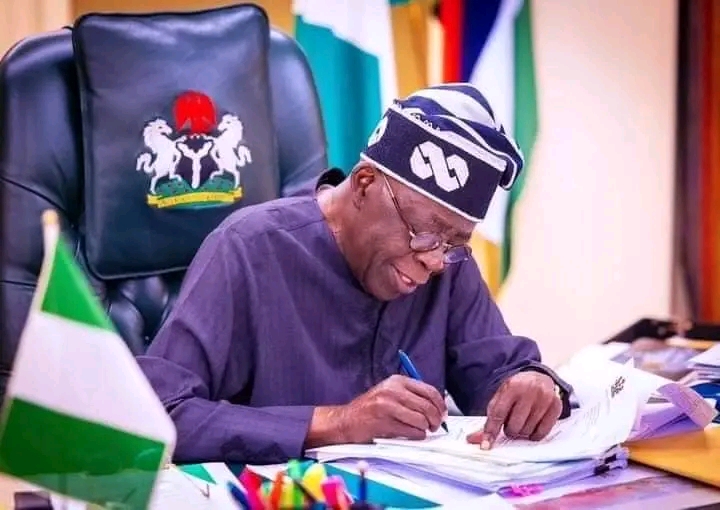
Asiwaju Bola Ahmed Tinubu

Multiple blows to a reactive North: Emilokan na your mate? 

By Shettima Dan’Azumi, ESQ

Northern Nigerian states are gradually losing a significant portion of their Federal Accounts and Allocation Committee (FAAC) allocation shares, which is undoubtedly their biggest revenue source. From the Local Government Funds and Fiscal Reform Bills to dividends from NLNG shares of NNPC and, today, the National Lottery, all these are part of the pool that makes up the monthly national cake distribution known as FAAC.

These developments are not surprising to any student of development. We all saw it coming. Early this year, the Supreme Court, in a suit filed by the Federal Government, scrapped the States and Local Government joint account, which had previously entrusted local government funds to their respective states.

In another case, the Supreme Court also agreed with the AGF’s argument. It held that the NNPC’s stake (shareholding) in the NLNG, unlike the NNPC itself, actually belongs to the Federal Government, not the entire Federation. Those billions of dollars accrued to NNPC from NLNG annually are no longer to be shared with the States as part of FAAC. 

Similarly, VAT, a chunk of the non-oil revenue currently shared based on equity, derivation, and population formula amongst FG, States, and Local Government, will, if Emilokan’s Executive Bill succeeds at the National Assembly, now be shared based on derivation or consumption or both. Either way, I don’t see how the North can benefit. I will get to the reason shortly. 

Then came today, another blow in a Suit initiated by the Lagos State Government. The Learned Justices of the Supreme Court, while granting all the reliefs sought by the AG of Lagos State, held that revenues accrued to the Federation through the National Lottery Commission from the regulation and royalties of lottery and other online games are in reality within the Residual Legislative List, exclusive to States to regulate and generate revenues from. 

I believe there may be more of these seemingly harsh interpretations of the law in the near future because that is what the Constitution actually contemplated. 

If you put these chains of events together, you would only come to one conclusion: that full federalism is taking a crude shape in the country against the wish of everyone. We would have prepared for this time if northerners had been thoughtful and proactive. We would have confronted the issue of restructuring with strategy rather than our usual rejectionist attitude to achieve it on our terms and put a timeline for gradual implementation to minimise its impact. With our sell-out NASS members, who either do not appreciate where all this is headed or have been bought to look away, it’s only a matter of time. May Allah rest the soul of Senator Suke Yaro Gandi and the rest of his contemporary visionaries and patriots. 

What should we expect now? Our FAAC-reliant states will receive a shorter allocation. If VAT is to be shared based on derivation, then most of the Corporate Headquarters of businesses where the remittance of VAT takes place are far away from the north. What if it’s to be shared based on consumption? The follow-up question is: how do you determine the end users when you don’t have the data to prove where it is consumed? Even if this data exists, most of our businesses in the north, including Kano State, are not formal businesses, so their distributors are in Lagos and other Southern States. Our traders are running away from the institutionalisation of corporate governance frameworks in their businesses, which will give them the capacity to deal with manufacturers and wholesalers directly and document their dealerships properly. We are simply traders. 

The lottery is worse because most states think the whole business is haram. But, wait, is it not the double standard that you are operating a secular state, collecting VAT revenue generated from breweries and royalties from casinos, including the lottery, for all these years while still believing it’s haram? At least, it would soon be over, and we shall stick with halal revenues.

To cut a long story short, the North must wake up on governance and development issues. The culture of electing clueless governors and the dominance of corrupt and soulless political class must end. We must pay more attention to our manpower and skills development policies and reform our education systems because that’s what all these boil down to. EDUCATION! Our youth must stop social media praise-singing and political sycophancy and embrace education and skill acquisition. Our businesses must adopt corporate governance and innovation and be more industrious and forward-thinking. 

Because Emilokan is not your mate.

Tinubu mourns Ahmadu Kurfi’s death

By Anas Abbas

President Bola Tinubu expressed his condolences to the government and people of Katsina State following the death of Alhaji Ahmadu Kurfi, the Maradin Katsina and district head of Kurfi. 

Alhaji Kurfi, a distinguished elder statesman, was renowned for his significant contributions to public service throughout his career. Notably, he served as the executive secretary of the Federal Electoral Commission (FEDECO), playing a crucial role in overseeing Nigeria’s transition to democratic rule in 1979.

President Tinubu praised Kurfi’s exemplary dedication to the nation and humanity, urging current public servants to reflect on the legacy he has left behind.

The President also offered prayers for the eternal peace of the late elder statesman and extended his deepest sympathies to Kurfi’s family during this difficult time.

The passing of Alhaji Kurfi marks a significant loss for Katsina State and the nation as a whole.

Tinubu travels to Brazil for G20 summit

By Anwar Usman

President Bola Tinubu has landed in Rio de Janeiro, Brazil, to attend the 19th Heads of State and Government Summit of the Group of 20 (G20).

The President, who arrived on Sunday at 11.03 p.m. local time (Monday 3. 03 a.m. Nigerian time), was received by Amb. Breno Costa in the Ministry of External Relations of Brazil.

The president was joined by Yusuf Tuggar, the Minister of Foreign Affairs; Idi Mukhtar Maiha, the Minister of Livestock Development; and Hannatu Musawa, the Minister of Art, Tourism, Culture, and Creativity.

Others are the Minister of State for Agriculture and Food Security, Dr Aliyu Sabi Abdullahi, and the Director General of the National Intelligence Agency, Amb. Mohammed Mohammed.

The president is also expected to hold bilateral meetings on the sidelines of the summit on advancing Nigeria’s socio-economic reforms.

Brazil’s president, Lula da Silva, is hosting the 2024 G20 summit. He has held the group’s rotating presidency since December 21, 2023, and his tenure ends on November 30.

The summit, themed: “Building a Just World and a Sustainable Planet,” will focus on three areas of sustainable development – economic, social, and environmental – and the reform of global governance.

It will also highlight the rising global temperatures and the principles of the digital economy, among other themes.

The Brazilian presidency will also discuss, as a priority, the Israel–Hamas war and the rising bloc confrontation between the United States and China.

NAN reports that the conclusion of the work carried out by the country holding the G20 rotating presidency is usually presented at the annual summit.

It is when heads of state and government approve the agreements negotiated throughout the year and point out ways of dealing with global challenges.

Regarding the summit theme, Da Silva declared a three-point agenda of combating hunger, poverty, and inequality at the summit, scheduled for November 18 to November 19.

Tinubu is attending the 2024 G20 summit, to which the organisers invited representatives of the African Union and the European Union.

The Brazilian Ambassador to Nigeria, Carlos Areias, invited Da Silva to Tinubu to attend the 2024 G20 summit on Aug. 29, when he presented his Letter of Credence to him.

Areias had said Da Silva was looking forward to welcoming Tinubu to the G20 Leaders’ Summit, saying that food security was the main proposal of the Brazilian presidency at the G20 to eliminate extreme poverty by 2030.

Tinubu to host Indian PM Modi for bilateral talks in Abuja  

By Uzair Adam 

President Bola Ahmed Tinubu will host Indian Prime Minister Narendra Modi for a State Visit at the Presidential Villa in Abuja on Sunday.  

The Daily Reality gathered that this historic visit marks the first time an Indian prime minister has been to Nigeria since Dr. Manmohan Singh’s trip in 2007, during which a strategic partnership between the two nations was established.  

The Special Adviser to the President on Information and Strategy, Bayo Onanuga, disclosed this development in a statement on Saturday.  

According to Onanuga, the meeting aims to bolster ties between Nigeria and India. Both leaders will discuss avenues for collaboration across critical sectors. 

“Both leaders will exchange signed Memoranda of Understanding to enhance cooperation,” he stated.  

Prime Minister Modi is expected to arrive in Nigeria on Saturday ahead of the talks scheduled for Sunday.  

This visit underscores the commitment of both nations to deepening their longstanding bilateral relationship.

President Tinubu plans to lift Nigerians out of poverty – Gov. Uba Sani

By Abdullahi Mukhtar Algasgaini

Governor Uba Sani of Kaduna State says President Bola Ahmed Tinubu is determined to wipe out poverty in Nigeria.

Sani made this known at a town hall meeting and sensitization event on Tuesday in Kaduna for the N200 billion Presidential Intervention Fund and Loans Scheme for SSMEs, which the Federal Government organised in collaboration with the Bank of Industry.

He was represented by his Special Adviser on Economic Matters, Mr Ibrahim Muhammad.

He said the fund, which includes the Presidential Conditional Grant Scheme and loan options for MSMEs, is designed to boost Nigeria’s economy by empowering local entrepreneurs.

“This massive presidential initiative is proof that President Tinubu is a listening leader.

“Through these stimulus packages, small businesses and manufacturing enterprises will be revitalized, significantly benefiting both sub-national economies and Nigeria as a whole.”

He also emphasised the importance of MSMEs in driving job creation, innovation, and economic resilience, noting that Kaduna’s government is committed to fostering a supportive business environment.

The governor praised the timing of the fund, calling it a valuable support for Kaduna State’s ongoing efforts to boost the local economy, create jobs, and encourage entrepreneurial growth.

He urged all stakeholders to spread awareness of the initiative to maximize its impact.

Speaking at the event, Mrs Caroline Bala, one of the grant beneficiaries, expressed gratitude for the financial assistance that enabled her to start a soya milk business after she lost her previous job.

Bala said her business has been thriving, with daily earnings between 10,000 to 15,000 Naira.

She urged the organisers to sustain the initiative and ensure that deserving citizens continue to benefit from the grant, which she described as a life-changing opportunity.

Another beneficiary, Mr Albert Ibrahim, said he utilised the grant to purchase herbicides for his farm, resulting in a bumper harvest.

He expressed hope that others would also have the chance to benefit from this scheme.

Similarly, Summayya Ibrahim thanked the government for the support, adding that she looked forward to more assistance to enable broader outreach to aspiring entrepreneurs.

Muktar Aliyu, a cartoonist, said he used his grant to purchase specialised software to enhance his creative work.

He also appreciated the scheme, noting that it has greatly impacted his career.

Additionally, Mrs. Joy Oghiadomhe of the Bank of Industry outlined the eligibility criteria for both the grant and loan schemes, emphasizing the administration’s intent to tackle economic challenges through MSMEs as a key sector for development.

Senate confirms Yusuf Ata, Suwaiba Ahmad, others as ministers

By Uzair Adam 

The Senate has approved the nomination of several new ministers following a rigorous screening process. 

Among those confirmed are Yusuf Abdullahi Ata as Minister of State for Housing and Bianca Odumegwu-Ojukwu as Minister of State for Foreign Affairs.

Other appointees include Dr. Jumoke Oduwole as Minister of Industry, Trade, and Development, Dr. Nentawe Yilwatda as Minister of Humanitarian Affairs and Poverty Reduction, and Muhammadu Dingyadi as Minister of Labour and Employment. 

Idi Muktar Maiha was also confirmed as Minister of Livestock Development, and Dr Suwaiba Said Ahmad was confirmed as Minister of State for Education.

The Senate dedicated approximately five hours to screen and confirm the nominees following a motion by Senate Leader Opeyemi Bamidele to suspend certain procedural rules. 

This suspension allowed the Special Adviser to the President on Senate matters, Basheer Lado, to introduce the nominees during the plenary session.

Last week, Senate President Godswill Akpabio read out President Bola Tinubu’s letter listing the nominees for the ministerial positions.

Nigeria targets boost in oil production by 1 million barrels per day in next two years

By Uzair Adam 

The Federal Government has launched an ambitious initiative to increase Nigeria’s crude oil production by one million barrels daily within the next 12 to 24 months. 

This plan is part of broader efforts to address challenges such as oil theft, pipeline vandalism, outdated infrastructure, and attracting new investments.

The Nigerian Upstream Petroleum Regulatory Commission (NUPRC) noted a 1.68% decline in production from 1.571 million barrels per day in August to 1.544 million barrels per day in September. 

Despite this, the government’s new initiative, “Project 1MMBPD,” is expected to restore production levels through strategic interventions.

President Bola Ahmed Tinubu, represented by Senator George Akume, the Secretary to the Government of the Federation, emphasized that increasing production is crucial for boosting national revenue and economic growth. 

“Projecting one million barrels per day is a step towards a more sustainable future for Nigeria’s oil and gas sector,” the President said at the event marking NUPRC’s third anniversary.

Minister of State for Petroleum Resources, Senator Heineken Lokpobiri, urged the sector to aim for even higher targets. 

He noted that Nigeria once produced over two million barrels per day and should be looking to reach 2.5 million in the short term and four million barrels per day in the long term.

The government also approved four major divestment deals, including ExxonMobil’s sale of its assets to Seplat Energy, while blocking a $2.4 billion Shell divestment deal with Renaissance. 

Mallam Mele Kyari, the group CEO of NNPC Limited, and Tony Elumelu, the chairman of UBA Group, stressed the urgent need to modernize the country’s over 50-year-old oil infrastructure as key to achieving the new production goals. 

Both highlighted the impact of pipeline vandalism and regulatory uncertainty as major hurdles that need to be addressed to safeguard Nigeria’s oil sector and economy.

The incessant collapse of the national grid

By Zayyad I. Muhammad

In just 24 hours, Nigeria’s national grid collapsed twice, marking the seventh collapse over the past year. These disruptions are not new; they reflect longstanding issues within Nigeria’s power sector, driven by inadequate infrastructure, maintenance challenges, vandalism, and systemic corruption. The persistence of the national grid across almost all administrations that came before President Bola Ahmed Tinubu’s administration highlights how deeply rooted the problem is.

Many ordinary Nigerians are unfamiliar with the concept of the national grid. The national grid is an interconnected network designed to deliver electricity from producers to consumers. The grid comprises generation stations that produce electricity, high-voltage transmission lines that carry this electricity over long distances, and distribution systems that reduce the voltage for delivery to homes and businesses.

Why does Nigeria’s national grid often experience collapses? Many Nigerians have accepted that these ‘collapses’ are part of the country’s electricity sector.

Can Nigeria stop the frequent collapse of its national electricity grid? Certainly. Many countries have achieved reliable and efficient electricity generation, transmission, and distribution systems, providing their citizens with consistent access to power. These nations have demonstrated that it is possible to overcome infrastructure challenges and create a resilient energy sector.

To achieve similar results, Nigeria should benchmark against the successes of other countries, learning from their strategies and best practices. However, it must also consider its local needs and unique challenges, such as geographical diversity, population distribution, people’s pockets, the need to support businesses and varying energy demands. An effective strategy would involve engaging local stakeholders and addressing issues like outdated infrastructure and insufficient maintenance.

This approach can realise stability and reliability in the national grid. Furthermore, substantial investments in infrastructure, technology, and human resources are essential. This includes upgrading existing facilities and investing in renewable energy sources to diversify the energy mix. 

Building a skilled workforce to manage and maintain the grid will also be crucial. With the proper focus and investment, Nigeria can transform its electricity sector and ensure reliable power for all its citizens.

 Zayyad I. Muhammad writes from Abuja via zaymohd@yahoo.com

Palliatives are not solutions for hardship: The bitter truth

By Rabiu Musa

The removal of fuel subsidy has become increasingly problematic for the masses. The declaration was made by Bola Ahmad Tinubu on 29 May 2023, during the inaugural speech as Nigerian president.

On the occasion, the president said, “We commend the decision of the outgoing administration in phasing out the petrol subsidy regime, which has increasingly favoured the rich more than the poor. Subsidy can no longer justify its ever-increasing costs in the wake of drying resources. We shall instead re-channel the funds into better investment in public infrastructure, education, health care and jobs that will materially improve the lives of millions.”

As a result, several filling stations, not less than 24 hours after the president declared an end to fuel subsidy, saw the pump price of Premium Motor Spirit, commonly known as petrol, soared to N600 per litre from N195/l in many parts of the country.

This also triggered a 100 per cent hike in transport fares, and queues in filling stations worsened because many stations were shut down. The situation has become unbearable for many citizens due to government policies drastically affectingtheir livelihoods. The surge in hardship has been linked to rising insecurity and widespread hunger, leaving millions in dire circumstances.

Poverty in the country is escalating at an alarming rate, and many people can no longer afford necessities like food, healthcare and education. Civil servants, for instance, are forced to sell their cars or abandon them entirely due to skyrocketing and unstable fuel prices.

The government has introduced various palliative measures to relieve vulnerable citizens and ease their hardship. However, These poverty alleviation schemes are far from sufficient to address the root causes of economic distress many Nigerians face.

The former head of state, Gen. Abdulsalami Abubakar, recently expressed concern over this approach, stating that palliative measures alone are not the answer to the hardship and will continue to urge the government to address the hardship confronting the people. He said this during a visit from a delegation of Campaign for Democracy (CD), a Civil Society Organization (CSO) hosted in Minna, Niger State. He emphasised the need for the government to find more sustainable ways to alleviate the economic struggles of the people.

In an estimation of  216 million Nigerians population, according to the National Bureau of Statistics (NBS), Nigeria’s palliative distribution efforts are not enough to address the depth of poverty and hunger affecting the masses. The key questions are: Will these palliative measures truly alleviate the hunger people are experiencing? Are the goods and support reaching the most vulnerable citizens? 

Numerous reports of corruption and mismanagement in the distribution of palliatives have been published. For example, a report published by Punch Newspaper on September 5, 2023, highlighted that the Department of State Services arrested some Nasarawa State Emergency Management Agency officials for allegedly diverting palliatives meant for vulnerable citizens.

The government should rethink its policy-making process and prioritise the needs of the poor before implementing any new actions. One crucial step would be to create an enabling environment that attracts investment, which can, in turn,positively impact the lives of citizens. Achieving this requires adopting a flexible and inclusive approach to policy-making

—one that genuinely considers the welfare of the masses.

Rabiu Musa wrote from the Department of Mass Communication, Bayero University, Kano. He can be reached via musarabiu913@gmail.com.

President Tinubu congratulates Dr Zainab Shinkafi-Bagudu on her election as President of UICC

By Abdullahi Mukhtar Algasgaini

President Bola Ahmed Tinubu congratulates Dr Zainab Shinkafi-Bagudu, a renowned paediatrician with a distinguished career in public health and former First Lady of Kebbi State, on her election as President of the Union for International Cancer Control (UICC).

The President underscores the historic significance of Dr. Shinkafi-Bagudu’s election on October 8 as the first African and the fifth woman to lead the global cancer control organisation.

The President notes that her election attests to her competence and character and affirms the enormous talents that abound in Nigeria.

President Tinubu describes Shinkafi-Bagudu’s ascension in the organisation as a landmark achievement and a testament to Nigeria’s growing influence in global health leadership.

President Tinubu recalls Dr Shinkafi-Bagudu’s invaluable services to Kebbi state and the country, for which Nigeria is deeply grateful. He lauds her stewardship as Chairperson of the First Ladies Cancer Initiative and her contributions to establishing the Kebbi State Strategic Plan for Cancer Control during her tenure as the First Lady of Kebbi State.

Zainab Shinkafi-Bagudu founded the Medicaid Cancer Foundation. She is also a Senior Advisor to the Coordinating Minister of Health and Social Welfare and Vice Chair of Nigeria’s National Taskforce on Cervical Cancer Elimination.

Through the Federal Ministry of Health and international partnerships, Nigeria has successfully vaccinated 12 million girls against the Human Papillomavirus (HPV), a leading cause of cervical cancer. The administration has allocated N37.4 billion to the Federal Ministry of Health’s Oncology Initiative.

This initiative will facilitate the establishment of six cancer centres across the country within two years, located in teaching hospitals in Benin, Zaria, Katsina, Enugu, Jos, and Lagos.

President Tinubu expresses confidence in Dr. Shinkafi-Bagudu’s ability to use her new office and leadership to improve cancer control and global health.

The Geneva-based UICC was founded in 1933 and has more than 1100 member organisations in over 170 countries and territories.