When the former president Muhammadu Buhari’s praise singer Dauda Adamu Abdullahi Kahutu (Rarara), held a media conference some time ago, he stirred up the hornet’s nest. A press conference that initially appeared to lament about being sidelined in the current government ‘that they work hard to enthrone’ took an unexpected turn. Rarara would veer off the course to make damning allegations about the administration of his former boss.
One of these damages, which sent shockwaves in social media, was that President Buhari did not leave the office until he brought every part of the country to a grinding halt, stating, ‘sai da ya yi dama-dama da kasar nan’. A journalist immediately posed the question that many Nigerians would be wondering: You were in the administration for eight years but haven’t raised a finger until now. Why? Rarara’s response was typical; he claimed he had been hopeful that something positive would happen, so he remained aloof during the eight-year tenure.
However, sceptics, who don’t take things at face value, could argue that the president had an eight-year mandate. Within those years, how long would have been enough time for Rarara to raise the alarm? This was not to mention the apparent romance Rarara had had with the government during those years. This reminds me of one scandal that occurred during the Goodluck Ebele Jonathan (GEJ) government, and upon the pressure from the public, GEJ appeared determined to leave no stone unturned, so he gave two two-week ultimatum to the committee he set up to finish the investigation to bring the culprit to book.
However, to the most awe and shock, the person indicted for corruption would join the then-presidential foreign tour immediately after the order. A typical case of saying something, but body language says another. When considering the complete picture of the scenarios, the questionable timing and an unconvincing response led almost everyone to dismiss Rarara’s claims with a wave of the hand.
Rarara also launched another salvo, asserting that the 100 days of Bola Ahmed Tinubu were better than the entire eight years of Muhammadu Buhari. While the general view is that Buhari didn’t meet the messianic expectations set for him, drawing a parallel between eight years and 100 days for two different governments is like judging a sprinter’s performance in the first few meters of a marathon. For Rarara to make this shallow comparison, he must be among the Nigerians who thought 100 days was enough for the government to make substantial development. Ever since the United States president, Franklin D. Roosevelt, coined “first 100 days”, the gesture kept going wild; Nigerians have since imported and made it a ritual.
Because the mainstream media has amplified it and become embraced by the public, the newly elected Nigerian officials have become desperate to show that they could lift Zuma rock in the first 100 days in office. Assuming the new government has no serious court litigations to contend with, and the previous administration has little influence on their government, when did the busybody officials finish digesting the thousands of pages of the transition document handed over to them to decide on the administration trajectory? It is even the previous government budget that is already running. When they started to make their own, when were the projects conceived and implemented and matured for the public’s admiration? The speed at which a project is untimely executed to impress the public would go down the heel with double the speed.
In another arsenal that Rarara unleashed, he claimed to have contributed more to Buhari’s success than Buhari did himself. Following the historic dethronement of the incumbent in 2015, people pondered on the key figures that played the most significant role in paving the way for this landmark event: Rarara, President Buhari, and the Card Reader. Including Rarara in this list is a testament to his significant contribution to President Buhari’s success. However, that is not the complete story. All successful people have a tale to share; one crucial factor that defines them is consistency. They persistently push forward until circumstances align for success. So, in that moment of triumph, who rightfully claims the bragging rights?
Two theories were put forward to explain Rarara’s controversial media conference. One theory suggested that Rarara was acting based on the consent of the current administration, an indirect way of informing the public about the status quo of the country they inherited. Masses were already a block of ice waiting for an opportunity to rupture, no thanks to the ever-increasing prices of goods and services. This gave the ruling APC a conundrum: Should they give themselves excuses by condemning the previous administrations, or should they avoid self-sabotage and keep quiet? Therefore, Rarara, lacking a political appointment but commanding a Northern audience, became a strategic mouthpiece. This theory is plausible enough because, beyond the surface, the government could employ several manoeuvres to shift the public’s focus during hard times to avoid citizens’ wrath.
The second theory shared by many, including Prof. Abdallah Uba Adamu, was that Rarara is a typical gold digger; his loyalty is not through thin and thick. He has consistently known to forsake one boss at a time of scarceness and identify with another where the abundance is emerging. From praise songs to invective ones; from Saraki Sai Allah for Shekarau to Malam yayi rawa da alkyabba, from dawa ta bare for Kwankwaso to Tsula tsilla tsilla, from uban Abba for Ganduje to hankaka. But despite that, the nation was surprised to wake up with Rarara’s latest bombshell. Because Rarara seems to have gone aboard when it comes to Buhari and his government, he goes all out against the critics of Buhari not only in his songs but also in several interviews he offered.
As Rarara now courts new relationships with incumbents like Nasir Yusuf Gawuna, Dikko Umar Radda, or Bola Ahmed Tinubu, caution is advised. His track record of shifting loyalty raises questions about the depth of his commitment. These figures and their supporters should be wary of potential shifts and assess the sincerity of the newfound alliances.
Birnin Kudu. The 1960s. An incredibly wonderful town. Still a wonderful town! Even more, wonderful, friendly people. So far away from Kano that a whole limerick was composed to warn of its distance ‘Birnin Kudu da nisa take / ɗa ya ɓata bare jika /.
For me, the town evokes memories of wonderful summer months spent there in my auntie’s house in ‘Gangare’ quarters, literally, a sloppy part of the town located in a depression. Years later, they filled the depression on the main road, making it easier for motorists to travel through the town easily. The mountain range has a wonderful greenback during the rainy season. The range stretches as far as the eyes can see, providing a wonderful wallpaper for the students in the secondary school (BKSS) at the foot of the mountain.
Memories of her earthen water storage pot (randa) with jema-scented grass floating in to give the water a cool, pleasant scented taste. The mere presence of the jema grass also scented the room. Then there is the river, about two kilometres away from her house. More like a brook than a river, the clear water flowing over the underlying rock bed was a wonderful sight for a city boy. I used to spend hours just watching the water bubbling gently under the bridge towards an unknown destination and trying to read my African Film (Lance Spearman) pictorial novels
And the rocks that littered the town – dark, broody, holding centuries of secrets. Massive rocks – you can see them from the atrium of her house. It became a pleasure to sleep in the open atrium, the night sky framed with those slabs. The rock paintings enhanced the appeal of the town discovered a decade earlier, in the 1950s. Conferring on the town an ancient status – and they had evidence of a 2,000-year human artistic activity.
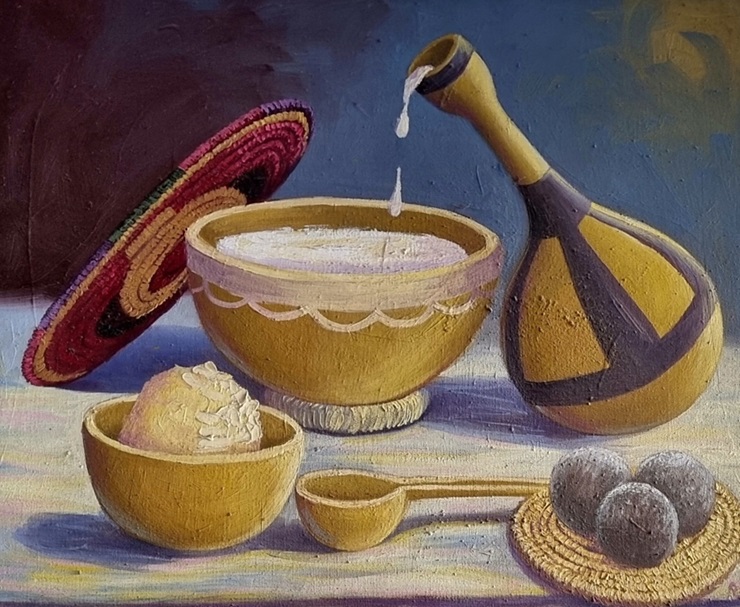
However, the best memory was the kindirmo (yoghourt) market, right by the roadside near the entrance to the market. Sold by the stereotypical Fulani milkmaids. Kindirmo is so thick that it breaks up like ice floes on a frozen river when you hit the skin film on top of the large calabash holding it. Kindirmo is so sweet that it harks back at an ancestral memory of existence. Pure. Natural.
My old aunt was an artist and adept at churning up the thick kindirmo with equally massive balls of fura. Using a ludayi (ladle) carved from a gourd plant, she was adept at blending the fura right into the kindirmo floes in a calabash. The end product was a supremely nourishing, rich, tasty meal of classic fura – containing all the ingredients needed to nourish the body. Absolutely no sugar is needed or even desired. As you slurp it, you are often lucky to come across an unblended fura – gaya. Taken in a calabash container with ludayi. The ecstasy can only be imagined.
Sold with the kindirmo was fresh butter. Aunt used to fry the butter into a ghee. Pour a spoonful into any meal – ecstasy reloaded! Evoked Hassan Wayam’s verse:
Ga fura ta mai nono /
Tuwo na mai nama /
Years passed by, and my childhood memories of Birnin Kudu were kept in storage in my mind. Whenever I passed by the town – my aunt had left the place in mid-1980s when her husband passed on – and crossed the bridge, the memories came flashing by. Of the only friend I made, a Yusha’u, whom I cannot trace.
The daily grind made it difficult to re-create the culinary pleasures of my aunt’s fura. Further, I was too occupied with other things. One day, the urge came back after my return from studies. The question was, where would one get a fura meal? I was told it has now become a franchised business, and right opposite the block of flats I was staying in, Zoo Road, was what I called ‘Fura Café’ run in a kiosk. I dashed up there for a treat.
I was shocked. First, the fura balls were tiny. Like a baby’s fist. And white – not enough millet, obviously. Then, horror of horrors, he dropped three of them into a BLENDER! Would you believe it? A BLENDER! That’s the machine I saw my wife using to grind those ingredients used in making a soup! The worst was yet to come.
Next, he poured WATER into the blender. I could not stand it any longer, and I stopped him, asking for the kindirmo. ‘That was it. I just poured it into the blender,’ he saucily replied. Nothing like kindirmo – more like ‘tsala’ – watered down milk. He pressed buttons. Everything churned and chugged in the blender cup. He stopped, removed the cup, and then poured the lot into a PLASTIC cup – more like moɗa! I was speechless throughout this charade. I decided to see it through.
I asked for the ludayi. He gave me a look that clearly indicated he had never heard the word and passed on a PLASTIC spoon – y’know, the kind that comes with a cheap rice takeaway. I paid, took the cup, and had a sip. It was horrible. Sour. No pleasant flavour (garɗi) of a true kindirmo. Seeing the expression on my face, he offered cubes of sugar. I passed. I handed the entire sludge to him and left. That was the end of my first attempt at rekindling a memory.
Years later, after a five-year absence from Kano, I came back to see modernised Fura Cafes all over – Habib, Yusrah and the new kid on the block – Rufaidah. I was told some, e.g., Habib, had been around for a long time. Knowing I might regret it, decided to relive Birnin Kudu again. So, I popped into Rufaidah for a treat. Better than the horrid kiosk I had been to before. I was attracted by the post-modernist décor. Like the airport in Dubai.
Ahaf! The same Furakenstein monster was there. A blender, watery milk, lots of sugar, tiny chunks of unblended greyish fura, and a ‘dambu’ – moistly powdered fura as a spare. All are neatly packaged in a pretty container. It’s not as bad as what I had before, but it’s still a Furakenstein monster. Seems the Rufaidah Fura Café is the ultimate in the fura business. I am happy for them and impressed by their franchise. But for old codgers like me, even at our Fresh Young Dattijo (FYD) phase? Thanks, but no thanks. I can’t stand the monster – Furakenstein – that is the modern blender-churned fura, no matter how ‘ultra-modern’ their café is. Young people who throng the place, happily taking selfies, have no idea what they have missed in the generational journey.
Fura, as a meal, should be churned in massive chunks of kindirmo floes, the likes of which I am pretty sure can only be found in Birnin Kudu, Bulkachuwa and Danbatta. With huge dark grey fura balls providing high millet content. Spicy fura. Thick floes of yoghurt. No sugar. Not because you are on a health kick, but because it is almost a sacrilege to put sugar in such yoghourt.
So, to celebrate this culinary purity, I am sharing the third painting in my office of classic Fura da Nono and fresh butter lost heritage scene painted on a medium canvas by the brilliant Bashir Abbas of Kano Polytechnic. It reminds me of the idyllic, peaceful and wonderful Birnin Kudu, with its rolling hills, tema grass (still available?), and the now drying river.
I was tagged in a Facebook thread lamenting the perceptions of Hausa popular culture studies by Muhsin Ibrahim on how such a course of action is looked down upon. Indeed, he related personal bad experiences on his encounter with what one might call ‘culture purists’ who do not see anything worthwhile studying about contemporary popular culture. I feel that my response should be enlarged beyond the one I gave in order to reach wider audiences and stimulate debate.
‘So, what exactly is ‘popular culture’? Without being bogged down by technicalities, it is simply what people like. Often referred to also ‘mass culture’. Which differentiates from the ‘elite culture’ preferences of the high order of the society. Elite culture is often favoured because it is seen as cultural representative due to its historical purity. For instance, Shata is an elite culture, while Rarara is a popular culture. Both are singers. But while Shata was a griot whose lyrics represent the historical antecedents of his society and culture, Rarara is a singer whose lyrics represent his pocket.
Thus, everything people do can come under the purview of popular culture – fashion, food, literature, cyberculture, sports, architecture, theatre, drama, films, music, art, you name it, it is popular culture. It is the dominant culture. Some of the universities that teach popular culture in the world include Harvard, Cambridge, MIT, and Stanford, to name some of the top ones, plus thousands of others.
So, why study popular culture? There are many reasons, but one of the most compelling is social awareness. Such a study makes us aware of important social issues. You may not follow Hausa TV show operas, but they illuminate critical tensions within communities, and some reflect the ideals of the political culture; Ado Ahmad Gidan Dabino’s “Kwana Casa’in” is a case in point. Mediated popular culture gives creators opportunities to be creative.
Thus, popular culture can raise awareness about important social issues. TV shows, films, and music often address topics like discrimination, environmental concerns and mental health, sparking discussions and encouraging positive change. For instance, in Kano in early 2023, AA Rufai Bullgates [sic], an individual with mental health issues, became a popular culture media celebrity due to his delusions of grandeur; at one stage, he bought Kano State for ‘gangaliyan’ naira – his coinage. It took social media to make people aware of the extent of his illness – and stop exploiting his guile.
The contempt with which we approach studies of Hausa popular culture – or, let me modify, modern/contemporary culture – allowed a big room for others to be experts on us. In this way, researchers such as Mathias Krings, Carmen McCain, Novian Whitsitt, Brian Larkin and Graham Furniss came to dominate the documentation of Hausa popular culture.
In 2007, I was a visitor to Graham Furniss’s house in London for lunch, and I was blown away by a bookshelf covering a whole wall devoted to his documentation of Hausa romantic (soyayya) fiction containing over one thousand volumes. In Kano, we refused even to acknowledge such novels existed, and at one conference, I heard a University librarian describing them as ‘trash’. Now, if you want to study the earlier novels in the genre, you can only find them in the Library of the School of Oriental and African Studies, courtesy of Graham Furniss – while they are not available at Bayero University, Kano.
Novian Whitsitt, an American, became an expert on the feminist ideologies of Bilkisu Salisu Ahmed Funtuwa and Balaraba Ramat Yakubu – two wonderful and brilliant female writers we ignored. He made a name out of researching their novels – and he had to learn the Hausa language first before he could even read the novels. In Kano, where we speak Hausa, we looked down on these writers. Now, if you want any reference to the works of these ladies, you have to go to Amazon for his books, for he is considered an expert on Hausa feminist writers.
Matthias Krings collected more Hausa cinema tapes than any European researcher and established a vibrant Hausa film reference library at Johannes Gutenberg University, Mainz, Germany, where he is based. In Kano, we refused even to acknowledge that Hausa film is worth studying – until we gave the study a shove and held an international conference on Hausa films in 2003 – the first of its kind in the whole of Africa in studying an indigenous African language film industry. Even the practitioners – filmmakers, producers, directors – don’t see the value in studying their works, believing that such is done to denigrate them rather than a critical analysis of their art. When I established Yahoo! Groups social network in 2001 – long before Facebook – those who entered the group were constantly fighting us for studying their art.
In any event, it was Brian Larkin from New York who even opened up the doors in 1997 with his brilliant paper, “Indian Films and Nigerian Lovers: Media and the Creation of Parallel Modernities.” Soon enough, he became the only reference point on the emergence of modern-mediated Hausa popular culture. I could go on, but you get the point.
As for music, no one cared – until the Talibanic censorship regime from 2007 to 2013 in Kano favourably enabled the separation of Nanaye soundtrack music from Hausa films, creating an independent Hausa Afropop music genre. It also led to the emergence of Rap music among young Hausa lyricists in 2013 – the year of creative freedom for Hausa popular culture. Billy-O produced the biggest hit Hausa Afropop hit of the year with ‘Rainy Season’, producing a brilliant Engausa song accompanied by Maryam Fantimoti.
No attempt was made to internationalise the study of the emergent music genres by anyone. They were all obsessed with studies of the songs of griot acoustic musicians, believing that the Afropop genre was a passing fad. Seeing a room for documentation, I entered into the field. In any event, I was considered a loose cannon in the whole Hausa ‘adabi’ canon. Luckily for me, my foray into Hausa popular culture, or ’Adabin Hausa’ as they often call it (while I prefer ‘Nishaɗin Hululu as the Hausa term for popular culture), was from the prisms of Stuart Hall (Birmingham School) and Frankfurt School critical theory perspectives.
Most importantly, I was analysing popular culture as a mass-mediated communication, rooting myself firmly in communication theories. I was not interested in etymology, morphology, syntax, grammar, pragmatics, stylistics or other branches of the study of literature in my analysis (I profess ignorance of these branches). My focus was that something was happening; it was providing a stethoscope on the social awareness pulse. We need to document it. It was no longer acceptable to let others become experts on us.
Thus, studying or even debating mediated popular culture was definitely frowned upon in northern Nigeria. I believe I am one of the few flying the flag of the discipline – such that it has now crept its way into a university curriculum. Next semester (December 2022/23), I will be teaching M.Sc. Popular Culture in the Department of Mass Communication – one of the very few Departments in the country courageous and bold enough to do so. It’d be a fully interactive class, touching all aspects of what gives us social awareness through mediated popular culture.
Now, to the question of Murja Ibrahim Kunya, a TikTok influencer who speaks at more than 100 km per second. She is important enough to have a Wikipedia page. Dr. Muazu Hassan Muazu was one of the lecturers teaching the EEP 4201 – Venture Creation and Growth course in the School of General and Entrepreneurship Studies (SGES), Bayero University Kano. We once taught the course together. In the first semester (2022/2023) examination, question #5 went like this: “Murja Kunya and Me Wushirya are bloggers who trend by causing scandalous contents on their social media handles, for that reason, they are given advertisement jobs. If they do that, they become – (a) influencer marketers, (b) brand ambassadors, (c) trading agents, (d) marketing managers.” Students are to choose one which they believe was the correct answer.
What drew attention was the focus on the activities of TikTokers – activities not taken seriously, especially those of Murja Kunya, who elicited different reactions from different people. One posting on Facebook even labelled her a mental health patient. And yet, here, a university is asking academic questions about their activities. The entire 70-item question paper included references to various brands – KEDCO, Rufaidah, Salima Cake, A.A. Rano, L&Z Yoghourt, Sahad Stores, MTN, Chicken Republic, and so on. All these are marketing HUBS. Why not TikTokers?
Marketers are looking for audiences – notice how those silly and irritating videos pop up on news sites on your device to attract your attention. Dr. Mu’azu’s inclusion of cyber popular culture in his course – and Chicken Republic, dealing with food, IS part of popular culture – to me, is a brilliant acknowledgement of popular culture and its social relevance. Crazy, drugged, attention-seeker or not, people follow Murja Kunya. That means audiences, that means market – making her a perfect vehicle to advertise products. So, what’s wrong with that? If a woman frying ƙosai by the roadside has the same level of audience attraction, we should also acknowledge her as a marketing potential. That does not mean we endorse what they do – it means we are interested in reaching out to their audiences to buy our products.
Without pop culture, we wouldn’t be able to understand generations, so knowing gives us all a better understanding. Overall, a critical analysis of pop culture and media can help to shed light on the ways in which media interacts with society and can help to promote a more informed and nuanced understanding of media’s role in shaping our world.
Now, print Ale Rufa’is Bullgates gangaliyan note and purchase your village.
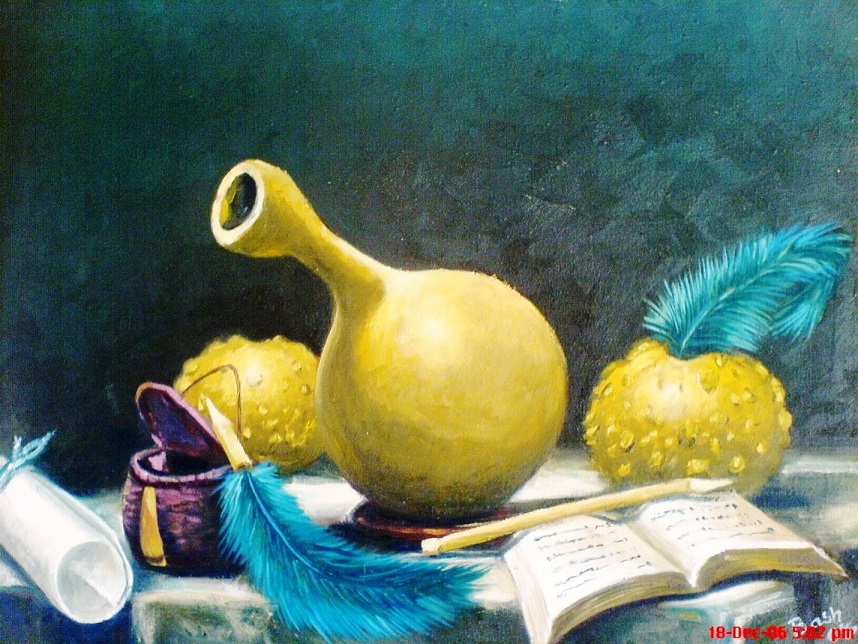
The painting evoked memories. And a sense of scholastic pride. Pride in being part of a process that has generated centuries of excellence. And today is Teacher’s Day, a case for celebration of scholarship from below. Even Google’s Doodle for the day acknowledges this.
Years ago, a painting was brought to me to purchase by an artist, Nura Yusuf – the artist being aware I am an art nut. It was a medium-sized canvas and truly beautiful in a photorealistic way. My Ajamization of Knowledge initiative inspired him. But there was no way I could afford the price he was asking, even if I accepted that it was a fair price. I asked his permission, though, to photograph it with my Sony DSC.
I eventually saw the canvas hanging in the outer waiting room of the Emir of Kano’s main reception chamber. Regretfully, you will only notice it if you swing your head up. I think, eventually, it was relocated.
Looking at the painting, as I said, evoked memories of Makarantar Malam Hussaini, Mandawari. Now renamed Makarantar Malam Buhari and reinvented as an Islamiyya school, along Sabon Titi, in the inner city of Kano. In the school, when Malam Hussaini was the Head, you left early if you reported early; otherwise, you stayed behind after the school closed to continue your studies.
Memories of going from house to house, requesting the good folks to allow us to brush their cooking pots with our bare hands, seeking the fine soot that covers the pots, the result of open-fire cooking with logs of wood. Once you gather enough powdered soot, you then dunk your hand in a bowl of water and wash the soot off. Next, you sprinkle a few crystals of gum Arabic in the water and boil the lot – effectively creating a syrupy ink, the classical ‘tawada’. While burnt wood from home cooking fires can do the job, the elite of Tsangaya inks is ‘zuge’, a burnt desert-date tree. The ink itself is often mixed in various colours, depending on its use in copying the Qur’an. These colours come in handy, especially on the graduating certificate – allo – when it is decorated with zayyana calligraphic designs. A whole industry has existed around this trade for years, especially in the heart of the city of Kano, northern Nigeria.
To make a pen, you need a thick dry stalk – gamba – from the grass used for fencing (zana) homes in rural areas. Using a Tiger razor blade (not Nacet, as it easily breaks), you sharpen the edge of the stalk and fashion a neat nib, creating an alƙalami — pen. There were many styles for the nib, depending on the writing to be done. For some, the alƙalami can be a true calligraphic tool.
Properly armed with a pen and ink, you begin the process of carefully copying the verses of the Qur’an, according to your grade, onto the wooden slate until you copy the right passages. You lean it against the wall for it to dry and await your turn to read what you copied by the teacher. Once properly groomed on the reading, off you go to practice reciting on your own.
Once you feel you are proficient enough, you go back to the teacher, read your passages and once satisfied with your diction, and cadence, you are permitted to go to the next passages – wash off the present one – wanke allo – and copy the next sequence. Due to the dark colour of the ink, the wooden slate often absorbs the ink and darkens the slate. The best way to get rid of it is to use sandpaper to scrape it completely – or, failing that due to cost, rice bran – ɓuntu – which works just as well – to remove traces of the previous ink. If the smudges or shadows of the ink still remain, you can use powdered limestone – farar ƙasa – to overlay the darker stain of the ink, giving a clean white surface on which to write.
Ink is kept in a pot, kurtun tawada, while the pens are kept in a pen holder, ƙorami/alkurdu. For adolescents starting up, it was the wooden slate. For the more advanced students, the writing is done on conqueror bond paper (usually imported from North Africa), but the pen is now a quill from the tail or wing feathers of a bird (chicken, duck, guinea fowl).
And in case one gets thirsty doing all that hard work, you can always quench your thirst from the water stored in your water bottle – jallo, made from a gourd. This type of water bottle enters into the Hausa lexicon with the expression: “ina neman sa kamar ruwa a jallo/desperately looking for him.”
This scholastic tradition is well-preserved in this painting by Nura Yusuf, who incidentally happened to be a brother to the writer and poet Khalid Imam. Being Teachers Day today, I dedicate this painting to all Alarammomi, Gardawa, and Ƙolawa, who are my fellow classmates in every Tsangaya in this country. We pray for the souls of our Malaman Tsangaya, who set us on the right path. Allah Ya jiƙansu da Rahama.
I was never lucky enough to come under Yusuf Bala Usman’s tutelage while I was a student at Ahmadu Bello University Zaria, Nigeria, from 1976 to 1979. Being a student in the Faculty of Education, I missed out on having to take lectures in the famous FASS – Faculty of Arts and Social Sciences, undoubtedly, the hotbed of critical theories in the 1970s.
Yusufu Bala Usman, Ibrahim Tahir, Patrick Wilmot, and Mahmoud Tukur enlivened the university with their rhetoric about culture, history, polity and anthropology. My roommate was a History student, so I gleaned a lot from him about the critical theories flying about on the campus. Those years were indeed the intellectual years of ABU. Every subsequent northern radical traces his roots to that era and its critical reflection on Nigerian society.
As M.M. Gwadabe noted in his obituary to Yusufu Bala Usman, published in Africa: Journal of the International African Institute, 2010, 80(1): 165-168.
The contributions of Bala Usman lie not only in the number of papers he has written or the publications he has left for posterity. He spearheaded the establishment of a school of thinking quite distinct from the perception of history that used to be prevalent in Nigeria before the 1970s. Before him, history was generally understood and taught within the paradigm of colonial historiography. The efforts of Bala Usman and some of his colleagues in the department liberated history teaching as they masterminded the establishment and nurturing of the School of African historiography at Ahmadu Bello University, Zaria (ABU).
And in spite of his towering intellectualism, he remained humbled by the very scholarship he served. As Gwadabe further informs us:
“In 1985, the authorities of Ahmadu Bello University, considering Dr Usman’s contribution to knowledge, promoted him to the rank of a Professor. Humble as he was, Dr Usman turned down the promotion on the ground that ‘he was not convinced that he had done enough to be a Professor’. While he was without [a] doubt qualified for the promotion, his action was an attempt to show his displeasure with the way promotions to the rank of professorship were politicized and abused. So, Dr Usman died with the rank of a Reader.”
Now compare this towering inferno of intellectualism with our intellectuals today – who, based on some newspaper and junk journal publications, proudly present themselves as professors – when no one has ever read their works or become impacted by their expected contribution to knowledge.
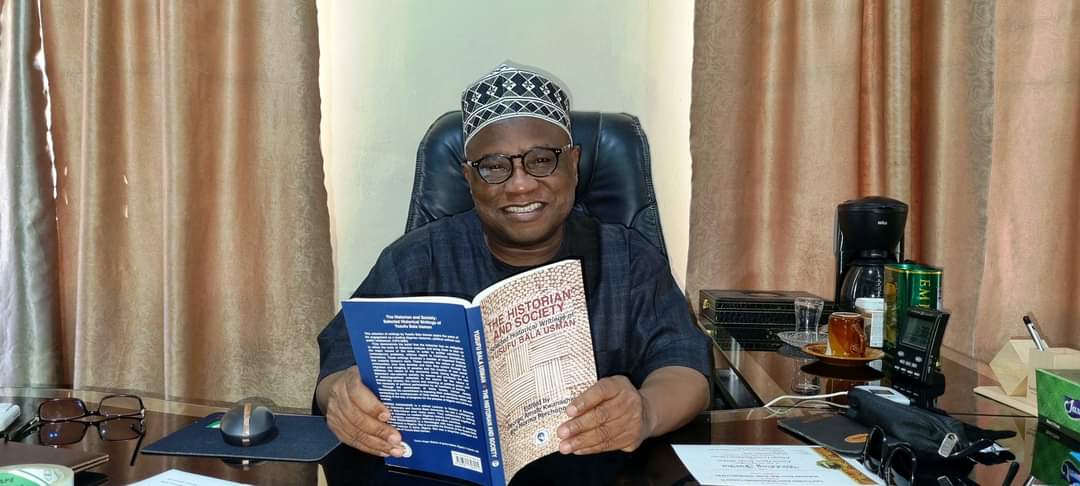
Yusufu Bala Usman passed away at 60 years old in 2005, relatively still in his prime. His thoughts and ideas, however, live on through the Yusufu Bala Usman Institute in Zaria. To refresh our memories about his fiery and critical writing, the Institute, on 23rd September 2023, released a compendium of his lectures that captured the years of engagement as a leading Nigerian historian, political activist and public intellectual, mainly from 1972 to his death, in 2005. The book, The Historian and Society: Selected Historical Writings of Yusufu Bala Usman, was edited by George Ama Kwanashie and Normal Perchonock. It provides a handy introduction to the thoughts of Yusufu Bala Usman for those who only heard about him. Going through the 12 chapters of the book would convince you that with his death, northern Nigeria has lost a formidable voice in contemporary critical theory.
The book is now available as a physical copy. There is a website for the Institute where you can order the book at 3,500 NGN.
In an attempt to gauge the current popular culture market in Kano, I visited my old haunt at Kasuwar Ƙofar Wambai today, 2nd August 2023. It was the place where virtually all Hausa popular culture media products were distributed in the late 1990s to 2000s. It was simply the best in West Africa, as media products from this market – which took over from the Bata market – were distributed to other parts of Hausaphone West Africa.
I was shocked at the fact that there were only three shops selling CDs/DVDs and cassette tapes. The market had been taken over by plastic household items and blouses/football jerseys! It was so sad to see such a vibrant market – the best in West Africa – down on its luck. Discussions with three forlorn merchants reveal two main reasons for this sorry state of affairs of consumptive popular culture media in Kano.
The first was the proliferation of Download Centres. In these places, films were ripped off DVDs or CDs and with a reduced resolution to fit a Smartphone screen – and dozens were packed on a microSD card and sold for peanuts. This denies the content providers of profit from their hard labour. A licensing compromise was agreed between filmmakers and Downloaders to everyone’s satisfaction. Thus, no more CD purchases that require both a CD player, a TV and electricity to play. Downloaders often get their primary source directly from the producers – thus eliminating the media production processes.
Second was the rise of TV series, popularised massively by Arewa24’s Dadin Kowa (although it was not the first). Now almost every producer has jumped on the TV series bandwagon and using YouTube to distribute their programs. With data getting cheaper, it means viewership has migrated to YouTube series dramas – where more money is made with AdSense clicks. Rarely does a producer bother now with a feature film.
Sad as I was with these developments, I perked up when I visited the shop of Alhaji Muhammad Kalarawi. He is quite simply the best ethnomusicologist in the market. His nearest rival, Musa Nasale, passed away some time ago (and no one knows what has happed to his catalogue of unique and rare music field recordings).
Alhaji Muhammad Kalarawi got his name from being the recordist of the late Kano-based Islamic cleric, Alhaji Lawan Kalarawi (d. 1999). The term, “ƙala rawi” means ‘the narrator said’. Kalarawi established himself as a fearless, acerbic preacher in Kano – earning him numerous jail sentences. He was really telling it like it was – bringing his incredible interpretations on leaders (both modern and traditional) and commoners alike. Thanks to modern media technologies, there are hundreds of Lawan Kalarawi’s archival recordings on YouTube and MP3 trawler/caching sites.
Kalarawi’s popularity was enhanced by his street speech mode with jovial, often bawdy commentaries, which made him immensely popular. I personally count three Islamic preachers in Kano as those I avidly listen to: Lawan Kalarawi, Ibrahim Khalil and Aminu Daurawa. All down to earth. Just as it is, without any excess baggage or appendices.
The current Muhammad Kalarawi has almost every incidence of the late preacher’s recordings. That is a huge treasure trove. In addition, he still has stacks of tapes and CDs of traditional Hausa griots, which are simply not found anywhere. I was so elated to know he is still in the game, despite the suffocating pervasive influx of Hausa Afropop in Kano (which studiously avoided the Wambai market). I wish research institutes such as the History and Culture Bureau in Kano, or Arewa House in Kaduna, would license Kalarawi’s priceless catalogue and digitise them for posterity. Once they are lost, they will be gone with the wind.
In 1968 I was a twelve-year-old whippersnapper and found solace in my father’s library (hate football and games anyway!). A journal, Kano Studies of the year, caught my attention because of the way my Dad held on to it. I fixed my sights on it, eventually opening it and trying to read it. Oh, I did, quite all right, but I did not understand half of what was written! However, I did not give up and continued perusing the journal.
Eventually, during high school years, a couple of years down the road, I discovered what glued my late father, Muhammadu Uba Adamu, alias Kantoma, to that specific issue – his article. The article was titled “Some Notes on the Influence of North African Traders in Kano”. This time when I read it, it made sense. I found it fascinating, and I can genuinely say it planted the roots of historical interest in me. However, I was keener on race, culture and identity, and in particular, how new racial identities emerge as a result of what Kantoma himself later referred to as ‘confluence and influences.’
“Some Notes on the Influence of North African Traders in Kano”, as I was to discover later, was based on the methodology of what Victor Turner referred to as “the anthropology of experience”. Kantoma embedded himself in the Arab community (a bit easy to do, with an Agadesian grandmother) in the Alfindiki community in the heart of the city and close to his traditional family homestead at Daneji. It was through extremely loose focus group discussions that he was able to gather as much data as he could. And he was then a student of Political History at Ahmadu Bello University Kano (via Abdullahi Bayero College).
Years later, I had the chance to befriend one of Kantoma’s teachers, John Lavers. He glowingly told me how excited he was with Kantoma’s initial paper and how he made a series of suggestions that eventually turned the paper into a classic. John Lavers was one of the founders and editors of Kano Studies.
The paper was extensively revised by Kantoma as “Further notes on the influence of North African traders in Kano”. It was presented at the International Conference on Cultural Interaction and Integration Between North and Sub-Saharan Africa, Bayero University Kano, 4th–6th March 1998 – some thirty years after the original. Unfortunately, despite being the person who typed it up for him, I could not locate a copy (remember, we were using floppy drive storage in those ancient days!).
Some notes planted in me an interest in race, culture and identity and the interrogation of the specific gravity of racial identity in Africa. For instance, take a community of Tripolitanian Arabs who settled in Dandalin Turawa, Kano, right on the edge of the Kurmi market. Years later, they were no longer ‘Turawa’ but African – at least in colour and language, as most have also lost the Arabic language of their forebears. So, what exactly are they? Arabs? Hausa? Or do they create a crazy hyphenated identity – Hausa Arabs (like the ridiculous ‘Hausa Fulani’)?
So, I started my own anthropological trajectory by writing a proposal for a Stanford University (US) residency on Race, Culture and Identity. I wanted to map the six groups of Arab residents in Kano to determine how they self-identify – language or genes. These are Shuwa, Sudanese, Tripolitanians, Syrians, Lebanese, and the Yemeni. Again, Kantoma had much data on especially the Yemeni, in addition to his earlier Tripolitanian engagements.
For a few years, I worked with him to flesh out the project and even got some of the Yemeni elders interested in proper documentation of their community (as was done by S.U. Albasu in “The Lebanese in Kano”). I did not get the Stanford residency, and other things about the daily grind kept me away from the project, so I put it on hold! I can’t even locate the original proposal now. But who knows? Once I have a free year or so, I might rummage through some forgotten hard drives and see what lurks there and, if possible, get back into the race (pun intended!).
Here, for your archival pleasure, is a gift from Kantoma pending a full-blown site that will have all his writings much later in the year (hopefully by Fall). Download from here: https://bit.ly/3p2LeOx.
His name was Tijjani, and nicknamed Ma’aslam. He mainly lived in the Sabon Sara ward, Kano city, but was a common sight along the Mandawari junction to Kasuwar Kurmi corridor in the 1960s.
Everyone considered him nuts. Apparently, he built a single-storey building without stairs to access the upper floor. He did not think a door was necessary for any structure either, so the building had no doors. He simply jumped up to the upper floor at night and jumped down in the morning. It was enough for the ward head to report him to the Jakara magistrate for him to be locked up on insanity charges.
During the hearing, he was given a basket to fetch water. He simply laughed at the judge, informing him that only a madman would attempt to fetch water in a basket. The judge threw the case out, declaring him perfectly rational. He may be nuts – although eccentric was more apt to describe his behaviour. But then, it takes a certain amount of nuttiness to be an innovator. And he was an innovator.
As children – and I am talking 1960s inner city Kano – we simply referred to him as Ma’aslam. He, I would argue, planted the seeds of onomatopoeic intertextuality in Hausa popular culture, at least in Kano. This was the process of picking up an element of popular culture, say, a song, converting it side-by-side into a different language (intertextual), using ‘sound-alike’ of the original (which is onomatopoeia) into a new one. A quick example was the Bob Marley hook:
Get up, stand up,
Stand up for your rights
Sadi Sidi Sharifai, a Kano onomatopoeic superstar, converted this to:
Jallof, Jallof,
Jallop, sai da rice
Try singing both the original and Sadi’s interpretation, and you have become an onomatopoeic star yourself!
In 1967, the American super soul star James Brown & the Famous Flames recorded the stunning live double album of their concert at the Apollo Theatre in New York. It was, perhaps unimaginatively enough, titled, ‘Live at Apollo.’ A standout track on the album was ‘I Feel Alright’. Its choral hook was:
‘Hey, hey, I feel alright
One time, uh!’
The album of the concert was released on 16th August 1968. I was 12 years old then, and still now, totally wired in music, complete with a Ukulele guitar, given to me by David Hofstad (author of Tabarmar Kunya play). My Dad, an avid music lover, noting my attachment to the song which was played on the radio, simply bought the double album for me at Musa Zamani Record store in Fagge (are there any old codgers who remember this record store?). I played it to death on the old Grundig music player we had then.
Back to Tijjani Ma’aslam. With his eccentric behaviour categorising him as loony, Ma’aslam started reciting the ‘Dalailul Khairat’, a celebrated manual of salutations upon the Prophet Muhammad (SAW), written by Muhammad ibn Sulayman al-Jazuli in 15th century Morocco. What was unique about Ma’aslam’s open-air recitation, however, was that he adopted the James Brown meter in the song, ‘I Feel Alright’, as his chorus. His rendition of the hook for his recitation of the Dalai’lu was:
Mujibun, Mujabun,
Afiyan, Afuyan,
Rasulillahi
Ahlan wa Sahlan
Rasulillahi
This was accompanied by James Brown’s dance moves (shown on Television’s Soul Train, which was available in a few houses that he might have access to). Maybe he was not reciting the salutations in their structured order, but at least his verses were discernible, as the Dalai’lu itself was recited in a song form by many reciters in Kano. What he did, and did it differently, was using a foreign music meter to make it more accessible. This formula was to be adopted by the Ushaqu Indiya group of devotional singers in the city of Kano (actually along the same neighbourhood as Tijjani Ma’aslam). More of this in subsequent articles/posts.
Tijjani Ma’aslam’s delivery mode was intertextually onomatopoeic to ‘Hey, hey, I feel alright’. The chorus was ‘Rasulillahi’. Ma’aslam was usually followed by a gaggle of kids echoing the chorus while he merrily led the way, clapping his hands, dancing and reciting the names of the Prophet from the Dalai’lu. Elders were bemused at the spectacle and simply labelled Ma’aslam crazy. He might have been. He certainly was not following the sequencing of the Salawat from the book. But his performances opened a door.
Up the road from his haunt and covering the same zone was the Palace cinema. This was built and completed in 1951 and opened in 1952. Palace cinema became an instant hit with the youth, closeted in the city and without any visible means of night-time entertainment. Before its opening, and still a carryover from the World War II years (1939 to 1945), a curfew used to be imposed on city residents at 8.00 p.m. With the relaxation of the curfew, the few neighbourhood plazas (dandali) that offer games for youth (both boys and girls) were no match for the sheer spectacle of a massive screen accompanied by loud music. The predominant films shown in the cinema were cowboy or mainstream European films. However, after independence in October 1960, Indian films started to be shown from November 1960 in Kano cinemas. Early films screened included Cenghiz Khan, Jaal, Sangeeta, Raaste Ka Patthar, Waqt, Amar Deep, Rani Rupmati, Dharmatama, Dost, Nagin and thousands of others. The one that caught massive imagination in Kano’s inner city, however, was Rani Rupmati, originally released in India in 1957 but only found its way to Kano cinemas in the 1960s.
Like all Indian films, at least from what the industry refers to as Bollywood, Rani Rupmati had a lot of songs – in fact, its overall screenplay is based on two people united by their love of music. However, two songs from the film caught Kano’s inner city imagination, ‘Itihaas Agar Likhna Chaho’ and ‘Phool Bagiya Mein Bulbul Bole.’ Interestingly, there was no choreographic dancing in these two songs, unusual for general Bollywood films but typical of earlier, more historical and artistic ones.
The first, ‘Itihaas’, sung by Lata Mangeshkar, has a great hook that, thanks to Tijjani Ma’aslam, became domesticated by kids along his sphere of influence and Palace cinema zone. It goes something like this:
Itihaas agar likhana chaho /
Azaadi ke mazmoon se /
…
To seencho apni dharti ko /
Veeroon tum upne khoon se /
Har har har Mahadev /
Allaho Akubar /
Har har har Mahadev /
Allaho Akubar /
Sung within the backdrop of a band of warriors getting ready to go into a battle, led by a woman (the titular Rani Rupmati), it certainly gave the picture of a woman more enlightening than what was both the Hausa and Indians are used to. The film itself endeared itself to Hausa through the modesty of the women – shy drooping kohl-enhanced eyes with long blinking lashes, fully clothed (even the swimming scene shows the singers fully clothed in the river), with sari that resembles Hausa wrapper (zani), lots of jewellery, and stunning beauty. A Hausa common saying of the period was, ‘Allah, kai ni Indiya ko a buhun barkono’/God, let me visit India even in a sack of pepper. That was how besotted Hausa youth were to the beautiful Indian women seen on the screen, giving a false impression that every single Indian woman is beautiful.
Hausa youth, inspired by Tijani Ma’aslam, quickly domesticated the chorus of the song as:
Ina su cibayyo ina sarki / where are the warriors, where the is king?
Ina su waziri abin banza / And the useless vizier?
Mun je yaƙi mun dawo / we have return from the war
Mun samo sandan girma / and we were victorious
Har har har Mahadi / hail, hail the reformer
Allahu Akbar / Allah is the Greatest
Har har har Mahadi / hail, hail the reformer
Allahu Akbar / Allah is the Greatest
In an interesting case of lyrical substitution, the Hausa intertextual transcription captured the scene of the song as shown in the film, if not the actual meaning of the words. Loosely translated, the original verse was urging warriors to defend their land with their lives and become part of history. The chorus translates as ‘Let each of us sacrifice ourselves to Mahadev’.
While Mahadev was a reference to the Indian deity, Shiva, this pantheistic line was followed by a monotheistic reference to Allah, the Supreme Being in Islam. Thus, two contrasting religious sentiments were expressed in the song. It was likely that S. N. Tripathi, who directed the film and composed the music, introduced the chorus to attract both Hindu and Muslim audiences. After all, while Rani was a Hindu, her love interest in the film, Baaz Bahadur, was a Muslim. The expression, however, has since then been used as a slogan of communal harmony between often warring Hindu and Muslim communities in India.
But more stunningly, the Hausa version substituted the word ‘Mahadev’ with ‘Mahadi’. The Hausa heard ‘Mahadi’ (guided one), not ‘’Mahadev’, which worked perfectly well. Substituting Mahadev for Mahadi Islamized the song, as it were. In Islamic eschatology, Mahdi is a messianic deliverer who will fill the earth with justice and equity, restore true religion, and usher in a short golden age lasting seven, eight, or nine years before the end of the world.
The second song from the film, ‘Phool Bagiya Mein Bulbul Bole’ (also sung by Lata Mangeshkar, with Mohammed Rafi), also inspired onomatopoeic intertextually but further afield from Kano and bizarrely entered into Hausa urban legend of the 1960s. Its first verse goes something like this:
Phul bagiya me bulbul bole /
Daal pe bole koyaliya
Pyaar karo /
Pyaar karo rut pyaar ki aayi re /
Bhanwaro se kahati hain kaliya /
Ho ji ho ho ji ho ho ji ho /
Ho ji ho /
What Hausa youth heard in the choral refrain was ‘Hotiho’, not ‘Hojiho’, and in the film Rani Rupmati, the lady (played by Nirupa Roy) came to be referred to as Hotiho. The Hausa griot, Mamman Shata (d. 1999) popularised the word (which has no particular meaning) in his song, Mallam Sidi, ‘Mijin Hotiho’/Mallam Sidi, Hotiho’s husband.
In the film, there was no marriage between Rani and Baaz Bahadur because she said she was ‘married to her music’, despite living with him after running away from home to avoid death from a chalice of poison given to her by her father to avoid the shame of her rejecting a chosen husband. In all their dialogues, Rupmati and Baaz Bahadur stress their shared love for music, not their love for each other. So, Shata did not accurately describe the relationship in the film. However, such deep film analysis is not important to the transnational interpretation of Shata of Baaz Bahadur as a signature tune for a hen-pecked husband. Shata’s interpretation of the actor who played Rani’s lover was certainly in order as he was effeminate and obsessed with music rather than empire building, despite being heir to a throne. It was even Rani who led their army into war. He was wounded in the battle and ran away.
Another Hausa griot, Ali Makaho (d. 1984), known famously for his anti-drug song, ‘Mandula’, briefly referenced Rani Rupmati in another of his songs.
Za ni Kano / I’m going to Kano
Za ni Kaduna / I’m going to Kaduna
Mu je Katsina lau za ni Ilori / Let’s go to Katsina and Ilorin
Na je Anacha / I will go Onitsha
Ni ban san kin zo ba / I didn’t know you had arrived
Da na san kin zo ne / If I had known you have arrived
Da na saya miki farfesu / I ‘d have bought you [pot of] pepper soup
Hitoho hotiho /
Hotiho hotiho /
With a comedy skit thrown in, Ali Makaho’s rendering uses Phoolbagiya’s meter to narrate a series of anticipated travels over northern Nigeria. As an intertextual comedy, it worked and remained of his most memorable skits.
A third Hausa griot to adapt a song from Rani Rupmati was Abdu Yaron Goge, who played the goge (a large fiddle played with a bow). Abdu picked ‘Raat Suhani’ from the film for his adaptation. Since, unlike the other griots who used the elements of the songs from the film, Abdul was a musician, he used two approaches – first was rendering the symphonic structure of the opening bars of the actual composition, Raat and playing it on his fiddle, then secondly, he onomatopoeically appropriated Mangeshkar’s lyrics as Hausa version. The original lyrics were as follows:
Raati Suhani /
djoome javani /
Dil hai deevana hai /
Tereliye /
Tereliye /
These lines were pure expressions of love the protagonist has for her lover, especially ‘in the beauty of the night’ [raati Suhani]. Abdu Yaron Goge’s rendition was as follows:
Mu gode Allah, Taro / We should thank Allah, people
[These lines vocalized the opening bars of Raat]
Duniya da daɗi /This world is nice
Lahira da daɗi / The hereafter is nice
In da gaskiyar ka / If you are truthful
Lahira da daɗi / The hereafter remains nice
In babu gaskiyar ka / If you are untruthful
Lahira da zafi / The hereafter is blazing
Thus, in a single verse (which he kept repeating over and over till the end of the performance), Abdul Yaron Goge borrowed a popular musical motif from another culture and domesticated it to Hausa entertainment. At the same time, he delivered a message totally different from the original meaning.
There were, of course, many other onomatopoeic intertextual interpretations of Indian film songs, but the three songs from Rani Rupmati, predated by Tijjani Ma’aslam’s innovative use of foreign motifs, were the definitive pioneers in music. In Literature, look towards Abubakar Imam and Magana Jari Ce. The intertextual origins of Hausa arts, of course, started in the 1930s; but its migration to music was certainly in the 1960s. It spawned a Hausa Cinema industry which was labeled ‘Kanywood’ in 1999, a few years before the term ‘Nollywood’ to refer to the Nigerian English language cinema, was created.
On a final note, Nazeer Abdullahi Magoga, a Kano ‘Indian’ (who speaks the language fluently, to the shock of BBC Delhi, who sent a crew to interview him in Kano, in Hindi) composed a song for the Centre for Hausa Cultural Studies, Kano which I was heading, but which I had to pause due to lack of funding. He used the Raat Suhani meter and used both Hausa and Hindi lyrics in his wonderfully beautiful tribute to the Centre. A link to the song on YouTube is given below. To really appreciate Nazeeru’s performance, listen to the original Raat Suhani from the film Rani Rupmati, also provided in a link.
Cibiyar Nazarin Al’adun Hausa by Nazeer Magoga [Raat Suhani template]
For the past 43 years that I have been a researcher, there were two areas I stay clear of: politics and religion. If you see my hand in any of these two, then the entry point is popular or media culture. For instance, I have recorded a lot of Kano Qadiriyya’s Anfasu zikr, not as a devotee, but as an ethnomusicologist – focusing on the body percussion and movements (after studying the wonderful works of Margaret Kartomi on body percussion while in Morocco). Similarly – and to balance things somewhat – I recorded Tijjaniyya zikr sessions at Chiranci in the city of Kano as part of a larger study on religious performances. All my recordings were uploaded to a dedicated YouTube public channel. I was, therefore, amused when people try to pigeonhole me either as Qadri or Tijjani. I am neither.
Politically, I am apolitical, meaning I really don’t care who rules the country. I don’t even vote, having done once a long time ago (at the insistence of a dear friend), and promised never to do it again. But performance arts brought my attention to protest songs and the prosecution of singers in Kano. The end product was a paper, “Poetic Barbs: Invective Political Poetry in Kano Popular Culture” which I am sure is floating somewhere in a modified form. And I thought that was it.
In 2014 I came across a song that I found amusing. I was playing it on my laptop when someone exhibited surprised that I was listening to the songs of Dauda Adamu Abdullahi Kahutu, with a stage name of Rarara. That was the first time I even heard the name. The song was “Zuwan Maimalafa Kano.” It attracted my attention in two ways. First, its lyrical construction, as well as its delivery, was just amazing. Rapid fire. He should have been a rapper, a genre of music I am totally besotted on (old school DMX, 2Pac, Snoop Dogg, Ice Cube, Queen “The Equalizer” Latifah, y’all). It was clear Rarara was singing off the cuff, not reading from a setlist or lyrical sheet. Second, it was the most detailed invective song I have heard in the Hausa Afropop music genre. I started digging and latched on to him and his songs. So, for the last seven years or so, I have been following every song he released using the invective matrix.
So, what is an invective song? Invective is the literary device in which one attacks or insults a person or thing through the use of abusive language and tone. If you like, “zambo/shaguɓe”. Invective is often accompanied by negative emotion. Invective can be divided into two types: high and low invective. High invective requires the use of formal and creative language, while Low invective, on the other hand, makes use of rude and offensive images. From 2010, Rarara became a master of popular Hausa invective oral poetry. He used his skills to abuse, insult and body shame anyone he was paid to insult. Including former masters and associates.
A pattern evolved. His switchbacks. Chronologically, his earliest non-invective song was “Saraki Sai Allah” (in honour of then Governor Ibrahim Shekarau’s turbaning as Sardaunan Kano in 2010 by the late Emir of Kano, Alhaji Ado Bayero). In 2011 – barely a year later – when Shekarau failed to anoint Rarara’s ‘master’, Deputy Governor Abdullahi T. Gwarzo, to succeed him, Rarara became ballistically invective – and established a career in body shaming, abuses and innuendoes against various previous masters. Shekarau bore the blunt of colorist abuses – often a case of the kettle calling the pot black. No one was spared his invective barbs. Deeply cut. Insulting. Spread over 39 songs, from 2014’s “Malam Ya Yi Rawa Da Alkyabba”, to 2023’s “Tangal-Tangal.”
I have seen social media calling Rarara out on his not being a Kano indigene, getting rich in Kano through his songs, and yet insulting Kano’s leaders. This is all true. However, ‘da ɗan gari a kan ci gari’ (enemy within). Only about three songs in my analytical corpus by Rarara were free-standing (i.e., unsponsored). All the others were commissioned and paid for – by politicians from Kano, to abuse other politicians from Kano. Rarara always acknowledges his sponsors in the opening doxology of his performances.
Rarara was a highly unprincipled and unethical businessman. Show him the money, and he will praise his closest friend and abuse the friend’s enemy. Show him more money, and he will insult the same friend he praised, and heap praises on the enemy he insulted. Does anyone remember that the glorified “Ɗan Ƙaramin Sauro” (irritating mote) was part of the demeaned “Banza Bakwai” (Bastard Seven)? The bromance did not end well, did it? Business unusual.
In any event, Rarara’s invective braggadocio came back to hit him hard on 5th April 2023 when his opponents used his mother’s picture in unflattering terms and splattered it all over social media and gave her a feminine variation of an insulting name he used against one of his targets. Apparently when the shoe is on the other foot, it pinches.
Thus, instead of focusing on political ideology and promises of creating a better life for the electorate, often politicians in Kano (and I think Kano, as usual, is the only state that uniquely does this) would pay more attention to denigrating, shaming, and condemning opposing candidates, creating an unfavorable imagery of the politician to prevent his being voted. Rarara was a perfect malleable puppet in this process. He has the same emotional value to Kano politicians as an alien from Saturn. Despite his lyrical brilliance and acerbic wit, he was expendable. How many singers from Kano can you recall doing the same invective insults as Rarara to Kano politicians? Two? Three? Their corpus is not as extensive as that of Rarara. Conversely, how many politicians from Katsina pay Rarara money to insult other Katsina politicians? I can only remember one.
Wary of possible legal action against direct defamatory speeches, politicians often find it easier to engage what I call ‘political drones’ to communicate their defamatory messages through the popular medium of singing. In this way, when push comes to shove, it is the singer who would face legal – or in some cases, physical – wrath in one way or other. Unethical singers like Rarara – who was arrested, but not charged in 2014 over “Zuwan Maimalafa Kano” – were willing to pay the price in exchange for the stupendous amount of money they will receive. At least they will have enough for medical care when their houses were wrecked, assaulted and incapacitated to continue singing.
And the politician who caused it all? He can’t even remember the song that made him popular, having moved on to greener political pastures. Until the next election cycle when he will latch on another expendable drone to help him heat up the polity through more invective songs using campaign words he does not have the guts to utter himself.
Rarara’s defense of not uttering specific names in his invective taunts and body shaming do not stand up to scrutiny under Nigeria’s defamation laws, and demonstrates that while he was a brilliant lyricist, he needs to understand the law. This is because his invective defamation in the form of his songs is publicly available (indeed, he made them so), created a narrative about individuals that are easily identifiable either by their physical appearance or public behavior, created a negative impression on the person being so targeted, and was not misquoted as Rarara’s utterances (from his songs) were publicly available and subject to an only interpretation as intended. A clever prosecutor would have enough to jail Rarara on listening to any of his invective songs, if someone complained hard enough.
Invective songs can often have their positive sides in the sense of making politicians – or their targets – aware of public perception of their misdemeanors, or at most, errant behaviors. Rarara’s invective narrative in the selected songs I analyzed, however, do not demonstrate their oversight functions in public accountability for politicians. Regardless of whether explicit names were uttered or not, their narrative was focused on kicking them when they are down, and subjecting them to public ridicule. This questions the artistry of Rarara as a purveyor of aesthetic values of the Hausa oral arts.
Academicians ignore Rarara and his art – and I think that’s a mistake. True, some would argue that his songs have no aesthetic, intellectual or ideological value. On the contrary, they do. In their own way. They are beautiful as lyrical discourses. His delivery is truly artistic, even if the content is inelegant. Unlike other songs in the repertoire of political communication, his are not protest songs, and thus lack ideological focus. They neither educate, illuminate or illustrate any aspect of political culture. They only entertain – at the expense of the dignity of the people he attacks. His songs synthesize Hausa rural lexicon overlayered with abusive, often self-constructed urban jargon to enhance general appeal – and act as rabble rousers for politicians who think like him. It is a unique, if unadmirable business model in the performing arts.
Subsequently, Rarara’s songs cannot be compared, by any stretch of imagination, with the classical Hausa protest poets such as Sa’adu Zungur, Mudi Sipikin, Aƙilu Aliyu, Abba Maiƙwaru and Aminu Kano, whose artforms were fueled by educative political ideology, certainly not profit. Mudi Sipikin, for instance. used his poetry to attack the system of colonial rule. Aƙilu Aliyu wrote poems directly attacking the NPC. Abba Maiƙwaru wrote a 10-line NEPU poem for which he and Aminu Kano were arrested in the mid-1950s.
Zungur used his poetry originally to warn the emirs of the north of the necessity for reform, as illustrated in his central work, Jumhuriya ko Mulukiya [Republic or Monarchy]. In this work, he called for political and social problems to be solved on the basis of the existing Islamic institutions, rejecting alien political concepts. He later used his poetry to appeal directly to the common people. In a similar vein, one of the earliest poems written for a northern political party was by Aminu Kano, and called ‘Waƙar Ƴancin NEPU-Sawaba’ [Freedom poem for NEPU-Sawaba], and published in 1953 and put in the final form by Isa Wali. It was one of the earliest statements of Nigerian nationalism.
Despite all these, I argue that as researchers we can’t afford to ignore a current of knowledge flowing right at our feet. But the cold shoulder given to Rarara by our community, opposed to Aminu Ladan Abubakar (ALAN Waƙa) who is a toast to the academic and intellectual community, merely emphasizes the expendable and ephemeral nature of Rarara’s art. Ten years after the release of any ALA song, it will still have relevance. The relevance of Rarara’s songs rarely last to the next song release. Instantly forgettable.
Nevertheless, just as we struggled for the recognition and documentation (if not acceptance) of the Kano Market Literature in the 1990s when everyone was denigrating it, we need also to document the stream of popular culture, including Rarara – warts and all – flowing around us at all times. As far as I can see, only Maikuɗi Zukogi has focused attention on two of Rarara’s songs. More needs to be done.
As soon as I tell myself that I will wrap up the research, he will release a song insulting a former master or associate. Subsequently, I delayed publishing the research until he insulted two people, and true to expectations, he did. These were President Muhammadu Buhari (Matsalar Tsaro) and Governor Abdullahi Umar Ganduje (Lema ta sha ƙwaya). With the ‘Hankaka’ barb against Ganduje in the Lema song, my fieldwork became almost complete. His destruction of “ɗan ƙaramin sauro” leaves only the references to be completed. As I argued, based on his corpus, Rarara sells to the highest bidder with neither conscience nor ideology. The huge profit he makes serves as insurance against future loss of earnings when Kano politicians become mature enough to stop patronizing him to insult each other (and themselves) and utilize his skills in more constructive ways.
My thanks to a team of eager research assistants, headed by my ever-faithful and close companion, Hassan Auwalu Muhammad – a former songwriter and lyricist himself. He was the one who mainly, patiently, transcribed the songs, which I wove into a narrative going to almost 40 pages! I plan to upload the lot during my Summer break when the children are all here on holiday! By then, the threatened wobbling ‘Tangal-Tangal’ had stopped and probably settled for a four-year legal battle.
Professor Abdalla Uba Adamu can be contacted via auadamu@yahoo.com.
It happened 40 years ago. A friend’s wife in Kano had delivered a bouncing baby boy. My friend chose Maikuɗi as the name for the baby. The families on both sides were having none of this. Maikuɗi was not a name, they argued. But he saw nothing wrong with it – a nice traditional Hausa name. He was adamant. They were adamant. Cue in A Mexican Standoff.
Three days before the naming ceremony, he blinked first and apparently gave up. With a glint in his eyes, he decided to name the child Ibrahim. A beautiful Hebrew name but cognately shared by both Muslims and Christians (from Abraham, the father of all). Everyone was happy – until it dawned on everyone that Ibrahim was the name of my friend’s father-in-law. Tricky. In Hausa societies, the names of parents are never uttered. In the end, everyone ended up calling the boy Maikuɗi! Right now, the boy is a successful international businessman living in the Middle East. Earning serious cash and living up to his name – which means one born on a lucky day. Or Tuesday.
A few years later, the same friend’s wife gave birth to a beautiful baby girl. He decided to name her Tabawa. Objections reloaded. Cue in Dog Day Afternoon. As previously, my friend blinked first. He decided to name her Hajara, another cognate of Hagar, the wife of Abraham. It also happened to be the name of his eldest sister. His mother could not utter it – both the Hausa and Fulani system of cultural relations prohibit mothers from calling the names of their first series of children. In the end, everyone ended up calling the child Tabawa. She is currently a university lecturer and a doctoral student in Nigeria. Living up to her name – which means Mother luck, or the name given to one born on Wednesday (in Kano; in Katsina, it is Tuesday) is considered a lucky day. Two children, both lucky in their lives. Their traditional Hausa names became their mascots as they glided successfully through life.
So, why the aversion to Hausa ‘traditional’ names? You can’t name your child Maikuɗi, but everyone will applaud Yasar (wealthy – mai kuɗi?). Or Kamal (perfection). Or Fahad (panther). Or Anwar (bright). Or Fawaz (winner). You can’t name your daughter Tabawa, but it is more acceptable to call her Mahjuba (covered). Or Samira (night conversationist –TikToker?). Name your daughter ‘Dare’, and you are in trouble. Change it to Leila, and you out of it, even though this is an Arabic for ‘dare’ (night).
A lot of the names the Muslim Hausa currently use have nothing to do with Islam. Bearers of such names rarely know their actual meaning or context. They were Arabic and forced on us by the Cancel Culture that attaches a derogatory ‘Haɓe’ coefficient to anything traditional to the Hausa.
Therefore, my friend, whose family story I just related, another friend and I decided to get together and be Wokish about traditional Hausa names. Paradoxically, none of us is genetically Hausa (whatever that might mean) – one had roots in north Africa, another had Kanuri heritage, and one had Agadesian and Torodbe roots – but all of us self-identified, with absolute honour and tenacity, as Hausa. None of this ‘Hausa-Fulani’ aberrational nonsense.
‘Hausa-Fulani’ appellation, in my view, is a Nigerian Cancel Culture device to suppress the Fulani culture. The Fulani may have conquered the ruling of the Hausa (except in one or two places) and imposed their rule. The Hausa, on the other hand, have linguistically conquered the Fulani. In Kano, claiming Fulani heritage is considered anthropological purity – without knowing a single word of Fulfulde (the Fulani language). Substituting rulers does not get rid of the general populace who remain what they are.
The third friend then took the task with gusto. He spent over ten years compiling authentic traditional Hausa names that have absolutely nothing to do with ‘Maguzanci’ (the label gleefully and contemptuously attached to any Hausa who is not a Muslim by the Hausa themselves) before Islam in about 1349, at least in Kano). He also collected names that had only a tinge connection to Islam. The end product was a hitherto unpublished list of 1001 authentic, genuine, traditional Hausa names that reflect the cosmology of the Hausa.
Hausa’s anthropological cosmology reflects the worldview and belief system of the Hausa community based upon their understanding of order in the universe. It is reflected in their naming system – just like any other culture. The Yoruba Muslims, for the most part, have retained this attachment to their traditional cosmology. Farooq Kperogi has done wonderful work on Yoruba naming, although with a focus on their adaptation of Muslim names. The failure of the Hausa to do so was, of course, due to the suffocating blanket of Cancel Culture that the Hausa had been suffering for almost 229 years.
Now, let’s look at the names and their categories. The first category I created from the 1001 Names, which I edited, revolved around Being, Sickness and Death. As noted earlier, the traditional Hausa centre their naming conventions on ecological and cosmological observations—using time, space and seasons to mark their births. Based on this, the first naming convention uses circumstances of birth. This category of names refers to the arrival of a child after another child’s death, the death of a parent, the sickness of the child immediately after being born or a simple structure of the child that seems out of the ordinary. Examples include:
Abarshi. This is derived from the expression, ‘Allah Ya bar shi’[May Allah make him survive]. A male child was born after a series of miscarriages. A female child is named Abarta. A protectionist naming strategy is where the child is not given full loving attention after birth until even evil spirits note this and ignore it and thus let him be. Variants include Mantau, Ajefas, Barmani, Ajuji, and Barau. Now you know the meaning of Hajiya Sa’adatu ‘Barmani’ Choge’s name – the late famous Hausa griotte from Katsina (1948-2013).
Then there is Shekarau, derived from ‘shekara’, a year. A male child is born after an unusually long period of gestation in the mother’s womb. A variant of this name is Ɓoyi [hide/hidden]. A female child is named Shekara. Now you know the meaning of the surname of Distinguished Senator Malam Ibrahim Shekarau from Kano.
A third example is Tanko. This is a child born after three female children. Variants include Gudaji, Tankari, Yuguda/Iguda/Guda. I am sure you know the famous Muhammed Gudaji Kazaure, a Member of the House of Representatives of Nigeria and his media presence in late 2022.
Each of these sampled names reflects a philosophical worldview, reflecting spiritual resignation or slight humour. They, therefore, encode the traditional Hausa perspective of living and dying as inscribed in the way they name their children.
Names that even the contemporary Hausa avoid because of bad collective memory are those linked to wealth and being owned or slavery.
Slaves have prominently featured in the political and social structure of the traditional Hausa societies, especially in the old commercial emirates of Kano, Zaria, Daura and Katsina. Their roles are clearly defined along socially accepted norms, and they are expected to perform given assignments demanded by their masters.
Slaves in Kano are divided into two: domestic and farm-collective. Trusted and, therefore, domesticated slaves are mainly found in ruling houses and are prized because of their loyalty to the title holder. Farmyard slaves were often captured during raids or wars and were not trusted because of the possibility of escape. They were usually owned by wealthy merchants or farmers and were put to work mainly on farms
Although the institution of slavery as then practised has been eliminated in traditional Hausa societies, the main emirate ruling houses still retain vestiges of inherited slave ownership, reflected even in the categorisation of the slaves. For instance, in Kano, royal slaves were distinguished between first-generation slaves (bayi) and those born into slavery (cucanawa).
At the height of slave raids and ownership, particularly when owning a slave was an indication of wealth, the names of the slaves often reflected the status of the owner. Examples of these names include Nasamu (given to the first slave owned by a young man determined to become a wealthy man), Arziki (first female slave owned by a man), Nagode (female slave given away to a person as a gift), Baba da Rai (first gift of a male slave to a son by his father), Dangana (male slave of a latter-day successful farmer or trader, although later given also to a child whose elder siblings all died in infancy. The female slave variant is Nadogara), and Baubawa (slaves with a different faith from the owner), amongst others.
The changing political economy of Hausa societies since the coming of colonialism has created new social dynamics, which included the outward banning of slavery. Thus, many of the names associated with slaves and ‘being-owned’ in traditional Hausa societies became disused, unfashionable, or, which is more probable, to be used without any idea of their original meaning. It is thought that some records of them may be of value. An example is ‘Anini’, usually a slave name but later used to refer to a child born with tiny limbs. The ‘smallness’ is also reflected in the fact that ‘anini’ was a coin in the Nigerian economy, usually 1/10th of a penny—a bit like the small Indian copper coin, ‘dam’ (from which the English language got ‘damn’, as in ‘I don’t give a damn’).
Further, with the coming of Islam, slave names were eased out and replaced by conventional Muslim names as dictated by Islam, Retained, however, are slave names that also served as descriptors of the functions of the slave, even in contemporary ruling houses. Examples of these slave titles, which are rarely used outside of the places, include:
Shamaki (looks after the king’s horses and serves as an overseer of the slaves), Ɗan Rimi (King’s top slave official and looks after all weapons), Sallama (King’s bosom friend [usually a eunuch], same role as Abin Faɗa), Kasheka shares the household supplies to king’s wives [usually a eunuch], Babban Zagi (a runner in front of the king), Jarmai (the head of an army), Kilishi (prepares sitting place for the king), amongst others. These names are almost exclusively restricted to the palace and rarely used outside its confines. Cases of nicknames of individuals bearing these names remain just that but had no official connotation outside of the palace.
The coming of Islam to Hausaland in about the 13th century altered the way traditional Hausa named their children and created the second category of Hausa beside the first ‘traditional’ ones. This second category became the Muslim Hausa, which abandoned all cultural activities associated with the traditional Hausa beliefs. This was not an overnight process. However, taking it as it does, centuries. Even then, a significant portion of Muslim Hausa material culture remains the same as for traditional Hausa. The point of departure is in religious or community practices, which for the Muslim Hausa, are guided by tenets of Islam.
Affected at this point of departure is naming conventions. This is more so because Islam encourages adherents to give their children good meaningful names. These names must, therefore, not reflect anything that counters the fundamental faith of the bearer or reflect a revert to a pre-Islamic period in the lives of the individuals.
However, while predominantly accepting Muslim names, traditional Hausa parents have domesticated some of the names to the contours of their language. For instance, Guruza (Ahmad), Da’u (Dawud), Gagare (Abubakar), Auwa (Hauwa), Daso (Maryam), Babuga (Umar), Ilu (Isma’il), amongst others.
So, here you are. If you are looking for an authentic, ‘clean’ traditional Hausa name or trying to understand your friend’s traditional Hausa name (or even yours), you are welcome to 1001 Traditional Hausa names.
The list is divided into two. The first contains 869 authentic traditional Hausa names. The second contains 132 Arabic/Islamic that the Hausa have somehow domesticated to their linguistic anthropology.