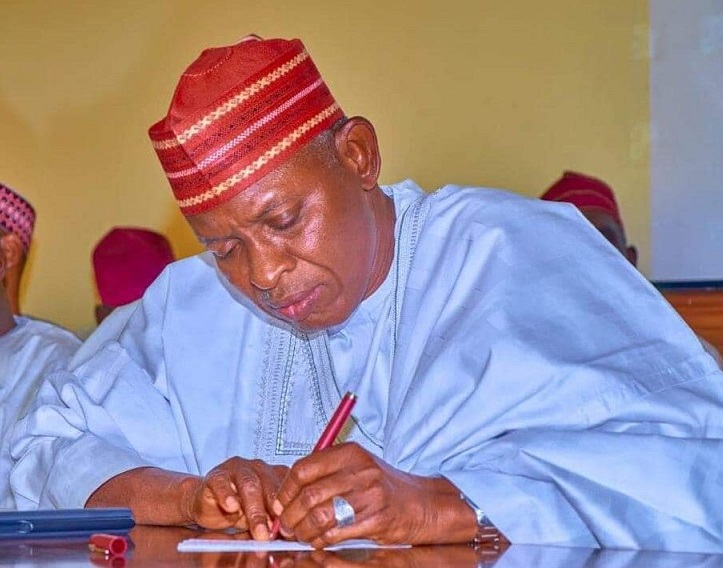
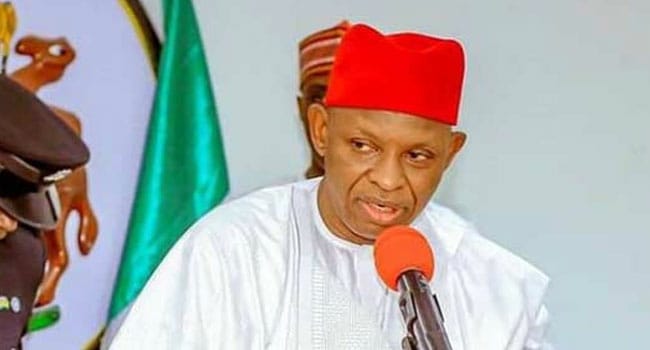
Abba Kabir Yusuf (Gida-Gida)

Court adjourns hearing on Kano emirship tussle

By Uzair Adam Imam

The Federal High Court sitting in Kano has adjourned the hearing regarding the removal of Kano Emir Aminu Ado Bayero to June 13, 2024.

The lawsuit, filed by Aminu Babba Dan’agundi, a title holder and senior counsellor in the Kano emirate, challenges the repeal of the 2019 Emirate Council Law by the Kano State House of Assembly.

Presided over by Justice Abdullahi M. Liman, the court has set the case for ruling on June 13, 2024. Aminu Babba Dan’agundi, represented by Barrister M. S. Waziri, argues that the repeal of the 2019 law unlawfully stripped both the Emirate Council and the plaintiff of their powers.

Counsel to the 1st and 4th respondents, Mahmoud Abubakar Magaji SAN, urged the court to decline jurisdiction to entertain the matter, citing that the law has gone through legislative processes and the order was made after the action was done.

Ibrahim Isah Wangida, counsel to the 2nd and 3rd respondents, aligned himself with Magaji’s submission, stating that the applicant’s rights were not breached as the 2024 law was repealed and accented to before the applicant filed the action.

Sunday Ekwe, counsel to the 5th and 6th respondents, stated that they did not file any issue on jurisdiction, as the duty of the police is to maintain peace and wait to carry out the court’s order.

The court requested written submissions from both sides and will review them before rendering a decision on June 13.The respondents in the suit include the Kano State Government, Kano State House of Assembly, Speaker of Kano State House of Assembly, Attorney General of Kano State, Kano Commissioner of Police, Inspector General of Police, NSCDC, and DSS.

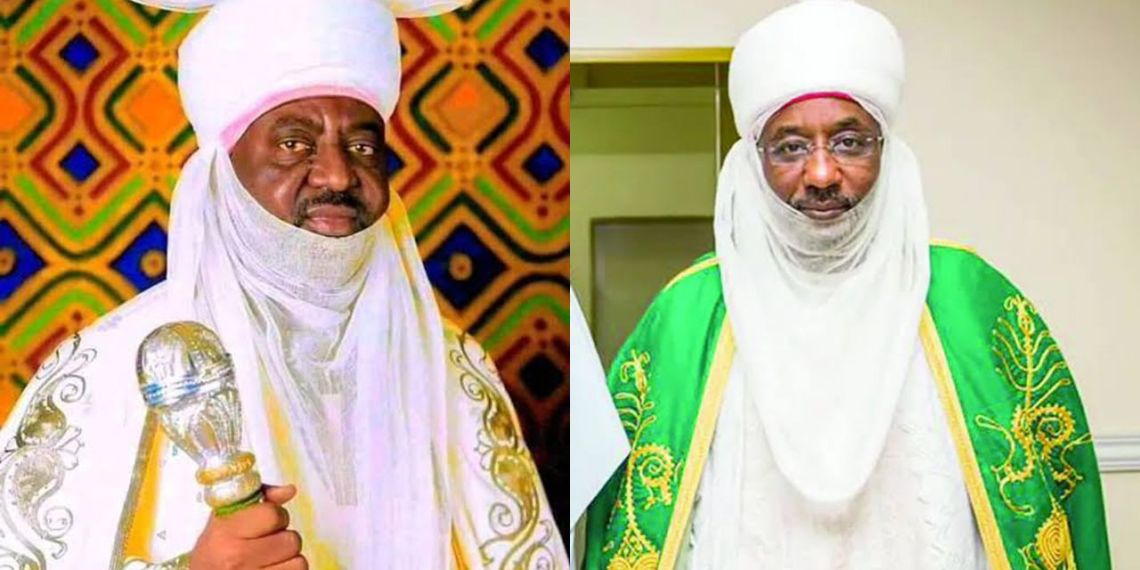
This legal battle is part of a larger crisis revolving around the emirship in Kano, following the dethronement of Aminu Ado Bayero and the reinstatement of Muhammadu Sanusi II by the Kano State government, creating tensions in the ancient city.

Currently, both emirs are holding court from separate palaces, with Sanusi operating from the main emir’s palace and Bayero presiding from the Nasarawa GRA mini palace.

Reinstatement of Emir Muhammadu Sanusi II and the resurgence of thuggery in Kano

By Aliyu Dalhatu Adamu

Kano people are known as peace-loving, as inculcated by the longest-serving Emir of the kingdom, Alhaji Ado Bayero,who led for over 50 years. His charisma and love for his people made him unique among all African traditional rulers. 

Kano people were traumatised by His Highness Alhaji Ado Bayero’s demise in June 2014, and the loss remained irreplaceable until 2020 when His Highness Alhaji Aminu Ado Bayero became the Emir of Kano. His emergence renewed the hope of the Kano people because he exhibited the same characteristics as his father. This makes him earn the love that people have for his father, which no one has in Kano.

The recent development of the Emir and reinstatement of the deposed Emir Sunusi Lamido Sunusi have seriously disrupted peace and stability in the state. This has opened doors for hooligans and thugs to widen their operations in the state.

It is a known fact that hooliganism and thuggery threaten the security of lives and property in every society. Hence, leaders are saddled with the responsibility of maintaining law and order to prevent potential offenders from engaging in such acts. 

It is unfortunate to say that the current administration of Governor Abba Kabir Yusuf has begun to do the other way around, as hoodlums and thugs are allowed to take over the Kano palace in the name of protecting the selfish and politically motivated interest of his political godfather. This has become a serious threat to the peace and safety of people in Kano as the hoodlums are harassing and intimidating people at will within the vicinity of the Kano Emir’s palace, all in the name of imposing Sunusi on the throne, which is facing outright absolute rejection by the good people of Kano.

This unbecoming attitude is becoming an eye-opener for young children who are now growing to witness this evil as a condoned behaviour. This may contribute to making hooliganism a wider phenomenon, a useful symbol, and a social obsession in the future tradition of the Kano Emirate traditional system.

Since the reinstatement of Sunusi Lamido Sunusi to Gidan Dabo, the palace and areas such as Kofar Kudu, Kano Municipal, Gwale, Dala, and the surrounding areas become the headquarters of thugs. Even medical workers at Hasiya Bayero Paediatric Hospital were attacked on the 27th of May, 2024. The Nigerian Medical Association (NMA) issued a statement condemning the barbaric development. Many other people living in the neighbourhood are not spared either.

This situation arose when the city’s public spaces were “swarming” with thousands of newly armed groups mandated to “protect” and pay allegiance to Emir Sunusi. These groups were recruited by the Kano state government only to praise their political master at the detriment of public safety.

Indeed, Gov Yusuf’s incompetence, ineptness, and clueless leadership style are undoubtedly taking Kano back to square zero. The pickle of the Kano emirship brawl is a cessation of Kano peace and stability as a courtesy to Senator Rabi’u Musa Kwankwaso, former Governor of the state Kwankwaso, by Governor Yusuf and the former Emir Sunusi Lamido Sunusi, in a bid to drag Kano to the state of anarchy. 

Hooligans also came to represent the dangers inherent in loosening constraints on society. Even when hooligans victimised people far from their concerns, the increase in their numbers, the apparent pettiness of their motives, and the savagery of their actions within Gidan Dabo suggested that certain members of the lower classes were either very beastly or very angry and that the mechanisms of state’s control were no longer in place to checkmate this.

Now, what we ask is, does the state government prioritise praising its political godfather over protecting the blood of theKano people?

Ironically, hooliganism and thuggery that previous administrations fought have now been revived by the present administration as the number 2IC in the government triggered the infiltration and indoctrination of youth into hooliganism and thuggery.

On this note, we are calling on the federal government, security agencies, intelligence communities, Nigerian Bar Association (NBA),  northern traditional rulers, religious leaders and all other relevant authorities to intervene. They should also advise the Kano state government to obey the court order restraining them from reinstating the deposed Emir Sunusi Lamido Sunusi and dissolving the remaining four Emirates in the interest of the good people of Kano. This will bring an end to hooliganism, public disrespect, defiance, chaos, and violence that are capable of destabilising the peace and security of Kano State.

Aliyu Dalhatu Adamu wrote from the Federal University, Dutsinma, Katsina State, via

aliyudalhatuadamu@gmail.com.

Preserving our heritage: The dethronement saga in Kano State

By Fatihu Ibrahim

Sometimes, our directionless life in Nigeria amazes me. Although we were once ruled by British colonists, we adopted the American presidential system, which is not only costly but also ineffective for our country.

With a heavy heart, I reflect on the recent dethronement of the 15th Emir of Kano, His Royal Highness Alhaji Aminu Ado Bayero. This event marks yet another instance where the government of Kano State has seemingly exercised its power dictatorially. Aminu was dethroned for no reason other than his association with the Ganduje administration. There was no justification for this action other than political disagreements and personal enmity.

This is the second time this government has taken action that deeply affects me. The first was the demolition of business buildings at the Eid praying ground, which caused the loss of billions of Naira worth of properties. This act indiscriminately affected nearly everyone in the Kofar Wambai market, regardless of political affiliation.

Some might argue about Sanusi Lamido Sanusi’s dethronement, which I also believe was wrong. However, at least there were allegations against him, whether true or false. In Aminu’s case, there was no such basis. He has tried to stay out of the political drama, avoiding the turmoil.

One wrong cannot right another. The most troubling aspect of this saga is how quickly the House acted, from proposing the motion to passing the verdict, in stark contrast to the usual legislative process. I recall advocating for gender-based violence laws in Kano State, which took months, if not years, to pass. The double standard is glaring.

The House of Assembly should focus on pressing issues. Our children have performed poorly in the SSCE qualifying exams, and our education system is dire, especially in primary and secondary schools. While I commend the governor for declaring a state of emergency on education, more must be done. Our universities are burdened with a 600 million Naira debt. Yet, the administration is spending 2.7 billion Naira on exotic cars for assembly members, ignoring the plight of the masses who elected them.

Ironically, the member who proposed the dethronement motion has no significant achievements. Many people who share his political affiliation vote for him out of blind loyalty to the party. It’s time we recognise the importance of voting for suitable candidates, regardless of their political views.

Yesterday, it was Sanusi; today, it’s Aminu. Who knows what will happen tomorrow? This cycle of dethronement could continue, with each governor bringing in their emir. What will become of our traditional institutions? Kano is renowned as one of the best Emirates in West Africa, if not the world. If this continues, can we still boast of being the Kano we once were?

Conflicts between the government and the emirate are not new; they date back to the colonial era and span various regimes. The government should find a way to resolve differences with traditional institutions without resorting to dethronement, preserving our history.

Perhaps someday, a governor will return the emirship to the HABE, the original heirs to the throne. There are still descendants of Muhammadu Rumfa and Sarki Muhammad Alwali, the last Hausa king. This, however, is a story for another day. Before anyone questions my loyalty or faith, I am a proud descendant of one of Shehu Dan Fodio’s flag bearers, making me Fulani by genealogy from the Kuninkawa clan.

May Allah bless Kano and its people. May we continue to lead in the political sphere in the north and Nigeria at large.

God bless Nigeria.

Fatihu Ibrahim wrote via fisabbankudi123@gmail.com.

BREAKING: Dethroned Bayero occupies mini-palace in Nassarawa

By Uzair Adam Imam

Alhaji Aminu Ado Bayero, the dethroned Emir of Kano, has returned to the ancient town and taken up residence in a palace in Nassarawa, fueling confusion and tension.

His return came in the early hours of Saturday, when his aircraft landed at Aminu Kano International Airport at around 4:30 am.

Upon his arrival, Bayero was greeted by a large crowd of supporters, who chanted verses from the Holy Quran, including Surah Al-Fatihah: “It is You we worship and You we ask for help.”

His convoy then made its way through the city, eventually arriving at the mini-palace in Nassarawa, where he has taken up residence.

Meanwhile, Sanusi II has taken over the traditional Gidan Rumfa palace, which has been the seat of the Emir of Kano for centuries.

Both palaces are now under heavy security cover, as the situation remains tense and uncertain.

Return of Sunusi: The dilemma ahead

Mohammad Qaddam Sidq Isa (Daddy)                     

The return of Muhammadu Sunusi ll as Sarkin Kano is yet another manifestation of the influence of politics on the traditional Masarauta establishment, which, after all, has always been used and abused by politicians.

Since the British conquest of the Usman Dan Fodio Islamic sultanate in what subsequently became part of today’s northern Nigeria, the enthronement and dethronement of emirs (Sarakuna) have always been motivated by underlying political interests. 

Throughout the colonial era, the British would only enthrone aspiring princes deemed the most loyal to the British colonial establishment as leaders of their respective emirates. This practice enabled them to maintain their colonial grip through those proxy-Sarakuna. And since then, successive generations of military and civilian administrators have followed suit, enthroning and dethroning Sarakuna literally at will. 

The only shift in this regard is that, in the past, the influence of political leaders would mostly come to play only when a throne became vacant mainly due to the death of the Sarki, when the incumbent governor would influence the emergence of his successor, as it happened in 2014 in Kano that led to the enthronement of Sunusi. However, now that the trend is becoming systematic, it will indeed, if left unchecked, render the reins of Sarauta effectively tenured, subject to the tenure of the governor behind it. 

After all, just like his enthronement in 2014 by then-Governor Rabiu Musa Kwankwaso and his subsequent dethronement in 2020 by then-Governor Abdullahi Umar Ganduje, Sarki Sunusi’s return to the Kano throne remains politically motivated within the context of the power struggle in Kano politics between Kwankwaso and Ganduje, two provincial vindictive enemies hell-bent on finishing off each other.  

By the way, as a subservient Kwankwaso ‘boy’, Governor Abba Kabir Yusuf himself is a mere fighting tool in the hands of his godfather in the struggle. 

Interestingly, Kwankwaso has tactically put his vengeful mission against Sunusi on hold for now, pending finishing off Ganduje and his legacy. 

Sunusi incurred then-Governor Kwankwaso’s wrath as a then-Lagos-based bank executive when he kept dishing out disparaging criticisms against Kwankwaso and his government. For instance, in an article he titled “The Kwankwaso Phenomenon”, Sunusi described then Governor Kwankwaso as a “rural aristocrat” who “surrounds himself with provincials and places key posts in the hands of rural elite”. He also compared Kwankwaso’s government to “the classic comedy of the Village Headmaster in a village council”. 

Kwankwaso got mad at Sunusi and demanded his sacking by his then-employer, United Bank for Africa (UBA). He threatened to stop his government’s dealings with the bank in case of non-compliance. 

Anyway, now that Sunusi is back, it remains to be seen how it plays out between him and Governor Abba, considering Sunusi’s penchant for publicity stunts involving controversial utterances against government policies and wrongdoings. 

As much as Sunusi is excited about his return to the Kano throne, the development represents a tricky dilemma for him that also tests his supposed commitment to outspokenness against government wrongdoings. 

On the one hand, Governor Abba won’t tolerate his stunts in the name of outspokenness; no governor will, either. And unless he (Sunusi) has, this time around, decided to desist from his stunts to keep his throne, Governor Abba, under Kwankwaso’s influence, won’t hesitate to go to any extent, including dethronement, to deal with him. 

On the other hand, his distance from his stunts would undoubtedly mean the end of the reputation he has somehow earned as an outspoken critic of government wrongdoings.  

Mohammad wrote from Dubai and can be reached via mohammadsidq@gmail.com.

The return of Sanusi

By Aliyu Nuhu

I have read the amended Kano Emirates law, which was brief, concise and straight to the point, to achieve certain ends. It is a promise fulfilled by the new NNPP government. Engr. Rabiu Musa Kwankwaso had said time without number that if elected, the government would repeal the Dr Abdullahi Umar Ganduje-led Emirates laws.

If Governor Abba Kabir Yusuf signs the amendment into law (which is a certainty), it will remove the present emirs from their offices and return all the Ganduje creation of first-class emirs back to district heads (hakimai). The affected emirs are those of Gaya, Rano, Karaye and Bichi.

The new law gives the governor the power to either re-appoint them hakimai or remove them and search for new ones.

Until the coming of this new law, I thought that Muhammadu Sanusi II’s return was impossible, as it had no precedence in the history of the Kano emirate. But after talking to officials and people who know the workings of the government, it appears certain that Sanusi will return to his throne, in fact, soon enough to preside over the coming Eid-Kabir prayer. 

Nothing is certain yet, but nothing is impossible, thanks to political intrigues and the need for the new government to reverse Ganduje’s legacies. There is no love lost between Kwankwaso, Abba, and Ganduje.

For my own views, I support the amendment of the Emirates laws and the return of a strong Kano emirate, but I don’t support Sanusi’s return as emir of Kano. The current Emir of Kano, Aminu Ado Bayero, is doing well and is loved by the people. 

I don’t support Sanusi’s return. I know he has not learned a lesson and will still come back and meddle with Kano politics, attack Abba and his government, and continue shooting his mouth as if he is an ordinary person. People who sit on the Kano throne don’t talk too much. He must also not try, like his grandfather did to Sardauna, to outshine the Kano state governor.

In history, there was an incident where the then-Emir Muhammadu Sanusi shamed Sardauna in the Kano race course parade ground by attracting a standing ovation with the Sardauna seated. The premier of Northern Nigeria considered it an affront to himself as the Emir stole the spotlight by arriving in full splendour and pageantry, and the whole assemblage had to stand up for the Emir in traditional homage and honour. It was a percussion to the dethronement of Emir Sanusi of Kano.

The grandson Sanusi Lamido Sanusi has inherited those tendencies from his grandfather, and I daresay when it comes to attacking and criticizing the government, Kwankwaso/Abba don’t have the patience, and if you like to call it table manners of Ganduje. They will throw out Sanusi in a blink of an eye.

They said a leopard never changes its colours. But time will tell.

Until then.

Governor Abba K. Yusuf’s admin under scrutiny: Mismanagement and controversies rock Kano

By Umar Sani

Governor Abba Kabir Yusuf’s tenure in Kano State has been marked by a series of controversies and challenges, with the most recent scandal surrounding the Ramadan feeding program shedding light on broader issues of governance, priorities, and accountability. As we delve into the intricacies of these matters, it becomes evident that there are systemic failures that need to be addressed urgently to restore public trust and ensure effective governance in Kano.

The Ramadan feeding program scandal serves as a microcosm of the larger issues plaguing Governor Yusuf’s administration. This program, which is meant to provide essential support to the less privileged during the holy month of Ramadan, has instead been tainted by allegations of corruption, mismanagement, and inhumane practices. Reports indicate that resources allocated for the program have been misappropriated, with food meant for the needy ending up in the hands of those who are already well-off. Furthermore, there have been disturbing revelations of substandard food being distributed, posing health risks to the recipients.

Such egregious mismanagement not only squanders public funds but also undermines the intended purpose of welfare programs, which is to alleviate poverty and provide a safety net for society’s most vulnerable members. It reflects a blatant disregard for the welfare of the people and a failure to uphold the principles of transparency and accountability in governance.

However, the issues plaguing Governor Yusuf’s administration extend beyond the mismanagement of specific programs. There are deeper underlying problems related to governance, priorities, and political dynamics that must be addressed comprehensively.

One key issue is the misplacement of priorities. Despite the pressing need for investment in critical sectors such as healthcare, education, and infrastructure, resources have been diverted towards superficial endeavours associated with Governor Yusuf’s political agenda. The phenomenon of Abba Gida Gida, characterized by flashy projects and grandiose gestures, has overshadowed genuine efforts to address the socio-economic challenges facing Kano State.

The emphasis on political symbolism over substantive governance reflects a fundamental disconnect between the government and the governed. Instead of focusing on initiatives that have a meaningful impact on people’s lives, Governor Yusuf has prioritized activities that serve his political interests and consolidate his power base. This shortsighted approach not only undermines the credibility of the government but also exacerbates the suffering of the ordinary citizens who bear the brunt of poor governance.

Moreover, Governor Yusuf’s close association with the Kwankwasiyya political movement has further complicated governance in Kano State. While political alliances are a common feature of Nigerian politics, the tight grip of Kwankwasiyya on the state’s affairs has stifled dissent and marginalized opposing voices. This monopolization of power has created a culture of impunity where accountability is sacrificed at the altar of political expediency.

The entrenchment of Kwankwasiyya in Kano’s political landscape has also fueled factionalism and polarization, undermining efforts to foster unity and inclusivity. Instead of governing for the collective good, Governor Yusuf has been preoccupied with consolidating his grip on power and silencing dissenting voices within his own party and the opposition.

Furthermore, the lack of effective checks and balances has enabled corruption and malfeasance to thrive unchecked. The absence of independent oversight mechanisms has emboldened corrupt officials to exploit public resources for personal gain, exacerbating the state’s economic woes and widening the gap between the rich and the poor.

To address these challenges and chart a path towards genuine reform, Governor Yusuf must demonstrate a commitment to transparency, accountability, and inclusivity in governance. This requires a paradigm shift away from political patronage and towards evidence-based policymaking that prioritizes the needs of the people above partisan interests.

In addition, there is a need for robust institutions and mechanisms to curb corruption and hold public officials accountable for their actions. This includes strengthening anti-corruption agencies, empowering civil society organizations, and promoting a culture of transparency and accountability across all levels of government.

Moreover, Governor Yusuf must prioritize investments in critical sectors such as healthcare, education, and infrastructure to improve the quality of life for all citizens. This requires prudent resource management and strategic planning to ensure that public funds are utilized efficiently and effectively to address the most pressing needs of the population.

Furthermore, Governor Yusuf should endeavour to build bridges across political divides and foster a spirit of inclusivity and cooperation in governance. This means reaching out to opposition parties, civil society groups, and other stakeholders to solicit their input and support in addressing the state’s challenges.

Ultimately, the road to meaningful reform in Kano State will require courage, vision, and a genuine commitment to the principles of democracy, good governance, and social justice. Governor Yusuf has a historic opportunity to leave a positive legacy by addressing the root causes of the state’s problems and charting a new course towards prosperity and progress for all its citizens. However, this will require bold leadership and a willingness to challenge the status quo in pursuit of a brighter future for Kano State.

Umar Sani wrote via umarhashidu1994@gmail.com.

Group lambasts Governor Yusuf for alleged cover-up amidst governance failures

By Uzair Adam Imam

A political movement based in Kano, Arewa Renaissance Front (ARF), has criticized Governor Abba Yusuf for levying what they term as unfounded accusations against Dr. Abdullahi Umar Ganduje, the National Chairman of the All Progressives Congress (APC).

ARF accused Yusuf of using unsubstantiated claims against the former governor as a shield to conceal his own failure in meeting the expectations of the people.

In a statement released by Aminu Gawama, the Secretary-General of ARF, the group alleged that Yusuf, along with his political mentor, former governor Rabiu Musa Kwankwaso, are engaged in a vendetta against Ganduje.

According to the statement, these allegations were merely propaganda orchestrated by state-owned entities to divert attention away from the glaring inefficiencies and lack of direction in Yusuf’s administration.

The statement further highlights the public’s growing frustration with Yusuf’s tenure, questioning his accomplishments despite the ample fiscal resources available to the state. ARF denounced the judicial commissions of inquiry initiated by Yusuf to probe Ganduje’s tenure, labeling them as biased and aimed solely at depleting state resources.

ARF also condemned Yusuf’s selective targeting of Ganduje’s administration while absolving Kwankwaso’s tenure from scrutiny, characterizing it as a futile attempt to mislead the populace.

Military can end Nigeria’s security crisis

By Uzair Adam Imam

Former Minister of Defence and National Leader of the New Nigeria People’s Party (NNPP), Sen. Musa Kwankwaso, has emphasized the capability of the military to effectively address the prevailing security challenges in Nigeria, provided with the requisite support.

Speaking to journalists after the NNPP National Executive Committee meeting in Abuja, Kwankwaso underscored the pivotal role of the Federal Government in addressing the security crisis while urging Nigerians to actively contribute by providing crucial information to security agencies.

Drawing from his extensive experience in security matters as a former Minister of Defence and Chief Security Officer of Kano State, Kwankwaso emphasized that the gravity of the situation necessitates the involvement of the Nigerian military.

He stressed that alternative security measures, such as state-led initiatives, fall short of addressing the magnitude of the crisis.

Highlighting the dire consequences of the security challenges, including disruptions to agricultural activities and rampant abduction of innocent civilians, Kwankwaso urged collective efforts towards restoring peace and security in the country.

Asserting his party’s readiness to tackle the nation’s problems, Kwankwaso positioned the NNPP as a beacon of hope for Nigerians disillusioned by the failures of the All Progressives Congress (APC) and the Peoples Democratic Party (PDP).

Echoing Kwankwaso’s sentiments, Kano State Governor Abba Yusuf urged unwavering dedication among party members, emphasizing the need for wholehearted commitment to the NNPP’s vision for a better Nigeria.

In search of a link between some Hisbah operations and Shari’a implementations

Isma’il Hashim Abubakar

A few weeks ago, the Kano State Hisbah Board stole the limelight when a brief misunderstanding erupted between the Kano State Governor, Abba Kabir Yusuf, and the Hisbah leadership. The Muslim public, represented by religious leaders and the elite, played a significant role in calming tensions and restoring peace in the issue, which everyone welcomed with sincere happiness and unique hope that the short altercation would result in the promotion and reinforcement of Hisbah. 

In the two articles I penned within the clusters of that misunderstanding, I stressed that Hisbah is virtually the only government institution that transcends abstract symbolism and remains the lively organ that operationally contributes to the implementation of the Shari’a project, which was once the highest ambition of the Nigerian Muslims. I emphasised that all Muslims should regard Hisbah as their delicate property that should not be, in the least, jeopardised by internal or external commissions, omissions or inactions of any individual, no matter how highly placed, let alone common people who can just be dealt with and cracked down by responsible leadership.

One of the top functions of Hisbah is to serve as a machinery that supports the process of Shari’a implementation by deterring people from committing crimes, apprehending suspects, and presenting them before Shari’a courts for proper investigation and ruling. Of course, at different stages, Hisbah commendably serves as a forum for reconciliation and solving social disputes, which at times pleases and satisfies opposing parties in a better way than courts do. Nonetheless, this is never an excuse for the institution if it operates so that its effort to intervene in matters and find solutions for them becomes counterproductive to the letter, spirit and goals of Shari’a, which the board was primarily established to protect. 

Although preserving dignity is a principle that characterises Hisbah’s operations, as a government force backed by law, the board is not expected to provide cover or leeway for criminals to evade the wrath of the law. Shari’a will cease to have its proper meaning if criminals assume they are not to be treated as culpable and should, in principle, be deterred from, cautioned against, or punished for flouting Islamic law. 

In light of how some Hisbah officials handle cases both at the headquarters and various branches in the 44 local governments, some categories of criminals now utilise Hisbah to get their crimes tacitly covered as they further pursue their fiendish goals by conniving with or approaching some elements within the board. They no longer fear legal penalties that their crimes could lead them to, but could even summon the courage to approach the board to confess their crimes and demand certain rights that may have followed the consequences of their crimes. 

To be clearer, by citing examples, in a recent report I watched, which was broadcast by Tozali Magazine Online TV, a Chinese master in a company in Kano impregnated the daughter of his driver. When this crime was unmasked, the people involved tried several ways to abort the six-month pregnancy. After failing to get rid of the mess since medical experts refused to conspire with the Chinese fellow and his illegitimate in-laws, the case was taken to Hisbah, who is said to have searched for a solution for them. 

The report has it that the Hisbah leadership has resolved that the Chinese man, who earlier sought to silence his poor driver through pecuniary consolation, should just now marry the girl despite her heavy pregnancy so that the matter would be put to rest. If this report is true, with all its attendant jurisprudential intricacies, similar to what has allegedly occurred repeatedly in several branches of the morality police, then the institution needs to review its operations. 

As a Shari’a implementation body, when a suspect admits committing a crime as felonious as this, which involves adultery and attempts at feticide, is the expected response from Hisbah to look for a solution or to make a comprehensive investigation and forward the case to Shari’a court for judgment? Is Hisbah not shielding adulterers and providing escape routes for suspects who attempted to commit a feticidal crime? The punishment for an adulterer is clear; to be stoned to death and 100 lashes for the girl who seems to be unmarried since her Chinese lover, according to the report, did not rape her or use any form of coercion to have carnal knowledge of her. How could all this be replaced by forcing these criminal parties into marriage? 

A knowledgeable person heads the Hisbah, and the wisdom behind resorting to marrying culprits of this nature is a motive to preserve human dignity, conceal wrongs committed and prevent an illegal child from being born from perpetual bullying and stigmatisation. But yet, is this enough reason to sacrifice divine injunctions and render them obsolete? From what we read in the Glorious Qur’an and interpreted by the Messenger (SAW) through his speeches and deeds, suspects could only be shielded if the matter is not taken to authority or the relevant legal agency has not got hold of the felons. Concerning a set of crimes and their penalties, Allah says:

“illa alladhīna tābū min qabli an taqdirū ‘alaihim fa’lamū anna Allaha Gafūrun Rahīm” (except those who repent before they fall into your power, then know that Allah is Most-Forgiving, Most-Merciful) [ Sūrat al-Mā’idah: 34].

In several instances, the Prophet (SAW) warned that once a matter was presented before his court, then Allah’s law would take precedence over all other concerns. However, the Prophet (SAW) took pity on an illegal child born by a woman from the al-Ghāmidī clan. As a result, he asked her to go and take care of her child when the woman returned after she successfully weaned the child. She insisted that she must be punished according to the divine law; the Prophet (SAW) did not look for any other solution but applied the law to her, which, interestingly, promoted her posthumous virtue and spiritual rank. Worthy of notice also, nothing was heard about the man responsible for her illegal birth, nor did the Prophet himself ask her to mention him, just as the child was also integrated into the society without inscribing a permanent taboo on his status. 

Of course, many will argue that the penalties above are practically infeasible, but yet rewarding the felons with marriage is also discouraging and counterproductive to the goals of Shari’a. A midway solution is at least to apply a warning penalty (ta’zīr) on the criminals by serving their sentences to spend years in jail, which will be done by the court.

The scenario of Ɗan Chana and his street in-laws represents one of the many cases that evince Hisbah’s indecision to fully side with the spirit and letter of Shari’a as fully enshrined in the state law and is still the main legal framework that ought to guide Shari’a implementation process. It is now common to see a girl carrying a small child and asking for the address of Hisbah to report a case of her love affair, which resulted in the birth of a bastard whose alleged father refuses to adopt, take care of, or just abandons. The girl will summon enough courage and temerity to shamelessly divulge her secret affair just because she is confident she won’t be served with proper Shari’a law. Her aim for approaching Hisbah is not to repent and make amends but rather to wheedle her way into favour and capitalise on the institution’s power to extort money from her accomplice, who may have even denied being responsible for the unwanted birth. 

Even if Hisbah won’t pursue the case to the court, which it should, it should at least explain to girls like this that pregnancy and birth are enough evidence to prove a woman guilty of adultery or fornication, unlike in men’s cases, which primarily demands eyewitnesses or personal confessions. After all, illicit relationships do not have a sanctity similar to marriage, which has a Shari’a cover. As such, failure by a partner in illicit relationships to fulfil certain duties should not be equated with marital disputes between spouses. If a whore pretends that she is innocent and goes on to claim damages or demand a right, then what makes her different from a legitimate housewife or a divorcee? 

In the same manner, men accused of raping innocent girls are sometimes relieved from their burden through local arrangements with victims’ families such that in the long run, money will be the prime solver of the dispute, and suspects get away once they make commitments to take care of certain clamours about their victims.

The disconnect between some operations of Hisbah, which is portending a gloomy future for the institution, shall be one of the priorities of the governing council of the board, but also the head of government, who now does not have any doubt about the institution’s significance and dearness to the Muslim public. As we are in an era of normalisation of strange and weird mores and practices, Hisbah should be highly cautious and extra-careful not to be an agent through which barbaric, savage and amoral attitudes will be mainstreamed. 

Lovers who lack fear of God or a woman who falls so low to trade with her dignity in exchange for cash will continue to be emboldened to make a claim when any of them feels cheated in an illegal deal. No matter how rich or influential a man is, he shouldn’t be given a cover to get away with his crime just for pledging to take care of his rape victims. The application of appropriate legal sanctions is the only solution and guarantee for the safety of all parties, including the Hisbah and its leadership.

Isma’il writes from Rabat and is reachable via ismailiiit18@gmail.com.