By Abdullahi Mukhtar Algasgaini
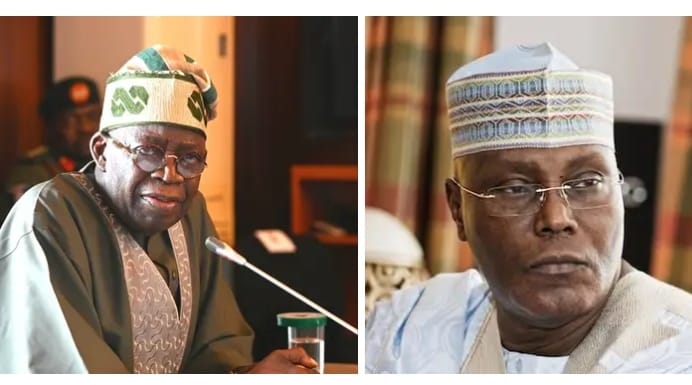
The Presidency has fired back at former Vice President Atiku Abubakar, dismissing his recent criticism of President Bola Ahmed Tinubu’s economic policies as “pedestrianism” and arguing that the opposition leader’s concerns are rooted in outdated data from 2024 rather than Nigeria’s current economic reality.
In a detailed statement issued Saturday by presidential spokesperson Bayo Onanuga, the administration provided a point-by-point rebuttal to Atiku’s allegations of “fiscal recklessness,” defending its record on borrowing, subsidy removal, tax reforms, and overall economic management.
The statement took particular issue with Atiku’s reliance on 2024 data, arguing that Nigeria’s economy has evolved considerably since the painful adjustments of that year.
“Judging a reform programme solely by its earliest and most painful phase is like judging chemotherapy by the nausea it induces while ignoring the remission it seeks to achieve,” Onanuga wrote.
According to the Presidency, Nigeria’s dollar-denominated GDP has recovered from approximately $253 billion following the 2024 exchange-rate reset to about $377 billion – a 49 per cent increase. Naira GDP has expanded from about ₦314 trillion in 2024 to around ₦530 trillion, a 69 per cent increase.
On the question of Nigeria’s borrowing, the administration argued that the country’s debt-to-GDP ratio remains modest at barely 40 per cent compared to peer economies, including South Africa (85 per cent), Egypt (80 per cent), and Kenya (75 per cent).
The statement highlighted what it called a “remarkable achievement” in reducing the debt service-to-revenue ratio from nearly 100 per cent in December 2022 to less than 60 per cent today.
“Nigerians suffered over the years as a vast proportion of our resources were deployed to pay fuel-subsidy merchants,” the statement said, noting that the Obasanjo-Atiku administration “never did the needful” on the subsidy issue.
The Presidency defended the removal of fuel subsidies, pointing to improved revenues accruing to states and local governments through the Federation Account.
“President Tinubu has tactically placed more responsibility for socioeconomic development on states and local governments, while providing requisite funding. This is true federalism,” Onanuga stated.
The administration rejected Atiku’s suggestion that the government has chosen to tax Nigerians more, describing the claim as “blatantly false.”
The statement explained that the tax reforms aim to reduce burdens on low-income earners earning N1 million and below annually, and small businesses with turnover of N100 million and below, while strengthening compliance among higher-income individuals and profitable enterprises.
The statement outlined several achievements in health, education, and infrastructure over the past three years:
· Over 100 facilities providing free caesarean operations for indigent mothers
· Three world-class cancer centres operational in Kubwa, Enugu, and Katsina
· Over 3,000 Primary Healthcare Centres revitalised
· More than 11,000 projects through the Universal Basic Education Commission
· Over 1.64 million students benefiting from NELFUND loans totalling N303 billion
· End to university lecturers’ strikes
The Presidency dismissed Atiku’s claim of an N7.98 trillion oil windfall, arguing that such calculations ignore production costs, crude sharing arrangements, and forward contracts.
“Incremental revenue from higher oil prices is reflected in monthly FAAC figures,” the statement noted, adding that average daily production of 1.6 million barrels per day has fallen short of the 1.84 million bpd forecast.
The statement concluded on an optimistic note, projecting that inflation, which fell to 14.4 per cent in November 2025 before rising to 15.91 per cent due to Middle East conflicts, will trend towards 12 per cent by year-end.
“Nigeria’s economy is not yet where it aspires to be. But neither is it where it stood at the height of its structural distortions or in the bygone years of fiscal waste and slackness,” Onanuga wrote. “The worst is over.”
The administration also highlighted new ward-centric programmes worth more than $3 billion aimed at strengthening primary healthcare, basic education, and supporting vulnerable communities, in addition to cash transfers to 15 million vulnerable households.
Opposition Leader’s Criticisms Are Based On Outdated Data, Misrepresentations—Presidency

ByAdmin
2 August 2026