Religion

Sheikh Zarbaan Al-Gamidi is dead

By Ibrahim Siraj

A renowned Islamic scholar and Chief Imam of the historic Qubaa Mosque in Medina, Sheikh Muhammad bin Abdallah Zarbaan Al-Gamidi has been reported dead. He died Friday, according to sources familiar with the development.

Sheikh Zarbaan was a teacher, mentor and father figure to all Nigerian graduates of the prestigious Islamic University of Medina. He was instrumental in the admission of hundreds of Nigerian students into the prestigious University through the Daura intensive training he coordinated for several years since the inception of the programme in Nigeria.

Prominent among Sheikh Zarbaan’s students are the late Sheikh Ja’afar Mahmud Adam, Drs Muhammad Rabi’u Umar, Bashir Aliyu Umar, Abubakar Muhammad Sani, Ibrahim Ilyas, Ibrahim Jalo Jalingo, Isa Suleiman, Muslim Ibrahim, Sheikh Abdulwahab Abdullah, Professors Mansur Sokoto and Abdallah Saleh Pakistan, to mention but a few.

He will be remembered for his special attachment to his Nigerian students, whom he mentored up to his final moment on earth. Every year, he would call some of them during the annual Ramadan Tafsir to pass a message of goodwill and encouragement.

He recently donated his entire book collection for the benefit of Nigerian scholars. The books were received through Dr Abubakar Muhammad Sani and will be kept in a library in Dutse for access by the public.

He was a friend to many prominent Nigerian scholars and philanthropists such as late Sheikh Aminuddeen Abubakar, late Halifa Sheikh Isyaku Rabiu and Alhaji Aminu Dantata. May Allah have mercy on him and make Aljanna his final abode, amin.

Arewa Today: Shari’ah for the masses, democracy for the elite

By Ibrahiym A. El-Caleel

Northern Nigeria, Arewa launched her Shari’a project on the eve of the third millennium, precisely in 1999. The project was cheered by Muslims, who are the larger share of the Arewa population. But, on the other hand, the project became a thorn in the flesh of liberal Muslims as well as Islamophobes. Therefore, this generated heated discussions within the Arewa intelligentsia, from the mosques’ pulpits to traditional media pages.

Immediately Shari’a was launched, additives were added to strengthen its influence over the years. The Shari’a courts appeared visibly effective and powerful in their jurisdictions. On the other hand, they were feared due to their initial charisma. Shari’a hudud (penalties) were unapologetically executed in states that subscribed to the project. In 2003, Kano State impressively established the Kano State Hisbah Corps to deepen Shari’a application further. All these were efforts that every conscious Muslim found impressive. Nigerian Muslims were able to leverage democracy to re-establish their lost treasure of Islamic Law. It was a sort of blessing in the eyes of conscious Muslims. Today, however, things are beginning to fall apart.

In recent years, we see rather poor management of the Shari’a project. Convicts in Shari’a courts now find a way to evade justice, leveraging the weak points in the project. More problematic is the visible selective application of Shari’a among Arewa Muslims. Concerning the Shari’a application, Arewa currently operates a caste system. Masses are prosecuted under Shari’a for the slightest offences, but the elites commit big offences and get away with impunity. The Shari’a practised by the earliest Muslim generations was egalitarianism, where everyone was equal before the Islamic Law. But in Arewa today, Shari’a is an elitism that only applies to the nobodies in the society, while the elites break the code and fingers are not raised at them.  

Kano Hisbah is famous for coming into the spotlight with all sorts of amazing arrests and “Shari’a law enforcements”. There are pictures of them randomly stopping youths and cutting their hair because they have kept bushy and unkempt hair. To me, this should be a minor thing that should bother Kano Hisbah, when every week, men and scantily dressed women converge at costly-rented event centres, dancing and freely mixing in the name of celebrating weddings. Kano Hisbah never shows up in such Shari’a noncompliant events because they might be meeting the last son of a commissioner, the wife of a minister or even the nation’s First Lady herself. Apologists of this caste system might say perhaps Kano Hisbah never comes across these numerous events that happen frequently and simultaneously. But the answer is, after concluding the events, these “untouchables” audaciously flaunt the immoral pictures and videos on social media to the public glare. And nothing still happens.

Shari’a in Arewa will continue to be feeble because Arewa leaders are not genuinely committed to executing it. Only Allah knows the hearts of men, but the body language we are seeing is that these leaders use Shari’a in the spirit of populism; to woo political fandom. If we have Shari’a, then everyone must come equal before it. In a sane society, everyone comes equal before the law. This is called “the rule of law”.

It was narrated that during the reign of Caliph Umar bnul Khattab, Amr bnul Aas was the governor of Egypt. This governor had a son who entered a horserace with an Egyptian man, and the Egyptian man won the race. This defeat angered the governor’s son, so he decided to flog the Egyptian man. The man left Egypt and travelled to Madinah to complain to Caliph Umar. Umar summoned Governor Amr bnul Aas and the son to appear before him. When they showed up, Umar asked the Egyptian man to flog the Governor’s son as he had flogged him. Then he said to the governor, “when did you start to enslave people when they were born free?”. This incident indicates that Caliph Umar, as one of the most influential leaders in history, never allowed impunity and elitism to prosper in the land.

Secondly, when a lady from Bani Makhzum committed theft, the people of Quraysh requested Usama bn Zayd to intercede for her with Prophet Muhammad (Peace be Upon Him). When Usama spoke about it to the Prophet (Peace be Upon Him), the Prophet said, “Do you try to intercede for somebody in a case connected with Allah’s Prescribed Punishments?” Then he got up and delivered a sermon saying, “What destroyed the nations preceding you, was that if a noble amongst them stole, they would forgive him, and if a poor person amongst them stole, they would inflict Allah’s Legal punishment on him. By Allah, if Fatimah, the daughter of Muhammad stole, I would cut off her hand.”

Prophet Muhammad (Peace be Upon Him) is the grand patron of all leaders executing the Shari’a. This is him (Peace be Upon Him) saying if his own most beloved daughter were found guilty, he would apply the laws on her with no regard to her exalted status. May Allah’s salutations be upon him. He indeed is our ultimate role model worthy of emulation.

Until Arewa leaders take the Prophet (Peace be Upon Him) as a role model in the Shari’a project, we will continue to be a laughingstock. It is quite shameful that daughters of Arewa governors and emirs dress immodestly at their weddings. We have seen the daughter of former Kano Emir Mallam Muhammadu Sanusi II taking a handshake from the Vice President, an ajnabi (strange man), in front of her father. The daughter of Kano State Governor Khadimul Islam, Dr Abdullahi Ganduje, dressed immodestly on her wedding day. She wore a sleeveless wide-necked gown that almost revealed her chest. As if that was not enough of breaking the Shari’a code, she danced in this outfit to the visuality of strange men. The daughter of former EFCC Czar Mallam Nuhu Ribadu also made a similar appearance some months back.

This week, the trending topic on Arewa Facebook centres around another Kano princess, Zahra Nasir Ado Bayero, who is getting married to the President’s son, Yusuf Muhammadu Buhari. In her bridal shower event in Abuja, the princess appeared in a tight wedding gown, exposing the upper part of her torso. Of course, her hair was styled and opened to the public like her fellow sisters in the Shari’a code-breaking. People are wondering how Kano Hisbah is not seeing all this and issuing a press release.

The amoralism is getting institutionalised by the children of Arewa leaders. It speaks volumes to why Shari’a is still a baby in Arewa despite spending more than 20 years in the system. People who could give us a formidable Sharia are issuing licenses to their children to abuse the code and go scot-free. This is why even convicted blasphemers these days do not end up suffering the penalties. Anyone with some copper coins in their pockets and a little political network can find a way out. Only the poor and the unconnected can be convicted and be eventually punished. This is the caste system we have awaken to in Arewa today. Unfortunately, leaders are not ready to walk the talk. We need a leveller to be able to have an effective Shari’a system. What is good for the goose has to be good for the gander. Else, we are all joking around.

Ibrahiym A. El-Caleel is a Civil Engineer by training with an interest in public and social commentary. He writes from Zaria and can be reached via caleel2009@gmail.com.

Prof Maqari vs Dr Abdallah: A diversion from Abduljabbar’s heretic teachings?

By Dr Muhammad Sulaiman Abdullahi

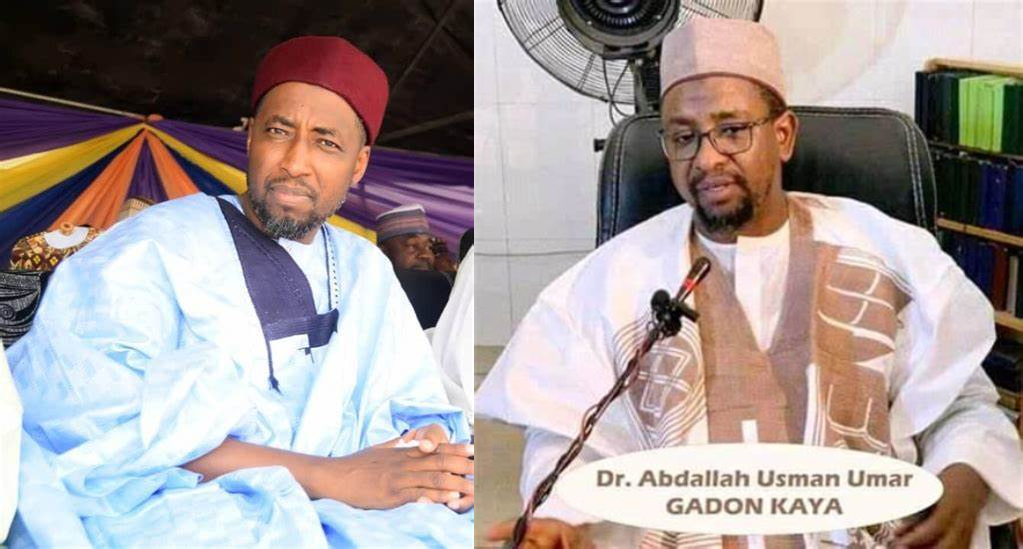
Tension grew as Prof. Ibrahim Maqari intends to sue Dr Abdalla Usman Gadon-Kaya based on what he (or his lawyers) called defamation of his character. It may be recalled that the main point of divergence between the two was their different religious affiliations, where Prof. Maqari subscribes to Tijjaniya Sufism, and Dr Abdalla is an Izala/Sunni scholar who preaches mostly against the teachings of Prof. Maqari and Tijjaniyya order in general.

Initially, the blasphemous and heretic teachings of Abduljabbar Kabara were the genesis of their misunderstanding, where Dr Abdallah erroneously cited a wrong reference when referring to an Abuja Imam. It was clear that the coalition of Kano Ulama, under the chairmanship of Dr Sa’idu Dukawa, lodged their complaint against what they found to be lies and concoctions against Bukhari, Muslim, some Sahabas, which in turn, ridicule and subject the sanctity of the Prophet’s household into questioning. These immoral teachings have negatively impacted some irate and ignorant youth, where they mockingly copy and paste anything from the sacred books and ridiculously call it a lie.

In response to this unprecedented religious turmoil, the scholars in Kano unanimously agreed to form a coalition to defend Islam’s sanctity. Abduljabbar directly targets Dr Abdalla and other prominent Sunni scholars in Kano as his reference point and as one of those at the forefront of exposing his evil antics. These altercations have taken a long time without Prof. Maqari featuring in the scene with either support or opposition to what Kano Ulamas have been doing.

After the debate session, the Muslims were happy as Abduljabbar failed to defend his heretical teachings. However, while everyone was happy and waiting for a verdict from the government, suddenly Prof. Maqari used his position from the Abuja Central Mosque and said that he perceived a form of propaganda in all that has been happening in Kano concerning Abduljabbar’s case. Thus, Prof. Maqari breathed life to all the supporters of Abdujabbar who died and buried their heads in shame.

Maqari’s submission made Dr Abdalla go berserk and even erroneously, out of emotions, mentioned many instances where an Imam in Abuja, which may be Prof. Maqari, used his position to delve into this – what no Imam in the history of Abuja Mosque ever delved into before. He cited instances where such an Imam said many things and even went to the extent of claiming to own classified audios of phone calls where that Imam, who may be Prof. Maqari, wanted to intervene in cases related to blasphemy.

In response, Prof. Maqari, in what shows his humility and humbleness, as usual, posted a video where he debunked all that Dr Abdalla said and called for peace. Later, Dr Abdalla also posted another video, clearly apologizing and calling for peace. Most poor innocent followers of these famous sheikhs were happy that the matter was settled amicably, only to wake up with another fresh video of Prof. Maqari saying he would go to court. I think this will be one of the first court cases that will generate high tension, cause a lot of damage, and divert people’s attention from the real cause of the trouble. It will indeed cause more harm than expected.

The decision may not ordinarily be  Prof Maqari’s. It may be that some people who are angry with Dr Abdallah may feel that this is the right time for them to score their cheap religious point by dragging Prof. Maqari and Dr Abdalla into the ring. How I wish it were done differently. How I wish it were not for Prof. Maqari and Dr Abdalla. Whoever knows Prof. Maqari knows a humble, soft-spoken, modest and religious personality. The way he doffs his Dara on his head can make everyone think of the kindest people of Magrib who devote their lives to the services of Islam.

On the one hand, Prof. Maqari is a Professor of the Arabic language, an Islamic scholar who triples as an Imam in the national mosque in Nigeria. He maintains a very cordial relationship with many people to whom he subscribes to their ways of religiosity and those he differs with. However, Prof. Maqari is tactically but unmistakably anti-Izali with a complete Tijjaniya Sufi disposition. These, he has never hidden and is found in many of his teachings. There are so many instances where he displayed anti-Izala inferences in his teachings, and this is not in any way bad as much as he is sure of his contrary opinions. Such disagreements and oppositions have been there among scholars since an immemorial time.

On the other hand, Dr Abdalla Gadon Qaya is a vocal, vibrant and versatile Islamic scholar who is also an Imam in an Izala mosque; he also triples as a lecturer of Islamic Studies at Bayero University, Kano. He has been known to talk during his Friday sermons fiercely against anybody who blasphemes, jokes, maligns or tries to tarnish the image of Islam. In addition, he has been known as a social media influencer, where he uses his position to viciously flatten his rude opponents, most of whom are not well-versed in Islamic studies, but trying to change the religious narratives, in the name of modernity or what they call modern Islam.

Looking at the delicate situation we are in now, I, therefore, call on these two gladiators in the ring to not allow their followers to use them to divide the Ummah further. We have many problems ahead of us, and that of Abduljabbar is not yet settled. Against whom are we to set our faces now? This may lead to another sectarian violence.

To me, both are good people. They are religious scholars; they are role models in their own rights. They are not infallible. Both have erred. Prof. Maqari emotionally chose the wrong time for his submission, while Dr Abdallah emotionally said something which Prof. Maqari didn’t say. All these are not supposed to come from Islamic scholars. Don’t allow those you call ‘YanBoko to play with your intelligence.

Your respected position will be trampled upon if you allow that. Both of you have lawyers who can give the last drop of their blood in protecting each of you; let these lawyers go and defend the sanctity of the Prophet. What will you gain if you see another person’s downfall just because you feel he wrongs you or he belongs to a different sect? What if the table turns? It isn’t socio-morally a welcome development for Islamic scholars to go to court. And who even initiated the idea of going to court? Who wants to use these reputable Malamai as his case study?

Finally, I am not in any way against going to court to look for justice. On the contrary, I support it. But, I won’t support scholars who are the mirrors to the Ummah to do that. What if one of your disciples learns from you that taking matters to court is the last good thing? Whether we like it or not, this will have sectarian colouration, and it will sow more rift than ever. Therefore, I kindly advise Malam Maqari to stop the court procession for good silently. I also kindly remind Malam Abdalla, Prof Maqari and all other Islamic scholars to guard and weigh their utterances and actions before uttering or doing anything.

Both clerics should silently sit, own the issue, discuss it and shame the detractors. Both Prof. Maqari and Malam Abdalla emotionally erred, and they apologised. That should have been enough reason to close the case. Why turning around and going to court? Otherwise, this will lead to digging more and more resolved issues by those rude supporters who don’t have much love for the religion, and it will lead to further disunity. Don’t we have other vital problems to deal with, please? And if both parties are doing it for the sake of Allah, then why court? Only the evil FOLLOWERS may propel their teachers to court cases just for them to laugh and continue to enjoy their ignorance.

Muhammad Sulaiman Abdullahi, PhD., is a lecturer at the Department of Nigerian Languages, Bayero University, Kano. He can be contacted via +234 80 65846225.

Sheikh Abduljabbar Kabara is a blessing in disguise

By Abdurrahman Nasir Salis

The emergence of Abduljabbar Kabara is a blessing and not entirely a curse to the Muslim Ummah from this part of the world. Abduljabbar is a common enemy to variegated clans of foes, to wit Izala, Tijjaniyya, Qadiriyya and Salafiyya, among other sects, who could neither share a shade to rest, mosque to preach and pray nor a home to shelter.

The aftereffect of fighting the common enemy has taught all the clans that the commonalities they share as Muslims far outweigh the differences. It taught all the sects that they have for long overtired themselves on trivialities that are neither a passport to paradise nor a ticket to hell.

Yesterday, I saw three or four different sects I mentioned hereinbefore, who, to an extent and often attribute infidelity or disbelief to each other gathered amicably in a mosque in Kano belonging to one sect (Tijjaniyya), preaching together and praying together. I saw their guards, “Yan Agaji“, working side by side in complete harmony and feeling of togetherness, considering themselves brother’s keeper.

From the onset, seeing Izala guards together with Qadiriyya’s and Tijjaniyya’s “Yan Agaji” at the doors of Tijjaniyya Mosque named SHEIKH IBRAHIM INYASS MOSQUE bewilderedly caught my eyes and attention. Despite the saying that curiosity kills the cat, I entered the mosque with no fear of being killed as the cat. I saw scholars of all the sects on a single table and a crowd of onlookers, the loud cheerers, from all the sects, listening to their Sheikhs filled with feelings of togetherness and inclusivity, and above all, seeing each other as Muslim with Islam at the top of the priority scale and pushing all other considerations to the bottom of the scale.

Life is indeed the best teacher. This happening is not just an ordinary incident that will pass by time. Muslims and their Sheikhs should take this as a lesson that should symbolise how we should behave like Muslims. Unity shall be our sigil. Let me conclude by the saying of the Almighty Allah in the Holy Qur’an Chapter 8 Verse 73: “The Unbelievers are protectors, one of another: Unless you do this, (protect each other), there would be tumult and oppression on earth, and great mischief”.

Abdurrahman Nasir Salis writes from Kano.

abdurrahman00800@gmail.com

+234 806 578 7324

Igboho is just a bloody criminal – Muslim group says

A Kano-based Muslim group, Muslim Youth Forum, describes a report by Sahara Reporters, which equates the migration of Prophet Muhammad (SAW) with that of the self-identified Yoruba activist, Sunday Igboho, as unethical, criminal and insensitive.

The controversial online news medium published a report by Afenifere, a pro-Yoruba organisation, comparing the two different journeys. In reaction to that report, the Muslim group urges all Nigerians to desist from making any utterance, which can create chaos, confusion and hamper the volatile nature of the country.

“Most Northerners have not known or care to know about Igboho and his criminal activities. However, it was on record that he spearheaded attacks on many innocent Northerners who reside in the South, just in the name of ethnicity, barbarity and criminality. He was praised and cheered by many ethnic jingoists and thugs in the country who see him as a champion of the Yoruba agenda. We didn’t mind what he was doing, though it was painful to see humans acting like animals and being applauded by other criminals”, the group says.

“We are surprised by the actions of Afenifere or whatever they are called who made the analogy. Are they representing an obnoxious, dissenting Christianization agenda? Are they representing evil Christians? Good Christians never say anything bad about any religion”, the group adds.

The group finally called on all well-meaning Nigerians and all Muslims not to take the law into their hands and call on the government and leaders to take action as this wrong move can throw the country into a state of anarchy. Muslims tolerate many things against their personality but not sacrilegious attempts to tarnish the image of their noble Prophet. This action alone can make Sahara Reporters lose value among the teaming followers it has laboured to gather over the years.

Igboho is NOTHING like Prophet Muhammad ﷺ

By Sanusi Lafiagi

The blasphemous and sacrilegious statement credited to Afenifere, a Yoruba socio-cultural group, (and published by Sahara Reporters) comparing the plight of Sunday Igboho to that suffered by the Prophet Muhammad ﷺ is a great insult to Islām and Muslims all over the world. It behoves every Muslim, especially of Yoruba extraction to publicly condemn this blatant disrespect to our religion and demand an unreserved apology from them. The ignorance exhibited by the group about the Prophet ﷺ shows how lowly the so-called Yoruba nation agitators think of Muslims. Why did the group deem it fit to travel far into the 7th century to find a comparison for a thug when I could have simply compared him to Afonja?

Sunday Igboho is NOTHING compared to Prophet Muhammad ﷺ for the following reasons:

1. Muhammad ﷺ was a Prophet and Messenger of Allāh. He was divinely anointed and heavenly guided. Sunday Igboho, by his own admission, is a political thug and hire-for-pay warlord whose conscience is sold to the highest bidder.

2. Muhammad ﷺ spent 13 years in the hostile plains of Makkah preaching Unity of Allāh and devotion to His worship. In spite of the persecution (including summary execution) that he and his followers faced, it is NOT on record that he instigated them against the system or called for secession. Sunday Igboho on the other hand resorted to self-help and terrorised innocent northerners (remember that only a court of competent jurisdiction can declare anyone guilty of crimes brought against them), leading to deaths and destruction of invaluable properties. He instigated a violent insurrection against the system.

3. Muhammad ﷺ advanced the cause of humanity and was vehemently opposed to tribal bigotry and jingoism. He abolished the class system and preached the equality of mankind before Allāh. Sunday Igboho on the other hand is a tribal bigot who advanced ethnic cause and preached the superiority of Yoruba to the Hausa and Fulani ethnic groups. He described the latter as parasites and cancer, who are feeding fat on the fortunes of the Yorubas.

4. Muhammad ﷺ belonged to all who professed faith in Allāh and submitted to His worship. Despite that, he treated even his worst enemies with fairness and justice. He never at any time supported the corrupt system that operated in Makkah.

Sunday Igboho on the other hand (by his own admission) is a bonafide member of PDP who participated actively in election malpractices that foisted insecurity and corruption in society. His last political outing with the current governor of Oyo State, Engineer Seyi Makinde, was in Kogi state, during the election that earned governor Yahya Bello for the second term in office. This, it is not far-fetched to say that Igboho’s agitation, just like his counterpart’s, Nnamdi Kanu of IPOB is LARGELY (to put it mildly) political!

5. Muhammad ﷺ migrated to Madīnah to establish an Islamic state where members will be able to live freely and practise Islām without fear of torture and persecution. As a precursor to this flight, he had earlier sent his followers in groups first to Abyssinia, and later to Madīnah to take refuge while he stayed back. Neither did he leave his followers behind, nor fly to hide from the powers that be. Muhammad ﷺ wasn’t a coward. Sunday Igboho, like Ojukwu and his mentee, Nnamdi Kanu, fled the scene after causing trouble (leading to the death and arrest of some of his followers) to enjoy the warmth of his wife and kids. He’s a coward and rabble-rouser who has no balls!

6. Muhammad ﷺ fought the Makkans ONLY after he had settled in Madīnah and established an Islamic state with all its political and administrative apparatuses. The first battle, Badr, came about a year after his settlement in Madīnah. At the time, the majority of his followers had fled Makkah. Thus, he was able to provide maximum protection and support for them in the friendly and serene terrains of Madīnah. Sunday Igboho on the other hand wants to cause an uprising that will not only destroy the lives of millions of Yorubas living across the country but will also ground the nation’s fragile economy and heap more difficulty on innocent people.

7. Muhammad ﷺ was severally persecuted and harassed on the street of Makkah, yet he remained undeterred in his mission. He didn’t run away or stockpile arms to force liberation. There were days that he was attached even while observing Salāt. Sunday Igboho on the other hand is an oppressor and lout who publicly harassed first class Obas of Yorubaland and threatened violence. He’s on tape to have threatened to kill the Ooni of Ife and Bola Ahmed Tinubu, attack the palaces of some prominent Obas, mocked pastor Adeboye over the death of his son, and traded insults with Gani Adams.

8. Muhammad ﷺ was NOT a magician. He didn’t practice magic or boast of diabolical powers. Sunday Igboho, as it turns out is a jester, a lousy idiot, a comic actor and an empty shell of nothingness. One would expect that by now, given his incessant JuJu braggadocio, the security forces that invaded his house would have turned into fowls or that he wouldn’t need to go through an airport to disappear into thin air. Alas! The acclaimed warrior of Ife-Modakeke communal clash disappointed his cheerleaders and fans by not living up to expectations!!!

Therefore, comparing the noble Prophet of Islām to a nuisance like Igboho is a great disservice to humanity and an insult to the sensibilities of Muslims all over the world. It should be retracted immediately and an apology tendered.

Sanusi Lafiagi is a lecturer of Islamic Studies at the Al-Hikmah University, Ilorin, Kwara State.

The Day of Arafat

This year’s Hajj and the preceding one are unique and unprecedented because they gather the lowest number of participating pilgrims since the creation of the Saudi Kingdom in 1932, thanks to coronavirus. Earlier, authorities in the kingdom had asked the international Islamic community not to participate in this year’s ritual for the fear that the pandemic might get a breeding ground among the pilgrims. So, only a few Saudis and fewer foreigners are participating.

As such, pilgrims arrive at Mount Arafat to observe the biggest of the Hajj ritual; we, outside Saudi Arabia, too share those moments, appreciate the day, and in awe supplicate to the Almighty Allah (SWT).

Mount Arafat is a sacred place where Prophet Muhammad (SAW) delivered the famous farewell sermon in which he, among other things, warned Muslims to guard as sacred: people’s property, their blood, women’s right, including their security, food and dignity. On that day, it was said, the last portion of revelation was sealed: “On this day, I’ve perfected for you your religion”, says Quran. Thus, the Arafat vigil offers the pilgrims some opportunities to stand, sit and bow in a contemplative, solemn mood to the Almighty. On this day, Allah forgives more people and liberates them from hellfire to paradise.

Arafat signifies diversity and pluralism, hence, the subtle directive for tolerance. The word ‘Arafat’ derives from the word ‘Arafah, or he learned/knew. Arafat is a place where people get to know each other. The place is known as Jabal al-Rahma or the Mountain of Mercy. Assembling such diverse people in one place, under one umbrella of universal brotherhood, is God’s subtle command: tolerate each other. I am yet to understand from which religious sects such as Bokoharam, Taliban, etc., emanate.

Moreover, Hajj, Aràfat in particular, is symbolic; it signifies peace and social inclusion as Muhrim/pilgrim is asked not to kill even an insect, including mosquitoes, flies, bees, etc. So when a pilgrim returns home, he’s at least taught to respect other God’s creatures as part of the ecosystem. Therefore, their lives are spared because they’re as sacred as human souls. In other words, Arafat teaches Muslims not to kill! 

Arafat signifies tolerance, as Muslims converge from different continents, countries, races, colours and languages in one place, same time, wearing the same garments, and performing the same rites. As a result, bodies come closer, faces meet, hands are shaken, pleasantries exchanged, tongues converse, and hearts reconcile.

Arafat symbolises utmost humility as people share sameness: bareheaded, with simple white clothes or Ihram, rich and poor, the rulers and the ruled, men and women, Arabs and non-Arabs, whites and blacks come together for a shared purpose. In this togetherness, unity penetrates the hearts as physical beauty is ignored: “The believers are but single brotherhood,” says Quran (49:10). 

Arafat is an adaptation of the day of judgement as people submit to the will of Allah in an open, vast ground. It, therefore, replicates and reminds the faithful that a day would come when only the kingdom of God reigns; only He can arbiter!

May the Lord in His infinite mercy restore peace to the world.

Salisu Yusuf teaches at the Department of English, Federal College of Education, Katsina.