Opinion

Before you assume, learn the facts; before you judge, understand why

By Aisha Musa Auyo

My mom and her colleagues were sitting in the famous Faculty of Education train at Bayero University, Kano (BUK), a corridor linking five faculties in the New site before the renovation. A lady walked by, and her ID card fell from her books. They kept calling her attention, but she ignored them. One of them even attempted to run after her while yelling the name they saw on the card, but she cared not to look back. They got annoyed and decided to let her pay for the consequences of her arrogance.

In those days (I don’t know for now), when a student lost a school ID card, they had to bring evidence, such as a police report to get a replacement. If exams are approaching, the student may be given a temporary ID card from the admin before they present the evidence, and a new ID card will be processed for them. This protocol was not an easy one. I’ve gone through it. It was my first time going to the police station.

My mom’s colleagues assumed the girl was doing ‘Yanga’, a typical snobbish attitude of undergraduate ladies. So they planned to throw away the ID card. My mom, being her usual kind person, begged them not to. She collected the card with the intention that she would take it to the lady’s department after work. As she read the name on the card, she identified the surname. We live in the same neighbourhood.

After work, she went to the house and gave them the card, explaining how they kept calling the girl, and she didn’t bother to answer. One of the mothers in the house said, ‘Ai ba za ta amsa ba, tana da matsalar kunne, ba ta ji’. (Meaning she couldn’t answer because she is deaf). Mom was so happy and relieved that she helped and promised to inform her colleagues about the lady’s condition.

If not for our human nature, we are quick to assume a thorough look into the ID card will reveal that the student is from the Department of Special Education. Most of the students in the department are either deaf, blind, or mute, and we are obliged to help them in any way we can. My mom’s colleagues were kind; they could ignore the card when it fell. They attempted to help her. They even called her name and ran after her. What they did wrong is the ‘judging’. They were quick to assume.

But they are only human. We do this all the time—you and I. We are quick to judge and assume. I have been accused of being a snub because I couldn’t recognise some of my relatives, colleagues, or classmates. People did not know that I have been diagnosed with Prosopagnosia, a medico-social disorder characterised by difficulty recognising family members and close friends. (I’ll write extensively on the topic next week, in sha Allah.)

This judging and quick-to-assume syndrome didn’t stop in our offline interaction with others. We brought it online. It’s especially unforgiving if it’s coming from a vendor. I read yesterday a comment from a vendor complaining that she did a voice-over of the price and location of her items, yet some annoying people kept asking her for that information.  

The question here is, what if some of those asking her are deaf? What if they don’t understand the language she used? Of the few thousand friends I have on Facebook, some are deaf. About seven of them have reached out to me. Many others have not. We interact with them, and they comment and react, but we don’t know what they’re battling with. You may also have similar people in your contacts or come across them on other social platforms.

Please, let us be less judgemental; it’s God’s responsibility, not ours.

Please, let us have more compassion.

Please, let us have more patience.

Before we assume, let’s learn the fact.

Before we judge, let’s understand why.

Aisha Musa Auyo is a Doctorate researcher in Educational Psychology, a wife, a mother of three, a Home Maker, a caterer and a parenting/ relationship coach.

Revisiting a Classic: M.U. Adamu’s notes on North African traders in Kano

By Prof. Abdalla Uba Adamu 

In 1968 I was a twelve-year-old whippersnapper and found solace in my father’s library (hate football and games anyway!). A journal, Kano Studies of the year, caught my attention because of the way my Dad held on to it. I fixed my sights on it, eventually opening it and trying to read it. Oh, I did, quite all right, but I did not understand half of what was written! However, I did not give up and continued perusing the journal. 

Eventually, during high school years, a couple of years down the road, I discovered what glued my late father, Muhammadu Uba Adamu, alias Kantoma, to that specific issue – his article. The article was titled “Some Notes on the Influence of North African Traders in Kano”. This time when I read it, it made sense. I found it fascinating, and I can genuinely say it planted the roots of historical interest in me. However, I was keener on race, culture and identity, and in particular, how new racial identities emerge as a result of what Kantoma himself later referred to as ‘confluence and influences.’

“Some Notes on the Influence of North African Traders in Kano”, as I was to discover later, was based on the methodology of what Victor Turner referred to as “the anthropology of experience”. Kantoma embedded himself in the Arab community (a bit easy to do, with an Agadesian grandmother) in the Alfindiki community in the heart of the city and close to his traditional family homestead at Daneji. It was through extremely loose focus group discussions that he was able to gather as much data as he could. And he was then a student of Political History at Ahmadu Bello University Kano (via Abdullahi Bayero College). 

Years later, I had the chance to befriend one of Kantoma’s teachers, John Lavers. He glowingly told me how excited he was with Kantoma’s initial paper and how he made a series of suggestions that eventually turned the paper into a classic. John Lavers was one of the founders and editors of Kano Studies. 

The paper was extensively revised by Kantoma as “Further notes on the influence of North African traders in Kano”. It was presented at the International Conference on Cultural Interaction and Integration Between North and Sub-Saharan Africa, Bayero University Kano, 4th–6th March 1998 – some thirty years after the original. Unfortunately, despite being the person who typed it up for him, I could not locate a copy (remember, we were using floppy drive storage in those ancient days!).

Some notes planted in me an interest in race, culture and identity and the interrogation of the specific gravity of racial identity in Africa. For instance, take a community of Tripolitanian Arabs who settled in Dandalin Turawa, Kano, right on the edge of the Kurmi market. Years later, they were no longer ‘Turawa’ but African – at least in colour and language, as most have also lost the Arabic language of their forebears. So, what exactly are they? Arabs? Hausa? Or do they create a crazy hyphenated identity – Hausa Arabs (like the ridiculous ‘Hausa Fulani’)?

So, I started my own anthropological trajectory by writing a proposal for a Stanford University (US) residency on Race, Culture and Identity. I wanted to map the six groups of Arab residents in Kano to determine how they self-identify – language or genes. These are Shuwa, Sudanese, Tripolitanians, Syrians, Lebanese, and the Yemeni. Again, Kantoma had much data on especially the Yemeni, in addition to his earlier Tripolitanian engagements.

For a few years, I worked with him to flesh out the project and even got some of the Yemeni elders interested in proper documentation of their community (as was done by S.U. Albasu in “The Lebanese in Kano”). I did not get the Stanford residency, and other things about the daily grind kept me away from the project, so I put it on hold! I can’t even locate the original proposal now. But who knows? Once I have a free year or so, I might rummage through some forgotten hard drives and see what lurks there and, if possible, get back into the race (pun intended!). 

Here, for your archival pleasure, is a gift from Kantoma pending a full-blown site that will have all his writings much later in the year (hopefully by Fall). Download from here:  https://bit.ly/3p2LeOx.

Book Review: History of Imamship of Kano

By Dr Shamsuddeen Sani

Where I got History of Imamship of Kano by Muhammad Wada is somewhat hazy in my memory, but it is an MA thesis that underwent a transformative process. The author undertook significant efforts to draw from diverse historical sources. This task merits recognition due to the inherent challenges associated with such an endeavour in the Kano historical tradition.

Despite its small physical size, this book ambitiously tackles a weighty subject matter. The initial chapter, which ideally should have served as a generous introduction, takes a look at the historical backdrop concerning the role of Imams within classical Sunni Islam. In doing so, it imparts valuable insights into their spiritual and intellectual significance. The second chapter charts the evolution of the Imams’ role within the classical religious culture of Kano before the advent of the Sokoto Jihad.

Commencing with the arrival of the Wangarawa during the 14th century, their influence played a pivotal role in the domestication of Islam as a state religion during that era. With the gradual expansion of their spiritual responsibilities and socio-political influence within the royal court, the Imams assumed a central position within the annals of Kano’s historical tradition.

The third chapter examines the transformative impact of the Sokoto Jihad at the turn of the 19th century, bringing about substantial changes to the role of Imams and how they were selected. These changes also served to define an expanded set of functions for the state-appointed Imam.

The author peppers fragments from the biographies of early post-Jihad Kano Imams alongside pivotal milestones punctuating their official lives. As the colonial powers exerted their influence in the early 20th century, the 4th chapter examines how the role of Imams underwent a notable shift, culminating in their formalisation within the judicial council, albeit with a subsequent reduction to primarily spiritual functions.

The book’s final chapter highlights the Imams and their ever-evolving roles from post-independence to the present. Moreover, it investigates the expansionist developments surrounding the establishment of Friday congregational prayer mosques across the state. While the book serves as a comprehensive introductory exploration of its subject matter, it might require additional intellectual depth that one might expect within broader, modern academic discourse.

There are also some ectopic clerical errors in the book that could have been identified and corrected before printing. While acknowledging the inherent challenge of achieving complete neutrality in historical works, it is reasonable to expect greater nuance and fairness in a work of this nature.

Dr Shamsuddeen Sani wrote from Kano. He can be reached via deensani@yahoo.com.

As Governor Fintiri commences second term 

By Zayyad I. Muhammad

The 2023 Adamawa governorship election was not only tough for Governor Ahmadu Umaru Fintiri, but it also shocked him to his marrows. Fintiri said he didn’t only contest against Senator Aishatu Dahiru Ahmed Binani, but against a powerful people in Abuja- Governor Fintiri further said it was an attempted coup d’état against him.

The aftermath of the April 15th governorship election rerun led to Gov. Fintiri ending his first term in a kind of ‘Anger’. So, Fintiri’s second term is highly likely to begin in anger, vengeance, and fighting real and imaginary political enemies.

This is where we must pity Fintiri; if he mistakenly allowed these three things to control his thinking in making appointments, siting of development projects, and creating policies and programs – his four years of the second term would be shrouded with just politics, politics and politics. if  Fintiri is not very careful, he will allow the ‘trauma’  of April  15th to be on his head- his second term’s appointments, projects, and policies will be full of vengeance, anger, and unnecessary fights- if that happens; it will be the beginning of the end of his political future,  because of 2 things- the complexity of Adamawa politics and the current moment.

Nevertheless, Fintiri’s first actions will be how to punish those he presumed did anti-party in the PDP and how to compensate the ‘outsiders’ who did anti-party in their parties to his advantage. This is where the first problem of Fintiri’s second term will commence- new enemies within his party, the outsiders will feel meagerly compensated while those who worked hard for his second term will feel that the outsiders have more than what they ought to have.

For his political survival, Fintiri’s second term should be a kind of political redemption for him- work on his poor relationship with some of his party stakeholders, discard any thought of unnecessary fights with people who he thinks have worked against him and cool the growing tongue and faith division in the state’s polity, especially among jobless young people.

Fintiri’s second term should be a reconciliatory one towards some of his party stakeholders, the traditional class, and some of his so-called enemies. And his appointment should reflect Adamawa’s complexity and the people that truly contributed to his victory in both his first and second terms. This will go a long way to ‘heal’ the past and ‘nurture’ the future.

As things stand now,  if Fintiri doesn’t apply the science of politics and wisdom in his thoughts-  most of his actions will be viewed through the prism of ‘we’ vs ‘them’, which will be very bad for a Governor in a second term; because second terms are intricate – one’s political values diminish as he utilizes the term’s years; followership  reduces, permutations and carpets cross occur without necessarily factoring the second term’s driver’ while those wishing to replace the driver becomes more of yes men, at the detriment of the driver

Fintiri should quickly make some in-delectable marks with legacy programs and projects in the area of youth empowerment, poverty reduction, and human development and industrialization, amongst others. Roads projects are good- but  within 10-20 years, often,  people will forget who to do them; while some will deteriorate, new ones will replace them, but human development and youth empowerment are everlasting- this is where Kwankwaso and Tinubu derived their unending popularity at their primary constituencies

The truth is, the Binani case is a big hammer dangling on Fintiri’s head. Anything can happen in a Tinubu regime that will be thirsty to maintain the old & get new strongholds and votes, including being non-apolitical on some issues.

Fintiri should be fast- bring new thinking, new ideas, and new vigour. Though this is only possible if he brings on board all his party, including young people and even people with opposing political views, to do some intelligent thinking free of politics but development.

Congratulations, Governor Ahmadu Fintiri.

Zayyad I. Muhammad writes from Abuja via zaymohd@yahoo.com.

President Tinubu, please do no harm

By Mohammed Kabir

The title of this piece was adapted from “A Physician’s Diary,” a Daily Trust’s column written by my friend Dr. Fatima Damagum. Titled “First, Do No Harm”, Dr. Damagum counselled her fellow medical practitioners to do no harm to patients with chronic and complicated illness when they are not so sure the prescribed treatments would improve the patients’ conditions. I am myself a victim of harmful decisions taken by medical personnel when I first lost my hearing at the age of 9.

The same principle applies to the newly sworn-in President of Nigeria, Bola Ahmed Tinubu. If his predecessor, former President Buhari, had done no harm after carrying out exhaustive analysis of the underlying challenges facing Nigeria when he assumed office in 2015, he would not probably have left the country worse than he met it. I know some people may argue that Buhari had left Nigeria better than he met it. That’s their opinion and they are certainly entitled to it.

Tinubu has achieved his lifelong ambition to become Nigeria’s President. He admitted it is the proudest moment of his life. However, he was quick to add that the proud moment is not for himself but for all the people of Nigeria. I sincerely pray and hope so. Nigerian leaders have penchant for making insincere political statements. Former President Buhari’s (in)famous “I belong to everybody and I belong to nobody” is still vivid in our memories.

President Tinubu must quickly assemble his team and hit the ground running. There is no time to waste. Nigeria is currently in an ICU. It needs urgent diagnosis and quite possibly multiple surgeries. Sectors that need immediate priority attention include security, economy, power and national unity. This is not to say that other sectors like education, health, agriculture and foreign policy are insignificant.

On security, the President should sack the present crop of service chiefs he has inherited from his predecessor and replace them with more competent ones. If he and his team cannot identify qualified high ranking officers in the military and police to fill the top positions and drive his national security agenda, he should just manage with the current ones. The new President should please do no harm. Any thoughtless attempts to replace the service chiefs with indolent or incompetent ones will spell greater disaster for our country and worsen the prevailing security situation.

On the economy, the President needs to rescind his ambiguous statement regarding fuel subsidy removal. I am not sure it was a carefully thought-out policy statement. A first-hand and
more painstaking analysis is necessary to decide whether or not the fuel subsidy should be sustained. Former President Buhari who repeatedly called the fuel subsidy a scam before his ascension to power could not do away with it for eight long years. I am sure there is more to it than what the anti-subsidy elements are telling us.

It may be absolutely true that the fuel subsidy has been benefiting the affluent class. However, the reckless and ill-timed removal has translated to exponential rise in fuel price and caused a general galloping inflation. Nigerians are already fed up with the incoherent policies of the ruling party under former President Buhari and any attempts by President Tinubu to push for policies that will further aggravate the already precarious situation of the masses is likely to trigger nationwide anger and discontent.

President Tinubu should focus on blocking leakages in the oil sector, place a total ban on smuggling of petroleum products through our ever-porous borders and impose severe penalties on smugglers. The new administration should liaise with the Dangote Refinery to ensure availability of petroleum products, support the completion of the ongoing BUA Refinery, encourage the development and operational efficiency of modular refineries, and make concentrated efforts to revive our ailing refineries. Otherwise, President Tinubu should retain the subsidy payments and do no harm.

Still on the national economy, the President’s order for sacking the Governor of the Central Bank of Nigeria and the directives given to the relevant law enforcement agencies to immediately arrest and prosecute him for economic crimes and sabotage is a timely idea. No apex bank governor in the history of Nigeria has done so much harm and caused chaos and suffering to the unsuspecting citizens of Nigeria like Mr. Godwin Emefiele. The President’s statement on the unification of exchange rates is a good move but should be done with caution. His economic management team must come together and help him make informed decisions. Otherwise, he should just maintain the status quo and do no harm.

On power, the new President should declare state of emergency, set up a high-powered committee to review the current arrangements pertaining to the generation and distribution of electricity nationwide. The recent dispute between market operator and distribution companies caused avoidable intermittent blackouts across the country and crippled businesses worth billions of Naira. It is becoming quite obvious that a cabal has hijacked the power sector and it is fraudulently profiting from the present generation and distribution arrangements. The President should maintain status quo and do no harm if he cannot implement urgent reforms needed to guarantee uninterrupted power supply and foster the growth of SMEs.

On national unity, the country has never been so polarized. The Muslim-Muslim ticket generated enormous anger and pitted so many millions of Nigerians against one another. The new President should initiate people-oriented policies and programs that foster harmonious coexistence among Nigerias from diverse backgrounds. President Tinubu should work with the national assembly to enact relevant legislations that will transform the present six geo-political zones into six regional development agencies and foster inter-regional cooperation, as well as healthy inter-regional competition. If the president has no interest in prioritizing national integration and harmony, he should do no harm by allowing his belligerent supporters and overzealous political associates to calumniate and disparage members of the opposition and anyone who criticizes his policies.

On a final note, it appears the president is someone who is so eager to make statements. He should be made aware that the office he now occupies demands the highest level of restraint. His words must be carefully chosen in order not to jeopardize our staggering economy or the already fragile national unity. However, still President Tinubu needs to speak regularly to Nigerians about his policies and programs but also avoid making statements that are open to unnecessary speculations and allusions. Once again, president Tinubu, please do no harm. If you are not so sure about the feasibility, workability and sincerity of any proposed policy or action, just maintain the status quo ante bellum. So many millions of Nigerians, including those who did not vote for you are sincerely rooting for you and praying that you succeed.

Mohammed Kabir sent this article from Kaduna and can be reached via mohammedkabir.ibrahim@gmail.com

Education crisis looms in Bauchi 

By Mukhtar Jarmajo 

The state of education in Bauchi state is in disarray as over 1.4 million children remain out of school, according to recent reports. This crisis manifests itself in the acute shortage of qualified teachers, inadequate infrastructure, and poor funding for education. The Gabchyari community in Darazo local government is a classic example of the sorry state of our education system.

The only primary and junior secondary school in this area, which has approximately 350 students, has just three teachers, as reported by The Nation Newspaper last Monday. This is a gross inadequacy, as it means that each teacher will be responsible for teaching over 100 students. This will invariably lead to overcrowding, poor quality of learning, and the inability of individual students to receive adequate attention and care.

The continual neglect and unwillingness of the government to provide quality education for our children is evident in the rising number of out-of-school children in the state. This growing trend should be of concern to well-meaning citizens of the state, as it poses a threat to our future and that of the nation.

The consequences of the education crisis in Bauchi state are far-reaching and multifaceted. The inability of these children to access quality education could lead to a high rate of poverty, unemployment, and a general lack of development in the state. We cannot continue to ignore the plight of these children, as they represent the future of our society, and their education is a fundamental human right.

It is, therefore, imperative that the government takes urgent steps to address this crisis. The government must invest more in education by providing adequate funding, training and recruiting qualified teachers and building more schools in rural areas where the majority of these children live.

The education crisis in Bauchi state is a ticking time bomb that needs to be diffused as soon as possible. As stakeholders and well-meaning citizens, we must continue to put pressure on the government at all levels to take education seriously as an essential tool for development and nation-building. The time to act is now before it is too late.

Jarmajo can be reached via dattuwamanga@gmail.com.

Book Review: Nigeria Unlocked

By Zahra Batul

A Nigerian entrepreneur and investor, Taslim Ahmed Iya has made a significant contribution towards resolving Nigeria’s protracted economic woes with the unveiling of his book, Nigeria Unlocked: Unleashing the Potential of a Great Nation

The 60-page book comprehensively analyses Nigeria’s current challenges and a practical roadmap for restructuring its economy. 

Interestingly, it is a product of intense research by an expert in economics and business who has obtained degrees in Economics and Management from Bocconi University in Italy. 

Taslim is also the CEO of Eximus Partners, an investment management firm focused on Long-Term Investments and Private Equity in Nigeria, Europe and the US.

The book draws from case studies and best practices from other successful emerging economies, presenting a bold vision for Nigeria’s future. 

From addressing corruption and creating a more transparent governance structure to promoting entrepreneurship and creating a skilled workforce, “Nigeria Unlocked” offers a comprehensive roadmap for revitalising the Nigerian economy and improving the lives of its citizens.

The inspiring book is available nationwide in Roving Heights and Spine and Label Bookstores.

Also available on Amazon in e-book and physical copy format

The author also worked as a Management Consultant in various industries, including Oil and Gas, Insurance, Real Estate, FMCG, Supermarkets, and Restaurants. 

His extensive experience in these industries has given him a unique perspective on the challenges and opportunities businesses face in today’s ever-changing market.

His latest literary work is essential reading for policymakers, business leaders, economists, and anyone interested in Nigeria’s economic future. It provides a clear and compelling vision for transforming Nigeria into a vibrant and prosperous nation that serves as a beacon for the rest of Africa and the world.

Apart from his professional endeavours, Taslim is also a passionate entrepreneur, having founded Uncle Tee’s, a restaurant chain in Nigeria, among others. 

He is also deeply committed to improving the education system in Nigeria. He is the founder of Youth Compass Foundation, a non-profit organisation dedicated to providing educational opportunities for young people in the country.

Zahrah Batul wrote via xahrabatul91@gmail.com.

Counting the cost of Kano demolitions

By Mohammad Qaddam Sidq Isa (Daddy) 

Notwithstanding the appropriateness or otherwise of the recent and unprecedented wave of demolitions in Kano by the newly inaugurated governor, Abba Kabir Yusuf, it may have triggered a vicious circle of the incumbent governors and their predecessors taking turns revoking, converting and reallocating public land and facilities in the state. 

Though purportedly guided by relevant legislation and overriding public interest, successive Kano state governors have been involved, to various extents, in controversial public land and facility-related scandals. However, the immediate past governor, Abdullahi Umar Ganduje, having literally overdone it, has been particularly notorious in this regard. 

Now with the recent demolitions, Governor Abba has proven that it’s indeed his turn. The way they were conducted, which made the operation look more like mob action, has been effectively set as a precedent for future similar operations in the state. 

So, unless this looming vicious circle is averted, Kano may, after every four or eight-year tenure, witness similar operations with persistently worsening intensity and impacts.   

Having monitored the situation from afar, thanks to the viral video clips on social media, I felt not only sad but extremely embarrassed watching helplessly how my city, a supposedly aspiring mega city, was being systematically bastardized.

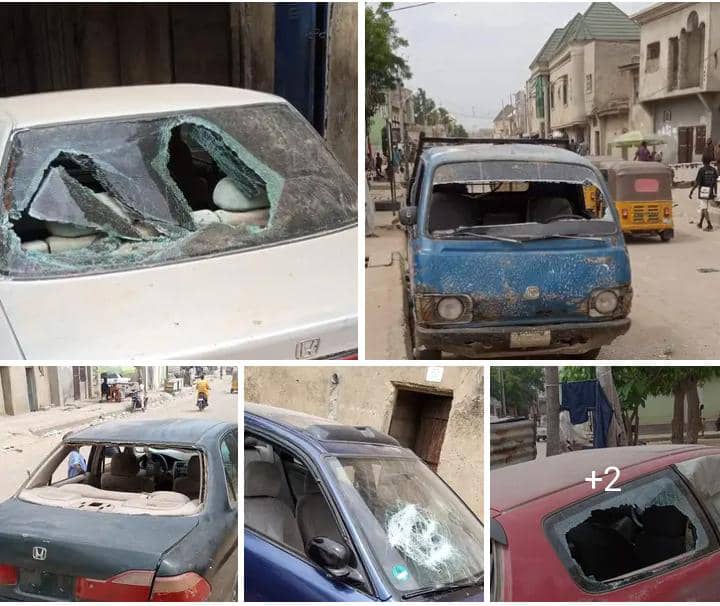
I watched in shocked dismay how the lives of innocent traders, who simply happened to be tenets in the targeted buildings, were being turned to, perhaps, perpetual misery overnight by crowds of sadist creatures feigning being human looting their (traders) merchandise. Some buildings had already been looted even before the demolition team got there. There are verified heartbreaking stories about the plights of many victims. In a particular instance, one was reliably reported to have gone mad out of frustration. 

The sheer ferocity with which the mob plundered traders’ goods suggests deep-seated populist sadism and sheer envy in a society where tacit gloating over the misfortune of any real or perceived wealthy person has become normal. I have also observed tacit attempts on social media by many otherwise reasonable people to underestimate the plights of the victims and even put the blame on them for their ‘failure’ to evacuate their goods in time. 

Meanwhile, the cumulative impacts of this vicious circle on the state’s economy and other strategic interests cannot be overestimated. It’s already seriously affecting local investor confidence, for no one will consider the viability of any significant investment, especially in, say, real estate development and other related sectors, knowing that the land allocation is prone to arbitrary revocation and the structures are subject to impulsive demolition at any time. 

Equally, banks and other financial institutions will have to discontinue recognizing Kano government-issued certificates of property ownership as collateral, knowing that they may at any time be rendered as worthless as takardar tsire. 

Likewise, the state’s attractiveness to direct foreign investment (if there is currently any) will be hit even harder, for no prospective foreign investor, being typically particularly sensitive to any red flag suggesting policy inconsistency, will consider investing in Kano knowing that whatever policy or incentive attracted him can be impulsively terminated at any time. 

Now, obviously, Governor Abba is aware deep down that that wasn’t how he was supposed to handle the situation in the first place. His approach is enough to vindicate those who insist that he is simply on a vengeance mission with a premeditated resolve to settle scores with political opponents and their associates on behalf of his political godfather, Rabi’u Kwankwaso. 

He can address whatever land use abuses his predecessor committed, which are so many, by the way, but he should do it in a civilized way through due process leading to the demolishing of what indeed deserves to be demolished and sparing what deserves to be spared for the purpose of reclaiming and converting it into a public facility. 

Mohammad Qaddam Sidq Isa (Daddy) wrote from Dubai, UAE, and can be contacted via mohammadsidq@gmail.com.

Book Review: The Lebanese in Kano

By Dr Shamsuddeen Sani

I thought The Lebanese in Kano: An Immigrant Community in a Hausa Society in the Colonial and Post-Colonial Periods merely contained a handful of newspaper tales. I was mistaken! Within its pages lies a meticulously researched body of work, a testament to the cultural heritage of Kano that begs to be savoured and preserved for generations to come. It has profound glimpses into the very foundations of Kano’s societal evolution as it illuminates the paramount role played by the Lebanese community in the rich Kano’s historical traditions.

This book, published in 1995 and authored by S.A. Albasu, unfolds with an intricate chronology of eight captivating chapters. As the introduction sets the stage, the initial chapter gracefully delves into the existing body of literature on migration, skilfully intertwining it with the historical fabric of West Africa and Nigeria. Embracing a tangent in the second chapter, Albasu illuminates the emigration of the Lebanese into Kano, beginning in the mid-19th century.

However, a pivotal juncture in Lebanese history within Kano emerged in 1920, a defining moment marked by profound geographical and religious divisions among the Lebanese migrants. The historical catalysts propelling Lebanese emigration into Nigeria were meticulously examined within this segment.

It becomes apparent that prior to the 1920s, the Lebanese immigrants in Kano predominantly belonged to the Maronite Christian community. It is only after this period that a demographic shift occurs, welcoming the arrival of Muslim Lebanese, particularly those of the Shiite sectarian extraction hailing from southern Lebanon. The book exposes the reader to the sociocultural intricacies of the Lebanese community’s towns of origin and unravels the fabric of their society, dispelling prevailing myths.

The entire Lebanese migration into Kano is thoughtfully categorised into four distinct phases, each meticulously explored with great detail: 1890-1903, 1903-1912, 1912-1920, and the 1930s during the tumultuous period of the great depression. Each of these phases represents a significant milestone in the history of the Lebanese community within Kano, as well as its impact on the city’s socioeconomic development.

Subsequent chapters of this book delve into the physical establishment of the Lebanese community, intricately entwined with crucial historical policies such as colonial taxation, the indirect rule system, and segregation policies.

Chapters four, five, and six embark on an exciting journey, covering the consolidation of the Lebanese community within Kano’s vibrant business milieu. From the thriving cattle trade to the realms of Kolanut and groundnut businesses, the book unfurls the profound influence of factors like colonial intervention, the upheaval of the Second World War, Nigeria’s independence, and the burgeoning national consciousness. The book has revelations of ground-breaking nature, leaving you enlightened and astounded, and for me, every piece seamlessly falls into place now.

A glimpse into Abdulhamid’s exceptional, short life

By Adamu Muhammad Burga

As I scrolled down my Facebook newsfeed on Thursday, 11th May 2023, I came across a post that reads, “Indeed we belong to Allah, and to Him we shall return”, and another one that reads, “Losing a good friend like Abdulhameed leaves a scar in the heart that never wanes,” and lots more. They left me agape and confused. Why? They were all attached to the same photo, Abdulhameed’s photo. My shock amplified when I checked my WhatsApp status updates to realise the same thing was happening. I know how death news sounds in peoples’ hearings and hearts, but mine couldn’t believe what I saw. It all seemed to be like a dream to me. 

Yet I called a friend out of sheer confusion to verify whether what I read was true, to which he answered in the affirmative and consoled me. I had one minute of silence before I moved on with my daily routines, still thinking that the news could be a fake one or maybe was mistaken for someone not Abdulhameed. Or perhaps it would later be retracted. ‘How could this be true about someone I visited a few days ago?’ is the question I had been asking myself for a while. 

It had also come to my notice on the day he passed away that a river miles away from my residence claimed a boy’s life. The devastating news saddened me, and why wouldn’t it? The boy was drowned on the day WAEC exams commenced, of which he was a candidate. He even had the wherewithal to sit the exam in the morning before he ‘answered the call of his Lord’. However, I was more shocked by the former’s demise than the latter’s. 

Friends and friends are two categories of people your life can never be devoid of. With the little I know about Abdulhameed’s life, I can conclude that the number of his friends and allies outnumbers that of friends. And this is one of the whys that made me pen this tribute to give a mere exposure to this great personality and exemplary icon — Rahimahullāh.

Abdulhameed was one of the unusual ones. He was resilient. Diligent. Jovial. Religious. Hardworking. A man in whose veins kindness flowed. A true optimist. An exceptional conservationist. 

Abdulhameed was so many different things. A teacher. A student. A Hafidh. A brother. A tech. An exceptionally proud member of the MSSN who served almost at all levels. And a great, a truly great man at diplomacy. And he was most likely a lot more than that. 

But there was one thing Abdulhameed wasn’t. And that’s afraid. Abdulhameed wasn’t scared of his challenges. Of being judged by people. He wasn’t afraid of friendship. A good laugh. He was never scared of a good time. A hard time. Or consequences of his good actions. Or of an impossible task. Or any kind of danger on the right course. And he certainly wasn’t afraid of doing the right thing. Ever.

No matter how hard life was for Abdulhameed, Abdulhameed loved life back. He embraced it without reservation, regret or remorse. And that’s rare, very rare among people of his time.

I wish more people were kind-hearted, diplomatic and easy-going like Abdulhameed. They’re the things about him I’ll miss the most besides his smiles. And I hope it’ll be some time before all my memories of him start to fade.

I remember the last time I visited him. I remember the smiles. I remember his beaming countenance, which told me I’d miss him when he passed. Little did I know that he was bidding me farewell. I wish I had bidden my final adieus to my friend as he bade me his before he left. But, unfortunately, I couldn’t. I failed. 

Having heard different stories of the deceased from other people from different angles, I believe that I’m not having a ‘single story’ of him, as put by Chimamanda Ngozi Adichie, nor am I satisfied with my only story of him. 

These few lines may not richly tell who Abdulhameed was, as they are, but what I have been able to gather from personalities and territories reachable to me. It’s just the tip of the iceberg. And I’m pretty sure there’s more to come—in sha Allah. I pray that Allah forgives his imperfections, provides him with a unique dwelling in Jannah, and gives fortitude to the bereaved.

And after all, ‘we’re all not here for a long time. We’re here for a good time’. May Allah make our ending a good one. 

Adamu Muhammad Burga writes from Bauchi and can be reached via or at abuzharrin212@gmail.com.