Literature

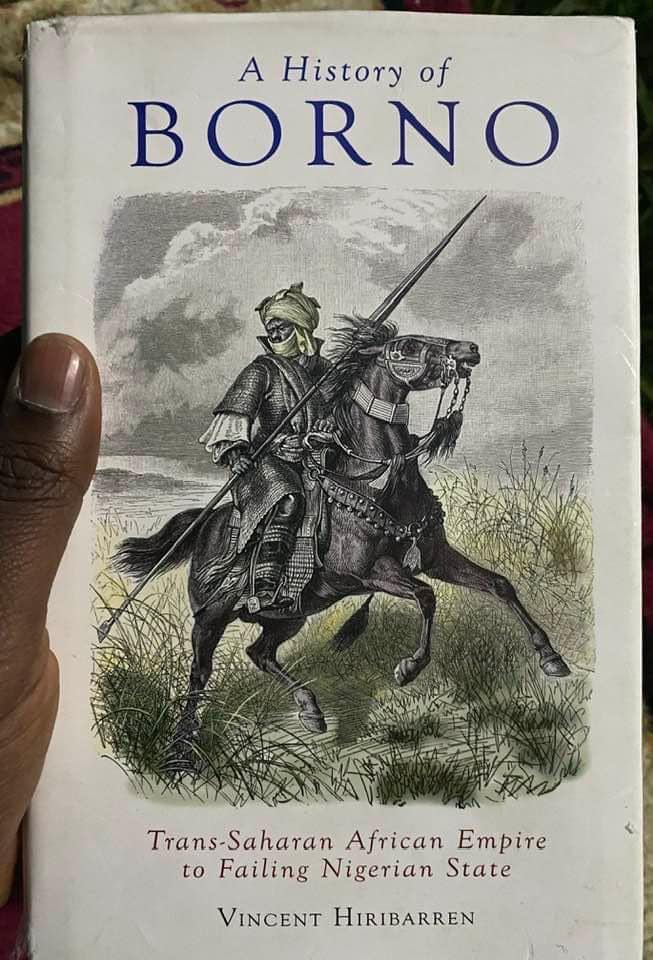
BOOK REVIEW: A History of BORNO: Trans-Saharan African Empire to Failing Nigerian State

Author: Vincent Hiribarren

Date of Publication: 2017

Number of pages: 310

Publisher: Hurst & Company, London

If you knew very little about the territorial framework of the Borno empire before now, then reading this book might likely shatter some previously held notions about the region. Borno has, in recent years, notoriously gained renewed academic attention as a result of the Boko Haram insurgency. Spoiler alert: this book isn’t about the origin of Kanuri or other inhabitants.

Although the Borno empire found its roots in the 8th century, this book covered only the past 200 years of the kingdom’s existence. Therefore, the 8 chapters of the book started at the beginning of the 19th century down to around 2014 when the research for its publication was concluded. The author seemed very mindful of the political significance of the Borno empire following the Fulani jihad, even if the invasion had a different outcome, but that’s another topic entirely.

The earlier section of the book highlighted the spatial continuity of the territorial framework of Borno, which argued that fairly stable structural borders existed well before colonial times. This was a pivotal juncture, as discussed later in the book, for the ‘scramble for Borno’, where the 19th-century spatial frameworks were used to legitimise conquest by foreign invaders. It proved important even in the European colonial competition against each other.

Later on, the book explored how, essentially, the British and the Germans recycled the Borno region within their colonial spatial framework with an additional detailed perspective of the Indirect rule. It didn’t stop there, it goes on to analyse how, in reality, the colonial administration of Borno during the early colonial period played a decisive role in the preservation of its territorial continuity.

Navigating this book, you need to have an incredible tolerance for some nitty gritty details. The writing style is aggressively academic, and it is filled with flayed raw materials to inspire further reading. It is definitely not a very easy-to-read book but rather a slice of rock-hard brain playground! It’s very clear that the author is a cartography freak.

The book itself must have been inspired by the thesis undertaken by the author while pursuing a PhD at the University of Leeds in the UK with the title “From a Kingdom to a Nigerian State: the Territory and Boundaries of Borno 1810-2010”. The author teaches African History at King’s College London.

Dr Shamsuddeen Sani wrote from Kano, Nigeria.

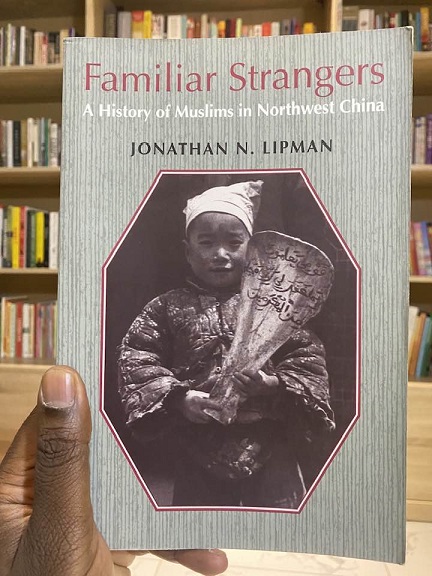
BOOK REVIEW: Familiar Strangers: The History of Muslims in Northwest China

By Dr Shamsuddeen Sani

It is easy for the narrative about Uyghur Muslims of China to draw your attention due to the fierce East-West political drama about them. Before now, I had no clue of the profound complexity inherent in the history of Islam in Muslim northwest China.

Jonathan N. Lipman skilfully avoids the more sensitive politico-religious aspects, as he aptly puts it, making it not a book about the history of the Muslims in northwest China but a comprehensive account of the history of Muslims living in northwest China.

This book offers a critical analysis of the origins of Islam in northwest China, the evolution of Muslim identity and culture in the region, and their intricate connections within the broader context of greater China. This examination spans six comprehensive chapters and incorporates both pre and postmodern contextual perspectives.

Following an elaborate introduction that combines geography and ethnography in northwest China, Lipman offers an extensive overview that spans nearly a millennium, encompassing the entire cultural landscape of China. He achieves this by positioning Muslims as unique elements within the familiar historical context of China from the Tang dynasty through the Ming dynasty.

After the Qing conquest of the 1640s, he investigated specific solidarities among Chinese Muslims and their leaders. Additionally, he examines the development of Sufism in northwestern China and the integral role played by the Shuyuks and Tariqa in the region’s social fabric. By the mid-18th century, as the book highlights, Sufi orders had already ignited a significant drive towards political activism, community cohesion, and horizontal competition.

Coming to the early 19th century, Lipman looks into the era marked by the transition from the Qing Empire to the Chinese nation-state. He explores the intricate processes of change, driven by internal factors and influences originating from Europe, America, and the Muslim world, which swept across the outskirts of China. These forces compelled individuals to make decisions under unfamiliar and challenging circumstances. The book took a tangent to meticulously analyse four key Sino-Muslim figures who embarked on distinct yet equally complex journeys towards finding common ground with a modernised China.

This book is not an easy read, given the unfamiliar names one must remember, but it is worth every minute of your time.

Dr Shamsuddeen Sani wrote from Kano, Nigeria.

NCRRD aims to improve reading culture in Nigeria

By Muhammad Aliyu Gombe

The Centre for Reading, Research and Development (NCRRD) Bayero University Kano, Nigeria, has organized its Fourth National Conference on the promotion of reading culture among students and researchers. The event which took place at Ɗangote Business School, New Site, (BUK) was a 5 day even which included a Pre-Conference Workshop which aims at sensitizing the participants on the new methods of improving teaching especially from the basic level. The theme of the conference reads ‘Children’s Books and The Teaching of Early Grade Reading in Nigeria.’

The Director of the Centre Professor Talatu Musa Garba, during her speech, says that, as part of the mandate, of the Centre, it “had instituted the annual conference in 2019 to provide a platform for teachers, researchers and other educationists to share ideas on the best practices for the promotion of teaching of reading in Nigeria.” The Director, together with the Vice Chancellor of the University, Professor Sagir Adamu Abbas, commissioned the Centre’s resource room which is named Rebecca Rhodes Resource Room. The room has a modest collection of books and e-resources. It is open to researchers, teachers and students as a reference library.

It has been noted by various participants during the occasion that reading culture is past dying not only in Nigeria but across the globe. There is a huge need to revive it through practical methodologies which will guarantee and assist young readers to be taken right from the tender age.

Some of the participants, especially students and other invited guests, showed their appreciation and happiness with these gigantic efforts which the center is putting to revive reading culture in Nigeria.

Lost Heritage Series: The (w)rite stuff of Hausa Islamic learning

By Prof. Abdalla Uba Adamu

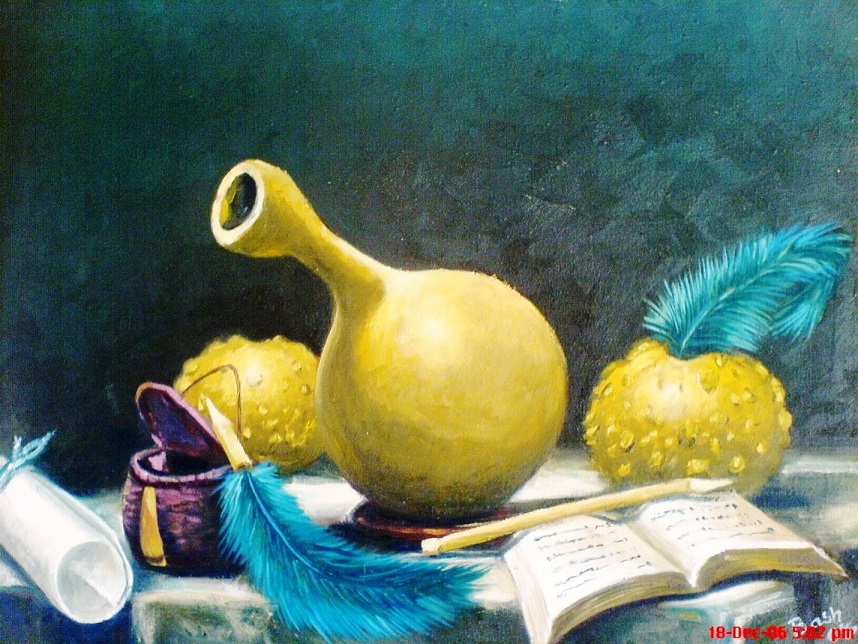
The painting evoked memories. And a sense of scholastic pride. Pride in being part of a process that has generated centuries of excellence. And today is Teacher’s Day, a case for celebration of scholarship from below. Even Google’s Doodle for the day acknowledges this.

Years ago, a painting was brought to me to purchase by an artist, Nura Yusuf – the artist being aware I am an art nut. It was a medium-sized canvas and truly beautiful in a photorealistic way. My Ajamization of Knowledge initiative inspired him. But there was no way I could afford the price he was asking, even if I accepted that it was a fair price. I asked his permission, though, to photograph it with my Sony DSC.

I eventually saw the canvas hanging in the outer waiting room of the Emir of Kano’s main reception chamber. Regretfully, you will only notice it if you swing your head up. I think, eventually, it was relocated.

Looking at the painting, as I said, evoked memories of Makarantar Malam Hussaini, Mandawari. Now renamed Makarantar Malam Buhari and reinvented as an Islamiyya school, along Sabon Titi, in the inner city of Kano. In the school, when Malam Hussaini was the Head, you left early if you reported early; otherwise, you stayed behind after the school closed to continue your studies.

Memories of going from house to house, requesting the good folks to allow us to brush their cooking pots with our bare hands, seeking the fine soot that covers the pots, the result of open-fire cooking with logs of wood. Once you gather enough powdered soot, you then dunk your hand in a bowl of water and wash the soot off. Next, you sprinkle a few crystals of gum Arabic in the water and boil the lot – effectively creating a syrupy ink, the classical ‘tawada’. While burnt wood from home cooking fires can do the job, the elite of Tsangaya inks is ‘zuge’, a burnt desert-date tree. The ink itself is often mixed in various colours, depending on its use in copying the Qur’an. These colours come in handy, especially on the graduating certificate – allo – when it is decorated with zayyana calligraphic designs. A whole industry has existed around this trade for years, especially in the heart of the city of Kano, northern Nigeria.

To make a pen, you need a thick dry stalk – gamba – from the grass used for fencing (zana) homes in rural areas. Using a Tiger razor blade (not Nacet, as it easily breaks), you sharpen the edge of the stalk and fashion a neat nib, creating an alƙalami — pen. There were many styles for the nib, depending on the writing to be done. For some, the alƙalami can be a true calligraphic tool.

Properly armed with a pen and ink, you begin the process of carefully copying the verses of the Qur’an, according to your grade, onto the wooden slate until you copy the right passages. You lean it against the wall for it to dry and await your turn to read what you copied by the teacher. Once properly groomed on the reading, off you go to practice reciting on your own.

Once you feel you are proficient enough, you go back to the teacher, read your passages and once satisfied with your diction, and cadence, you are permitted to go to the next passages – wash off the present one – wanke allo – and copy the next sequence. Due to the dark colour of the ink, the wooden slate often absorbs the ink and darkens the slate. The best way to get rid of it is to use sandpaper to scrape it completely – or, failing that due to cost, rice bran – ɓuntu – which works just as well – to remove traces of the previous ink. If the smudges or shadows of the ink still remain, you can use powdered limestone – farar ƙasa – to overlay the darker stain of the ink, giving a clean white surface on which to write.

Ink is kept in a pot, kurtun tawada, while the pens are kept in a pen holder, ƙorami/alkurdu. For adolescents starting up, it was the wooden slate. For the more advanced students, the writing is done on conqueror bond paper (usually imported from North Africa), but the pen is now a quill from the tail or wing feathers of a bird (chicken, duck, guinea fowl).

And in case one gets thirsty doing all that hard work, you can always quench your thirst from the water stored in your water bottle – jallo, made from a gourd. This type of water bottle enters into the Hausa lexicon with the expression: “ina neman sa kamar ruwa a jallo/desperately looking for him.”

This scholastic tradition is well-preserved in this painting by Nura Yusuf, who incidentally happened to be a brother to the writer and poet Khalid Imam. Being Teachers Day today, I dedicate this painting to all Alarammomi, Gardawa, and Ƙolawa, who are my fellow classmates in every Tsangaya in this country. We pray for the souls of our Malaman Tsangaya, who set us on the right path. Allah Ya jiƙansu da Rahama.

A fool

A fool I was,

To believe we shared something.

I had never felt so broken before,

Not even when my last left me.

I should have learned my lesson then,

But NO!!

I believed you were better than that.

Now, it’s all plain in sight,

Directly in my face 

I can’t deny the obvious truth anymore.

Your betrayal hurt like hell,

The thought of our “forever deal” breaking off 

Keeps turning me mad,

I seem to be losing control……

I know this is me 

not letting go of the shattered dreams,

But if this is truly a dream,

Wake me up to reality 

I don’t think I can survive this pain.

©Ink of Emotions 

Yusufu Bala Usman – The quintessential historian

By Prof. Abdalla Uba Adamu

I was never lucky enough to come under Yusuf Bala Usman’s tutelage while I was a student at Ahmadu Bello University Zaria, Nigeria, from 1976 to 1979. Being a student in the Faculty of Education, I missed out on having to take lectures in the famous FASS – Faculty of Arts and Social Sciences, undoubtedly, the hotbed of critical theories in the 1970s.

Yusufu Bala Usman, Ibrahim Tahir, Patrick Wilmot, and Mahmoud Tukur enlivened the university with their rhetoric about culture, history, polity and anthropology. My roommate was a History student, so I gleaned a lot from him about the critical theories flying about on the campus. Those years were indeed the intellectual years of ABU. Every subsequent northern radical traces his roots to that era and its critical reflection on Nigerian society.

As M.M. Gwadabe noted in his obituary to Yusufu Bala Usman, published in Africa: Journal of the International African Institute, 2010, 80(1): 165-168.

The contributions of Bala Usman lie not only in the number of papers he has written or the publications he has left for posterity. He spearheaded the establishment of a school of thinking quite distinct from the perception of history that used to be prevalent in Nigeria before the 1970s. Before him, history was generally understood and taught within the paradigm of colonial historiography. The efforts of Bala Usman and some of his colleagues in the department liberated history teaching as they masterminded the establishment and nurturing of the School of African historiography at Ahmadu Bello University, Zaria (ABU).

And in spite of his towering intellectualism, he remained humbled by the very scholarship he served. As Gwadabe further informs us:

“In 1985, the authorities of Ahmadu Bello University, considering Dr Usman’s contribution to knowledge, promoted him to the rank of a Professor. Humble as he was, Dr Usman turned down the promotion on the ground that ‘he was not convinced that he had done enough to be a Professor’. While he was without [a] doubt qualified for the promotion, his action was an attempt to show his displeasure with the way promotions to the rank of professorship were politicized and abused. So, Dr Usman died with the rank of a Reader.”

Now compare this towering inferno of intellectualism with our intellectuals today – who, based on some newspaper and junk journal publications, proudly present themselves as professors – when no one has ever read their works or become impacted by their expected contribution to knowledge.

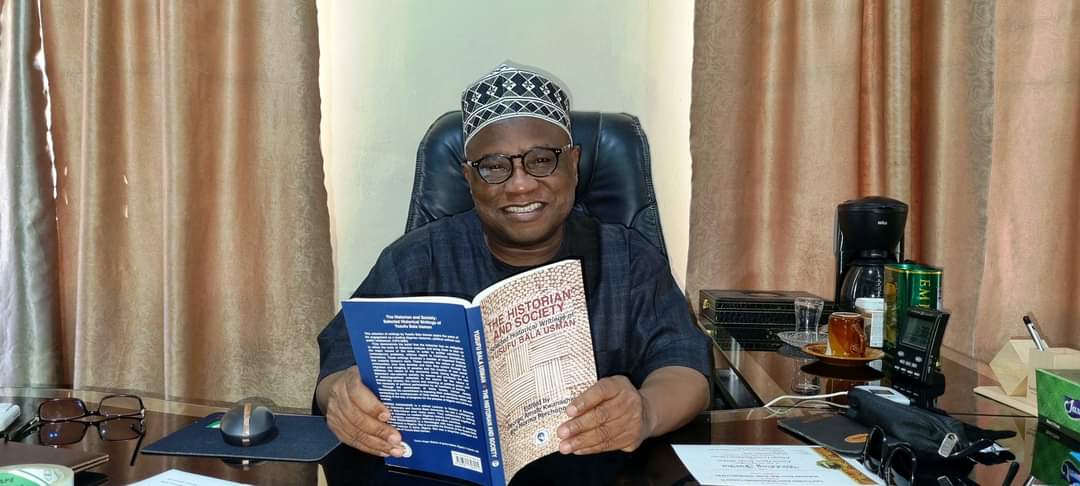
Yusufu Bala Usman passed away at 60 years old in 2005, relatively still in his prime. His thoughts and ideas, however, live on through the Yusufu Bala Usman Institute in Zaria. To refresh our memories about his fiery and critical writing, the Institute, on 23rd September 2023, released a compendium of his lectures that captured the years of engagement as a leading Nigerian historian, political activist and public intellectual, mainly from 1972 to his death, in 2005. The book, The Historian and Society: Selected Historical Writings of Yusufu Bala Usman, was edited by George Ama Kwanashie and Normal Perchonock. It provides a handy introduction to the thoughts of Yusufu Bala Usman for those who only heard about him. Going through the 12 chapters of the book would convince you that with his death, northern Nigeria has lost a formidable voice in contemporary critical theory.

The book is now available as a physical copy. There is a website for the Institute where you can order the book at 3,500 NGN.

Writing: Empowering a friend’s creative journey

By Abdurrazak Muktar Makarfi

A friend approached me, expressing his desire to write but unable to do so effectively. I promised to help him by sharing valuable tips on writing. These insights shouldn’t be kept to ourselves; they have the potential to inspire others too. Therefore, I’m eager to share them with the public, hoping to ignite creativity and passion in aspiring writers and touch hearts with the transformative power of words.

As promised, below are some tips that will help you on your writing journey.

Immerse yourself in the vast ocean of literature: Envelop your mind with the profound wisdom and eloquence of renowned authors. By delving into diverse literary works, you’ll embrace the artistry of language and discover the nuanced dance of words.

Forge a formidable foundation: Master the enchanting symphony of grammar, sentence structure, and punctuation. As the conductor of your prose, a firm grasp of these elements orchestrates a harmonious cadence that bewitches your readers.

Grace your prose with seamless transitions: Like silk threads weaving an intricate tapestry, the subtle interplay of transition words guides your readers effortlessly from one idea to the next. From “however” painting a brilliant contrast to “therefore” forging unyielding connections, your writing becomes a journey of revelation.

Dance with diversity in sentence structures: Allow the rhythm of your writing to undulate, embracing the grand waltz of varied sentence structures. From the tango of concise thoughts to the waltz of eloquent expression, each step captivates your readers’ hearts.

Paint a vivid tapestry with your words: Unleash the kaleidoscope of language, and adorn your prose with dazzling colours of description. Pluck the most resplendent words from your lexicon, imbuing each sentence with life, depth, and vividness.

Polish your masterpiece with an artisan’s eye: Like a sculptor refining a statue, meticulously chisel away any superfluous words or pedestrian phrases. Carve your prose into a masterpiece where every word finds its rightful place and the allure of elegance abounds.

Let the quill dance upon the parchment: Embrace the alchemy of creativity by transmuting thoughts into written gems. Through regular writing rituals, unleash your inner wordsmith, painting the canvas of expression with artistic zeal.

May these stylistic incantations lend wings to your writing, elevating it to new heights of artistic brilliance and captivating the hearts and minds of those who partake in the splendour of your words.

THE LAND

The world is liveable

But this land is terrible

Releasing orders without sympathy

Where’s your instinct of empathy?

Abrupt removal of subsidy

Things loose out of custody

Prices go rocket higher

Traders nap having no buyer

We can’t secure aliments

Nor can we cure ailments

Schools have been deserted

After the increment exerted

Compatriots hover without refuge

Nobody can afford a mortgage

Even the fittest can’t survive

We’re not but corpses alive!

Vanguards of liberation

Become gladiators of domination

Not only a rare golden opportunity,

Seat is heavy responsibility!

– By Hashimu M Bala

Zaria public library or a shattered bed of bats and rats? A call upon the government

By Maryam Shehu

I write with a heavy heart and bleeding eyes to the extent that my sights are closed, and I can’t catch a glimpse of the words that percolate through my pen.

Zaria is known as the heartbeat of its state, moving from its social amenities and the acuity of its residents and advocates. It won the best award for breeding leaders and world scientists with excellent records of surveillance and stateliness.

Its leaders have incentives for every eclipse and malady, but I am yet to have a vision of the sad situation of its library. Does that spell another prestige or a paralyzing facet of its artistry and reading culture? Only God knows how much a lack of a library plays in the eruption of the educational sector and traditions.

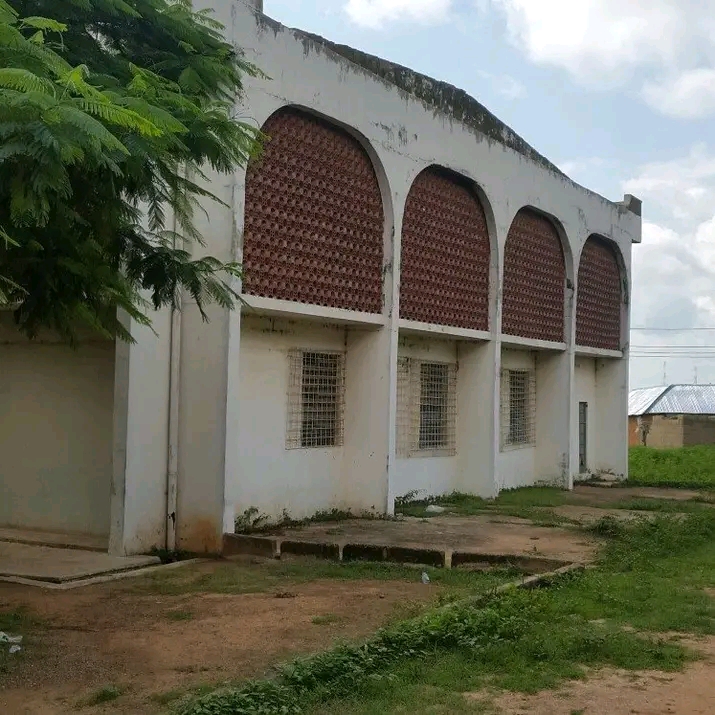
 ‘Mostly students within Zaria from the 1980s used the Public Library, but now it remains only the building’; this was what I saw as a description of a group named ZARIA PUBLIC LIBRARY FRIENDS on Facebook… A very disheartening description, indeed! Does that mean education ended in Zaria after those days, or is it only for those in the 1980s? Oops, I can’t uphold the irritation!

Everyone that often visits the place is a bystander to how barren and malodorous the place is, the books are outdated, and the shelves are scanty and scattered to the magnitude that one can not confidently point to a visitor or a person who has been reading about or watching notable libraries.

I write for the government or any other personnel responsible for the library to reminisce, if forgotten, about the virtues and diamonds behind refurbishing the library and its roles in developing a state/LG with few ravines of mine. These are:

First, it supports the educational sector: Education is the bedrock of every progressive state. It soothes every rough wall for governance. Whenever/ wherever a state owns a gear of education and capitalize its residents with the necessities, that administration is said to have grappled with every hole of unemployment, insurgency, and other suppressed deed that might lead to the tumult of any governance. It can contribute to nation-building and reconciliation. As said by Nelson Mandela, “Education is the most powerful weapon you can use to change the world”.

Second, it preserves the cultural heritage of the society: A rich cultural heritage defends how the residents maintain its distinctiveness and sets it as a mirror to look at by young ones. We have different skin colours, languages, and marks, and our clans mingle with others (good/bad), but the pictures we sow in their hearts and books are those that could reflect and defend their susceptibilities. The library is the only place where those scrapbooks and photographs could be carefully salvaged.

Third is the provision of useful textual materials: The availability of a standard and substantial library provides advantageous scripts and materials for self-development and implementation of a basic constitution… It helps especially those from underprivileged backgrounds.

Fourth, it also provides an avenue for recreation and relaxation. Libraries are one of the most significant factors that lead to the development of arts and crafts; they create seats for all crawling and professional clubs and carve stages. It composes words for artists and other microphones partners.

Furthermore, it also provides and enhances reading culture. As the slogan says, ‘Readers are leaders’; likewise, writers and other mellow people, we succeed by reading from the served letters of our antecedents. And many people strive to be voracious readers but the lack of money to buy books drag their necks back and turn their faces from the papers by furnishing the library; that surely could be a buzzer to the sleeping readers.

With the above few ravines of mine, I hope the government and other related personnel are persuaded and forecast how much renovation of the public library could make their governance suitable and memorable and how lack of it will keep draining the administration. We hope you listen to our dried throats and reconstruct our shattered floors.

Maryam Shehu wrote from Zaria via maryamshehu6354@gmail.com.

Book Review: The Unforgettable Queens of Islam

By Dr Shamsuddeen Sani

It’s very easy to ignore this book. Underrate it even. I found myself rereading it for many days, given the enormous importance of the topic, especially in the contemporary discourse in Muslim-majority countries about woman’s leadership. Being a recent publication in 2020, and although the author didn’t explicitly state it, it appears to be building to improve upon earlier work by the late Moroccan feminist writer and sociologist Fatima Mernessi with her book, The Forgotten Queens of Islam.

Shahla Haeri embarks on a journey of gendering the historical narrative of sovereignty and political authority in the Muslim world, shedding light on the lives of Muslim women leaders who defied the norms of dynastic and political power to rise as sovereigns in their deeply patriarchal societies.

The author’s usage of the term “queen” is not meant to be taken literally for all six prominent figures discussed in the book but rather to signify their immensely influential leadership roles during their respective eras. While recognising the significant impact of numerous women in Islamic history who exerted influence behind the scenes, Haeri emphasises those women who stood at the forefront of the political machinery, actively engaging with the structures of authority and power.

She doesn’t just relay the historical milestones of these great women in historical Islam but brings in a fresh perspective on how we look at the concept of women’s leadership in the Islamic tradition. The author situates women rulers’ rise to power within three interrelated domains: kinship and marriage, patriarchal rules of succession, and individual women’s charisma and popular appeal.

This book prompts deep contemplation on patriarchy within the pre-modern normative Islamic tradition. But one needs to be careful because the author appears to be overly problematising patriarchy in some instances significantly beyond what we consider as would have been normal in pre-modern Islam. She did allude, however, to the critical role of men in women ascending to positions of political authority. 

Structurally, this book has a Preface and Introduction and is broken into three main parts with two body chapters. Part I, Sacred Sources of Authority: The Qurʾan and the Hadith, lays the background for her accounts, with a deep examination of the primary sources of the Qurʾan and hadith, through the Qurʾanic story of the Queen of Sheba and the biography of the Sayyida Aisha (RA). Haeri relays the Quranic account of the dramatic encounter between King Solomon and the Queen of Sheba, popularly known as Bilqis. Drawing primarily from Tha’alabi and al-Tabari, the book cross-examines the sovereignty of Bilqis and connects the Quranic revelations with what she believes was the exegetes’ medieval patriarchal reconstructions.

Part II of the book is about Medieval Queens: Dynasty and Descent. In Chapter 3, the book explores the leadership life of the long reign of the Ismaili Shiite Yemeni queen. It examines Queen Arwa’s fascinating political acumen and how she survived the political and power succession tussle dealing with the 3 Fatimid caliphs of Cairo. Chapter 4 examines the short sovereign rule of the only female sultan of the 13th century Delhi Sultanate, Razia Sultan: ‘Queen of the World Bilqis-i Jihan. 

The 3rd part of the book, which explores the contemporary Queens and examines the institutionalisation of succession, provides an in-depth look at Benazir Bhutto and Megawati Sukarnoputri but will not spoil more here for the interesting details in the book.

Haeri concludes this work of ethnohistory which is deeply personal as she peppers in the concept of the “paradox of patriarchy,” which refers to the historical tradition of power succession among men, particularly fathers and sons, or even brothers, whose family ties legitimise the customary transfer of power. She quickly alludes that the relationship between fathers and sons can be a source of tension and rivalry, where they may fear, resent, or even seek to eliminate each other. In contrast, father-daughter relationships tend to be more personally fulfilling and have fewer political consequences for the father. The preference of patriarchs for their daughters is not only driven by self-preservation but also by their recognition of their daughters’ talents and political astuteness.

Dr Shamsuddeen Sani wrote from Kano. He can be reached via deensani@yahoo.com.