International

Justin Bieber suffers from face paralysis

According to the US Magazine, Justin Bieber got real about his recent health issues, which have left half of his face paralyzed — and made him pause his tour. Bieber briefed his fans on the issue and informed them that they shouldn’t worry, he would be telling them more about the situation.

“I love you guys and keep me in your prayers,” the 28-year-old musician captioned an Instagram video on Friday, June 10, asking his fans to “please watch.”

The “Yummy” crooner, who has been battling Lyme disease for years, explained that he wanted to update his fans on “what’s been going on” with his body recently, pointing out that people can “probably see from [his] face” that something is not normal.

“I have this syndrome called Ramsay Hunt syndrome. It is from this virus that attacks the nerve in my ear and my facial nerves and has caused my face to have paralysis,” Bieber said, showing how one side of his face is stationary. “As you can see this eye is not blinking. I can’t smile on this side of my face. This nostril will not move.”

The Grammy winner addressed fans who may be “frustrated by my cancellations of my next shows,” telling them, “I’m just physically, not capable of doing them.”

Bieber continued: “This is pretty serious as you can see. I wish this wasn’t the case. But obviously, my body is telling me I need to slow down.”

The Canadian singer, who is currently on his Justice World Tour, noted that he will be using his time off to “rest and relax and get back to 100 per cent so I can do what I was born to do.” He added: “I gotta go get my rest on so that I can get my face back to where it’s supposed to be. I love you guys, thanks for being patient with me.”

The “Peaches” crooner insisted he’s “going to get better.” Meanwhile, Bieber has started to do facial exercises to help his recovery. “I trust God. I trust that this is all for a reason,” he concluded. “Not sure what that is right now, but in the meantime, I’m going [to] rest.”

Bieber’s health scare came three months after his wife, Hailey Bieber (née Baldwin), was sent to the hospital in March following a blood clot on her brain. The 25-year-old model was “pretty much back to normal” when she arrived at the emergency room, but at the time felt like she was having a mini-stroke, according to a YouTube video she shared in April.

Hailey was later diagnosed with a Grade 5 PFO — Patent Foramen Ovale, which is a flaplike opening in the heart per a Mayo Clinic definition. Doctors recommended closing the hole in surgery, and she agreed to the procedure.

“It went very smoothly and I’m recovering really well,” she explained in the April video. “Thank you to everyone who has reached out with well wishes and concern, and for all the support and love.”

Source: www.usmagazine.com

Nupur Sharma: Indian BJP member who attacked Islam

Throughout this week there is a heavy tension in the Muslim world, as one lady called Nupur Sharma, who is the spokeswoman of the Indian Hindu party, BJP, spewed insults on the prophet of Islam. Many commentators around the world accused Modi’s government of complicity in such crimes as there is so much increase in attacks and humiliation of Muslims and Islam in India right from the beginning of his reign. This time around, the Muslims worldwide, are outraged and condemned the barbaric act of Sharma and called upon the Indian government to act against such transgression.

Indian women protesting against the ignorant Nupur Sharma’s madness

According to Aljazeera, leaders “of India’s Hindu nationalist ruling party have instructed officials to be “extremely cautious” when talking about religion on public platforms after derogatory remarks about the Prophet Muhammad drew protests from Muslim nations.

Two leaders of Prime Minister Narendra Modi’s Bharatiya Janata Party (BJP) said verbal instructions were given to more than 30 senior officials and some federal ministers who are authorised to take part in debates hosted by Indian news channels often broadcast live to millions of viewers, the Reuters news agency reported on Tuesday.

 “We don’t want party officials to speak in a way that hurts the religious sentiments of any community … They must ensure the party’s doctrine gets shared in a sophisticated manner,” said a senior BJP leader and federal minister in New Delhi, according to the report.

With about 110 million members, mainly Hindus, the BJP is the world’s largest political party, while Muslims comprise about 13 percent of India’s 1.35 billion population.

Last week, the BJP suspended its spokeswoman Nupur Sharma and expelled Delhi media cell head Naveen Kumar Jindal after Muslim nations demanded apologies from the Indian government and summoned diplomats to protest against anti-Islamic remarks made during a TV debate.

Qatar, Saudi Arabia, Oman, the United Arab Emirates, Indonesia, Afghanistan, Pakistan and Iran were among the nations that made their complaints public.

The influential 57-member Organisation of Islamic Cooperation (OIC) said in a statement that the insults came in the context of an increasingly intense atmosphere of hatred towards Islam in India and systematic harassment of Muslims.

On Wednesday, Iranian foreign minister Hossein Amirabdollahian arrived in New Delhi for bilateral talks with India – the first visit by a senior minister of an OIC member nation after remarks on the prophet triggered outrage in the Arab world and other Muslim-majority countries.

Iran had summoned the Indian envoy in Tehran to lodge its protest against the anti-Islam remarks made by Sharma and Jindal.

BJP youth leader arrested

Meanwhile, police in northern Indian state of Uttar Pradesh arrested a BJP youth leader for posting anti-Muslim comments on social media, officials said on Wednesday.

Harshit Srivastava was arrested in Kanpur city following communal tensions last week during a protest by Muslims to denounce the anti-Islam comments.

“We arrested the local politician for making inflammatory remarks against Muslims,” said Prashant Kumar, a senior police official, adding that at least 50 people were taken into custody following the tensions in Kanpur.

Srivastava’s lawyer was not available for a comment.

Sporadic unrest was reported in other parts of the country over the anti-Islam comments by the BJP’s Sharma.

Members of Muslim groups in India said it was the first time influential foreign leaders had spoken out against what they called the humiliation experienced by the minority community.

“Our voices have finally been heard, only world leaders can nudge Modi’s government and his party to change their attitude towards Muslims,” said Ali Asghar Mohammed, who runs a voluntary rights group for Muslims in Mumbai city.

India’s Muslims have felt more pressure on everything from freedom of worship to wearing the hijab (head scarves) under Modi’s BJP. There were Hindu-Muslim clashes during religious processions recently, following deadly riots in 2019 and 2020.

Although the party has denied any rise in communal tensions during Modi’s reign, the BJP rule has emboldened hardline Hindu groups in recent years to take up causes they say defend their faith, stoking a rise in anti-Muslim sentiment.

The US State Department, in an annual report on international religious freedom released last week, said that attacks on members of minority communities, including killings, assaults and intimidation, took place in India throughout 2021. India’s foreign ministry said on Monday the offensive tweets and comments did not in any way reflect the government’s views.

“We are not barred from speaking on sensitive religious issues, but we must never insult the basic tenets of any religion,” said senior BJP spokesperson Gopal Krishna Agarwal.

Modi in recent years has improved economic ties with energy-rich Muslim nations, the main source for India’s fuel imports, but relations have come under stress from the anti-Islamic comments by the two BJP members, foreign policy experts said.@

Germany: Ducks cause car accident

  • News Desk

A family of ducks caused a crash of three cars on the A7 autobahn near the city of Heidenheim an der Brenz, Baden Württemberg.

A man driving an Opel stopped his car when he noticed the ducks crossing the road. A Skoda driver did the same. However, a Volkswagen driver approached from behind and crashed onto the Opel.

Passengers were hospitalised and property damage of €70,000 is estimated.

Why Kwankwaso deserves more accolades

By Najib Ahmad, PhD

We often hear people saying that ‘he [Sen. Rabiu Musa Kwankwaso] did it with the government funds.’ And so? Oh, you expect him to do it with his money; then, you will ponder whether he’s worthy of their gratitude. But, this is not how things have been done right from the inception.

If you read over the history of the previous great Muslim rulers like Umar Ibn Abdulaziz (61-101 AH), may Allah have mercy on him, you will realize the incredible impressions he left on people despite being a caliphate for a short period. But, it is known that all he had achieved and built weren’t from his funds. Still, he’s remembered and admired.

People often appreciate the history of how other nations developed, which primarily transpired through human development. But, for example, how do you think today’s China and Singapore got it right? Do you think they only wake up to all this in the morning? No, it was because some leaders decided to do it right and went on to create policies that enabled them to reach where they are today.

For instance, if you take China, they unconditionally relish Deng Xiaoping – the architect of modern China. While Singapore’s Lee Kuan Yew is also highly recognized as the founder of modern Singapore, they constantly appropriate him for its development. During their time as leaders of developing nations, all they have accomplished weren’t with their funds but with the government funds.

Those leaders’ priorities then were primarily policies on education and the industrial revolution transformation. Sending students, including the peasant farmers’ children, to universities worldwide via scholarships was part of Mr Xiaoping’s most significant policies that China benefited from. His initiatives have matured into a whole system, i.e., the China Scholarship Council (CSC) and China Postdoctoral Science Fund. This remarkable initiative alone helps them strengthen their universities and vocational colleges with a quality workforce and, in turn, enables them to become the world’s industrial powerhouse.

Today, check all your household belongings to verify the above. Those two leaders are still relevant in China’s and Singapore’s present days. You can’t underestimate their significance no matter how you try due to the enormous opportunities and equal advantages they created for their people.

I understand your frustrations, which is why one person out of more than 12 million people of Kano is receiving too many accolades. First of all, it is their choice to appreciate him, mind you. This is because he means so much to them. The good thing is, you can’t deny them this satisfaction even if you try. So, why the resentment? Allow those that prefer to do what suits them to continue thanking and re-thanking him till the end of time, if that is their wish. What’s your problem with their choice, fisabilillahi?

Above all, the main thing to look at is that appreciating Kwankwaso’s effort doesn’t physically hurt you or anyone else or destroy any of our fundamental values. In fact, it is teaching people to learn to recognize good deeds and be thankful to whoever is responsible or part of their progress in life. Isn’t this a harmless mannerism to learn, emulate, and propagate?

Dr Najib Ahmad is a Postdoctoral Researcher at Shandong University, China. He can be contacted via namuhammad03@gmail.com.

That Summit of Global Coalition against ISIS

By Mukhtar Ya’u Madobi

Occasioned by the continuous attacks being carried out by the terrorists across various lengths and breadths of the world (especially in Middle East and Africa), which poses significant threat to the international peace and security and continuous harmony, the Global Coalition to Defeat ISIS (Islamic State of Iraq and Syria) lately converged in Marrakesh, Morocco and brainstormed on the roadmap for stemming the rising tides of terrorism.

The parley, held on Wednesday, May 11, 2022 was co-chaired by the Moroccan Foreign Affairs Minister Nasser Bourita and the United State Secretary of State Antony J. Blinken.

As a result of threat due to ever-increasing expansion of terrorists and their nefarious activities, the US deemed it necessary to announce on September 10, 2014, the formation of a broad international coalition to defeat the ISIS. Members of the coalition comprised 85 states and other host of international organizations who joined to offer their quotas of contribution towards dousing the tensions.

Among other mandates, the coalition is also aimed at protecting member states against any form of terror attacks and equally provide humanitarian supports to unavoidably affected nations.

This time around, the meeting which was held for the first time in the African continent, officials from member states and a handful of organizations, including the Arab League, North Atlantic Treaty Organization, NATO, and Interpol attended the ministerial roundtable discussion for a move against ISIS.

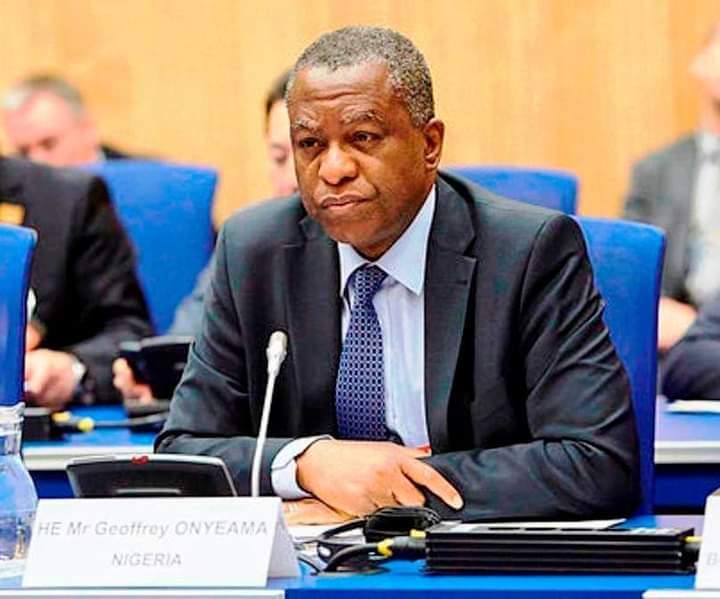
For Nigeria, the powerful delegation included State Minister of Foreign Affairs…. and the National Security Adviser, NSA, Major General Babagana Monguno (Rtd)

It can be recalled that in early February 2022, NSA Monguno was in London where he engaged with his United Kingdom counterpart on security, Stephen Lovegrove in a dialogue bordering on a range of issues including Counter-Terrorism, Civilian Policing and Human Rights.

At the event, participants reaffirmed their shared determination to continue the fight against Daesh/ISIS through both military and civilian-led efforts contributing to the enduring defeat of the terrorist group.

They emphasized the protection of civilians as a priority and affirmed that international law, including international humanitarian law and international human rights law, as well as relevant UN Security Council resolutions, must be upheld under all circumstances.

As noted in UN Security Council Resolution 2170, “terrorism can only be defeated by a sustained and comprehensive approach involving the active participation and collaboration of all States.

Meanwhile, Africa’s issues were not to be underscored at the parley as underlying causes of insecurity in the continent were also stressed at the event. The Coalition reiterated that any lasting solution to halting the spread of ISIS in Africa would rely primarily on national authorities, as well as sub-regional and regional efforts and initiatives that acknowledge and address the political and economic drivers of conflict.

In addition, the Ministers noted with concern the proliferation of non-State actors, including separatist movements, and the deployment in Africa of private military companies that generate destabilization and further vulnerability of African states and that ultimately favors Daesh/ISIS and other terrorist and violent extremist organizations.

The Ministers also recalled that the Defeat Daesh/ISIS Coalition will continue to be a civilian-driven effort by, with, and through African members, in line with the principles of national ownership, and in accordance with the specific needs of African member states.

Again, the Ministers reiterated the importance of allocating adequate resources to sustain Coalition and legitimate partner forces’ efforts. Civilian-led efforts, including prevention, stabilization, countering terrorist financing, counter narratives and foreign terrorist fighter prosecution, rehabilitation and reintegration are increasingly necessary to achieve the lasting defeat of Daesh/ISIS.

Therefore, Nigeria’s participation in the 2022 Global Coalition to Defeat ISIS was an opportunity to compare notes and share knowledge, as well as expand network on strategies to minimise or eradicate national, sub-regional and regional threats posed by the activities of terrorist groups and violent extremists.

It can be remembered that, at the wake of COVID-19 pandemic, Nigeria and the United States co-chaired a virtual meeting of the same event in November 2020, where Nigeria’s position on the global coalition was firmly emphasized.

Nigeria, through the Counter-Terrorism Centre in the Office of the National Security Adviser (ONSA), highlighted, among other issues, that the challenges of global terrorism had negatively impacted virtually every facet of human endeavour, including national security, the economy, polity, environment and the lives and livelihoods of people, as apparent in the Sahel, the Lake Chad Basin and parts of the North-East of the country.

Thus, the need to suppress the activities of criminal elements is a function of multinational societies as whole and other security apparatus.

The U.S. emphasizes that there is a role for every country to play in degrading and defeating ISIS. To that effect, some partners are contributing to the military effort, by providing arms, equipment, training, or advice. These partners include countries in Europe and in the Middle East region that are contributing to the air campaign against ISIS targets.

International contributions, however, are not solely or even primarily military contributions. The effort to degrade and ultimately defeat ISIS will require reinforcing multiple lines of effort, including preventing the flow of funds and fighters to ISIS, and exposing its true nature.

At the birth of the Coalition, five mutually reinforcing lines of effort to degrade and defeat ISIS were put forth at an early September 2014 meeting with NATO counterparts.

These lines of effort include; Providing military support to the partners; Impeding the flow of foreign fighters; Stopping financing and funding; Addressing humanitarian crises in the region; and Exposing true nature of the terrorists’ syndicates.

Nevertheless, with this Nigeria’s strong statement at the just concluded ministerial meetings, it apparently solidifies the country’s effort and commitment to maintaining national, regional and sub-regional peace and security in Africa.

 Mukhtar wrote from Kano via ymukhtar944@gmail.com

Texas shooting: another dimension in the culture of killing innocent people in US

It was a tragic moment, when an unidentified terrorist stormed a primary school in Texas and killed many people, mostly innocent children. The US officials have confirmed that all the victims of the recent Texas shooting were killed in a single classroom.

According to the Upday News, the “US President Joe Biden has called for new restrictions on firearms in America after a gunman massacred at least 19 children at a Texas elementary school. All of those killed in the shooting were in one classroom, a state public safety official said.

In an emotional address to his nation from the White House, Mr Biden pleaded for action to curb gun violence after years of failure – and blamed firearms manufacturers and their supporters for blocking legislation in Washington.

He said: “When in God’s name are we going to stand up to the gun lobby? Why are we willing to live with this carnage? Why do we keep letting this happen?”

The US leader spoke just hours after an 18-year-old gunman opened fire at Robb Elementary School in Uvalde, 85 miles west of San Antonio, killing at least 19 children and two adults.

It is America’s deadliest school shooting since 20 children and six adults died at Sandy Hook Elementary in Newtown, Connecticut, in late 2012.

The gunman – identified by officials as Salvador Ramos, who lived in the community – was killed by law enforcement responding to the massacre. Texas governor Greg Abbott said one of the two adults killed by the gunman was a teacher.

With US first lady Jill Biden standing by his side in the Roosevelt Room, the US president, who has suffered the loss of two of his own children, spoke in visceral terms about the grief being suffered by the victims’ loved ones and the pain that will endure for the students who survived.

“To lose a child is like having a piece of your soul ripped away,” Mr Biden said.

“There’s a hollowness in your chest. You feel like you’re being sucked into it and never going to be able to get out.”

He called on the nation to pray for the victims and families – but also to work harder to prevent the next tragedy. “It’s time we turned this pain into action,” he said.

Just one week earlier, Mr Biden had travelled to Buffalo in New York state to meet with victims’ families after a racist gunman killed 10 black people at a grocery store.

The back-to-back tragedies serve as sobering reminders of the frequency and brutality of an American epidemic of mass gun violence.

Hours after the attack, families were still awaiting word on their children.

Outside the town civic centre, where families were told to await news about their loved ones, the silence was broken repeatedly by screams and wailing.

Many of the wounded were rushed to Uvalde Memorial Hospital, where staff members in scrubs and devastated victims’ relatives could be seen weeping as they walked out of the complex.

It is not immediately clear how many people were wounded, but Uvalde Police chief Pete Arredondo said there were “several injuries”.

Earlier, Uvalde Memorial Hospital said 13 children were taken there. Another hospital reported a 66-year-old woman was in critical condition.

“These kinds of mass shootings rarely happen anywhere else in the world – why?” Mr Biden asked in the White House.

The president reflected that while other nations have people filled with hate or with mental health issues, no other industrialised nation experiences gun violence at the level of the US.

“The idea that an 18-year-old kid can walk into a gun store and buy two assault weapons is just wrong,” Mr Biden said, adding: “I’d hoped when I became president I would not have to do this, again.”

Echoing Mr Biden’s call, former president Barack Obama, who has called the day of the Sandy Hook shooting the darkest of his administration, said: “It’s long past time for action, any kind of action.”

US congress has been unable to pass substantial gun violence legislation ever since the bipartisan effort to strengthen background checks on firearms purchases collapsed in the aftermath of the 2012 shooting.

Despite months of work, a bill that was backed by a majority of senators fell to a filibuster – unable to overcome the 60-vote threshold needed to advance.

In impassioned remarks on the US senate floor on Tuesday, senator Chris Murphy, who represented Newton, Connecticut, in the house of representatives at the time of the Sandy Hook massacre, asked his colleagues why they even bother running for office if they are going to stand by and do nothing.

He said: “I’m here on this floor to beg – to literally get down on my hands and knees – to beg my colleagues.”

Mr Murphy said he was planning to reach out to Texas Republican senator John Cornyn after the two had teamed up on an earlier background check bill that never became law. He said he would also reach out to Texas’ other Republican senator, Ted Cruz.

“I just don’t understand why people here think we’re powerless,” Mr Murphy said. “We aren’t.”

The teenage gunman had hinted on social media that an attack could be coming, according to state senator Roland Gutierrez, who said he had been briefed by state police.

He noted that Ramos “suggested the kids should watch out”, and that he had bought two “assault weapons” after turning 18.

Before heading to the school, Ramos shot his grandmother, Mr Gutierrez said. Other officials said later that the grandmother survived and was being treated, though her condition was not known.

Investigators believe Ramos posted photos on Instagram of two guns he used in the shooting, and they were examining whether he made statements online alluding to the attack in the hours before the assault, a law enforcement official said.

Officers were serving multiple search warrants on Tuesday night and gathering telephone and other records. Investigators were also attempting to contact Ramos’ relatives and were tracing the firearms.

The attack began at about 11.30am local time (5.30pm BST), when the gunman crashed his car outside the school and ran into the building, according to public safety officials.

A resident who heard the crash called 911, and two local police officers exchanged gunfire with the shooter.

Both officers were shot, though it was not immediately clear where on the campus that confrontation occurred, or how much time elapsed before more authorities arrived on the scene.

Meanwhile, teams of Border Patrol agents raced to the school, including 10 to 15 members of a Swat-like tactical and counter-terrorism unit, officials said.

One Border Patrol agent who was working nearby when the shooting began rushed into the school without waiting for backup and shot and killed the gunman, who was behind a barricade.

The agent was wounded but able to walk out of the school, the law enforcement source said.

Gaddafi’s death is cause of Nigeria’s security problem, says ex-AGF Aondoakaa

By Ahmad Deedat Zakari

A former Attorney General and Minister of Justice, Michael Aondoakaa, has blamed Nigeria’s security crises on the death of former Libyan leader, Muammar Gaddafi. 

Aondoakaa, who is among the Benue governorship aspirants set to contest for the ruling party’s ticket, disclosed this at the International Conference Centre in Abuja on Friday, May 20, 2022. 

According to him, the security situation bedevilling the country started during President Yar’adua’s time and aftermath of the death of Gaddafi.

“After Gaddafi was overthrown, there was no strong government in Libya, and there was a kind of persecution, and most of the soldiers ran away with light weapons and came in.” He said

He added that the problem would go away with time. 

“The insecurity is an external aggression that is spreading within the country, but it is something that will go after some years. We also had the great Wild Wild West in America that was so frightening that we thought America will break. But what happened? It evolved,” he stated.

Buhari jets out to Abu Dhabi to meet new UAE President

By Uzair Adam Imam

President Muhammadu Buhari will depart Abuja Thursday for United Arab Emirates (UAE) to commiserate with the new UAE President, His Highness Sheikh Mohamed bin Zayed Al Nahyan, over the death of Sheikh Kalifa bin Zayed.

Sheikh Khalifa bin Zayed is the former president of the UAE and died on Friday at the age of 73. Until his death, he was the UAE president for 18 good years.

A statement signed by the Senior Special Assistant to the President on Media and Publicity, Malam Garba Shehu, disclosed.

The statesmen added that President Buhari will also extend his congratulations to the new President as a way to renew bonds of the longstanding friendship between Nigeria and the UAE.

According to the statement, President Buhari will be accompanied by the Minister of State Foreign Affairs, Amb. Zubairu Dada, the Minister of Communications and Digital Economy, Prof. Isa Ali Pantami, the Minister of Federal Capital Territory, Mohammed Bello, and the Minister of Aviation, Senator Hadi Sirika.

“The President, in an earlier congratulatory message to the new UAE leader, had reaffirmed Nigeria’s cordial relationship with the country, noting that the cooperation between both governments have helped Nigeria in tracking down illegal assets and tracing terrorist funds.

“Under the new leadership, President Buhari looks forward to a bigger and stronger partnership for peace, stability and prosperity of both countries.

“The President is expected back in the country on Saturday,” the statement added.

UAE President, Sheikh Khalifa Bin Zayed is dead

By Ahmad Deedat Zakari

The Ruler and President of the United Arab Emirates, Sheikh Khalifa Bin Zayed, is dead.

The Ministry of Presidential Affairs announced the sad news on Thursday, May 13.

The Ministry of Presidential Affairs condoles the people of the UAE, the Arab and the Islamic nation and the world over the demise of His Highness Sheikh Khalifa Bin Zayed Al Nahyan, the president of the UAE, ” the statement reads.

The late president was born in 1948. He was the second president of the UAE and the 16th Ruler of the Emirate of Abu Dhabi. He succeeded his father, the late Sheikh Zayed bin Sultan, who was UAE’s first president upon his death in 2004.

Shireen Abu Akleh, prominent Palestinian-American Aljazeerah journalist, assassinated by Israel forces

Aljazeera said Wednesday that Shireen Abu Akleh, a veteran journalist for the news network, was fatally shot by Israeli troops in the West Bank refugee camp of Jenin.

According to the Washington Post, Steve Hendrix reported that in JENIN, West Bank — Israeli forces killed a Palestinian American journalist for the Al Jazeera news network in the West Bank early Wednesday, according to the network and the Palestinian Health Ministry. Israel said the journalist, Shireen Abu Akleh, was killed in an exchange of gunfire and called for an investigation.

Abu Akleh, 51, a longtime Al Jazeera correspondent, was shot in the head while covering Israeli raids in the Jenin refugee camp, according to the network and the ministry. She was taken to a hospital before dying from her wounds.

In a statement, Al Jazeera accused Israeli forces of killing Abu Akleh “in cold blood” and said she had been “clearly wearing a press jacket that identifies her as a journalist.” Two journalists who were standing next to Abu Akleh said in interviews that the area had been relatively calm before she was shot.

“It was dead quiet,” one of the journalists, Ali al-Samudi, who was also injured by gunfire, said in an interview from his hospital bed.

In a statement, Prime Minister Naftali Bennett said the shooting occurred while the Israel Defense Forces were conducting counterterrorism operations in Jenin, after a spate of deadly attacks over the past few weeks in Israeli cities. During the operation, he said, “armed Palestinians shot in an inaccurate, indiscriminate and uncontrolled manner.”

“Our forces from the IDF returned fire as accurately, carefully and responsibly as possible. Sadly, Al Jazeera journalist Shireen Abu Akleh was killed in the exchange,” he said. “To uncover the truth, there must be a real investigation, and the Palestinians are currently preventing that. Without a serious investigation, we will not reach the truth.”

Brig. Gen. Ran Kochav, an IDF spokesperson, told Israel’s Army Radio that “all of the data indicate with a high degree of probability” that Abu Akleh was killed by Palestinian fire. “But I say that cautiously,” he added.

A senior Israeli official, in a statement sent to reporters, said that the army’s assessment was based on evidence that included video footage in which a gunman is heard saying in Arabic, “We hit a soldier, he’s on the ground.” The Israeli military said that no Israeli soldiers were injured during clashes in Jenin on Wednesday and that the Palestinians in the video may have been referring to Abu Akleh.

It was not clear when the video, which was published on the Israeli foreign ministry’s Twitter account Wednesday, was recorded, or where the incident depicted in the video occurred. A Jenin field researcher from B’tselem, an Israeli human rights organization, shared a map with reporters marking the location of Abu Akleh’s killing and the location of events depicted in the video distributed by Israelis.

The map locations, determined by GPS coordinates and aerial shots, were nearly 950 feet apart.

In a message posted on Twitter, Israeli Foreign Minister Yair Lapid wrote: “We have offered the Palestinians a joint pathological investigation into the sad death of journalist Shireen Abu Akleh. Journalists must be protected in conflict zones, and we all have a responsibility to get to the truth.”

Palestinian Authority President Mahmoud Abbas said in a statement that he “condemns the crime of the execution Shireen Abu Akleh” and holds Israel “fully responsible.”

U.S. Ambassador to Israel Tom Nides said in a message posted on Twitter: “Very sad to learn of the death of American and Palestinian journalist Shireen Abu Akleh.”

A spokeswoman for the U.S. Embassy in Jerusalem said “The United States encourages a swift, thorough, and transparent investigation into the circumstances of her death.”

“We understand the Israel Defense Forces have already stated that they will be investigating this incident. As we have said numerous times, the United States supports press freedoms and the protection of journalists in carrying out their work,” she said.

Samudi, who works for the Jerusalem-based Al-Quds newspaper, said Wednesday that he and Abu Akleh had been standing several hundred meters from a house where Israeli soldiers were carrying out an arrest. His shoulder was wrapped in a bandage, and dark blood stains were visible on a bullet-resistent vest marked “PRESS” on the table beside him. He had been working with Abu Akleh on Wednesday as a producer, he said.

“The house was at the top of the camp; we were far below,” he said, referring to the Jenin refugee camp. They were alone with four or five other Palestinian journalists, all wearing protective gear marking them as such. They had not yet set up to film, he said.

They were near Israeli military vehicles, he said, and they moved slowly to make sure the soldiers could identify them as reporters. There were no other Palestinian civilians or fighters in the area that he could see, he said.

Suddenly, a single shot rang out, Samudi said, close enough for him to hear the whiz of a bullet. He said he turned and ran and was immediately hit in the upper left back. He said he knew he had been hit, but he also remembers his colleague’s reaction.

“I heard Shireen scream, ‘Ali has been shot! Ali has been shot!’ ” he said. “Then they shot Shireen. She dropped dead immediately.“ He was adamant that the group was not caught in a crossfire between soldiers and militants, as the Israeli government has suggested.

“There were no fighters where we were, none at all,” he said. “We don’t put ourselves in the line of fire. Whatever the Israeli army says for us to do, we do. They shot at us directly and deliberately.”

Another journalist, Shatha Hanaysha, 29, said the group stood in an open area “for about 10 minutes to make sure the Israeli army can identify us as journalists.”

“We were told by people there were Israeli snipers on the roofs, but I didn’t see any,” she said. “It was very quiet. There was no danger in our area.

She said there was no fire fight happening in the area — just the sudden individual shots. “At the shots, everyone ran toward a wall. But Shireen and I weren’t able to climb it,” she said. “Shireen was screaming ‘Ali is shot!’ Then she fell. I tried to help her up, but I couldn’t.”

“She was shot,” she said, pointing at her own neck.

Atah Abu-Rumeleh, a doctor in Jenin who said he witnessed the shooting, also said there had been no exchange of fire before the journalists were shot. “It was a clear day, and the sun was shining,” he said in a telephone interview. “A sniper from somewhere shot Shireen in the head. And Ali al-Samudi was also hit.”

Abu Akleh was among the most high-profile Palestinian journalists and a veteran of covering the Israeli-Palestinian conflict. She joined Al Jazeera in 1997 as one of the network’s first field correspondents. In the over two decades since, her voice, face and reportage became a mainstay for Palestinian audiences.

“Shireen was a brave, kind, & high-integrity journalist that I and millions of Palestinians grew up watching,” tweeted Ramallah-based Palestinian activist Fadi Quran. “A devastating tragedy.”

Husam Zomlot, head of the Palestinian Mission to the United Kingdom, called Abu Akleh the “most prominent Palestinian journalist and a close friend.”

“Now we will hear the ‘concerns’ of the UK govt & the international community,” he wrote on Twitter.