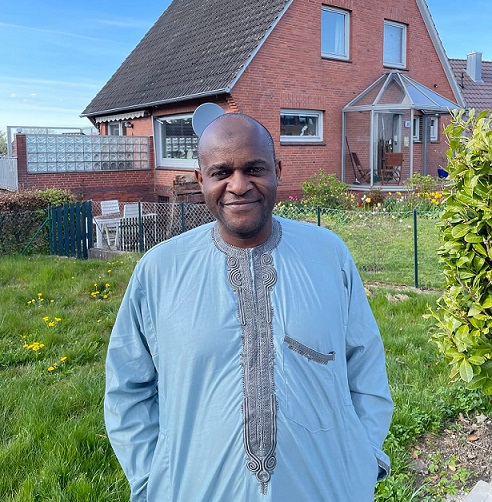
By Nura Jibo MRICS
Expo City in Dubai was bathed in semi-winter brightness that night. It was a serene atmosphere. We all came together with the same goal, motivation, objective, and aspiration: to come together, act, save the world, and prevent the climate from shifting into something that could wipe out humanity! Sitting atop Tegula concrete kerbs at Blue Zone with a few pals, I was bemoaning the depressing status of our nation and doubting its advancement. Then I saw her approaching us with a small group of people in tow. She exuded energy and personal temerity as usual!
She was followed by three men, whom I believed might be her security personnel, and perhaps one might even be her Minister of Environment. They were all looking gentlemanly dressed. One of them in his immaculate waistcoat stared at me as I stood up, moved towards them from “nowhere”, and started talking to her!
Her Excellency, Honourable Mia Amor Mottley, looked at me very politely and laughably asked her man, who is he? I quickly introduced myself as a long-term admirer of her fantastic leadership. I told her that she’s my mentor-at-large! The Prime Minister laughed and stopped to listen to my stories. I briefly told her about my NGO: the African Climate Change Research Centre and the United Nations Climate Observer Organization (ACCREC). I told her that for well over thirteen years now, I have been the UNFCCC-DCP on climate change. Under my NGO, we have planted over 1.5 million trees and constructed a fantastic three-hectare green shelterbelt in Asayaya Village, Sule Tankarkar Local Government Area, in Jigawa State.
She was pretty in haste to enter into a meeting. And typical of her, she was honest and down-to-earth! She told me frankly, “I am going into a meeting now. “Let’s keep moving.” I was extremely happy for this archetypal leadership gesture coming from the Prime Minister of Barbados. It is a small but remarkable country with a dogged leader who has struggled to overcome most Barbadian climate change challenges over the years under the country’s first female prime minister, Mia Mottley! It is no longer news that the big climate change polluters have for so long a time refused to rescue small island states and regions such as Barbados, where tropical storms are causing lots of climate change havoc along the Caribbean islands, and in effect, they affect places such as Anguilla, Antigua, Barbuda, Dominica, Martinique, Montserrat, St. Martin, St. Kitts, Nevis, and Guadeloupe.
Indeed, before the COP 28, to be precise, a month before the Dubai COP 28, there was a serious report from the United States Embassy in Barbados that showed heavy rains from Tropical Storm Tammy that would affect the northern Windward and Leeward Islands on October 20, spreading into the British and U.S. Virgin Islands and Puerto Rico. The rainfall was envisaged to have produced isolated flash floods, urban flooding, and isolated mudslides in higher-rain areas.
And don’t forget the storm disasters that gripped or rocked Puerto Rico four years ago, which left President Donald Trump in bewilderment! But instead of learning a lesson, Trump became confused and opted out of the climate change negotiations that placed the United States seven steps backwards!
The world’s climate change catastrophes are the reasons that Her Excellency, Ms Mia Amor Mortley, never hid her position of telling the truth to any global audience about the Barbadian climate struggles and disasters that are ravaging her country with little or no support from the major climate polluters.
I wanted to follow her to any of her meetings at COP 28 and take notes on the climate solutions that she often proposes as a fait accompli in alleviating the hardship of not only the people of Barbados but also the African people and the African condition. Whenever I listen to her, I become delighted that Africa and small island states might be great one day. As a follower of her political trajectory since childhood, I understand that this woman is a climate champion because she has the same manner, attitude, and passion as the late Honourable Wangari Maathai. Indeed, I hold many global female leaders dear, and I see something in them that inspires international debates and provides robust solutions to global climate justice.
Prime Minister Mia Amor Mottley is undoubtedly one of them! Indeed, there are lots of things that I learned from Mia. Her simplicity, eloquent and convincing tongue, and brave and lion-hearted soul are unparalleled. Whenever she speaks her mind before any global spectators, the entire crowd “sneezes” because she’s a global colossus who has no fear of telling the truth to the world’s mighty powers. As the legendary Robert Nesta Marley once described these kinds of people in his redemption song, they have “no fear of atomic energy” because their type of character believes that “none of them can stop their time.”
The only difference between the apolitical Marley and the political Mia, in Bob Marley’s words, is this simple truth: “I not a politician. Politics is money business, and we in people business.” However, Mia combined both a leader’s apolitical and political characteristics per excellence! A combination of Marley’s redemption of people via songs plus Mahatma Ghandi’s salvaging of the oppressed, Madiba’s dogged freedom fighting, and the stubborn attitude of Donald Trump made Mia Amor Mortley a complete “tonic” and unique persona in the international leadership arena.
Mia Amor Mortley is a different leader. She is rare in her thinking and ideologies, just like the late Prof. Ali Mazrui. If all African leaders emulate Her Excellency Mia Mortley, the continent will be a haven for global growth and development. Because I understood her busy schedule, I allowed her to go. But before I left her and her entourage, I asked for her contact address in case I wanted to correspond. This great woman unhesitatingly obliged and started dictating her email to me! I was trying to grasp it up front but missed some letters. The gentleman in the waistcoat and long-sleeve shirt in her company slowed down and dictated the email to me. He made sure I got it right. I then bid farewell to her and her men of honour.
The honourable Prime Minister was surprised by how I told her about my intention to visit her in Barbados with my family. I was deliberate in telling her this because a long time ago, to be precise, in 2018, immediately after I came back from Katowice, Poland, I played my beautiful wife Mia’s video while she was addressing the United Nations General Assembly in New York on climate change and its attendant consequences. I encouraged my wife to spare some time and watch Madam Mia Amor Mortley if she wanted to learn the power of thinking big. I sincerely told my wife that this woman was the first female Prime Minister of Greater Barbados.
Lessons from my COP 28 meeting with the Prime Minister
As I left the Prime Minister and returned to my friends, I spotted our country’s President coming out of a meeting with his vast entourage. I was not interested! I turned my back and continued to avoid the heavy security that followed him as if he was the only president out of the over 100 presidents who attended COP 28! Before then, I spotted some of his ministers moving aimlessly without any UN-COP experience. They were going up and down, watching how things unfold because they were all laypersons attending UNFCCC COP meetings for the first time. At least, I met one of them (picture withheld), who confessed to a global gathering that he was there to learn what was happening. I don’t blame my country’s ministers because Mr President directed them all to attend the COP at the expense of public funds.
I also met with my country’s president’s son, who felt pompous as if he was also a president. My encounter with him did not end well, as I did not spare him, especially when he tried to denigrate me and a gentlewoman who wanted to seek his audience. The rest is history.
The next day at the Blue Zone, I spotted Prof. Jeffery Sachs. My mind was tempted to stop him and greet him. But I tried, as I don’t think it’s necessary, because I met him and even collected his business card in Paris during the Paris Agreement. Thanks to his SDGs, we look forward to salvaging Mother Earth!
I also saw Bill Gates walking with a couple of climate champions. I wanted to stop and engage him and get more insights into his food security agenda and how that impacted the African people, particularly under him and Melinda. I then decided to allow him to go until our paths crossed once again so that I could raise my hands and ask him what happens to the issue of public health in Africa and the so-called Bill & Melinda public healthcare that he “pumped” ample money into Africa to eradicate malaria. However, the continent and its leaders are still wallowing and highly impoverished by malaria, infectious/tropical diseases and other grovelling absurdities.
The failure of Bill Gates’s African plethora of health programmes made me discouraged about his wizardry. But he still earned my respect as a global leader in technology, especially when he and Paul Allen founded the U.S. Microsoft on April 4, 1975, which opened a gateway for all of us to use MS Windows and MS-DOS, which dominated the personal computer operating system.
Indeed, I am trying to make this point: leadership and public service have a tradition. And if we agree that our role is to serve the general public, then we must again take a cue from Bob Marley, whose song “Revolution” resonated well as a form of emancipation for the people of Kingston. Marley lyrically exposed the ills, frustration, and anger of the people of Kingston, who were suffocated by the curfews and corrupt police force. In that song, the legendary Marley looked at the different angles of a citizen uprising, simultaneously revelling in the destruction, understanding the motivations, and expressing disgust at the violence that ravaged a community and left them stranded without any hope of attaining redemption.
The same way Marley had a feeling to save people from leadership corruption through music is akin to Mia’s political journey. She’s in Dubai at COP 28 not because of anything but, in clear terms, to campaign for climate justice.
Over the years, this woman traded the paths of just and clean societies. She is an ardent believer in paying climate reparations for losses and damages. And she did not leave the COP 28 venue until the loss and damage funds were approved by all and sundry!
During her maiden Nelson Mandela lecture at Kwazulu Natal as the guest speaker, Mia agitated and motivated a global audience by urging them to rise and go for Africa’s climate-stabilizing natural capital so that we Africans can compete in the comity of nations. The honourable Prime Minister advised all Africans to use climate-friendly technology and infrastructure at African concessionary rates.
Mia is undoubtedly a climate colossus who always speaks her mind on global enforceable action to immediately halt all major emission-causing businesses, including but not limited to fossil fuel production, investment, and exploration.
The Paris Agreement’s $100 billion climate pledge dilemma
I told the Prime Minister that I would pay her a visit with my wife and children to sit down with her and make her listen to my take on the $100 billion climate change pledge cardinal questions.
First, why should African leaders wait for America, China, France, Germany, Russia, or India to contribute $100 billion to deal with climate change? What money are they expecting from these developed nations when Nigeria’s budget, for example, is today projected at 21.83 trillion? Why should a Nigerian president, for example, wait for a portion of $100 billion to work on climate change? What happens to his country’s money? What would he do with it?
Why should the Egyptian and South African presidents convene in Paris and expose themselves bare to an international community and the French President by saying that they haven’t seen a penny of the $100 billion pledged during the Paris Agreement? Do they have to wait for this money to handle the climate change disasters and mess in their countries? Your Excellency, you must talk to your African colleagues about getting serious about leadership if they want to make Africa great. There is no point whatsoever between actions committed to meaningful goals and public service. The two are inseparable. The leaders of African countries must rise and do more for Africa.
In my memo to two new African presidents, I have extensively advised them on making their countries great. I deliberately wrote those memos to them because they were newly elected, and I hope to see them champion a new beginning. My idea is to remind them about Africanity and its revolutionary proposal as prophesied by Kwameh Nkrumah and Gamel Abdel Nasser. But the reality of the African continent is still at its nadir.
Dear Prime Minister, my problem with your African colleagues is not far-fetched from the fact that the majority of them behave toward the global north as inferior. That inferiority complex in virtually all African leaders could have emanated from the colonial era when our forefathers were subjugated and enslaved by the colonial north. That’s why I firmly believe we don’t have that kind of Mortleyism and Mazruina coming from within them! Indeed, it is quite unwholesome to see almost all 54 African countries struggling to have good leadership and governance even when colonial men and their mentality are no longer in Africa. What makes the African leaders have this second-class inferiority complex mentality? One hasn’t the vaguest idea!
Seriously, out of the 54 African countries, one can hardly tell at least five that are doing very well in economic growth and development. What then happens to the African leadership? What is wrong with Africa?
Dear Prime Minister, as we meet again in Azerbaijan in November 2024, God willing, I hope to be there and express my displeasure over how global leaders have mishandled the issue of climate change negotiations since the Paris Agreement. I am of the view that we give lip service to the climate change matter that today the GHGs produce problems that nobody can escape their public costs. I still believe climate negotiations repeatedly fail to produce realistic agreements because we often focus on reducing public bads instead of contributing to public goods.
While many see the Paris Agreement as a success, people like me think that the result we are getting is still insufficient. Nonetheless, the 2015 COP is still celebrated by some people and countries as a breakthrough!
Sincerely,
Nura Jibo, MRICS, PQS, MNIQS, RQS, UN-DCP
Chartered (Senior) Quantity Surveyor (MRICS), Royal Institution of Chartered Surveyors (RICS), United Kingdom. He is the founder and secretary-general of the African Climate Change Research Centre, United Nations Climate Observer Organization, Jigawa State, Nigeria (2010-Present). Nura is currently the United Nations Designated Contact Point (UN-DCP) on Climate Change for 13 years.