International

German man sued for having too many barbecues

By Abi Carter

A 75-year-old man from the town of Bad Tölz in Bavaria has successfully sued his neighbour for causing a bit of a stink by lighting his barbecue with unusual irregularity. As RTL reports, the two men live in the same apartment building in the small town, and the one in the upstairs flat began to get frustrated with his neighbour, who apparently took to grilling food on an electric barbecue on his terrace almost every single day. 

The smoke and rising smell became “unbearable” for the upstairs pensioner, who was named by RTL as Heinz J. Together with his wife, he reported his neighbour to the local authorities, and the case ended up in court. 

While the first court threw out the complaint, the plaintiffs appealed and a second district court in Munich – after hearing testimony from around a dozen witnesses about the smell and smoke caused by the grill – eventually sided with the couple. 

The court has ruled that the downstairs neighbour is only allowed to light up his barbecue four times per month and added that he is not allowed to grill two days in a row on the weekend. If he does not comply, he risks being slapped with a 250.000-euro fine. 

Source: iamexpat

Sheikh Sudais marks 40 years as the Imam of Masjid Al Haram

By Ahmad Deedat Zakari

Sheikh Abdulrahman Sudais, the renowned Islamic cleric and revered Imam of the grand mosque in Makkah, has completed forty years as Imam of the mosque. 

According to reports by the Haramain Sharifain on Tuesday, Sheikh Sudais was appointed as Imam of Masjid Al Haram, Makkah, by Royal Decree issued by the Late Custodian of the Two Holy Mosques, King Fahad bin Abdulaziz in 1984/1404 at the young age of 22.

Sheikh Sudais led his first Salah on 22 Sha’ban 1404, corresponding to May 1984. His First Salah in the Haram was the Asr Prayer.

Below is the brief biography of Sheikh Sudais:

Sheikh Sudais was born in the Islamic year 1381 in the City of Qassim, Saudi Arabia. He got his early education in Riyadh, and by the age of 12, he had memorized the whole Quran under the supervision of Sheikh Abdul Rehman Al Firyan.

Sheikh Sudais graduated from the Faculty of Sharia in the year 1402, Completed his final years of Studies at Umm Al Qura University in Makkah and earned a PhD Degree in Sharia in 1416.

He was appointed Imam of Masjid Al Haram in 1404 at the very young age of 22. Since then, Sheikh Sudais has been leading Taraweeh every year, and in 1441, he completed his 40th time of completing the Quran and reading the Khatam ul Quran Dua.

In 1433, he was appointed as the President of General Presidency for the Affairs of the Haramain in a decree ordered by the Late King Abdullah of Saudi Arabia just before the Grand Expansion started in Masjid Al Haram

Sheikh Abdul Rahman As Sudais was appointed by King Salman to deliver the Hajj Khutbah in the year 2016/1437. Later, by Royal Decree issued by the Custodian of the Two Holy Mosques, Sheikh Sudais was reappointed as President of the General Presidency for a period of 4 years in 1441.

In 1444, Sheikh Sudais completed 40 years of his appointment as Imam and Khateeb of Masjid Al Haram, Makkah.

2023 Ramadan: Qatar reduces prices of 900 consumer goods

By Ahmad Deedat Zakari

As Muslims all over the world prepare for fasting in the holy month of Ramadan, Qatar has announced a reduction of prices of 900 consumer goods for citizens of the country.

On Monday, the Qatar Ministry of Commerce and Industry (MoCI) made the announcement of the reduction of prices for hundreds of goods during Ramadan.

“Prices of more than 800 commodities have been reduced in coordination with major outlets in Qatar, starting from Wednesday, March 23, until the holy month of Ramadan,” MoCI said.

The Ministry added that the types of discounted goods include the most important food and consumer goods required by a family during Ramadan like:

Honey, flour and its products, cereals and corn flakes, yoghurt and dairy products, powdered and condensed milk, cheeses, juices, sugar, coffee and its products, dates, mineral and bottled water, tin foil (aluminium), paper napkins, washing powder, trash bags, pastries and pasta, legumes, rice, frozen vegetables, poultry and its products, eggs, meat products, tomato paste, tea, ghee, yeast, salt, personal hygiene items and household cleaning detergents and edible and cooking oils.

Biases and microaggressions against Muslim female doctors

By Khadijah Tijani

Today is #InternationalWomensDay so I thought I should write about a not-so-popular topic.

This is a reality that many Muslim female physicians, including myself, face everyday, but people don’t seem ready for the conversation. When we try to bring up the topic, the same people who call themselves advocates of equity, justice and inclusion would only pay lip service to the issue and nothing is done about it eventually.

These biases are often rooted in stereotypes and misconceptions about Islam and Muslim women. For example, people believe that “All Muslim women are oppressed or subservient to men and therefore, therefore, they don’t belong in a prestigious profession like medicine.”

This is nothing but fallacy. The opposite is, in fact, the case. We have a long record of historical Muslim women who have excelled in the health field, even before the Western world started allowing women to learn about healthcare and medicine. The Prophet himself (peace be upon him) permitted women to be involved in healthcare. Neither the fathers nor the husbands of these women had any objections. We had women like Rufaydah Al-Aslamiyyah and Nusaybah bint Ka’ab who followed the early Muslims to the battlefield and provided care for the wounded soldiers.

Muslim women are encouraged to pursue careers like medicine because it fits our feminine nature. We are empathetic and resilient. We have seen a lot of young muslim women graduating from medical schools with excellent performance. We don’t want to waste those brains, do we? We want them to be helpful to the community and to the world at large.

These biases can manifest in several ways, such as assumptions that Muslim women cannot make decisions for themselves or that they cannot effectively communicate with male patients or colleagues or that they end up not practising medicine after all the educational investment. Muslim women are just like any other human being. Allāh has given us the ability to think critically and make decisions that can lead to the preservation of lives and limbs. We may have some limitations and boundaries, but nothing stops us from saving lives.

According to Khan et al. (2022) “gendered Islamophobia is prevalent in Canada and is premised on the stereotype that Muslim women are powerless victims of their religious tradition. Visibly identifiable Muslim women in health care professions are affected by gendered Islamophobia in the form of exclusion and discrimination, which can result in lack of safety, fear, decreased job satisfaction and burnout”. (Culled from Canadian Medical Association Journal).

Muslim women in medicine also face discrimination or stereotyping based on their appearance or religious practices. For example, a Muslim woman who wears a hijab may be perceived as less professional, or may face challenges in finding work or career advancement opportunities. Many have been forced to change the way they wear their hijabs, or even, remove it altogether!

Some patients or colleagues may have negative attitudes towards Muslim women who pray during work hours. This often leads to overt bullying and hurtful comments. While I was working in a particular hospital in Nigeria many years ago, it was hard for me to boldly take an excuse from my seniors when it was time for prayers. I had to sneak out and ask a fellow junior doctor to cover for me. In contrast, when I was in Saudi Arabia, prayer times were respected and each medical employee was allowed, and even encouraged, to pray at the right time.

Another common bias against Muslim women in medicine is the assumption that they are not proficient in English or that they are not familiar with Western medical practices. This happens when women from African and Asian countries travel to the West for further training. Muslim female physicians are often overlooked for certain positions or not being taken seriously in their work, unless and until we prove our worth beyond reasonable doubt.

These biases can have significant negative impacts on the careers and lives of Muslim women in medicine. They can lead to loss of opportunities, increased stress and burnout, feelings of isolation and exclusion, and finally, total loss of interest in the profession. These things shouldn’t be happening to us, considering the need for female doctors in the Muslim community. We need more female gynaecologists to take care of our women, but the journey is riddled with these biases we’re talking about.

You may begin to wonder…”but there are still many Muslim women doing just fine in their profession”. The truth behind their success is hidden under the sea like an iceberg. They won’t tell you how they had to reduce their hijab to a certain length so that they won’t be seen as extremists. They won’t tell you how they missed salah because the environment was not fit for praying. They won’t tell you how their marriage crashed (or almost crashed) because of an unsupportive spouse. They may also not tell you how they constantly regret the moments they were not available when their children needed them most.

It is important for the medical community to actively work towards addressing and dismantling biases against Muslim women in medicine. This can involve education and awareness training for medical professionals and staff, creating more inclusive workplace policies, and actively recruiting and promoting Muslim women in medicine.

Khan et al. (2022) opine that “Education about Islamophobia and gendered Islamophobia should be incorporated within existing anti oppression and transformative learning-teaching practices in medical education. Research and stronger institutional policies and practices are needed to mitigate the harmful impact of gendered Islamophobia on Muslim women in medical spaces.”

In conclusion, discrimination against Muslim female medical professionals is a real problem affecting Muslim communities in many parts of the world. Not all of us will be able to relocate to Islamic countries. Some of us may have to stay in our home countries or travel to the West to gain more knowledge and expertise. By addressing these biases, we can create a more equitable and just environment for all medical professionals, irrespective of religion, gender, or cultural background.

Khadijah Tijani is a medical doctor. She writes from London, Ontario and can be reached through askdoctorkt@gmail.com or @AskDoctorKT.

International Writing Day Celebration

By Abdurrazak Muktar

On March 3rd, the world celebrated International Writers’ Day. This special day honors the indelible mark writers have made on society, inspiring, educating, and entertaining us all through their words.

While many people may immediately think of famous novelists or poets when they think of writers, the truth is that writing is a skill that can be applied in a wide variety of contexts.

As for myself, I may not be identified as a professional writer yet, but I have personally authored over 200 articles. This in itself is quite a noteworthy accomplishment, and it demonstrates that writing is not simply a domain of a selected few, but rather, it is a skill that anyone can develop if they have something meaningful to share or communicate. Whether you’re writing for your own blog or for a company, the ability to effectively express yourself through the written words can open countless doors and lead to amazing opportunities.

In our current digital era, the demand for writers has grown exponentially. From copywriting to content creation, social media management to email marketing, etc. Today, businesses require writers to help them engage their audience effectively. As e-commerce continues to gain more prominence, companies need high-quality product descriptions and persuasive sales copy to attract customers. As such, freelance writers are increasingly on demand, making this an ideal time for anyone looking to earn an income through writing.

Writing, however, is not just limited to the professional realm. It can be an incredibly therapeutic exercise that allows you to express your thoughts and emotions in a healthy way. Journaling, in particular, is a popular practice that many people use to reflect on their experiences, thoughts, and feelings. By writing down your goals and aspirations, you can also clarify your vision and take tangible steps towards realizing your dreams.

In summary, the Writers’ Day was a day to celebrate the profound impact that writers have made on our lives. Whether you’re a professional wordsmith or someone who enjoys writing as a hobby, you can contribute to society by sharing your knowledge, insights, and experiences through the written words. Therefore, take a moment to recognize the power of writing and don’t be afraid to put a pen on a paper and see what kind of magic you can create.

Happy International Writers’ Day.

Abdurrazak Muktar Makarfi can be reached via; prof4true1@gmail.com

AU urges Atiku, Obi to maintain peace as they seek redress in court

By Uzair Adam Imam

The African Union (AU) has called on the discontent presidential candidates to maintain peace and order as they seek redress over the outcome of the election results in court.

The AU’s Chairperson, Moussa Faki Mahamat, made the call in a statement he issued to journalists on Friday.

Challenging the outcome of the election results that declared Bola Ahmed Tinubu as the winner, both Atiku Abubakar of the Peoples Democratic Party (PDP) and Peter Obi of the Labour Party (LP) have vowed to drag INEC to the court over the results.

Mahamat said, “In this regard, the Chairperson urges all stakeholders to uphold peace and the rule of law and further urges that any post-election dispute or grievance be pursued through the judicial system, as provided for by the law.”

“The Chairperson expresses his deep gratitude to H.E Uhuru Kenyatta, former president of the Republic of Kenya, for his outstanding leadership as head of the African Union Election Mission to the Federal Republic of Nigeria.

“The Chairperson also extends his appreciation to ECOWAS and other partners for their fruitful collaboration in support of a peaceful election process in Nigeria.

“The Chairperson renews the commitment of the African Union to support the sisterly Federal Republic of Nigeria in her journey to deepen democracy, good governance, sustainable development and consolidate peace, security, and stability in the country,” he added.

Bill Gates becomes grandfather

By Ahmad Deedat Zakari

Billionaire and Microsoft co-founder, Bill Gates, has become a grandfather for the first time.

This is after his eldest daughter, Jennifer Gates, welcomed a child with her husband, Nayel Nassar on Saturday.

Jennifer Gates announced the news of the birth of their new baby on Instagram.

Sending love from our healthy little family,” she wrote in the caption.

Bill Gates also shared the same photo to his Instagram stories, telling the new parents how proud he was. Melinda French Gates also expressed her happiness over the news.

“Welcome to the world,” Melinda French Gates commented below her daughter’s post. “My heart overflows,” she added. Jennifer’s sister Phoebe also responded to the announcement with heart emoticons.

The couple got married in October 2021. In November last year, they announced that they were expecting their first child.

Twitter: Nigerian users troll Zelensky for congratulating Tinubu after election victory

By Muhammadu Sabiu 
 
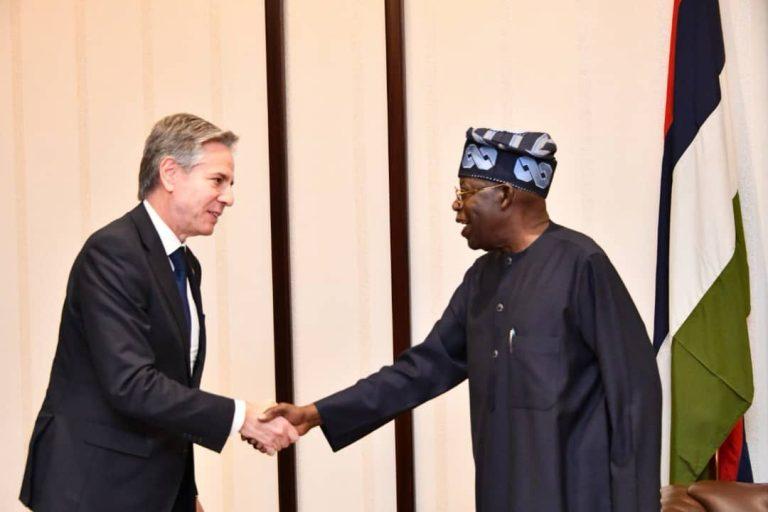
Volodymyr Zelensky, the president of Ukraine, has drawn criticism for congratulating Bola Ahmed Tinubu, the winner of Nigeria’s 2023 presidential election, on his victory last Saturday.
 
Zelensky expressed his country’s readiness to collaborate with Nigeria to address global concerns, particularly risks to food security, in a tweet on Saturday.
 
Zelensky’s tweet reads, “Congratulations @officialABAT on the victory in the election of the President of Nigeria. I look forward to close cooperation. I am convinced that the two-way interaction 🇺🇦 and 🇳🇬 will strengthen. Ukraine is determined to work together to overcome global challenges, including threats to food security!”
 
Criticising the Ukrainian president, some Nigerian Twitter users expressed their dissatisfaction over the tweet, as can be seen as follows:
 
@IjeleMela, “Corrupt people always know how to align with one another. This guy is probably very corrupt.”
 
@WeriseB, “May Putin never leave Ukraine!! Amen!”
 
@TheOliviaMead, “You will not get any money from Nigeria! Get out!”
 
“Our democracy was invaded and you are congratulating the man … on behalf of Ukrainians,” @aai_austin claimed in reply.”

A few other users have also raised Mr Zelensky for the congratulatory message to the President-elect.


Nigerians and mass migration: Addressing the Japa syndrome

By Umar Yahaya Dan’inu

Mass migration is a complex and multifaceted phenomenon that affects individuals, communities, and entire countries. It is driven by factors such as economic opportunity, political instability and natural disasters as people seek to improve their lives.

In Nigerians, many people are driven to migrate for better lives, education and healthcare, and job prospects. Political instability, such as conflict, insurgency and human rights abuses, also contributes to a mass migration of Nigerians.

The term “Japa” refers to the migration of Nigerians to foreign countries, especially Western ones, in search of a better life. A lack of quality leadership in the country at all levels often causes this phenomenon. Several reports and writing has shown that despite their love for their home country, many Nigerians have lost trust in their leaders and feel compelled to leave in search of a better future. Moreover, the decay in leadership has caused division within the polity; every tribe or region is suspicious of one another, and there is fear of domination and marginalisation.

In the 60’s and late ’70s, Nigeria was a country that commanded respect in the global arena. Our passport is a thing of pride at any entries and departure level. The Nigerian currency and economy were in good shape. However, the challenges facing Nigeria, such as insecurity, kidnapping, banditry, corruption and political violence, have led to the decline of the country’s economy and international standing. This decline has driven many young people, skilled and unskilled, to leave in search of a better life.

In Northern Nigeria, where Islam dominates the culture, people prefer to migrate to Middle Eastern countries, such as Saudi Arabia and recently Dubai and Qatar, where they share the same religion and beliefs. In contrast, Southern Nigeria is the centre of migrants, as people seek to escape bad governance and poor leadership. Despite the differences between the North and South in terms of access to education, quality of life, job prospects and economic opportunities, many young people still feel compelled to leave.  

However, the skilled and unskilled knows what they can do to navigate their way to leaving Nigeria. In Benin, the state of Edo, people are trafficked in the name of migration to get a better life, and they mostly end up enslaved and sold to work without regard for the dignity and respect they left in their country.  

Furthermore, some skilled migrants bring positive changes to Nigeria; they are doing wonders in their new countries, such as setting up companies that employ Nigerians, impacting the economy positively. In addition, statistics have shown that Nigerians are highly skilled people in the UK and the US, contributing to the economies of the host countries.

The migrations of these groups affected Nigeria negatively because Nigeria is among the world countries with the highest numbers of out-of-school children and increased maternal mortality rates. Nigerian-trained Doctors, Engineers, Scientists, Musicians and filmmakers are all over the world doing great work. Nigerian government needed their services and contribution to help in reducing the numbers of maternal mortality and to help in actualising effective education take place at all levels.     

To address the Japa syndrome, a multi-faceted approach is needed that addresses the root causes of migration and its challenges. These involved improving economic opportunities, promoting stability and security, and increasing access to education, healthcare, and employment opportunities can help reduce migration. In addition, strengthening the democratic process, improving wages and salaries, and enhancing the country’s security architecture are also important steps that need to be taken.

Nigeria is ours, and our responsibility is to ensure a bright future for our nation and youth. We must take action to address the Japa syndrome and create a future that is worth staying for.

Umar Yahaya Dan’inu wrote from Hausari Ward, Nguru, Yobe State. He can be contacted via umarnguru2015@gmail.com.

Philip J. Jaggar: The exit of another giant Hausaist scholar

By Prof. Abdalla Uba Adamu

I first met Philip Jaggar in March 2008 at the School of Oriental and African Studies (SOAS) when I was engaged as the cinematographer for a visit, mediated by the British Government, of Sheikh Dr Qaribullah Nasir Kabara of Kano, to various places in the UK, including the University of London.

While I knew of Jaggar (although never having met him before), the rest of the team was pleasantly surprised by his total command of the Hausa language (and inner city Kano Hausa at that) – and his absolute refusal to respond to any question except in Hausa. The SOAS meeting brought together an impressive list of scholars to receive Sheikh Qaribullah. These included Graham Furniss, Dmitry Bondarev (specialist on Hausa handwritten Warsh Qur’anic manuscripts of Hausaland) and Philip Jaggar himself. It was a very pleasant encounter, full of banter.

My next encounter with him was later in November 2008, when I was commissioned to deliver a lecture at the Universität Hamburg. Jaggar had taught at the university, and I was honoured he attended my public lecture. Only two meetings, but he treated me like a long-lost friend, despite the eleven-year age gap between us. I was also elated when he told me of his interest in my works which at that time were beginning to gain traction in media and cultural studies. It was our last meeting, but very memorable for me due to his simplicity, love for Kano and absolute devotion to Hausa studies. He taught at Bayero University Kano from 1973-1976 and had pleasant memories of his experiences.

Jaggar’s most famous and highly acclaimed book is simply titled Hausa (John Benjamins, 2001). It was considered a classic comprehensive reference grammar of the Hausa language spread over sixteen chapters which together provide a detailed and up-to-date description of the core structural properties of the language in theory-neutral terms, thus guaranteeing its ongoing accessibility to researchers in linguistic typology and universals.

While Jaggar, or Malam Bala as he preferred to be addressed when he was in Kano, was known for his immense contributions to Hausa grammar, I interfaced with his work on the ‘maƙera’/blacksmith industry of Kano. Jaggar was the first to provide a comprehensive study of the blacksmith industry in Kano. His landmark book, The Blacksmiths of Kano City: A Study in Tradition, Innovation and Entrepreneurship in the Twentieth Century (Rüdiger Köppe, Cologne 1994), brought out the honour, dignity, creativity, aesthetics and the technology of the metalworking industry in the heart of Africa. The blurb of the book summarizes this amazing work:

“The present book examines the factors involved in the expansion, during the colonial and post-colonial periods, of a traditional pre-European craft. It discusses the art of blacksmithing in Kano City, northern Nigeria, and its eventual conversion into a modern metalworking industry. In doing so, it challenges the widely-held and simplistic assumption that such traditional professions declined before the economic and technological onslaught of colonialism.”

For me, the book provides a fascinating and ethnographic picture of the industrialization of the inner core city where I spent the early years of my life. It vividly brought to life the alleyways, the people and the entrepreneurial focus of the various wards in the city. This alone is enough to endear a reader to the book, even without the fascinating focus on the blacksmithing industry. I was able to snatch a copy in a bookstore at the University of Maiduguri in 2003 at ₦800 – barely 2€ now, but the publisher is currently selling it for 24€, about ₦12,000.

If, and only if, someone in the policy circles of the Kano State government of the day had taken note of the book, our maƙera would have received a boost and been incorporated into the development agenda of a national creating a synergy between its creative proto-industrialists and modernity.

When he celebrated his 75th birthday in 2020, many of his colleagues paid a lot of glowing tribute to him. Now that he has sadly passed away, those tributes remain etched in stone. He will be surely missed by hundreds of his colleagues and thousands of Hausa students who benefitted, directly or indirectly, from his extensive scholarship on the Hausa language.

Tribute to Philip Jaggar (2020)
https://study.soas.ac.uk/tributes-to-philip-j-jaggar/

About Philip Jaggar
https://study.soas.ac.uk/jaggar-hausa-champion-soas/

Various scenes with Phil Jaggar and the OP, as well as with Sheikh Dr Qaribullah Nasir Kabara’s team