Opinion

Domestic service or domestic slavery?

By Yusuf Shuaibu Yusuf

Though there is still one form of slavery or the other worldwide, I was particular on this topic after watching recent footage showing how a housemaid was savagely killed by her supposed Arab employer. I, therefore, aim to join multiple voices clamouring for the governments of some Gulf countries, United Nations and other international communities to end the practice of domestic servitude whose victims are primarily African and Asian migrants. These poor people are stuck in many Gulf countries. The housemaids undergo horrendous treatment. Among these victims are many Nigerians who leave their country for political or economic reasons. 

At first, I couldn’t have expounded on issues so sensitive as this, even more so, as it involves the place of birth of our Noble Prophet, the country inhabiting the holy sites, the Qibla and the pilgrimage of any Muslim. Still, the issue at hand transcends any sentiment. 

While many Arabs in Gulf countries are piously angelic, treating their housemaids with honour and dignity, others are contrary to that. Instead, they are fiendishly sadistic as they take delight in humiliating their African and Asian housemaids, turning them into modern-day slaves.

Since time immemorial, it has been a long tradition for African Muslims to stay in Saudi Arabia and work as domestic servants after performing their religious obligations. Consequently, domestic service in Saudi Arabia came to be considered lucrative jobs among many Asians and Africans, particularly Nigerians.

Recently, due to political and economic challenges, Nigeria has witnessed the proliferation of bogus travel agents who fill their clients with utopian ideals about Gulf countries and who themselves are loosely linked with the recruiting firms in those countries. Desperate to leave the country, these clients easily fall for these lies and illusions. Hence, there has been an influx of youth from Nigeria into Saudi Arabia, Oman, Dubai, Qatar, Lebanon and some few Arab countries in Africa like Libya and Algeria. 

While most of the pilgrims working as domestic servants in Saudi Arabia before were primarily people of diverse age and sex, the recent influx has seen political refugees and economic migrants constituting of youth – predominantly females. Some of these migrants usually become disillusioned a few days after their arrivals in such countries as their recruiters leave them at the mercy of their employers. Having nobody to turn to for help, they often become subject to molestation and other forms of gender-based violence.

Women are believed to be more exposed and vulnerable to all sorts of these harassments than men. Perhaps their relatively delicate biological constitution and the fact that most of them live in the same compounds with their employers heighten their risks of being abused. 

The emotional story of “Sarah”, a Ghanaian maid in Lebanon who narrowly made her escape from the abusive family she had been working for, is an excellent example of how prone to abuse housemaids are. Sarah is not her real name for privacy sake. Shortly after her escape, she narrates to Mark Stone, a Middle East correspondent, how she was raped at knifepoint by her employer’s brother while taking a bath. 

It was also recounted, in another video clip, by a former housemaid in one of the Arab countries that a housemaid can be called to work at any time. A housemaid is not assigned one particular job like cooking, cleaning, or attending to children. Instead, she is given different tasks like attending to the sexual needs of her employer or some members of his family or both. Should she fail one of these tasks, she is treated savagely. 

The case of housemaids being thrashed by their bosses in Gulf countries has become a norm. Racist and invective are the common languages used to address the housemaids on slight provocation.

I couldn’t believe what my eyes saw in one footage sent to my sister on September 16, 2021, from Saudi Arabia via WhatsApp. I had never before imagined a barbarous and atrocious act of that magnitude could be perpetrated against animals at this so-called civilized age, much less a human being. The footage videotapes a person, allegedly a Saudi nobleman, attired decently in Arab dress, closing in on a black lady, supposedly his maid, who is lying on the floor, screaming, frantically struggling to disentangle herself from her supposed killer. But, on the other hand, stands, a broadly built woman, dressed in a green jacket, clenched in her left hand is what looks like a syringe, yelling at the struggling and screaming woman to stop resisting (at what only God knows what). This second black lady could be a nurse or anything else.

I’m sure that she is also under the payroll of this assumed killer. Even though the man’s intention is bent on killing the other housemaid, this woman has never attempted to intervene. Throughout the footage, she can just be seen yelling and pleading with the screaming girl to stop resisting. The man is captured in the video clip incessantly hitting the face of this screaming lady with his right hand and his right knee while pinning her down with his left hand and his left knee so that she can’t escape. Finally, the man ruthlessly strangulates her.

Prompted by this macabre footage, I tenaciously grew more curious and went further to download some television interviews, more violent footage and audios (some of which I have already hinted about) of some ex-housemaids in Gulf countries recounting their harrowing experiences while conducting their jobs as housemaids. 

According to Middle East Eye, the first video is of Sumi Akter 25-year-old Bangladeshi maid, bitterly and soulfully crying and begging for her escape.  She shares how she was beaten, tortured and abused by her employer and his family in Saudi Arabia. She is said to have posted the video from a hidden location to her Facebook account, where millions viewed it, which prompted protests in Bangladesh. 

Another footage of a black lady trying to get out from what looks like a toilet while being sent back by repeated flogs by her supposed Arab boss. As shown in the video clip, the incident occurs in a family room in an Arab quarter in an unidentified country. Arab family and other black housemaids are in the footage. An Arab lady asks the enraged boss to stop beating the black lady, but he doesn’t seem to listen. Later the beaten housemaid is captured standing in the middle of the living room, desperate, her back awash with blood. 

An ex-Nigerian housemaid in Oman shared her tormenting experience in audio recently trending on social media. She recounts how she had to leave two jobs because of advances made to her by her lesbian mistresses.

To end this crime, the countries these victims come from should impose laws checkmating the activities of those bogus domestic service agencies and their clients internationally. They should also ensure the rights of their citizens are not only protected within their countries but also in foreign countries. The governments of the Gulf states should crack down on those households who take advantage of the defenceless migrant domestic workers in their states. The killers such as the one described above shouldn’t go unpunished. They should be tracked down and brought to justice to serve as deterrents to others. United Nations should also formulate stricter laws safeguarding the rights of domestic workers internationally. 

Yusuf Shuaibu Yusuf sent this via yusufshuaibuyusuf@gmail.com.

On teenage girls and the house help business

By Maimuna Abubakar

The house girl business is ancient in Nigeria and the most common one in my area. I am from the north-central part of Nigeria, also known as ‘The Middle-Belt’.

It is common among women here in my local government area to keep girls at home as house helps, girls who, in most cases, are between the age of 13-18 while some may even be younger.

The idea of keeping young children as house helps has always eaten me up, and I have probed a lot of people regarding the rationale behind it. And because I am familiar with a number of these girls and even one of the parents, I decided to ask directly from the horse’s mouth.

For the sake of privacy, I will name the girls after colours. The first house girls I know are Violet, Lavender and Purple. They were about the same age, 12 or 13, I guess. They were brought to the city by a man from their village, who works in the city and became the supplier of these girls. These three girls stayed with people I know, and their job description involved doing all house chores and hawking.

In addition, the girls took care of the domestic needs of their madam’s children, such as the washing of clothes, sweeping and tidying of their rooms, making their meals etc., including children that are older than the girls. Their case, except for Lavender, is a bit favourable compared to others because these madams treated them almost the same as their children. They bought whatever they got for their children and enrolled them in Islamic schools (Islamiyya).

When I asked Violet who I was closest to why they don’t attend a school like the children of their employers did, she told me their parents are against it and asked that they should be enrolled in skill acquisition instead. Unfortunately, the reason these parents are against their children going to school was not disclosed to the wards concerned, as Violet told me.

However, she was very curious to learn. She would always ask me to teach her how to spell things or say when speaking to someone who doesn’t understand Hausa. As Violet got older while staying with her madam, she began to lose interest in her job. Every time she came back from their two-week annual break – they got to see their parents for only two weeks in a year – Violent kept telling me that she wished she never returned, that her father is an older man who she believes needed her assistance. Still, her stepmother insisted that she be married off with nothing from her family if she didn’t return to her job. So she was sent out to the city to fetch money to get her married to a man chosen by her family. Violet later told me that she kept coming back even though she hated it because it was the only choice she got if she didn’t want to get married at such an early age.

The story is the same for Purple. Although, unlike Violet, who was very enthusiastic and ready to learn, Purple always stayed home and watched movies while her madam was at work and the children had gone to Islamiyya. 

On the other hand, Lavender was not as lucky as Violet and Purple. Her mistress owns a local restaurant. She woke up as early as 5 am and slept as late as 12 am, and the cycle continued. She often faced sexual harassment from her madam’s customers, but she could not report them because the first and the last time she did, she was beaten black and blue after being accused of lying. So she had to learn to protect herself by cursing them and drawing others’ attention when anyone tries something inappropriate.

Lavender didn’t attend any school, nor did she acquire any vocational skills. She later ran back to her village and never returned. But I heard from Violet that she was taken to another state different from ours. These three girls were later called back home by their parents and were married off.

Blue is another girl I know who was brought to the city by a woman from her village. She worked with this lady who didn’t allow her to eat with the rest of the family, wash her clothes along with the lady’s children’s or even sleep on the same bed even though they were almost Blue’s age or younger. She couldn’t eat if the children didn’t eat because she was supposed to eat only the remnants of the family’s meal. She got beaten for slight mistakes like accidentally destroying anything from the lady’s home, even if it was as small as a plate. The lady always threatened to deduct it from her annual payment.

I asked Blue why she stayed despite this visible maltreatment, and she said it was because she had to earn to support her family. She never returned after she left this lady’s house, but I am almost certain that she was taken to another home.

On the other hand, Ash is a bit older than the rest of them, and she is the one whose mum I know. Financial hardship made Ash’s mother send her to her neighbour’s house as a house help in exchange for Ash’s school fees. When this neighbour decided to relocate to a new environment, Ash’s mother pleaded with her to take her daughter along to get an education. But this neighbour is a difficult one.

If Ash doesn’t finish her chores on time, she won’t be allowed to go to school. If the neighbour’s children don’t go to school, Ash won’t go too. If they are sick, Ash cannot go to school. Ash will also have to miss school if their school is on break. And because Ash does everything in the house, including cooking for about eight to ten kinds of dishes a day since the neighbour loves varieties and always have guest around, Ash is consistently unable to do her homework and often fails her tests and examinations. Not considering all the extreme labour Ash is carrying out, this neighbour told Ash’s parents that she is a dumb girl and only wastes her money on Ash’s education. She refused to allow her to attend extra lessons organized for students like Ash, who are left behind academically, especially since they are about to write their SSCE. Ash was only enrolled in Islamiyya when the neighbour’s kids were old enough to attend. 

Ash felt she couldn’t take it anymore, so she sought respite in marriage. She decided she wanted to get married as soon as she completed her WAEC and NECO, so she brought home a man she chose for herself. He is a young man who owns a kiosk close to Ash school. He asked Ash out when she was in SS2. But Mrs Neighbor said that Ash could not marry an illiterate. That Ash should either bring an M.Sc. or at least a degree holder or no one. She told Ash’s parents that it is in the girl’s best interest that she is trying to make sure Ash has both social and financial security.

Although Ash is not very far from her parents’ house, she seldom visits them because, according to this neighbour, no one will do the house chores while she is gone. Therefore, if Ash’s parents wanted to see her, they would go to the neighbour’s house. Ash’s mother, on several occasions, goes to this neighbour’s house while the neighbour is at work to relieve her daughter of the overbearing labour.

These are a few out of a hundred horrible stories of such girls. I’m not saying there are no house helps who have attained success or are in the process of achieving their life goals with their initial job as a stepping stone. There are!

I know someone who owns a fashion designing shop. I also know someone who has graduated from a higher institution and is already starting a career. Some are still pursuing their education at different levels. But, there are only a handful of such girls, they are rare, and their rarity proves the point that house help business as conducted in my locality especially is just typical child labour and abuse.

How do we curb this dangerous abuse that has been going on in almost all parts of the country?

Since the growing number of working-class women in our society means that mothers can no longer take care of their children 24/7, entrepreneurs can use this opportunity to create niche markets. They can then form a house help agency in or around areas where mothers with such needs are residing.

Again, we have thousands of graduates from the department of ECCE (Early Child Care Education) both from our various colleges of education and our universities. These entrepreneurs can implore their services. These agencies can then employ older women willing to take care of children. Young individuals, both men and women, can also be engaged as either part-time or full-time employees depending on such a person’s financial needs.

The agency can also run a temporary employment program for college students who are on holiday to earn money before resumption. These agencies can have two or more departments; those involved in housekeeping, those responsible for babysitting etc. That way, hopefully, these teenage girls whose parents have been taking advantage of them can also have a life of their own. 

Maimuna Abubakar is a Sociology Student at Ahmadu Bello University, Zaria. She sent this article via maimunaabubakar200@gmail.com.

One last truth

By Zaynab Abdool

It’s winter morning, a new day, and I’m awake, Alhamdulillah. When my foggy gaze fell upon the aesthetic rays of sunshine that sneaked through the holes in the window, surged past the transparent curtains, and stood grandly on my bedroom’s plain wall, I couldn’t help but admire its gracious beauty while my soul sent praises to the creator of man and nature. 

‘Zainabuwa, what on earth are you still doing in bed? Reincarnating?’         

A lusty yet irritating voice accompanied by a loud knock sailed me back from my small world of imagination. That was Husna, my new friend who just moved next door a month ago. The love we both had for certain things, such as the love for books, poetry, cats, henna and hijab, truly helped blow the flames of our friendship. So, we were on good terms.    

Stepping down from my bed, I yawned lazily, ignoring the annoying voice behind the closed door. After taking off my crystalline PJ’s, I slipped on a black gown and strolled across my room to get to the door. Glowering Husna was all I saw before I was kicked aside, and the next was the elegant Husna clad in a light blue hijab that complemented her black skin, cat-walking towards my bed while reciting a poem with the zestiest voice ever:

‘Habibi, you carried          

The weight of my poem         

Like pen amidst thy fingers,          

You stole my lines, stanzas         

And my entire muse         

With just a blink.’

After listening to those lines, I was shocked out of my wits. 

‘WTF! I’ve always thought you’re only into dark poetry! Don’t tell me you wrote that piece!”

‘Babe, forget about those dark kinds of stuff, I’m a phoenix now, and I’ve finally found him,’ she said happily with stars in her eyes.

‘Him? Who?’ I asked, confused.’ My knight mana,’ she replied with a sly smile plastered on her pretty face.

‘Oh! Do you mean to tell me that you’ve found a handsome male lad in those web novels you downloaded lately?’

‘Damn! I found one last night, and he’s so damn amazing that I felt like dying in his arms…’

I scooped and sat beside her on the bed, rolling my eyes.

‘You’re a fool, you know?’, she reacted to my body language. 

‘Yeah, a pretty fool,’ I chuckled before adding: ‘You need to get back home and return after I had my breakfast. It’s hot milk and chips today.’

‘I hate milk and chips,’ she frowned.’ Oh, wow! Stay and feel at home then,’ I exclaimed gladly.

‘Stingy brat, now let’s discuss some serious kinds of stuff.’ 

‘Oh, okay, let’s discuss fast; I’m hungry,’ I yawned

‘My man’s birthday party is in five days and, of course, I will be there because I’m his queen,’ she stated happily. 

I stared blankly at her flushed face, uttering: ‘What’s she talking about,’ I thought, still finding it hard to believe what I just heard.

‘What man? What birthday party? What queen? Do you want to slay? Or you wanna join the movie industry?’ I asked hectically.

‘Yeah, babe, I wanna slay for my boo. He’s worth it,’ she replied while browsing through her phone’s gallery. ‘Here, meet my prince,’ she flashed me a photo on her screen which got me back from my blackout state. ‘Huh!’ My jaw dropped. All I saw was a bronze skin guy with dreadlocks, dressed in sophisticated cocktail attire. The stiff aura around him emits a strong ‘arrogant playboy’ vibe.

‘How on earth did she even meet him? He’s so disgusting,’ I thought. ‘Erm, hmm Husna yo…you fancy him? Erhm, I, I mean you love him?’ I asked in between stammers.

‘Yeah, I truly love him. He’s charming and amazing… He’s not what you’re thinking, Zainab. He’s an overall different person inside. Don’t judge him by his appearance.”

‘So, to you, he’s worth imitating to your future kids?’ I asked in a low muttering voice. 

‘Yes, at least that’s what I think, and nobody’s perfect anyway. So, what do you suggest I wear to the party? ‘He said I should appear as classy and sexy as possible, even though he claimed to do something about my black skin before the D-day. I still need to give in some effort, right?’

‘What nonsense!’ I thought.

‘Husna, you’ve changed,’ I whispered. She chuckled before saying, ‘love has changed me.’

‘What love? This is pure bullshit. Have your parents even acknowledged him?’ I asked, finally coming back to my senses, knowing quite well that Husna’s parents – being the typical Hausa parents who will strictly push their kids towards the Deen; the type of parents who will teach their kids that Islamic education and good morals are far more important than anything – would never acknowledge her ‘so-called boyfriend’ as their son-in-law.      

‘No! Wallahi, you’re so dumb. Can’t you understand that we are into a secret relationship?’ she almost barked. 

‘Whatever the case, you’ve to break up with that demon you call a prince. You deserve someone far better than him-someone that will accept all your flaws and appreciate everything about you, someone with the ilm to defend his religion, a man of Deen whom your kids will be so proud to call ‘papa.’ You deserve someone whose testimonials are inspiring, someone whose effect on you would extend beyond this Dunya, a man who will walk you to Jannah, a man you can hold on to, a man you can proudly call the source of your true happiness and external strength. Not someone that will encourage you to bleach your skin and change who you are, not someone that will persuade you to flaunt your beauty and mess up your goals.’ I stopped to breathe.

‘You don’t have to impress anybody, my dear, you don’t have to sacrifice your happiness to anyone-the happiness your parents put so much effort to build and protect…’ I paused again and stared blankly at the walk with misty eyes, not sparing Husna a glance.

‘Our parents had gone through a lot to make us who we are today. They have sacrificed their blood and sweat to give us happiness, yet we chose to, to…’ I paused as tears of pity flowed down my cheeks to seek solace on my lips—tears of pain, the pain of betraying their thoughts and trust.

I restricted my gaze from the plain wall and pasted it on Husna’s forlorn face. I was shocked when I saw tears rolling down her flushed cheeks.

‘But it’s a free world, Husna, and as a friend, I’ve played my role here to guide you. So now it’s left for you to decide because hell is free, anyway,’ I said as I stood up lazily, wiped my tears and walked to the door. ‘I need to get my breakfast, Habibty; feel at home,’ I said, holding the doorknob. 

Innalillahi, I almost destroyed my life. What was I thinking, Astagfirullah’ I heard Husna mutters to herself from behind. 

I smiled, let out a sigh of relief and closed the door behind me before walking to the kitchen in high spirit.


© Zaynab Abdool (abdullateefzainab96@gmail.com)

Of Hanifa Abubakar and our wicked world

By Ambali Abdulkabeer

More than any other incidents, the recent killing of one Hanifa Abubakar in Kano state by her wicked school head, Mr Abdulmalik Tanko, has been making the rounds on social media. People have angrily commented on the gory incident and demanded that the perpetrator be immediately killed in return. However, more than the angry ocean of comments made by parents who put themselves in the shoes of the diseased’s parents, it would be depressing to construe the motive behind the action. If truth be told, we live in a world rife with sheer inhumanity.

Based on the reports published by several newspapers, Mr Tanko, who is a father of three, had kidnapped the deceased and demanded 6 million ransom weeks before he eventually murdered her. He did that, according to reports, because the innocent girl recognized him. I can’t wrap my head around this. But, while we feel battered by his action, we should not forget that Mr Tanko is a representative of a larger, utterly redolent society.

In several parts of the country, such a case is rising. Our society has degenerated into a theatre of inexplicable death while we continue to pretend nothing is happening. It is not out of point to mention that ours is a world of wolves in sheep’s clothing. We no longer value human souls. Instead, we belittle the significance of life as enshrined in the sacred books available to us. Daily, people’s interactions are shaped by motives that stray away from the principles of humanity.

In all of this, I think we have to reflect on the happenings in our world. The fact that suspicion, manifest in hypocrisy and sheer wickedness, defines our relationships as a people should remind us of the destruction that has befallen the human race. As far as I know, no religion justifies the termination of the human soul on flimsy reason. No culture encourages such. What is wrong with us?

For instance, ALLAH reminds us in Qur’an 5:32 that killing of the human soul is a grave offence: “For that, cause We decreed for the Children of Israel that whosoever killeth a human being for other than manslaughter or corruption in the earth, it shall be as if he had killed all mankind, and whoso saveth the life of one, it shall be as if he had saved the life of all mankind.” Several Hadiths of the noble prophet Muhammad (SAW) also remind us of the enormous aberration that unjustifiable termination of human souls represents.

It is high time we began to pay attention to virtue in our society. I have always felt that Nigeria is descending into a society where morality and values are no longer cherished. People are driven by wealth, and this practice is not unconnected to the litany of woes that our society experiences. Cases of young people dying in their quest for ‘quick money’ are numberless. Unarguably, the high rate of unemployment, mismanagement of resources by those at the helms of affairs, utter cynicism evident in our religious institutions and others have also been cited as reasons people engage themselves in the unimaginable.

However, we would help our society a lot by refusing not to be driven into egregious acts such as killing innocent people, as Tanko did. He didn’t even think about Hanifa’s innocence, her parents and the fact that she had a future. Mr Tanko’s action, in other words, is a manifestation of the death of ethics in our evil society. George Bernard Shaw was right when he said, “The nation’s morals are like its teeth; the more decayed they are, the more it hurts to touch them.”

Mr Tanko should be punished according to the gravity of his offence. He doesn’t deserve mercy, and the law must not be altered to excuse his egregious act as not deserving of death. For subjecting the deceased’s parents to endless grief, for showing that the human soul doesn’t matter to him, for doing the unimaginable, Mr Tanko must not go scot-free. May ALLAH bless the deceased and comfort her parents.

Ambali Abdulkabeer writes in from Ilorin. He can be reached via abdulkabeerambali@gmail.com.

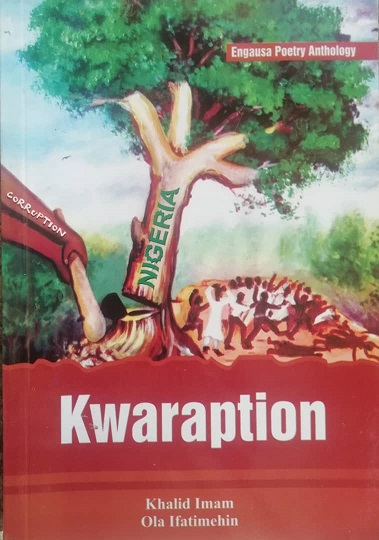
Book Review: “Kwaraption”

Book Title: Kwaraption

Editors: Khalid Imam and Ola Ifatimehin                                                                                   

Type: Anthology of poetry written in Engausa

Publisher: Whetstone Art and Information Service

Pages: 72

Year of publication: 2021

Introduction:

Although not simple to define, corruption is a major impediment and barrier to Nigeria’s progress. For many years the country suffers a lack of infrastructure and poor condition of living because of corruption, which not only stagnates the nation but also derails it from the path of progress. Although more endemic now than ever before, the story of corruption in Nigeria is at least very old.

A missionary teacher in Kano, Madam Ethel Daniel Miller (who came to Kano in 1917) in her book The change here in Kano complained of a prince from the emirate that gifted her a set of clothes for the simple reason that she is a sister to Dr Walter Miller, thinking that she could influence his choice as a successor to the throne.

Other examples can be found in fictional works such as Magana Jari Ce (1937), where Dan’iya bribed a police officer to deceive his friend, Daudu, in a story titled “An ƙi cin biri an ci dila.” The case of Obi Okonkwo in Achebe’s No longer at ease (1960) and that of The Incorruptible Judge (1962) by Olu Olagoke were just a few out of many similar cases. These are clear indications of how writers used their pen to expose and sometimes fight corruption since the beginning of Nigeria formation.

This anthology of poetry edited by indefatigable Khalid Imam and awesome Ola Ifatimehin contains 51 poems contributed by 45 poets. Nearly half of the contributors are female writers, which is a clear indication that females have come of age in terms of literature in northern Nigeria.

The title of the book “Kwaraption” is a Hausa and English attempt at pronouncing corruption. While the first, “kwara” part is just the Hausa sound of the first four letters, “corru” (in a word corruption), the second part was derived from the last for letters (ption) of the original word. In other words, kwaraption is a corrupt way of saying corruption. Instead of the editors using Hausa translation of the word corruption which is loosely translated as Cin-hanci or Rashawa, or just writing Hausa variant of corruption as kwarafshin, they decided to retain part of the original English words. This is to portray the uniqueness of the work as an anthology of poems written using Engausa which involves coding switch or mixing of languages (English and Hausa) with a view to achieving artistical beauty and increasing richness of literature.

An Appreciation of Some of the Poems in the Collection

Looking at the anthology, one can understand that the poems covered a wide range of issues of interest as far as corruption in Nigeria is concerned. Some of the issues covered are:

  1. Recognizing Nigeria as a rich country which is very blessed with both human and material resources, but whose citizens are poor because of corruption and other social vices.

ƙasa mai albarka da albarkatu,

mai attajirai, masu ilmi da yan siyasa Hafsa Ja’afar in a poem titled Rashawa (p. 30). 

  • The state of the country as far as corruption is concern. For example, Ameer Nasir in Cutar Zamani described the country as one having expertise in corruption to the extent that it is difficult to separate us from corruption “tamkar jini da hanta” (p.17). Basheer Adam Gobir assumes that ‘almost everyone’ in the country is corrupt (p.23). Similarly, Farida Mohammed Shehuin Abin Takaice (p.24)and Khalid Imam (p.37) see corruption as a hazard whose impact is everywhere; mosque, church and in all places, and Khalid particularly described corruption as ‘flood’ that destroys (Corruption Everywhere, p.39). Khadija Hanga in her poem titled Despicable Diseases sees corruption as marriageable girl, however dubious whose main goal is to deceive “a fool”. In fact, as captured by Ola in his allegory, “Kukan Kurciya”, corruption is now “new education”. Because we are so accustomed to corruption that we are given it good names and the corrupt person were assumed to be philanthropist as captured in a poem Philanthropist na gangan (p.26) “barazanar ɗan ta’adda ba ta mayar da shi gwarzo”. Also, YZ Ya’u corroborates this in his “Sai Mai Taimako”. Umma Aliyu educates us on different forms of corruption that we don’t see as such due to level of societal decay.
  • Looking at corruption as a cause to many problems this country witnesses.  For example, in a poem “Tick” byAbubakar Isah Baba, corruption is responsible for poverty and insecurity;

It causes abubuwa masu yawa,

Poverty mai kashe gwiwa,

Insecurity mai karkatse rayuwa,

Ga misalan scandals nan da yawa.

In “Lamentations for a Country,” Adesina Ajala blamed corruption for dividing the country along many social layers “Corruption is the common denominator that divides this land without fractions.” The division is along religious, ethnic, regional and even occupational strata. In “Gobarar Daji” Yahaya Abubakar sees corruption as “alpha and Omega”, hence, the chance of getting out of the current quagmire is very slim,

“ta yaya za mu yi rayuwa sustainable,

tattalin arziƙinmu disabled.”

Bashir Umar blames corruption for bankrolling the country such that it cannot meet its basic needs, he sees it as embarrassing that the country now relies on foreign aid for its development “wai yau ni ke neman aid from foreign organization”. The writers believed that Nigeria has taken a poisonous venom, whose effect transmitted to the children, making them engaged in killing one another “mun ɗauki kansakali, maimakon magani.” Ajuji in his “Bragging da Kayan Sata” captures an attribute of a corrupt person.

“there stand akimbo…

carrying pot belly,

like expected mother.”

  • Trying to understand the dynamism and causes of corruption is one other focus of the poets in the anthology. Amatullah Saulawa in her “We shall not be afraid” boldly says:

“yes, it is our faults,

if dictators shift gears,

we bring them back” (p.15).

This is a similar submission of Maryam Baffer in the poem “Har da ni”. However, the politicians are most blamed in the collection because they stand for it

“ko da tsiya ko da tsiya tsiya

sun kasa

sun tsare,

sun raka,

sun rabe”

as stated by Hafsa Ja’afar in Rashawa (p. 30). Lynda Mustapha in her two poems “Write it down” and “Buhu-buhun Iskanc”i blamed politicians for perpetrating corruption in the country. Moses Odozie writes on corrupt civil servants whom he nicknamed “Ɓarawo mai Biro”. Murtala Uba Mohammed, in his poem “Corrupt Nation”, believed that corruption is not limited to politicians, there is also the police, court and parents (p.51).  

  • The writers are tense of corruption and eagerly want it to end. Adesina Ajala said;

“Yaushe zamu warke daga wannan ciwon ne?

Wa zai haska fitilar gaskiya cikin wannan duhun baƙi?.

Corruption is here seen as a wound that needs to be cured and darkness of a night that should be put in the light. In “The Oak Tree”, Aliyu voices out; “yet we hope for betterment”

  • The authors not only lamented over the problem, they also recommended some solutions to the problem. Madinah Abdussalam in his “Yours and Mine” sees the solution as public, that every person should do it himself.  He says “who will end corruption in ba mu ba”.

In “Soyyayar Corruption” by Elizabeth Zephaniah, the public is seen as a solution, she metaphorically states “yaushe za mu ga eagle na fighting corruption”. Musa Adam was also having a similar view in his “My father’s 61st Rebirth”. Some of the poets expressed unity as an important factor in the fight against corruption, “dole we have to be united” as stated by Haneefa Musa Isah in her poem “Mu haɗa kai” (p 31). Also, Sani Abdullahi Salisu in his Kwarapshin (p.61).      

Engausa

It was not surprising when I saw this anthology. This is because of my prior knowledge of the debate that started on the page of APNETi when Dr Ola began to release his poems in a fashion of code switch, mixing English with the Hausa language which Khalid and some other members called ENGAUSA and opined that it is new and welcomed development. Some members of the group, most especially Professor Yusuf Adamu objected to that saying that language blend and code switch is not new in poetry particularly among Hausa poets citing a popular line of late Nai’ibi Sulaiman Wali in his poem Damina

“… su yi kasuwa su yi kantuna,

kowa busy sai su damina.

Yaran gari ko sai bal suke,

kowa ka duba very happy…”.

Khalid and his likes were not convinced arguing that the example given is INGAUSA, different from ENGAUSA. They said INGAUSA is a Hausa poem where words and phrases are used to complement the writer’s inability to come up with the right words based on context or meaning as opposed to ENGAUSA which is a poem written specifically with two languages blending and it is purely artistical. In the introduction of this book, the editors maintained this view indicating that they had not shifted their position, more so, in an interview conducted by Ola stated that this Engausa is almost his own daughter.

While this anthology may certainly be the first collection on the ENGAUSA poem, the view that the ‘new ENGAUSA’ is different from the ‘conventional INGAUSA’ is very weak. This is because language swap in Hausa poetry is not just triggered by weakness or inability to come up with the right phrase or word in a context, it is equally deliberate. Also, when we look at recent popular Hausa songs we can see Engausa. In particular hip-hop singers such as Billy’o in his song “Rainy Season” wherein he said:

Mosoyiya, farkon ganinki na yo confusing,

sai da zuciyata tai ta squeezing,

sai da temperature ta tai rising,

jiri nake sai ka ce na sha poising,

ni ko so nake a san ina da reason”

is a good example of Engausa. In recent, northern Nigeria’s film series such as “Son of the Caliphate” and “Gidan Danja” are also full of Engausa. In addition, Aliyu Idris aka Abdurabbihi is another example, whose poems are in a mix of Hausa, English and Arabic languages even before seeing Ola’s “Sarauniyata” which appeared first in APNETi platform. Agreed, Ola and to some extent. Khalid can take the accolades of popularizing the Engausa and APNETi for holding the first workshop to teach it. It is another issue as to whether the new Engausa has a rule or not. But it is important to state that Engausa is an attempt to mimic how we (particularly the educated elite among us) talk at home and other places.

Finally, I wish to congratulate the editors for the first Engausa anthology and the All Poet Network International (APNETi) and Centre for Information Technology and Development (CITAD) for sponsoring the publication of important literary work that can help in Nigeria’s corruption crusade. The text is truly a noble of a kind. While wishing to see more literary work of this format, I wish the editors will do more in editing the Hausa language in the subsequent publications. I noticed many orthographic errors with respect to the Hausa language, which our indefatigable Imam will share the larger blame for his expertise in the area. I also conclude with the following lines:

Mai biɗar gane corruption,

To ya ɗau wannan collection,

Hausa tare da Englishin,

Sandwich kuma conjugation,

An zubo concatenation,

Kar ku ce contamination,

An yi ne don education,

Tun da Ola ya yi motion,

Ka ga Khalid zai yi action,

An yi  don inganta nation,

Yau kwaraption mun rejection.

The reviewer, Dr Murtala Uba Mohammed, is with Geography Department, Bayero University Kano, and can be reached via murtalamuhammadu@gmail.com.

Why, as a man, I fight period poverty, menstruation stigma

By Bilyaminu Idris Ndasadulau

I believe in collective action, responsibility and collaboration. That’s why I joined as a man to fight against period stigmatisation and period poverty. It’s everyone responsibility, not only the females.

Menstruation matters to me. Thus, I consider any form of stigma associated with menstruation a social abuse and crime against women. Unfortunately, millions of women and girls continue to live in period poverty around the world without any support from the government to end the problem. We need to address the issue collectively. That’s why in 2019, I started online research studies on health matters, and I found out many women and girls need pads, but they cannot afford them, which can often lead to girls not attending school and also unhygienic practices. 

So in 2020, we initiated the “Rescue A Girl” project, which aims to end the stigma and discrimination and focus on enhancing, from the grassroots, adequate education, health and gender equality, which is a key to achieving the Sustainable Development Goals agenda. 

In the same year, during the COVID-19 pandemic, we launched the project on International Girl Day. We outreached to different schools and communities where we educated and impacted over 350 women and girls with free sanitary pads.

After our 2020 project report, we understand that sanitary pads are not the best solution to end period poverty and financial inequality worldwide. So we design a sustainable solution strategy to support these women and girls through reusable pads products. Which is very affordable and also help in economic empowerment to produce these materials and sell them. At the same time, our approach will be a sustainable solution to end period poverty and increase available good health hygiene aids for women and girls. 

In late 2021, we decided to push the sustainable solution to reality, where we visited and trained almost 1000 women and girls in different marginalised places. While we also raise awareness to improve knowledge and practices of menstrual hygiene management, especially for the local residents and school girls.

This effort was supported by Connected Development in collaboration with ShareYourself Organization from the USA. Through this project, we build transparency data of impact to ensure our partners and the public can see the sustainability of our work. So we can gain more support around the world. 

This project targets 2000 women and girls just for the 2021 goal. Still, it is a life continuation work to ensure we reduce the high rate of women and girls facing period poverty and lack of MHM knowledge. While we also empower them to become self economic independent and minimise environmental waste caused by sanitary pads. 

We will keep pushing the Rescue A Girl project as a movement to ensure policymakers, government, NGOs and individuals all play their role through taking it as a responsibility and commitment to change the policies and mindsets to support these vulnerable living survivors. 

The experience we gained throughout this health project was unique. We travelled to slums; we met a lot of young housewives and girls, and we built confidence brought hope and a smile on their faces.         

You can reach Idris Bilyaminu Ndasadu’Lau via bilyaminuidrisndasadulau@gmail.com.

Let’s promote our culture

By Usama Abdullahi

It’s challenging that we are found wanting in our own culture. We don’t promote it simply because we don’t want to be looked down upon or mocked about it. Western culture has now substituted ours. We assimilate and worship anything western. Ironically, the West doesn’t force their culture on us; we rather westernise ourselves. 

Sometime in 2013, my uncle bought us pizzas. I used to see pizza as the best dish ever, but I was nauseous when I took my first bit. Being in the company of my cousins, I had to conceal my bitter feelings and fake some smiles to fit in. I was pretty low that day. 

For me, pizza is supremely overrated and not as delicious as I thought; it’s aromatic, though. Mind you, I’m not condemning the Italian dish in its entirety. But why do I bring this to light? I felt like sharing my experience, and I want my people to understand that not everything foreign is delectable.

As people with beautiful cultures, we have crazy good dishes that can excite and quench so many aliens’ appetites. Yet, we don’t promote that. We fault it instead. I have watched several western TV shows where the westerners expressed their liking for African culture, particularly their foods.

Arguably, most Nigerians tend to shun and dislike their culture because, to them, it’s worthless. The preference for western dishes leads to the decay of our cultural dishes. Sadly enough, most of the dishes are given western names, which has become difficult to catch on to. Those names don’t correspond and are mostly corrupt versions of the western ones.

Some of us, the so-called civilised ones, erroneously claim that most of our foods are detrimental to one’s health. Though I’m not medical personnel, the little I know tells me that foods like Tuwo provide the body with energy. Awara/Kosai, the most-avoided dishes by the corps d’elite, help build and repair tissues because they are “proteinaceous”. My claims are open to criticism because they are perhaps not well-grounded.

There are others too, which I guess could be harmless and good for consumption if thoroughly examined. It’s time we stopped self-hating or ridiculing ourselves merely because we want to look or sound different, say like the western. Until we promote our culture, our culture will go extinct someday.

Usama Abdullahi wrote from Abuja, Nigeria. Can be reached at usamagayyi@gmail.com.

The most dreadful experience of my life

By Yahuza Abdulkadir

Many a time, I listen to people expressing their feelings and emotions, telling their beautiful and ugly stories, talking about the experiences they encountered through their journeys.

But then, there’s this story I wanted to write, but I couldn’t. Whenever I tried to, fear overwhelmed me. So, I overcame my fears and summoned the courage to write this story today.

In April 2021, while travelling to Funtua in Katsina State, I had a dreadful experience that left a big scar on my heart.

On that day, I reached Kano at around 6:30 PM and boarded the ‘Adaidata Sahu’ tricycle to Rijiyar Zaki Park because I was told that it’s only there I could get a car that would take me to Funtua by that time.

We started the journey to Funtua at around 9:00 PM. It was late and a lovely friend who happened to know how the road used to be at night advised me to stay till morning. But I couldn’t heed her advice because I wanted to reach Funtua that night and complete my assignment the following day.

I started regretting why I embarked on the journey when our car spoiled at Malumfashi. The driver tried to get the car back to work for almost an hour but no progress. Finally, he decided to walk a few metres away to get a mechanic. And we were lucky that he came back with one. After several trials, the car engine started, and it got back to work.

I can still echo the voices of the two women seated at the back, pouring blessings upon the mechanic who helped fix the car’s problem. He really tried, but God’s miracle has taken place, I believe.

As we continued the journey – chatting and listening to other passengers telling their stories, I fixed my eyes on the road, and many thoughts knocked me on the head. When I noticed no car coming from the other side of the road, fear robbed my mind. My heart kept beating. I wanted to tell the driver that I was uncomfortable with this journey, but silence kissed my lips. I kept mute for some minutes. But deep inside of me, I wasn’t feeling okay.

A few kilometres to Bakori, we spotted torchlights reflecting from a close distance. And I heard the driver saying, “Inna-lillahi Waa Inna Ilaihir-rajiun,” meaning: “From Allah we are, and unto him is our return.” He tried turning the car to escape the trap in our front, but the sound of gunshots flying in the air made him stop the car.

I couldn’t remember what happened, but I saw people with guns and torchlights telling us to get out of the car. We went out, and I was terrified. Some voices began to whisper into my ears, “Had I known, I could have stayed in Kano till the following day like my friend said, but my stubbornness got me into this, it’s not my fault; this is my fate.”

That night we were robbed. “The Children of the Night” collected all our money and that of the driver. Then, they took away our cell phones and walked into the bush, shooting in the air.

When they left, I got into the car, shivering. Then, I realized that my smartphone was inside my small travelling bag, which I kept close to where I sat. I put the phone into the bag earlier because its battery was flat. So, I was lucky that my smartphone was still with me, though they took my small phone I used for calls. I know that we were lucky enough to be alive that night.

We stayed there till dawn because our car couldn’t get back to work again. We were thinking of what to do next when a car carrying bags of maize showed up. We waved hands for the driver to stop. And he did. He got out of the car and headed to where we stood. We told him about the incident, and he showed his concern, sympathizing with us. He told our driver that he was rushing to get to his destination. Then I saw him removing some money from his pocket and offering it to our driver. The driver thanked him and asked us to do the same. This man is very kind. Humanity lies in his heart, I whispered.

We kept waiting there till an empty commercial bus came. Then, after discussing with its driver, he asked us to get in. And we headed to Funtua. Our driver left his car with the intention to get a mechanic at Funtua who could repair it.

When we reached Funtua, I wished the other passengers well and prayed for their safety everywhere they would be. Then, I took my travelling bag and walked to my destination.

Although I have been travelling along the Damaturu-Maiduguri highway, I have never felt shocked and frightened like this before.

This was the most dreadful experience of my life. It’s a memory I can never forget.

Yahuza Abdulkadir wrote via yahuzaabdulkadir50@gmail.com.

A minute of silence for Hanifa Abubakar

By Maryam Muhammad Lawan

“Baby sis! I’m craving for something spicy,” I said in a cosseted voice. 

“Don’t worry, please. Your lazy sis will take care of you today. Guess what! No, I’m not even telling you anymore. Just wait for it,” sis said. 

I jabbed at her amusingly while saying, “Go and prepare whatsoever it’s please”.

“So, you’re poking fun at me. I’ll surprise you today”, My sister said while cackling.

“Yeah, don’t surprise me with rubbish, please, “I teased while she guffawed and moved on. “What a sis? Bless her ya Allah, “I said silently.  

I was left alone in the room when I logged into my Facebook account and started scrolling. Why do I see Haneefah’s pictures on almost every post? Did those other sets of humans release her? So I decided to read, to discover what it is. 

SubhanAllah! AstagfiruLah! I read as many updates as possible, for I couldn’t believe what I read from the first update. But eventually, I realized even the first update was as right as a trivet. 

“Don’t tell me you couldn’t wait for me to finish. I want to cook delicious food, so be more patient, please,” My sister said as she heard my footsteps towards the kitchen. I stood there, and she quickly looked at me. “Okay. Cry, cry, baby, what’s wrong again? Let me turn off this cooker before this mood of yours spoil my hot spicy meal,” sis said aggressively.

I couldn’t spell out even a word, maybe because I was emotional. So all I could do was to extend the phone to her. 

She used her hands and closed her mouth. Tears had no option rather than to roll out of her eyes.

Innaa lillaahi wa innaa ilaihi raaji’uun! AstagfirulLah wa atubu ilaik! Ya Allah, have mercy on us. The girl I so much like? Though I don’t know her, the girl I always pray for Allah to protect her wherever she’s, and from the evil of those men?” she said with a sorrowful voice. She continued reciting, “HasbunalLahu wa ni’imal wakeel”.

“Her school teacher did this, then, if learning places are not safe, where on earth then? What a wicked world, Ya Rahman, have mercy on us. Ya Razzaq, grant her parents the fortitude to bear this loss,” My sister prayed

I replied, “Ameen ya Rabb,” while giving her a shoulder to cry on.

Maryam Muhammad Lawal wrote from Kaduna via mmafamam@gmail.com.

Let there be Rice!

By Tahir Ibrahim Tahir Talban Bauchi. 

As intelligent, hardworking and technologically advanced as we brag about being, it is ironic that at the end of the day, we fail to show up for patriotism and country — and choose to dwell on the divides that do not crystallise into the positive building blocks of our national development. Instead, we tow the lines that harp on our differences and rhetorics based on political party apathy.

We often embrace the gulfs of ethno-religious segmentations of our society and deliberately fail to show up for our country. We are absent when it comes to celebrating the country’s achievements and progress. We instead converge to mock her, even when she has birthed something fruitful and prosperous. However, anytime we find ourselves stuck or in need of a dear country, our voices are gravelly with echoes of her name and her might.

When D’Tigers made waves whacking USA’s Dream Team, it was called Igbo or IPOB teams. When it wobbled, it was Nigerian again. When the Super Eagles didn’t score, the striker is labelled gateman because he is of a particular demographic. Still, when he does, the Super Eagles are flying again and are the only team in AFCON 2021 to make the group stages on a stainless slate. 

The CBN and RIFAN (Rice Farmers Association of Nigeria) unveiled the pyramids in Abuja as seeds of the long and aggressive Anchor Borrowers Programme. Many rose to blindly and sheepishly discredit the programme. An old image from a certain state, which showed the assembling of rafters, as if constructing a roof, with rice bags placed as tiles, to simulate a huge pyramid, was shared to disillusion gullible ones, that the CBN/ RIFAN event was dubious and unreal. Some said the bags were filled with sand, while some dissected the event as a waste of resources and energy. Some didn’t want to credit the administration due to party affiliations, and others didn’t want to have any of it because of their own biases. Most couldn’t put Nigeria first and all other differences aside and be happy that the motherland has achieved this milestone, despite the overwhelming and depressing global environment for business and governance. 

In our importation bills, it is more than evident that the importation for food, especially rice, has stepped down many notches. This is because government intervention in rice importation has also dropped astronomically. One million bags which is just a percentage of what RIFAN has produced, were unveiled at the event, being an aggregation of the 2020 dry season and the 2021 wet season. They are the commitment from farmers in the repayment of their loans from the Anchor-borrowers programme.

No fewer than 230 small, medium and large scale rice mills have emerged all over the country from 2015 to 2021. A Kano-based lady has a 160 ton per day capacity rice mill, while another, one of the biggest, has a 32 metric tonnes per hour capacity built-in Lagos. From averaging less than 3 million metric tonnes per year, in 2015, an outstanding 7 to 9 million metric tonnes per annum was achieved in 2021. The rice revolution is unbelievable but far away from being a hoax. 

Ado Hassan, the Secretary of the Kano chapter of RIFAN, had said that their move was towards engendering the twin benefits of food security and economic diversification. Agriculture contributed over 21% of our GDP. This is incontrovertible evidence that a lot has actually been achieved in this sector. Nigeria has become the largest rice grower in Africa, and neighbouring countries are coming in to educate themselves on how Nigeria is dominating Africa, as the giant of any continent should rightly do. 

Nigeria is gradually achieving food security, which we should be proud of and glad to attain. Unfortunately, the vociferousness of global inflation is biting the most developed countries too, and not just developing nations like dear country. A Briton was lamenting that the cost of parking, which was just £.10 a few months ago, had risen to £.50! Perhaps if Nigeria were not hindered by insecurity and a pandemic for the last three years, we could have been celebrating a lot of such pyramids across the country.

The Nigerian military does a show of force, so does the NAF with jets in formations over our skies. Lecturers have conferences, and the NBA has annual conferences as well. Every sector of our economy has players coming together under one roof to showcase their achievements and discuss prospects. So why can’t our dear farmers, under the auspices of RIFAN, do their own show of rice? Isn’t it an important part of accountability?

We pray that their efforts will directly affect the market price of rice in the coming weeks, as the mills get busy husking the rice that was showcased. We also pray that unscrupulous marketers will not deny the everyday person the fruit of this labour. Those ones are a whole chapter of those unpatriotic ones we so have to live with. 

Tahir is Talban Bauchi.