Education

Banditry and students’ abduction: Revisiting the ‘Safe School Initiative’

By Mukhtar Ya’u Madobi

The alarming rate of insurgency, banditry and kidnappings are rising across Nigeria without any sign of abating.

These myriads of insecurity challenges have been inflicting wanton damages on the country’s political, socio-economic, and educational institutions.

Initially, the prime targets of kidnappers are wealthy individuals who can afford a ransom of any sum to regain their freedom. But nowadays, the narrative has since dramatically changed, as individuals who live from hand to mouth have now become the targets of these blood-sucking demons.

Worse still, this heinous act has been extended to the education sector, looking at how mass abductions of students have become a norm.  These students end up in the kidnappers’ den and get subjected to different forms of torture, leading to the premature death of some of them, while the lucky ones that survive usually go a long way battling with post-traumatic stress disorders (PTSD) due to the horrific experience they were exposed to.

According to the latest edition of Nigeria’s National Security Strategy (NNSS) 2019, a document released by the Office of the National Security Adviser (ONSA), retired Major General Babagana Monguno, it was emphasized that kidnapping, armed banditry and militia constituted about 40% incidences of national insecurity in Nigeria.

Reports have indicated that several schools have come under attack by bandits since late last year in which innocent students were horrifically abducted. Records have shown that 20 attacks had been carried out on some Nigerian schools in which about 1,436 children were kidnapped and 16 dead, while 200 children are still unaccounted for.  It is with dismay that many schools were closed, thereby pushing the country’s education system on the cross.

Several schools in Northern Nigeria have been raided by bandits in which mass students were abducted. Notable among them are Government Science Secondary School Kankara, Katsina State, Government Girl Secondary School, Jangebe, Zamfara State and Government Science College, Kagara in Niger state. In addition, bandits have also stormed and kidnapped students from tertiary institutions in Nigeria, such as the Federal College of Forestry Mechanization, Afaka and Greenfield University, both in Kaduna State.

The continuous infiltration of Nigerian schools by bandits, especially in Northwestern Nigeria, is pervasive and disastrous. Currently, students of Bethel Baptist High School, Kujama in Kaduna State and Federal Government College, Yauri, in Kebbi State are still being held in bandits’ camps for more than four months with a slim hope of ever regaining freedom. Meanwhile, the abducted pupils of Salihu Tanko Islamiyyah School, Tegina, in Niger state, did regain their freedom in August after spending about 88days in bandits’ enclave.

UNICEF raised the alarm not long ago, saying that at least one million school children across more than 37 schools in Nigeria are afraid to return to school. According to the agency, the fears by the children were a result of insecurity in the country, especially abductions that had taken place in some schools across the country.

Reports indicated that Nigeria has the highest number of out-of-school children in the world. For every five children that are not attending school globally, one of them is Nigerian. And this is mainly attributed to the danger the students face in their school from the anti-educational forces.

However, the question that is still begging for an answer is, what are the necessary measures taken by the government towards preventing the recurrence of kidnappings in our schools?

Albeit, armed groups, have since proliferated and become more sophisticated over the years. Henceforth, enhanced coordination between state and federal governments will surely improve the response to banditry and general insecurity. Part of this strategy should involve the use of early warning and early response systems involving the federal government, state governments, local vigilantes and community leaders.

Honestly, it will be apt should the Federal Government return to the drawing board to invigorate the earlier established Safe School Initiative program. The Safe School Initiative was unveiled in 2014 in Abuja during the World Economic Forum on Africa (WEFA) by the Nigerian government in collaboration with the United Nations to rebuild, rehabilitate and restore normalcy in the education sector. It was launched in May 2014 after the abduction of more than 270 Chibok girls from their school in Borno State.

The program was established to build community security groups to promote safe education zones, consisting of teachers, parents, police, community leaders and young people. In the longer term, the program will further focus on bolstering the safety of schools by providing school guards and police in partnership with Nigerian authorities, training staff as school safety officers, and providing counsellors to schools at risk of attack.

Additionally, this initiative constituted a series of research, campaign and programmatic activities in collaboration between Theirworld and the Global Business Coalition for Education to raise the profile of safe schools and learning environments in times of conflict and emergencies.

The policy had been successfully launched and recorded tremendous successes in some countries such as Syria, Lebanon, Pakistan and Latin America. Safe School Initiative offers supervision, services and teaching in saving children’s lives in the short term and helping them develop in the long term.

Presently, it is heartwarming to learn that the Nigeria Security and Civil Defence Corps (NSCDC) has commissioned an all-female squad mandated to safeguard schools from any harm by either bandits or kidnappers. This is part of its efforts to promote the Safe School Initiative and provide full-proof security for schools as directed by the federal government.

However, the Senate President, Senator Ahmed Lawal, has lamented that the Safe School Initiative program in Nigeria was designed to fail. This is because the Education Ministry was not involved in the funding or application of funds for the program, as the Ministry of Finance handles all these activities entirely.

The time is long overdue to stem the tide of banditry and kidnappings, as Nigeria must be liberated from the hands of ‘aliens who have turned to blood-sucking demons.’ Otherwise, this will retard the bright future of our children and the country they tend to inherit.

Mukhtar wrote from Kano State via ymukhtar944@gmail.com.
Nigerian Universities to embark on fresh strike

By Khadija Muhammad

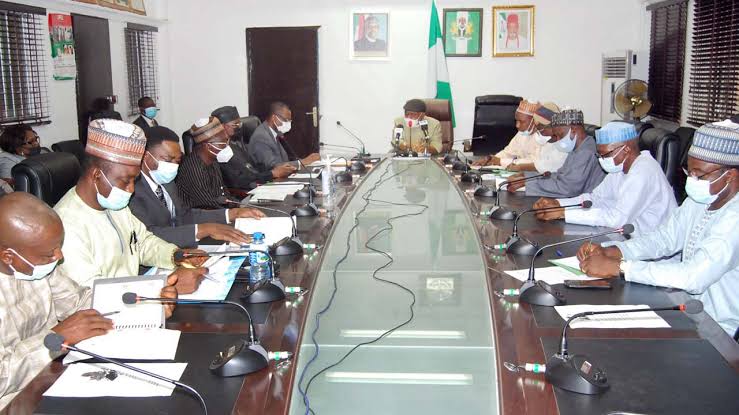
The national president of the Academic Staff Union of Universities (ASUU), Professor Emmanuel Osodeke, expressed concern over how the Federal Government of Nigeria is handling the demands of the universities unseriously. Together with other union leaders, he expressed their dismay at a press conference in Abuja on November 15, 2021.

The Academic Staff Union of Universities (ASUU) issued a three-week ultimatum to the Federal Government to address all issues as agreed in the December 2020 Agreement.

ASUU President, Professor Emmanuel Osodeke, stated this on Monday while addressing reporters in Abuja.

The president warned that the union might be compelled to embark on another nationwide strike should the government fail to implement the Memorandum of Action signed with ASUU before suspending the last industrial action.

According to the ASUU President, all the issues, including unpaid academic earned allowances and the universities revitalisation fund, have not been addressed almost one year after an agreement was reached.

The ultimatum is part of the resolutions reached at the National Executive Council (NEC) meeting of ASUU held in the nation’s capital.

It can be recalled that ASUU embarked on a nationwide strike in March 2020 following its disagreement with the government over the funding of the universities and the Integrated Payroll and Personnel Information System (IPPIS), among other issues. Accordingly, it had proposed the University Transparency and Accountability Solution (UTAS) to replace IPPIS. But in a bid to get the lecturers back to class, the Minister of Labour and Employment, Chris Ngige, convened a series of meetings with leaders of the union and relevant government officials.

Amid the strike that lasted several months and negotiations that ended in a deadlock, the government and ASUU later signed a Memorandum of Action in December 2020. This led to the suspension of the protracted industrial action that lasted nine months. However, not after the government offered a cumulative N65 billion to the lecturers to address earned academic allowances and revitalisation of universities.

On the IPPIS tussle, both parties agreed on the UTAS, while the government would pay the university lecturers’ salary arrears on a different platform.

ASUU had on several occasions warned that it would indeed go on strike if the federal government continued to break the promises and throw away all the agreements reached.

The fallacy behind free education in Kano

By Salisu Uba Kofar-Wambai

It might sound obnoxious, as bitter as gall, if I may say this free education program by the Kano state government may not see the light of the day. Often, politicians politicise education. The concept of free education has been with us for quite a long spell. Our education has always been free. The token amount collected from the students isn’t the actual school fees. Students only pay 700 Naira per term. Is this the school fees?

And hardly could you find where a student is deprived of attending classes because he fails to settle his payment.

In fact, the school heads face punishment if they send away a student or pupil who can’t pay his fees. The only way is to persuade the student to do the needful or grant him an exclusion considering his financial plight. The money raised is always spent in the school under the watch of the PTA, and auditors come from the education ministry to ensure the money collected isn’t embezzled and is used wisely and judiciously. Prudence is always the watchword.

The school heads usually run into trouble if they’re found wanting in the area of class furniture problems, paucity of teaching aids, unrepaired broken windows and doors, non-provision of markers and chalks and what-have-you.

Now, the government has directed the schools’ authorities to stop collecting such peanuts to maintain, sustain and administer the schools in the name of free education and claimed to be giving out money to the schools as upkeep to take care of them.

The bone of contention here is that: could the government continue to provide this fund? In case of delay or non-payment by the concerned authorities, what will happen to the schools? It will be very hard if they can continue supporting the schools.

This was a similar scenario under Engr. Rabiu Musa Kwankwaso administration. He stopped the tertiary institutions and universities from collecting fees in the name of “free education” and couldn’t provide enough funds to run the schools.

I am not hoping and praying to have problems with the program, but at least we shall embark on something feasible. Unfortunately, the politicians are only trying to be popular with the program, to impress voters, to the detriment of the system.

Many outside the system may not get me right. And our society will see me as someone who has no sympathy or don’t like to see the children of the poor getting education, NO! It isn’t. Rather am doing this for the betterment of their education.

National Conference on Reading: Bayero University offers Advanced Diploma in Reading

By Muhammad Sulaiman Abdullahi

It has been widely confirmed and unanimously agreed by academics and other educational stakeholders that the culture of reading is fast dying across the globe, especially in Nigeria. This may be the reason why Bayero University, Kano, in collaboration and support of Florida State University, USA, established “The Nigeria Centre for Reading Research and Development” at Bayero University, Kano.

The Centre’s main aim is to encourage, support and upgrade the nature of reading and revive the reading culture, which, according to experts, is the only way and key to development of any nation.

The Director of the Centre, Professor Talatu Musa Garba, disclosed this development today during the opening ceremony of the 3rd National Conference on Children’s Book and the Teaching of Early Grade Reading in Nigeria.

Garba added that “It is my pleasure to announce that the Centre is now focused to develop various courses, in collaboration with the Department of Education, Bayero University, Kano, following the expiration of its collaboration with Florida State University earlier this year.

The Postgraduate Diploma in the Teaching of Reading approved by the university and advertised on the BUK official website has already commenced this academic year, which opened last week, on 1st November, 2021. The Centre has also concluded arrangements to offer the Certificate in the Teaching of Reading beginning in July 2022″.

BUK Vice-Chancellor, Professor Sagir Adamu Abbas, revealed that the Nigeria Centre for Reading, Research and Development is now entirely under Bayero University, Kano. He further added that “We in the management pledge to support its operation fully. In this regard, I  am pleased to inform the conference that the construction of the permanent building for the Centre has reached an advanced stage, as the physical structure is currently being furnished and equipped, accordingly. What remains is the landscaping, and the university is making provision for that before the end of the year.

The conference is still ongoing, and it will dwell and deliberate on “Children’s books as tools for the effective teaching of reading skills in the early grade in Nigeria”.

NECO releases 2021 SSCE results

By Muhammad Sabiu

The results of the 2021 Senior Secondary Certificate Examination conducted in May by the National Examination Council (NECO) has been released on Friday.

Professor Ibrahim Wushishi, NECO Registrar, made the disclosure to journalists in Minna, where the examination body’s headquarters is based.

The Registrar first apologised for the delay in releasing the results, adding that 878,925 candidates got five credits and above, including Mathematics and English language, representing 71.61 per cent of the candidates.

According to a report by Channels TV, Mr Wushishi further stated that 23,003 candidates were enmeshed in “examination malpractices indicating a decrease of more than 13,000 compared to last year.”

Also, exam malpractice has negatively affected two centres in Katsina and three others, each in Kastina, Bayelsa and Bauchi, which led to the “de-recognition” of the centres.

FG approves N30 billion for polytechnics and colleges of education

By Hussaina Sufyan Ahmed

The Federal Government of Nigeria has approved the for Polytechnics and Colleges of Education the sum of 30 billion naira through the Ministry of Education, from the head Mallam Adamu Adamu, at a round table organized by ASUP in Abuja this afternoon.

The Minister was ably represented by the Executive Secretary, National Board of Tertiary Education, NBTE, Mr Idris Bugaje. The round table theme is “Repositioning Nigeria’s Polytechnics for National Relevance and Global Competitiveness.”

Bugaje said the allocated fund is meant to alleviate the challenges facing Polytechnics and Colleges of Education in the country.

He read: “I am glad to report that as part of the realization of the pivotal role of Polytechnics to the advancement of Nigeria, Mr President has approved the sum of 30 billion Naira to ameliorate the challenges facing Polytechnics and Colleges of Education in Nigeria.

“The Ministry is working hard to ensure the release of this amount to the respective institutions.”

He told unions in tertiary institutions to focus more on capacity building through skill development, revered to be the core mandate than mere certification.

In his welcome address, President of ASUP, Comrade Anderson Ezeibe, advised the Federal Government to discontinue indiscriminate proliferation of Polytechnics and focus on funding and development of the existing ones.

The ASUP President noted with dismay that Polytechnics are fast becoming mere constituency projects established to satisfy political convenience rather than for educational development and the growth of the nation.

Ezeibe lamented the devaluation and discrimination of polytechnic graduates, which he blamed on ignorance and poor funding for the institutions that have resulted in an infrastructural gap, making Polytechnics less attractive to students.

He said: “We do not agree with the continued establishment of new Polytechnics on the largely unsubstantiated premise of providing greater access to tertiary education for young Nigerians as the existing ones remain unattractive to young Nigerians.

“Our Polytechnics are fast becoming mere constituency projects established to satisfy political convenience.

Our Polytechnics are currently facing an identity crisis as we are not convinced that sectorial mandates as envisioned in the National Policy on Education are being met.

“Our products are underappreciated, discriminated against and traumatized by the prospects of an uncertain future after their training.

“Our members (teaching staff in the sector) are not motivated as there is little of self-actualization in their chosen careers.

“This is adversely affecting productivity and leading to consistent migration of qualified manpower away from the sector.

The Polytechnics are nowhere close to preferred destinations for Nigerian students seeking tertiary education as the sector suffers from deep-seated discrimination in different facets mainly driven by class tendencies.

“The nation has equally been reaping bountifully from the tale of woes in the sector as shown by different economic indices which constitute an embarrassment to a nation with so much promise.

“Funding is abysmally poor, leaving widening infrastructural gaps; legal and policy frameworks are insufficient leading to weak levels of supervision and regulation.”

“Curriculum review is Irregular, therefore leaving the sector with obsolete curricula which are out of sync with the dynamic needs of industries and the society.”

“Indeed, the current unemployment figures in the country tell the entire story of a sector with diminishing impact to the nation’s economy.”

Of Professors in the Ivory Tower: Inner Rumblings

By A. A. Bukar

Let me preface this with the caveat and confession that part of the reason I recently slow down hobnobbing with professors is my increasing abhorrence of this culture of excessive bootlicking and kowtowing that is creeping into academia and eroding the ideals of independent thought, spirit of free inquiry and detachment that hitherto characterise intellectual discourse. The radical critique of issues and events for the betterment of humanity and irradiating the society is slowly taking a wing, supplanted with overt politicisation of minor issues (and even non-issues). Today, young academics, like myself, are becoming increasingly afraid to express even simple admiration of who they consider as the IDEAL TYPE among their teachers and mentors in academia because of “interpretations”. For this, you can even be reported to the enemy of such a scholar to possibly victimise you “sabida ai yaron wane ne! Ku kyale shi, ai zai zo defence, ai za’ a kawo papers dinsa for assessment”. And on and on. Such pettiness and vendetta. Hence, many – out there – see  Nigerian academics as the worst enemies of themselves and are happy with how FG is dealing with them.

Little wonder whether this culture is obtainable in other parts of the world. Departments are compartmentalised into cliques and camps a la political parties in the larger society. Professors are becoming like emirs fortified by sycophants, making them unnecessarily snobbish and covetous of flattery. PhDs are deliberately delayed or tactically killed because a candidate does not BELONG. A blind eye is turned to obvious wrongs, mediocrity, and crass injustice because “our oga” is INVOLVED. Entitlements and privileges (especially of the younger ones) are stampeded to settle SCORES.

A friend sent me a Jumaat goodwill message, a quotation from Rumi which reads: “Listen to silence; it has so much to say”. How many PhD/MSc candidates do you know writhing in silent pain of frustration? Prof sirs and mas: listen to our silences and that shy smile that says “ba komai sir”. When I was an undergrad, I once overheard my teacher, Dr Gausu, talking about one of his colleagues in Economics, Business or Accounting (I can’t remember exactly) who’d become agoraphobic and almost schizophrenic because of PhD manhandling from a senior colleague. Of course, then I was too inexperienced to understand the heck that was about. They sarcastically even refer to the initials as “Pull Him Down”.

Whether this augurs well for generation, production and dissemination of ideas and knowledge typical of the Ivory Tower, I leave it to your imagination.

For these and more, many ideal intellectuals are on the lookout for escape windows from the suffocating atmosphere of poverty and frustrations taking over academia like a thick cloud on the horizon. Many are “diversifying”, hence diverting their attention from the absolute commitment ideal scholarship demands. Others are increasingly becoming nonchalant – that I-don’t-care attitude of: “if the department or unit fuels the generator set, fine, otherwise I teach the SPSS or Word Processing on the whiteboard”. Elsewhere blackboard. So Nigerian hospitals are not alone; medical practitioners are just a cohort.

Despite all odds, I love being at the University. It is a place where I feel I naturally belong. And our campuses are still dotted with the IDEAL TYPE (just as there are IDLE TYPES who do not “profess” any knowledge) that constantly bring back to one’s memory my favourite: Edward Said. Critically engaging. Highly unassuming – like Mazrui. Passionate about nourishing the mind; concerned with the public good and Humanity as a whole. People who will unconsciously make you feel you are far from arriving without making you feel embarrassed. I have recently met and enormously admire one such intellectual is Professor Abubakar Mu’azu of the Mass Communication department, UNIMAID.

Interpret this one too the way you like. Report me anywhere. Land me into trouble. I no longer care. But Allah knows whether this is coming from the bottom of my heart or elsewhere. Such as an attempt to curry favour.

After all, what use is admiring people if you cannot tell them or others you do? Or should we hold on till they are no more? Wouldn’t that serve as a token of encouragement to maintain the course and tempo against all odds?

I have earmarked a few other similar intellectuals I will write about in due course on this space. I will unburden my heart about people I feel positively towards. Yes, I will specify those who fit my definition of the ideal intellectual. Part of this is, of course, honesty. Wallahi, no matter how engaging you are, you are out of the equation once it comes to the light you are dubious and too self-centred. If you’re extorting money or sex from your vulnerable students, you cannot be my model. But again, I am not looking out for an angel.

Back to the subject, I have met with Prof Muazu only a few times. One was when he came as an external examiner to my thesis in April 2018 and some months earlier as an accreditation team member for the college I taught in Yobe state. The last, some weeks back. Each, he left me with nothing but admiration and deep respect.

When I phoned my referee and supervisor at undergrad, late Prof Maikaba, to congratulate him on his last promotion, he typically enquired about the progress of my thesis. I told him then, “I was done with viva yesterday and effecting corrections now”. Curiously, he returned with a finder about the examiner. When I replied that it was Mu’azu, he said: “kace an sha aiki”. Toh Bukar. PhD beckons. You can’t wait, especially for one in this business. He admonished me as usual; I giggled, thanked and said my goodbye.

I don’t know whether it’s appropriate to reveal this too. Some hours before the viva voce, my supervisor, Dr Binta Kasim Mohammed, called alerting me “to prepare very well. Because the external examiner brought is extremely thorough and critical”. Sir, you are appreciated and held in high esteem not only by nonentities like us but also by your colleagues. But my assessment of you from afar is that: these things matter little to you (if at all) – out of humility.

From both you and the late Maikaba, I graduated with distinction. But each time we met, you left me feeling inadequate, making me wonder ‘when will I arrive?’. Parts of this are the books you recommend, which I never read, or know not exist. But somewhere in WHERE I STAND, Sheikh Gumi has opined along this line that knowledge is such enigmatic that the more you learn, the more you realise that you know very little. I wonder whether you feel something similar sometimes. Yes, despite the accomplishments. In just your last visit, you recommended, as the situation warranted, many texts. Among these are Peter Winch’s THE IDEA OF A SOCIAL SCIENCE AND ITS RELATION WITH PHILOSOPHY. Then the POSITIVIST DISPUTE IN GERMAN SOCIOLOGY. The latter is such a rare collection – in fact, my first time to meet Adorno, Habermas and Karl Popper in one place. Both books remind me of similar stuff I read from the staple of Claude Ake and Yusuf Bala Usman of blessed memory.

In this vein of characteristic modesty, you specifically asked me to read Ben Bagdikian’s MEDIA MONOPOLY after the viva voce in order to steel my argument on the influence of profit drive in media content production. A copy of my thesis still carries your adorable handwriting suggesting the title and other points. But little wonder you never drew my attention to the fact that you have written extensively on media in peacebuilding until my curiosity took me to the internet and a bookshop where I stumbled CONFLICT MANAGEMENT AND THE MEDIA IN NIGERIA  – a book coedited by you and Gani Yoroms. This was despite your awareness that my thesis is squarely about this matter of controversy. Quite recessive indeed.

With the crisis engulfing Nigerian Universities (the worst I have ever seen) and academics running helter-skelter for greener pasture, I equally wonder what becomes of the academia after the few of you that remain out of passion pass on to something else or the inevitable great beyond. And especially if this maddening ill-treatment continues from the federal government. Allah Ya kiyaye, amin.


Bukar teaches Mass Communication & Journalism at Ahmadu Bello University, Zaria.

FCE Yola shuts as students protest over water, electricity

By Adamu Ibraheem Jimeta

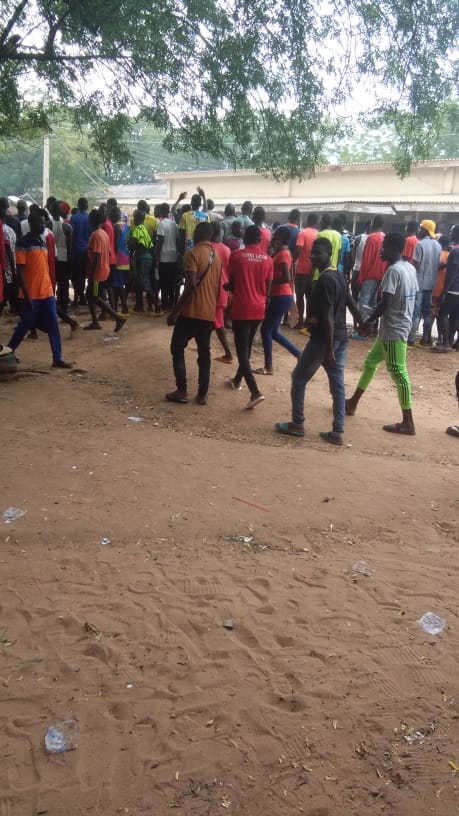
There was pandemonium at the main entrance of the Federal College of Education, Yola, on Tuesday,  October 26, 2021, when students blocked the college entrance protesting a two-week total blackout of electricity and water supplies in the college.

The protest, which started as early as 7 am, grounded academic activities as students and lecturers were denied access to the college.

According to the protesters, they have opted for the protest as their last resort as all pleas to the management to intervene in the incessant problems of water and electricity supplies fall on deaf ears.

Speaking to our correspondent, a level 300 Education/English student who prefers anonymity told The Daily Reality that for over a week, there was no water nor electricity in the college. He said, “Living in the hostel with no water and light, lecture theatre with no electricity supplies for over weeks have been excruciating.”

He said the Students’ Union Government (SUG) has not lived to the expectations and welfare of the students. He called on the management to take drastic measures that would bring these problems to an end.

Responding to the accusation by the students, the SUG President, Comrade Sulaiman Abdullahi, told our reporter that his administration has been running around over the problem. “We have had a meeting with the Acting Provost, and he has assured us that the management will fix the problem. Even yesterday, I spoke with the provost on phone, and he said he has arranged a tanker that will start supplying the college effective from today, Tuesday. Therefore is not true that we have not done anything about it,” said the SUG president.

All efforts to speak with the Registrar of the college, Malam Gidado Ahmed, proved abortive during filing this report. He earlier told The Daily Reality he was in a meeting and promised to get back to us but, he didn’t reply to the messages and calls put to him by the reporter before going to press.

It took the intervention of a joint task force of soldiers, mobile police and men of NSCDC when the protest escalated to burning tires within the school premises. The JTF fired gunshots in the air and dispersed the protesters.

In a related development, the management of the Federal College of Education, Yola, has announced the closure of the college. In a circular signed by the Registrar, Ahmed, it was stated that after its emergency meeting on October 26, 2021, the management has reviewed the situation on the ground and resolved to close the college immediately.

Students are given up to 10 am to vacate the campus, the circular added.

Attention Yobe State Scholarship Board (YSSB)

By Khalid Yusuf Tebo

I am an indigene of Yobe state. I was among the beneficiaries of Yobe state scholarship bursaries from 2014 to 2020. I was paid for three sessions throughout my school days at the university. It is a government tradition in my state to pay students’ tuition fees since from the time of late Mamman Bello Ali (MAL), a former governor who pioneered the programmme. Unfortunately, the board is unable to pay the students bursaries every year and, on time.

Apparently, this scholarship is a motivation towards helping the students acquire their education across different tertiary institutions of learning in Nigeria and abroad. In addition, this monetary reward reduces the burden on parents who cannot support their children to earn an education in the state, especially the poor.

Nevertheless, YSSB had recently published a reminder on their Facebook page about the 2020/2021 session payment. As regards, I hope the board is aware of the hardship in the country and the situation in which students of the state are facing daily at schools. Of course, this is not to update the general public about the issue of payment only, as the board used to do in our days without a positive outcome. Obviously, it is about paying the students bursaries on time every year.

I can remember receiving my last payment in 2020 on a table instead of via my bank account as exercised by the board. I suffered a lot before I was paid my 2018/2019 bursary. I went to the board three times and paid transport for every trip from Maiduguri where I schooled and later from Potiskum to Damaturu. Some of my friends were studying in neighbouring states; they too faced the same problem.

According to the board, a technical problem was encountered, and the beneficiaries provided incorrect details and account numbers. While to my knowledge, I provided the correct details and most of the students too, I believe. But, as an economist, I don’t play with anything related to money, especially scholarship. So, last year, it took the board more than a year to pay a few students their bursaries.

As usual, the tradition in previous administrations is not like that, even though they skipped payment of bursaries than regularly. But, in Buni’s administration, students face a severe problem in their education than at any other time. Yet, Yobe is the only state that declared an emergency on education and is still among the states with the highest number of out-of-school children.

Therefore, I am calling the attention of YSSB to avoid such problems encountered in the past. An unconfirmed source said the problem was due to corruption. Anyway, one of the only sources of happiness for students is scholarship in Yobe state. Unfortunately, the government cannot employ graduates in civil service and areas of business. Lastly, I am appealing to the board to pay the students every year on time and encourage the students to be the ambassadors of the state in all tertiary institutions of learning.

May Yobe and YSSB succeed!

Khalid Yusuf Tebo is an economist and activist. He can be contacted via khaleedyusuftebo5@gmail.com.

Tertiary institutions students to be supported as CBN donates N500 grant


By Uzair Adam Imam

The Central Bank of Nigeria (CBN) has earmarked N500 million grant to the universities and polytechnics in Nigeria.

CBN said that the effort is to help the teeming youths in tertiary institutions to promote entrepreneurship and also reduce unemployment.

In the report titled: “Guidelines for the implementation of tertiary institutions entrepreneurship scheme”, CBN made this known on Wednesday

“Five top Nigerian polytechnics and universities with the best entrepreneurial pitches/ideas shall be awarded as follows: first place – N150m; second place – N120m; third place – N100m; fourth place – N80m; and fifth place – N50m,” it said.

According to the guideline, the aim of the scheme is to promote access to finance by undergraduates and graduates of universities and polytechnics in Nigeria.

Students will be help with innovative Entrepreneurial and technological ideas to enable them build their future.

The guidline added that Individuals will be entitled to a loan limit of N5.0 million to be paid within the maximum period of 5 years at an interest rate of 5 percent for each year.