Education

Rethinking my legacy: How our local tradition wowed Western intellectuals at an Ivy League University

By Umar Sheikh Tahir (Bauchi)

Columbia is an Ivy League University, one of the eight most prestigious institutions in the United States of America. Ph.D. students at this university undergo two years of coursework. One of the classes I took was Islam, Knowledge and Forms, which a visiting professor from Germany taught. Part of the course is a library visit to the exhibitions section under the project of Islamic Sciences, Science, Nature, and Beauty: Harmony and Cosmological Perspectives in Islamic Science (2022) at Butler Library, the largest library of Columbia University with millions of resources. 

The exhibition contained objects, images, rare manuscripts, and other learning materials. Two materials, among others, became the most astonishing factors in the exhibition: one of them is a rare copy of the Holy Quran, and the second is a locally handmade wooden tablet (Allo).   

The instructor asked everyone to talk about any material in the exhibition. Students gave their feedback on the experiences passionately; different things wowed everyone. When it came to my turn as someone who had known these items since childhood in my father’s private library, where we sneaked as children, which housed similar treasures. To us, these are the most useful items in his library as we do not read books; we only view images and magazines, such things that are not viewed as essential to the readers. Then, I shared my familiarity with these items, telling them I was exposed to most of the exhibited materials from my upbringing in Northern Nigeria, including “rare manuscripts” of the Quran. 

The Quran displayed was a giant copy of the original Uthmanic Quran, denoted to the third Caliphate of the Muslim nations who reigned (644/23H–656/35H). It was so amazing to all of us. As for me, the Quran is the most frequently read book in my entire life, and to their surprise, I can read this copy fluently without diacritical marks. I highlighted that memorising the holy Quran, even without understanding Arabic, is common in Northern Nigeria.  Most of my fellows never knew that sometimes people memorise it at an early age. I did not shock them with that, as I am one of them. 

In the second incident, Professor Brinkley Messick invited me to speak in his class on Islamic Shariah Law as someone with experience with an Islamic Madrasa background and went to Azhar University in Egypt. The theme of the class is the Islamic madrasa. He is interested in the Islamic tradition, as evident from the cover of his book, “Calligraphic State.” 

Allo

The Professor brought Allo a wooden tablet to the class and circulated it to students. Everyone was looking at it with surprise. I named it to them as a personal tablet for inscription and memorisation of the holy Quran, and the students asked for more details. I said we write verses from the holy Quran for memorisation after repeating it several times; not everyone understands how that works, except those with Islamic background. However, when I told them when we wash the script, we drink it, everyone was left with open mouths, surprising our embodiment of the holy book, including the professor. They could not process as modernised individuals with high sensitivity to germs and bacteria. Again, as I told our class last semester, this is very common in Northern Nigeria. 

Coincidently, one of the attendees from a Saudi background added that people used some scripts for Talismite and protection from Djinn (Ruqyā in Arabic or Ruqiyya in Hausa) by reciting some verses in water. I told her this is true; we have that part in our culture too, but the biggest part is that we drink washed script for the embodiment and show respect for not letting a drop of that water on the ground as a sacred word. As kids, we were told that whatever verses we memorise from the holy Quran and drink will stay in our hearts for a long time.

In reference to that, American Professor of Islam in Africa Rudolph Ware published his book Walking Quran on the Madrasa system in West Africa. He referred to those Quranic students’ embodiment as the Walking Quran in relation to the narration of the Hadith reported in the books of Hadith such as Ṣaḥīḥ Muslim; Aisha was asked about Prophet Muhammad’s PBUH character, and she said he was a Walking Quran.  

Our cultural legacy, often undervalued by some of us in our region, gained recognition at Ivy League institutions. Those people appreciate a centuries-old Quranic educational tradition or Almajiri system and show their respect to our subregion. Even our way of drinking the washed script of the Quran mesmerised them. 

A professor dedicated his projects to studying a school system called Daara schools in Senegambia or the Tsangaya schools in Northern Nigeria, making it evident that our legacy is an astonishing point to those communities. Then, as indigenous Africans who were introduced to the colonial system of Education less than a century ago in Northern Nigeria, we should be more proud of our system by appreciating those communities who choose to preserve it, as they make our subregion a central point of high intellectual conversation around the world. 

We should not deny our legacy by stigmatising the Almajiri system of education. Instead, we should support it and create a way of modernising it to empower and preserve our centuries-old legacy.  Whoever shows kindness to the Quran and its reciters will receive people’s applauses in this life, including Western intellectuals, and God’s reward in the hereafter. Thanks to those state governments in Northern Nigeria who support and recognise this system of education.

Umar Sheikh Tahir is a PhD student at Columbia University, New York, USA. He can be reached via ust2102@columbia.edu.

Neo-liberalism and Cotonou degree alternative

By Dr Kabiru Danladi Lawanti

The whole Cotonou degree is criminal and all those involved need to be fished out and punished. Some people might see us as harsh or maybe insensitive for saying this. 

There are things we cannot say in public, but one needs not to be prophet of doom to predict that Nigeria cannot withstand this onslaught and will eventually crash. 

Our desperate quest for certification through whatever means led us to this situation. Parents are desperate to have their kids in the university, some even underage (we saw 15, 16 and 17 year olds being pushed to universities), whose mental capacity is too elementary to grasp or cope with challenges of university education.

The crises in higher education and the adoption of neo-liberal policies that have no place in a developing country like ours also contributed to this confusion. Consequences of commodification of knowledge is enormous in a country with no strong institutions to checkmate excesses and greed of capitalists. The results is the proliferation of degree mills all over.

Adoption of neo-liberal policies means cutting funding for public services like education, health and sanitation. Nigerian public universities suffer from these policies. Funding was cut, citing many reasons. The results is restrictions in admissions. When you have many applying to enter university and the slots are few, universities have to admit based on quota. Therefore, few can be admitted.

Parents, in their desperate efforts to get their children into universities, started sending their kids to some African countries for bachelor’s degrees – Uganda, Benin Togo, Ghana, Sudan, Niger Republic, etc. 

Another reason is the dichotomy between degree and HND. Many people affected by stagnation in their places of work because of HND opted for a way to have a degree that can help them get promoted. Many went for the Cotonou degree. Since it is acceptable by MDAs or they made it acceptable, most of them started trooping to these mushroom universities to obtain these degrees to get promoted.

Then we have people who can’t cope with rigorous nature of our public university system. I know a lot who not only failed exams, but are withdrawn from diploma programmes, but appear after 6 months with a degree from these degre milling centres. Others could not pass UTME therefore unqualified to enter public universities. Cotonou degree provide an alternative.

The last, in my opinion, are those running from ASUU strike. Many parents justify purchasing the Cotonou degree because of the unending industrial disputes in the public universities.

I don’t want to talk about the “motor park gang” led by former minister of education Adamu Adamu and his National Universities Commission (NUC) executive secretary, who bastardised the university system for only God knows why. They have killed what remained of our public university system.

Lastly, some of our private universities are not any different from the “Cotonou universities”.

President Bola Tinubu needs to do a lot more to rescue the situation. I like how the Minister of Education, Prof. Tahir Mamman, handles the situation. But sincerely, the students of these dubious universities, their agents, officials from Federal Ministry of Education, NUC and the other places need to be rounded up, arrested and punished according to our laws.

Kabiru Danladi Lawanti, PhD, wrote from the Department of Mass Communication, ABU Zaria, via kblondon2003@yahoo.com.

‘Mu Farka Youth Development Initiative’ lights up Kano as over 240 children embrace gift of education

 By Uzair Adam Imam 

“Mu Farka Youth Development Initiative,” in collaboration with the Ministry of Women Affairs and Social Development and UNICEF, orchestrated an event that brought unparalleled joy to the faces of over two hundred children in Kano.  

The grand enrollment ceremony took place on Wednesday at the Kano State Hisbah Board, Kano Municipal, unfolding a new chapter of education and sparking excitement and hope among the children and their families. 

Nura Ahmad Muhammad, the Executive Director of Mu Farka Youth Development Initiative, radiated enthusiasm as he spoke about the collaborative effort with the Ministry of Women Affairs and Social Development and UNICEF.  

The foundation’s achievement involved enrolling more than 240 children, a significant number of whom were Almajiri and girls who had discontinued their studies for various reasons. 

As a beacon of educational empowerment, Mu Farka did not merely open the doors to classrooms but generously provided the children with essential reading materials, school bags, uniforms, and books.  

The foundation has placed education at the forefront of its initiatives.

This includes specialised programmes designed to teach the girl child and Almajiri various businesses, all while ensuring their protection from any form of abuse.  

Moreover, the foundation takes on the responsibility of safeguarding the health and well-being of these budding scholars. 

Nura Ahmad Muhammad urged the government to lend its support to such noble initiatives, emphasising the significant role communities play in nurturing the moral upbringing of children. 

The collaborative effort of Mu Farka, the Ministry of Women Affairs, and UNICEF showcased the potential for positive change when organisations and communities unite for a common cause. 

The jubilant voices of the children echoed stories of newfound joy and opportunity 

Fatima Tijjani from Dukawa, overwhelmed with happiness, expressed gratitude for being enrolled in school and fervently prayed for continued assistance from Allah.

She also appealed to the government to promote and support similar programmes. 

Usman Muhammad, another excited beneficiary, pledged to do his best to make the most of the educational opportunity presented to him.  

Zainab Sa`ad Muhammad, who had to pause her education due to financial constraints, now revels in the happiness of returning to the classroom. 

Students have their choices – Hajiya Jamila 

One notable aspect of Mu Farka’s initiative was affording the children the liberty to choose the school they wished to attend.  

Hajiya Jamila Garba Umar, expressing her excitement, affirmed the importance of considering proximity to prevent future challenges associated with transportation. 

Sheikh Nasir Abdullahi, the Imam of the Al-Hamsad Juma`a Mosque, applauded the event and called upon the government and affluent individuals in the community to join hands in supporting such impactful programs. 

He stressed the crucial role parents play in ensuring that the children enrolled in school continue their educational journey.

List of 18 foreign universities FG banned over allegations of issuing fake degrees

By Abdurrahman Muhammad

Following the report of how the Daily Nigerian journalist obtained a university degree from Cotonou in six weeks and participated in the NYSC scheme, the Federal Government of Nigeria, through the Ministry of Education, had on Tuesday, January 2, 2024, suspended the evaluation and accreditation of degree certificates from Togo and Benin Republic universities.

In a statement on its website, the National University Commission labelled the blacklisted foreign universities as ‘degree mills.’

The statement reads in part, “The under-listed “degree mills” have not been licensed by the Federal Government and have therefore been closed down for violating the Education (National Minimum Standards, etc.) Act of the Federation of Nigeria, 2004.”

The affected institutions include five universities from the United States, three from the Republic of Benin, six from the United Kingdom, and three from Ghana.

Below is the list of the 18 foreign universities the Federal Government banned from operating within its borders.

1. University of Applied Sciences and Management, Port Novo, Republic of Benin or any of its other campuses in Nigeria.

2. Volta University College, Ho, Volta Region, Ghana or any of its other campuses in Nigeria.

3. The International University, Missouri, USA, Kano and Lagos Study Centres, or any of its campuses in Nigeria.

4. Collumbus University, UK, operating anywhere in Nigeria.

5. Tiu International University, UK, operating anywhere in Nigeria.

6. Pebbles University, UK, operating anywhere in Nigeria.

7. London External Studies UK operating anywhere in Nigeria.

8. Pilgrims University operating anywhere in Nigeria.

9. West African Christian University operating anywhere in Nigeria.

10. EC-Council University, USA, Ikeja Lagos Study Centre.

11. Concept College/Universities (London) Ilorin or any of its campuses in Nigeria.

12. Houdegbe North American University campuses in Nigeria.

13. Irish University Business School London, operating anywhere in Nigeria.

14. University of Education, Winneba Ghana, operating anywhere in Nigeria.

15. Cape Coast University, Ghana, operating anywhere in Nigeria.

16. African University Cooperative Development, Cotonou, Benin Republic, operating anywhere in Nigeria.

17. Pacific Western University, Denver, Colorado, Owerri Study Centre.

18. Evangel University of America and Chudick Management Academic, Lagos.

MURIC hails FG for suspending degrees from Benin, Togo

By Abdurrahman Muhammad

An Islamic human rights organisation, the Muslim Rights Concern (MURIC), has commended the Federal Government (FG) for suspending the accreditation of degrees obtained from the Republic of Benin and Togo. 

The ban on accreditation followed the discovery of irregular and fraudulent practices in the admission and course programs of some universities in the two countries.

MURIC’s commendation came through a statement issued by its Executive Director, Professor Ishaq Akintola, on Wednesday, 3rd January 2024. 

He said:

“A laudable move was made yesterday by the Federal Government (FG) when it suspended the accreditation of degrees from the Republic of Benin and Togo for their irregularities and fraudulent practices” (FG Suspends Accreditation Of Degree Certificates From Benin Republic, Togo – Channels TV).

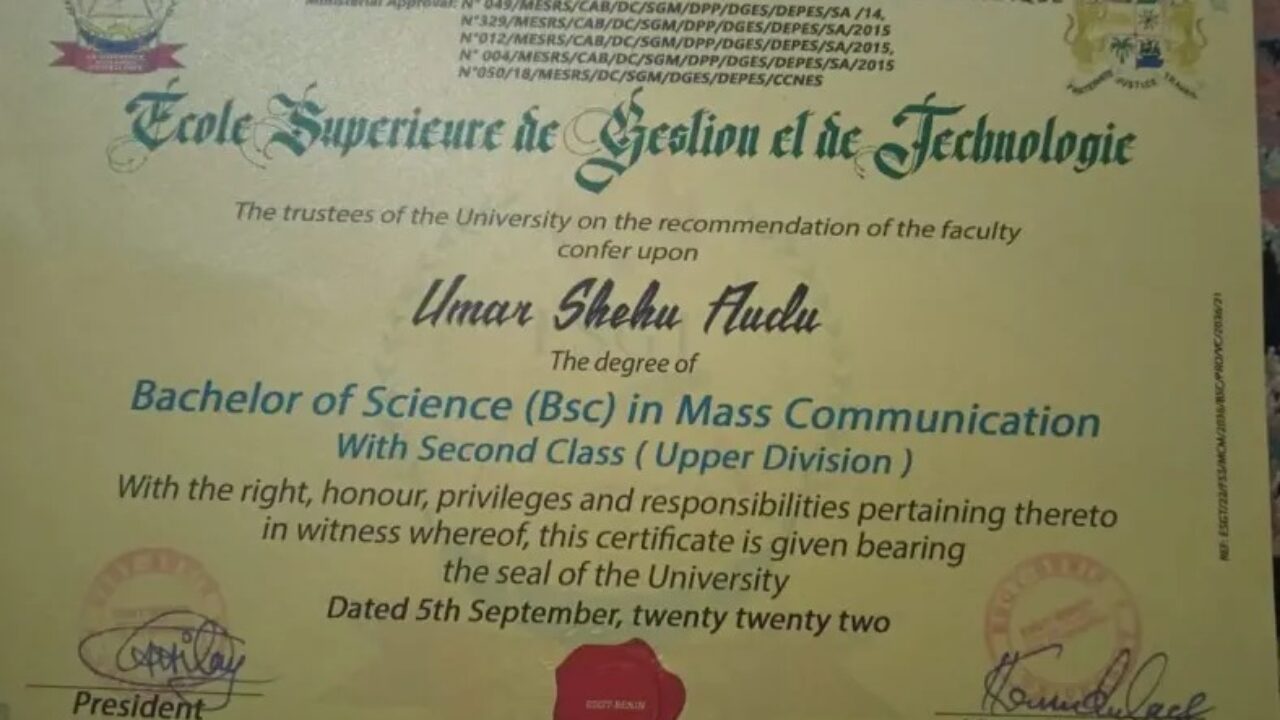
“It will be recalled that Umar Audu, an investigative journalist of Daily Nigeria newspaper, reported recently that he bagged a degree within six weeks of being admitted into one of such universities and also served as a corper in the National Youth Service Corps (NYSC) with the certificate obtained. The undercover journalist received both the transcript and certificate of the Ecole Superieure de Gestion et de Technologies (ESGT), Cotonou, Benin Republic, after six weeks only.

 It was this story that prompted FG to ban the accreditation of certificates obtained from universities in those countries (https://dailynigerian.com/undercover-how-daily-nigerian/). 

“MURIC lauds FG for banning those fraudulent certificates. The holders of such fake credentials pose a grave danger to the lives of Nigerians and the quality of public service, too. 

“We charge the ministries of education at both federal and state levels to be wary of holders of such certificates. Those found to have been employed with them should be shown the way out. Furthermore, the security agencies should fish out those behind the fraudulent admissions within Nigeria. Those are agents of the fake tertiary institutions in faraway Benin and Togo. They should be made to face the full wrath of the law.

“We demand an investigation into circumstances surrounding the clearance letter issued by the Federal Ministry of Education, which confirmed that the university (ESGT) is on the ministry’s list of accredited institutions. It was this letter which enabled NYSC to accept 51 fake graduates to serve in the scheme.  On its own part, NYSC authorities must take necessary action on the 51 fake corpers from ESGT who are serving illegally. They must be flushed out. 

“We also advise gullible but innocent Nigerians who have obtained the certificates to quickly set the machinery in motion to correct the anomaly. They should upgrade themselves by seeking authentic university admission either within or outside the country.

“Education may be the key to technological breakthrough and the concomitant industrial progress, but half-baked education and fake certificates are deadly dynamites in the system which is capable of destroying everything that may have been achieved.

“Before we draw the curtain, we find the undercover journalist equally worthy of encomiums. He went underground to unearth this educational fraud. He put his life on the line for the sake of his country. Umar Audu is worthy of emulation by his colleagues in the Fourth Estate of the Realm.”

As bandits relocate to Taraba and the Plateau 

By Zayyad I. Muhammad

Recently, the media have been awash by the news of bandits’ attacks in Taraba and Plateau states. On November 24, 2023, it was reported that gunmen in their numbers attacked and killed 20 people in the Yangtu Development Area of the Ussa Local Government Area of Taraba State. In the early hours of Tuesday, December 19th, 2023, other gunmen attacked the Pupule community in Yoro Local Government Area of the same Taraba state, kidnapped Umaru Nyala, the chief of Yorro chiefdom, and also abducted 22 other people.

The Taraba State police command and other security operatives killed over 50 bandits terrorizing villages along the corridor of Bali Local Government Area on Tuesday, November 28th, 2023. On the other hand, on Wednesday, December 27, 2023, a group of bandits stormed the Gondon Maliki weekly market in Taraba State, kidnapped scores of people, and carted away food and wares using motorcycles.

The Sultan of Sokoto, Alhaji Sa’ad Abubakar III, while condemning the gruesome murder of over 100 people in the Plateau, said, “The bandits seem to be ahead of the government.”

To be fair to all the Nigerian security operatives, they’ve done an excellent job in the Northwest states of Zamfara, Kaduna and Katsina, in facing the menace of the bandits. These states have witnessed a visible improvement in security in areas being terrorized by the bandits, and the Abuja-Kaduna highway is secured while the Niger axis is a little bit silent.

It appears that the military onslaughts on the bandits and other terrorists have killed many of their leaders, and they have dispersed to the Northeast axis and some parts of the Plateau. Why did the bandits settle in these areas, especially the Northern parts of Taraba State – Yorro, Lau, Jalingo and Ardo Kola local government areas? Is it due to its topography, location or economy? Taraba State is among the poorest states in Nigeria but rich in agriculture and forestry. Probably the bandits found solace in Taraba due to its uniqueness in geography and agricultural activities. Furthermore, the Cameroonian mountains, which stretch almost to the entire Northern and Southern parts of Taraba, linking the state with the River Niger, will certainly provide a hiding place for criminals, bandits in particular.

The only way of this menace is for the state, federal and local communities to work together; collaboration is key to security management. For example, at its 8th and 9th meetings held in Maiduguri, the Borno State capital, on September 9th, 2023, and in Yola, the Adamawa State capital, on November 24th and 25th, 2023, the Northeast Governors’ Forum expressed its concern about the new dimension of the growing banditry in Bauchi, Gombe and Taraba states, and this may be as a result of the concerted efforts of the military on neutralizing the bandits from other parts of the country. The governors called on the federal government to intervene and promised to work with and support all security agencies.

Managing security in a vast country like Nigeria with inadequate modern technology for security management can be very difficult, and our security operatives cannot be everywhere and anywhere at the same time. So what is the solution?

The re-invigoration of the kinetic and non-kinetic security approaches by the Office of the National Security Adviser (ONSA) has resulted in many successes and breakthroughs; however, more intelligence gathering is needed; community engagement and direct communication with the bandits should be employed. In community engagement, the model being used by the Governor Ahmadu Umaru Fintiri-led Adamawa state government in tackling farmer-herder conflict should be adopted; the community should be made to feel part of the solution in security management, thus providing intelligence and also being a watchdog for security operatives without being endangered.

Secondly, the reported ongoing ‘soft approach’ should be sustained and, indirect communication with the bandits. Most of them now also use social media; thus, a kind of smooth operation should be launched by the ONSA and other relevant bodies to recruit people who speak the languages of bandits to send convincing messages to them on the ills, disadvantages and evils associated with their dangerous ‘trade’ while showing them the beauty and benefits being enjoyed by their ‘kind’ who adopt normal lives, go to school both western and religious, but still maintain their culture, beliefs and inherited legal trade.

Furthermore, radio and TV are also tools to reach the bandits, as satellite TV and solar power technology have now made it possible to watch or listen to the world, wherever one is – bandits, hiding in thick forests, use solar power and satellite technology to charge their phones, watch TV and listen to the radio. Above all, justice and fair play by those in power in providing the basics of life and alleviating poverty and ignorance away from these bandits will surely assist a lot in reforming them back to society.

Zayyad I. Muhammad writes from Abuja via zaymohd@yahoo.com.

BUK graduates give out almost N1 million, foodstuffs to deceased colleagues’ families 

By Sabiu Abdullahi

The graduates of the Faculty of Arts and Islamic Studies (FAIS) class of 2004 at Bayero University Kano (BUK) gathered at their 12th Annual General Meeting in Kano on Sunday to extend a helping hand to the families of 18 deceased classmates. 

Chairing the reunion, Sulaiman Muhammad Adamu noted that the event wasn’t merely about socialising but a platform to reminisce about the past, savour the present, and collectively envision the future while fortifying the bonds that tie them together. 

Daily Trust quoted Adamu to have said, “We are here to enhance unity among the members of this forum and support the families of our deceased colleagues who have passed away. We are supporting them in order to bring them in for more support.”

Disclosing that the support includes food items and a cash token amounting to N50,000 for each family, Adamu assured that the forum would continue to explore additional ways to assist the bereaved families. 

The beneficiaries expressed gratitude for the thoughtful gesture, acknowledging the significance of being remembered and included in the activities of their former classmates. 

This act of solidarity not only reflects the compassionate spirit of the FAIS class of 2004 but also serves as a testament to the enduring bonds forged during their university years.

The Three Musketeers and the Last of the Mohicans

By Prof. Abdalla Uba Adamu

It is not every day that a series of coincidental events converge. Like the passage of Haley’s Comet, these events happen only once in one’s lifetime. I am eternally grateful to Allah (SWT) for enabling me to witness one of these coincidental events. 

While still in active service in the university, where I have been for the last 43 years, I feel fulfilled that three of my students who became my colleagues and friends in the Department of Education have now become Vice-Chancellors in the same period within three years of each other. These are Prof. Sagir Adamu Abbas (VC Bayero University Kano, 2020), Prof. Abdulrashid Garba (VC, Khalifa Isyaku Rabi’u University Kano, 2023) and the most recent, Prof. Muhammad Ibrahim Yakasai (VC Sule Lamido University, Kafin Hausa, Jigawa State, 2023). 

During their career development, I nicknamed them “The Three Musketeers” because of their closeness to each other, coupled with the almost military approach they adopted to their career. They started their doctoral studies at the same time, finished at the same time, rose and became professors at the same time! Each was highly focused with a target in mind. Each has proven his mettle scholastically – with each spending extended periods as a Visiting Professor in foreign universities. The research area of each of them was truly a contribution to knowledge in the discipline. 

The term I chose to describe them is based on characters in a novel by Alexandre Dumas in 1844 called “The Three Musketeers”, which describes the adventures of three-foot soldiers who were close pals. I consider myself part of them because they are individually my friends. And these three Vice-Chancellors are really close, not just as professional colleagues but their families are also close. 

Of course, besides myself, they had other tutors in the Faculty of Education (Bayero University Kano). Still, I am the only one remaining out of all those who tutored them since all the others have retired. I am, therefore, the Last of the Mohicans (another literary reference, this time to James F. Cooper, 1826) and had the unique opportunity of seeing his career convergence in December 2023 when Prof. Muhammad Ibrahim Yakasai was appointed the Vice-Chancellor of the Sule Lamido University, Kafin Hausa, Jigawa State. 

It is a rare opportunity to see a celebration of such success, humility and friendship in each of them. Allah Ya taya su riƙo, amin.

NYSC: A case of poor data management

Ishaka Mohammed

In a recent report by DAILY NIGERIAN, a reporter called Umar Audu worked under cover and obtained a degree certificate from Cotonou in Benin Republic within six weeks instead of four years, and the National Youth Service Corps (NYSC) mobilised him for the mandatory national service. 

Although the report contains a lot of disturbing revelations, only one thing surprises me. The said Umar Audu is a genuine graduate in mass communication who participated in the NYSC scheme from 2018 to 2019. Yet, the agency mobilised him again in 2023 and captured his fingerprints without catching him for multiple registrations. It’s scary to realise such poor data management in a scheme which, since its creation, has been headed mostly by high-ranking military officers.

Concerned Nigerians have discussed the benefits of data harmonisation and the effects of its neglect. One of the numerous consequences of scattered data in Nigeria is the presence of people receiving multiple salaries from government ministries, agencies or departments. This is widespread in the same country where millions of citizens, regardless of their qualifications, battle with unemployment, hence suffering from poverty and hunger. With a standard database management system, the suffering of Nigerians can be reduced significantly. 

I sometimes wish that Nigeria would be a country with mandatory registration of children at birth. I dream of a country where every birth certificate would contain the bearer’s national identification number (NIN), which would be the chief of the eligibility criteria for free or affordable basic and secondary education, SIM registration, admission to tertiary institutions, employment, visa or passport application, etc.

I imagine a nation with a central database management system which makes everybody’s identification number and fingerprints verifiable. My ideal country is where every government ministry, agency or department can verify anyone’s date of birth, level of education, employment history, etc., using the person’s fingerprints. With all these in place, it would be impossible for one to simply outsmart a federal government agency just like Umar Audu did.

By the way, I commend everyone involved in that investigation. Stories of illegal Cotonou degrees can no longer be called baseless rumours. I’ve heard of similar racketeering in Kogi State but have yet to obtain any tangible proof.

Does internet help in medical treatment?

By Aliyu Nuhu

I saw a post by a friend advising people not to check their symptoms on internet and should go to hospitals for all their complaints. He was partially correct, but wrong in underestimating the power and importance of internet-based knowledge.

Medicine recognizes home treatment for non emergency medical conditions. But there is a caveat that you should consult a doctor if symptoms persist or get worse.

Always remember that doctors themselves know a lot about their speciality, but they also know little in a vast ocean of knowledge in other fields of medicine. You can know better than them if you choose to read.

My son was given about fifteen medications to take after heart surgery. But because I have knowledge of the disease and drug options,I was able to engage the doctor and at the end the drugs were reduced to four. Take note that I did not reduce the medication on my own. I only used my knowledge of pharmacy to engage the doctor and get him to reduce them himself. Some of the drugs were to be taken for few weeks and to be discontinued. Some were doing the same job and one of them has to go. Some were to alleviate symptoms, and if the child didn’t have the symptoms what was the need for them? Some were for pains from surgery and if the wound was healed there was no need for them. I once educated a doctor for asking a child to take calcium for bone strength, but he obviously didn’t know that the body would need vitamin D to successfully process calcium. Medicine is so vast that doctors must also read the internet to keep abreast.

There are treat-at-home symptoms you can learn from internet. I successfully treated myself for common illnesses through internet and over the counter medications. Why should I for instance go to hospital to treat nail fungus? You are your own best doctor. Arm yourself with knowledge before approaching your doctor.

There are symptoms that you know you need professional help. You know the red flags for potentially life threatening symptoms. When you can’t breathe you don’t need anyone to tell you to rush to get medical help at the hospital. When you have severe headache and other symptoms you never had before you should know that you need an immediate medical emergency.

I know when to see a doctor. The important thing for you is to also know when to see your own doctor. Even when meeting with my doctor, my vast knowledge of medicine prepares me for drug options and procedural choices. Internet makes you even choose the right doctor. If you have blood in your urine check for the possible causes. The regular GP may not detect if your condition is postate cancer. Oncologist knows what other tests to do and confirm if you have the condition. If you have shortness of breath, painful arm, etc, the cardiologist is the person that will know that you need angiogram to know if there is blockage in the circulatory system.

We have good doctors no doubt but always know that we have imposters, some that did not even read medicine in the university. Our hospitals are populated with half-baked professionals that only knowledge could save you from their deadly mistakes.

A whole teaching hospital treated a relative of mine for cerebral malaria when she actually had tuberculosis of the spine. My son was diagnosed with truncus ateriosis when in actual fact he had tetralogy of fallot. Without internet I would have been lost. However, a careful check gave me better understanding of the symptoms and led me to the right laboratory that identified the right disease. Internet led me to the right doctors abroad.

It will be suicidal just to rely on doctors without having elementary knowledge of your symptoms and treatment options. Drugs have side effects and also, interaction issues with other drugs or foods. If you don’t read you won’t know. Your doctor is human and has many patients and will not have time to educate you. Educate yourself. Knowledge is not only power, but in medicine it can be a life-saver.

Aliyu Nuhu writes from Abuja, Nigeria.