Admin

Ramadan: ABU Professor distributes 40 bags of rice to students

By Ahmed Deedate Zakaria

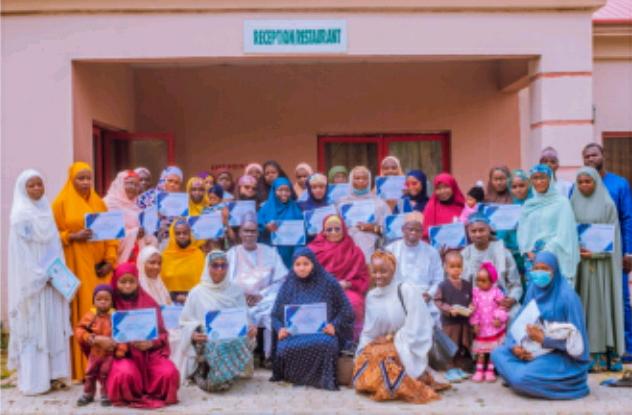
Madinan-educated Professor of Islamic Law, Prof. Arsalan Muhammad, has distributed 40 bags of foreign rice to his students. 

On Tuesday, Professor Arsalan, who is reputed for his generosity, donated 40 bags of rice to the 400-level students of the Faculty of Law, Ahmadu Bello University, Zaria. 

The beneficiaries organised themselves into groups to receive the professor’s rare act of kindness. 

The Daily Reality gathered that all interested students got the rice irrespective of their faith.

Professor Arsalan is known for his generosity and always reaches out to outstanding students with textbooks, handouts and even money.

Below is a brief biography of Professor Arsalan Muhammad:

Professor Muhammad Arsalan was born in 1968. He attended several local Quranic schools between 1973 to 1983. Arsalan started his formal education in 1983, got admission into Jama’atu College of Arabic Studies Zaria and graduated in 1987. He then proceeded to Bayero University Kano, where he obtained his Diploma between 1987-1990.

Muhammad Arsalan travelled to the Kingdom of Saudi Arabia and got admission into the Faculty of Sharia, Islamic University Madina and graduated in 1995 and returned to Nigeria immediately and served his NYSC in 1996. 

Muhammad Arsalan got admission for his LL.M. and appointment as a Graduate Assistant in the Faculty of Law, Ahmadu Bello University Zaria, in 1996 and graduated in 2000 and proceeded to his PhD in 2001 and graduated in 2009. 

Arsalan was promoted to the rank of Lecturer 2 upon his successful completion of his LL.M in 2000 and promoted to the rank of Lecturer 1 in 2005, and to the rank of Senior Lecturer in 2009, he was also promoted to the rank of Reader/Associate Professor in 2012 and finally promoted to the rank of Professor in 2015.

“All this hardship I am going through is for you to be educated”: My Mother’s words that always sound in my ears

By Hamza Basiru Tsoho

My name is Hamza. My father had two wives.  The family comprised ten children from two different mothers. I was the eldest and the sixth in my mother’s room and the family, respectively. We were three in my mother’s room. 

One fateful day, our father, Alhaji Basiru, and his friends travelled to Katsina. Unfortunately, they had a ghostly road accident returning to Funtua, our hometown. Only one person survived. I was not enrolled in a public primary school at that time, not to talk of my younger brothers. Our mother became our father and mother; for she had taken all the responsibilities of the father. 

Glory be to the Sustainer.  Since before our father gave up the ghost, she had embraced some petty trade at home like selling ruwan leda (water, then, usually,  packed in a medium-sized leather after being cooled by a Randa ‘earthy pot’), roasted groundnut and selling food later. Her local restaurant, which was home, had become renowned in the locality and the neighbour then, as there were fewer restauranteurs in the area. 

She used to sell a bag of rice in two or three days in the comfort of her home. Over time,  competition increased. Sequel to that, she boiled to cook only a few measures of rice. I hawked the food on a silver tray when things started getting out of hand. The hawking was usually done after I returned from morning school and sold before late afternoon prayer (Asr), after which I had the opportunity to go to Islamiyya.

Furthermore, she ensured we had all we wanted so that we had the equal privilege to be educated like other children whose parents are alive. I can never forget when I told her what someone told me about what seemed to them like we were chasing education. He said one of his friends said, “If he (referring to me) must further his education, we will see who will sponsor him.” 

I felt sad even after narrating the story to our mother. She said, “You see, all these hardships that I endure are for you to be educated. I wish I had money to sponsor your education to university; I can spend any amount in my belongings for you to be educated”. She continued, “Although I do not have enough money to sponsor your education, I believe you will get someone to help you, and that is what I always pray for.” Whenever I remember that, I feel motivated. 

Fortunately, I sat for my SSCE and came out with flying colours. It was in the school of our neighbour and brother who sponsored a duo of us, my half-brother and I, in his school. May Allah (SWT) reward him and add to his wealth, amin. 

I then applied to Ahmadu Bello University (ABU) Zaria with a JAMB score of 252 for MBBS in 2020. After some years of waiting, due to Covid-19 and the lingering strike, I sat for post-UTME and scored relatively well. However, afterwards, I did not secure admission. That may be due to too much competition.

Still, I did not give up. I knew MBBS was, most of the time, not a one-off thing. So the following year, I sat for another one, prayed, and worked harder. This time around was Federal University Dutse (FUD) and still the MBBS. After all, I got it in that school in early January this year (2023). 

I owe my success to my dearest mother. As Prof. Abdalla  Uba wrote, her likes are the “REAL woman of substance.” In a few years, I hope to become a feather in her cap ( to be a professional medical doctor ), become an important person to society and save the lives of many victims.

Hamza Basiru Tsoho wrote from Funtua via hamzafta212@gmail.com.

PSG, Man Utd, Chelsea scramble to sign Nigerian striker Osimhen

By Muhammadu Sabiu

Victor Osimhen, a striker for Napoli, is much sought after by top European football teams, including Paris Saint-Germain, Chelsea, and Manchester United.

An exclusive post by seasoned football journalist Fabrizio Romano on his officially verified Facebook page confirmed this.

He wrote, “Chelsea plan to sign another striker alongside Christopher Nkun. [Nigerian] Victor Osimhen could be an option – all the top clubs want him: Chelsea, Man Utd and PSG”.

Osimhen is excellent in his prime, having steered Napoli of Italy to the UEFA Champions League quarterfinals.

RAAF laid the foundation for the sake of Rigasa

By Pharm. Mustapha M Umar

Rigasa is a ward in Igabi local government in Kaduna State endowed with people. It has an estimated population of 3 million people. Politically, Rigasa as a ward provides the largest number of votes, even higher than some local governments, in the state. The people of Rigasa are zealous about any development, which gives birth to different community-based organisations working tirelessly to move the community forward. Rigasa Action and Awareness Forum (RAAF) is among those organisations regarded as the most collaborative and active pressure group in Rigasa.

Elections are won and lost due to voters’ choices. There are no voters without voter cards. Every person who got a new voter’s card or transferred from anywhere to the Rigasa ward did that through the RAAF effort.

After the conclusion of the initial phase of Continuous Voters Registration (CVR) on 21st September 2021, RAAF observed poor awareness in the Rigasa community. With the new polling units added to Rigasa from 23 to 153 and the big dream of having an LGA or constituency one day, we realised that we must come together and mobilise to ensure all new polling units have the required number of voters to avoid cancelling any polling unit.

To achieve this, RAAF constituted and inaugurated a CVR committee in October 2021.  This committee works day and night. It enters all the nooks and crannies in Rigasa. Single-handedly, RAAF’s CVR committee members registered and transferred more than 11000 voters, the highest in the nation as a ward.

The committee worked from October 2021 up to July 2022. To ensure the new and transferred voters collected their cards, RAAF extended the period of the committee work to help mobilise and ensure the Rigasa community had collected their cards. It was a successful job, and about 90% collected their cards.

The presidential election came with poor voters turning out, which was the same nationwide. For our efforts not to be in vain, a voter’s mobilisation committee was inaugurated to ensure people come out in mass during the governorship and state house of assembly election.

One of the issues observed as the cause of the poor voters turning out is the voters’ migration, which affected many people unaware of where to vote.

The committee members worked tirelessly by printing signs to help people locate their new polling units. Then, immediately, it stationed its members at every main polling unit to check and direct voters to where they are to vote using the INEC website. It was fantastic to work that significantly increased the number of votes cast.

Every single time, energy and resource spent by the members of the RAAF with little or no help from anyone are for the betterment of the community. We thank the Almighty that our effort has yielded a result.

The best ladies and gentlemen always volunteer to develop the Rigasa community, not for personal gain. We are game-changers.

The winner of the Igabi West State assembly seat, the speaker, Hon Yusuf Zailani, got almost half of his winning votes from the mighty Rigasa ward, which is 46.28% of the total votes. The remaining six wards combined gave him 53.72%. With this, Rigasa cannot be ignored for any reason.

Rigasa gave the governor-elect, Hon. Uba Sani, 32.06% of the total votes from Igabi LGA, the second LGA with the highest vote for his victory. No single ward in Kaduna gave the governor-elect this percentage of votes.

We have done our part of the bargain. The winners must do their part. Our community needs to get representatives in this government, structural and human development, and adequate government support equal to the effort we put together toward your victory.

Always remember those that help you when you are in need. There will be another time when you will need them again. What you did today to reward their efforts determines what will happen next time you need them. Four years is just around the corner. Time and history will always judge us.

His Excellency Governor Nasir El-Rufai needs all the gratitude from the winners of this election because we couldn’t have convinced people if he had not done all he did for Rigasa. May Allah bless and protect you, sir, as you hand over to the next governor, which we are hopeful will make Rigasa Community proud as they made them proud.

Pharm. Mustapha M Umar wrote from Rigasa Kaduna and can be contacted via mustaphau03@gmail.com.

Cristiano Ronaldo puts own private jet up for sale

By Muhammad Sabiu 

Former Real Madrid forward Cristiano Ronaldo, who currently plays for Saudi side Al Nassr, has put his private jet up for sale.

Al Nassr, in a short post on its official Facebook page, made the Portugal legend’s decision known.

The post reads, “CR7 decides to get rid of his private plane, the Gulfstream G200, which he bought in 2015, at a price of 23 million euros 💵 ✈️”.

However, the proposed price of the plane has not been revealed as of the time of filing this report.

Recall that Ronaldo left his former club Manchester United after a controversial interview with Piers Morgan in which he fiercely criticised the club and accused its management of “betraying” him.

INEC fixes date for supplementary elections

By Ahmad Deedat Zakari

The Independent National Electoral Commission (INEC) has fixed Saturday, April 15, for the conduct of all supplementary elections. 

On Monday, the commission made this known in a press statement signed by its National Commissioner and Chairman Information and Voter Education Committee, Mr Festus Okoye. 

Part of the statement reads: ” The Commission has fixed Saturday, 15th April 2023, for the conduct of the supplementary elections in the affected polling units nationwide.

We appeal to all political parties, candidates and stakeholders to note the date and locations of the supplementary elections. The earlier accreditation for polling and collation agents, observers and the media still subsists for the supplementary elections.”  

As regards the gubernatorial polls, voting is expected to take place in Kebbi and Adamawa states on the said date. 

The governorship elections in Adamawa and Kebbi states were earlier declared inconclusive by INEC owing to cancelled votes, which were more than the margins between leading candidates.

INEC will also conduct supplementary elections for federal and state parliamentary elections, which were declared inconclusive on the said date.

The consequences of religious politics in Nigeria

By Usman Muhammad Salihu.

Religion has been a part of Nigeria’s political landscape for decades. The country has a diverse population with multiple religions, such as Christianity, Islam, and traditional faiths.

The influence of religion on Nigerian politics cannot be overemphasised, as it plays a significant role in shaping political decisions and outcomes. However, the involvement of religion in politics in Nigeria has come with both positive and negative consequences.

One of the positive consequences of involving religion in Nigeria’s politics is the promotion of moral values. Religion teaches moral values such as honesty, integrity, and justice, which are crucial for a stable and just society. Religious leaders can use their platforms to advocate for these values and hold politicians accountable for their actions. Additionally, religion can inspire people to participate in politics and contribute to the development of their communities.

On the other hand, the involvement of religion in Nigeria’s politics has also led to negative consequences. One of the most significant adverse consequences is the proliferation of religious extremism and intolerance. The politicisation of religion has fuelled religious conflicts and violence, leading to the loss of lives and property. The Boko Haram insurgency, which began in 2009, is an example of the consequences of religious extremism in Nigeria.

Another negative consequence of involving religion in Nigeria’s politics is the erosion of the country’s secularism. Nigeria is a secular state, but the involvement of religion in politics has led to the blurring of lines between religion and state. This has resulted in the adoption of policies that favour one religion over the other and the exclusion of minorities from political processes.

Furthermore, the involvement of religion in politics has also resulted in the emergence of religious leaders as political power brokers. This has led to the entrenchment of corruption in the political system, as religious leaders often use their positions to secure political appointments and contracts for their followers.

In conclusion, the involvement of religion in Nigeria’s politics has both positive and negative consequences. While religion can promote moral values and inspire people to participate in politics, it can also fuel religious conflicts and lead to the erosion of secularism.

Therefore, it is essential to strike a balance between religion and politics to ensure that the positive consequences of faith are maximised while minimising the negative effects. This can be achieved by promoting interfaith dialogue, adopting policies that promote equality and inclusivity, and establishing effective mechanisms to hold politicians accountable for their actions.

Usman Muhammad Salihu writes from Mass Communication Department, Abubakar Tatari Ali Polytechnic, Bauchi, Bauchi state. He can be reached via muhammadu5363@gmail.com.

On Jonathan AC Brown’s Slavery and Islam

By Dr Shamsuddeen Sani

In a flurry of literary exploration, my daughter recently stumbled upon the book entitled Concubines and Power. Her curiosity was piqued as she asked me to explain the meaning of “concubine”. A seemingly simple inquiry prompted a deep and complex conversation encompassing a broad range of considerations about slavery, including its religious underpinnings and contemporary relevance.

That exchange reignited my intellectual curiosity, leading me to revisit the noteworthy insights presented in Jonathan AC Brown’s seminal work, Slavery and Islam. I was compelled to reflect on and share some of the most insightful revelations from this ground-breaking work.

The book meticulously examines the historical context and practice of slavery within the Islamic tradition, as well as the ways in which Islamic law and theology have addressed the institution of slavery. Brown argues that slavery was ubiquitous throughout much of human history and was not unique to Islam.

However, Brown also acknowledges that slavery played a significant role in the development of Islamic civilisation and that the Islamic legal tradition provided a framework for the regulation of slavery. He offers an insightful and nuanced perspective on this complex issue, providing valuable insights into the intersection of religion and human rights.

Brown’s book highlights a fundamental premise: the Islamic tradition’s nuanced and intricate approach to slavery. On the one hand, Islamic law allowed for the practice of slavery; on the other, it imposed stringent limitations on how slaves could be treated and offered opportunities for manumission. According to Brown, these regulations illustrate a deep-seated concern for the well-being of slaves and a profound appreciation of their inherent human dignity.

At the same time, Brown acknowledges that there were significant abuses of the institution of slavery within Islamic societies. For example, he notes that some Muslim scholars and rulers sought to justify and perpetuate the practice of slavery through a misinterpretation of Islamic teachings and that many slaves were subjected to inhumane treatment.

He argues that while there are certainly instances of slavery and human trafficking that occur in Muslim-majority countries, these practices are not inherently Islamic and are often the result of broader social and economic factors.

Luka Modric in talks with Ronaldo’s Alnassr over possible move to Saudi Arabia

By Muhammadu Sabiu  

Real Madrid midfielder Luka Modric is reportedly in talks with Cristiano Ronaldo’s present club, Al Nasr, in the hope of making a move to the Middle East. 

Modric’s contract with Real Madrid is said to come to an end this summer, and there are no signs that Los Blancos are interested in extending the stay of the Croatian international. 

A Saudi news outlet was quoted as reporting that Al Nassr are also interested in bringing the one-time Ballon d’Or winner. 

Modric left Tottenham for Real Madrid in 2012, and he has been able to gather 22 trophies and other individual awards over the period of his stay at the Santiago Bernabeu.

How to survive without a housemaid

By Aisha Musa Auyo 

The current trends of housemaids poisoning their employers are so sickening and scary. It happened countless times, and one can’t escape seeing one or two videos of such heinous acts. From sexual and physical to mental abuse, housemaids and their masters always have these issues in their relationship.

Whenever I encounter such an incident, I wonder why we continue to employ maids or why others leave their homes and work with people they hate. I had maids, and I grew up with maids in our house. But things are different now. People do not fear God. Humanity is lost. From the employee to employers, we are all at fault. 

As much as we agree, the maids are vulnerable and more likely to become victims. Unfortunately, these maids have upped their games, and the family employed them are becoming the victims. I’m not here to tell who is right or wrong, but I know that maids had abused us, taken advantage of our kindness, stolen from us, and deceived us to the extent that we decided we no longer have maids in our home.

Is it easy? No. Is it doable? Yes. We can bring an end to this problem. This issue is almost none existence in developed countries. Regardless of how educated or wealthy you are, cleaning your home is something one takes pride in doing, except for celebrities and rich people who employ the services of cleaning agencies who can hardly be cheated on and are less likely to betray too.

Another advantage of doing your house chore is that it helps you burn calories. Moving your body here and there, doing this and that makes you burn calories, makes you more energetic and more alert. As a result, you gain most of the advantages that come with doing exercise. Researchers have proven that active women around the home are healthier and less likely to be attacked with a certain illness than women who sit and do nothing all day.

As a homemaker, I’ve devised ways to survive without a maid, and with the help of Allah, I’m doing fine, if not great. I don’t have the constant apprehension of trying not to harm another person or be hurt by that person. The peace that comes with this feeling is priceless. 

1. Wake up earlier than others, or simply reduce your sleep hours. You will be surprised what an extra hour will do to make your work faster and your home cleaner. This can be an hour before everyone wakes up or an hour after everyone else sleeps. This will give you undivided attention to do whatever needs to be done.

2. Engage other family members. From your kids to whomever you are living with, allocate an age-appropriate chore to everyone, and ensure they do it. Even if it’s just cleaning up after their mess. A five-year-old can wash their plate and spoon. Can pick up toys, and older than/six years old can change the bedding, bathe themselves, and clean up after using the loo.

3. Clean as you go. From always picking up dirt and cleaning drops with wipes or napkins to washing dishes as you cook and immediately after eating, you will manage to have a clean space almost all the time.

4. Reduce the number of plates for dishing up. All those fancy food flasks, jugs, spoons, forks, saucers, knives, and big trays are not a must. Use only what you need except when you have visitors. I mostly dish up from the pot straight to the plate (there are elegant plating styles to please the eyes) or a plate and a bowl. Fruits could be served or arranged in a big bowl for everyone to eat together. Drinks can be served directly in used water bottles or paper cups, so you can just throw them away after use. 

5. Hire a one-day help at intervals. The point here is to get someone to help you with things you find hard and time-consuming. For example, laundry is my number one weakness, so we employed someone to do this, as the person doesn’t have to go and stay with us to achieve this. You can engage them weekly or bi-weekly, so they can help you with bulk cleaning, like removing the cobwebs, cleaning the compound, brushing sofas and rugs, and doing other deep cleanings that will help keep the house sane throughout the weeks. If this is not an option for you, you can just take the clothes to laundry services, as you will need all the help you can get.

6. The toilets. Depending on the number of people using it, a bathroom should be washed every other day. In between, ensure that every mess is cleaned after usage.

7. Fridges and freezers; the fridge can be cleaned and decluttered once a week, and the freezer can be cleaned once a month, depending on how you shop and cook.

8. Buy machines that will make your work easier. From a washing machine, a strong blender that can blend Tiger nuts and beans, a vacuum, a dishwasher, and many others, depending on your pocket size, you need all the help you can get. This is where your husband comes in. He should know that you made a sacrifice for the safety and sanity of the family, and you need his financial support and understanding.

9. Husbands, we need your support here. You see, all those allowances that should have been used to pay a maid, we need it, in two or three folds. We are the glorified house helps now. We keep the home set and safe. A token will motivate us to do better.

Verbal support is a must. Commend her efforts for taking good care of the homeland and everyone in the family. It’s not easy. I know it’s her duty, but one or two good words won’t hurt, you know?

Still, the husband should try to overlook when she sometimes errs in caring for the house. She is only human, with two hands. And if you can sometimes help with one or two things when you are less busy, that will be a plus for you and her, if you know what I mean.

If you can afford it, make water and electricity 2/47-thing. This is a necessity, not a luxury. She needs this to make work easier for her. Almost all the tasks at home need either electricity, water, or both.

10. Look for temporary help when you are sick or pregnant. Find someone reliable from your family or friends to help you before you get back on your feet.

11. If you can afford it, carve out a playroom or a play area for your kids so that they limit their playing objects to that place. Your living room should always be clean; a toy here and there will make that mission impossible.

12. Lastly, start the day with prayers and a potent stimulant. A hot black tea or coffee will do the trick. Trust me; you need it. If you are an addict like me, ensure you never run out of it. Also, habitually do the zikrSubhanallah, Alhamdulillah, and Wallahu Akbar – while you go around your daily routines. Our prophet taught Nana Fatima this when she asked him to give her a slave to help her with domestic chores. He said this would be best for her, here and hereafter. Listen to radio, podcasts, Quranic recitations, music, or audiobook. This will energise, entertain, educate and make housework less burdensome and easy for you.

My fellow woman, this piece is not for the sick, pregnant, lazy, or full-time working mom (9-5). If you are lucky with your maid, hold on to her, don’t come and kill yourself with work.

But if you are healthy, up and doing, have a flexible job, or not working at all, this is for you; congratulation. You will be rewarded immensely for this. You will have peace of mind, thus not constantly worrying about what’s happening in your house. You will raise a family who will learn to manage a home without depending on others. You won’t raise another person’s child at the expense of yours. And trust me, it won’t last forever. Once the kids are all grown, you can relax and do minor chores.

Whenever I feel overwhelmed and think of getting a maid, this idea will often cross my mind, especially if I can afford it. I ask myself, how will I cope if I live in a Western country? This resets me.

Aisha Musa Auyo is a Doctorate researcher in Educational Psychology, a mother of three, a Home Maker, a caterer and a parenting/ relationship coach.