Admin

Nigeria Customs Service vows to leverage technology to boost border security, facilitate trade

By Sabiu Abdullahi

The Nigeria Customs Service (NCS) has reiterated its commitment to harnessing technological advancements to fortify the country’s borders and facilitate trade.

Comptroller-General of Customs, Bashir Adewale Adeniyi, made this declaration on Tuesday, July 30, 2024, when he received a delegation from the Defence Research and Development Bureau (DRDB) led by Major General Emmanuel Ndagi. 

Adeniyi expressed the NCS’ readiness to partner with the DRDB to sustain its commitment to technological development, stating, “I see a lot of possibilities that will continue to evolve between the Nigeria Customs Service and DRDB in the area of technology because we live in the age of technology now.”

He reiterated the need for constant technological development, saying, “Any organisation that ignores research and developments might be digging its own grave.” 

The NCS has already set up structures devoted to special intelligence and geospatial intelligence to combat border crimes.

Speaking, Adeniyi noted the importance of research and development, citing the Command and Staff College, where students engage in periodic research and operations. 

Major General Ndagi, Director-General of DRDB, sought partnership with the NCS to address border security concerns, stating, “Addressing these challenges with compassion and jointly developing technologies that address border security concerns will help us to fortify our border areas.”

He also expressed optimism about the potential collaboration, saying, “I want to seek the cooperation of the Comptroller-General of Customs to join hands with DRDB in partnership.”

N70,000 minimum wage: Kano State sets up implementation committee 

By Anas Abbas

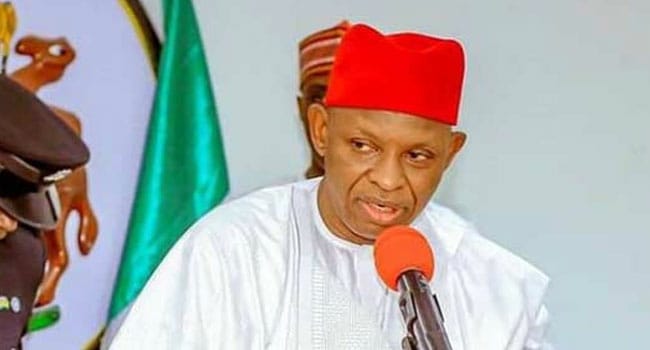
Governor Abba Kabir Yusuf has inaugurated the Kano State Advisory Committee on the New National Minimum Wage to oversee the implementation of the newly approved N70,000 minimum wage in the state.

The committee, headed by Alh. Usman Bala Muhammad, Special Adviser to the Governor on State Affairs, has been tasked with presenting practical recommendations for the state government’s immediate implementation within three weeks.

Speaking at the inauguration, Deputy Governor Comrade Aminu Abdussalam Gwarzo emphasized the committee’s responsibility to plan effectively for the newly approved minimum wage, stressing that the welfare of workers is a top priority for the government.

The committee comprises representatives from various state ministries and departments, including the Head of the Civil Service, Commissioner of Finance, Planning and Budget, Information and Internal Affairs, and other stakeholders.

Abba assured workers that the implementation of the new minimum wage would boost development across all sectors in Kano State.

The move follows President Bola Ahmed Tinubu’s approval of the new national minimum wage, which is intended to improve the standard of living for Nigerian workers.

Zamfara police arrest lawmaker, ex-chairman, monarch for alleged kidnapping

By Uzair Adam Zamfara

State Police have taken into custody a member of the state assembly, a district head, and a former local government chairman due to alleged ties to kidnapping and banditry.

The arrested lawmaker, Aminu Ibrahim, is suspected of involvement in the kidnapping of an elderly man, Alhaji Ibrahim Sarkin Fada, in Kasuwar Daji village.

Additionally, the district head of Kaura Namoda, Alhaji Jafaru Abdullahi Kumburki, and the former chairman of Kaura Namoda LGA, Nasiru Muhammad, are also in police custody.

According to the Commissioner of Police, CP Muhammad Shehu Dalijan, the district head of Kaura Namoda allegedly colluded with two suspected associates of bandits and kidnapped nine locals in Gidan Sambo village, receiving a ransom of N800,000.

The former council boss is accused of collaborating with two others to abduct Alhaji Ango in the Kumurya community of Zamfara State.

Furthermore, three district heads from Danjibga, Bukkuyum, and Unguwar Gyauro in Tsafe and Bukkuyum LGAs are under investigation for alleged involvement in kidnapping and banditry.

The police commissioner has confirmed these arrests and stated that the investigation is still ongoing.

IGP: We can’t afford to have violent protests in Nigeria

By Abdullahi Mukhtar Algasgaini

The Inspector General of Police, IGP Kayode Adeolu Egbetokun, addressed the nation in light of the planned nationwide protests, emphasizing the severe negative effects of violent demonstrations on our society. 

In his address, the IGP highlighted several critical points that underscore the importance of maintaining peace and order during protests.

“It is not only in Nigeria that there is hardship. It is a global meltdown. Is the government doing anything about it? Yes! This is what a responsive government will do,” stated the IGP. He stressed that while the current economic challenges are not unique to Nigeria, the government is actively working to mitigate their impact and provide relief to the citizens.

Reflecting on the 2020 EndSARS protest, the IGP remarked, “Where police stations were burnt down, criminals took over. Arms looted were in the wrong hands, and armed robbers took over. Women could no longer walk freely once it is 7 pm.” He warned that the destruction of police infrastructure leads to a breakdown in law and order, leaving communities vulnerable to criminal activities.

“There are enough lessons to learn from previous violent protests in Nigeria,” the IGP continued, urging citizens to remember the chaos and suffering that followed such events. “Serious dangers come with unchecked demonstrations,” he added, highlighting the potential for loss of life, property damage, and widespread fear among the populace.

The IGP acknowledged the right to protest, stating, “The right to protest is a right to peaceful protest.”He called on all Nigerians to exercise this right responsibly and to avoid actions that could escalate into violence. Peaceful protests, he emphasized, are a powerful tool for expressing grievances and driving change without endangering lives and properties.

In conclusion, the IGP reaffirmed the Nigeria Police Force’s commitment to protecting the rights of citizens while maintaining law and order. He urged all Nigerians to cooperate with the Police to ensure that any forthcoming protests are peaceful and orderly.

On the nationwide protest

By AM Ashafa

There has been nothing left that has not been said for and against the proposed nationwide protest in Nigeria. The government mobilised various people and groups to fight against it. In the first place, mercenary anti-protests amongst religious groups, youth groups, women, and tribal groups were brought or mobilised, allegedly spending a lot of national resources to campaign against the protest with some recorded successes and failures. 

The government also pointed at the opposition and other Jacobins as being behind the protest with the intent of taking over the government. Indeed, this may sound like Yahoo’s political argument. What has not been said much is that both the government and protesters are patriotic. The question is, who is more patriotic among them?

First, is a protest criminal? Is the expression of disliking government political decisions an act of criminality? Certainly no. On the other hand, is the government stopping a protest that, in its wisdom, tends to cause destruction to be allowed to happen? Certainly no. This means there’s a need to strike a balance. Any example of countries where protests turned into violence is mere pessimism. People won’t say that police brutality in response to protests was largely 95% of the reason why peaceful protests often turned violent.

The government has a responsibility to listen to its citizens. Citizens, not those controlling the government, own the police and all law enforcement agencies and machinery. The condition of members of the armed forces and their families in the harsh and messy socio-economic quagmire is no better than that of the entire citizens. Yet, they have a responsibility to save the citizens, the country, and the government that will make life bearable. 

The government must try hard not to criminalise protests. Protesters must try hard not to engage in violence and criminal destruction of public and private properties to vent their anger. When I heard one cleric saying obedience to all kinds of leaders in all brutal policies is obedience to Allah and doing otherwise with protests is criminal disobedience to Allah, I quickly reflected on the protestations in 1804 by Usman Danfodiyo, whose protestations brought about the Sokoto Caliphate that brought sanity to the Hausa society of the 19th century. 

My question to that cleric is, was he saying that Danfodio and the successive leaders of that largest political state in pre-colonial Africa were and are products of criminality? Certainly, Danfodio led a peaceful protest until the King of Gobir, Uunfa, responded with a high-handedness that the peaceful protesters couldn’t bear. The tide then turned, and the rest is history. 

We must always learn from history. Government and protesters must never ground our country. It’s for all of us. We have no other country but Nigeria. We must collectively refuse to be idiots in how we handle its stability and future.

Hunger: FG begins sale of 50Kg rice bags for N40,000

By Uzair Adam

On Monday, the Federal Government announced the distribution of an additional 10 trucks filled with 50kg bags of rice to each state. These bags will be available for purchase at designated locations for N40,000 each.

During a council meeting, Minister of Information and National Orientation, Mohammed Idris, informed State House correspondents that this initiative aims to alleviate poverty and address the high cost of living.

Idris stated, “The Federal Executive Council believes that most of the demands made by protesters are already being addressed by the government. Therefore, there is no need for further protests, as the government is actively working on these issues.”

“The President has listened to those planning protests and is already taking action on their behalf. For instance, the government is making efforts to ensure food availability.

“In the previous Council meeting, we announced the distribution of 20 trucks of rice to state governors for distribution to those in need, particularly the poorest in society.

Additionally, rice is being sold at about 50% of its usual cost, with each bag priced at N40,000.”

Idris explained that the rice has been transported to various centers across all states, where it can be purchased for N40,000 per bag. “Initially, 10 trucks have been provided to each state.

“This is just the beginning, and while we acknowledge that the supplies may not be sufficient, these are necessary first steps. More interventions will follow,” he concluded.

NNPC to sell crude oil to Dangote, other refineries in Naira

By Sabiu Abdullahi 

President Tinubu has proposed that the Nigerian National Petroleum Company (NNPC) sell crude oil to the Dangote Refinery and other new refineries in Naira. 

This is believed to be a move aimed at stabilising fuel prices and the exchange rate between the dollar and the naira. 

The Federal Executive Council (FEC) accepted the proposal, which is expected to provide a valuable lifeline to the Dangote Refinery. 

According to reports, the Dangote Refinery requires 15 shipments of crude oil annually, totaling $13.5 billion.

The NNPC has pledged to provide four of these cargos. 

The FEC has agreed to make available 450,000 barrels for local consumption, which will be offered to Nigerian refineries in Naira, with the Dangote refinery being the initial test. 

The exchange rate will remain constant throughout this transaction, and Afreximbank and other Nigerian settlement banks will support trade between Dangote and NNPC Limited, removing the requirement for international letters of credit and resulting in significant cost savings for the country by reducing the billions of dollars spent on importing refined fuel. 

This move is seen as a strategic step towards maintaining the stability of fuel prices and the exchange rate between the dollar and the naira.

President Tinubu assents new N70,000 national minimum wage into law

 By Sabiu Abdullahi 

President Bola Tinubu has signed the National Minimum Wage Amendment Bill 2024 into law, officially setting the new minimum wage at N70,000.

The legislation, which is subject to review every three years, was signed at the State House in Abuja on Monday. 

The signing ceremony was attended by Senate President Godswill Akpabio and other National Assembly leaders, who had expedited the bill’s passage.

President Tinubu expressed his gratitude to the National Assembly for their swift action on the legislation. 

According to the Head of Service, the new law demonstrates President Tinubu’s commitment to the welfare of workers, saying “the new law will undoubtedly reassure the workers that the President cares about their welfare.” 

This is believed to be a step forward in bringing down the dire situations Nigerian workers are in, in the face of the unprecedented inflation around the country.

ACAGL backs out of nationwide demonstration over security, economic concerns

By Uzair Adam

The Arewa Citizens Action for Good Leadership (ACAGL) has announced its withdrawal from the planned nationwide protest against hunger and economic woes in Nigeria, citing potential risks and security consequences.

During a press briefing on Monday at the Sarina Suites and Apartments in Kano, ACAGL Spokesperson, Comrade Saeed Sulaiman Umar, explained that the decision was made after careful and thorough consideration.

Umar stated that ACAGL had initially been active in mobilizing people for the upcoming protest due to the prevailing conditions of insecurity, hunger, and starvation in the country.

He expressed concern about the widespread economic hardship, noting, “This is alarming as many hardworking people can no longer deliver on their basic responsibilities to their families.”

Explaining the reason for the withdrawal, Umar said, “This decision is borne out of the desire to prioritize the peace and stability of our dear Kano State and the northern region. We have witnessed the devastating effects of protests in some countries, where initially peaceful demonstrations escalated into violent conflicts, resulting in loss of lives, destruction of property, and long-term instability.”

Despite their withdrawal, ACAGL emphasized the ongoing suffering due to insecurity, hunger, and starvation.

“The economic situation in the country has worsened, leaving many without access to basic necessities,” Umar added.

Umar also called on the government at all levels to address these pressing issues urgently.

He urged the Kano State government to take immediate action to alleviate the unprecedented economic challenges facing the people.

Additionally, ACAGL called on President Bola Ahmed Tinubu to address the issues of Boko Haram attacks promptly, to find innovative solutions to end the current hardship in Nigeria as quickly as possible, to revitalize refineries, and to reduce petrol prices to an affordable and sustainable level.

The organization also urged the government to reverse electricity tariffs and indefinitely suspend any increments, revert tertiary institution fees to their previous rates, reduce the cost of governance and the salaries and allowances of all political office holders, starting with President Tinubu, and to refrain from foreign loans that could mortgage Nigeria’s future.

Umar reiterated ACAGL’s commitment to prioritizing the peace and stability of Kano and the northern region, and to working towards a brighter, violence-free future for all.

A feminist reading of Jammaje’s Nanjala

  • Production:    Jammaje production
  • Producer:       Abubakar Bashir Maishadda
  • Director:        Ali Nuhu
  • Cast:               Sani Mu’azu, Ali Nuhu, Nancy Isime, Enyinna Ngwige, Rabi’u Rikadawa, Segun Arzine, Abba Al-Mustapha, Asabe Madak, Abba Zaki.

Nanjala, an eponymous and one of the most expensive movies in the Kannywood industry by Jammaje Production, is a breathtaking movie that explores and thematises patriarchal power, domination and mistreatment towards women gender. Nanjala, a leading character, is victimised by her chauvinistic father, who disbands her for being a female in favour of a male child, Dititi (Abba Zaki). Captain Jimmoh (Rikadawa) becomes her adopted father and helps to actualise her dream of becoming a renowned journalist.

Furthermore, Captain Sembene’s family is set on fire as his beloved son, Ditit, becomes a spoiled child, drug addict, thief and clubgoer. Plus, his other female daughter, Jarry, takes a leave from home for her father’s chauvinistic mistreatment. Falmata, another victim of Captain Sembene’s chauvinism, befriends her biological brother, Ditit, with a view to wed him.

Nanjala becomes a renowned and influential journalist who tirelessly fights and exposes corruption in the government. She encounters obstacles along the way from the authority. She is detained in cells for exposing corruption. Finally, she appears triumphant.

Mistreatment and domination are long-held traditions shown to women by a patriarchal world. Women, as chauvinists maintain, are disaster and second-class citizens who can’t contribute to one iota of life. In those days, women had to cancel their identities to have their voices heard—the same as Nanjala has to take a leave from a patriarchal home to attain her potential. 

Thomas Aquinas (1274) opines, “A woman is really an imperfect man… an incidental being … a botched man’’. Nanjala’s treatment by her father affirms Aquinas’s stance that women are imperfect and a botched to her male brother, Dititi. Plus, according to Baudelaire, “woman is natural, that is abominable’’ Some men consider women disgusting. This perception runs through Nanjala’s father, who finds the female gender abominable – divorcing Falmata’s mother for carrying a female unborn child, making life unbearable to Majuma (Asabe Madaki) and causing a great aspersion on Nanjal and Jarry, whom all are females. They have to leave their homes to feel at home.

The belief that women are nothing but second-class citizens, abominable and sex machines for men to exploit became prevalent during the Victorian period (1837-1901) and also in plenty of their literature. We see the fate of Susan Henchad, who is auctioned in Thomas Hardy’s The Mayor of Caster Bridge (1886), women who are sexually exploited by men at Sixa in Mango Beti’s Poor Christ of Bomba (1956) and Firdaus’s sexual abuse by men in Women at Point Zero (1975). Likewise, patriarchal domination doesn’t put a halt here but tries to silence any emerging powerful female voice. 

Women like Gorge Eliat (1919-1880), Gorge Sand (1904-1876), Charlotte Bronte (1816-1855), etc., succumb to patriarchal pressure and accept defeat to vie with men intellectually and literarily. Comparatively, Nanjala encounters the same treatment, where patriarchs try to silence her intellect and voice. They envy her fame, success, and education. Men are jealous of women’s successes, but Nanjala struggles and succeeds. 

For women to succeed in the patriarchal world, they have to be educated, pushed, and struggled. We see how women break the bonds. Li succeeds in The Stillborn (1984) via struggle and education, as Ada in Second-class Citizens(1974). Also, we see in the Kannywood movies- Hauwa Kulu (2019) where Hauwa (Hasana Muhammad) and Laila (Hadiza Gabon) in Manyan Mata (2023 succeed through education. However, Firdaus in Women at Point Zero (1975) and Nnu Egu in The Joys of Motherhood (1980) fail because they are illiterate or barely educated.

Meanwhile, Simone De Beauvoir (1908-1986) asserts that “males define what it means to be human, including what to be female. Since the female is not male”. Beauvoir maintains, “She becomes another”. Indeed, this derogatory portrayal has been born by females throughout many centuries. In the film, Nanjala’s father has this perception run in his blood. He evidently defines who a human being is to him, his male child, Ditti.  He loathes all his three daughters – Nanjala, Jarry, Falmata and Majuma because they are “others”. Women become secondary or non-existent players. 

Finally, Beauvoir asserts, “Women must break the bonds of their patriarchal society and define themselves if they wish to be a significant human”. This is what Nanjala does, and she becomes a “being” in the patriarchal society. Meanwhile, Kate Millet (1970) says, “A female is born, but a woman is created”. As Nanjala defines herself as a true human being, discarding the notion of femaleness in her, she creates womanness, as Millet (1970) puts it, through hard work, education, struggle, and boldness.

By way of conclusion, Nanjala mirrors patriarchal society and uncovers stereotypical portrayal of women as “others”, Second-Class Citizens, incidental beings, imperfect men, and abominable and other derogatory names forced women to accept by men. The film depicts the power of education and struggles as the only means for women to break the long-held tradition enjoyed by men and bury women’s intellect.

If not for education, Nanjala would have been buried alive like other female characters. The film is a clarion call to women to be educated, to disown being relegated to non-existent players or “others”. Nanjala succeeds and becomes a “human being”, whereas Majuma, Jarry and Falmata become second-class citizens.

Reviewed by Abba Musa Ibrahim. He can be reached via abbamusa6888@gmail.com.