Month: September 2021

National Board for Technology Incubation DG visits Engausa Global Technology Hub

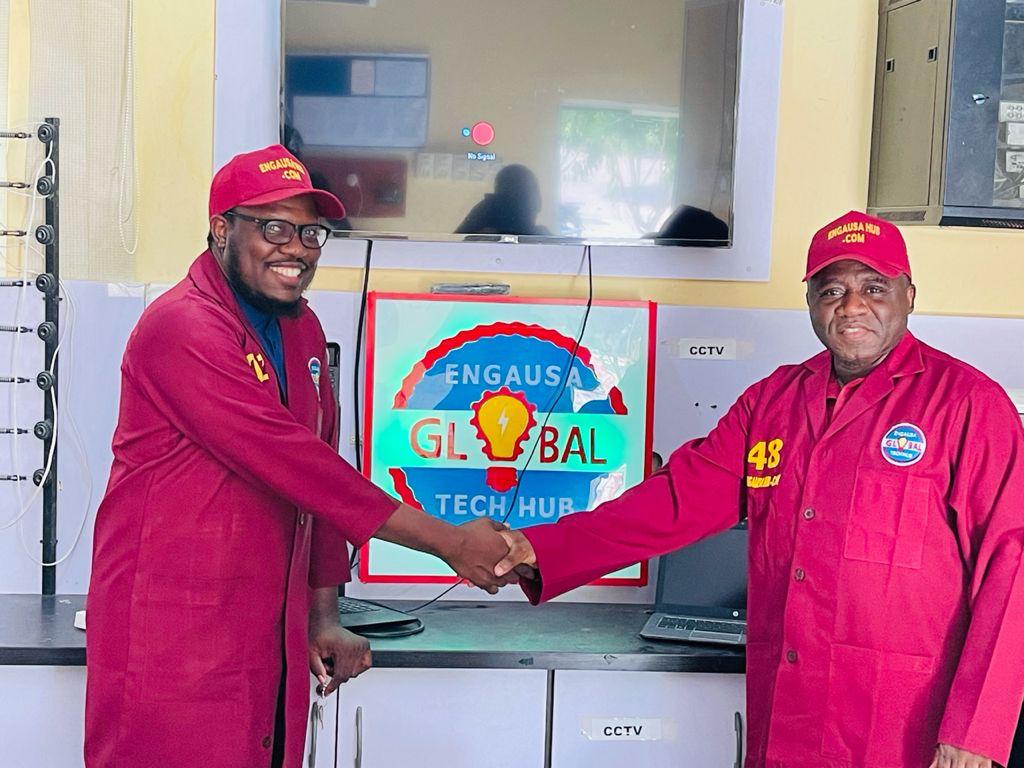
The Director-General, National Board for Technology Incubation, Engr. Dr Muhammad Jibril paid a special visit to Engausa Global Tech Hub, Kano, on September 11, 2021. The Engausa Management warmly welcomed the DG.

As the DG frequently does, the purpose of the visit was to monitor and ascertain the level of commitment of the business under the centre towards human capital development, skill development, and youths empowerment.

On his part, the Founder/CEO of Engausa, Engr Mustapha Habu Ringim, profoundly thanked the Federal Government, the Federal Ministry of Science and Technology (through the National Board for Technology Incubation) and the Federal Ministry Communications and Digital Economy ( through National Information Technology Development Agency) for providing a favourable business environment for Engausa Global Tech. Hub

The CEO noted that, if not for this elderly support and guidance from the Agencies, Engausa would not have recorded the successes so far.

Furthermore, the CEO briefed the DG NBTI about the 47 businesses harvested out by the hub and 1000 graduated apprentices powerfully trained in digital technology to bridge the digital skill gaps we have in the North and Nigeria at large.

The DG heartily applauded Engausa’s impact across the country and pledged to support the hub’s goals to cover more milestones. The DG added that they would do whatever it takes to help businesses and grow them to withstand any business tides through his office. He said that people who have business ideas, especially technology and innovation related ones, should put those ideas to work because the government will always be there to support innovative businesses like Engausa.

The DG was taken around the hub and ascertained the quality of the training tools, equipment, and bilingual education system deployed to ameliorate teeming youths’ learning difficulties.

Dear NECO registrar, removing English as admission criterion can be costly

By Ishaka Mohammed

Dear Professor Ibrahim Dantani Wushishi, we are aware that you have reached the pinnacle of your career as a Nigerian academic. That means you must have directly interacted with an overwhelming number of Nigerian students. We also know that you specialise in education. Therefore, you should know better than many of us the pros and cons of educational policies.

As the current registrar of the National Examinations Council (NECO), you think that the Federal Government of Nigeria should consider removing credit passes in English language and mathematics as criteria for admission to Nigeria’s higher institutions. This is further proof that you know Nigerian students and how difficult it is to pass these subjects in their Senior School Certificate Examinations (SSCE).

Similar to your suggestion, the current registrar of the Joint Admission and Matriculation Board (JAMB), Professor Is-haq Oloyede, once advocated that a credit grade be removed as an admission criterion for the arts and humanities in polytechnics and colleges of education. I subscribe to his submission.

However, considering the status of the English language in the 21st century and the fact that it’s our official language, I think it’s costly to abolish a credit grade in the subject (English language) as a criterion for admission into our tertiary institutions.

It’s glaring that despite the presence of this criterion which forces many of us to learn the language, we’re far from attaining true proficiency.

Prof., if you seek a paragon of “nobody is perfect”, just pay attention to how we (Nigerians) use the English language, starting from this write-up. Even the highly educated are prone to uttering or writing wrong English expressions. Concerning this claim, many people argue that no one is above mistakes, but I say that mistakes aren’t the same as errors. When one’s use of a wrong expression results from one’s unawareness of the correct pattern, that’s an error.

Sir, I think a few examples will suffice. Many Nigerian graduates wish to further their studies abroad, specifically in the United States and the United Kingdom, but their proficiency level hinders them in the English language. Each of the two main internationally recognised English language proficiency tests is difficult for most Nigerians to pass. Those who have sat for the tests or accessed their past questions can attest to my claim. Even an excellent Nigerian graduate needs intensive coaching to pass the Test Of English as a Foreign Language (TOEFL) or the International English Language Testing Systems (IELTS).

Prof., if making English errors were a criminal offence, we would be in jail. But, of course, that’s if judges aren’t guilty as well.

Sir, it’s a known fact that exposure to news media content boosts one’s language proficiency. Although the reverse isn’t totally the case in our country, consumers of Nigerian media content had better be wary of heavily relying on their (the media’s) expressions. Other authorities, including dictionaries, should be consulted as frequently as possible.

Let me buttress the above point. Since 1961, the Nigerian Guild of Editors has been a network of experienced journalists who have attained editors’ positions in their respective organisations. Ordinarily, one would assume that every member of the network possesses an unquestionable mastery of the English language. But, no, this isn’t the case. Some of the past presidents of the guild have repeatedly published wrong English expressions not as mistakes but as errors. One of such expressions is “Buhari felicitates with”. I’m sure the president has media aides, two of whom have presided over the affairs of the Nigerian Guild of Editors in the past.

In a similar vein, many of the federal ministry of education documents aren’t free of English errors, neither are those from our schools.

The above instances speak volumes about our deficiency in our lingua franca. Being aware of this situation, isn’t it advisable that we adopt measures to encourage us to learn the English language? Will it then be wise to abolish existing measures? 

I believe in the saying that where there’s a will, there’s a way. Our determination to secure admission to tertiary institutions makes us learn English more than we would ordinarily do. The more we practise, the better we’re highly likely to become. Frequency and expertise have a significant relationship.

Therefore, Prof., let’s maintain a credit grade in English as a criterion for admission to our higher institutions.

Ishaka Mohammed writes from Kaduna. He can be reached via ishakamohammed39@gmail.com.

KTSG’s Public Opprobrium: English is not the problem

By Ahmad Ganga

The recent executive order signed by Katsina State Government (KTSG) is filled with grammatical and typographical errors that critics can never overlook, even though English is not the problem. Instead, the problem lies in constituting members of the executive council tasked with governance delivery. Virtually, almost every politician in the North despises having competent people within their domain who can question their decision and ask for clarification for every policy made. That’s why lowbrows make a list of cabinet members: SAs, EAs, PAs, Secs, etc.

Being His Excellency, Governor of Katsina State, a former Speaker House of Representatives and an experienced administrator, the errors wouldn’t have happened —if the politicians in this State didn’t present their puppeteers while constituting cabinet. Competency and skills should be a yardstick in the process, instead of connection. The Executive Governor is not alone in this. Secretary to State Government, Dr Mustapha Inuwa, was in academia for long before he set his feet into politics. Tell me why critics would not descend on KTSG for committing such public opprobrium?!

Let me tell you a story. When the news of my Principal’s house stormed media, I came across a post he made himself wherein he showcased the house on the internet. I asked him why he did it, and he told me that his guard said to him that some people, assumed to be journalists, came snapping the house and asking people about the person of Honourable Member who’s President Buhari’s nephew. So, instead of letting the journalists break the news and twist it the way it suits them, he broke the news himself. 

Let me go back to the initial topic. Suppose the elected and appointed officials gave room for competency, like asking for inputs from their aides and secretaries on every policy before releasing them to the public. In that case, they could avoid such errors. As I say in the headline, English is not the problem. Every one of the elected and appointed politicians is looking for someone who always says YES to whatever.

Considering the consequences that followed this executive order, I suggest that His Excellency give room for competency to reign in his cabinet to control the damage done so far since he was sworn in as the Executive Governor of Katsina State.

Ahmad Ganga can be contacted via ahmadganga66@gmail.com.

75 kidnapped students regain freedom in Zamfara

By Muhammad Sabiu

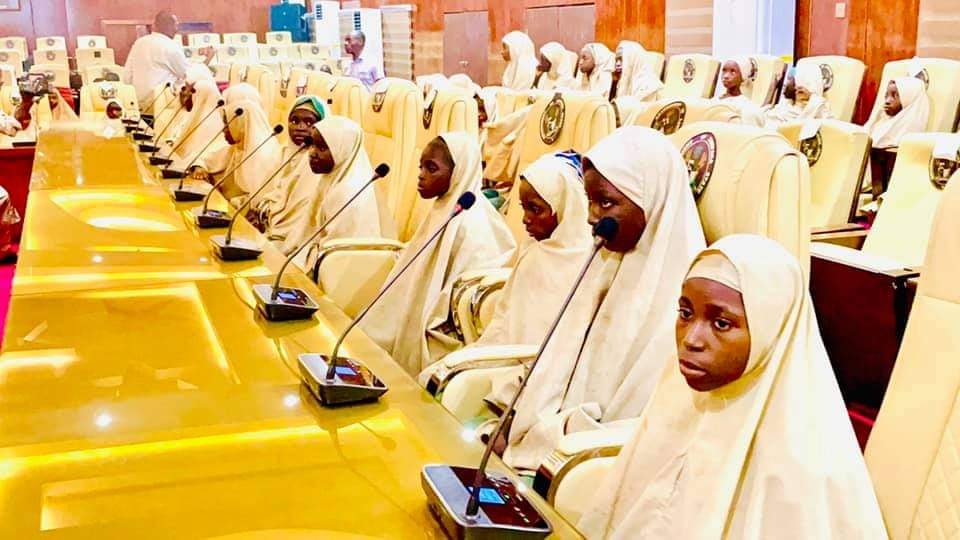
Reports coming from Zamfara State, in Nigeria’s northwest, have indicated that at least seventy-five students, who were kidnapped at Government Day Secondary School, Kaya, have finally regained their freedom after spending twelve days in captivity.

The released students were received by Governor Muhammed Bello Matawalle at the state’s Government House in Gusau.

Confirming the release, Nigeria’s national television, popularly known as NTA, posted on Facebook that, “The seventy-five students of Government Day Secondary School Kaya in Maradun Local Government Area of Zamfara State abducted about two weeks ago regained freedom.”

This is coming amidst a military onslaught against the terrorists operating in the region, who are notorious for killing and kidnapping.

The Matawalle-led Zamfara government had since taken measures to halt the violent activities of the terrorists by intercepting the supply of foodstuffs and petroleum products to their respective camps.

The military onslaught has reportedly forced a number of them to flee their camps amidst suffering heavy casualties.

For the good of the North

By Abubakar Isah Baba

The misrepresentation of northern Nigeria ranges from distorting and falsifying reality, profiling, underreporting, and not reporting about the region by media outlets owned and controlled by others. Apparent and alarming as this is, it has been going on for a long time. This requires no evidence or justification; it is a growing trend, especially when the country propagates alienation over harmony. But who cares? Even those who have the responsibility to do so are busily aggrandising their powers.

But how long it will take the sick region to learn from this great proverb: Until the lion has a historian, the story of the hunt will always favour the hunter. The North was painted black with negative phrases, tales of violence, poverty, unemployment, irresponsible marriages, out-of-school children and whatnot as if there were no other positive realities.

John Campbell attests to the above mischaracterisation in his book, Nigeria: Dancing on the Brink, that “The Nigerian media, mostly headquartered in the Southern part of the country, is routinely insensitive and simplistic in its reportage about Northern Nigeria. And it is the Nigerian media that colors the too-often superficial Western view of the North.” This has a significant effect on the economic decline in the North as no investor will invest in the region that is dangerous, volatile and unpromising.

Apart from the traditional cores of mass communication, which include informing, educating, and entertaining, it is also used for propaganda to gain support or sympathy from the public or authority. EndSARS saga is an indicator of the power of propaganda, for it taught the north a lesson that “Dokin mai baki ya fi gudu” – the South has a much louder voice. Please don’t confuse my lamenting with Afghanistanism (a term used in journalism to describe journalists who shun the problem of their community but go extra-mile in condemning others), far from it. I suggest North should define itself and tell its version of the story; represent itself properly as bias in the news is often backgrounded. Others could not define us nor report us properly. 

Traditional rulers, political leaders, scholars, and concerned people in Northern Nigeria should speedily and strategically address this problem of bad press and misrepresentation of the North through investing in the media and utilising it for the good of their people. With Daily Nigerian, Sahelian Times, Nigerian Tracker and recently The Daily Reality (TDR), we need to see more outlets so we can ship our information without thinking about sinking. Recently, TDR’s publications have changed the North’s fate. Remember CBN and the reopening of the NIRSAL site, Netflix and the Kannywood, etc.

Abubakar Isah Baba writes from Kano. He can be reached via abubakarisahbaba01@gmail.com.

The University System and the academic ranking that I know

By Abdelghaffar Amoka Abdelmalik 

We (Nigerians) are a very interesting set of people. God truly took his time to specially create us. In most cases, we look at issues with emotions and live by the moment. For every discussion, especially if it’s on a controversial issue, we choose the side to support based on the personality involved and our loyalty at that moment. We pose to know everything and as online expert commentators on all issues.

A widely publicized questionable promotion by a Nigerian university was observed a few days back that created heated discussions where individuals that have got no idea on how universities work and can’t differentiate between Assistant Professor and Associate Professor were trying hard to defend the questionable act by the university. Some attempted to give a religious colouration because an Islamic Scholar is involved. A popular online public commentator was so sure that the promotion to the rank of what he called a “full professor” has no specific criteria. That, universities can confer professorship to anyone they so wish. Really? By the way, there is no rank called “full-professor” in any Nigerian university.

Let me share my opinion having spent the last 16 years in academia on tenure appointment at Ahmadu Bello University (ABU), Zaria. 5 of these years were spent in Europe; 2 years as a Postdoc at NTNU Trondheim, and 3 years for PhD/Part-time teaching assistant at Leicester. While I was at Leicester for graduation in July 2012, my second PhD supervisor hosted me in his house at Market Harborough. During our conversation, I asked him about the criteria to get the position of a Lecturer at Leicester and other universities in the UK and he said PhD with 5 journal articles in reputable journals. I asked about Professors and he smiled and responded that it is about how much money your innovative ideas can bring to the university. Professors are the lifeline of the universities in the UK as they are relied upon to attract grants/funds to the university. He added that you can be just Lecturer or Senior Lecturer till retirement if you can’t attract enough grants to earn a promotion.

Dear Nigerians, Professorial rank is not an honorary rank. Not in the British university system and not in any university in Nigeria. There are criteria to get to the rank. Search online, and you will find the promotion criteria/guidelines for several universities around the world. There is a strict guideline for promotion to the rank of Professor or any other rank in all the universities around the world. For Nigeria, I find the university of Ilorin promotion guidelines very interesting. It is a progressive and result-oriented promotion guideline. The guideline if implemented judiciously will place the university in a scholarly database visible to the world of research. I am hoping that other universities in Nigeria will adopt something similar.

For some universities in Nigeria, to be qualified to be promoted to the rank of Professor, you must have published a minimum of 15 journal articles in “non-predatory” journals, have 7 conference proceeding/conference papers, be involved in community service, have supervised at least 2 PhD students, involved in teaching and research for at least 3 years after the last promotion to the rank of Reader (Associate Professor), etc.

Meanwhile, before you get to that highest university rank, a fresh PhD with 3 journal publications and 2 conference papers may be employed as Lecturer II or Lecturer I. You are expected to teach for the next 3 years, research within that year and publish a total of 6 journal papers and 4 conference proceedings/papers to be promoted to the rank Senior Lecturer.

As Senior Lecturer, you are expected to be involved in postgraduate and undergraduate teaching and supervision for 3 years, supervise at least 1 PhD student, published a total of 10 journal papers and 5 conference proceedings/papers, engage in community service to be qualified for a promotion to the rank of a Reader (Associate Professor). And from there to the rank of Professor after satisfying the minimum condition stated above.

Every Nigerian public university is established with an Act of the National Assembly. They are independent of each other. They have their respective Governing Councils that steer their activities. Some academics rise faster by moving from one university to another. But for you to move from one university to another, you must secure a fresh appointment at the university you want to move to. You can then transfer your service from the old to the new public university in Nigeria. That is how it works.

The point to note is that a university cannot offer a promotion to an academic in another university. A non-faculty member and without employment history cannot be offered a promotion in any university except NUC has approved a rank called “Honorary Professor” for politicians.

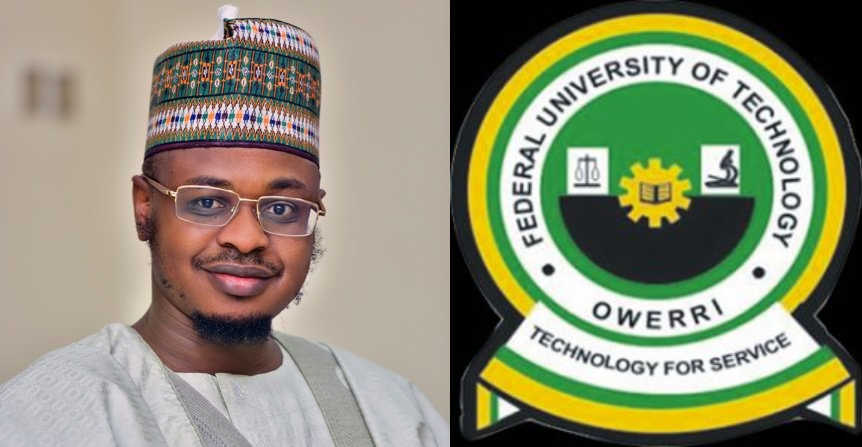
Dr Isa Ali Ibrahim (aka Sheikh Pantami) was a lecturer at ATBU Bauchi from 2004 to January 2014 according to his ResearchGate profile. He proceeded on study leave in 2010 to Robert Gordon University, Scotland for his PhD. Immediately after his PhD in January 2014, he got an appointment as an Assistant Professor at the Islamic University of Medina. Some said his rank at the Saudi University was Associate Professor. But I doubt if any serious university will employ a fresh PhD as Associate Professor. He spent 2 years 7 months at the Saudi university before he terminated his contract to pick up the political appointment at NITDA in 2016. 

Meanwhile, it is not certain if he absconded from ATBU to pick up the Saudi job or ATBU has no bond for their PhD scholars that went on study fellowship. He left Saudi Arabia to pick up the appointment with the government in 2016. He has worked as DG and is now a minister for the past 5 years. He seems to have no link with any university over the last 5 years and specifically no employment history with FUTO. But only to see the advertorial from Zamfara state governor on a national daily congratulating the Sheikh for his promotion to the rank of “Full Professor” in 2021 by the Council or Senate of the University. He was said to have published 160 papers. Papers that could not be found on the database of scholarly articles.

The advertorial raised questions and discussions started. From his history in academia, he seems not to possess the requirement for the said new rank. He is not involved in teaching and research for the last 5 years. Meanwhile, as a Minister of the Federal Republic, he can’t even take up another Federal government job except he resigns. If FUTO actually needed him for whatever reason, they could have hired him as a Visiting Professor, which is a part-time job and it is allowed. They can then offer him the position of Professor when he is done with his political appointment as long as he is willing to live, teach, do research, and supervise postgraduate students at FUTO. 

During the discussion, some irrelevant points were raised. It is to note that during the time of Aristotle, Albert Einstein, Marie Curie, and up till Wole Soyinka’s period, you can be a Professor without a PhD. But that is not the case now. For now, you can’t be a Professor (aside Medical Consultants) without a PhD. There is an ongoing discussion on the need for Medical Consultants to have a PhD to become Professors. People are quick to mention Dr Bala Usman even though he was not relevant in the discussion. The highly respected critic was qualified to be a Professor but chose not to be a Professor for personal reasons. 

Yes, we have issues of irregularities in the appointment and promotion in some of our universities and we hope that the Governing Councils of the respective universities can put an end to that someday as we work towards regaining the lost glory. But this questionable promotion at FUTO of a PhD with 2 years 7 months post-PhD teaching and research experience and 3 visible materials on Scopus and without employment history in the university, seems to be part of such irregularities.

Dear University managers, we have a responsibility to protect the university system and the ranks which are reserved for only those in the university that have worked for it and merited it in accordance with the university guidelines. We should not let it go the way of honorary degrees that are allegedly being purchased by politicians that are hungry for titles. 
ASUU has over the years worked very hard for the Autonomy of the universities, especially the federal universities, to shield them from political interference that is crippling the university system in Nigeria. We are still struggling with the principle of university autonomy even with the existence of the Autonomy Act. Let’s not give room for the interference to take new dimensions. We all need to rise against the irregular appointment and promotions like this so that it will not become a norm like honorary doctorate that is allegedly sold to politicians.

Dear Sheikh Pantami, you are a highly respected Islamic Scholar that I want to believe is not looking for titles. Titles can’t add value to your personality and what you stand for. It has no value for the hereafter. You have recorded notable achievements as a Cleric and as DG of NITDA and the Minister of Communications. It is obvious you have a love for academics. Just be patient and finish your assignment as the Minister. You can then join us in Bauchi or Owerri to mentor the next generation of cyber security experts, and you will rise to become a highly decorated Professor.

Dear Executive Secretary of NUC, I hope you will read this piece and take appropriate action to protect the little integrity left in our universities.

Abdelghaffar Amoka Abdelmalik writes from Zaria and can be reached through aaabdelmalik@gmail.com.
Army to investigate murder of taxi driver by own personnel in Jos

By Muhammad Sabiu

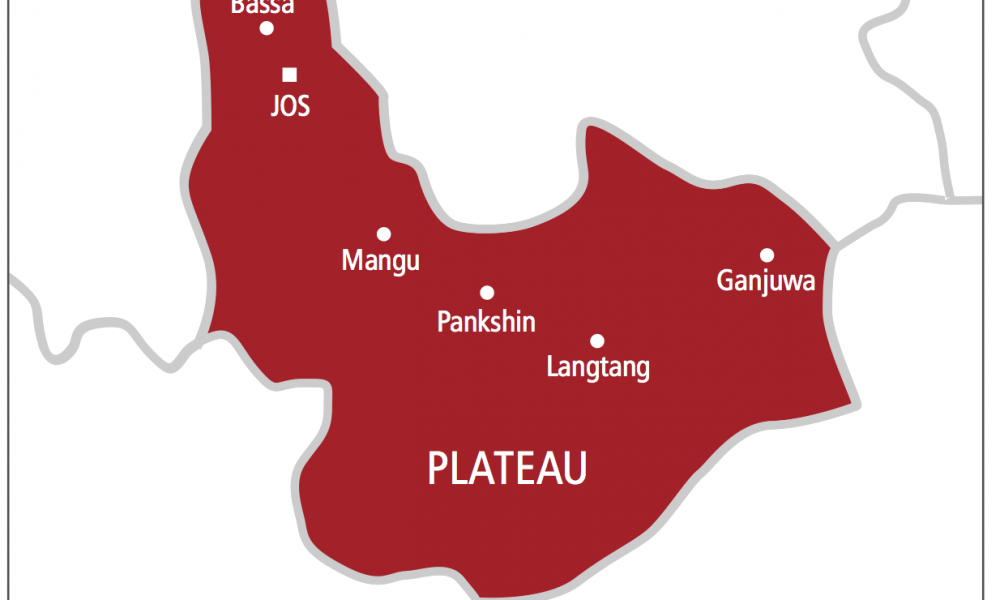
The alleged murder of a taxi driver by some men of the Special Task Force, Operation Safe Haven (OPSH) for allegedly flouting the 10:00 pm curfew imposed on some parts of Plateau State is going to be investigated.

This was disclosed on Saturday by the spokesperson of the operation, Maj. Ishaku Takwa, in Jos.

Recall that the taxi driver, identified as Abdullahi Karafa, was alleged to have been beaten to death by soldiers around the Farin Gada axis in Plateau State.

During a condolence visit paid to the family of the deceased, the Commander of the Task Force, Ibrahim Ali, gave assurance that any soldier culpable of the murder would be punished.

The statement reads, “OPSH received with shock a report that its personnel deployed at Farin Gada beat and murdered a commercial taxi driver, Mr Abdullahi Karafa.

“Immediately we received the report, our commander visited the deceased family and condoned them over the unfortunate incident.

“The commander has since constituted a board of enquiry to unravel those behind the heinous act.”

Since after the murder of some 30 Muslim travellers in the Rukuba community of Plateau State, there has been tension which is as a result of attacks and reprisals, and that forced the Plateau State Government to impose a night curfew on some parts of the state.

Shekarau will return to PDP — Prof. Umar Farouk

By Muhammad Abdurrahman

Professor Umar Farouk of the Department of Mass Communication, Bayero University, Kano and a former Kano State Commissioner of Information during the second tenure of Dr Rabi’u Musa Kwankwaso spoke with The Daily Reality on the possibility of Malam Ibrahim Shekarau’s return to the Peoples’ Democratic Party (PDP) and the possible emergence of the Third Force before 2023 elections.

Prof. Farouk said that “Mal. Ibrahim Shekarau’s decamping to APC didn’t help him. They don’t respect him. Someone as eloquent as Shekarau is now missing in the headline tells you there is a problem in APC. His silence tells you he is not happy with the manner he is treated. He is just waiting for an opportunity to break his silence.”

“When he was at PDP, Dr Rabi’u Musa Kwankwaso visited him, sought for his support and made him many promises when they form a government. But Shekarau thought differently and decamped to APC. Even though people see him as our arch-rival, look at how Kwankwasiyya supporters received him at the airport without any hard feelings. Look at how they escorted him to his car, and also those at Nassarawa Local Government look at their pictures with him. This is the discipline instilled in them by our “Jagora” [Kwankwaso].”

A similar incident brought Senator Kwankwaso and the Minister of Communication, Dr Isa Aliyu Pantami, at the same Malam Aminu Kano Airport in 2019. At that time, some Kwankwasiyya supporters shouted at the latter, a few others attempted to wrestle him. Recalling this regrettable incident, Prof. Farouk responded, “Dr Isa Pantami was only unlucky because of the political climate at that time. And that brawl was mainly premeditated by a lot of issues.”

Since 2003, supporters of Kwankwaso and Shekarau dominated political programmes on Kano radio stations with talks and counter talks on the two political giants. But it seems that is no longer the case.

Prof. Farouk argued, “To the best of my knowledge, it is infrequent now, that is if even it happens to see a bona fide Kwankwasiya supporter criticising Shekarau on both social media and conventional media. Considering how the leadership of APC in Kano and at the national level treats him, we sympathise with him. A Kano State governor for eight years; a former minister and presently a senator of Kano Central, but his party, APC, doesn’t see his worthiness.  He is not contacted about the party’s activities in most cases as he was not considered in the previous local government elections.”

“There is a possibility that both Shekarau and Kwankwaso will forget their differences and form a formidable alliance to bring the change people have been aspiring for because we all tested the bitterness of APC’s administration. Shekarau was from PDP, and certainly, he will return. We, the Kwankwasiyya bloc, have an existing structure that is waiting for him. It is not a shame if he comes back to his home, PDP. His return will certainly boost the strength of PDP,” said Prof. Farouk.

The Third Force is not a new phenomenon in Nigeria’s politics, especially when there are crises in the ruling party and things are not faring well. Both politicians and the governed look for an alternative. Prof. Farouk added, “Though it is a bit late, Third Force is inevitable considering the political unrests in the country. Both APC and PDP have internal crises with many cases in the court about the leadership structure and other issues.”

“There would be a lot of movements to and from both parties depending on where the wind blows. Therefore, governors, senators, and state and federal representatives need to be the third force to cause any change. Without these people, it is a futile exercise to talk about the third force. This is the reason why, often, some people stay in the ruling party because it has the resources to win elections, legitimately or otherwise.”

“But naturally, there must be an opposition. Those members who stay and nurse their ambition to fruition will win. This is what President Muhammadu Buhari did for many years, and in the end, APC won. So you must be patient,” Prof. concluded.

Where will Buhari retire to?

By Ahmadu Shehu, PhD

Since The Daily Reality has become the darling medium through which northern elites are called to task, I would instruct them to extend a short message to President Muhammad Buhari this weekend. Although Nigerians are used to the deafening silence of this administration to most of our perils and concerns, the president needs to be reminded of a few disturbing, foreseeable facts.

Let me first state that the people of this country, especially his brothers and sisters in the north, can’t wait to see the end of his rule. His ethnic group, the Hausa-Fulani, have carried his cross for too long. For over a decade, they gave their lives, wealth and resources for his candidature, and for seven years, they bore the blames, stereotypes and animosities for his presidency. What is their gain? An avoidable but seemingly inevitable genocide. If the president does not know, I will tell him that the people of this region are tired! They are no longer looking for what he can do for or to them. They are only anxious to survive the remaining days.   

I want the president to observe a few things. First, all Nigerian leaders lucky to have left the Villa alive went back to their hometowns after their tenures. For instance, Shehu Shagari, who was overthrown by then General Muhammadu Buhari, moved permanently to Shagari, securing a serene, fruitful life after that. While in retirement, Shagari remained relevant and served in various traditional positions within the Sokoto Caliphate. His love for his people, his engagements with his roots throughout his career, his pride in his people and culture and constant, persistent and proud leaning to his region endeared people to him even after his tenure. That love held him physically and psychologically intact, made him relevant and happy all through his old age.  

General Ibrahim Badamasi Babangida, who succeeded Gen. Buhari, retired to Minna, his birthplace from where he and his wife established great organizations that engendered socio-economic development. As a result, Babangida’s home became a centre of excellence in Minna metropolis, and people trooped to his doors for all kinds of support and favours.

General Abdussalami Abubakar became the Head of State after the death in office of Gen. Sani Abacha. Abdussalam followed the footsteps of his predecessors and retired in Minna, his hometown. This was possible for the two Generals only because of their good to their people and region. To date, Niger and indeed the North-Central are thankful for their service as Heads of State. They gained relevance and recorded developmental strides hitherto impossible without the emergence of their worthy sons.   

Then came Olusegun Obasanjo, who returned to power for the second time. After eight years in office, Obasanjo moved to Otta – not even Akure – to start a new life as a statesman. While Yar’adua died in office, his successor, President Goodluck Ebele Jonathan, immediately vacated Asorock for Otuoke, his birth village and assumed his gentle duty as the breadwinner of his people and region. Jonathan has was devilishly maligned as the enemy of the north, the clueless president of the country. But he ensured that the Niger Delta amnesty program succeeded, for he was conscious of life after office in the creeks. He, therefore, begot for himself and his people a place to live in peace. 

Here at home, the breadwinner of Adamawa state, former vice president, Alhaji Atiku Abubakar, ensured that the state’s economic strength is sustained. He established institutions, provided hundreds of thousands of employments, empowered businesses and established banks for entrepreneurs and start-ups. Atiku Abubakar built his retirement home in Jada and moved his business headquarters to the state. He ensured that human development services, such as education, healthcare, media and IT industries only obtainable in the cultural West are brought home to the doorsteps of his compatriots. Thus, he was able to stay at home and proceed with his political career gracefully.  

But with all the situations in the northwest, especially Katsina – his home state – and Kaduna – his preferred haven, where does President Buhari intend to retire and spend the rest of his life? For one, at 80, Buhari will be the oldest Nigerian president to leave office and probably the sickest at that weak point of human life. That is the moment he needs people the most and will undoubtedly go through the most painful retrospections of his administration’s actions and inactions. Then, he would face realities – poverty, inhumanity, misery, deprivation, etc. – that have become the norm on Nigerian streets. At that point, Buhari would need Nigerians, and Nigerians would not need him for anything.

The excoriating economic disaster in Buhari’s northwestern region today has not been seen in a long time. Thousands of people are homeless, hopeless and desperate for food and shelter. In Daura, for instance, hundreds of thousands of youth are unemployed. At the same time, his close relatives and families have bought over most farms and grazing lands around the emirate, extending the wicked hands of poverty to more people than ever. As it stands, hundreds of thousands of people are fleeing this region for safety, as kidnapping and banditry have overtaken citizens’ daily lives. Worse still, the president’s disposition and sheer lack of concern on anything “north” make it impossible for him to enjoy his cult-like mob that kept his military retirement years afloat.

Sadly, there is no going to be Buhari the messiah, Buhari Maigaskiya or Buhari jagoran talakawa. There will be only one Buhari in the world: the one who became president and failed to help his people. The one that has disappointed his most loyal supporters; the messiah that couldn’t save his people from hunger, deprivation and poverty. The Buhari who oversaw the worst economic period of his country. That Maigaskiya supervised the most criminal and cruellest regimes of corruption. The one that promised heaven but gave hell. How life looks for someone at that age in this condition will be very interesting to see.

Dr Ahmadu Shehu is a nomad cum herdsman, an Assistant Professor at the American University of Nigeria, Yola, and is passionate about the Nigerian project. You can reach him at ahmadsheehu@yahoo.com.

Dr Pantami, silence is not golden

By Ibrahiym A. El-Caleel

Saner climes aren’t saner climes for nothing. They seem to have broader perspectives on life. They acknowledge success wherever it is and not getting unnecessarily fixated on just one thing. 

In Nigeria and several African countries, academic qualifications and honorary titles are seen as the only testimonial to weigh your level of intellect, level of exposure, degree of societal awareness and overall social image. So, if you want to be seen as a “rare gem” and the next human being to have sense since Plato, then you must accumulate as many academic qualifications as possible and have titles. 

Several people laughed at my comment elsewhere on Africans and their love for titles. I reminded us that the official name of the former Gambian President was, His Excellency Sheikh Professor Alhaji Dr Yahya Abdul-Aziz Awal Jemus Junkung Jammeh Naasiru Deen Babili Mansa. You may please count the number of titles there. If you are a meticulous fellow like the academics, you would want to follow each of these titles to see how Yahya Jammeh got them. In most of the titles, you’ll see that they are either honorary or just self-assigned. 

The truth is, you don’t need all those titles before you can become an effective President. At the same time, across saner climes, America’s President was simply “Barack Obama”; UK’s Prime Minister was simply “Theresa May”; Turkish Prime Minister was simply “Recep Erdogan”. Yet all these countries were doing far better than the country whose president accumulated more titles than his name. 

Do not get me wrong. If you have titles, please feel free to assemble them before your name at birth. It is said that titles are adornments. If you have terms, flaunt them to everyone’s eyes! If you don’t have them, work hard to get them and then exhibit them. But do not get so obsessed with titles and attach them to your name; then, when it is time for verification, it will seem as if people are just envious of you or hate you. People want to verify things that aren’t so clear to them. It is in the spirit of filtering contents before they go into history. The unborn generation deserves to read truthful content. We owe them that. 

With all this Dr Pantami’s issue going on, I continuously kept visiting his official Facebook page to see what he might have to say. But, unfortunately, there was nothing there to read on the issue. 

As an academic, professorial chair is the pinnacle of your career. How would someone attain such great success and not be overwhelmed with joy to the extent of announcing it to us, his lovers and admirers? Isn’t such a promotion what we should celebrate with our loved one? Don’t we deserve to be let aware from the horse’s mouth? Do we deserve to be let in the hands of “envious academics” and polemicists who churn out narratives and counter-narratives as the clock ticks? 

I think lovers and fans deserve better treatment. With the level of energy dissipated, silence is not golden. The silence is graduating to the approval of the professorial appointment or promotion or whatnot. 

On the one hand, if the professorial appointment is genuine and legit, Dr Isa Pantami will only clarify the inconsistencies on his number of peer-reviewed papers and the number of years spent in active service. Whatever it is that the Federal University of Technology, Owerri (FUTO) used as a legit fulcrum to promote him, that is just what he will explain, and the world will have to live with it. 

On the other hand, if the promotion is just the sensationalism of overzealous fans, then Dr Isa Pantami only needs to clarify so to ask the public to disregard it. Because his silence would imply an integrity defect which is bad for his image first as a reputable Islamic scholar and second, as a distinguished compatriot of the Federal Republic of Nigeria. 


Ibrahiym A. El-Caleel writes from Zaria and can be reached via caleel2009@gmail.com.