University Education

Popular Nigerian university dismisses lecturer over ‘sexual misconduct’

By Muhammad Sabiu

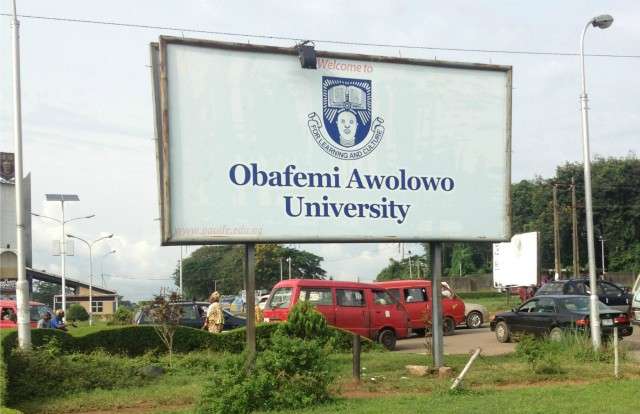
Authorities of the Obafemi Awolowo University (OAU), Ile-Ife, have dismissed a senior lecture, Adebayo Mosobalaje, from the institution over alleged sexual misconduct.

The senior lecturer was from the Department of English in the Faculty of Arts.

The dismissal was announced in a statement by the university’s public relations officer, Abiodun Olarewaju.

Mr Olarewaju said, “In its avowed determination to rid the University of any form of sexual intimidation, harassment and, or coercion, the Governing Council of Obafemi Awolowo University, Ile-Ife, has dismissed another lecturer who was found guilty of sexual demeanour against a female student.

“The decision to dismiss Dr. Adebayo Mosobalaje of the Department of English Language in the Faculty of Arts was taken by the University Council at its last sitting on Tuesday, September 7th, 2021.

“Having exhaustively deliberated on the report of the Joint Committee of Council and Senate, which investigated the case of sexual harassment against Mosobalaje, the University Council, unambiguously declared its zero tolerance to sexual harassment in any form or guise and, accordingly, applied the appropriate University sanctions for such an offence as contained in the University regulation.”

This is not the first time the OAU got enmeshed in the scandal of sexual misconduct between lecturers and students.

In 2018, a professor of accounting at the institution, Richard Akindele, was also found to have been involved in a sex-for-marks scandal, which got him fired from the institution.

Prof. Akindele demanded five-round sex from a student before he would pass her in a course he took. 

The news went viral after the student exposed him through their recordings in the course of their engagement.

Since 2018 when the story of sexual harassment allegations against a professor of accounting at the university’s Faculty of Administration, Richard Akindele, went viral, the institution has regularly been in the news for similar reasons.

Akindele, who the university dismissed, was also found guilty and sentenced to two years imprisonment following his prosecution by the Independent Corrupt Practices and Other Related Offences Commission (ICPC). He has since been released.

There is also the unresolved case of a lecturer of International Relations, Bisi Olaleye, and another at the school’s Centre for Distance Learning, Monday Omo-Etan.

China’s Reward of Enlightenment: A lesson for Nigeria

By Najib Ahmad, PhD.

Beyond doubt, you may have by now discerned that nearly everything you are using in your households, offices, and places of worship were made-in-China. A few weeks ago, I had a conversion with my friend and confidant, who told me that this China-made domination is manifested worldwide, even in Europe, where he lives. Hence, he no longer blames Nigeria for clinging to China-made products.

On another occasion, some German professors visited our research group (in China) two years ago. During lunch, one humorously told my former program supervisor that he thought even his shirt was made-in-China. We all laughed and continued eating. Unless you don’t know Germany, the European economic powerhouse, and the history of its industrialisation, this will startle you. Indeed, Germany is still technically capable and well industrialised, but Chinese products are ubiquitous there.

The question you may ask is: How did China achieve all this? I guess you are curious to have an insight into their progress. And how they catch up – sometimes even overtake or compete – with the most industrially advanced countries whose supremacy in this area was matchless within a short time? Their quest for financial power started ages ago, after the country’s opening-up in the 1970s by the then leader, Deng Xiaoping, otherwise known as the principal architect of China’s reform and significant foreign policy changes.

A former Emeritus Professor of Social Sciences at Harvard, Ezra F. Vogel, described the leader in his book, Deng Xiaoping and the Transformation of China, as the “man who most influenced China’s modern trajectory.” The central idea of his reform plans was nothing extraterrestrial. He only ensured that the ordinary Chinese population was enlightened (or educated) to the level they could create their path in a lifetime. He also superbly promoted China from “an agrarian society to the industrial powerhouse” (or manufacturing hub of the world). Beyond the shadow of a doubt, his projections have prospered in making China where it is today. The most important resolution was massive enlightenment. These resolutions have markedly shaped the trajectory of his policies to where they are today.

Provision of adequate and essential reading, writing, and good numeracy skills was the quintessence of the primary phase in their development journey. Thus, presently, you hardly encounter an older person who can neither read nor write or consider using a calculator for basic arithmetic summation (remarkable, right?). Although some reports show a few others are illiterates, especially in villages, it is a small percentage compared to the over a billion people who can. Moreover, there are all-women-operated shopping centres as the reform structure targeted women to prepare them for exceptional jobs. Many women work in hospitals now, especially in women-related matters.

The government of China sponsored children of low-income farmers and city workers to study in elite American and European universities. Some of these students specialised in sciences, applied sciences, technology, and other critical areas for China’s development. This scheme shaped the education development in China. At the same time, some of them remained in their newfound home. Today, five out of ten research papers from the European and American universities will have Chinese-sounding names. They are also in many places working on state-of-the-art science and technology. This was part of the product of the policies made on education about a century ago.

Many others joined various newly founded public universities and colleges all over China to teach and train young students. According to Statista, as of 2019, China has the largest education system globally, with 2688 public universities and colleges, a mixture of central (or federal), provincial (or state), and local government-owned institutions. Out of these institutions, 1,423 are higher vocational colleges. According to reports from the Chinese Ministry of Education, privately owned vocational colleges reached about 300 in 2021. Yet, they looked for more to provide jobs and ultimately boost the country’s economy.

In retrospect, you can see that China’s quest for economic supremacy started with excellent policies favouring education. It continues to this day. New policies were implemented and sustained in educating the society, for example, policies like a free nine-year compulsory quality education for primary and junior secondary schools.

Again, one of China’s leading, perhaps secret, ingredients for unprecedented technological developments is its total commitment to vocational education training at all levels. Vocational colleges (higher institutions) and vocational schools (secondary schools) have undoubtedly contributed to the record economic growth in China. They are the fundamental and out of sight driver and catalyst of their economy. They have produced craftspersons with skills that supported the country in job specialisations such as electrician, mechanic, computer technician, carpenter, tailor, beautician, chef, welder, fabricator, product designer, bus driver, and electric train driver, among others.

The government’s commitment to funding and sustaining vocational training schools have vastly invigorated the manufacturing capacity you see in China today. Subsequently, most foreign brands like Apple, Unilever, Nike, Zara, Mercedes-Benz, General Motors, and many more produce China-made products. The availability of highly-skilled workforce is another reason those brands go to China, among other benefits. Unfortunately, time and space will not permit me to mention them here. However, the reward of sound policies on enlightenment to a society and its propensity is ostensibly enormous. And above all, the government has significantly reduced poverty among its people and improved their livelihoods.

We can learn from the above that enlightening everyone, at least, to the level that they can read and write and get numeracy skills, even if it is in their native language. So doing is vital for the prosperity of society and the country at large. Sometimes, not everyone could have profound education. Suppose everyone you meet in the market, other places in Nigeria could read and write in their native languages. Undoubtedly, our growth and development as a society would be in a better direction than our current condition. Lack of these skills for everybody contributes to our lack of progress, absence of skilled workers, failure of industries, among other ills bedevilling our societies in Nigeria.

As the government is founding new universities year-round, they should consider establishing vocational colleges. As I see these days, the National University Commission (NUC) issue license to many private universities nationwide. Individuals can similarly step in to establish private vocational training colleges. It is not always that everything rests on the shoulder of the government. We need to take these few but critical steps to reset the collective societal future of Nigeria. Implementing them could set a new stage for self-directed youths equipped with the required skills to assist Nigeria’s economic growth, particularly at one of the worst phases of the country’s financial crisis, thanks to the coronavirus pandemic and poor governance.

Dr Najib Ahmad is a Postdoctoral Researcher at Shandong University, China. He can be contacted via namuhammad03@gmail.com.

Tuition hike: Fire from Kaduna to Niger

Ibrahim Yahaya

A proverbial Hausa dictum states that ‘If you see your neighbour’s beard go in flames, you should wet yours’. For instance, this can be simplified to mean that if you notice the car in front of you crash because of high speed, you should apply the brakes. Emphasis is on being cautious and proactive at all times. But that was not the case with the people of Niger State, at least in terms of action as Kaduna went ablaze.

When news broke out about the hike in tuition fees in Kaduna State, the internet went agog, followed by public uproar and protests. And…. as you would expect, nothing more than grouses here and there as parents were forced to comply with the increment or keep their wards outside the walls of the varsity.

The decision stood, despite the opposition, protests, and ‘aluta gra-gra‘. But, like an infectious disease, it has now spread its tentacles to the neighbouring Niger State. So much for solidarity, eh?

In the cold hours of Wednesday, 4th August 2021, another shocker hit the public space. This time, Ibrahim Badamasi Babangida University, Lapai, Niger State, followed suit in the tuition hike competition, with a staggering increment somewhat above 150%!

Where do we go from here?

The students are confused. The parents and guardians are even more so. There is fear that there would be a repeat of Kaduna State which appears to be the vanguard in the hiking tournament.

Agreed, education is expensive. But the same ought to be made affordable in the interest of social growth and development. No society prospers on gargantuan illiteracy, and none ever will. So, isn’t it ironical that a region (North) already struggling with many out of school persons and abject under-development is striving so hard to make education unaffordable? Does it make any sense?

For the umpteenth time, where do we go from here?

How can a state deem it fit to impose above 150% increment in tuition fee where the same state is struggling to meet the minimum wage mandate? For a while now, this same state has failed to pay 100% salary, for God’s sake. Look at Borno State, for instance; it is a region blighted by insecurity, yet they pay wages in full when due and equip their educational institutions with state of the art facilities without resorting to milk the lot on educational grounds. So what is wrong with Niger State, please?

It wouldn’t be long before conspiracy theories begin to fly here and there, justifiably. And, don’t be shocked to see the lot argue that an agenda is being pursued to deny the poor access to education despite it (education) being a fundamental human right. It is bad enough that graduates roam the streets without meaningful jobs. But, I hate to think of a scenario where those roaming the streets are aggrieved students compelled to drop out of school due to ill-advised policy/policies by those in the corridors of power.

Now that the fire has reached Niger State, our neighbours should better wet their “bear-bear” by supporting them to help persuade the government to reverse this increment.

This fire should be extinguished here and now!

Yahaya Ibrahim can be reached via yahayaibrahim006@gmail.com.