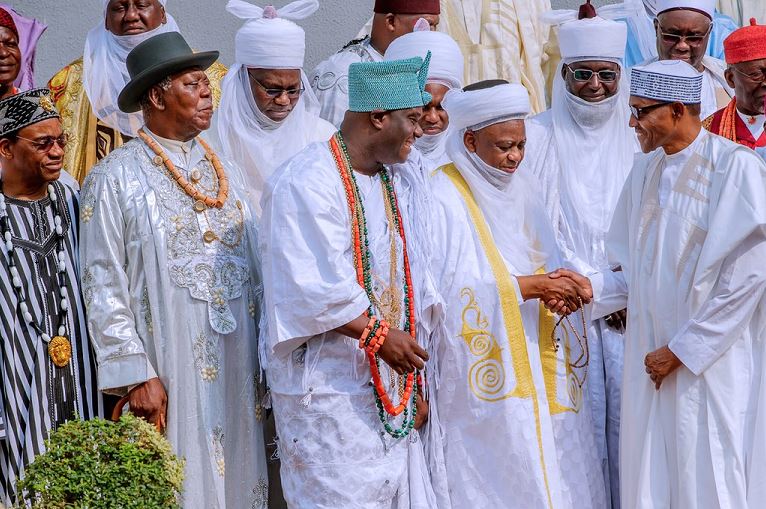
The need to revive our traditional institutions
By Usman Muhammad Salihu
Our traditional institutions are institutions built on the historical culture, norms, values, and religious beliefs of the said community, often led by an Emir, an Igwe, an Oba, and so on. Like almost all societies, Nigeria had witnessed times when traditional rulers effectively agitated the activities of their various communities, particularly prior to the arrival of colonial masters.
Although they have no formal power, our traditional institutions are well equipped and standard, allowing the colonial masters to wield effective indirect power, particularly in northern Nigeria, and to a lesser extent in the west, and ineffective in the east. This is because our traditional institutions are solid and effective.
Our Institutions suffered a significant decline, particularly after independence, as political office holders were elevated far above our traditional rulers — who mingle, co-exist, and know the needs of the community and the solutions to its enormous problems in most cases better than elective politicians.
The importance of these institutions cannot be overstated because they play a vital role in mediating and resolving minor conflicts, enhancing mutual identity, and serving as guardians of culture and tradition, among other things. Their opinions and commandments are held in high regard and respected by members of their various communities, as they are considered sacred in some communities.
They also promote peace, unity, cohesion, and harmonious relations as one of the government’s goals, especially among their various communities, which leads to rapid development. According to Joseph I. Igwubor, ‘traditional rulers are bridge builders that the government can use to cement existing relationships between different ethnic groups in Nigeria.’
The main factor pushing back our traditional institutions is the lack of clear roles for these institutions in the 1999 constitution, since also after the 1979 constitution failed to provide precise functions.
These institutions play essential roles in maintaining peace, security, and the rule of law in the country and also in achieving development goals, which is why they must be revived because they are closer to the people.
The government should enact legislation that will give these institutions constitutional recognition and support. This will allow them to discharge their obligations effectively. The government should also collaborate with these institutions on policy implementation. When they issue a resolution, the government should critically evaluate it and consider whether it is feasible to implement it in our contemporary society.
They must also be encouraged to help secure their respective domains. As grassroots leaders who are closer to the people, they may have some knowledge of community-related security issues, which, if handled with utmost importance and secrecy, will undoubtedly help reduce the threat of insecurity that plagues our country, as both government and traditional institutions will manage security-related issues.
Finally, when these institutions are revived and carried out constitutionally, they significantly impact issues of development in their various communities and security. As grassroots leaders, people hold them in high regard. Their followers regard them as cultural and traditional guardians, and their words are considered, respected, and held in high esteem. Therefore, these institutions are in an excellent position to provide lasting solutions to the problems that would set our country back if they were removed.
Usman Muhammad Salihu writes from the Mass Communication department, Abubakar Tatari Ali Polytechnic, Bauchi, Bauchi state. He can be reached via muhammadu5363@gmail.com.
