Students

Tribute to my dear friend, Abdulaziz Ahmad Adam

By Ahmad Deedat Zakari

The last time I saw Abdulaziz was on the evening of Tuesday, May 2, 2023. He was on the way to the sick bay supported by Waziri and Albani. Nasir, the NAMLAS president, was also in their company. A bike was eventually called upon to convey them there. Sadly, that was the last time I saw him in flesh and soul. In his infinite wisdom, the Creator has decreed that “every soul shall taste death.” And the time came for Abdulaziz on the evening of Thursday, May 4, 2023.

As Muslims, we believe and submit to the will of Allah. However, a week after Abdulaziz’s demise, I still live in self-denial. Everything seems too sudden, and I still wish it is a terrible nightmare. It’s somewhat unfathomable that he did not complete the examinations he so much prepared for and started with us. Like many final-year law students, Abdulaziz’s mind was already in the Nigerian Law School, and preparation was underway. His demise was the least expected way to say goodbye.   

I have known Abdulaziz since we assumed academic activities in January 2017 at the Faculty of Law. However, we became closer in our fourth year when we shared room 90 of Ali Akilu hostel. He would spend much of his time listening to scholars of comparative religion. Videos of Zakir Naik and the late Sheikh Ahmad Deedat dominated his phone gallery. He had an unquenchable thirst for the study of comparative religion, and he was ever ready to share this knowledge.

A week before his death, he had addressed us after morning prayers in Al-Muntada Mosque and emphasised the need to study comparative religion. He undertook to take the course to willing participants in the second semester.

Like many of us, Abdulaziz was a man with dreams for a great future. When we lived together, he narrated the ordeals that led him to study law after he completed NCE and became a certified teacher. That’s a pretty long story, but the bottom line is that he had a reason to work hard, and he worked very hard. He knew where he was going and what it took to get there, and he was set for the journey to greatness at dawn. Sadly but with gratitude to the will of the Almighty, his light was blown out in his prime.

Allah endears his loved ones to people. Abdulaziz was loved by many. This was evident in the crowd that graced his funeral. His teachers, colleagues, friends, students and even non-Muslims were all at Haruna Danja Mosque to bid him farewell. The love the people had for him did not end with him; it extended to his immediate family.

A few days after his death, classmates and friends raised more than half a million for his wife and the two children he left behind. I think he is loved by Allah, who perfected his character and made him the darling of everyone whose path he had crossed. He always met all of us with a cheerful countenance, and he was never known for engaging in frivolities. As much as this is my opinion, I am not subjective. My opinion about him would not have been different if he were alive. 

Abdulaziz will be missed for many reasons and by many people. He left a positive mark on the lives of many. The local chapter of the Muslim Student Society of Nigeria (MSSN) of the Faculty of Law will miss him dearly. He had been a committed official since his admission to the faculty and was committed till his transition.

Abdulaziz’s teachers and classmates will miss him greatly. He was an exceptional student who spoke and asked questions in class when necessary. I remember vividly how he was asked to translate Suratul Kafirun by Professor Danladi in our last Jurisprudence and Legal Theory class. Unfortunately, that was just two weeks from his unanticipated exit. 

He also left a vacuum to be filled at the Kongo Campus Islamiyya, where he taught Tawhid, amongst other courses. His learned brothers at the Student Bench and Counsel, who had appeared before him while he was Khadi of the student judiciary, will miss his judicial wisdom and excellent understanding of Islamic Law.

Besides his family, whose pain at this difficult time is unimaginable, Abdulaziz will be in our pleasant memories for a long time. As the reality of his death sets in, I feel his absence. May Allah forgive him, forgive us, console us and take care of his family, ameen

Why do students hate or fail mathematics?

By ImamMalik Abdullahi Kaga

Many students across Nigerian schools hate the king of subjects – mathematics. Mathematics is a subject that has application in most things, if not everything, in our life. Yet it is loved by few. Why?

The application of mathematics is there in every aspect of our life. Mathematics is crucial for industries, artisans, doctors, engineers, and many others. Yet, despite the vast and promising applications of the subject in our day-to-day activities, many students find it uninteresting. However, as a 200-level student, it is among the most straightforward and exciting subjects I enjoy. The reasons for the aversion towards mathematics include the teachers’ teaching methodology, students’ attitude towards the subject, poor reading culture, and lure of peer mates.                                                                                                                                                  

Some teachers (trained ones) employed to teach this almighty subject do not teach from the background. On the other hand, some are not trained and qualified to teach the subject. We cannot deny the fact that not all that are practising the noble profession of teaching are teachers. The majority have found themselves in the cause accidentally. This results in their inability to carry out the job correctly. It is becoming rare seeing a well-trained mathematics graduate teaching the students because the untrained ones are displacing them. And this applies not only to mathematics but to other subjects too. It is worrisome to notice that most of our schools produce students with a minimal or poor background in mathematics. The truth is that our schools are invaded by non-professionals parading themselves as teachers.                     

Students’ lack of seriousness and keenness on the subject cannot be over-emphasized. In this world of technology, students face many distractions which cause hindrances to their studies. Students nowadays are addicted to phones. They prefer surfing the internet and social media, playing games, watching the so-called series films, listening to music to devoting time to practising the subject. With this attitude, no student will perform excellently in this subject because mathematics requires constant practice.                                                                        

These days, students are not keen on their studies, so they barely read their books. In the past, students worked hard; some even read harder than their teachers. This helped them understand mathematics and other subjects, and then a holistic knowledge and solid background. Ours is entirely different. We hardly ever find students that have devoted keen interest in reading the subject in the six-year academic program at the secondary level. Still, they expect to score a credit pass in the subject.                                                

In some instances, fellow students discourage others in their crew from being focused on the study of mathematics in our schools. Some of the students in question, either out of sheer laziness or fear, would not devote their time and energy to the subject, which is one of the reasons for the mass failure in the subject in recent times. It is a fact that once a student hates a topic, he will equally hate the teacher, resulting in a large group of students who develop an aversion toward learning the subject. Another disturbing aspect is the influence of peer groups that lure others who might have an interest in this subject to go to games, parties and others. This has ignited lugubrious discouragement to others.                                                                    

Another disturbing aspect is the kind of textbooks used in schools. Unemployed folks searching for jobs plagiarize the works of hardworking researchers and sell them to schools. You will believe me that the books in circulation in various schools are full of silly pictures instead of extensive clarifications about the topics contained.

ImamMalik Abdullahi Kaga wrote from Borno State University via abdullahiimammalik@gmail.com.

ASUU strikes: Many students may opt to “yahoo-yahoo” and other crimes

By Ahmad Deedat Zakari

It is the grass that suffers when two elephants fight. This is the sad situation of students in Nigeria’s public universities. Students find themselves suffering anytime ASUU goes on strike.

The innocent Nigerian students bear the brunt of the impasse of the duo – the Academic Staff Union of Universities (ASUU) and the federal government. At the end of every fight for a better condition of service by ASUU, their remuneration is paid, but the students are left to compensate themselves for the time they lost and the emotional trauma caused by the strike.

As legitimate as ASUU’s demands may be, keeping students at home to pursue these demands does not appear logical to me. As for the government, their attitude reminds me of Gbemisola Adeoti’s poem, “Ambush” where the literary genius described the land using many metaphors to demonstrate how dreams are murdered.

Students dreams are unceremoniously halted whenever ASUU embarks on strike. Some lose interest in education altogether, and others continue with less enthusiasm. Clichés like ‘school na scam’ seems to then make sense and many students embrace crimes like cyber fraud popularly known with the sobriquet ‘yahoo yahoo’ as an alternative to education. This is among the many problems usually caused by strikes.

Adeoti was right in his poem when he said, “The land is a giant whale that swallows the sinker, with hook line and bait aborting dreams of good catch fishers turn home at dusk blue peter on empty ships” Many students often try to escape this land that consumes dreams, they seek education in small neighbouring countries like Togo, Niger and Ghana etc. Some stay back to attend private universities they can afford while politicians and wealthy people send their children to Europe to get education. ASUU’s strike is not only demarketing our public universities in Nigeria. This attitude slowly kills the dreams and the universities, as anyone with a choice will not consider the option of attending one.

ASUU’s strike put students at a disadvantage in the pursuit of their progress, happiness and other life aspirations. It causes them unnecessary delays. They watched their peers in private universities graduate and take on the next steps in their lives while they are consoled with the saying that God’s time is the best. The Nigerian student is often stared in the face with the reality of George Orwell’s saying that “All animals are equal but some are more equal than others. A country that is seemingly careless about the education of its people is breeding the ground for poverty and crimes.

Quality education is no doubt the key to the greatness of any nation. But, sadly, it is not on the priority list of our leaders. While the government takes the most considerable blame for why universities are always on strike; we cannot wholly excuse ASUU for their complicity in killing the university education in Nigeria by going on regular strikes which often leave students stranded and confused.

Please ASUU change your strategy, we suffer every time.

Ahmad Deedat Zakari can be reached via ahmadzakari111@gmail.com.

Parents, students plead to FG as ASUU mulls over fresh strike

By Uzair Adam Imam

Students and their parents are worried as the Academic Staff Union of Universities (ASUU) threatens to embark on a fresh indefinite strike.

Recall that ASUU suspended its nine-month-long strike in 2020 after reaching an agreement with the Federal Government. Still, after a year, the government is yet to fulfil its promises to the union.

The ASUU’s strike has been described as one of the most lingering issues that has been paralysing Nigerian universities, leading to the delay in students’ graduation and the deterioration of the education system in the country.

Not only that, many people argue that the strike has destroyed the future of many promising youths.

In a statement on Thursday, the Chairperson of ASUU Kano State Branch, Comrade Haruna Musa, and the Union’s Secretary, Comrade Yusuf U. Madugu, declared Monday, February 7, 2022, as a lecture-free day.

Its essence is for ASUU to use the day to sensitise university students, parents and other stakeholders on the brewing crisis arising from the Federal Government’s failure to implement the existing agreements with the union judiciously.

Educational sector at the receiving end

A lecturer at the Department of Nigerian Languages, Bayero University, Kano, Dr Muhammad Sulaiman Abdullahi, said that the strike was killing the country’s educational sector and the economy.

Dr Abdullahi cried: “It is a sad development. It looks childish and an endless menace, especially to the Nigerian educational system. Strike has become a thorn in the flesh of Nigeria’s general development. No nation can prosper morally in such a nasty situation. It is, indeed, unfortunate.”

He added that the situation “generally makes people, teachers, students and their parents to become very dull and uncertain of their future. You can take it to the banks that crime rate will somersault, and new bad things will manifest within the wider community”.

Students at risk

The president of the Mass Communication Students Association (MACOSA), Bayero University, Kano chapter, Comrade Sadisu Sada, decried that industrial action in Nigerian universities had been there for quite a long time.

He said, “It is worrying. The issue affects students directly. And for me, the government is to blame.

“ASUU is doing her best to give the educational system all that it requires. If not, education would have died.”

Umar Isah Dandago, an undergraduate of the Department of Mass Communication in the university, also voiced his grievance, saying this would delay his graduation.

Dandago said: “We would have graduated if not for the 2020 strike. This is a serious problem. A lot of people want to do something, like setting up a new business after university, but because of the strike, it’s becoming almost impossible.”

He, therefore, urged the Federal Government to give ASUU what it demanded, saying, “I believe it’s not even half of what’s being squandered in some things that are not important to us. So let’s get the education we deserve as Nigerians so that we’ll be proud of our leaders and our country.”

Also speaking, Comrade Ibrahim Mukhtar Sulaiman, a level 300 student, said: “Sadly, students taking a four-year course will graduate in five, six or seven years. And this affects not only their academic careers but also their personal life.”

Parents raise alarm

As the strike looks imminent, some parents lamented that the brewing crisis between the government and ASUU jeopardises their children’s future.

A parent, Malam Adamu Kolo, who looked disturbed by the imminent strike, said that his son would have graduated if not for ASUU incessant strike.

Malam Adamu Kolo said, “My son would have graduated this year if not because of ASUU incessant strike. You can see that I am poor. I am hopeless. Our hope is on this boy.”

Orientation for fresh students

ByBilyamin Abdulmumin

At the beginning of a new session, usually from this period that many schools release admissions, fresh students often in the euphoria of the admission have their optimistic bar in full scale. Everyone has a plan for a result they want to graduate with, perhaps for what lies ahead: the labour market, scholarships, or any other opportunities.

But at the end of the study, looking back from the beginning, the dreams of a majority cannot be said to have been achieved. Although much potential would have been blown along the journey, few fittest would survive the perilous journey unscathed.

But there’s good news; having orientation at the right time, tutorials, mentorships, attendance, references, and past questions can help the freshers’ yearnings come true.

Fresh students come to meet arrays of tutorials from which one has many to choose. The school associations at the departmental, faculties, or states deem it their responsibility to provide headway for the newcomers. The religious bodies are also offering among the best tutorials on the campus. As a new to the environment, there could be so many areas of distraction, but tutorial venues should always be among the focal points. 

Like tutorials, studying past questions gives the 1-million-dollar idea about courses and the length and breadth the lecturer can go with questions. Past questions accord a student with knowledge for how the same question can be asked. These save a lot of time during the actual exams, even if exact questions are not asked. Past questions help students develop ideas on how to go about answering some questions. With past questions sufficiently studied, the student can deliver a marking scheme.

One should belong to the right group of friends. If you want to go fast, go alone, but if you want to go farther, go with others. Interacting with some coursemates more prepared offers a chance to leverage from them. Many students who attend extra moral studies such as Zaria refresher or similar are friends material. Students who participate in such programs are usually ahead of what lies ahead.

References are another goldmine when it comes to smart study. Reference implies the materials, especially the book (s) a lecturer uses. In class, you hardly get the average gist of a lecture, and you might already jot down a chunk of a mix-up. Reference is the undiluted notes that would allow a comprehensive digest of the lecture. In other words, references are like having the original copy of a story. It helps you go through the story without interfering with anyone else’s opinion.

With regards to exams, references can be the holy grail. One of my undergraduate memories came in 300 Level. One Chemistry course from the Chemistry Department made students decry to high heaven. To make matters worse, the course coincided with a hectic day for us; it was offered after six hours of laboratory work. But this is not to justify the massive failure that followed. One of the notorious test questions that led to the catastrophe happened to be examples from a particular textbook – Castellar, I think – the reference I couldn’t lay my hands on at the right time. I passed the course with credit, but I always remember the scenario with my index finger bitten, hoping in retrospect that I had read the book (reference) just at the right time. Having a lecturer’s references is reassuring because, with it, you have your lecturer on the palm.

The most important tip that a student can take to the bank is attendance. Imagine getting information from chains of narrators. Usually, the integrity of the information fades as it cascades down from one narrator to another. It is safe to compare this scenario with missing a class. Even if one attends a class, it is not plug-and-play. So, the hope of understanding the lecture becomes blurry when a student copies from another who basically writes his side of the story. If you decide to rely on friends’ notes, the chance is that you tell a different story from that of a lecturer. Hence, you shall get ready for angry-looking results. 

Bilyamin Abdulmumin is a PhD candidate in Chemical Engineering at ABU Zaria. He is also an activist for a better, informed society.

FCE Yola shuts as students protest over water, electricity

By Adamu Ibraheem Jimeta

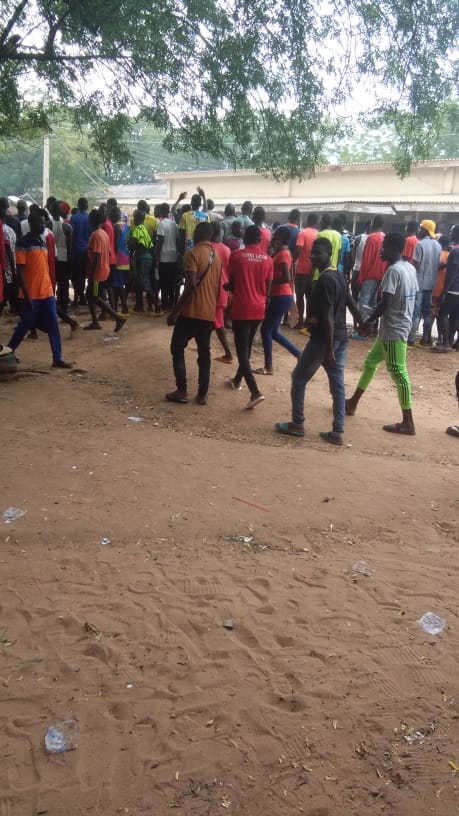
There was pandemonium at the main entrance of the Federal College of Education, Yola, on Tuesday,  October 26, 2021, when students blocked the college entrance protesting a two-week total blackout of electricity and water supplies in the college.

The protest, which started as early as 7 am, grounded academic activities as students and lecturers were denied access to the college.

According to the protesters, they have opted for the protest as their last resort as all pleas to the management to intervene in the incessant problems of water and electricity supplies fall on deaf ears.

Speaking to our correspondent, a level 300 Education/English student who prefers anonymity told The Daily Reality that for over a week, there was no water nor electricity in the college. He said, “Living in the hostel with no water and light, lecture theatre with no electricity supplies for over weeks have been excruciating.”

He said the Students’ Union Government (SUG) has not lived to the expectations and welfare of the students. He called on the management to take drastic measures that would bring these problems to an end.

Responding to the accusation by the students, the SUG President, Comrade Sulaiman Abdullahi, told our reporter that his administration has been running around over the problem. “We have had a meeting with the Acting Provost, and he has assured us that the management will fix the problem. Even yesterday, I spoke with the provost on phone, and he said he has arranged a tanker that will start supplying the college effective from today, Tuesday. Therefore is not true that we have not done anything about it,” said the SUG president.

All efforts to speak with the Registrar of the college, Malam Gidado Ahmed, proved abortive during filing this report. He earlier told The Daily Reality he was in a meeting and promised to get back to us but, he didn’t reply to the messages and calls put to him by the reporter before going to press.

It took the intervention of a joint task force of soldiers, mobile police and men of NSCDC when the protest escalated to burning tires within the school premises. The JTF fired gunshots in the air and dispersed the protesters.

In a related development, the management of the Federal College of Education, Yola, has announced the closure of the college. In a circular signed by the Registrar, Ahmed, it was stated that after its emergency meeting on October 26, 2021, the management has reviewed the situation on the ground and resolved to close the college immediately.

Students are given up to 10 am to vacate the campus, the circular added.

Tertiary institutions students to be supported as CBN donates N500 grant


By Uzair Adam Imam

The Central Bank of Nigeria (CBN) has earmarked N500 million grant to the universities and polytechnics in Nigeria.

CBN said that the effort is to help the teeming youths in tertiary institutions to promote entrepreneurship and also reduce unemployment.

In the report titled: “Guidelines for the implementation of tertiary institutions entrepreneurship scheme”, CBN made this known on Wednesday

“Five top Nigerian polytechnics and universities with the best entrepreneurial pitches/ideas shall be awarded as follows: first place – N150m; second place – N120m; third place – N100m; fourth place – N80m; and fifth place – N50m,” it said.

According to the guideline, the aim of the scheme is to promote access to finance by undergraduates and graduates of universities and polytechnics in Nigeria.

Students will be help with innovative Entrepreneurial and technological ideas to enable them build their future.

The guidline added that Individuals will be entitled to a loan limit of N5.0 million to be paid within the maximum period of 5 years at an interest rate of 5 percent for each year.