Self-reliance

Fancy pigeon’s feathers of fortune 

By Fatima Ishaq Muhammad 

Pigeon breeding is one of the oldest forms of aviculture, with records dating back to ancient civilisations in Mesopotamia, Egypt, and Rome. Among the most captivating branches of this practice is the breeding of fancy pigeons—birds selectively bred for their unique colours, feather structures, size, posture, and overall appearance. Today, fancy pigeon breeding has become both a cultural heritage and a thriving hobby, attracting enthusiasts worldwide.

Fancy pigeons are descendants of the rock dove (Columba livia), the common ancestor of all domesticated pigeons. Over centuries, breeders have cultivated distinct breeds by emphasising certain traits. This has resulted in hundreds of recognised fancy pigeon varieties, such as the Jacobin, known for its feathered hood around the neck, the Fantail with its dramatic tail spread, and the Frillback with uniquely curled feathers. Each breed reflects aesthetic beauty and the artistry and dedication of generations of breeders.

As a Kano-based breeder, Sabiu explained in an interview, “In the past, pigeons were just part of household compounds. Now, they are a symbol of prestige and creativity. People take pride in keeping rare and beautiful breeds.”

According to Ibrahim, a breeder, “Breeding fancy/exotic pigeons requires patience, knowledge, and attention to detail. There is a need to carefully pair birds to enhance specific traits, whether it be feathering pattern, body posture, or head structure. Another thing is Proper housing, nutrition, and clean loft management are essential for maintaining the health and vibrancy of the flock.” Breeders also keep detailed records of lineage to avoid genetic weaknesses and to preserve the purity of each breed.

The practice of breeding fancy/exotic animals in Nigeria is not without challenges. Muhammad, a breeder and seller of fancy/exotic pigeons in Sabon Gari market, explained that Issues such as genetic disorders, disease outbreaks, and environmental stress can threaten the pigeon population and quality. He said, “This also affects the pricing. He added that the time and financial commitment required to maintain healthy and well-bred birds can be demanding”. 

However, dedicated breeders often view these challenges as opportunities to deepen their skills and ensure the sustainability of the hobby. The passion continues to thrive. For many breeders, the joy lies not only in competition but in the daily routine of nurturing and admiring their birds.

Fancy/exotic pigeon breeding has become a source of livelihood for many Nigerians. Depending on the breed and quality, a single bird can sell for anywhere between ₦30,000 and over ₦200,000, with pairs fetching even higher prices. Kano-based breeder Suleiman explained, “In the past, pigeons were part of everyday compounds. Today, a single rare pigeon can pay school fees. They are more than pets—they are investments.” Rare, imported varieties or well-bred local stocks are in particularly high demand. Breeders often generate income through:

Sales of pigeons both locally and across state lines, Breeding services like pairing and hatching rare breeds for clients and supplying loft materials and feeds as more people take an interest in pigeon keeping. As a Kaduna breeder shared, “Some people underestimate pigeons, but they can generate a steady income. A well-managed loft can sustain itself and even support a family.”

With more young people entering the hobby and the growing visibility of pigeon markets on social media, the future of fancy pigeon breeding in Nigeria looks promising. Breeders now use platforms like Facebook, Instagram, and WhatsApp to advertise, sell, and network, expanding their customer base beyond their immediate communities. 

For many Nigerians, fancy pigeons are no longer just a hobby—they are an investment and a path to financial stability. The sight of a well-bred Fantail or Jacobin in a loft is not only a mark of beauty but also a reminder that even tradition can evolve into opportunity.

Advocating for Africa’s economic self-reliance

 By Umar Umar Namadi

Africa faces significant challenges from declining global aid and economic transitions, as highlighted in the Africa Policy Research Institute (APRI) publication, “The African Union vs ‘the End of Development.'” The report stresses the urgency for Africa to achieve self-reliance, innovate financially, and ensure the success of the African Continental Free Trade Area (AfCFTA) to achieve Agenda 2063. 

Navigating Reduced Global Aid:

Africa’s longstanding reliance on external aid for development is increasingly unsustainable. Recent trends show a significant reduction in aid from traditional donors. For example, UK development aid to developing nations has dropped sharply since 2019, with cuts of 55%, 49%, and 49% for Least Developed Countries, Lower Middle-Income Countries, and Upper Middle-Income Countries, respectively. This decline necessitates a strategic pivot towards self-sustaining financial strategies.

Enhancing Economic Freedom:

One effective way to mitigate the impact of reduced aid is to enhance economic freedom within African nations. Research consistently shows that countries with higher economic freedom experience more robust economic growth. Botswana is a prime example, where market-friendly policies have led to significant economic advancements. By improving economic freedom across the continent, Africa could attract essential foreign direct investment (FDI), which brings in capital, technology, and expertise critical for development.

Focusing on Education and Human Capital:

Investing in education is another crucial strategy for fostering self-reliance. The APRI report highlights the strong correlation between higher educational attainment and economic freedom. By enhancing their education systems, African nations can equip their populations with the necessary skills to drive economic growth and innovation, thereby addressing the continent’s long-term job creation needs. A well-educated workforce is pivotal for adapting to and harnessing new technologies and sustaining economic progress.

 Prioritising Strategic Autonomy and Intra-African Trade:

The successful implementation of the AfCFTA is fundamental to Africa’s economic integration and growth. This trade agreement could reduce dependence on external markets and bolster intra-African trade, leveraging the continent’s collective strengths. The African Union (AU) must prioritise AfCFTA’s implementation, ensuring it is shielded from geopolitical and economic uncertainties. By fostering intra-African trade, the continent can create a more resilient and self-sufficient economic bloc.

 Tapping into Intra-African Strengths:

Beyond the AfCFTA, Africa must look within to tap into its collective strengths. The AU should promote policies encouraging collaboration between African nations, focusing on sectors where the continent has a comparative advantage. This could include sectors like agriculture, mining, and technology. By building robust supply chains within the continent, African nations can reduce their dependence on external markets and create more resilient economies.

Innovating Financial Strategies

In the face of declining global aid, African nations must innovate their financial strategies. This could involve tapping into alternative funding sources, such as diaspora bonds, sovereign wealth funds, and public-private partnerships. Additionally, enhancing domestic revenue mobilisation through tax reforms and improved financial management can provide the necessary funds for development projects.

The Role of the African Diaspora

The African diaspora represents a significant potential source of investment and knowledge transfer. By engaging the diaspora community through targeted policies and initiatives, African nations can attract investments and leverage the expertise of Africans abroad to drive development. This includes creating favourable investment climates and incentivising diaspora engagement in local economies.

Conclusion

The future of Africa hinges on its ability to adapt and innovate in response to global challenges. African nations can chart a path toward sustainable development by promoting economic freedom, investing in education, and focusing on strategic autonomy. The AU must spearhead this initiative, proving that Africa can drive its growth despite the global narrative around “the end of development.” The continent’s progress depends on pragmatic strategies emphasising self-reliance and intra-African collaboration.

Umar Namadi wrote via namadijunior@gmail.com.

Engausa Global Technology Hub launches library to enhance reading culture

By Uzair Adam Imam

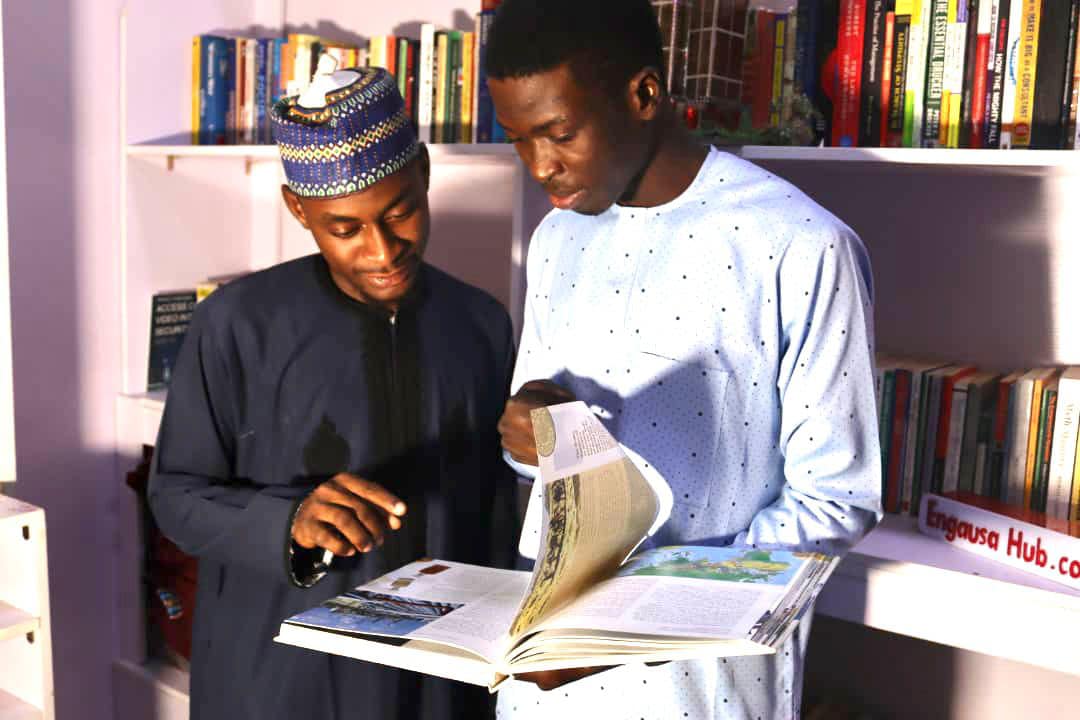
Engausa Global Tech Hub (EGTH) has launched a library to enhance lifetime reading culture among youths at its school premises in Kano State, Nigeria.

The founder and chairman of the technology hub, Engineer Habu Ringim, disclosed this in a statement he made available to journalists on Saturday. 

Ringim said the library is named Maisuga Ringim Library and has both hard and soft copies of reading materials for the apprentice of the technology hub. 

He also stated that the Maisuga Ringim Library project aimed at bridging the wide gap between academic and vocational education in society.

He further explained that the effort was to break the barriers of language impeding the cognitive aspect of learning in almost all African education systems. 

The statement read, “Launching Maisuga Ringim Library is a big step towards cultivating a rational lifetime reading habit among our youths by making the scarce library resources available to our apprentices at both entry and professional levels of learning hard and soft skills.

“The main objectives of EngausaHub.com, as our motto reads, ‘breaking barriers and bridging gaps’, is to entrench an inclusive technical skills acquisition and entrepreneurial skills among our teaming youths, against all language barriers and technical gaps bedevilling the human capital development at the grassroots.

Engausa was founded in 2019 and has recorded numerous successes in teaching people various scientific and technological skills to depend on themselves and become employers of labour.

The Daily Reality recalls that over two thousand people, including university lecturers and students who have never had formal education, such as Almajirai, graduated from the Engausa Global Technology Hub just recently. 

The graduates were trained in various skills to become self-reliant and job providers.

What next after NYSC?

By Fatima Usman

During their compulsory National Youths Service Corps (NYSC) scheme, many people don’t usually ask themselves, “What next after the service year”? Many people know what they want and what to do, but they don’t have any concrete idea of what they want or even what they want to do.

But now, the service year is over. For many, the reality will face them right in the face, NO MORE ALLAWEE (33,000 stipends). As small as this money is, it will become gold to many who could not find a job after some months of completing service.

The scheme’s purpose is primarily to inculcate in Nigerian youths the spirit of selfless service to the community and emphasize the spirit of oneness and brotherhood of all Nigerians, irrespective of cultural or social background. This is because the history of our country since independence has indicated the need for unity amongst all our people and demonstrated the fact that no cultural or geographical entity can exist in isolation.

The Joy of every student is to see that they graduate and serve their father’s land without minding the stress they passed through while in the school, but then what next after the one year of NYSC? This is the question many people ask themselves while still on camp, but when you know the answer to it, you are good to go, and vice versa.

After the service year, you are faced with the next phase of life. Some very lucky ones will get a well-paying job or will further their education, while others may have to start all over again after the 33k allowance must have stopped coming.

Back in the day, when a person graduated from tertiary institutions, there was a high tendency that such a person would get a well-paying job without any stress of going to look for a job, but now the case is different. Many students are scared of even leaving the NYSC because they know that there’s no job.

Millions of graduates with outstanding results out there are looking for white-collar jobs, but the country doesn’t have jobs to give everybody. Thus, you should try as much as possible to acquire one or two skills that can be of help after your service year. Don’t wait to finish NYSC before you start thinking of what to do next. Before you even go into NYSC, ask yourself these questions:

What is life after NYSC?

What am I going to do after NYSC?

How am I going to start with life?

When you know the answers to these questions, you are 50% on the track. Today’s world requires us to do more than going to school or graduate with good grades.

Don’t be carried away by the title “graduate”; get yourself something doing. If you have a skill already, develop it; start from small. Yes, it’s pretty stressful, but you will reach that goal with determination and hard work.

Many people who are now successful today passed through a lot, but today they are doing fine. So if those people can do it, there’s no excuse for you.

Fatima Usman is a 300 level student of mass communication at IBB University, Lapai. She can be reached via usmanfatima499@gmail.com.

My life, my choice: Why I rejected university job for catering (II)

By Aisha Musa Auyo 

Coursework lasted for four months. I enjoyed it as it’s Psychology, and got excellent results. But I couldn’t go back as planned, as I had already enrolled my kids in school. I complained to my parents about my lack of a job and how relatively boring it was to stay without my husband. They promised to do something about that. I ventured into the catering business full-time while my husband and I were still making plans to reunite. Fortunately, another transfer was by the corner, so the goal is to wait and see the posting. Living alone was getting harder for him and affecting his work productivity. No man wants to go home to an empty house. No man wants to be eating out every day; the inconveniences are just too numerous.

On my side, I felt empty and taking care of the home and raising the kids alone was taking a toll on me. He could only come once a month and spend two to three days. His kids saw him as a stranger. Although we were constantly on video calls, it’s not the same as being present.

An opportunity for a university job came, but I rejected the offer, explaining that we were leaving as soon as the transfer came out. The one and half years we did apart as couples have taught us never to try that again; I’ve changed my decision on work. I called my husband, told him about the offer, and made it clear I was not accepting it. He advised I should not do anything hasty, but I remained unshaken. Any job that would tie me to one place and make me apart from my husband is not worth it. At that time, the transfer came out, and the location was not travel-friendly. His workload too would not allow unnecessary travel, so the job is a big No for me. 

However, People judge from afar and couldn’t hide their disappointment of me not working in a cooperative world. A neighbour looked into my face and told me, ‘if you reject the job because of your husband, I swear you will regret this decision’.

 I was not saying I would not work outside my kitchen, but whatever my work is, it shouldn’t be the one that would split my family apart. One should not be surprised if they see me working outside home tomorrow if the work was within the place I stay and can offer transfer whenever we are made to leave the state. So, yes, my future work should revolve around my husband’s work state.

But for now, I choose catering, and I decide to do what works for me. Who knows it, feels it. Those who mattered have accepted and made peace with my decision. The challenge now is balancing the catering business with my PhD thesis.

Let me explain why my parents want us to pursue these degrees. They are university professors, have few kids, with guaranteed pension and gratuity. So, they don’t need any financial help from us. But they want us to be independent and financially stable. In addition, they want us to be highly educated and respected. As parents of girls, in this era of divorce, irresponsibility, and many life uncertainties, they know the best they could give us is this education.

Our parents often tell us that they’re not rich; they won’t leave us with mansions and millions when they die. This education is the only legacy they have, and I understand them. The University environment does that to its inhabitants. This is a general problem ‘we quarters’ children’ face.

A neighbour of mine whom we came from the same quarters made a similar decision not to work or further her education. She told me how her dad used to compare her to coursemates, that they’re all PhD holders now and doing great things in the university. Thus, he always begged her to at least further her education. To our parents, a bachelor’s degree is never enough.

To say I’m grateful to my parents is an understatement. Wallahi, I often cry, knowing I can never pay them for all they did to me. They’ve given and are still giving me the best of everything; we are over-pampered. We are the envy of our peers, and we have achieved so much at young ages due to their persistence and guidance. It’s not only Boko (Western education) they gave us; they also ensured all of us have memorised the Quran at young ages and have attended multiple Islamic schools and conferences.

Moreover, they have our best interests at heart; they are even overprotective. So I’m not only grateful, but I always feel indebted. All I do is pray for them to have the best of here and hereafter. Now, this story is history as I’ve eaten my cake and still have it. I’m doing my PhD while my family have been reunited. A postgraduate program is temporary and flexible. I’m glad I followed my parents’ advice, thanks to them, I’ll be a young Dr soon inshaAllah.

The lessons here are:

1. Allow, guide and encourage children to follow their dreams and passion. The result is a win-win, as parents won’t have to push the kids to work or study hard. Passion naturally breeds excellence.

2. Don’t make or set life goals too early. Be open-minded. The definition of success is very dynamic. Our dreams can change as we advance in age and transition from stage to stage in life.

3. Accept people’s decisions even if you have power over them. Just pray, and let them face the consequences. If it turns out good, that’s great. If it turns out bad, that’s a lesson, not a failure. All decisions are born from real-life experiences and or reading that change one’s line of thinking or learning an idea somewhere that sparks one’s interest in something.

4. When your passion is what you do for a living, your life will be happier thus healthier. The fulfilment and peace are on another level.

5. Diversify your knowledge and skill. Don’t just dwell on a single niche and plan your life around that. Don’t pigeonhole your thinking into believing that “I am a civil servant” or “I am a business person” and nothing else. It’s too dangerous. Life is dynamic; even if you chase degrees, learn a skill or trade. Government jobs are not guaranteed. Priorities also change, especially for women. For instance, my catering business has never been affected, even though I’ve been moving around. Cooperate jobs will not have been this flexible. 

6. Read, read, and read. Learn, unlearn, and relearn. Reading is an art that teaches one about life beyond their daily reality. Reading could help you avoid many problems, crises, and misunderstandings. Reading changes one’s outlook towards life makes one understand himself, those around him and the world better.

7. People should learn to mind their business and respect other people’s choices. Every individual is entitled to their decision. Making derogatory comments, asking personal questions, or judging based on half-baked information hurts. Many people think my husband, as an Ustaz, dictates my decision to be a housewife for now. On the contrary, he supports, pushes, and encourages me to work hard on my school projects. When I told him about the university job offer, he was willing to sacrifice. I single-handedly decided to reject it. He promotes my thesis and business on their tv channels. He pays for my air tickets whenever I need to see my supervisor and lots more.

8. Sometimes, one needs to stand firm on his decision, especially about his own life. Sometimes, one needs to put himself first; it’s not selfishness.

9. A married woman can actualise her dreams, career, and aspirations with a husband’s support.

10. To achieve greatness, one needs to make sacrifices. Success has never been achieved without struggle.

Finally, and most importantly, pray hard for God’s guidance on whatever decision or journey you want to embark upon. With a clean heart and good intentions, trust Allah to be always there for you.

Aisha Musa Auyo is the CEO of Auyo’s Cuisine and wrote from Abuja. She can be contacted via aishamuauyo@gmail.com.

My life, my choice: Why I rejected university job for catering (I)

By Aisha Musa Auyo 

Today, as a wife and mother, my definition of success is being an excellent homemaker that nourishes and nurtures my family in the best way possible. I want my topmost contribution to the world to be a set of individuals who are peaceful, loving, respectful, intelligent, honest and hardworking people. I want to be more successful as a homemaker than in school. I want to be always there for my family, not relying on others to discharge my primary responsibilities. Today, this is my priority!

In the world of academia, nothing counts better than degrees and working in the university. I was born and brought up in that world. My parents are academics, and their dream for us is to have as many degrees as possible and as early as possible. We know nothing but books. And lucky enough, the books love us.

I finish secondary school at 16 and my bachelor’s degree at 20. I wanted to be a doctor like every brilliant student, but life had it; I had a chronic ulcer in my teenage age. Thus, I was always in and out of the hospital. That ailment made my dad change his mind about letting me study medicine. He said he couldn’t stand seeing my dream and hard work being crushed by (University) Senate committees because I was sick and couldn’t write or pass medical school examinations. “I’m in the committee for years, and I know these things”, he told me.

That’s how I was advised to study education. It was not what I wanted, so I wrote exams to pass, not to fail. I graduated with a 3.46 CGPA, below almost everyone’s expectations. I’m always known for acing my exams. The least they expected from me was 2:1. I learned not to do what I didn’t want from that result, never again. It’s either “A” or nothing. 

I have a passion for cooking, and it’s known to everyone around me. So, after graduation, my mom enrolled me in a catering and hospitality management program –to ‘kill’ time before the mandatory National Youth Service Corps (NYSC) scheme. I gave that program my all and finished with an excellent result.

I got married a few days after my catering program. The plan was to live in our state, but my husband was transferred to another state two weeks after marriage. So, NYSC came, and I was posted to my home state as planned. However, I was alone, and my husband had to travel to and fro every week to his place of work and his new bride. It wasn’t easy on us, and we decided to stay together after service.

But before finishing my service, my parents advised me to register for a master’s degree. So, I started lectures a few days after my POP. Unfortunately, this delayed our decision to stay together with my husband, as we are constantly travelling to meet each other whenever we have a break in school and work, respectively. Fortunately, the master’s coursework is an 8-month program. So, I left the state immediately to settle with my husband, coming to school every month to see my supervisor. But this time around, I decided to study what I wanted.

I had to convince them that I couldn’t give it my all if it were something I didn’t like. Let’s negotiate; you want master’s, huh? Let it be something I like so that I’ll bring you the “As” you always want, I said to them. My parents wanted me to major in Biology, but I wanted Psychology, as it’s the only thing that caught my interest in education. It’s the only thing close to my medical career dream. Thus, I studied it with passion and graduated with First Class honours!

At 22, I was the youngest and the only one without a job in our class. The result proves to me passion breeds excellence. Kiyosaki’s Rich Dad, Poor Dad, and Angela Duckworth’s Grit taught and encouraged me to make employment out of what I love. They taught me how working on one’s passion can bring money effortlessly. I learned and practised making money out of what I love – cooking. Catering allows me to work in the comfort of my home, regardless of the location. People must eat anywhere, and many of them appreciate good food. Nonetheless, this passion of mine generates controversies.

Since I was young, those who have known me always thought this girl’s future was in academia. She’s a bookworm, brilliant, etc. So, they’re disappointed; such a waste of intelligence! Some bold ones even ask why I don’t work. Won’t your husband let you work? Why are you furthering your education since he will not let you work? Why continue wasting time, energy and resources on school if you don’t want to work? This and that.

Back to my academic life, I continued travelling from where I stayed to where I schooled, and vice-versa for my thesis until another transfer came – too far away location now. At that time, I was almost done with my master’s thesis as I was waiting for external defence. I had to wait for good eight months before I was called. Travelling from the new location to the university was far and stressful, as one had to travel by air.  So, there’s additional strain on travelling and financing. I had two kids then, and I travelled with them whenever school called.

We went for the viva, which was so relieving. At least now we can rest, I thought. A few weeks later, my parents advised me to register for a PhD. I tried to convince them that the distance was too much, promising them that I’d do that whenever I settled in one place, not now that I’m on the move. I also told them PhD was for those with a career in academia and that I was not working yet.

Moreover, a PhD is expensive, and I have never seen a self-sponsored unemployed candidate doing that. I even argued that at 26, I was too young for a PhD. But no, they would not hear me. I didn’t want to hurt them or make them think that I put my husband before them; I applied. They were delighted.

I went for the aptitude test, and my score was high. I was ranked the second-best; my admission number is 00001—the first to be given admission that year. But deep down, my husband and I were not comfortable with the decision. We thought it was too early to be living apart as our marriage was still young, less than ten years. Within me, I have this fear of what would happen to my marriage? Should I leave my husband and come to pursue worldly degrees? It’s not like he failed in any of his responsibilities. He is, in fact, the one sponsoring the PhD.

Being in the barracks has opened up my eyes to the realities of life. Sadly, gentlemen turned to womanisers due to a lack of family around. I have seen how northern Muslim men change or are lured and tempted by the evils of the world. I have seen many scary things that I had never thought could exist or happen. Even though living alone should not be an excuse for their behaviour, their bad behaviour couldn’t have escalated to that level. I vowed never to leave my man at the mercies of those home breakers, so I planned to go back immediately after coursework.

Aisha Musa Auyo is the CEO of Auyo’s Cuisine and wrote from Abuja. She can be contacted via aishamuauyo@gmail.com.