Tesla Demonstrates Flying Roadster Prototype, Targets 2028 Production
By Sabiu Abdullahi
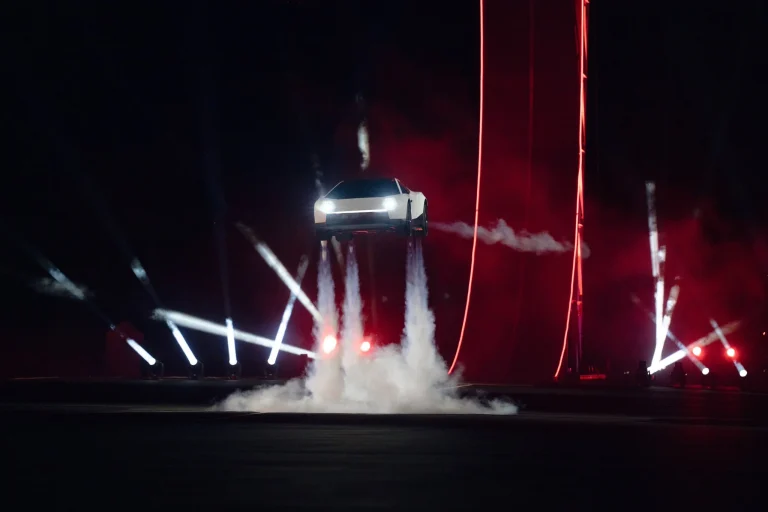
Tesla has showcased a prototype of its next-generation Roadster sports car, featuring technology designed to lift the vehicle briefly off the ground, as the company targets production in 2028.
According to CNN, the demonstration took place on Thursday at a SpaceX testing facility in Texas, United States. The 2-seater vehicle reportedly performed several manoeuvres, including driving upside down before making a brief airborne movement.
The prototype operated without a driver during the test. Tesla chief executive Elon Musk explained that the precaution was necessary to protect people during the demonstration.
“to make sure we don’t kill anyone.”
“Success is not guaranteed. I mean that. It’ll probably work, but if it doesn’t work, we’re at a safe distance,” he said.
CNN reported that the vehicle uses 10 nozzles and high-pressure air tanks to generate thrust. Musk also claimed it could accelerate from zero to 60 miles per hour in less than a second.
The project combines Tesla’s automotive technology with SpaceX’s rocket engineering capabilities, reflecting Musk’s ambition to introduce unconventional features to electric vehicles.
He described the development as “the results of what happens when you have a collaboration with the world’s best car company and the world’s best rocket company.”
Musk also told spectators that witnessing the demonstration in person would help establish its authenticity.
“We need an audience to prove that it’s not AI or SI. So you guys can tell people you saw it with your eyes, because what you see with your eyes, you will not believe.”
However, aviation experts have raised questions about whether the vehicle can achieve sustained flight and whether such technology would be practical for everyday transportation.
Roger Conner, curator for vertical flight at the Smithsonian’s National Air and Space Museum, told CNN that designing a vehicle capable of operating both on roads and in the air presents significant engineering challenges.
“Aircraft are extremely sensitive to weight, whereas with ground vehicles you want them to have bumpers and crumple zones and all that,” he said.
“Inevitably, something that is a hybrid between the two is going to be a poor performing aircraft and a poor performing vehicle, and also quite expensive,” he added.
Conner also questioned whether the demonstration qualified as actual flight.
“We’re not talking about sustained flight. We are literally talking about hopping,” he said.
Jim Dukhovny, chief executive of flying-car startup Alef, expressed confidence in the feasibility of the technology but acknowledged the challenges involved in transitioning from vertical take-off to forward movement.
“It absolutely is 100% feasible,” he told CNN.
“That being said, the hardest part on all eVTOLs, and for us, it’s a transition from (rising) vertical to (moving) forward. It needs to be extremely careful, making sure you do not lose lift, and making sure it’s very stable,” he added.
CNN also reported that Alef’s prototype weighs approximately 254 pounds, is powered by 8 propellers and is designed to carry one person.
Tesla has set 2028 as its target for beginning production of the new Roadster. However, the latest demonstration has yet to establish whether the vehicle can function as a practical flying car capable of sustained flight.