Qur'an

Kiru Tahfeezul Qur’an graduates 1,643 Qur’anic memorizers

By Uzair Adam

Kiru Tahfeezul Qur’an Secondary School has graduated 1,643 students who have memorized the Holy Qur’an.

The graduation ceremony, held on Sunday at the school’s conference hall, celebrated students who completed their studies between 2019 and 2024.

In a statement, Balarabe Abdullahi Kiru, Director of Public Enlightenment at the Kano State Ministry of Education, disclosed the achievement.

Speaking at the event, the Kano State Commissioner of Education, Dr. Ali Haruna Makoda, congratulated the graduates, describing their accomplishment as a divine blessing.

He commended the school for its role in promoting Qur’anic and Islamic education, recognizing it as one of the best in the state.

Represented by the ministry’s Permanent Secretary, Alhaji Bashir Baffa Muhammad, the commissioner announced the state government’s plan to renovate the school under Governor Abba Kabir Yusuf’s administration.

He noted that a team of engineers had recently assessed the school’s infrastructure to prepare a bill of quantity for the renovation.

Dr. Makoda reiterated the government’s commitment to improving education through various initiatives aimed at enhancing learning conditions.

He urged the graduates to uphold the values instilled in them and be exemplary representatives of their alma mater.

Earlier, the school’s director, Alhaji Mamuda Abdullahi, highlighted the institution’s impact, noting that many of its alumni have attained prominence within and outside Kano.

He added that the school currently has 1,400 students from all 44 local government areas of the state and beyond.

Dignitaries at the event included the Chairman of Kiru Local Government Area, Alhaji Abdullahi Sa’idu Kafin Maiyaki, and the Executive Secretary, Alhaji Rabiu Saleh Gwarzo.

The ceremony underscored the school’s commitment to quality Islamic education and the Kano State Government’s efforts to support learning and infrastructure development.

Iraqi Quran-burning organizer shot dead in Sweden

By Muhammad Sulaiman

Salwan Momika, the Iraqi refugee known for organizing Quran-burning demonstrations in Sweden, was shot and killed on Wednesday night in Södertälje, near Stockholm.

According to Swedish authorities, police responded to reports of gunfire at an apartment building, where they found Momika with multiple gunshot wounds. He was later pronounced dead. Five individuals have been arrested in connection with the shooting as investigations continue.

Momika gained international notoriety in 2023 for desecrating copies of the Quran, sparking widespread protests and condemnation from Muslim-majority countries. He moved to Sweden in 2018 and had been granted a three-year residence permit.

At the time of his death, he was facing trial for incitement to hatred, with a verdict scheduled for Thursday morning. The court has since postponed the ruling.

Swedish Prime Minister Ulf Kristersson confirmed that the country’s security service is involved in the investigation, citing possible foreign links to the killing.

Authorities are yet to disclose a motive, but the killing has raised concerns over tensions surrounding Momika’s controversial actions.

Preserving the sanctity of the Qur’an: Why “Festival” is the incorrect term

By Abubakar Aminu Ibrahim

Language is a powerful tool. It shapes how we think, communicate, and understand our beliefs. In the Islamic faith, words carry immense weight, for they are tied to sacred meanings and spiritual truths. This is why using the term “Qur’anic festival” to describe any event associated with the Qur’an is both misplaced and misleading. While the word “festival” may seem innocuous, its implications are incompatible with the spiritual essence of the Qur’an and the traditions it upholds.

A festival is often marked by joy, festivities, and entertainment. While it can sometimes carry religious undertones, its modern usage is predominantly cultural or secular. On the other hand, the Qur’an is a divine revelation—a book of guidance, wisdom, and moral discipline. It is meant to elevate the soul, inspire reflection, and connect individuals to their Creator. Associating the Qur’an with a “festival” risks reducing its sacredness to something casual, even trivial.

Consider the Islamic celebrations of Eid al-Fitr and Eid al-Adha. These are joyous occasions deeply rooted in worship, gratitude, and submission to Allah. Their joy is spiritual and reflective, not superficial. To call these occasions “festivals” would diminish their profound meanings. Similarly, attaching the word “festival” to the Qur’an creates a disconnect between its sacred purpose and the secular image that the term often evokes.

Moreover, using the term “Qur’anic festival” opens the door to misinterpretation. To the uninformed, it might conjure images of parades, loud music, or revelry—activities that Islam often cautions against when taken to excess. For instance, a Qur’anic recitation event might aim to deepen one’s connection to Allah, but labelling it a “festival” could unintentionally attract a crowd expecting entertainment rather than spiritual enlightenment. Precision in language is vital in Islamic traditions, and terms like “gathering” or “symposium” better preserve the solemnity of such occasions.

The Qur’an is not just a book; it is Allah’s final message to humanity, and its recitation, study, and understanding are acts of worship. To frame these sacred practices as part of a “festival” undermines the dignity of the Qur’an and the reverence Muslims owe to it. Imagine referring to a gathering for tahajjud (night prayers) or a Qur’anic competition as a “festival.” Such terminology strips the event of its spiritual depth and misrepresents its purpose.

It is also important to, with all sense of humility, caution scholars and traditional leaders against carelessly inventing new terms or traditions on a whim. If some have historically criticised the celebration of Maulud (the Prophet’s birthday) as an innovation, why then should the term “Qur’anic festival” be any less scrutinised? This is not to argue the correctness or incorrectness of the concept of Maulud, Qur’anic events or similar practices but to highlight the inconsistency in applying principles of linguistic and theological precision. The issue is, first and foremost, with the choice of the word “festival” attached to the Qur’an.

The Qur’an deserves words that uplift its message, preserve its sanctity, and reflect its divine status. It is a guidance for humanity, a light for those in darkness, and a connection to Allah that transcends worldly pleasures. Let us honour its dignity by rejecting terms that fail to encapsulate its sacred purpose.

Abubakar Aminu Ibrahim (AbuMuhd) can be reached via matazu247@gmail.com.

Prominent clerics who made my days during 1445 A.H Ramadan (II)

By Isma’il Hashim Abubakar 

Dr. Bashir Aliyu Umar was the second teacher whose tafsir I did not miss not only this year’s Ramadan but also many years ago. I had the privilege of attending the tafsir personally several times, which was conducted at Al-Furqān Mosque at GRA, Kano before I left Nigeria five years ago. Dr. Bashir’s erudition and dexterity in addressing contemporary issues that were paraded to him while using sophisticated jurisprudential techniques are enough credentials to attract listeners and students like me.

Additionally, I personally cherished the tafsir session because whenever I heard Malam Sa’idu Harun, the recitation assistant (mai jan baki), it reminded me of Shaykh Ja’far’s tafsir which always proved unique with the recitation of Malam Sa’idu. Dr Bashir’s tafsir would appeal to intellectuals and listeners with a background in Western education. 

Dr Bashir explained verses which mention scientific and universal phenomena excellently and more lucidly. Atheists would find the correct answers to many of their questions and clear up many misconceptions through the exegetical exercises undertaken by Dr Bashir. Drawing on a view of the late Shaykh Isa Waziri on a similar issue, Dr. Bashir, in one of his tafsir sessions, argued that Nigerians are likely robbed of divine bounties similar to what befell the inhabitants of Saba’. 

Dr Bashir is an extraordinarily easygoing and calm person, so much so that at times, he allowed his recitation assistant to decide which question he would respond to either due to its substance or when there was no time and the recitation assistant was eager to fill the venue with his sonorous voice. 

I was surprised, however, when during the closing session of this year’s tafsir on the 28th day of Ramadan, Dr Bashir refused to answer a question about the legal status of bleaching in Islam, which, according to the questioner, has been said to be lawful by some scholars. Dr Bashir’s refusal to respond to the question elicited the interest of the audience to unanimously thundered “Allahu Akbar”, which left a suggestion that the answer to the question was well known to everyone and it might have just been posed to trigger needless, belated controversy. Unlike many scholars, Dr Bashir does not bother to ask new converts if they were forced or they willingly chose and decided to embrace Islam. 

One of the unique episodes with which Dr Bashir’s final tafsir has been characterised for some years is the courtesy visit of his nonagenarian father to bless the occasion and, at times, make sobering reflections on some of the clerical trajectories of his scholar-son. To my knowledge, only Dr Bashir is continuously lucky to have his aged and royal figure father appear during his tafsir and publicly endorse his son’s venture.

Isma’il writes from Rabat and is reachable via ismailiiit18@gmail.com.

Prominent clerics who made my days during 1445 A.H Ramadan (I)

By Isma’il Hashim Abubakar 

No doubt, the holy month of Ramadan is a special season that always reactivates our religious consciousness and hikes the level of our spirituality. As Nigerians are passing through unprecedented inflation and increase in prices of commodities, this year’s Ramadan came with a hope that it offered an opportunity for Muslims to use the medium for deep reflections, improvement and promotion of piety and righteousness, but also to devote their time for supplications so that Allah would take them out of the woods and mess they have been grappling with over the years.

One interesting feature of Ramadan season is the commitment of Muslim scholars to deliver religious lessons and to, in a more concentrated fashion, bring the Muslim public closer to Islamic teachings in such a way that they would graduate from Ramadan school with paperless certificates that attest to their participation in one month course for reform of faith and creed, learning and relearning of worship and liturgical formulas and practice, refreshing minds with Islamic history and so on.

Although a few scholars teach books apart from the Qur’anic text, including works on some themes such as traditions and biography of Prophet Muhammad (SAW), interpretation and exegesis (tafsir) of the Glorious Qur’an, the queen of heavenly scriptures and the apex Islamic text, is the dominant exercise that makes the month unique and the best of all other months. Returning to the Qur’an during Ramadan is a universal custom for Muslims, but Nigeria’s religious sphere annually unveils a scintillating atmosphere that other Muslim climes would hardly rival. Pairing a male chief Mufassir and a female recitation assistant (mai jan baƙi) seems to be a strange feature of this year’s tafsir, which elicits so many brouhahas.

As an age-old exercise, tafsir in Hausaland has seen several transformations and shifts both during pre-colonial and contemporary eras, which saw the emergence of hundreds of mufassirun (interpreters of the Qur’an) of varying calibres and credentials. However, the post-independence era has never seen an eloquent, erudite and versatile interpreter of the Islamic scripture like the prominent cleric, the late Shaykh Ja’far Mahmud Adam, who was assassinated in 2007 while leading dawn prayer in his mosque in Kano. Even by accounts and confessions of his critics, opponents and detractors, Shaykh Ja’far was proven and credited to have excelled all his peers and contemporaries in analyzing and expounding the verses of the Glorious Qur’an. His annual Ramadan tafsir at Ndimi Mosque in Maiduguri was a matchless and extraordinary religious conference that reawakened Muslims and renewed and revived Muslims’ interest in the Qur’an and the process of making meaning out of it. 

When Shaykh Ja’far exited the scene in a historic and memorable manner, having been assassinated by unknown gunmen, which enhanced his posthumous popularity and brought millions of Muslims to his camps, many young and upcoming scholars adopted his method of tafsir and not only sought to replicate his path but also rose to earn his popularity, prominence and influence. 

However, God destined that Shaykh Ja’far’s friend and longtime colleague, Dr Muhammad Sani Rijiyar Lemo, would be unanimously accepted to succeed the former in especially the Ndimi Mosque tafsir conference, which later relocated to Bauchi due to persistent insecurity in Maiduguri. Rijiyar Lemo’s erudition was vouched for by no other person more than Shaykh Ja’far himself, who during his lifetime repeatedly mentioned Rijiyar Lemo as a colleague on whom he relied in many respects, particularly in matters pertaining to Hadith authentication, the area in which Rijiyar Lemo specialized.

Interestingly, as sources informed me, when Rijiyar Lemo finished his PhD in Madina in 2005, he intended to stay in Saudi Arabia to work with a research and publication centre. Still, Ja’far prevailed upon him to return to Nigeria to engage in the Da’awah arena, insisting that he would be more useful at home than in Saudi Arabia. It must be a form of karama that Ja’far would successfully persuade a friend to come back to Nigeria, not knowing that he would be his successor within two years in many of his religious engagements.

Rijiyar Lemo’s relocation to Masallacin Gwallaga in Bauchi provided a fertile ground for him to effectively continue with the tafsir exercise and his method, which radically differs from his predecessor’s and makes his rendition more favourable to advanced students of Islamic knowledge. Perhaps one does not have to conduct further research when invited to present tafsir elsewhere and could just have to listen to and summarize the exhaustive tafsir rendered by Rijiyar Lemo. I have made it one of the few lessons I rarely miss within and outside Ramadan. 

Besides the main task of interpreting the verses of the Qur’an, answering questions at the beginning of the conference and leading the session of conversion to Islam by giving the testimony to new converts by the scholar, one of the top themes which Rijiyar Lemo’s tafsir focused on this year was stressing and underscoring the position of Sunnah as an essential component of Islamic legislation. Rijiyar Lemo’s defence for Sunnah came at a time when the year witnessed simmering misunderstandings and social media exchanges about the position of prophetic reports in some popular Hadith collections and the degree of their authenticity. This debate was ignited earlier by Abduljabbar Nasiru Kabara, who was imprisoned after he failed in the historic debate, which then silenced his impasse and briefly paused discussions on the matter. The matter returned, it seems when after he visited Iran to deliberate the plight of Palestinians, Dr. Ahmad Gumi prodded and stirred the discussions through his utterances, which were interpreted by many as a continuation of the task of condemnation of Sunnah which Abduljabbar Kabara started.

Rijiyar Lemo’s response was complemented by a mention of several references for readers, such as Mustapha al-Sibā’ī’s masterpiece and grand defence for Sunnah titled “al-Sunnah wa Makānatuha fī al-Tashrī’ al-Islāmi’ī“. Needless to say, hearing the names of new books is among the countless benefits of listening to Rijiyar Lemo’s tafsir in particular and other Islamic lessons in general. From all indications, Rijiyar Lemo has the ambition to publish an excellent tafsir of the Qur’an before or immediately after interpreting the whole Qur’an in Bauchi or Kano, where he also replaced Shaykh Ja’far at Usman Bin Affan Mosque, Gadon Kaya.

Ismail Hashim Abubakar, PhD, wrote from Morocco. He can be reached via abuarqam89@gmail.com.

What is the true purpose of the Quran?

By Yuhya Gambo, PhD

Obviously, we truly need to be reminded of the true purpose of the Quran. The Quran is not just a book to be recited and memorized but rather a source of guidance and wisdom that we should strive to understand and implement in our lives.

Decades ago, the late Sheikh Abubakar Mahmud Gumi (may Allah have mercy on him) authored his famous book of Tafsir titled “Returning the Minds to the Meaning of the Quran” (رد الاذهان الى معاني القرآن). The book was written at a time when many Muslims in our community had drifted far away from the core teachings of the Quran. Back then, the Quran was mostly read to seek blessings in ceremonies and other gatherings, and nothing more.

Just like many others, I benefited immensely from the radio broadcast of tafsir sessions of the late Sheikh. Ever since I listened to his Tafsir of Suratul Nur, I learned how Allah wants me to relate with different categories of women in my life, the etiquette of entering people’s houses, and the requirement to lower my gaze and not stare at women lustfully. Alhamdulillah.

Also, I learned about the high status of Aishah (an epitome of chastity), the Mother of the Believers (may Allah be pleased with her). The enormous lessons inspired me to memorize the Surah entirely. May Allah reward Sheikh Gumi with Jannah, ameen.

As Muslims, we badly need the Quran in our lives. Not only does it nourish our inner selves, but it also contains every guide for us to prosper in this Dunya and the hereafter. We must make deliberate efforts to benefit from the pure knowledge and guidance contained in the Quran.

The Quran is practical; it is meant to guide our complete life, be it our spiritual, social, or economic dealings. It is equally meant to guide our creed (belief), speech, and actions to that which Allah is pleased with.

In Majmu’ al-Fatawa 23/55, Sheikhul Islam Ibn Taymiyyah (may Allah have mercy on him) said:

‏”المطلوب من القرآن هو: فهم معانيه والعمل به، فإن لم تكن هذه همةُ حافظه لم يكن من أهل العلم والدين”.

“What is required with regards to the Quran is: To understand its meanings and act upon it, for if this is not the goal of its memorizer, the person cannot be considered among the people of knowledge and [complete] religion”.

Let us make the Quran our companion and guide in this life and the hereafter. In fact, we need the Quran today more than ever!

Pope Francis condemns Quran desecration in Sweden

By Muhammad Abdurrahman

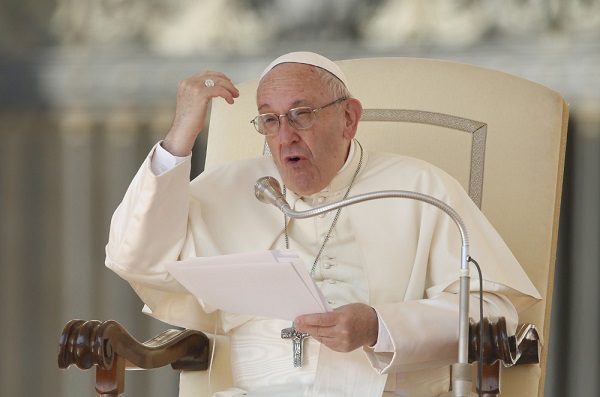
Pope Francis expressed his strong disapproval of the burning of the Quran, stating that he was both angry and disgusted by the act. He rejected any notion that this action could be considered a form of freedom of speech.

Recently, there was an incident of Quran’s desecration in Sweden where a man burned a copy of the sacred book outside a mosque in the country’s capital city. The Pope has made remarks in response to this event.

On Sunday, 57 Muslim states — under the banner of the Organisation of Islamic Cooperation — said that collective measures are needed to prevent acts of desecration of the Quran and that international law should be used to stop religious hatred.

Swedish police had granted Momika a permit in line with free speech protections, but authorities later said they had opened an investigation over “agitation against an ethnic group”, noting that Momika had burnt pages from the Islamic holy book very close to the mosque.

Sweden’s government condemned Momika’s actions on Sunday, calling them “Islamophobic”.

Holy Qur’an University confers honorary doctorate on Sheikh Pantami

By Abdurrahman Muhammad

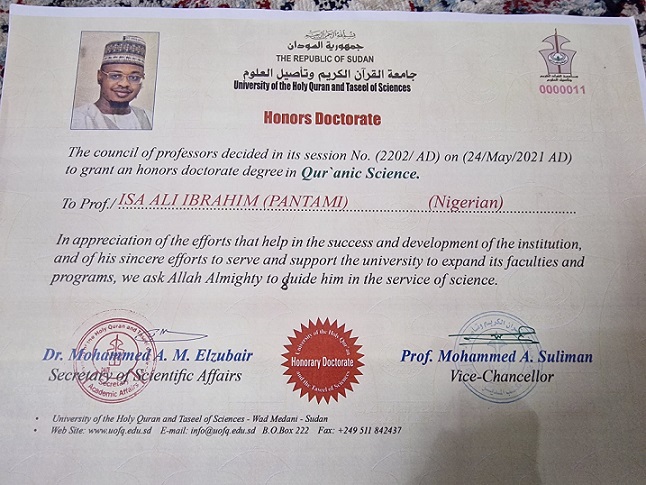
The University of the Holy Qur’an and Taseel of Sciences of the Republic of Sudan awarded Nigeria’s Minister of Communications and Digital Economy and renowned Islamic cleric, Professor Isa Ali Ibrahim (Pantami), with an Honorary Doctoral Degree in Qur’anic Science.

While the Honourable Minister was awarded in May 2021, he received the award certificate and shared the same on social media only recently.

According to the official social media handles of the Minister, he was the first person in sub-Saharan Africa to receive the award. The statement, in part, reads:

“With the exemption of North Africa, he was the first African to receive the recognition on the Glorious Qur’an.”

During Ramadan, Sheikh Pantami delivers Tafsir at the Annur Masjid in the Nigerian capital, FCT Abuja. He also holds other preaching sessions outside the Holy Month at the same mosque or elsewhere.

Nigerian lady emerges second in Dubai Qur’anic competition

By Ahmad Deedat Zakari

A Nigerian lady, Aisha Abubakar Hassan, has emerged as the second-position winner in the just concluded sixth edition of the Sheikha Fatima Bint Mubarak Holy Qur’an Competition for women in Dubai. 

Fifty countries participated in the competition that was held from the 1st to the 7th of October at the Dubai Culture and Science Society.

Aindati Sisi from Senegal came first, while Aisha Abubakar Hassan from Nigeria and Shima Anfal Tabani from Algeria took the second and third places, respectively.

According to the organisers, the participants were women Quran memorisers with mastery of tajweed. They also have to be under 25 years old. 

The first position-winner received 250,000 dirhams; the second got 200,000 dirhams, and the third 150000 dirhams. Other participants who performed brilliantly in the competition were also handsomely rewarded.  

The Dubai International Holy Qur’an Award, DIHQA, hosts and organises the event for women worldwide annually.

International Musabaqa: Nigeria moves into final round

By Ibrahim Siraj Adhama in Mecca

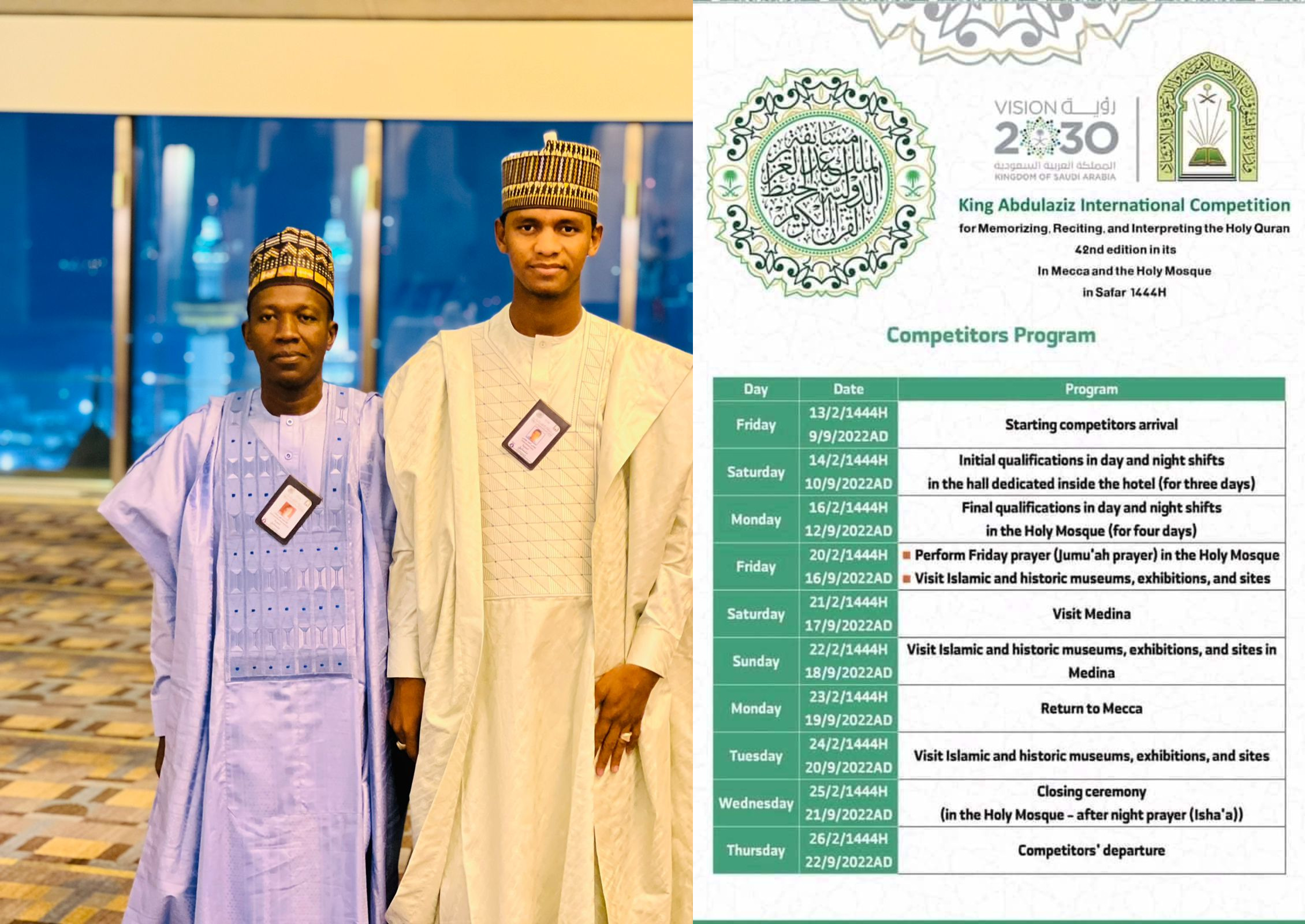
Nigeria’s participants at the 42nd King Abdulaziz International Competition for Memorizing, Recitating and Interpreting the Holy Quran taking place in Mecca, Saudi Arabia, have qualified for the final round of annual international contest.

Baba Sayinna Goni Mukhtar and Musa Ahmad Musa, both from Borno State, are competing in the second and third categories of the competition, respectively.

The preliminary stage was held between Saturday and Sunday in the hotel where all the participants are lodged and only successful reciters will make it to the final stage which will be conducted under full public glare within the precincts of the Grand Holy Mosque starting Monday.

Participants in the competition were drawn from Muslim countries around the world as well as representatives of minority Muslim communities.

The International Competition, which is returning after two years suspension due to the Covid-19 pandemic, promises to be exciting with the introduction of Qira’at category (now first category) and an upward review of cash prizes to be won.

Highlights of this year’s competition include visits to important religious sites in Mecca and Medina.

The competition will draw to a close on September 21 with the announcement of winners and distribution of prizes.