Prof. Yemi Osinbajo

RCCG’s support for Osinbajo shows his narrow mindedness – Farooq Kperogi; others react to church’s political move

By Ahmad Deedat Zakari.

Professor of Journalism and Emerging Media at Kennesaw State University, Farooq Kperogi, has faulted the Redeemed Christian Church of God’s interest in partisan politics. 

Kperogi expressed his disdain regarding the church decision on his verified Facebook account on February 10, 2022, in an article titled “RCCG’s Dangerous Foray into Politics for Osinbajo.”

He said he was not surprised at the church’s sudden interest in partisan politics. 

“This isn’t really surprising, frankly, because Pentecostal Christians see Osinbajo as their representative in government and think he is the fulfilment of Pastor Enoch Adeboye’s oft-quoted prediction that one of them would become Nigeria’s president during his lifetime.”

Kperogi also threw a subtle jab at President Muhammadu Buhari, faulting Osinbajo’s rise to the presidency as a ploy to burn the notion that the president is a fanatical Muslim.

He also described Osinbajo as a pentecostalist whose inner circle are his fellow pastors and churchgoers. 

“Osinbajo himself defines his role in government in the narrow terms that his co-pentecostalists see it: as the materialization of a Pentecostal Christian theocratic dream. That’s why his inner political circle is almost entirely made of Yoruba RCCG members,” he wrote.

Kperogi further argued that Osinbajo is not fit to be president. 

“There’s no Christian in government in Nigeria’s history who has ever been as narrow-minded, as culturally clueless, and as insular as Osinbajo, which was why, a senior Yoruba Christian professor told me recently that Osinbajo would “create greater instability as president” than Buhari has because “The Sharia folks will confront [Osinbajo’s] Christian fundamentalism with more violence” which would precipitate disabling communal upheavals.”

Several people have also reacted to the development. 

Aisha Yesufu, a human rights activist, in a Tweet said there is nothing wrong with the church supporting Osinbajo

“So let’s assume RCCG is doing this for Osinbajo, what is wrong with that? Why shouldn’t RCCG support a candidate? If the candidate is good, we vote. If the candidate is bad, we do not vote! Simple! RCCG have (sic) as much right to be interested in politics as anyone else.” She tweeted

Also reacting to the news on the Daily Reality Facebook page is Mallam Muktar, who condemned RCCG’s political move, said that “religious leaders participation in politics will lead to divided allegiance”.

“It will be devastating to hand over Nigeria presidency to religionists/extremists whether pastor or Imam because their first allegiance will invariably go to their faith. They are the propelling force behind the clamour for religious configuration of contesting persons and religious blackmail of our electoral process. Who knows, they might also be behind the continuous blackmail of that notable SW Muslim presidential aspirant and political benefactor of their man, who may be perceived as their major obstacle to the presidential ticket.

“Nigeria doesn’t need such leaders. Nigeria needs [a] liberal Muslim and Christian who only fear God but [is] not bound by a non-displaceable religious creed or allegiance. We should resist and shake off religious politics in 2023 by demystifying religion configuration ticket and by voting for liberal candidates with total disregard to their faith,” he concluded.

2023: Redeem Church moves to support Osinbajo

By Ahmad Deedat Zakari.

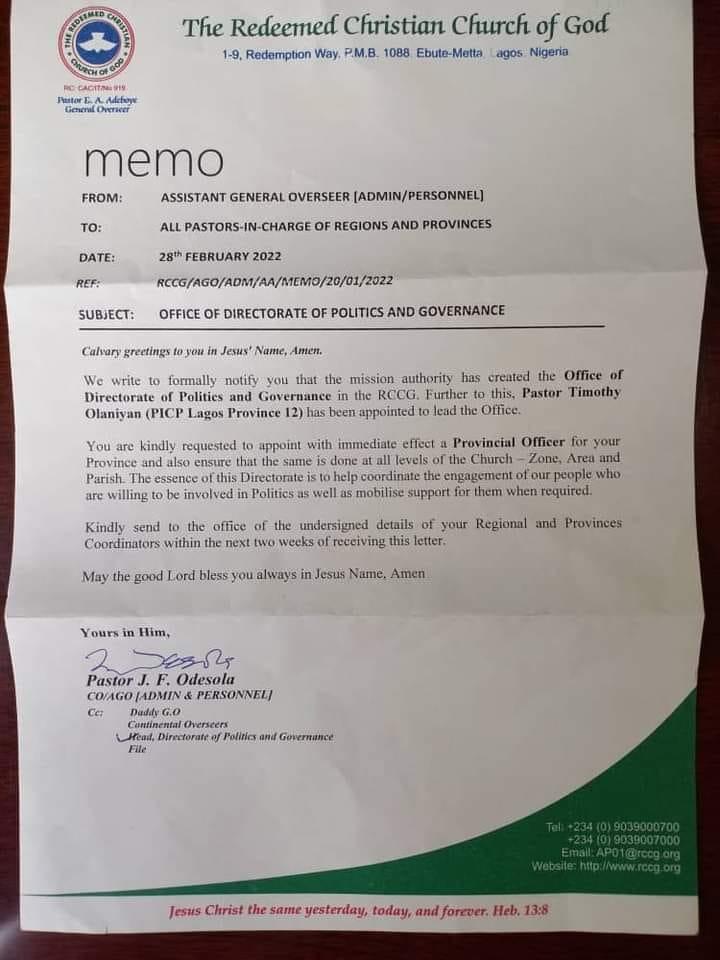
The Redeemed Christian Church of God (RCCG) has created a new directorate, named the “Office of Directorate of Politics and Governance.”

This development was contained in a memo dated February 28, 2022, and signed by the Assistant General Overseer Administration and Personnel of RCCG, Pastor J.F. Otedola.  

“We write to formally notify you that the mission authority has created the Office of Directorate of Politics and Governance in the RCCG. Further to this, Pastor Timothy Olaniyan (PICP Lagos Province ) has been appointed to lead the Office” The first paragraph of the memo reads.

Pastor Otedola also requested for provincial officers to be appointed for each province of the RCCG and all levels of the church with utmost urgency in respect of the new directorate. 

“You are kindly requested to appoint with immediate effect a Provincial Officer for your Province and also ensure that same is done at all levels of the Church – Zone, Area and Parish. The essence of this Directorate is to help coordinate the engagement of our people who are willing to be involved in Politics as well as mobilise support for them when required,” the memo further reads.

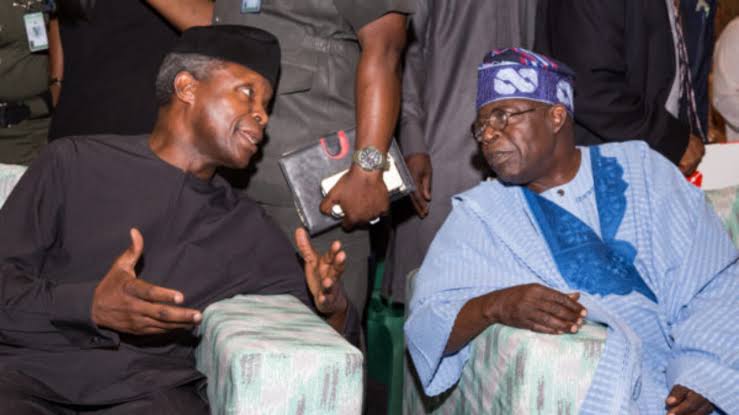
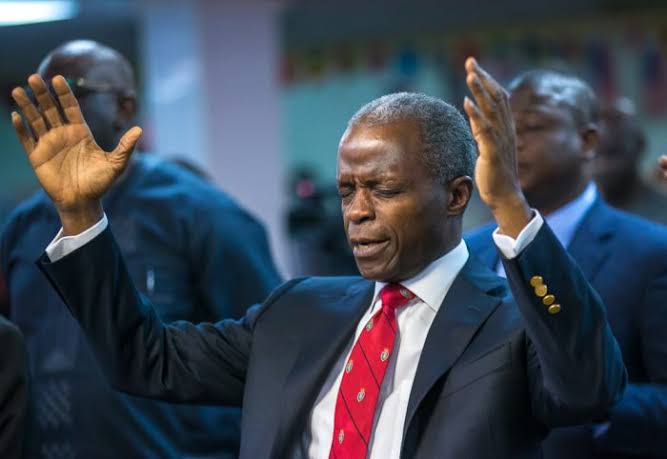
Nigeria’s Vice-President, Professor Yemi Osinbajo, maintains a father and son relationship with RCCG General Overseer, Pastor E. A Adeboye, is in charge of the Lagos Province 48 (Olive Tree Province Headquarters) of the RCCG. The recent development coming from the church cannot be unconnected with his 2023 presidential ambition.  

People have expressed different views on politics and religion and the active participation of the church and religious bodies. 

According to Mr Peter Onah, “they are biblical figures that participated actively in politics”. He added that religion and politics are two different things that can go together.

However, Mr Nurudeen Bukar, who was confronted by the Daily Reality on the issue of politics and religion, expressed a different view. According to him, “it is best when religion focuses on its primary mandate of preaching and guiding people”.

Bukar argued that partisan politics is not suitable for religious groups as it will distract them from their religious obligations.

A letter to Prof. Farooq Kperogi

By Muhammad Rabiu Jibrin (Mr.J)

I write this letter to you as a Nigerian and your follower for a long time. I am deeply concerned about having a better Nigeria, which is only possible if responsible leaders are elected. Leaders who have the country at heart think of her first before themselves or their families.

But the process or the means of discovering remains the problem to many Nigerians due to so many factors. We need to face that and address it as soon as possible. In so doing, Nigerians need to be guided by farsighted men like you. 

Prof. Kperogi, if Buhari, Osinbajo and Tinubu are “a troika of a treacherous villain” or “tarred with the same brush or the monsters of deceit and fraud” and Atiku happens to be among the “warhorses of corruption and ineptitude” as you pointed out in your recent piece, then who do you think should Nigerians go for come 2023?

It is indisputable that those you called names failed Nigerians on many fronts and seem not equal to the task based on the historical antecedents. But just pinpointing their lacunas that justified them as incapacitated and incompetent alone can’t suffice.

As a patriotic citizen, a critical thinker of reasonable foresight, with a wealth of experience and vast knowledge, you can endorse someone for Nigerians to vote for. Please, who do you think can lead Nigeria to the promised land?

With your pen, which is mightier than the sword they say, you can attempt changing the narration and have the Nigeria of our dream. Out of the 78,250 followers and 4999 friends you have on Facebook alone, plus those on your other social media handles, only God knows how many you can influence. As you shape their minds, they can also do the same to others, and the trend will go continuously. 

Nigerians want to stop being “clueless” and take off their heads the laurels of “enablers of Nigeria’s descent to the nadir of hopelessness”. So let’s do this together and make 2023 different.

Muhammad Rabiu Jibrin (Mr J) wrote from Gombe State via muhammadrabiujibrin@gmail.com.

Tinubu and Osinbajo: Two sides of the same coin

By Ishaq Habeeb 

So I made a rather lengthy comment on Prof. Farooq Kperogi’s Facebook post regarding Bola Ahmad Tinubu’s presidential candidacy. He thought it was an excellent observation and thus an independent write up. Here is part of what the comment entails: “Tinubu is too old, too inebriated, too corrupt, too unhealthy, too controversial and too unfit to lead a nation that had just survived a tsunami”. That was my first reaction to the news making the rounds on social media since Tinubu officially made his intention public to run for the office of the President of the Federal Republic of Nigeria come 2023.

A week before Tinubu’s announcement, our Vice President, Prof. Yemi Osinbajo, declared his intention to run for the same office come 2023 and officially informed his principal to seek blessings as he intends to succeed him. My confusion here is: Mr Osinbajo’s declaration didn’t generate half the noise, Tinubu’s declaration is causing – although mainly in the negative. It makes me wonder, why are we all too focused solely on Tinubu? Everybody talking about what a terrible choice he’d be for the job, all attentions shifted away from Osibanjo.

Osinbanjo, Buhari’s VP since 2015, has never had any rift or imbroglio with his principal regarding the state of the nation. So now I put this to sleepy-eyed Nigerians: if Buhari is Pharaoh, doesn’t that make Osinbajo, the Vizier? Pharaoh’s Second-in-Command. That said, Osinbajo’s nonchalance to Buhari’s bad governance can only mean one of three (3) things:

1. That Osinbanjo is 100% with and actively part and parcel of the Buhari govt hence part to blame for the crass mismanagement of this country since they took over in 2015.

2. That he’s indifferent to the misruling and mismanagement of the country by his principal, so long as he remains the country’s VP and his family is safe and far away from the horrible effects of the bad governance, the Buhari regime – in which he’s the VP – has unleashed on Nigerians.

3. That he is not happy with the status quo but lacks the integrity and moral decency to do the pastoral thing and speak out against the ills or even step down, rather than feign indifference, watching the daily destruction of Nigeria and Nigerians by his principal, with himself, as second in charge.

Concluding thoughts…

Osinbajo is just as terrible as Tinubu for the job they’re eyeing, and Nigerians shouldn’t reject Taye but accept Kehinde. They’re two sides of the same coin. However, imperfect as they both are, if they’re the only two options, between the two, I’d rather go for the least, healthy, mentally and physically fit Osinbajo, over a sick, decrepitly-old, shady, and stinkingly-corrupt Tinubu. But thank God for multiple choices.

Ishaq Habeeb writes from Kano and can be reached via his Twitter handle @realishaqhabeeb.

Osinbajo describes Sardauna as man of peace at memorial lecture

By Hussaina Sufyan Ahmed


The Ahmadu Bello Memorial Leadership and Governance 2022 event hosted in Kano state government house earlier today was themed “Reviving the Northern Traditional Institutions: Imperative for Peace and Security in Northern Nigeria”. 


The Ahmadu Bello Memorial Foundation organized the event in collaboration with the Kano state government on January 18, 2022. 


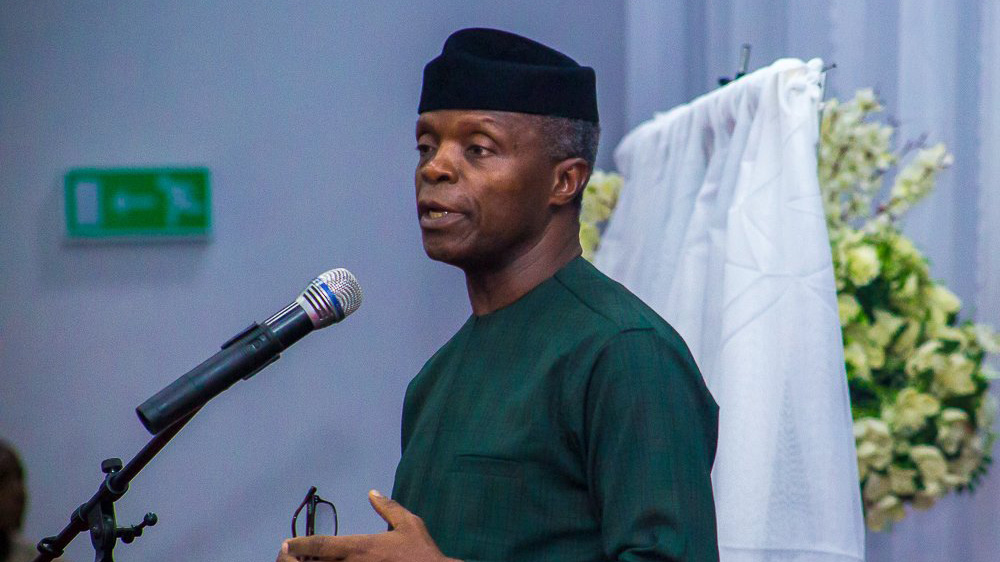
During the occasion, Vice president Yemi Osinbajo (SAN) commended Sir Ahmadu Bello Sardauna, adding that “[He] was a man of peace and courage, as well as a nurturer of traditional institutions, who demonstrated fairness and justice.”


Concerning insecurity bedevilling the North, the Vice President said that the federal government would employ technology in surveillance to fight the increased terrorism and insurgency in the country effectively.


He said: “We will also continue to ensure collaboration between the Federal Ministry of Justice, state counterparts and law enforcement agencies – to ensure that those apprehended for terrorism and violent crimes are effectively and speedily prosecuted.”


“This is a fight for this nation, and we are determined to win by the grace of God. All these evil forces will be eliminated.”

Buhari, Osinbajo, others honour soldiers on Armed Forces Remembrance Day

By Ahmed Deedat Zakaria


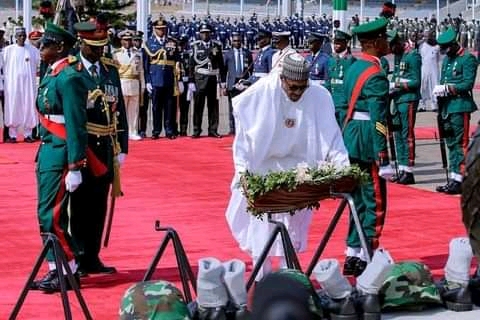
President Muhammadu Buhari led the nation alongside the Vice President, Professor Yemi Osinbajo, the President of the Senate and others in marking the Armed Forces Remembrance Day Celebration in Abuja.


The ceremony held in Abuja on Saturday is an annual event to honour and appreciate Nigeria’s living and fallen heroes.


The event involved the laying of wreaths at the National Arcade in Abuja. First to lay the wreath is usually the President, followed by the Vice President, the Senate President, Speaker, House of Representatives, Chief Justice of Nigeria and others. 


This tradition was duly observed by the President and the Vice president, and others in the usual manner.

Osinbajo commissions Kasuwan Magani Modern Market in Kaduna

By Sumayyah Auwal Ishaq

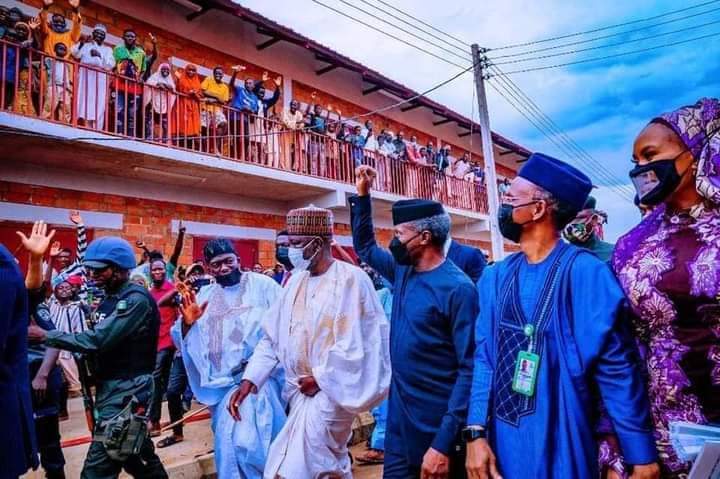
The Vice-President, Professor Yemi Osinbajo, SAN, has commissioned the newly constructed Kasuwan Magani Modern Market in Kajuru Local Government Area of Kaduna State.

Speaking at the commissioning, Governor Nasiru Ahmad El-Rufa’i said the Kaduna State Government partnered with the China Civil Engineering Construction Corporation (CCECC) to deliver the project. He further stated that the Kaduna State Government’s post-conflict assessment after the October 2018 crisis in Kasuwan Magani included a resolve to address the question of markets.

In his remarks, Prof. Osinbajo commended the administration of Governor El-Rufa’i and reiterated that the Federal Government will keep supporting and encouraging investment-centric efforts by providing a stable business environment, providing infrastructure, and ensuring security.

Rethinking Nigeria’s healthcare financing

By Dr Abdulkareem Kabir Masokano

The announcement of a high profile committee by President Muhammadu Buhari on September 6,  2021, to be headed by his Vice President, Prof. Yemi Osinbajo, to oversee reforms in Nigeria’s health sector, is a laudable and timely one. However, like most sectors in Nigeria, the health sector is, to put it mildly, in a state of stagnation that, with the existing structure and organisation, is practically impossible to make any headway despite the enormous potentials abound in the sector to the economy.

There are numerous angles to the problem bedevilling Nigeria’s fragile health sector. They include the collapse of the primary health care system, poor infrastructure, inter-professional rivalry, poor accountability, inefficient, limited health insurance coverage, etc. However, the single most important factor causing the apparent none progress of the sector is the absence of a robust, patient-centred health financing model. Every single one of the problems can be directly attributable to this.

Contrary to what many think, modern healthcare is too expensive to be offered for free anywhere in the world. Nigerians think other countries provide healthcare services almost free of charge to their citizens. Actually, these are products of either heavy government subsidies, strict universal taxation regimes, or compulsory insurance programs. Over the years, governments in Nigeria have gotten caught up with this delusion that they can offer free healthcare to their citizens from the little they generate of their internal and external revenues without any sustainable framework to ensure steady financing of such an important yet expensive sector.

The result of this thinking is the current problem of underutilisation of highly trained healthcare professionals across various tertiary hospitals in the country because of the unavailability of modern diagnostics and therapeutic equipment – all of which are very expensive to use and manage. For example, we have specialists across various surgical specialities with the necessary skills to perform highly technical surgical procedures like kidney transplants, open heart surgery and complex brain surgeries. However, the system is so designed that it cannot accommodate their expertise due to the unavailability of resources to sustain such programs. This leaves many Nigerian patients cumulatively spending billions on such medical procedures abroad, and Nigeria loses money tremendously.

Primary healthcare, the essential segment of any serious health system, is virtually non-existent in the country. This is not due to the absence of the structures. It’s because of the ‘internal’ brain drain within the levels of the existing health system. The primary healthcare centres are primarily under the care of the local governments in the country. Unfortunately, most of them cannot afford to employ the minimum required number of qualified doctors, nurses and other health workers who, by extension, are pulled by better-paying jobs available at the higher levels of the system. As a result, most of Nigeria’s primary health centres are manned by Community Health Extension Workers with minimal skills and expertise.

The National Health Insurance Scheme (NHIS), which is supposed to be the primary driver of universal health coverage in the country, is essentially running far below par due to the poorly regulated profit-driven model it is structured. According to various statistical sources, the NHIS covers less than 5% of all Nigerians (out of over 200 million people!). As a result, the vast majority of Nigerians resort to paying out-of-pocket to access specialised healthcare. With that proportion, the insurance pool can only generate a meagre sum of money.

Coupled with the profit-only motive that drives the Health Management Organisations (HMOs), one can only expect that the system cannot cover the comprehensive health needs of its enrollees, not to mention driving any meaningful growth in the sector. The state-run contributory health systems are even worse! They are fraught with inefficiencies, lack of transparency and corruption. And as far as I am concerned, they ought not to have been created as their creation only serves to decrease the pool and reach of the National Scheme.

From the preceding, it is evident that sustainable financing is the critical element missing in our health sector; the focal point of any meaningful health sector reform in the country should include improving it. The current model whereby health financing largely depends on what the governments generate from their dwindling revenue or generous donor agencies is not sustainable and cannot move the sector even an inch from its current state. Therefore, it is about time Nigeria’s policymakers look for other alternatives to fund our increasing healthcare needs, given our explosive population growth rate.

Accordingly, this high profile committee set up by Mr President should look into developing a comprehensive, sustainable, and transparent healthcare financing model that would cover every Nigerian’s most basic health needs. It should consider a complete overhaul of the country’s healthcare financing by the development of a hybrid health financing system at various levels of the healthcare system with varying blends of public, private and public-private partnership, through the creation of a compulsory basic healthcare taxation system to cover for a comprehensive healthcare financing at the primary level for all Nigerians regardless of socioeconomic class.

A comprehensive reform of the NHIS should supplement this to enforce the enrolment of all workers in the formal sector of the economy (public and private), cooperative organisations of the various non-formal entities of the economy like farmers, artisans, transport workers, among others. This will cover specialised healthcare across our tertiary and specialist hospitals, both public and private and broadening the insurance industry to include ethical health insurance systems like the Takaful system to increase inclusivity across the various demographics of the country.

The committee should also encourage creating windows for community-based contributory health safety nets to tap into the national health insurance pool to enable citizens from lower socioeconomic access to specialised healthcare at our tertiary health institutions.

Special funds can be set aside annually from the NHIS fund pool for research and development in our tertiary health institutions regarding funding for specialised healthcare services and preventive health. This should be enough to cover all the available infrastructure needed to procure, support and maintain modern diagnostic and therapeutic equipment.

The committee has qualified, world-class technocrats as members. It also has the Bill and Melinda Gates Foundation, Vesta healthcare partners, and WHO as observers. Thus, we are optimistic that it will develop a sustainable blueprint for health financing as the bedrock of their essential task. May the government implement the committee’s recommendation for the needed reforms in Nigeria’s fragile health sector.

Dr Abdulkareem Kabir Masokano is a resident Surgeon, ABUTH, Zaria. He can be reached via abdulkareemmsk@gmail.com.

Nigeria Jubilee Fellows Programme: Why you should apply

By Ishaka Mohammed

After many fruitless applications, job seekers in Nigeria get frustrated. As some delve into crime, others retire to idleness, leaving everything to fate. Neither of these options is advisable. Nevertheless, there’s no need to stop trying. The following instances might suffice.

In Nigeria, being called a SAN comes with prestige. The bearer of the title is an experienced legal practitioner, considered professionally (and to a large extent, economically) successful. It means Senior Advocate of Nigeria (SAN), yes? But, no, there’s a different angle to it.

Many young Nigerians can bear an unfortunate version of the acronym SAN. They don’t have to study law, not to talk of being called to the Bar.

To cut it short, a guy and two ladies meet (for the first time). In response to the question of what he does for a living, he replies, “I’m a SAN.” The ladies are amazed due to his age, so they try to congratulate him, but his conception of the acronym fills the scene with abundances of laughs. He gently says, “I am a Senior Applicant of Nigeria (SAN).” The guy has applied for many jobs, but he has yet to secure employment. After listening to his story, the ladies offer him a job.

That’s in a Nollywood movie, though. Now, let’s discuss reality. A friend and former colleague is currently an officer in the Nigerian military. At a point in his life, he handed copies of his credentials to a cybercafé attendant and asked him to keep applying for jobs that matched the credentials; he would pay after every application. That was after being tired of visiting the café all the time.

Road Safety, Prison Service (now Correctional), Navy, name it — my friend had sat tests or gone for physical screenings, but none had worked in his favour. He was literally tired, so exhausted that when he was called for a physical screening after his last application, he had concluded to ignore it. If not for the timely intervention of his family, he wouldn’t have gone for the screening. He made it afterwards and the rest is history.

The above instances clarify that you have no reason to give up. You don’t have to wait for the required “connection”. Keep trying. Thomas Edison once said, “Our greatest weakness lies in giving up. The most certain way to succeed is always to try just one more time.” That one more time might be the last effort required. That one more time shouldn’t be about today or tomorrow; it shouldn’t be about the number of attempts; it should simply be about whether or not you have attained your desired goal.

As a Nigerian, you can irrevocably say that many things have gone wrong in your country. The rate of unemployment is high and scary. Thanks to members of the political elite, who are busy hijacking what is meant for the citizenry.

Attempting to minimise unemployment in the country, successive governments have come up with beneficial programmes targeting the youth. However, the politicisation of selection processes and inconsistent remunerations have sabotaged the otherwise commendable initiatives. For instance, many of the past N-Power volunteers are still owed stipends after one year of exiting the programme. And even while in the scheme, a significant number of these youth often received overdue allowances. What about the Special Public Works Programme for 774,000 unskilled labourers? The three-month programme ended in March 2021, but many of the beneficiaries have yet to be paid. It’s worth stressing that each beneficiary is entitled to just N60,000 (spread across three months).

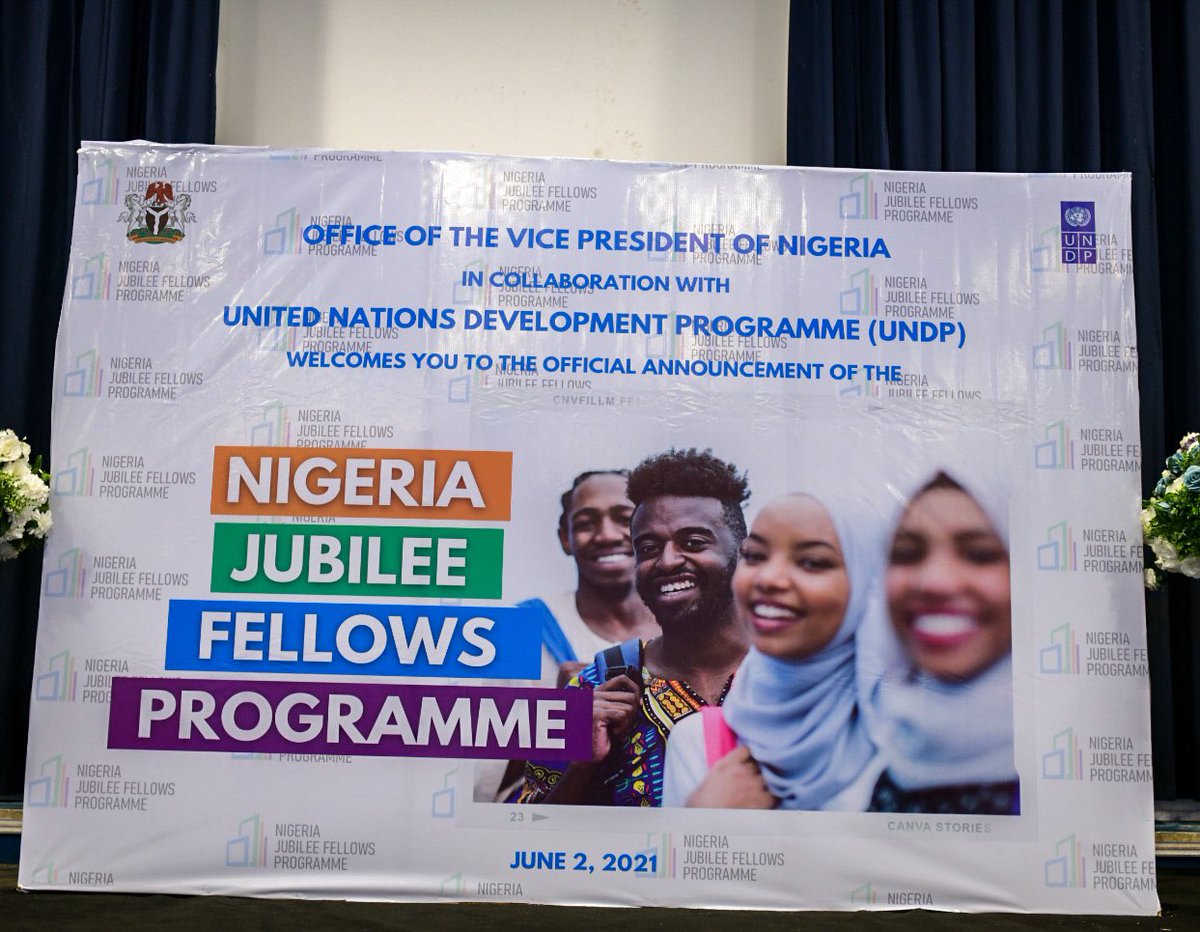
Despite the ugly situations in Nigeria, try this one. In collaboration with the United Nations Development Programme (UNDP), the Federal Government of Nigeria is enrolling 20,000 recent graduates in full-time paid employment for twelve months. In addition, the Nigeria Jubilee Fellows Programme is for young graduates.

I partook in a briefing session on Zoom with one of the programme’s team members, Erere Oghoghome, on Tuesday the 17th of August, 2021. According to her, the programme will engage 100,000 people across five years, and the first cohort will be inducted by October 2021. That means the call for applications will be out in the coming weeks. Every eligible and interested person is expected to have developed a craving for a particular skill.

Aside from being paid employees for the period of the programme, fellows stand the chance of being retained by their host organisations. Plus, they’ll join the alumni network upon completion of the programme, and the team will be the first choice for organisations seeking personnel to fill vacancies.

The basic requirements are: graduated not earlier than 2017, less than 30 years of age, unemployed, and possessing NYSC discharge or exemption certificate.
At this juncture, I implore anyone who meets the requirements to keep tabs on the UNDP in Nigeria for this rare opportunity. It might just be that one more step to their dream job.

Other than using the experience to land a job after the programme, one can deploy the skill, money, or both in self-employment. Remember, fellows will be paid as graduate employees, not given stipends.

Therefore, it’s vital that unemployed graduates apply for the programme. There’s no harm in trying.

Ishaka Mohammed writes from Kaduna. He can be contacted via ishakamohammed39@gmail.com.