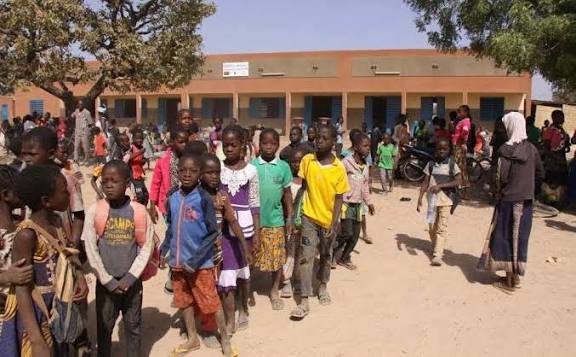
Out of school children

[OPINION]: Curbing the Menace of Out-of-school Children

By Hauwa Ibrahim

The issue of out-of-school children in Nigeria, particularly in the Northeast, has reached alarming proportions. With over 10 million children between the ages of 5 and 14 not attending school, Nigeria has the highest number of out-of-school children in the world. The Northeast accounts for a significant portion of this number, with states like Borno, Yobe, and Adamawa having some of the highest rates of out-of-school children.

This trend is deeply troubling, as it not only affects the future of these children but also threatens the stability and development of the region. Poverty, conflict, and cultural barriers are some of the factors driving this phenomenon, making it fundamental to adopt a comprehensive approach to address the root causes.

To curb the menace of out-of-school children, increased investment in education infrastructure and resources is crucial. This includes building and renovating schools, providing adequate materials and equipment, and training qualified teachers. Implementation of conditional cash transfer programs can also encourage enrollment, particularly among disadvantaged families. Community-based initiatives are vital in promoting education and awareness. Collaboration with local leaders, religious institutions, and civil society organizations can help challenge harmful cultural norms and promote the value of education.

Furthermore, policy reforms are necessary to address cultural and social barriers, ensuring that every child has access to quality education. The government has launched several initiatives aimed at reducing the number of out-of-school children. The National Education Plan, Safe Schools Initiative, Conditional Cash Transfer Program, and Education for All initiative are steps in the right direction. However, more needs to be done to address the scale and complexity of the problem.

Effective implementation and coordination among stakeholders are critical to the success of these initiatives. State and local governments must work closely with federal agencies, international organizations, and civil society groups to ensure a unified approach. Additionally, monitoring and evaluation mechanisms should be put in place to track progress and identify areas for improvement.

Ultimately, addressing the issue of out-of-school children in Nigeria’s Northeast requires a collective effort. We must prioritize education as a fundamental right and a cornerstone of national development. The National Almajiri Commission and other stakeholders must work round the clock to ensure that the number of out-of-school children is drastically reduced or eliminated. This will require sustained commitment, coordination, and collaboration among all stakeholders.

In conclusion, the issue of out-of-school children in Nigeria’s Northeast is a ticking time bomb that requires immediate attention. It is a collective responsibility that requires the efforts of all stakeholders. We must work together to ensure that every child has access to quality education and a brighter future.

Hauwa Ibrahim, Department of Mass Communication, University of Maiduguri.

FG launches 119 learning centres to boost education for Almajiri, out-of-school children

By Uzair Adam

The Federal Government has established 119 learning centres nationwide to improve access to foundational education for Almajiri learners and out-of-school children.

The development was disclosed by Nura Muhammad, Spokesperson for the National Commission for Almajiri and Out-of-School Children Education (NCAOOSCE), during an interview with journalists in Abuja on Sunday.

Muhammad explained that the centres operate under two models: some enhance existing Almajiri schools with structured literacy and numeracy classes, while others focus exclusively on out-of-school children using the Accelerated Basic Education Programme (ABEP) curriculum.

He noted that this approach allows learners to complete foundational education in a shorter time frame.

The spokesperson also announced the successful development of a National Policy on Almajiri Education, spearheaded by the Minister of Education, Dr. Tunji Alausa, ensuring that Almajiri learners will no longer be classified as out-of-school children.

He added that Almajiri schools will now receive the same support and funding as conventional schools.

In strengthening its nationwide presence, Muhammad said the Commission now has offices in all states within 28 months of its establishment.

It has also launched a ward-to-ward advocacy campaign in seven pilot states – Kano, Jigawa, Yobe, Borno, Lagos, Ogun, and Cross River – to engage parents, traditional rulers, religious leaders, civil society groups, and children on the importance of regulated education and school enrolment.

“Lagos, Cross River, Ogun, and Yobe have successfully covered all wards, and the public response has been very encouraging. The remaining pilot states are making substantial progress, and the model will ultimately be scaled nationwide,” he added.

The spokesperson emphasized that these reforms align with the Commission’s enabling Act, assented to by the President in May 2023.

The mandate includes reforming the centuries-old Almajiri system through literacy, numeracy, and skills acquisition, while enrolling millions of out-of-school children into formal and non-formal education pathways.

Muhammad said that upon assuming office, Executive Secretary Muhammad Idris conducted consultations with key stakeholders, including the Sultan of Sokoto, the CAN President, the Oba of Lagos, the Shehu of Borno, the Ooni of Ife, and the Olubadan.

These consultations culminated in two Abuja retreats organized with the Office of the National Security Adviser, producing the NCAOOSCE Strategic Plan (2025-2035) to guide reforms over the next decade.

Among the Commission’s flagship programs is the Tinubu Legacy Skills Training Institute, designed to equip Almajiri youths with both religious knowledge and vocational skills.

At the Kaduna campus, 200 learners completed a nine-month intensive training program covering Arabic and English literacy, Qur’anic interpretation, and vocational skills such as POP design, plumbing, agriculture, tiling, solar installation, GSM repair, and ICT.

Trainees followed the National Board for Arabic and Islamic Studies (NBAIS) curriculum, sat for examinations, and are now awaiting results.

A second branch in Ibadan is currently training 150 girls using the ABEP curriculum, combining foundational education with vocational skills. Upon completion, the girls will be eligible to continue formal education.

“These initiatives reflect the Tinubu administration’s commitment to reform the Almajiri system and ensure that no child is left behind. From expanded learning centres to community advocacy and skills development, the Commission is laying a foundation that will shape Nigeria’s education landscape for years to come,” Muhammad said.