Northern Nigeria

Southern governors should prepare for boomerang

By Muhammad Mahmud

Even as the nation is struggling to bring an end to the Boko Haram crisis, which could’ve been effectively tamed but for the inane and complacent manner the leadership of some Northeastern states treated the issue initially, we could not but gape at the myopic decision of the Southern governors to fly the kite of moral support to their organized thugs who were recently suppressed by the authorities. 

At their meeting on Monday, July 5 2021, the southern governors “resolved that if for any reason security institutions need to undertake an operation in any State, the Chief Security Officer of the State MUST be duly informed.” (Emphasis mine).

It is unmistakable that the governors were referring to the recent success recorded by the nation’s security agencies in arresting many IPOB members, including their “supreme leader” Nnamdi Kanu, and the arrests at the residence of a tribal warlord, Sunday Igboho.

One cannot but wonder how on earth these governors will be so insensitive to the flights of their people. The gory stories emanating from the arrested members of IPOB, where 2000 fresh skulls of innocent southern girls were targeted and how lives of fellow southerners who never aligned themselves to the “cause” were to be wasted, are enough to galvanize the governors into taking stern action against those terrorists. But to the shock of the whole nation, these governors, who never even found it worth their time to give a one minute silence to mourn souls of the ten brutally killed girls, have the temerity to demand that they must be informed whenever the criminals are to be arrested. 

Perhaps the support for IPOB and Igboho militia by the southern governors has everything to do with what Rochas Okorocha said, in an interview with BBC, that it was the fear of what the IPOB boys could do to them that stops Igbo elders from speaking against them. This gives a picture of caged and gagged elders who have no option but to simply watch as the boys took their entire region into uncertainty. This means that Kanu’s group has evolved into a monster that no Igbo could dare criticize even from afar. 

Maybe the southeastern leaders fear that what happened to the four Ogoni chiefs could befall them if they dare oppose IPOB. On May 21 1994, four Ogoni chiefs were beaten to death by angry Ogoni youths. The victims’ names were Edward Kobani, Alfred Badey, Samuel Orage, and Theophilus Orage. Their crime was that they were suspected to be against the MOSOP. Perhaps the Igbo leaders fear the Ogoni chiefs’ treatment from IPOB; that’s why they are backing them. 

But suppose Igbo elders are so terrified with the IPOB to the extent that they are hypnotized into submission, or they are so emotionally sympathetic to the “cause”. In that case, it is very dumbfounding that the south-southern governors couldn’t see the danger of backing IPOB for the simple fact that they (IPOB) made it categorically clear that any non-Igbo will be, and shall remain, a third-class citizen in the region. Suppose the south-western governors found it strategically right to support IPOB in supporting their tribal warlord, Igboho; what exactly is in it for the south-southern region? Their governors seem to be either coerced/harangued into submission or too foolish to figure this out for their people.  I believe if a south-southerner like Reno Omokri is among the governors, he will object to this. 

It appears as if the southern leaders are no longer in control. They seem to be tele-guided by the prevailing emotions in their regions instead of playing the leadership role of directing towards a better future for their people. 

Notwithstanding some of their failures and the resentments of their people, Northern elders are more in control and seem to be leading. When some northern youths issued a quit notice to the Igbos, in a reaction to the IPOB’s agitation, the leaders of the north rebuffed them. Governor El-Rufa’i even ordered their arrest. When some northern youths initiated “Shege Ka Fasa” as an answer to south-western governors’ backed “Amotekun”, the leaders of the north stopped them, and they complied. Even Boko Haram, with their firepower, did not frighten northern leaders into opposing the federal government to support them!

If the southern leaders are publicly backing their criminals with a kind of moral encouragement by attacking the federal government’s crush on them, they should, rest assured, know that it will boomerang. They should have taken lessons from what happened during the early stage of Boko Haram in the northeast.

During the initial stage of Boko Haram, they enjoyed massive support from their people. This is partly because they appeal to their people’s sentiments. All they need is to list eloquently, in a highly sentimental manner, the ills and backwardness that bedevilled the people in addition to hunger, poverty, diseases etc. and finally quote relatively congruent verses of the Qur’an and sayings of the Messenger of Allah (peace be upon him) to drive home their point that “Jihad” is the only way out and they, as the conveyors of that message, are the ones to lead. It was full of promises of a utopian state that will replace the current dystopian state. And that appealed to many, more especially as most of the movement members were children of the elite. What a perfect gulp of toxic will that be on the gullible, the strata of his/her social status notwithstanding.

It was only after the actual road to Sambisa was taken that the people realized, albeit too late, how wrong they were and how naive they behaved.

Now the IPOB and the tribal warlord, Sunday Igboho, are getting the support of the southern governors because they appeal to the sentiments of regionalism and tribalism (or drum up support for their political agenda), only time will reveal the sour fruits that will shower down. I hope some leaders will be blunt enough to put aside political correctness and act appropriately before that happens.

Malam Muhammad writes from Kano. He can be reached via meinagge@gmail.com.

Why we need to empower women

By Salisu Yusuf

There’s an established cultural practice of female social exclusion in the Muslim North that’s partly patriarchal and partly a cultural construct fuelled by religious misinterpretation, especially on business transaction issues. 

Many people wrongly and unfairly assume that women must not participate in business dealings because men cater for their needs. However, instances from Islamic history and established ahadith corroborate women’s active role in market-oriented activities, especially during the caliphate of Sayyid Umar bn Khattab (RA). I have a story to tell which will convince you that our women should, or even must, be allowed to transact.

A close, affluent friend of mine died two years ago. He left behind four wives, children and millions of naira. Fortunately or not, the deceased’s male relatives could not handle the proceeds of the orphans properly. And even if they could handle the wealth well, most people nowadays are morally lax in handling trusts, especially inheritance. Only a few handle it sincerely, while many others betray the trust given to them. So, the widows became carers and guardians; in other words, the bulk of wealth is handed over to them.

Those who had never transacted (only two out of the four) became businesswomen in their life. They are both fathering and mothering the young orphans. Although single parenting is a difficult task, the women brace up, take care of the children efficiently, conduct business aspects, get profits, provide daily bread, support the children’s education, and other basics such as clothing. I am deeply impressed by the women’s resolve to forget their differences, shun their rivalries, burry their wounds, pick up the pieces and continue to survive in the absence of the best husband and father. 

Two years after their husband’s death, the entire house fares very well, managing to survive despite the harsh realities of the Nigerian socio-economic milieu. When last I visited the family, they told me of the difficulty in combining business dealings with parenting and guidance. One widow told me how lucky they were to learn to trade even before their husband’s death because he had numerously given them startups to learn to earn a living. She said if they had not been this fortunate – under a caring husband who had so much empathy and understanding, they would have been left in the cold, would have devoured the money and would have been left at the mercy of a hostile public as beggars.

Two years since their breadwinner’s death, the women turned men survive because they can hold their heads, transact, guard and guide the young orphans.

Salisu can be reached via salisuyusuf111@gmail.com.

A case for technical colleges in Nigeria

By Adamu Tilde, PhD.

For a while now, Nigeria has been witnessing exponential growth in the rise of certificate-awarding institutions and massive production of holders of certificates of all kinds: diplomas, NCEs, degrees, masters, PGDs, etc. Ordinarily, this should be a welcome development. But, unfortunately, this phenomenon comes at the expense of acquiring quality skills, thus resulting in the production of certificate holders with no skills at all or with some skills that are not in demand and/or have no economic value whatsoever.

One comes to realise the effects of this phenomenon when one does a simple close-proximity analysis—for example, over sixty registered and unregistered colleges of education award NCE certificates in Bauchi state alone. Most of the courses offered in these colleges are combinations of English/Hausa, Social Studies/English, Arabic/Fulfulde, etc. The questions to ask are: what are the specific skills that an average NCE holder acquires in the three years they spend in college? Do these skills, if any, have any economic value? If yes, how many NCE holders, for example, does Bauchi state need at any given time?

Again, in Toro, one out of the twenty local government areas of Bauchi state, there are six colleges of health technology and counting. Most of the courses offered in these colleges are diplomas in Medical Records, Environmental Health, Community Health, Laboratory Technology, etc. I may sound so dismissive of these courses, but don’t get me wrong. These are significant courses and, perhaps, with valuable skills to offer, but we already have enough to go around. And, trust economics, its laws are no respecters of irrational decisions: the higher the supply, the lower the demand and invariably the price. So the need to rethink why we do certain things instead of other things could not be more urgent.

Way Forward

To be very clear, I am not presenting anything novel. Our pioneer leaders had envisaged the inevitable need for technical skills for economic growth and development, and that’s why they established monotechnics, polytechnics, and technical colleges across the country. No thanks to unimaginative leadership and penchant for mass production of certificates-wielding graduates that had led to having polytechnics with more students studying mass communication, theatre arts than engineering, computer science, statistics, etc. Nothing can be more ironic.

In the following subheadings, I will argue on why we should pay more attention to technical skills and invest more in establishing technical colleges:

Guaranteed employment

Rest assured that employers lined up waiting for you once you possess skills like plumbing, welding, woodwork, carpentry, masonry, tiling, electric wiring, programming, website and apps development, etc. With an increase in population comes corresponding demands for housing, food, and services. So these skills will forever be in need, so long as we breathe. And in the event you don’t want to be on the payroll of anybody, you can monetise the skills by employing yourself. For example, a diploma holder in animal health and production can engage in the private practice of visiting farms and local markets to provide first aid treatment. There are too many farms to go around. We can say the same about a plumber, tiler, painter, etc.

Less time than conventional schooling

Most technical skills can be acquired in a record time, probably in a year or two, and then you are good to go. The most interesting thing about a given skill is that the more you practice it, the more you master it. Moreover, it is more difficult for a person to forget a set of skills than the paper-based theories learned in school. Very unlike typical schooling (a diploma or a degree), where you would spend 2 or 4 years with no specific skills to show and then sooner you would forget the little theoretical knowledge you have acquired since you are not practising.

High return on investment

Compared to the money spent to acquire NCE certificates, diplomas in health-related courses, and some instances, degree courses, you are better off having any of the aforementioned technical skills. NCE holders and, in some cases, degree holders hardly make up to ₦30,000 per month in many private schools. In fact, even in public service, NCE holders fetch ₦36,000 per month in Bauchi state. When you analyse the time, money and energy expended to acquire the certificate and the monetary reward after that, you will struggle to make economic sense of the decision. So many Keke Napep guys make more than that amount in a month. So much for a heap of certificates!

Again, as a private investor, you are better off establishing a technical college, especially if you would engage in vertical integration by employing your products (graduates). For example, you can set a company that specialises in finishing and look for contracts. Trust me; we have a paucity of skilled workforce in the building industry. We do import tilers, plumbers, welders from outside. That’s how bad things are, and that’s how vast the opportunities are.

And for those who want to ‘japa‘ (to go abroad), your chance of securing a visa and employment abroad is greatly enhanced if you have any technical skills. This is for non-medical professionals and exceptionally brilliant computer wizards.

Note

The argument here is not whether an NCE certificate or health technology diploma or even degree certificate, for that matter, is good or not. No! The idea here is that we should go to colleges and universities to acquire skills that we can use to improve our financial situation. If the so-called certificate(s) you have obtained cannot fetch you a job or equip you with skills that people can pay for, you need to rethink why you were in school in the first place. We have tonnes of graduates and varying certificate-holders roaming the street for jobs that are not there and crying for lack of employment; meanwhile, they have no skills worth employing. We are massively producing what we do not need and under-producing what we urgently need. Something is wrong.

We have to appreciate the dynamics of time. Long ago, all it takes to climb the mythical social ladder and join the much-vaunted middle-class is a certificate of any kind. Whatever or not you studied in the university is immaterial; public jobs were waiting for you. But that was then. Those years of yore have passed for good. There are no more public jobs for everyone. Internalise this and know peace. As for private companies, well, first of all, they are not charity organisations. Secondly, they are profit-driven, so they don’t employ people to fill any underrepresented state’s quota. Thirdly, they reward value— what you have to offer is what counts. You need much more than a certificate to survive. You need skills, not just any skills, but skills that have economic value.

You need to wake up and smell the coffee. Hello!

Dr Tilde can be reached via adamtilde@gmail.com.

The onset of 2021 rainy season in Kano

Nazifi Umar Alaramma,

This year, 2021, had experienced a late onset of rainfall in Kano and surrounding. Therefore, the onset of rain in Kano and surrounding was computed to be five days with 83 millimetres of rain fall.

83mm is equivalent to 9.2% of the mean annual rainfall of Kano state. However, the duration of the rainy season in Kano is between mid-May to early October. Nevertheless, the rain may delay until June. This means the rainy season could not begin before mid-May in Kano and surrounding. Likewise, it will not extend to November.

As per the climate of Kano, the region falls within 100 rainy days in West Africa. Therefore, rain may fall earliest in mid-May, never before. However, it could delay up to July.

In 2021 the rain had delayed to very late June due to natural and anthropogenic factors. The natural characteristics are the routine of delay rainy seasons that happen to entire Sudano-Sahelian environments, some every five years, like parts of Mali and Ethiopia and some for many years like Kano in Nigeria.

This year could have followed the suit of those who predate it to bring rainy season late. However, it is significant to note that delaying the rainy season and frequency of drought in Kano and surrounding had reduced following the construction of Tiga, Challawa and other more than 30 dams in the state. These dams increased the recharging of clouds. Hence, no frequent drought in Kano and surrounding since the 1970s. However, a delay of the rainy season has not been totally hampered yet. 

The human factor in delaying the rainy season this year may be human-induced climate change. We believe it originates from outside Nigeria. It is linked to the general circulation of the atmosphere, which alters Africa’s condition even if the major polluters are from Europe, America, and Asia.

Nazifi Alaramma is a lecturer at the Department of Geography Yusuf Maitama Sule University, Kano. He can be reached via alaramma12@gmail.com or nazifiumar@nwu.edu.ng.

Record-breaking temperatures kill hundreds of people in Canada, US

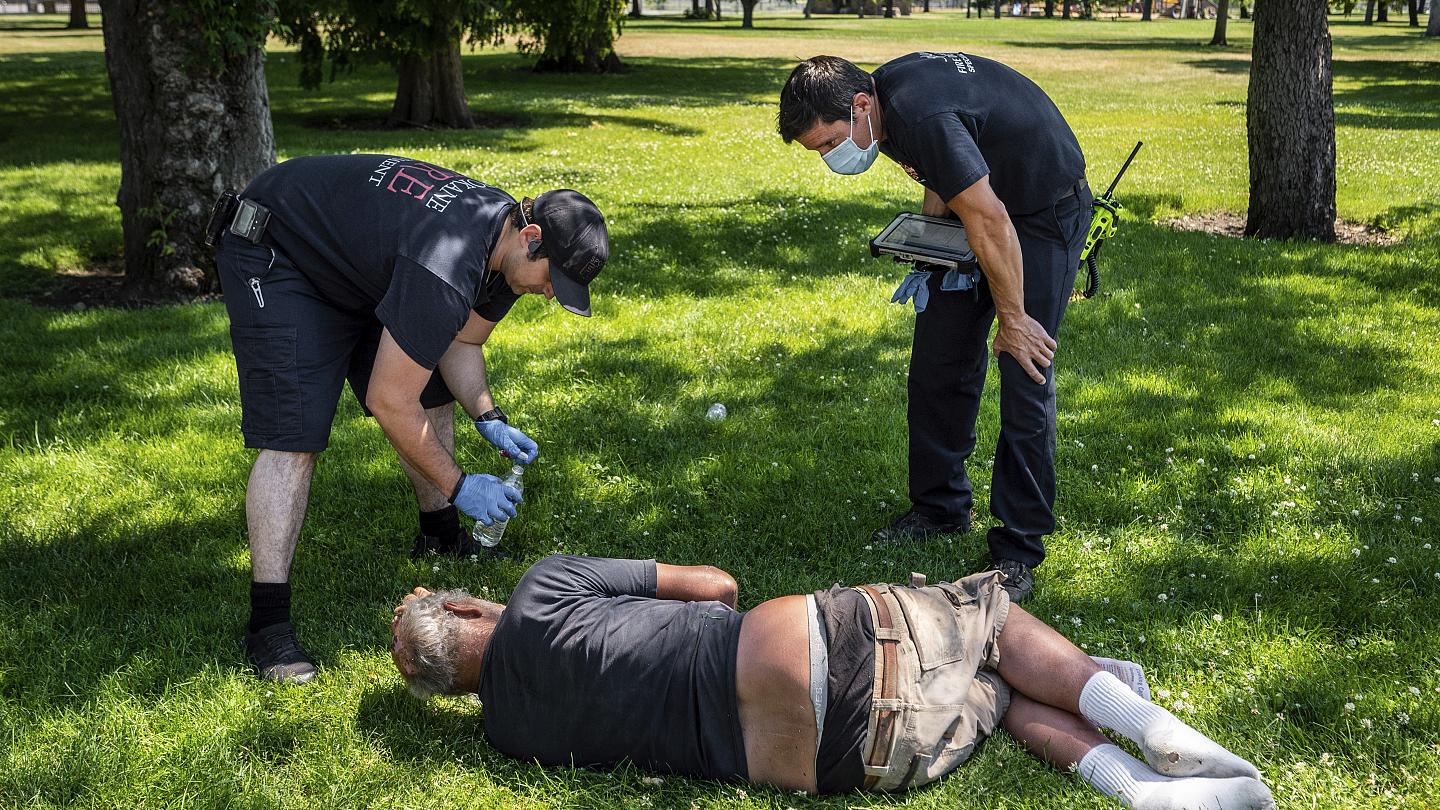
Record temperatures in British Columbia, Canada, and US cities, including Oregon, have resulted in the death of hundreds of people. The temperature reached up to 49.6°C (121.3F) on Sunday in parts of Canada, breaking a decades-old record.

The Oregon State Police said the state medical examiner’s office had received reports of 63 deaths. However, the heat is expected to subside by the weekend in most US cities.

The death toll is more devastating in Canada. According to a CNN report, at least 486 sudden deaths have been reported across the western coast of Canada near the US border.

“The 486 deaths currently entered represent a 195% increase over the approximately 165 deaths that would normally occur in the province over a five-day period,” British Columbia Chief Coroner Lisa Lapointe said in a statement.

Experts warn against associating this directly to the climate change the world witnesses. Others say the two are connected like lung cancer is to smoking. They added that other parts of the world, too, see unpredictable weather conditions.

So far this year, northern Nigeria has recorded a low rainfall. As most farmers depend on the rain in the region, they expressed concern over the situation. Nigeria may face a food shortage as a result.