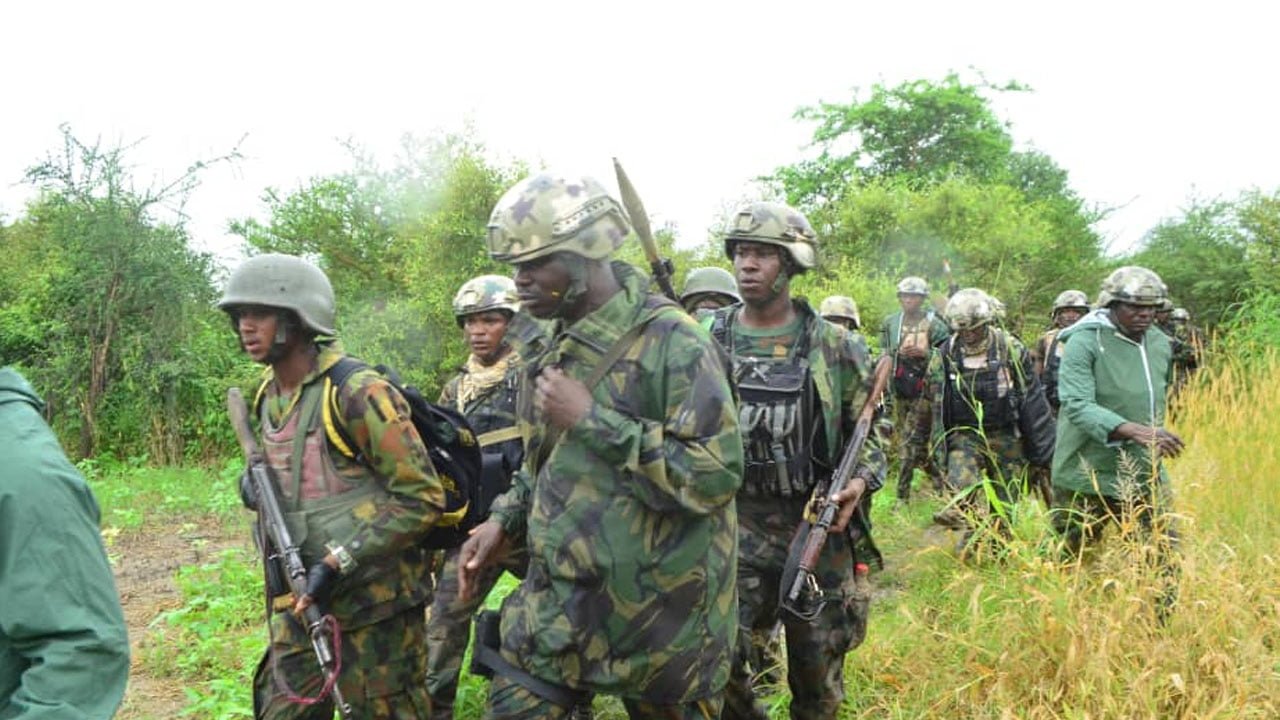
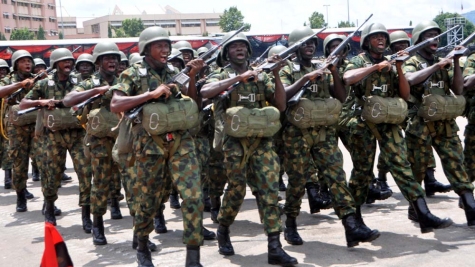
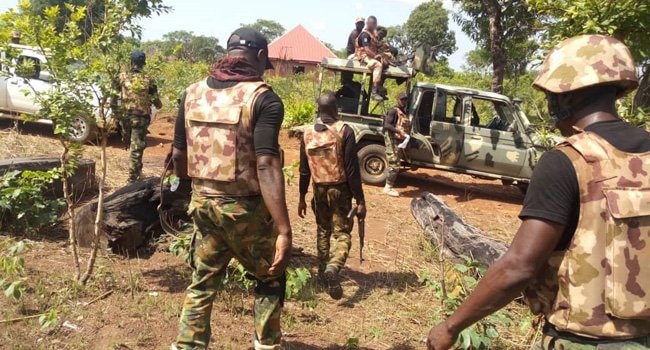
Nigerian Army

Nigerian Military vows to capture bandit leader Turji soon

By Uzair Adam

The military high command has vowed to bring Bello Turji, one of the notorious bandit leaders terrorizing Zamfara State and parts of the Northwest, to justice for his crimes against humanity.

General Christopher Musa, the Chief of Defence Staff, stated during a press briefing at the Defence Headquarters in Abuja that the military is determined to put an end to the levies being imposed by Turji and other terrorists on farmers.

He assured Nigerians that the days of the bandit leader are numbered, urging citizens to support the military’s efforts to restore peace.Gen.

Musa revealed that despite the bandits’ attempts to disrupt the lives of farmers, the military is working tirelessly to end these atrocities.

He also warned communities against supporting or providing information to the bandits, as doing so only prolongs the conflict.This declaration follows a recent visit by Gen.

Musa and other service chiefs to Sokoto, ordered by President Bola Tinubu, to intensify the fight against insurgency in the region.

The Chief of Defence urged Nigerians to remain vigilant and to collaborate with security forces to ensure the success of ongoing military operations.

Army hands over suspected killer of FUNAAB student to police

By Uzair Adam

The Nigerian Army has apprehended 23-year-old Adeleye Ayomide, suspected of being the killer of Christiana Idowu, a 300-level student of the Federal University of Agriculture, Abeokuta (FUNAAB), who was abducted in Lagos State.

The Lagos State Police Command confirmed the handover of the suspect on Thursday, following an investigation into the incident.

According to Lagos Police spokesperson Benjamin Hundeyin, Ayomide was handed over by the Nigerian Army’s 9 Brigade at about 2 p.m. on September 5.

The late Christiana was kidnapped along the Ikorodu-Yaba Road on August 19, sparking public outrage, especially on social media.

The hashtag #JusticeForChristianah has gained traction, with many Nigerians calling for justice.

A user on social media, going by “Man of Letters,” shared details of how the suspect, who was reportedly in a close relationship with Christiana based on their interactions on Instagram, was tracked down.

Security operatives traced Ayomide through his mobile phone, leading to his arrest at his parents’ house in Ikorodu.

Among the evidence recovered from the suspect was the victim’s blue ITEL A56 phone.

The investigation is ongoing as authorities work to bring justice for the slain student.

Terrorist ambush in Sokoto leaves 4 military personnel dead

By Sabiu Abdullahi 

Troops of Operation Hadarin Daji were ambushed by terrorists in Bachaka Kurya Forest, Gudu Local Government Area, Sokoto State, resulting in the loss of four military personnel. 

Major General Edward Buba, Director of Defence Media Operations, confirmed the incident in a statement released in Abuja, stating, “The ambush took place near the Nigeria-Niger border.

In the ensuing firefight, several terrorists were killed, and troops recovered weapons and ammunition.” The military authorities identified the perpetrators as a terror group from Niger Republic known as Lakurawa. 

“The corpses of the killed terrorist reveal that it was perpetrated by a terror group from Niger Republic known as Lakurawa. Sadly, 4 of our personnel were killed in the encounter,” the statement added. 

The military has vowed to pursue the remaining members of the terror group, who escaped into Niger Republic.

“Troops are however in pursuit to find and destroy the terrorist,” the statement concluded.

Nigerian Army strikes against terrorists in Borno, seizes weapons, recovers rustled cattle

By Uzair Adam

In a recent operation, Nigerian Army troops successfully eliminated five terrorists affiliated with the Islamic West Africa Province (ISWAP) in Bama Local Government Area, Borno State.

The clash with the terrorists resulted in the recovery of significant arms and ammunition, including two Rocket Propelled Grenade (RPG) bombs, two Dane guns, an RPG bomb charger, an AK-47 rifle magazine, 23 rounds of 7.62 mm ammunition, and six motorcycles.

Additionally, the troops recovered assorted medications and rustled cattle.During ongoing operations in the North East, the Army reported that 44 Boko Haram terrorists and their families have surrendered in Bama, Dikwa, and Gwoza Local Government Areas.

In Plateau State, the Army apprehended a notorious cattle rustler, Mallam Maawuya Shuaibu, in Mararaban Kantom, Barkin Ladi Local Government Area.

Shuaibu, previously on security agencies’ watch lists, was arrested with 32 stolen cows.

In Bayelsa State, a raid in Korokorosie Community led to the arrest of Mr. Donald Emason, who was found with a revolver pistol and two locally made guns.

In Oyo State, Mohammed Bello, 33, was detained in Akinyele Local Government Area for allegedly supplying arms to a kidnap syndicate.

These operations highlight the Nigerian Army’s ongoing commitment to addressing terrorism and criminal activities nationwide.

Sponsors of rioters waving Russian flag arrested – Egbetokun

By Uzair Adam

The Inspector-General of Police, Kayode Egbetokun, announced that the police have apprehended individuals responsible for sponsoring rioters who displayed foreign flags and called for a change in government.

The Daily Reality learned that an investigation is underway to determine their motivations.

The Comptroller General of the Nigerian Immigration Service, Kemi Nandap, revealed that some sponsors are based in the diaspora and have been identified and watchlisted.

He said that any attempts by them to enter the country will be met with arrest.

IGP Egbetokun also stated that funders of violence and subversion, both within and outside Nigeria, have been tracked, and their accounts have been blocked.

The security agencies assured that they have been managing the crisis carefully, using only tear gas and not live ammunition or rubber bullets.

He added that the reported shooting of a protester in Abuja is being investigated and may have been the work of armed robbers or hoodlums.

The Chief of Defence Staff, General Christopher Musa, emphasized the commitment of security agencies to their task and the respect they have for the country.

The Chief of Army Staff, Lt. General Taoreed Lagbaja, assured that the Nigerian Army will protect Nigeria’s democracy, peace, and harmony.

The DSS spokesman, Dr. Peter Afunanya, confirmed that some sponsors of the foreign flags have been arrested and urged patience as their identities will soon be disclosed.

Nigerian army kills 11 ISWAP terrorists in Sambisa forest

By Anwar Usman

Troops of the Nigerian Army, deployed for a special operation in Sambisa Forest, have eliminated 11 Islamic State of West Africa Province terrorists.

The Nigerian Army, in a statement on its official Twitter handle, disclosed this on Saturday.

It said the feat was achieved in coordinated special clearance operations with a hybrid force against a terrorists’ enclave in Jongo Village within the notorious Sambisa Forest.

It stated that the troops targeted the portion and engaged the terrorists in a fierce gun battle, killing some while others fled in disarray.

The army stated that its troops conducted further exploitation ahead of the enclave, leading to the capture of some weapons.

According to the post, the arms include 99 rounds of 7.62 x 54mm on a metal link, 19 rounds of 7.62 x 39mm, 3 AK-47 rifle magazines, two 36-hand grenades, and two locally made guns.

“This successful operation showcases the operational effectiveness of the Nigerian army in combating terrorism and securing in the region.

“The neutralisation of ISWAP terrorists and the confiscation of their weapons will undoubtedly contribute to enhancing security and stability in the area.

The post added that, “This further demonstrated the commitment of the Nigerian military to eradicating terrorism and protecting the citizens”.

Troops kill suspected ‘IPOB bigwig’, arrest two notorious terrorists In Imo

 By Anwar Usman 

The troops of the Nigerian Army killed a kidnap kingpin and arrested two other notorious terrorists during multiple raids of IPOB hideouts in the state, the army said in a statement on their X account formally known as twitter on Monday. 

One of the operations was conducted at a suspected IPOB hideout in Ezeinyen Okwe Umucheke, a community in Onuimo Local Government Area of the state.

The operation was targeted at the suspected IPOB Bigwig identified as Chinemerem, popularly known as “Bam Bam” in the community. 

“The operation led to the neutralisation of Chinemerem, as he attempted to reach for his weapon and the arrest of several of his accomplices,” the army said on their X handle. 

“A substantial amount of weapons, ammunition, and IPOB/ESN equipment were seized, and the hideout was subsequently destroyed.” 

The statement said the troops subsequently intercepted other suspected IPOB/ESN members at another hideout in Ama Hausa in Okigwe Local Government Area of the state. 

Tyey added that, “Overpowered in the ensuing shootout, the (suspected) terrorists were forced to flee in unruliness, abandoning a collection of ammunition and motorcycles”. 

Seventy-two rounds of 7.62 x 51mm NATO ammunition, four rounds of 7.62 mm (special), three rounds of 5.56mm, one FN rifle, a pair of military desert boots and one green beret were recovered from the hoodlums, according to the army. 

Though the army did not identify the security operatives who took part in the operations, it said the operations were conducted in collaboration with other security agencies. 

A similar operation was conducted in Orlu Local Government Area of Imo State, which targeted two other notorious Bigwigs – Izuchukwu Emejuru, otherwise known as “Kingkong,” and Chibuzor Chikwe, also known as ‘’Onyema.” 

During the operation, some valuables reportedly belonging to Ugonna Iriele, the traditional ruler of Ogberuru in the Orlu Council Area, were recovered by the troops. 

Furthermore, “The raid resulted in the arrest of these suspects and the confiscation of a variety of weapons, including a Semi-automatic pump-action gun, a locally made gun, and a pistol,” it said. 

IPOB, a group seeking the independent state of Biafra to be carved out of the South-East and some parts of south-south, Nigeria, has been linked to the deadly attacks in the regions.

The bandits, the vigilantes, and the government

By Rabiu Isah Hassan

Citing the killing of an army officer by bandits in Katsina recently, Sheikh Musa Yusuf Assadussunnah shows the futility of military measures in resolving the pastoralist-peasant conflict in northern Nigeria. By this daring act, the insurgents have demonstrated that the military, much less the vigilante, cannot end the insurgency. According to him, the only solution is a truce. From other sermons by clerics and numerous online items from the conflict area, it appears Assadussunnah is misreading the situation. Not only are the insurgents receiving severe setbacks, but the signs are also ominous. 

The army officer might have been killed not because the troops were weak or ill-equipped but because he exposed himself to unnecessary danger. The way the vigilante and locals praise his determination and commitment suggests he might have been motivated to sacrifice himself for Nigeria and significantly for a Hausa cause. In a way, the prolongation and viciousness of the conflict have started affecting the soldiers on the ground; as in any internal crisis, the armed forces, which are supposed to be neutral, are gradually and inexorably drawn into its vortex.

No group has drawn the wrath of most Nigerian groups, perhaps except for the Igbo during the Nigerian crisis of 1966-1970, like the ethnic Fulani presently. Anti-Fulani sentiments, always simmering below the surface mainly due to perceived historical wrongs, are now erupting due to the current widespread atrocities of mostly pastoral Fulani. An inchoate coalition of mostly Hausa youths and northern minorities is emerging based on shared grievances against the Fulani. Their violent rhetoric, both online and offline, reflects the extent to which the Fulani have slipped down from decent beings and citizens to savages and aliens. No amount of infractions against the ethnic Fulani is seen as grotesque or repugnant.

The troops on the ground and the Hausa vigilante have fused into a hardened armed fist against their perceived enemy. From diverse reports, a discernible pattern is emerging. As the soldiers attack the bandits, the vigilante form their rear, mopping up any stragglers and often dispersing or exterminating ethnic Fulani along their path. The vigilante are also at liberty to arrest, detain, and kill any ethnic Fulani or Hausa informers in an attempt to root out collaborators or destroy the bandits’ supply channels. When the bandits feel the heat, they attack, maim, and kill Hausa peasants randomly. They threaten to stop farming this season, forcing the government and the sedentary population into another truce. This only inflames the soldiers and the vigilante, resulting in more indiscriminate attacks against ethnic Fulani.

Some Islamic clerics still maintain that military operations will not end the insurgency and that the government should negotiate with the bandits to end the bloodletting. These statements make the bandits believe in their invincibility anddangerously encourage them to see their actions as serving an ethnic cause. In a bizarre twist, the bandits have come to link their survival with that of the ethnic Fulani. Since they no longer see themselves as the cause of the Fulani predicament, their removal from the scene is out of the question. This intransigence is further fueling the binary that currently pits the Fulani against the Hausa. Thus, instead of viewing the conflict as occupational and the bandits as criminals, some sections of the ulema have come to regard it as communal, with the insurgents seen as activists.

What some clerics and others fail to appreciate is that both the Hausa-speaking sedentary population of the Northwest and the pastoral Fulani have become one community through centuries of exchange. The pastoral Fulani are essentially an occupational and remnant group continuously absorbed into the general Hausa population. In other words, they do not exist as separate and closed groups. Like similar groups throughout history, the bandits are deviants that have emerged due to internal crises. They need to be tamed or destroyed, not hailed as vanguards of any ethnic group.

With the bandits vowing to fight to the bitter end, they risk dragging the rest of the ethnic Fulani into the abyss with them. The intensity and randomness of their attacks testify to this deranged stance. The indiscriminate reprisals from the other side are making life unbearable for the ethnic Fulani. As the noose tightens around them, there is little chance for their offspring to continue the fight as they hope. A war of attrition would only lead to their decimation; they cannot withstand the combined strength of the Nigerian state and the Nigerian masses. 

Unlike the Igbo, who returned to their homeland following the pogroms in Northern Nigeria, the ethnic Fulani are losing their remaining sanctuaries. If the war becomes protracted or its viciousness intensifies, the country risks sliding into the fate of Mali and Burkina Faso. With the bandits terrorising almost half of the country and the army engaged in fighting them in about a quarter of it, hatred against the Fulani is increasing among the soldiers. 

Like the inchoate movement developing among the ethnic Hausa and northern minorities online, a conspiratorial group with similar configuration and motivation could develop within the army. Given the toxicity across the land and the increasing hardship, they might attempt a putsch. As in Mali and Burkina Faso, where the raison d’être of the juntas is the containment of the Fulani in the case of the former and their destruction in the latter’s case, an idealistic junta in Nigeria would unleash its reign of terror not only against the ethnic Fulani but also against their symbols.

There is only one possible way to avert this Armageddon. Many groups before them have avoided this ruinous outcome. Recently, the Kanuri, who formed the bulk of the supporters of Boko Haram, quietly abandoned their weapons and dispersed among the general population as the magnitude of the catastrophe loomed. The followers of Maitatsine had followed the same course after realising the folly of confronting the state. After valiant resistance against Rabeh at the end of the nineteenth century, many Kanuri surrendered, and others fled. The leaders of the Sokoto Caliphate retreated in the face of superior arms. After their defeat at Burmi, a few withdrew from the territory and eventually submitted to the British authorities in Sudan. At the same time, the majority reconciled themselves to the new order in Northern Nigeria. When the Biafran secessionists realised that their intransigence would only lead to more destruction of the Igbo, they removed themselves from the scene to pave the way for surrender. These were the practical and noble paths taken in Germany and Japan at the end of the Second World War and countless previous conflicts. 

The preservation of the ethnic Fulani must supersede the bandits’ ego, and only surrender would spare their kinsmen from possible destruction. They should give themselves up and be tried in a military tribunal. Like the Nuremberg trials at the end of the Second World War, they must be sentenced based on the gravity of their offences. The minors could be assembled and enrolled in a rehabilitation program. A bold resettlement and integration plan must be rolled out for the pastoral Fulani. Parallel communities should not be allowed to resurface; the pastoralists should be settled among the sedentary population to end mistrust and bigotry. The homogeneous, stable, and prosperous nation that would emerge would be the compensation for these painful sacrifices. 

Rabiu Isah Hassan wrote from the Arewa House/Department of History, ABU Zaria. He can be contacted at rabiurafani@gmail.com.

Nigerian soldiers liberate 20 abductees, kill terrorist leader in Zamfara

By Sabiu Abdullahi 

The troops of Joint Task Force North West Operation Hadrain Daji have achieved remarkable success.

This operation led to the rescue of 20 kidnapping victims and the neutralisation of two terrorists, including the notorious leader identified as Sainaje from Katsina State. 

Captain Yahaya Ibrahim, Information Officer for Operation HADARIN DAJI, announced these developments in a statement shared today on Facebook.

On January 29, 2024, Operation HADARIN DAJI troops initiated a continuous clearance operation at terrorists’ enclaves in Rukudawa, Dumburum, Tsanu, Birnin Tsaba, Magare, and Shamushalle general areas of Zurmi and Birnin Magaji Local Government Areas of Zamfara state. 

During the operation, the troops effectively dismantled the discovered terrorists’ enclaves, including that of a notorious terrorist kingpin named Sule.

A vigorous engagement with the aggressive troops prompted the terrorists to abandon their camps. 

In the course of the operation, two terrorists, including the notorious leader Sainaje from Katsina State, were neutralised. This tactical move resulted in the liberation of 18 kidnap victims, consisting of four males, 14 females, and children. 

Additionally, Operation HADARIN DAJI troops rescued two victims abducted by terrorists along Shinkafi-Isa road in Zamfara state.

The captors abandoned the victims during a gun duel with the highly motivated troops, whose swift response ensured a successful rescue. 

All the rescued victims have been handed over to the appropriate authorities for reunification with their respective families.

Major General Godwin Mutkut, Commander Joint Task Force North West Operation HADARIN DAJI/General Officer Commanding 8 Division Nigerian Army, commended the troops for their unwavering efforts in restoring normalcy to the Northwest region.

Customs boss committed to establishing polo club for officers after victory in tournament 

By Sabiu Abdullahi

In his support for sports within the Nigeria Customs Service (NCS), the Comptroller-General of Customs (CGC), Bashir Adewale Adeniyi MFR, expressed his commitment to encouraging officers engaged in sports activities. 

According to the customs service spokesperson in a statement on Monday, this announcement came on Sunday, January 15, 2024, during the Polo Tournament between Customs Players and the Nigeria Army at the Nigeria Army Polo Resort in Abuja. 

CGC Bashir Adeniyi said, “We will consider officers who have expressed interest in the Polo game here to be the nucleus of our team — and we will give similar encouragement to other Officers to engage in the game.” 

Impressed by the NCS representatives’ performance, he declared, “I am quite impressed with what I have seen, and this will mark the beginning of the resurgence of Polo Games development in Customs.” 

Highlighting the importance of physical fitness, CGC Bashir Adeniyi noted that maintaining officers’ health directly impacts the NCS’s performance in revenue generation, trade facilitation, and smuggling suppression. 

“Our job is a very serious one: generating revenue, facilitating trade, fighting against smuggling — and these are serious callings. It requires us to be physically and mentally fit, as doing so will help maintain a delicate balance between the requirements of our work and the need to stay fit,” he remarked. 

The Chairman of the Nigerian Army Polo Association (NAPA), Major-General Adamu Garba Laka, organized the tournament to celebrate Army Remembrance Day and honor CGC Bashir Adewale Adeniyi MFR. 

Major General Laka urged other security agencies to emulate the NCS by engaging their staff in Polo activities, stating, “The easiest way to do that is to invite the big men to come and appreciate their players like CGC Bashir Adewale Adeniyi.” 

Major-General Laka recalled the game’s introduction to Nigeria in the 60s by Colonial Masters. 

The victorious NCS Players, honored with major trophies, received awards from dignitaries including Major-General Adamu Garba Laka, Director-General and CEO of Voice of Nigeria Jibril Baba Ndace, and Assistant Comptroller-General of Customs in-charge Headquarters Olaniyi Alajogun. 

Representatives at the tournament, Chief Superintendent of Customs Jamilu Haruna Funtua and Superintendent of Customs Aminu Labaran Kago, expressed gratitude to CGC Bashir Adeniyi for his morale-boosting presence.

They pledged increased efforts for future matches, aiming to bring more trophies to the Nigeria Customs Service.