Twitter has met only 10 conditions FG sets – Lai Mohammed
By Hussaina Sufyan Ahmad
By Mukhtar Ya’u Madobi
Subject to its wider ramifications, the burden of maintaining security is too cumbersome to be single-handedly by a solitary institution in a heterogeneous country like Nigeria.
Thus, the multi-stakeholders’ approach is often more necessary where there is a rise in security challenges. Therefore, security should be a collective effort of the government plus other state and non-state actors, including the private sectors.
The word ‘security’ simply implies the protection of the lives and properties of people from various forms of threat. It occupies the highest level of priority in the hierarchy of responsibility by the government as one of the core values that the state cherishes as non-negotiable and that does not admit compromise.
The contribution of private sectors in ensuring security can be rendered through various channels, including the construction of security facilities, donations of logistics to security services and providing equipment at their disposal during emergency response situations such as fire outbreaks, accidents, building collapse and natural disasters such as flooding, earthquake, etc.
Other alternatives include community participation in securing their locality in collaboration with police, i.e. the neighbourhood watch or vigilante group, involvement of religious and traditional leaders in disputes resolution among their followers and services provided by the business enterprises to their host communities through corporate social responsibility (CSR) initiatives.
To that effect, the role being played by the famous Civilian Joint Task Forces (Civilian JTF), through collaboration with the security agencies in countering the violent extremism of Boko Haram terrorists in the North-East (Borno), is very commendable. Such volunteer groups provided invaluable intelligence that led to the uncovering of many deadly terrorist cells and their subsequent elimination.
Now that the terrorists are surrendering, community leaders, civil society groups and NGOs have a greater job to embark on sensitizing the mindsets of the public in de-radicalization, rehabilitation and reintegration of the repentant terrorists into society. This will go a long way in maintaining the security of lives and properties of people.
It is noteworthy that the CSR initiatives of the Aliko Dangote Foundation donated 150 operational vehicles to the Nigeria Police Force in 2018, which was described as the single most significant gift ever by a private sector operator to the police.
In the Niger Delta region, where the problem of insecurity is mainly attributed to the feeling of anger and frustration by host communities due to negligence of CSR initiatives, the oil companies have turned a good leaf by changing the narratives.
Multinational corporations are now actively involved in providing infrastructural facilities such as schools, hospitals, roads, and water supply to their host communities. In the long run, they also designed a special scholarship scheme for the indigenes. They are provided with tuition fees and reading and learning materials to further enhance their educational careers. This initiative has undoubtedly contributed immensely to reducing the militants’ activities and other security tensions in the oil-rich Niger Delta region.
Moreover, several societal figures and organizations were known for their efforts in constructing and rehabilitating security outfits across the country. Recall that, immediately after the #EndSARS protests in which several lives of both civilians and security personnel were lost, many properties were destroyed, police stations looted, their firearms carted away and subsequently destroyed.
The giant private sector-led Coalition Against COVID-19 (CACOVID) procured new equipment for police officers and pledged to rebuild the burnt police stations destroyed during the civil unrest to restore security to the affected locations across the country.
Even the traditional institutions were not left out as Oba (Alhaji) Dauda Ajolola Adebimpe Akinfolabi of Ayedade Local Government Area of Osun State built a divisional police headquarters and the office for the Nigeria Security and Civil Defence Corps (NSCDC) office. The monarch noted that the gesture was necessary to protect his people and ensure safety in his community, considering the rising insecurity in the country.
In addition, private security companies are also part and parcel of the security architecture of every country. The responsibility of a private security guard is ‘securing the lives and properties of the client’. The client may be an individual, organization, private institution, government, etc. However, experience has shown that guards can perform additional functions other than just protecting the lives and properties of the client.
Their large number and widespread presence make them a critical part of the security system of the nation. The NSCDC is the ultimate regulator of all private guard companies in Nigeria and has so far licensed over 1000 companies. Almost all residences, offices, schools, shopping malls, parks etc., especially in the city, are staffed by private guards securing their location. To that effect, their number has even exceeded that of the entire Police Force in the country.
Therefore, the government and the security agencies can take advantage of this opportunity to collaborate with private guard companies, especially in areas of intelligence gathering and sharing, training and joint task operations towards securing the country from the activities of criminal forces.
Sequel to that, Nigeria’s Policy Framework and National Action Plan for Prevention and Countering Violent Extremism, produced by the Office of the National Security Adviser (ONSA), retired Major General Babagana Monguno have succinctly acknowledged the role of the prominent private sector in national security.
As they say, Emergency Management is everyone’s business.
Mukhtar sent this piece from Kano. He can be contacted via ymukhtar944@gmail.com.
By Hussaina Sufyan Ahmad
Lines of cars on heavy queues return to Kano filling stations on November 7, 2021, prompting some people to accuse the Independent Petroleum Marketers Association (IPMAN) of intentionally creating an artificial scarcity.
Most filling stations have been nil with no sign of activities, while motorists move about looking for the fuel.
Reports indicate that speculation of a possible increase in fuel price by the Federal Government might have resulted in the scarcity.
By Muhammad Sabiu
By Hussaina Sufyan Ahmad
The Nigeria Centre for Disease Control (NCDC) on Friday morning via it’s official website has announced the new toll of Covid-19 cases recording two deaths and 87 new cases of in the country.
The NCDC website said 87 new infections on Thursday was as a result of the infectious decrease from the 209 infections reported of on Wednesday.
The Public Health Institute added that the new infections were recorded across seven states of the federation and the Federal Capital Territory (FCT) on Thursday.
“Zamfara – 29, FCT – 25, Rivers – 11, Kano – 8, Bauchi – 5, Gombe – 4, Lagos – 3 and Taraba – 2.”
“While the latest report includes zero cases from Delta, Edo, Sokoto and Taraba States. Taking the country’s total confirmed cases to 212,446. However, 204,047 of those infected have recovered while 2,902 have died.
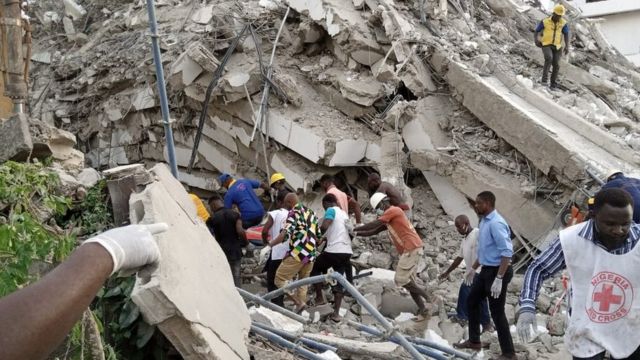
Indeed, the collapse of a 21-story building under construction in the Ikoyi area of Lagos State on Monday, November 1, 2021, is unfortunate. Unfortunately, this sad incident occurs in almost every region of Nigeria without proper investigation to determine the actual courses of action and adequate solutions to prevent future occurrences.
By Hussaina Sufyan Ahmad
The Tertiary Education Trust Fund (TETFund) has announced its target to raise the annual allocation to the National Research Fund (NRF) from N8.5 billion in 2021 to N10 billion in 2022, during a virtual meeting on the marking of the International Open Access Week October which holds October 25th – 31st, Nairobi, Kenya.
TETFund executive secretary, Professor Suleiman Bogoro, stated this for the theme “Democratisation of Higher Education in Nigeria through Open Access.” A meeting co-hosted by the Fund and the Training Centre in Communication, Nairobi.
According to the TETFund boss, following the agency’s proposal, the Board of Trustees’ had in 2019 graciously approved N5 billion for NRF, which was raised to N7.5 billion in 2020 and N8.5 billion in 2021.
“Over the last two and half years now, we have raised funds available for research. There are two categories; institution-based and National Research Fund.
“The institution based has a ceiling of N3,600 US dollars and it is mainly for basic research while the higher ceiling grant of about 92 – 93,000 US dollars is the National Research Fund aimed at promoting applied research. To this extent, in 2019 I made it a case to the Board of Trustees of TETFund to increase the threshold.”
“It used to be a kind of seed money. Seed money of N4 billion for eight years but from the year 2019 to last year and this year, 2021, we have increased it to N5 billion annually. Last year we increased it from N5 billion to N7.5 billion and this year it is N8.5 billion; and we are hoping in 2022 it will move to N 10 billion.”
By Bilyamin Abdulmumin
After the ugly event between 1967 and 1970 in Nigeria that threatened to end the country’s years of coexistence, the then Federal Government sought to mend the fences by mandating one year of National Youth Service Corps (NYSC) for university and, later, polytechnic graduates.
The program was made effective by ruling that prospective Corps are deployed interchangeably across regions and states. This provides a platform to understand better the country’s cultural diversity and catalogue other differences among Nigerians.
To many, the NYSC scheme is a brainchild to later life achievements, building connections that lead to many things such as jobs, skills acquisitions, marriage or lifelong friendship.
However, out of not knowing, many prospective Corps members risk missing out from this one-lifetime experience in the name of redeployment or service in absentia.
At the tail ends of the NYSC three-week orientation camp, one thing that dominates the exercise is relocation application.
The NYSC commission has provided the options for relocation after completing the three weeks orientation camp from one state of service to another on the grounds of many reasons such as health, marriage, security and what have you.
Many Corp members would seek to outsmart this relocation window, intentionally citing health grounds, among many other reasons, for the relocation. Last Thursday, during the ongoing orientation camp, Gombe State chapter DG had echoed that: “There is no need to invite sickness you do not have upon yourself for the sake of relocation”
It doesn’t take careful observation to note that most applicants are typical northerners, aka Hausa-Fulani.
This leads to an intriguing conclusion; Hausa-Fulani folks are home loving-people. Therefore, they do not want to explore other regions apart from their familiar environment despite the enormous possibilities attached with that.
These home-loving youths would come home after redeployment only to continue from where they stopped; the circle of routine activities but little do they realize that the bet wasn’t worth it.
In education, unarguably where the NYSC scheme found its most important use, many secondary schools poised as Place of Primary Assignment (PPA), especially the public ones, would improve their teaching capacity with these agile youth (bubbling with fresh ideas) who came from different backgrounds. In addition, many students would get their inspiration for future careers from these Corp members. I’m a living witness, and I have come across many friends who testified to that.
Those Corps who came away from their PPAs have only the service to offer; therefore, they are the most dedicated to their service. Service at home is a deterrent to the prospective Corp members from giving their best; therefore, it makes redeployment to home non-recommendable. On the other hand, service in absentia deprives the host PPA; it will also come back hunting the Corp members involved.
Sometimes later, whenever there is a discussion on the NYSC memories period while those who served in absentia are sent into oblivion, the deployed youths will just be cut short with little to reminisce. However, many of them never hesitate to voice their regret for being deployed to their homes or even from rural to urban cities.
When it comes to having eventful memories, serving in the rural areas is the bomb. That is where NYSC youth Corps members are treated with glamour or grandeur, unlike in urban areas. Perhaps the lack of due recognition to NYSC in the urban areas is because of the high number of youths who were once members; the society became used to the scheme.
Initially, when deployed to a particular environment, primarily rural, it depends on how rural the area is; the writing will be all over the wall that a significant readjustment is necessary, the hopeless loom large on the horizon. Cortisol level overshoot, the less tough youth (female) breakdown crying. Yet, at the same time, men who are more practical with emotions keep it within them. This traumatic experience would soon make the relocation processes continue at an unprecedented rate or invoke planning ideas of serving in absentia either by showing up just during the monthly CDSs or abdicating completely with impunity.
However, the enigma of the arrival would naturally fade away; the cortisol level would come down and, after given sufficient time, the codes of living in the newfound environment begin to be deciphered. One can then manipulate the environment to his taste until at a point after settled. Then, one begins to imagine the wind-up is fast approaching or even fantasy for an extension of the programs.
Dear Corps members currently on the camps or those coming later, avoid plunging into remorse later and shortchange the PPA community. It would be best if you rethink the idea of redeployment or service in absentia.
Bilyamin Abdulmumin is a PhD candidate, Chemical Engineering, ABU Zaria. He can be reached via bilal4riid13@gmail.com.
By Hussaina Sufyan Ahmad
Cheluchi Onyemelukwe-Onuobi at the NLNG award night at Lagos on October 30, 2021, won the $100,000 NLNG Prize for Literature, 2021.
Chairman of the Advisory Board, The Nigeria Prize for Literature & Literary Criticism, Prof Akachi Adimorah-Ezeigbo, disclosed that Cheluchi Onyemelukwe-Onuobi’s “The Son of the House” beat two other shortlisted novels, Abi Dare’s “The Girl with Louding Voice” and Obinna Udenwe’s “Colours of Hatred” to emerge the winner.
“The journey leading to the event started several months ago with the receipt of 202 novels for the Literature Prize since the genre in focus is Prose Fiction. Immediately the Panel of Judges were constituted, they swung into action and despite the challenges imposed by the pandemic, found creative ways to do their work meticulously, using a set of 11 clearly defined and approved Criteria. The Panel of judges also worked in close coordination with the Advisory Board, and the Secretariat of the Prize to produce evaluate and prune down the 202 entries to 50, then 25. From this point, they were able to produce a long list of 11 and thereafter, a shortlist of 3,” she said.
According to Adimorah-Ezeigbo, “Cheluchi Onyemelukwe-Onuobi’s “The Son of the House” was published in 2019 by Parresia Publishers. The novel presents the predicaments of two women, Nwabulu a one-time housemaid and a successful fashion designer; and Julie, an educated woman who lived through tricks, deceits and manipulation, as they meet in captivity.
Both women decide to tell each other their stories. They soon discover that their lives had crossed at different points. The subject matter of the novel is developed through the rupture of traditional plot and the mediation of a single narrative voice. It is made up of a prologue and three-part story moments, each dominated by multiple points of narration, “The Son of the House” is an experimental novel with a complex plot structure made up of the main plot and several subordinate plots that intercept.
By Hussaina Sufyan Ahmad
The former president of Nigeria, Olusegun Obasanjo has called for the creation of state police while delivering his speech at a lecture titled, ‘Social responsibility in nation building,’ to mark the 78th anniversary of Island Club in Lagos, on Friday.
Obasanjo said Nigeria needs state police to efficiently tackle the insecurity challenges of the country. He said only a safe environment can guarantee nation building.
According to Obasanjo:
“I have said it before and I will say it again. Nigeria should have state police all over the various states so that insecurity can be tackled efficiently. uaranteeing citizens a safe environment and round security is one thing a government must do.
No nation can be built where peace, security and stability are not guaranteed and with reasonable predictability of the President and the future not enthroned.”