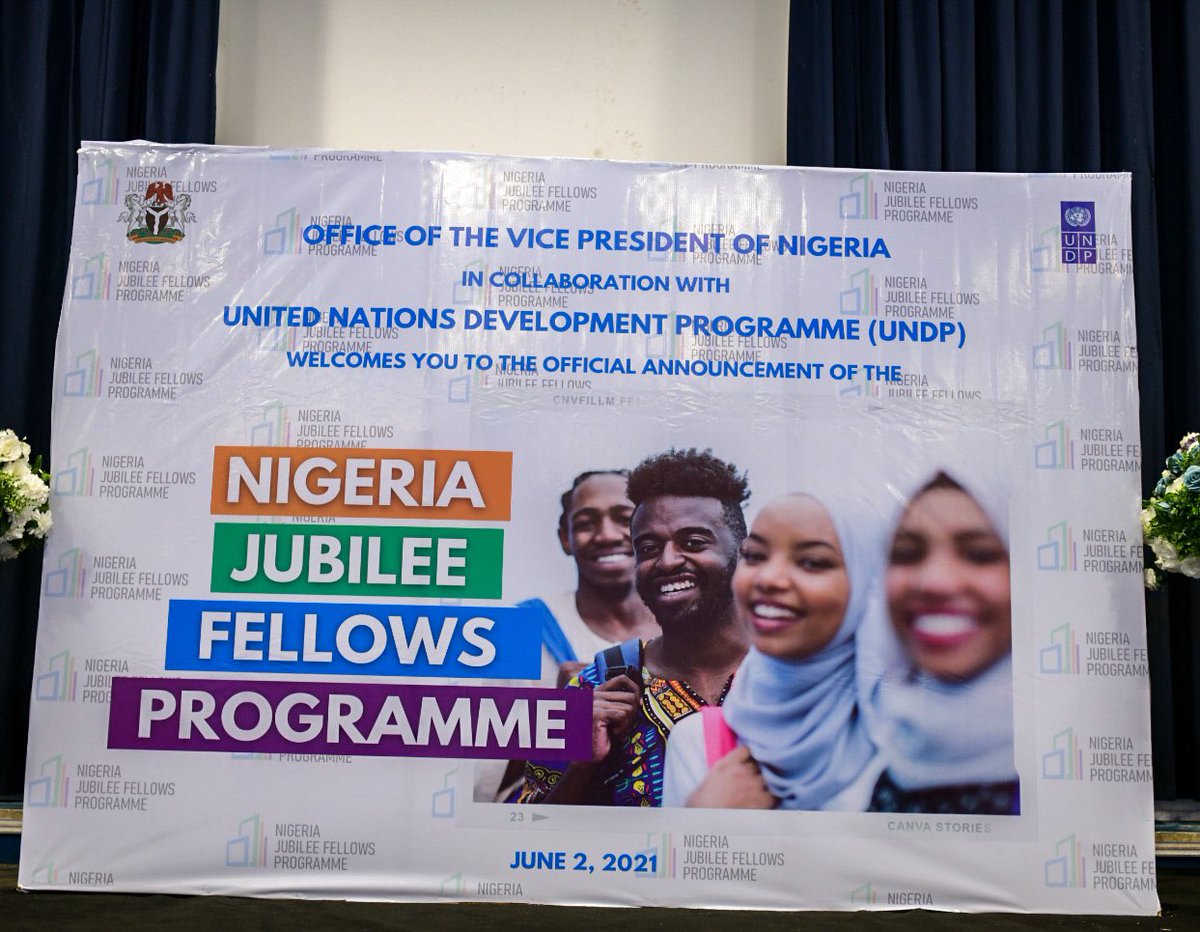
Nigeria Jubilee Fellows Programme

NJFP 2.0: Free labour for employers, 150K for young graduates

By Ishaka Mohammed

As a business owner in Nigeria, you can employ graduates to work for you for free, while each of them receives N150,000 from the European Union. Your role is to create a conducive environment for these young people to learn and grow over the next 12 months.

This is a marvellous opportunity created by the Federal Government of Nigeria, funded by the European Union and implemented by the United Nations Development Programme (UNDP).

The Nigeria Jubilee Fellows Programme (NJFP) was launched on August 31, 2021, to address Nigeria’s unemployment challenges by connecting talented graduates with job placement opportunities in organisations across the country—offering experience and building skills.

In the first phase of the programme, 20,000 graduates under 30 years were shortlisted in 2022, but official reports indicate that many of them were not matched with organisations due to a scarcity of interested and qualified host organisations. 

For those who were matched with organisations between 2022 and September 2025, each person was entitled to a monthly stipend of N100,000—now N150,000, effective from October 2025.

The portal is now open for NJFP 2.0. If you have an organisation registered with the Corporate Affairs Commission (CAC), this programme will greatly benefit you by boosting your visibility, providing free labour, and helping some young people in your host community achieve financial success. Visit https://host.njfp.ng/registration/, complete the application and check your email regularly.

With a reasonable number of interested and qualified host organisations, NJFP 2.0 is expected to be more successful than the first phase of the programme.

As for Nigerians under 30 who graduated not earlier than 2022 and possess the NYSC discharged or exemption certificate, this might be worthwhile. The application link is https://portal.njfp.ng/registration/.

By the way, many of those who were shortlisted in 2022 were delisted in 2025 without being matched with organisations. Consequently, interested applicants are advised to explore other means of upskilling and generating income even after being shortlisted.

Nigeria Jubilee Fellows Programme: Advice to three applicant categories

Ishaka Mohamed

According to a New York Times bestselling author, Joyce Meyer, patience is not simply the ability to wait — it’s how we behave while we’re waiting.

Many Nigerian youths have been eager for the outcome of their applications for the Nigeria Jubilee Fellows Programme (NJFP). Well, the waiting period is almost over because forty days from now, successful Fellows will have been deployed to their host organisations. This is according to the mail sent to many applicants, a version of which has also been posted on Facebook by the official page of the scheme: Nigeria Jubilee Fellows Programme.

That said, I write this purposely to advise all the applicants. I have categorised them into three.

The first group are those who have been pushed by impatience into using rude comments on posts by two Facebook pages: UNDP in Nigeria and Nigeria Jubilee Fellows Programme. I presume they’re really fresh graduates who, probably, haven’t been following recruitment processes in Nigeria. I’ll outline only three out of the countless cases of delay in the country for them. 

The Nigeria Security and Civil Defence Corps (NSCDC) started a recruitment process in 2019 but failed to complete it until 2022.

N-Power Batch C application started in June 2020, but the deployment of beneficiaries never happened until after 15 months. 

The Kaduna State Teachers’ Service Board (KSTSB) started a recruitment exercise in 2018 but managed to employ 7,000 secondary school teachers in July 2022. In fact, as of the time of writing this article, that’s nine months after their employment, none of these teachers has been posted to a school, let alone being paid a salary.

Therefore, there isn’t any need to feel too disappointed over something that is highly expected. It’s worth stressing, however, that it’s OK to clamour for a positive change in whatever concerns us, but decorum is highly recommended, at least for a young graduate and job seeker. So, rude comments should be done away with.

The second group are the over 340,000 applicants who won’t be selected. Yes, a total of 365,679 people applied for the scheme that needs only 20,000 Fellows per annum.

With or without cogent evidence, there’ll be lamentations from almost every angle when successful applicants are eventually picked. Many will blame favouritism and the like. A good number might lose interest in applying for other jobs, claiming that it’s by whom one knows. I urge all unsuccessful applicants (yet to know, though) to avoid losing momentum because of this; it’s simply part of life.

Now, to the third group, the privileged few, I advise that you think twice before leaving your ‘small’ job for the programme. Although it’s said that Fellows will be fully paid as graduates, being deployed doesn’t guarantee prompt payments. You must be realistic to yourself by keeping an alternative means of livelihood.

Of all of the schemes I’ve observed in Nigeria, only NYSC is somehow consistent in the payment of allowances. I’ll mention three others that have significantly failed in this regard.

One, as of January 2022, many of the past N-Power volunteers were still owed stipends. That was after 18 months of exiting the programme. And even while in the scheme, a significant number of these youth often received overdue allowances.

Two, the Special Public Works Programme for 774,000 unskilled labourers ended in March 2021, but a good number of the beneficiaries weren’t paid their N60,000 stipends until after nine months (end of December 2021).

Three, some Nigerian youth were placed on a three-month paid internship called the Work Experience Programme (WEP) from August to October 2021.

The Federal Ministry of Youth and Sports Development promised each intern a monthly allowance of N30,000 within the period of their engagement.

But such never happened, as the payment commenced in November 2021 and continued, inconsistently, through February 2022.

Some may think that NJFP will be different; I pray so, too. However, the scheme has already shared a pattern with its predecessors. In August 2021, it was promised that the first batch would be inducted in about two months’ time (October), only for the statement to be changed after seven months.

Based on the above instances, I reiterate that you keep an alternative source of livelihood before engaging in the programme. This is especially important for those who’d be posted to states other than their current settlements.

On a final note, if you’re privileged to be deployed to a private organisation, make sure to sell yourself. Much as many organisations usually aim to rightsize their employee base, none will be willing to lose a diligent young graduate if you really present yourself well.

Ishaka Mohammed writes from Kaduna. He can be reached via ishakamohammed39@gmail.com.

Nigeria Jubilee Fellows Programme: Buhari announces application date Tuesday

By Ishaka Mohammed

President Muhammadu Buhari is set to announce the commencement of applications for the Nigeria Jubilee Fellows Programme (NJFP) on Tuesday, August 31, 2021. 

According to UNDP in Nigeria, the federal government will make the announcement at 10 a.m.

The statement urged interested and qualified graduates and organisations to follow the page (facebook.com/UNDPNigeria) for more details on how to watch the announcement and apply.

Recall that the NJFP was launched in June with the aim of placing 20,000 graduates in 12-month fully paid employment.

For eligibility criteria, read: https://dailyrealityng.com/2021/08/25/nigeria-jubilee-fellows-programme-why-you-should-apply/

Nigeria Jubilee Fellows Programme: Why you should apply

By Ishaka Mohammed

After many fruitless applications, job seekers in Nigeria get frustrated. As some delve into crime, others retire to idleness, leaving everything to fate. Neither of these options is advisable. Nevertheless, there’s no need to stop trying. The following instances might suffice.

In Nigeria, being called a SAN comes with prestige. The bearer of the title is an experienced legal practitioner, considered professionally (and to a large extent, economically) successful. It means Senior Advocate of Nigeria (SAN), yes? But, no, there’s a different angle to it.

Many young Nigerians can bear an unfortunate version of the acronym SAN. They don’t have to study law, not to talk of being called to the Bar.

To cut it short, a guy and two ladies meet (for the first time). In response to the question of what he does for a living, he replies, “I’m a SAN.” The ladies are amazed due to his age, so they try to congratulate him, but his conception of the acronym fills the scene with abundances of laughs. He gently says, “I am a Senior Applicant of Nigeria (SAN).” The guy has applied for many jobs, but he has yet to secure employment. After listening to his story, the ladies offer him a job.

That’s in a Nollywood movie, though. Now, let’s discuss reality. A friend and former colleague is currently an officer in the Nigerian military. At a point in his life, he handed copies of his credentials to a cybercafé attendant and asked him to keep applying for jobs that matched the credentials; he would pay after every application. That was after being tired of visiting the café all the time.

Road Safety, Prison Service (now Correctional), Navy, name it — my friend had sat tests or gone for physical screenings, but none had worked in his favour. He was literally tired, so exhausted that when he was called for a physical screening after his last application, he had concluded to ignore it. If not for the timely intervention of his family, he wouldn’t have gone for the screening. He made it afterwards and the rest is history.

The above instances clarify that you have no reason to give up. You don’t have to wait for the required “connection”. Keep trying. Thomas Edison once said, “Our greatest weakness lies in giving up. The most certain way to succeed is always to try just one more time.” That one more time might be the last effort required. That one more time shouldn’t be about today or tomorrow; it shouldn’t be about the number of attempts; it should simply be about whether or not you have attained your desired goal.

As a Nigerian, you can irrevocably say that many things have gone wrong in your country. The rate of unemployment is high and scary. Thanks to members of the political elite, who are busy hijacking what is meant for the citizenry.

Attempting to minimise unemployment in the country, successive governments have come up with beneficial programmes targeting the youth. However, the politicisation of selection processes and inconsistent remunerations have sabotaged the otherwise commendable initiatives. For instance, many of the past N-Power volunteers are still owed stipends after one year of exiting the programme. And even while in the scheme, a significant number of these youth often received overdue allowances. What about the Special Public Works Programme for 774,000 unskilled labourers? The three-month programme ended in March 2021, but many of the beneficiaries have yet to be paid. It’s worth stressing that each beneficiary is entitled to just N60,000 (spread across three months).

Despite the ugly situations in Nigeria, try this one. In collaboration with the United Nations Development Programme (UNDP), the Federal Government of Nigeria is enrolling 20,000 recent graduates in full-time paid employment for twelve months. In addition, the Nigeria Jubilee Fellows Programme is for young graduates.

I partook in a briefing session on Zoom with one of the programme’s team members, Erere Oghoghome, on Tuesday the 17th of August, 2021. According to her, the programme will engage 100,000 people across five years, and the first cohort will be inducted by October 2021. That means the call for applications will be out in the coming weeks. Every eligible and interested person is expected to have developed a craving for a particular skill.

Aside from being paid employees for the period of the programme, fellows stand the chance of being retained by their host organisations. Plus, they’ll join the alumni network upon completion of the programme, and the team will be the first choice for organisations seeking personnel to fill vacancies.

The basic requirements are: graduated not earlier than 2017, less than 30 years of age, unemployed, and possessing NYSC discharge or exemption certificate.
At this juncture, I implore anyone who meets the requirements to keep tabs on the UNDP in Nigeria for this rare opportunity. It might just be that one more step to their dream job.

Other than using the experience to land a job after the programme, one can deploy the skill, money, or both in self-employment. Remember, fellows will be paid as graduate employees, not given stipends.

Therefore, it’s vital that unemployed graduates apply for the programme. There’s no harm in trying.

Ishaka Mohammed writes from Kaduna. He can be contacted via ishakamohammed39@gmail.com.