Muslims

Waqf would have saved the situation!  

By Abdullahi Abubakar Lamido

Alhaji Abdullahi (not a real name) is a rich man from Northern Nigeria, famous for his multidimensional philanthropy. He was, at a time, among the three richest men in his town. He came from a polygamous family and was the 14th child of his dad. He was the only rich man. Being polygamous himself, he has close to 20 children from three wives. As the only well-to-do in his extended family, his house is like a local government secretariat, always jam-packed with visitors from among family members. This is in addition to dozens of his “sons and daughters” born by his brothers and sisters, who reside in his house, under his total care. But Alhaji takes care of them all; feeding, clothing, education, healthcare, Sallah clothes, etc. He does that with all pleasure. After all, he has the means, and of course, the heart, as a wealthy businessman.

Here is a religious, wealthy man and an influential politician cum Islamic scholar. He has built several schools and mosques, sponsored the education of many orphans, given capital to many people, sponsored the marriages of many poor girls, and sponsored dozens of people to hajj. He is one of the best philanthropists you can think of. After all, that is what is expected of an affluent Islamic scholar. His school was once among the best two primary and secondary schools in the town. When he singlehandedly built it about two decades ago (he had built others much earlier), he would pay teachers’ salaries, buy uniforms for the students, and give them other learning materials. He loves the Qur’an, being also a hafidh himself. And he would provide copies of the Qur’an to all the hundreds of his pupils. This is in addition to dozens of people who rely on him for their livelihood.  

As time went by, the “law of diminishing returns” began to affect his fortunes. Gradually, he began to withdraw the subsidies from the school due to continually decreasing income and ever-expanding family financial pressure. But he wanted to maintain the good deeds. Now the school needed expansion while his pocket had experienced contraction. He gave his big land close to the school for the purpose. But no funds to build it. So, he sold another land and built it. Note that the school fees could, at best, pay salaries and take care of the running cost. Every student pays. But it is a middle-class school, so the charges cannot be high. So, he went and sold another asset, built the classes. He sold another one again and again until virtually all the sellable assets became exhausted.

One day, while sitting at home, he saw his children returning before the school closing hours. “What is going on”? He asked them. They were sent home because they did not pay school fees. This happened when he was battling with how to feed his family and settle many other bills. Alhaji never envisaged a day when his fortune would dwindle to that level. Therefore, he did not save nor invest for that rainy day. He thought he would continue to secure contracts and earn considerable resources to fund his schools and even establish more. He, in short, did not benefit from the advice of a waqf expert who could have shown him the simple way of establishing an investment waqf, using a portion of his assets, that would perpetually generate a flow of revenues. The revenues could sustainably fund his schools and other charitable interventions. 

Waqf offers a variety of ways for planning the future of your family and supporting other charitable projects sustainably. For instance, the idea of an investment/productive waqf would have perfectly saved Alhaji Abdullahi from selling and reselling his properties to expand his school. As it is, there are two forms of waqf; direct and invest waqfs.

A direct waqf is one created to provide direct welfare and societal development services. Examples are mosques, boreholes, and tuition-free schools that offer direct benefits to designated beneficiaries. An investment waqf is a money generating waqf whose revenues are dedicated to financing defined welfare and socio-economic development projects. An investment waqf can be made to fund and maintain a direct waqf.

For instance, a well-managed orchard can be dedicated as waqf such that the revenues generated from the sale of its fruits will be used to finance a tuition-free school. So, when Alhaji Abdullahi built his school, which he wanted to be a subsidized one, he could have established an investment waqf that would mature and, within some time, continue to finance the school from its proceeds. His other assets would have been saved for other equally important purposes. He could as well have saved himself from the embarrassment of the failure to pay children’s school fees later in his life when the recession hit him.

For instance, nothing stops this rich man from building rentable shops or apartments and dedicating them as waqf, such that what they generate would be divided into two; half reinvented and the other half injected into supplementing what is generated as school fees. He could as well have purchased shares of a halal company and dedicated the investment as a waqf for funding the school waqf. This way, the waqf corpus would continue to expand, and its revenues would grow sustainably. What started as a small waqf can grow into a megaproject that benefits society on a larger scale. Not only subsidies, the investment, if properly managed by trustworthy investment experts, would have funded the construction of more and more schools and the provision of scholarships, among others.

 So, if he provided subsidies at the beginning of the school, part of such funds would have been invested, and gradually he could withdraw the subsidies as the returns from investment take over the funding of the school. This way, his children could have become permanent beneficiaries of the scholarship provided by the waqf of their formerly wealthy father. Better still, he could have simply established a family waqf (a topic for another day) specifically for his children. Waqf, in short, could have saved the situation

Abdullahi Abubakar Lamido is the Chairman, Zakah and Waqf Foundation, Gombe. He can be reached via lamidomabudi@gmail.com.

How parenting changes a person

By Aisha Musa Auyo

Parenting is one of the most challenging jobs globally, a job that starts with pregnancy but never ends. It’s a lifetime commitment with many challenges, rewards, and experiences that change us, teach us and humble us. In fact, one doesn’t fully know himself till he starts bearing and raising kids. This commitment tests our patience, compassion, selflessness, strength, weakness, etc.

When I was in my teens, I didn’t have that natural love for kids, as I saw them as nuisance and disturbance, but ironically, kids love me and often extend their hands to pick them up. Usually, I didn’t bother to respond to their advances. I would look at them with a pretentious smile and move on. Later, a friend who loves babies explained that kids are attracted to me due to the constant eyeglasses in my face. That was relieving. My coursemates could not believe their eyes when they saw me on a TV program dishing out tips on parenting, child psychology, and upbringing.

A few years later, I became a mom, a fierce one for that matter, and this new responsibility has changed my entire outlook on life. It made me appreciate Allah more; the fact that a whole human being is produced in a womb from a drop of sperm, and the entire foetus transformation within nine months never cease to amaze me. The fact that milk begins to pop out from the breast after childbirth is still super.

Perhaps the most baffling is how tuwo, shawarma, rice, veggies, and whatever breastfeeding mother eats get transformed into breastmilk within minutes is brain blasting. Sometimes, I wish I could see how my body organs function to deliver this seamless production. Allah is indeed the Greatest. Tabarakallah Ahsanul khaaliqeen!

There’s a popular cliché that says if you want to change the world, change it while you are single, without a spouse, or a kid, as that is when you have freedom and might to do whatever you want because these two groups of people take your freedom and will power away. This is true in some ways. But if we look at it in another way, one can change the world when he becomes a parent by being a better version of oneself and upbringing pious, honest and loving generation.

Please permit me to list a few ways in which motherhood changes me. Perhaps others can learn, relate, realign, and prepare themselves for the unending task:

Motherhood made me more grateful to my Creator, more thankful to my parents, appreciate other parents, and made me understand to some certain extent the pain of not having kids, delayed fertility and parenting kids with special needs.

Motherhood humbled me, as all the things I never imagined myself doing are now my daily routine. From changing diapers to feeding kids, toilet training, wiping phlegm and saliva, and many activities I considered gross. I’m now cool with all of these. There was a day my husband took me to greet his friend’s family, as one of his kids had broken his ankle from the compound. I could hear the mom screaming at the kids. I was like, aww, this woman was loud, ta cika masifa.

At the time, she had five boys, and they were seriously misbehaving. Even the one who broke his ankle tried to touch a moving fan with his other hand. The others were all doing bad stuff, some using chairs as a ladder to touch the ceiling. Even so, I thought she unnecessarily shouted. As God will have it, I have only three boys. Trust me, I find myself shouting all day. It took a lot of practice, willpower and patience to REDUCE the shouting. This experience humbled me a lot. I stop judging.

There are times when you will feel relaxed, thinking that you are doing this parenting right. Then, suddenly, one of the kids will do something unpredictable, unimaginable that you will doubt yourself and all the efforts you’ve put in making and building them. That’s a reset and a humbling one, for that matter.

My selflessness and sacrifices increase: Although I intentionally always put others before me, I put my kids first without thinking, without weighing. It comes so naturally without an effort. As a mother, one finds herself the last option, the last one to be taken care of. At a point, I had to drop some of my dreams and aspirations to take good care of my kids.

Constant worry and wild imagination: I don’t know if it’s just me or all mothers do this. I don’t know if it’s the insecurity situation or the unhealthy vices of our time. I know I’m constantly worried about my kids, how they are faring in my absence, how they’ll turn out, their health, well-being, demeanour, interests, aspirations, etc. I cry a lot when they’re sick and in pain. I don’t even blink when they have a fever. I check them at least three times before daybreak. I’m always overwhelmed and have panic attacks here and there.

I start loving kids altogether, whether mine or not. If they are kids, they become my favourite persons. I love them. Nowadays, I prefer staying with kids than with adults. I enjoy their presence. This may be due to a course I studied (i.e. developmental psychology), which explains the entire human nature from pregnancy to old age. It made me understand a lot about kids and why they exhibit certain behaviours. It makes whatever kids do make sense to me. As a result, I became more empathetic and patient.

Kids make us become better versions of ourselves. Parenthood comes with the challenge that kids always look up to their parents on whatever they do. Kids look at us more than they listen to us. So, we parents know that we have to model the behaviour we want them to have. We have to show more than we tell. We have to always be conscious of our words and actions and be intentional about what we do. For example, there was a time I was reciting the Quran, not my usual tilawa time, as I’ve missed my schedule. Then my first son asked, “Mama, dama kina tilawa?” (Mama, do you recite Qur’an?) I was so baffled by the question. I answered yes, every day. He replied that he had never seen me do that, only me helping and commanding him to do his. In my little mind, I’ve chosen a time when the kids are asleep or at school so that I will not be disturbed. It never occurred to me that the kids thought I don’t do tilawa. So, we need to be intentional and specific on what we want them to see and model.

Steadfastness and patience. These creatures test your energy, patience, commitment and endurance. There’s no room for laziness or minor sickness. Your sleeping hours reduce to the minimum. They must be attended to every second of the day. Even in their absence, preparations are made for things they will need when they return. They consume your budget, plans, relationship with your Creator and creations, health, looks, well-being, and even wardrobe. If care is not taken, one loses himself in this parenting and only notice when it’s almost late. One has to be tough to survive this.

And mind you, this is coming from a mother who does not pay the bills. All expenses are taken care of. This is coming from a mother whose kids are all healthy, and none of them needs special care. The mother’s combining their motherly responsibilities with financial support, special nursing abilities, or both, I doff my hat for you. May Allah reciprocate your efforts in reward and fulfilment.

Finally, this parenting stuff is rewarding, both here and hereafter. If one is blessed with pious kids, there’s no greater joy. Even as babies, their innocent smiles instantly lighten up one’s mood. One often finds himself speaking sweet nonsense, singing non-existence lyrics, to see a baby laugh. Their love is raw, undiluted and genuine.

On a lighter note, I would like to advise myself and other mothers to take it easy; it’s okay to take care of oneself. It’s even highly recommended. Go out and have some adult interactions, discuss with other moms, watch movies, spoil yourself, and rejuvenate your mental health. You need it. Forgive yourself when you are wrong; parenting is learning in the process. You are human. Do your best, pray for God’s guidance and protection, leave the rest to the Almighty.

Aisha Musa Auyo is a doctorate researcher in educational psychology. A mother of three, parenting and relationship coach.

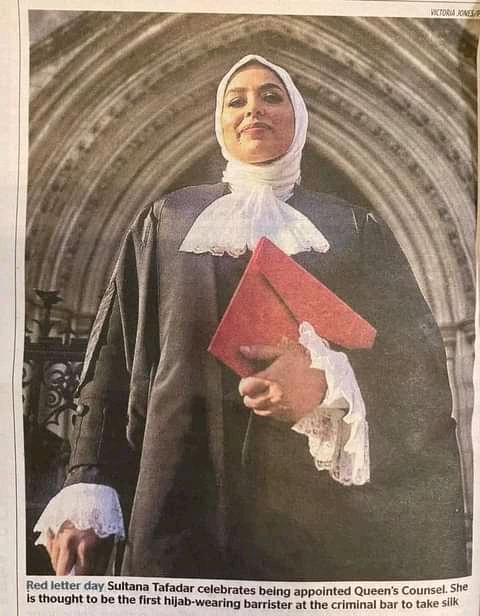
Sultana Tafadar, appointed as first muslim hijaab-wearing Queen’s Counsel in Britain

By Ahmad Deedat Zakari.

Sultana Tafadar, a hijaab-wearing Muslim barrister, has been appointed the Queen’s Counsel in the United Kingdom.

Radio News Hub reported this on their verified Facebook page on Monday, March 21, 2022.

“Sultana Tafadar received her letters Patent – the document denoting the award for excellence in advocacy – at the Palace of Westminster on Monday,” the news platform reported.

The rank of the Queen’s Counsel (QC) is the equivalent of the status of Senior Advocate of Nigeria (SAN). The QC and SAN titles are awarded to barristers who distinguish themselves in character and excel in advocacy.

Sultana Tafadar is of Bangladesh origin. Her elevation to the rank is a great inspiration to many hijab-wearing Muslim women across the globe.

When a father dies!

By Kharajnah Muhammed

Imagine a big mango tree with many branches, leaves and sweet fruits feasted upon by her children while also enjoying her cool shade that comes with a soft breeze, covering their heads from the scorching sun.

All of a sudden, someone cuts her off from her root. She fells down weeping, wondering how her children would survive without her, while they drink their tears day and night, searching for food and shelter, with little or no one to help them.

This is what happens when a father dies, leaving behind his family. At first, so many people will come and commiserate with them, with sugar-coated promises. His family will have hope that at least someone will be there for them even when the head of the family is no more. But what happens afterwards?

The widow(s) and her/their children are left to wander in the streets, searching for food, shelter, job to sustain their lives. Only a few are lucky enough to find help from his relatives or friends in one way or the other. It’s scary how fathers keep dying daily, leaving their families behind. Most people nowadays only do things for someone alive, someone they know they can gain something from. As soon as he is no more, they forget everything about him or his family.

As parents, I want to advise us to build a future in our children because we don’t know what tomorrow holds. Help them discover their talents and work on building them. As a husband, invest in your wife or wives, for they will never abandon your children. And she might be the only person to take care of them when you are no more.

And now, Ramadan is just a few days away. Have you ever wondered what most orphans are going through? Most of them have little or nothing to put in their breadbaskets, but they can’t ask anyone for it because they were brought up so that they can keep their family’s secret so that people will not look down on them. So, even if they ask some people, they might not help them out and probably go about telling other people or using the children’s helplessness to their advantage, especially the girl child.

I want to urge us to please help the orphans with food, clothes, and other items we can give out this Ramadan in order to gain manifolds of reward from the Almighty. You don’t have to go far. Look around your neighbourhood and start from there. Some people would rather cook plenty of food and throw it away in the morning than give someone.

Though things are hard these days, there is no harm in giving out the little you can afford. You never know what it will mean to them.

May the Almighty ease things for us, amen.

Harajnah Umar Ragada can be reached via kharajnah@gmail.com.

Probe JUTH over anti-Hausa-Fulani activities – MURIC

News Desk

An influential newspaper, the Daily Trust, yesterday published a damning report on discrimination against Hausa-Fulani Muslims resident in Jos, Plateau State, who are being forced by record officers at the Jos University Teaching Hospital (JUTH) to change their states of origin and local government areas before they can register to see a doctor.

Meanwhile, an Islamic human rights organisation, the Muslim Rights Concern (MURIC), has waded into the matter. The organisation described the forceful change of states of origin as ethnic cleansing and unlawful de-indigenisation. MURIC demanded a probe into the allegation.

This was contained in a press statement issued on Sunday, March 20, 2022, by the director of MURIC, Professor Ishaq Akintola.

The statement reads:

“An influential newspaper, the Daily Trust, yesterday published a damning report on discrimination against Hausa-Fulani Muslims resident in Jos, Plateau State, who are being forced by record officers at the General Out-Patient Department (GOPD) of Jos University Teaching Hospital (JUTH) to change their states of origin and local government areas before they can register to see a doctor.

“This, indubitably, is ethnic cleansing and unlawful de-indigenisation. It is horrendous, detestable and despicable. It is the most odious and insidious marginalization and encroachment on Allah-given fundamental human rights of any tribe that ever happened on Nigerian soil. It is unlawful, illegal, illegitimate and unconstitutional. We, therefore, demand full investigation which should start with immediate effect.

“It is highly appalling. We cannot imagine such inhuman practice happening to Nigerian citizens in a Nigerian state. Such audacity is criminal. There must be consequences for such temerity for the culprits, their sponsors and those who are encouraging them.

“The probe should unearth the identities of all the victims from the time the evil practice started with a view to reversing the wicked acts and restoring the states of origin and local governments of the victims.

“We are shocked that such a discriminatory practice is being allowed in a federally funded hospital where people’s state of origin should not matter at all, particularly for health care delivery. It points to the likelihood of more egregious and horrifying things happening in hospitals belonging to the Plateau state government.

“There is no doubt that the state government is complicit and should be held responsible. It is impossible that this highly reprehensible practice is happening without the knowledge and tacit approval of the state government. It is a big shame that this kind of illegality is being promoted by a state governor who swore to uphold the constitution and to provide welfare services to people of the state. Conscienceless power is subjugating powerless conscience.”

TikTok and selling immorality to consumers on the internet

By Yahuza Abdulkadir

A source culled from Wikipedia says that TikTok, known in China as Douyin, is a video-focused social networking service owned by Chinese company ByteDance Ltd. It hosts a variety of short-form user videos, from genres like pranks, stunts, tricks, jokes, dance, and entertainment with durations from 15 seconds to three minutes. TikTok is an international version of Douyin, released initially in the Chinese market in September 2016.

However, I was not a user of TikTok until a few weeks back when a friend gave me the hint to start using the app to promote my art by creating short videos of spoken word poetry. And then, I came to learn young people use the platform to showcase their talents in comedy, singing, dancing and other forms of entertainment through creating short videos and sharing them across a community of users.

However, after launching my account, I felt it was boring for people like me to find comfort there. The only person I was able to follow was Alhan Islam because I am interested in what she does. After a few days, I could no longer log in to the app again.

As of January 2022, out of the 4.8 billion social media users globally, TikTok has 1 billion active users, earning a spot in the six most famous social media platforms. Cloudfare’s 2021 Year In Review puts TikTok as the most famous website in 2021, surpassing even Google. Tiktok net worth is $50 billion in 2020 and now nearly $75 billion in 2022. Despite the nature of content promoted on the platform, one may want to know that so many individuals earn huge amounts of money through their videos’ engagements.

According to Forbes Magazine, a 17-year-old American social media personality and dancer, Charli D’Amelio, the most followed video-creator on the platform, earned $17.5 million in 2021, making her the highest-paid TikToker of the year.

I read many articles on Facebook and other blogs where people lament the platform to be a weapon for killing the young women in this generation. They said most of the videos created by users promote indecency and immorality. But recently, I found out that it’s not only in Nigeria that such content is being promoted; it’s almost everywhere globally. This made some countries take legal action on the matter. Countries like Pakistan has imposed and lifted four bans on TikTok, tagging the platform to be responsible for promoting immoral, obscene and vulgar content.

Bangladesh government also involved itself in the war against pornography to save children and adults from moral and social degradation by blocking the platform’s internet access. TikTok was also temporarily banned in Indonesia in the year 2018. The Indonesian government said the platform has a lot of harmful content to children.

In 2020, the platform was also banned by the Indian government to protect the data and privacy of its citizens from threats that have to do with national security, and they tagged the platform responsible for promoting inappropriate content. As a result, the platform lost 167 million users in the country. What would surprise you is that even China has banned the use of this platform.

This shows that the Nigerian government can also ban TikTok if it wants to. Do you think it’s not possible? I think it’s possible if we look at the “Twitter ban saga.” Unless the government thinks the use of this platform has no consequence on their side. If that’s the case, we need to go back to our homes and solve the problem. As people would say, “Charity begins at home.”

We shall all know that social media platforms are there to serve a purpose, and if it turns out that we tend to lose our good morals and forget where we came from by joining the trends and “feel among syndrome” – showing the world how indecent we are, then we have deceived nobody but us. So I think good characters matters the most.

Furthermore, it’s disheartening to see the young women in the Arewa community selling their body parts on cyberspace, not only on TikTok. This occurs almost on every social media platform. It’s a massive disappointment to our cultures and values. Whatever one might engage in, they should know “the internet never forgets.”

Yahuza Abdulkadir wrote from yahuzaabdulkadir50@gmail.com.

Police Hijab: Ignore Adegboruwa’s razzmatazz – MURIC

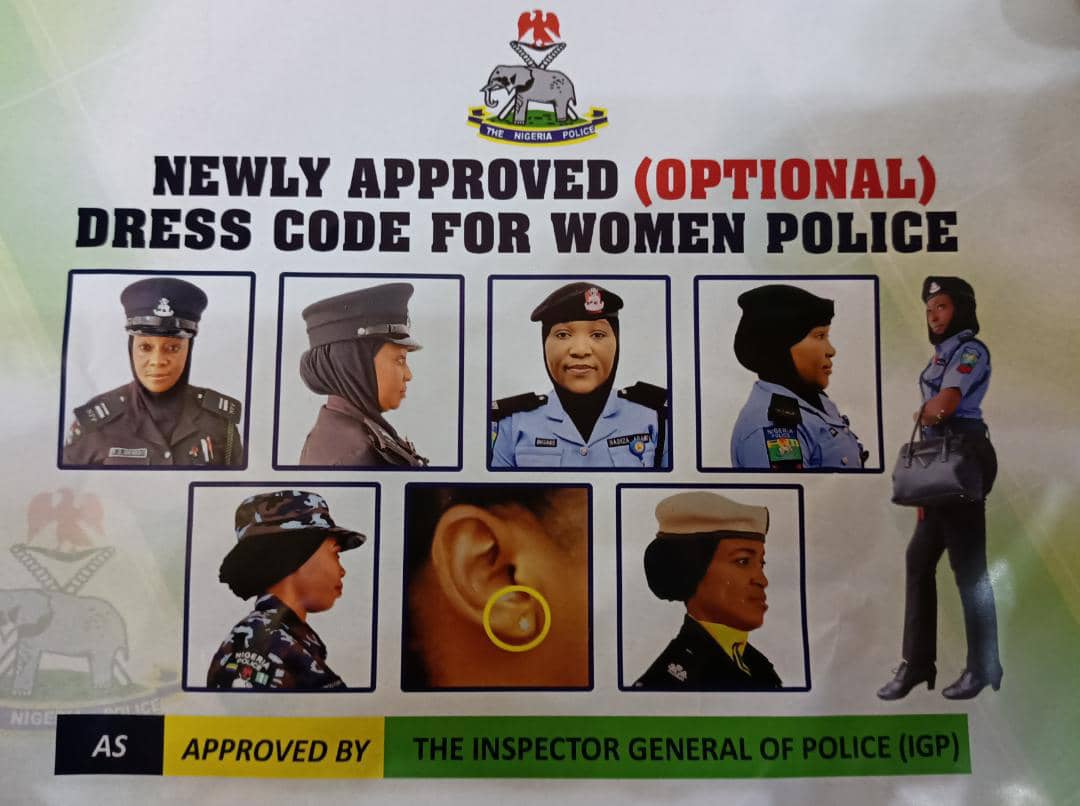
Mr. Ebun-Olu Adegboruwa (SAN) has declared the recently approved hijab by the Nigerian Police as illegal. The legal luminary made the declaration in a public statement issued yesterday, March 5, 2022. However, the Muslim Rights Concern (MURIC) has responded by telling the Nigerian Police to ignore Adegboruwa’s comment.

MURIC spoke on Sunday, March 6, 2022, through its chairman in Akwa Ibom State, Ustadh Jibril Ayu-Akpanim.

The statement reads :

“Mr Ebun-Olu Adegboruwa (SAN) yesterday declared the recently approved hijab by the Nigerian Police as illegal. Of course, we know his antecedents. He has never shown any support for the civil rights struggles of Nigerian Muslims. His opposition to the approval of the hijab in the police force is therefore understandable. Adegboruwa is simply staying in character. Our considered opinion is that the Nigerian Police should ignore his razzmatazz.

“How can a whole SAN oppose a matter of fundamental human rights? It is paradoxical that those who know the law are the ones who adopt prejudice against civil rights matters. Adegboruwa’s vituperation sprang from personal acrobatic religiosity. His articles and comments on the hijab crisis in Kwara and other places symptomize bias, intolerance and pathological hatred for Muslims.

“Is this the same senior lawyer who has been articulate on human rights in Nigeria all these years? We are appalled that he has elected selective justice. It means Adegboruwa’s definition of human rights is exclusive. Muslims must not enjoy human rights. Muslims have no place in his concept of equal rights, freedom and justice. Adegboruwa has exposed himself as a Muslim-hater nulli secundus.

“Adegboruwa should be stripped of his SAN title. A senior lawyer who ignored the tyranny of school principals and teachers who have been persecuting innocent school girls over an ordinary headscarf for decades but jumps up within 24 hours to oppose a window of liberty for them does not deserve the highest decoration in his profession.

“The SAN is asking how Catholics and Anglican women police should dress now that their Muslim colleagues have been allowed to use hijab. He should tell us how catholic and Anglican policewomen dress in Britain, America, Canada, etc. By the way, is Adegoruwa telling us that he has never seen pictures of Mary, the mother of Jesus (peace be upon him)? Has he ever seen Mary without a hijab on her head? Bigotry is indeed an almost incurable disease.

“Adegboruwa should ask catholic and Anglican policewomen to demand their own form of dress code if such a thing exists in real life. He will be surprised to see that Nigerian Muslims will not oppose their demand. Islam condemns pettiness and selfishness. It teaches Muslims to live and let others live. Anyway, Adegboruwa may advise Catholic and Anglican policewomen to dress like Mary, the much-honoured mother of Jesus (peace be upon him).

“Adegboruwa should know that the current uniform of the police satisfies Nigerian Christians because it was designed ab initio by the British colonialists who, essentially, were Christians. That is why Nigerian Christians have never complained about uniforms in schools and security agencies.

“Muslim interest was not taken into consideration by the colonialists when they were designing uniforms for schools and the security agencies. Justice and the need for inclusiveness demand that the design should be reviewed in the post-independence period. That is why even the recent approval must be seen as belated.

“Quarter-finally, has Adegboruwa forgotten the outcome of the hocus pocus created in Osun State when the court approved hijab and the Christian Association of Nigeria (CAN) incited Christian students to wear ridiculous garbs like a church choir, Sango, Oya and masquerade dresses to school? How long did it last? He should go to the state today to see how the female Muslim students shine with their hijab. No matter how fast falsehood runs and for how long, the truth will catch up with it in a single day.

“Semi-finally, we advise Adegboruwa to go to court if he feels so strongly that Muslim female policewomen have no right to use hijab. He may also want to go further by approaching the international court at the Hagues to stop British, American and Canadian policewomen and soldiers from using the same. Islamophobia in the legal profession is not new to us. The Amasa Firdaus matter on our minds. The learned silk may do well to consult his colleagues at the highly esteemed Council of Legal Education and the Body of Benchers before plunging into his prejudiced, ill-advised, ill-fated and anti-Muslim adventure.

“Finally, we congratulate all female Muslim policewomen in Nigeria on their newly won freedom. Nigerians have seen many of them on the streets wearing the hijab with their uniform in the past few days. They look awesome, fantabulous, fantasmagoric and fantaslamic. We urge them to continue using it. Without a court pronouncement, no lawyer from anywhere can force them to remove it. Not even a SAN.”

Tribute to my uncle, Sheikh Hamza Muazu (1982–2022)

By Omar Muaz

In the name of Allah, the Beneficent, the Merciful. All praise is due to Allah, the Lord of the world, the Creator of death and life, the Everliving, the Self-subsisting by whom all subsist; slumber doesn’t overtake Him nor sleep; whatever in the heavens and world is His. “Every soul will taste death, and you will only be given your [full] compensation on the day of resurrection. So he who is drawn away from the fire and admitted to Paradise has attained [his desire]. And what is the life of this world except the enjoyment of delusion” —Qur’an

My uncle, Hamza Muaz, is the best definition of detachment as far as the world around me is concerned. “Had it not been our culture to wear babban riga and to put on caps, I would spend my life wearing jalabiya—a white ankle-length shirt, with long sleeves, that buttoned up to the neck.” he once said that to us while advising us to renounce luxuries and worldly pleasure for the one in the afterlife.

I have seen humble people on this earth and have read biographies of thousands of humble people, but what kind of my uncle’s humbleness? That? I have never seen nor have I ever read of its ditto. I have lost words to highlight his positive features. But I know, and yes, they’re confirmed by many people who know who he was, that he was religious, trustworthy, loyal, devotional and very determined.

Hamza Muaz was born in 1982 in a small village of Hawul Local Government Area of Borno state. He attended The Islamic University of al-Madinah al-Munawarah, where he held a Bachelor’s degree in Hadith and Islamic Studies. It’s still fresh in my mind the reading moment we had together. Around 2019, when I visited him in Abuja, I remember he taught me Hadith throughout the days. So, I can say without a number that his hobby was “teaching.”

While battling the throes of his illness, “Only in this world,” he paused, and I realized he needed water “…learn, learn because it’s only through that, you could earn light for the hereafter.” So he told me after taking the water. He barely talked in his sickbed, but whenever he got to, he injected into us “knowledge.”

There was a night when everyone was sleeping except him and me. He smiled and reminded me of two prophetic traditions on sickness. “No fatigue, nor disease, nor sorrow, nor sadness, nor hurt, nor distress befalls a Muslim, even if it were the prick he receives from a thorn, but that Allah expiates some of his sins for that,” I said indeed. He said, “I am nothing compared to our beloved prophet, Muhammad (PBUH)…” while shedding tears, “Aisha (R) reported that she had never seen anybody suffering so much from sickness as Allah’s Messenger (PBUH).”

“This is true!” I interrupted. “Therefore, If Allah wants to do good to somebody, He afflicts him with trials.” He concluded with this Hadith and dozed off. May his soul rest in peace. All he did in the hospital besides taking his medication was reciting Qur’an and teaching people.

Rest in peace, Abban Hammad. He was married with a son, Muaz, named after our grandfather and nicknamed “HAMMAD”, which has overtones of being praiseful. Treasure? I know he left behind over 1000 books (may the books be beneficial to the world). That was him. O Allah, forgive my uncle, Hamza Muazu, and elevate his station among those who are guided. Send him along the path of those who came before, and forgive him and us, O Lord of the worlds. Enlarge for him his grave and shed light upon him in it.

Omar Muaz sent this article via muazuumar45@gmail.com.

SPECIAL REPORT: How desire for materialism affects marriages and relationships

By Uzair Adam Imam 

Materialism is not limited to friendship or brotherhood; marriages and relationships also suffer greatly.

Friendship and brotherhood are gradually losing their true meaning, if not buried at all, because of this sudden shift of behaviour to materialism, The Daily Reality gathered. 

The menace led and is still leading to the breakdown of many relationships, including marriages, thereby manifesting itself into a serious problem in society – such as the increase in the number of widows and heartbreaking individuals.

The Daily Reality speaks with some people on this issue.

People like Aisha Mujitaba believe that guys pretend to be rich in life in order to woo girls.

“Nowadays, both loves and marriages are based on materialism; that is how equivocation and deception have chipped in in the process of getting married.

“Guys pretend to be wealthy in order to win girls’ hearts. Consequently, when they are joined in matrimony, the true nature of what the person is will be revealed. This leads to the breakdown of relationships,” Aisha said.

Parents were also accused of encouraging this lingering issue in society, according to Suwaiba Umar. 

She said, “Today, parents encourage their children to marry rich people. Marriages nowadays are not for the sake of Allah, the almighty. That is why guys make-believe a big life.”

Frowning at this behavioural change, Juwairiyya Aminu compared marriages in the past and marriages today.

She said, “Marriage in those days was entirely different from the marriage in these days, including the process, lefe (trousseau), ceremonies and whatnot.”

Both girls and their parents find it very exciting to have rich as their husbands or sons-in-law, making it difficult for the poor to get married.

“A poor man finds it very difficult to be loved, much less being married. But when a rich person proposes, without hesitation or any proper investigation on his religion, habit or maturity, he will be accepted,” Sa’adatu Shu’aibu.

Buhari Ahmad posited that guys fear being rejected by the girls, let alone the parents. For this, he said, “Guys make a pretence of big life out of fear of being rejected by girls and their parents.

“That is why guys now rent clothes, hats, shoes, bikes or even cars when visiting their suitors.” 

Materialism: What Brings About It?

Dr Muhammad Sulaiman Abdullahi is a lecturer at the Department of Nigerian Languages, Bayero University, Kano. He told this reporter in an interview that many reasons made our society materialistic.

“There are so many reasons which contribute to the moral decadence we are witnessing today in the Hausa society. I can summarily list them as follows:

“1. Deficiency in terms of Islamic education and pursuing more in terms of Western educational life and style.

2. Negative modernity

3. Access to the new media and multi-media stuff which led to increasing in absorbing haram items.

4. Lack of proper orientation, etc.”

The solution to materialistic life

“Having sound Islamic education and fear of Allah, pursuing what is halal in any form of education and social life; and abiding strictly to Islamic teachings are the solution,” Sulaiman added.

Valentine’s Day: A strictly non-Muslims’ affair

By Adamu Bello Mai-Bodi

Valentine’s Day, also called Saint Valentine’s Day or the Feast of Saint Valentine, is celebrated annually on February 14. It originated as a Christian feast day honouring one of the early Christian martyrs named Saint Valentine. Later on, the tradition becomes a significant cultural, religious, and commercial celebration of romance and love in many world regions, including some Muslim communities (Mostly unaware of what they celebrate). But, Saint Valentine’s Day is an official feast day in the Anglican Communion and the Lutheran Church. In addition, many parts of the Eastern Orthodox Church also celebrate the day.

In my view, Muslims have no business celebrating this day. Moreover, a Saudi cleric, Sheikh Muhammad Al-‘Arifi, said on Valentine’s Day, “Celebrating this holiday constitutes bid’a—a forbidden innovation and deviation from religious law and custom and mimicry of the West.” Besides, Islam is all about showing love and humility every day, not only on February 14.

Numerous early Christian martyrs were named Valentine. The Valentine honoured on February 14 is Valentine of Rome (Valentinus Presb. Mart). He was a priest in Rome and martyred in 269. That was added to the calendar of saints by Pope Gelasius I in 496 and was buried on the Via Flaminia. The relics of Saint Valentine were kept in the Church and Catacombs of San Valentino in Rome and later in Santa Prassede, which remained an important pilgrim site for Christians.

In The Dictionary of Christianity, J.C. Cooper writes that Saint Valentine was “a priest of Rome who was imprisoned for succouring persecuted Christians.” It states that Saint Valentine was persecuted as a Christian and interrogated by the Roman Emperor Claudius II in person. Claudius was impressed by Valentine and had a discussion with him, attempting to get him to convert to Roman paganism to save his life. Valentine refused and tried to convert Claudius to Christianity instead. Consequently, he was executed.

However, before his execution, he is reported to have performed a miracle by healing Julia, the blind daughter of Emperor Asterius. As a result, the Emperor’s daughter and his forty-six member household (family members and servants) came to believe in Jesus and were baptized. That upset the Emperor even more.

So, on the evening before Valentine was to be executed, he is supposed to have written the first “valentine” card himself, addressed to the daughter of his jailer, Asterius, who was no longer blind, and signing it as “Your Valentine.” The expression, “from your Valentine”, was later adopted by modern Valentine’s letters. 

With the concatenations mentioned above, it is not rocket science to understand that Valentine’s Day is strictly a Christian affair.

Adamu Bello Mai-Bodi wrote from NPA Quarters, Apapa, Lagos.