Muslims

Lagos announces readiness to comply with apex court hijab-judgement

By Ahmad Deedat Zakari

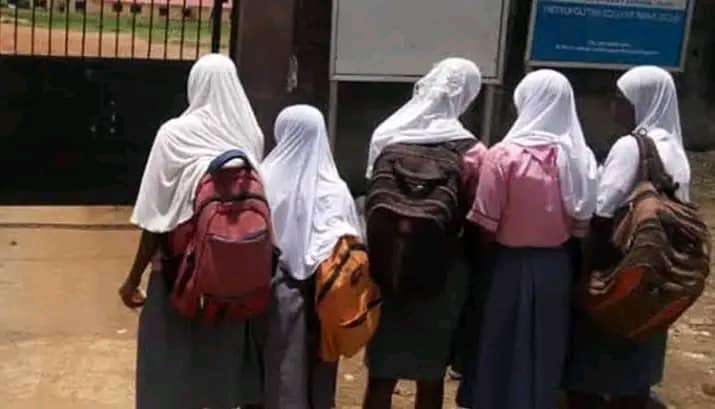
The Lagos State Government has announced that the State is ready to comply with the Supreme Court judgement on the use of hijab by female pupils and students in Lagos schools.

In July 2022, the Supreme Court had dismissed an appeal by the Lagos State Government and upheld the use of hijab in Lagos schools.

Lagos State Head of Service, Hakeem Muri-Okunola, announced the state’s readiness through a circular he issued and signed on behalf of the government on Monday, December 5, 2022.

“It’s hereby notified for general information that the supreme court judgment SC/910/2016 delivered on the 17th of June 2022 on the use of Hijab as it affects pupils/students in Lagos State schools has delivered that the students should be allowed to wear the hijab if desired,” the circular read in part.

Mr Muri-Okunola stated that a comprehensive guidelines on the use of hijab will be issued to all agencies of the government in due course.

He added that, “you are to note that the judgement is binding on all schools in the State.

“As a law-abiding administration, all accounting officers are to note the contents of this circular for immediate compliance and give it the deserved service-wide publicity,” He said.

Dangers of entrusting religious leaders with sex education responsibility

By Aishat M. Abisola

A few weeks ago, I read that the federal government ordered the Nigerian Education Research and Development Council (NERDC) to remove sex education from the basic school curriculum. This decision was made by the Minister of Education, Mallam Adamu Adamu.

This followed the call by experts that sex education should be placed in the hands of parents and religious institutions so that it would not be taught in schools in ways that would not further “corrupt” young children with phones and access to technology.

Adamu stated that since Nigeria is a religious country, morals and values should be taught in Mosques and Churches, adding that it would bring up children with strong morals and reduce the rate of out-of-school children.

When I read this, I was shocked for many reasons. First of all, the introduction of sex education into the basic education curriculum is still recent, and most schools are not even implementing it.

When I was in secondary school, my classmates and I were mainly taught about the biological and chemical aspects of reproduction, not the elements concerning sex and sexuality.

Secondly, how are they sure that sex education has not benefited the youths who are barely taught about it in schools?

Sex education can be defined as teaching and learning about a myriad of topics related to sex and sexuality. It dives into the values and beliefs regarding these topics. It helps people gain skills they will need to navigate their relationships with themselves, their partners, and their community and helps them manage their sexual health.

Sex education can be taught anywhere, in one’s house, school, community setting with trusted individuals, or online. As I stated earlier, I was not taught much about sex education in secondary school.

Luckily, my parents were there to answer my questions on sexual education and even imparted helpful knowledge that has helped me a lot in many ways.

When I learnt more about sex education and focused on what my parents taught me, I learned more about myself, my body, and how I could improve in terms of mental and physical health.

Despite common misconceptions that sex education corrupts children when taught about it at school, sex education can be more beneficial than you might expect. The full description of what sex education entails is as follows:

Human Development

This involves human anatomy, puberty and how it will affect them both physically and mentally, sexual orientation (the different types of sexual orientations), and gender identity (what it means to be male or female).

Relationships

Relationships consist of Interpersonal relationships such as family, friendships, romantic relationships, and relationships with healthcare practitioners.

Personal Skills

This involves areas surrounding communication, boundaries, negotiations, and decision-making.

Sexual Health

Sexual education covers the areas that deal with sexual health, like sexually transmitted diseases, Birth Control, and pregnancy.

Society and Culture

This involves Media Literacy, Shame, and stigmatisation associated with sex and sexual education, the way that power, identity, and oppression can affect sexual wellness and reproductive freedom.

But besides all this, my main concern is how sex education is so callously put in the hands of religious leaders and institutions.

Most parents can be trusted to impart their knowledge about sex education to their children so they are more aware and careful.

On the other hand, religious leaders and institutions cannot be trusted in the same way.

Historically and in recent times, both religious leaders and religious institutions have been known to use children’s lack of sexual knowledge against them in ways most foul.

Priests, pastors, and Imams have preyed on young children entrusted to them by unsuspecting parents.

The more commonly known religious institution to do so are the Catholics, but other religious institutions and their leaders have done the same.

In some Islamiyah (Islamic religious learning academies), Imams have inappropriately touched young children they were supposed to care for.

Some examples would be a French Catholic church that was reported after discovering that its clergy and lay members had sexually abused at least 330,000 children over the past 70 years.

Another example would be a young girl from Lagos whom a Friar sexually abused at her parish church. In 2020, an Imam had taped himself raping a five-year-old girl, and earlier this year, in July, another Imam was arrested for the sexual abuse of seven children.

In October this year, another Imam was arrested for sexually assaulting an 11-year-old. Men (Women as well) who are placed into positions of power are more often than not predators who seek to prey on those weaker than them.

These days, anyone can become an Imam or a pastor. Because of the relaxed nature in discerning whether someone is an actual man/woman of god or whether they can be trustworthy in a position of power, many people get hurt.

Young children should not be placed in their care, nor should they be allowed to discuss sex education with them.
For all we know, they could teach these young and highly impressionable children wrong things and could hurt them badly in the long run.

Statistics have shown that when children have been sexually abused, there is a high likelihood that they will go on to commit the same injustices that were performed on them.

Ultimately, it will perpetuate a cycle of pain and torment.

Appropriately trained sexual education professionals should be tasked with training children on what they need to know about sex education from a young age. This way, they will learn more about their bodies and the best way to know if what is being done to them is right or wrong.

Along with this, their community should also take care of children.

If more than one eye is trained on a child, then any odd behaviour will be noted and told to their parents so that they can take the proper actions necessary.

With these two in hand, parents won’t need to rely on religious leaders or religious institutions to teach children about sex education when children are more likely to be abused by them.

Perhaps then, the government will have more trust in the education system instead of leaving such a delicate and complicated matter in the hands of people who would instead make matters worse than fix anything.

Children are blank canvasses, and teaching them the right things will make lovely and ethereal colours glow on their canvas, but teaching them in the wrong manner will damage it.

Children are the hopes and future of their parents and forefathers; It is with them that a legacy of peace, faith, and kindness is ensured.

I hope whoever reads this takes my words to heart and acts righteously for these children who might be led astray due to improperly placed trust.

Aishat M. Abisola is a member of the Society for Health Communication, Wuye District, Abuja, via Aishatmohd02@gmail.com.

ABU lecturer wins ASR prize for Best Africa-Based Doctoral Dissertation

By Ahmad Deedat Zakari

A lecturer with Ahmadu Bello University, Zaria, Dr Nadir A. Nasidi, has been declared winner of the African Studies Review prize for ‘Best Africa-Based Dissertation’

The Public Affairs Directorate of the institution announced Dr Nasidi’s success in a statement on Thursday, November 24, 2022.

According to the statement, “Dr Nadir A Nasidi’s dissertation ‘ A Contextual Analysis of Sufi Saint Paintings in Kano Nigeria’ has won the 2022 African Studies Review (ASR) Prize for the ‘Best Africa-Based Doctoral Dissertation”.

The statement said Dr Nasidi will also be given a certificate recognizing the award and a $500 e-certificate from Cambridge University Press.

The Vice-Chancellor of ABU, Prof. Kabiru Bala, has congratulated him saying that the “University always takes pride to see its students and staff excel in a given task.”

Dr Nasidi is a lecturer at the History Department of Ahmadu Bello University, Zaria and had defended the award-winning dissertation in 2021 at the same institution.

Gender and the Disappearing Hausa Intangible Heritage: A Study of Shantu Music

By Prof. Abdalla Uba Adamu

Hausa Intangible Heritage Revival – Overture to the Symphony

When Gillian Belben, the British Council’s new Director in 2004, wanted to introduce a truly unique project in enhancing the cultural relations between Britain and Nigeria, a series of initiatives were proposed. One of them was Connecting Futures – a project that linked youth in Britain and Nigeria through music, films, debates, social advocacy and the arts.

I was involved in the film and music projects. In the music domain, we wanted to create a music ensemble that would revolutionize traditional Hausa music – an endangered performing art. The reason for its endangerment was its griot-based nature. Traditional Hausa musicians were seen basically as praise singers – singing the praises of rich, famous, infamous patrons who pay them a lot of money. The changing Hausa society in the 21st century saw the disappearance of such griot musicians – as no one had the money (or the gullibility) to pay to hear their praises, except politicians – thus making such performances short-lived and, fundamentally, non-artistic. I was the Chairman of the defunct Center for Hausa Cultural Studies, based in Kano. The Center and the British Council liaised to develop a project to create a sustainable focus for Hausa traditional performing arts, at least for as long as the Connecting Futures project lasted. There was no government input in this – we did not seek any, nor do we expect any, despite the existence of the History and Culture Bureau (HCB) in Kano.

Gillian and I were interested in contemporary European music of multiple-instrument ensembles and decided to recreate an ensemble of Hausa musicians playing different instruments. This was unheard of in Hausa ethnomusicology since, traditionally, Hausa griot musicians tended to stick to only one instrument (stringed or percussion). However, with the advent of ‘modernity’ in traditional performing arts, some Hausa club musicians started combining string instruments (kukuma mainly) with percussion – drums and calabashes. Examples include Garba Supa and Hassan Wayam. For more on this, see Jacqueline Cogdell DjeDje’s brilliant Fiddling in West Africa.

We were not interested in modern synthesizer music with its sampled sequencers of sounds that modern Hausa ‘nanaye’ singers arrange to form melodies and then transposed lyrics over the beat, often with female autotuned voices – all mimicking Indian film soundtrack singers. This production mode earned their genre the name of ‘nanaye’ – girlish (not female, incidentally!) music.

In our project, we envisaged four different instruments working in harmony to produce at least an acceptable ‘post-modernist’ Hausa traditional griot music – without the praise singing. We sent out notices requesting expressions of interest from interested musicians, mainly griot. Many ‘nanaye’ singers came, and we turned them away – we wanted musicians, not singers –none of the nanaye singers could play any traditional instrument. Auditions were held with those who can play a specific traditional instrument, and we first chose three: sarewa (flute), kukuma (fiddle), and kalangu (drums). Because there were many varieties of drums, we added duman girke ‘conga’ drums. All were to be played by males, as was traditional in Hausa traditional performing arts. That was when Gillian decided to up the ante by insisting on a female musician join the four young men.

This was a tall order for many reasons. Hausa women are not accustomed to playing musical instruments, especially in public. There were, of course, exceptions. The late Hajiya Sa’adatu Barmani Choge and Hajiya Uwaliya Mai Amada both had ‘calabash orchestras’ and performed in public. You can find further readings on her life and performance at the end of this. Currently, in 2022, Choge’s children and former bandmates have continued the tradition of performing in public – mainly at weddings and naming ceremonies. They used to perform during political campaigns, but the bad publicity and accusations of improper behaviours put paid to that.

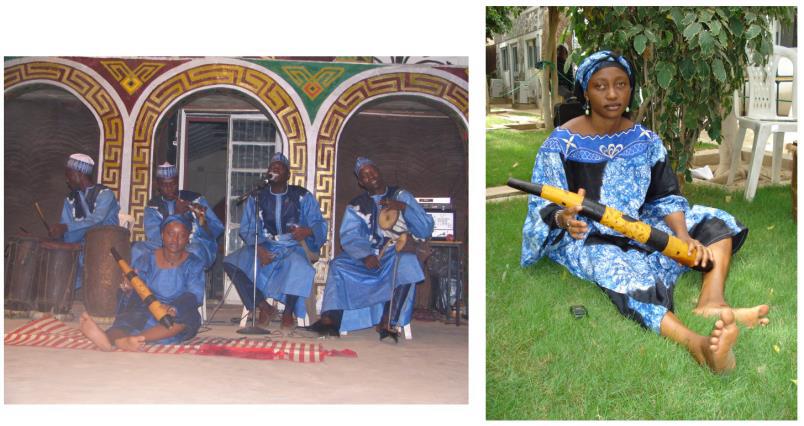
Both Uwaliya and Barmani were in advanced age and could get away with pretty much everything. Getting a young Muslim Hausa woman to join young males and perform in public was genuinely challenging. However, Gillian was determined to do it, so we focused on the instrument the female band member could play. The only viable one was shantu – an aerophone. This was a female musical instrument, which, together with the bambaro (mouth harp), has all but disappeared.

Eventually, we found Fati Ladan, a lady living in Kano but originally from Niger State, who was one of the ƙoroso dancers attached to the History and Culture Bureau (HCB), Kano. The HCB already have a shantu ensemble, made up of much older women who perform during opening ceremonies at government events – adding a bit of classic flavour to the settings before the long speeches start.

Fati could not play the shantu herself but was willing to learn, especially from the existing shantu ensemble at the HCB. She eventually became adept at it. In the next stage of our project, we added her to the earlier group of four male musicians and called the group Arewa. But since the fronts man of the band was Nasiru Garba Supa, the son of the legendary kukuma player, Alhaji Garba Supa, we later referred to the band as Nasiru Garba Supa and Arewa. You can watch Fati’s solo performance, which I recorded and edited in 2014 in Kano, at https://bit.ly/3DF1Hfk.

The shantu, a percussion tube used by Hausa women, found its way to North Africa due to the trade in enslaved women (for more, see Ames and King, Mercedes). The Kanuri ganga (double-headed cylindrical drum) and the Hausa and Songhai instruments of the same name are North African borrowings from West Africa. An extremely large variant of the shantu, called languru (sharing a name with a language learning and dictionary app) and also referred to as shantu, is played by male Fulɓe.

Interestingly, the languru is similar to the alphorn, a wind instrument that is a national symbol of Switzerland. It has been used by Alpine farmers for hundreds of years as a form of communication in mountainous regions, although now it is simply a musical instrument. During the 18th centuries it was regarded as a beggar’s horn, since it was most often played by impoverished shepherds in the cities, obviously using smaller versions. The Fulɓe languru is also a wind instrument and played during festivities in gatherings of the Fulbe in the evenings after the cattle has been squared away either in corrals or designated areas. The smaller shantu used by women is a tubular shell of a long, narrow gourd, open at both ends; often decorated with patterns burned on, or cut into, the outside shell. It is held in the right hand and beaten in a variety of ways by the seated player, including the following:

  • Stamped with its lower end against the inside of the right thigh, or against the calf of the right leg.
  • Stamped with its upper end against the open palm of the left hand
  • Tapped with its outer shell against the shin bone of the right leg
  • Tapped with the lip of its lower end against the ground
  • Tapped on its outer shell with rings on the fingers of the right or left hand
  • Used singly or with one or more other shantuna in the statement of zambo (innuendo), as in waƙar kishiya (song of co-wife), karin magana (proverbial sayings), etc., through the imitation of speech tone and quantity; used solo or with one or more other shantuna in the accompaniment of song
  • Used by women for social comment (e.g., by a co-wife in criticism of her partners) or for informal music-making.

Nasiru Garba Supa’s Arewa and Fati performed many concerts for the British Council over a period of two years, generating a lot of interest and accolades due to Fati’s often solo slot given during any performance. Since the concerts were family affairs – involving the whole family to attend – many young people were fascinated by Fati’s shantu playing.

Gender Rebellion and Shantu music – The QAC Troupe in Historical Perspective

Generally restricted mainly to elderly women playing it to amuse themselves, the shantu was made a choice of musical performance in all-female secondary schools in northern Nigeria in the 1970s. For the most part, they performed during school activities – graduation, cultural days, national events, etc. Once the students graduate from the secondary schools, they simply retire the shantu to what would pass for attic. However, perhaps remembered by people in their sixties, the prominence of shantu as an instrument in public performance was catapulted into legitimate public entertainment in the early 1980s by students of Queen Amina College (QAC), located in Kakuri, Kaduna, northern Nigeria, especially the 1984 graduating class. They were encouraged to use it as part of the then cultural revival in secondary schools. The main reason for their popularity was rehearsed perfection. Perhaps not surprisingly, they were more frequently featured on NTA Kaduna cultural variety shows.

However, soon enough they started drawing criticisms due to their increasingly bold, and what was seen as anti-cultural, performances. Perhaps carried away by their popularity, they became more experimental in their choreography. One of the performances on their setlist was Gantsare Gaye. Accompanied by the deep bass-like hollow sound of about 10 shantus, the dancers energetically move their derrières in an obscene movement of sexualized dance routine (mainly referred to as ‘gwatso’/thrust). Although the 1980s was a liberal decade (and almost twenty years before Sharia was launched in Islamicate northern Nigeria), the sight of teen girls performing such obscene dance routines on public Television drew critical reaction and condemnation in newspapers and from Muslim clerics in Kaduna and Kano. The QAC girls were undaunted, however, knowing fully well that they had the full protection of their powerful parents, the girls themselves eventually marrying into equally powerful influential homes, with quite a few of them becoming powerful themselves. QAC was an elitist school and thus created a cultural disjuncture in the performance of the girls. Interestingly, it evolved from a Catholic missionary educational tradition – thus giving multiple readings to the girls’ performances. The college was established as the Queen of Apostles College Kaduna by Catholic Missionaries in 1940, becoming Queen Amina College when it was taken over by the Kaduna State government in 1970s following government takeover of missionary schools.

Their defining creative moment was at the International Market for Film and Television Programmes, organized by the Nigerian Television Authority, held at Durbar Hotel, Kaduna, from 27th to 31st March 1983 (NTA IMPT ’83). Part of the festival included performances by various artists – and the QAC girls were requested to perform on stage for 15 minutes. Their troupe consisted of 22 performers – 12 call-and-response vocalists and dancers, and 10 shantu players who also called the chorus. There were no percussion instruments, with the bass sound of the shantu being sufficient enough.

Through trawling various Facebook postings, I have been able to identify some of the performers – now all grandmothers and in their mid-50s! They included Fatima Umar Wali, Halima Waziri Digma, Maryam Tinau, Maryam Adamu, Hauwa Suleiman, Aishatu B Musa, Rabi Tinau, Binta Tukur, Binta I Kaita, Fatima Musa, Fatima Usman, Mairo Mu’azu, Amina Musa, Zuwaira Abubakar, and of course, others, actually mentioned in some of the verses.

Their setlist for that festival was made up of five songs, plus intro and outro skits. The main songs were Karyamaye, QAC, Alhaji Lawal Kalabayye, Ko da Rabo, Gantsare Gaye. The song structure of their performance did not fall into the classic intro, verse, pre-chorus, chorus and bridge, associated with modern, basically English songs. They adopted the framework of chorus, verse, chorus – in a call-and-response pattern, typical of traditional songs in northern Nigeria. The chorus was also the song’s hook. Only one song had an opening doxology of one line (Karyamaye). Sleuthing on Facebook comments about the uploaded videos of the performances reveal that Alhaji Lawal Kalabayye was named after their food contractor! He apparently did a good job to warrant having a whole song devoted to him!

The opening song of the performance, after a few seconds of the intro skit, was their masterpiece: Karyamaye (a made-up word to provide vocal harmony). This was an invective song targeted at their public culture critics. The first (and actually, the main) verse is transcribed below:

To bismillah, jama’are, Arrahmani/People, we start in the name of Allah

Mu ƴan Hausa, da mu ƴan Shantu/We, the Hausa and Shantu club

Da ba ruwan mu da kowa/ Those who are not bothered

Ba ruwan mu da kowa/We are not bothered

Sai dai a gan mu a bar mu/See us, and leave us alone

Sai ko hararar  nesa/Your dirty looks only at distance

A cikin duniyar nan, Wallahi/ In this world, by Allah

Muna da masoya, kana muna da maƙiya/We have fans and we have haters

An ƙi jinin mu, kamar a sa mana kananzir/They hate us, wishing to pour kerosene on us

A ƙyatta ashana a jefa/And lit [the fire to burn us]

Ba’a san mu kamar a kashe mu/The haters want to see dead

Ga rijiya a saka mu /Or throw us in deep wells

Ko a samu warin gwano/Or make us stink like black stink-ant

Daga hange sai leƙe sai ko harar nesa/Watching afar, hating with dirty looks

Wataran sai labari/It’d be all over one day

…       

Ku san mai san ku/ Kana kusan mai ƙin ku/Know your fans/ Know your haters

Koda dare ko rana/ koda cikin ƙabari ne/Night or day, even in the grave

Koda ruwa ko iska/ koda cikin duhu ne/Through storms, even in the deepest darkness

Karyamaye, with full booming sound of 10 shantuna (pl.) with outside air energetically sucked down the aerophone provided a perfect percussion to their voices, and really demonstrated the power of the shantu in well-skilled hands. It is this rehearsed, almost flawless perfection that stood them better than other girl troupes in their immediate vicinity (e.g., Kurmin Mashi girls shantu troupe, also in Kaduna). Their verse was full of insouciance, defiance and pride in their art and identity; for instance:

Mu ƴan Hausa, da mu ƴan shantu/We, Hausa and shantu players

Perhaps, even aware of their delectable beauty, they cocked a snook at their unapproving but silent admirers:

Sai dai a gan mu a bar mu/ Sai ko hararar  nesa/

The line is basically saying, look, but we are untouchable – you can only hate from afar. As I indicated earlier, the second performance, Alhaji Lawal Kalabayye, was named after the school’s food contractor, as confirmed by a former Home Economics teacher at the College, Mrs Lasfir Tasalla Andow, in 2019. The song, however, did not mention Alhaji Lawal himself, although the first lines of the song salute farmers – an obvious reference to food, and tangentially, to Alhaji Lawal!

Ina jin hausin mutumin ba ya zuwa gona/I am annoyed at a person who detests farming

Sai ya zauna a tsakar gida sai ka ce turmi/Always at home like some fixture

The song, however, further reaffirms the Hausa identity of the performers because they went through a cycle of profiling various ethnic groups – essentially pointing out the bad character traits of the groups, justifying their unwillingness to allow their daughters to marry them because of the profiled reasons they gave. For instance:

Ina da ƴata ni baza na bai wa Zagezagi ba/I will not marry off my daughter to Zaria people

Fate da safe, fate da yamma, kamar mayu/Yam porridge all day, like hexers

Ina da ƴata ni baza na bai wa Fulani ba/I will not marry off my daughter to the Fulani

Uwa a daji, uba a daji kamar kura/Both mother and father in wilderness, like hyenas

Ina da ƴata ni baza na bai wa Beriberi ba/I will not marry off my daughter to the Kanuri

Uwa da tsagu, uba da tsagu kamar ƙwarya/Both mother and father with facial marks, like calabashes

Ina da ƴata ni baza na bai wa Yoruba ba/I will not marry off my daughter to the Yoruba

Suna da kuɗi, amma a kwano suke kashi/They are wealthy, but they poop in their dishes

Ina da ƴata ni baza na bai wa Katsinawa ba/I will not marry off my daughter to Katsina people

Uwa masifa, uba masifa kamar sauro /Both the mother and father are too fiery, like mosquitoes

Ina da ƴata ni baza na bai wa malamin bana ba/I will not marry off my daughter to modern Malams

Yana wazifa, hannunsa na shafa ƴan mata/While being devotional, they also fondle little girls

These stereotypes, of course, fall within the purview of joking relationships in forms of playful taunts between citizens of various cities that made up the old kingdoms of northern Nigeria. Such relationships are often based on ancestral pacts forbidding conflict or war between specific communities, and imply that the members must love one another and provide assistance where needed. The lyrics were therefore not meant to condemn or belittle any community or groups.  

It was surprising that Kano, with its almost manic commercialism, escaped this stereotyping – even though most of the girls were not from Kano, but perhaps their songwriters (most likely their Hausa subject teachers) were from, or affiliated with Kano! Whatever the case, their trenchant, non-politically correct lyrics cast them with an independent and spirited veneer that demands either acquiescence or indifference from the public. The ethnic groups of Yoruba, Kanuri and Fulɓe each came under their taunts. The Yoruba came into the picture because of Ilorin, considered one of the ‘bastard seven’ Hausa city-states (banza bakwai), although the historical narrative used Yoruba as a generic term; but it was only that Ilorin had a historical connection to the core Hausa states. Even respected Islamic teachers did not escape their barbs – – being accused of alleged sexual abuse of children under their care. This created a picture of betrayal of trust by those in charge of child care. Perhaps due to the constant radio criticisms of the girls by the cleric establishment in especially Kaduna and Kaduna, the performers felt obliged to point out that everyone has a bad spot, no matter how morally upright.

Alhaji Lawal Kalabayye ended with an acknowledgement of the support of their establishments in their art:

Teachers ku lura ku gane/Our teachers, be wary

Ƴan gulma suna nan/Gossipers abound

Yan baƙin ciki na nan/Haters are present

Gasunan dan su rabamu/Wanting to divide us

Wallahi baza su iya ba/By God, they will not succeed

They closed their performance with the song – and dance – that drew the ire of the public culture in northern Nigeria: Gantsare Gaye. The refrain was:

Gantsare gaye, gaye never go straight/

The sexual innuendo was clear in the ‘straight’ part of the chorus, and performing it in public took their art to a new level. The performance is available at https://bit.ly/3Eh0dYJ, with the ‘gantsarewa’ starting at tc1.01. ‘Gaye’ referred to what might be called ‘the dude’ – urban, transnational, metrosexual and sophisticated young man. Influenced by African American superstars such as Michael Jackson, young men in the north of Nigeria took to Jackson’s fashion and street cool. The Hausa ‘gaye’ (stylized from guy) was immortalized by the griot, Ɗan Maraya Jos in his song, ‘Ɗan Gaye Mugun Bawa’/The Badass.

Each of the girls was called out in the chorus to come and do the obscene gwatso dance – something that would probably make them blush later in their middle age years! Indeed, an unverified anecdote I once heard in Lagos decades after the event, was that one of the participating ladies phoned NTA requesting the TV station to stop repeated showing of the clip (which was part of archival cultural entertainment) because she said it was embarrassing.

The stage performance of Gantsare during the festival was more energetic than in the muted TV studio versions and an additional defiance to their critics – with total approval of their school.

Overall, regardless of the judgement on their performance, they did reflect an authentic female, and what I may even refer to as proto-teen feminist defiance. Certainly, the QAC girls had lent flair and elegance to a tradition of gendered performing art which counts as an intangible cultural heritage. Their granddaughters, by 2022, were the Gen Z cohort, and armed with TikTok, Snapchat and Instagram, rather than the shantu, carried the self-expression and defiance to a whole new level as petulant, entitled generation, and certainly without the cultural authenticity their grandmothers had.

Shantu Jazz Fusion and the Mezcal Jazz Unit

The Kano State History and Culture Bureau (HCB) subsequently established its own shantu troupe, made up of more mature ladies and keeping the spirit of intangible heritage alive. I had the opportunity to watch them perform live at the Emirates Palace Hotel, Abu Dhabi, UAE, on 1st October 2009 as part of the preparations to the conference on preservation of musical heritage of various cultures, Hausa being one of those chosen. I was with them in the dressing rooms backstage where I interviewed them, and later recorded their performance. A little bit of it is at https://bit.ly/3GBaSQG. A second Hausa act at the concert was Nasiru Garba Supa, who also performed, although without Fati and her shantu because by then Fati had left the band after getting married, although HCB retained her in some capacity.

Earlier in February 2009, the French Cultural Centre in collaboration with Alliance Française, Kano, organized a Kano Music Festival, Kamfest 2009. This was to bring French and Nigerian artists together for a three-day music festival. One of the French bands was Mezcal Jazz Unit, a jazz band formed in Montpellier, France. The band had established a reputation as being a fine jazz band and creating crossover fusion recordings with artists from various cultures worldwide.

The HCB shantu troupe was also featured at Kamfest 2009. While each band performed separately, a segment was created where a jam session was performed fusing MZU’s jazz improvisations with the HCB shantu sounds and vocals from the players. This creation must be seen as a real bridge between the two cultures via both authentic and peaceful exchanges, through music. Two cultures, two countries, one music!

Mezcal Jazz Unit, whose identity is maintained by regular confrontation with musical groups from all horizons, was one of the rare groups capable of engaging in smooth and fluid artistic collaborations that appear spontaneous. Their quartet was based on the clearly established principle of openness, allowing for a continuous invitation of “jazz” and “non-jazz” artists. This spirit inspired Mezcal Jazz Unit to formally record with the shantu ensemble in February 2009, just before the KAMFEST festival. The result was a CD, recorded in Kano, but mastered, pressed and marketed in Paris. The CD was simply titled Shantu. Released in 2010, it is available at https://apple.co/3zEMdGR, although some videos of the performance are also available at https://bit.ly/3DBDLcm.

Recently, the shantu has started coming back as part of female entertainment, especially during wedding ceremonies, as reflected in quite a few TikTok uploads of various shantu performances during ceremonies. Perhaps tired of the synthesizer love songs typical of modern Hausa singers (not musicians, since the singers rarely create the music accompanying their song) a revival of Hausa intangible cultural heritage is probably happening.

Preservation of the Hausa Intangible Cultural Heritage in Performing Arts

According to UNESCO, intangible cultural heritage includes the practices, representations, expressions, knowledge, skills – as well as the instruments, objects, artefacts and cultural spaces associated therewith – that communities, groups, in some cases, individuals recognize as part of their cultural heritage. Hausa female musical performance certainly are part of this heritage and is fast disappearing. There quite a few reasons for this.

First, music generally is frowned in Hausa societies. It is widely considered a low-class occupation (Smith has a good thought on this) – despite the immense popularity of both traditional griot and modern electronic (synthesizer) performing artists. This has the unpleasant outcome of relegating music and musicians to the background of any debate on social development.

Secondly, the subject matter of most musical performances also creates a distaste in the genre. With extremely few exceptions, Hausa performers are basically praise singers – singing the praises of politicians who pay them millions to praise them or denigrate their political opponents. This has contributed to lowering the image of musicians in the society. Rarely do musicians approach the art as an aesthetic process independent of client or patronage status.

Third, and mainly for women, public performance in predominantly Muslim communities is frowned upon because the audiences are not her muharrams – i.e., males with whom there is no possibility of any marriage. Salamatu Mai Gurmi, a female gurmi player, found a way around this by taking her husband along to her performances with his full permission. After all, the performances do put food on the table, as it were.

Fourth, the preservation of musical heritage requires a sustainable input in terms of concert dates, tours, record deals, publicity, distribution and marketing, etc., processes with not only required expertise that is absent among local, especially female, performers but also exposure – with attendant security risks – that will not make it possible for women to participate, no matter how talented. Currently, Barmani Choge’s female grandchildren have sustained their grandmother’s musical heritage in Funtua, Katsina State, but living in penury and lack of both individual and government support. I have instituted a project to get one of them to a studio and record her songs – which will be uploaded to YouTube for all to hear. Salamatu Mai Gurmi, from Bauchi, plays the gurmi on invitation to naming and wedding ceremonies, accompanied by her husband and playing to mainly female audience. She performed solely for the camera at https://bit.ly/3gkPKDS

Five, private female-only performances do take place in various places – for instance, the Sakaina (broken calabash as instruments) performance in the Kano Emir’s Palace in the past. However, such performances are not public, even though they are part of the intangible heritage to be preserved. There is a need to create public equivalents, even if restricted to private female audiences, of these performances, especially among older women.

As we focus on the preservation of the Intangible Cultural Heritage in the performing arts domain of the Muslim Hausa female, the main thrust of such preservation falls on the National Institute of Cultural Orientation (NICO), a UNESCO country partner representing the Federal Ministry of Information and Culture.

Thus, NICO can sustain its revival movements as a form of cultural activism that uses elements from the past to legitimate change—change comprising not only a reversion to past practices but innovation. Therefore, a series of initiatives are needed to preserve the intangible heritage of the shantu performance.

The Institute could initiate a policy dialogue involving public culture representatives – clerics, youth organizations, community leaders – that will fashion out an acceptable re-insertion of shantu music as accepted public performance. This is because the issue of the public visibility of the female within Islam has to be balanced out. Of course, there are many young women in Hausa societies who are currently performing as singers (though not as musicians) in the public domain. Yet, traditional instruments, in the hands of women and in public arena does tend to rub some people in the Islamicate culture of northern Nigeria the wrong way. Dialogue is critical to everyone being on the same page.  

At the same time, NICO could institute a competition among girls and young women and clustered by age for shantu playing, with prizes for the best three within each group. The songs needed not be on relationships – they could over all spectrum of human behavior, with prizes awarded for the best performance in each category – and such rewards to include marketing and promotion of the output.

Finally, the success of the crossover genre embarked by the Mezcal Jazz Unit and shantu clearly points to the future of such crossover improvisations. For instance, amada performers can be integrated with both shantu and gurmi players for a series of fusion concerts. This will create new innovations in Hausa female music and certainly provide a welcome alternative and exposure to a performance genre that is fast being smothered by synthesized sounds.

Select Bibliography

Adamu, Abdalla Uba. “Tribute to Hajiya Sa’adatu Ahmad Barmani Choge, Griotte, northern Nigeria, 1948-2013.” The Annual Review of Islam in Africa, University of Cape Town, South Africa, Issue No. 12/13, pp. 166-172, 2016.

Adamu, Abdalla Uba. “Womanist ethos and Hausa domestic ecology: A structuralist analysis of Barmani Choge’s operetta, Sakarai ba ta da wayo (Useless woman).” In S. Abdu (Ed.). Poetry and Poetics: Proceedings of the 5th Conference on Literature in Northern Nigeria. Bayero University Kano: Department of English and French, pp. 93-120, 2008. 

Almajir, Tijjani Shehu. 2022. Sigogin Waƙoƙin Shantu da Tasirinsu a Rayuwar Hausawa. Bayero University Kano. Kadarkon Adabin Hausa: A Festschrift in Honour of Professor Sa’idu Muhammad Gusau. Forthcoming, 2023.

‌Ames David Wason and King, Anthony V. Glossary of Hausa Music and Its Social Contexts. Northwestern University Press, 1971.

Ames, David Wason. “Professionals and Amateurs: The Musicians of Zaria and Obimo.”  African Arts, vol. 1, no. 2, pp. 40-45+80+82-84, 1968.

‌DjeDje, Jacqueline Cogdell. “West Africa: An Introduction.” In Ruth Stone (Ed.). The Garland Handbook of African Music. New York: Routledge, pp. 166-197, 2000.

DjeDje, Jacqueline Cogdell. Fiddling in West Africa: Touching the Spirit in Fulɓe, Hausa, and Dagbamba Cultures. Bloomington: Indiana University Press, 2008.

Erlmann, Veit. “Notes on Musical Instruments among the Fulani of Diamare (North Cameroon).” African Music: Journal of the International Library of African Music, vol. 6, no. 3, pp. 16-41, 1983. https://doi.org/10.21504/amj.v6i3.1166.

Jatau, Phoebe. “Shantu Songs: An Example of the Oral Heritage of Hausa Women in Kaduna State.”  In Saleh Abdu and Muhammad Badmus (eds.), Writing, Performance and Literature in Northern Nigeria. 2nd ed. Kano: Bayero University Press, pp.166-182, 2006.

Kassam, Margaret Hauwa. “Some Aspects of Women’s Voices from Northern Nigeria.” African Languages and Cultures, vol. 9, no. 2, Gender and Popular Culture, pp. 111-125, 1996.

Kofoworola, Ziky and Yusef Lateef. Hausa Performing Arts and Music. Lagos, Nigeria: Department of Culture Federal Ministry of Information and Culture, 1987.

‌Mack, Beverly Blow. Muslim Women Sing. Bloomington: Indiana University Press, 2004.

MacKay, Mercedes. “The Shantu Music of the Harims of Nigeria.” African Music: Journal of the African Music Society, vol. 1, no. 2, pp. 56–57, 1955. https://doi.org/10.21504/amj.v1i2.255.  

Musa, Umma Aliyu. “Promoting women empowerment through songs: Barmani Choge and her performances.” Journal of African Languages and Literatures, vol.1, 2020, pp.89-109, https://doi.org/10.6092/jalalit.v1i1.6735.  

Smith, Michael Garfield. “The Hausa System of Social Status.” Africa, vol. 29, no. 3, pp. 239–252, 1959.
Qatar 2022: Alcohol won’t be sold at World Cup stadiums

By Muhammadu Sabiu

Due to a policy change made by Fifa two days before the tournament’s commencement, alcohol will not be sold at any of the eight World Cup stadiums in Qatar.

Even though alcohol sales are legally prohibited in the Muslim nation, it was planned to be served in select places within stadiums.

Alcohol will still be available for purchase in the corporate sections of the stadiums during the competition.

When Qatar plays Ecuador on Sunday, the World Cup officially begins.

Beer manufacturer AB InBev owns Budweiser, a significant sponsor of Fifa, and it had exclusive rights to sell beer at the World Cup.

A statement from world football’s governing association states, “Following discussions between host country authorities and Fifa, a decision has been made to focus the sale of alcoholic beverages on the Fifa fan festival, other fan destinations and licensed venues, removing sales points of beer from Qatar’s Fifa World Cup 2022 stadium perimeters.”

Open Letter to His Excellency Gov. Dr Abdullahi Umar Ganduje, OFR, (Khadimul Islam)

With all sense of honour, respect and humility, your Excellency, I humbly write this letter to convey a fundamental message (worth noting) to you and members of your executive council as well as other relevant stakeholders.

Your Excellency, as you know, Kano State is among the most consequential and venerated African lands. The state hosts international and influential clerics of high repute that promote Islam and the sunnah of our beloved Prophet Muhammad (SAW) to all domains in the north and beyond. Moreover, Kano has been the African commercial hub since the nineteenth century and the centre of learning and administration. For that cause, Kano is always at the front line of religious development and other aspects of human life. In addition, after the re-introduction of Shari’ah in early 2000, Kano embraced it in haste. Muslims have welcomed the development in good faith and unwavering conviction that if Shari’ah is appropriately implemented, life will become good and better in this world and have good fortune in the future existence.

Alhamdulillah! For the said development, the Kano state government established agencies to oversee Shari’ah affairs and ensure its implementation. Shari’ah commission was inaugurated as the apex body for Shari’ah matters and related business. Shari’ah courts were instituted and equipped. Well-trained experts were employed as Shari’ah judges. Zakah and Endowment (Hubusi) was founded and systemized to regulate the collection and distribution of Zakah wealth as stipulated by Allah and manage the waqf properties in the best interest of beneficiaries. The social reorientation directorate (Adaidaita Sahu) came into existence to ensure moral compliance by Muslims. The mighty Hisba Board was incorporated to complement the task of the Shari’ah Commission. The Office of Special Adviser on Religious Matters was created to support the Governor in dealing with Shari’ah functions. Above all, Shari’ah penetrates all government agencies and parastatals to the extent that it’s considered in all decision-making.

At districts and wards levels, the good people of Kano have cooperated. Groups of concerned Muslims constituted robust committees to compliment the government’s effort, namely Zauren Sulhu and its likes. They have significantly impacted the lives of ordinary people. Many such initiatives are in existence to this moment for their monumental works.

People believe that if such strategies are correctly implemented, they will bring sustainable socio-religious and economic development. It will curtail the ongoing bribery and corruption in civil service, robbery, burglary and phone snatching, immorality and other social vices. It will improve productive economic activities and reduce the high rate of poverty. It will promote Zakah awareness and boost the collection of Zakah wealth that, if used efficiently, will cater to the needs and demands of vulnerable widows and orphans as it did in history. This gesture will please Allah the Almighty; in return, He will bless Kano abundantly and ease the affairs of the state.

Your Excellency, the considerable success and giant achievements that Hisba is recording from its inception to date are commendable. Hisba is meeting its objective, mission and vision despite the factors hindering national progress. The support you are giving to the agency is laudable.

Your Excellency, what motivates and triggers me to write this letter is that the high poverty level, with over 55 per cent of the citizens being poor, is a matter of concern, according to the National Bureau of Statistics. Thus, it may not be a surprise that beggars are trooping and roaming the streets today, begging and occupying masjids and other public gatherings, pleading for assistance in various forms. In addition, radio and Television stations are becoming typical to hear the voices of people echoing for help due to poverty and other reasons for the financial predicament.

Besides, I am aware that the state government created a body responsible for looking after the vulnerable and impoverished per the saying of Allahu (SWT) in the Qur’an suratul Tauba verse number 103. The matter of contention is that; is the state government aware of this situation and giving all the necessary support and attention to Kano State Zakah and Hubusi Commission to execute its responsibilities, or is the commission just becoming worthless?

Your Excellency, it’s a known fact that in early 2022 your administration engaged about 600 people in civil service as tax collectors. It’s indeed a wise decision, for it reduces youth unemployment. However, one may wonder how many zakah workers were recruited to support the activities of zakah and consolidate it to achieve its overall objective.

Your Excellency, sincerely, Kano is lagging regarding zakah collection and distribution in modern times while its neighbouring states and emirates are thriving in this noble course. For instance, in Jigawa state, Dutse Emirate alone is mobilizing zakah wealth that eclipsed that of Kano in multitude. The narration is still correspondingly in Kazaure Emirate and Hadejia Emirate, among others. By extension, Sokoto State Zakah and Endowment Commission (SOZECOM) under Malam Lawal Maidoki, Sadaukin Sakkwato, is providing leadership in the country. In other countries, poverty and unemployment are reduced to the barest minimum. These exciting stories signify that Kano state could also join the race and achieve a lot, as it has immense potential.

Your Excellency, this is a gentle reminder hoping to reach you and praying to Allah to grant you the ability to use it and make it among your legacies. Undoubtedly, instrumental Islamic economic policy will help you lay a solid foundation for uplifting the well-being of the good people of Kano state. Zakah will be a panacea to poverty, unemployment, corruption and all forms of vulnerability in Kano state. I, therefore, wish to submit that our emirates have vital roles to play in the reformation. Moreover, collaboration with key stakeholders is necessary at this stage.

Last but not least, I applaud your efforts to improve security affairs in Kano State despite worsening scenes in the country and other neighbouring countries. May Allah guard and preserve our dear Kano State and Muslim communities in Nigeria and beyond. May Allah support you and grant you maximum success in your reign and beyond. Ameen.

Yours

Aliyu Ɗahiru Muhammad

Department of Economics

Bayero University, Kano

alitahir797@gmail

4/11/2022

Qatar introduces Islam to World Cup fans through murals

By Ahmad Deedat Zakari

The Qatari government is preaching and introducing Islam to World Cup fans through murals placed in public places.

TRT World reported on Saturday that as Qatar prepares to host the 2022 FIFA World Cup, it has placed several murals in public places bearing Prophet Muhammad’s (PBUH) sayings and traditions written in Arabic and English.

According to the report, the murals feature various sayings on mercy, charity and good deeds. They are situated across the Pearl District, a popular tourist attraction in the Qatari capital, Doha.

The initiative of Qatar’s government has been applauded by many Arab journalists and Muslims worldwide.

Qatar’s government has been unpretentious about not compromising Islamic values because of the 2022 World Cup. However, their stance on homosexuality and the LGBTQ community has been critical; the government deems it unacceptable to their country’s values and norms.

The Head of Security for the 2022 Qatar World Cup, Major General Abdulaziz Abdullah Al Ansari, in a statement, said the country does not want LGBTQ flags in the venues of the World Cup, and LGBTQ is not acceptable to the country.

He said: You want to demonstrate your view about the LGBTQ situation, do it in a society where it will be accepted. Don’t insult the whole society because of this. You cannot change the religion for 28 days”.

Qatar is the first country in the Middle East to host the World Cup, the biggest tournament in the football world.

The other side of Almajirai

By Sulaiman Maijama’a

Almajiri System, over the last few years, has come under intense pressure, greeted with mixed reactions by stakeholders, especially in northern Nigeria. Many people have written many pieces on the negative consequences of the system, ascribing it to be one of the underlying causes of poverty, hunger, and insecurity, among other social vices in northern Nigeria. For this reason, it has been a topic of debate. Some call for repositioning the system, and some agitate for its total abolishment. In contrast, others argue that it should remain as it is today.

Undoubtedly, the present-day Almajiri system is, to a greater extent, different from what was obtainable in the pre-colonial era, hence the need for a review. Before British colonisation, the system, aside from the authorities’  high recognition and promotion, had enjoyed the support of other major stakeholders, such as the community, the parents and the pupils. So also, the whole financial burden of the system was being taken by the authorities with public funds. These indicate that the Almajiri system in those days was somewhat formal and, therefore, more organised.

However, the magnitude of the attack the system has now come under has given it a distorted image. It has developed a stereotype in some people, so much so that on the mention of the word “Almajiri”, the first connotation that comes to mind is negativity – illiteracy, poverty, hunger, dishonesty, insecurity and all sorts of social vices.

The word “Almajiri” is a derivative of an Arabic word, “Al muhajirun”, which could be traced right from the migration of Prophet Muhammad (peace be upon him) from Makka to Madina. Those who migrated with the prophet to Madina were called ‘Al-Muhajirrun’, meaning migrants. In Nigeria, the word “Almajiri” refers to those, usually teenagers, who are sent by their parents from respective villages and settlements to urban centres in the quest for Qur’an knowledge.

2014 UNICEF report estimated the number of Almajiri conservatively to be 9.5 million in Nigeria, predominantly in the northern part. If all of them were a nuisance, as widely believed by some people, the situation of our region would be worse than we could imagine. 

There is no doubt that there are bad eggs among them, which applies to every category of people. But, as much as bad eggs, there are equally good ones among the Almajiris who have passed through the system and become successful in different facets of life.

Almajiris excelled

Adamu Garba, a former Nigerian presidential aspirant, in an interview with the Punch Newspaper, says the Almajiri system in northern Nigeria produced some of the wealthiest men, including Africa’s pride, Aliko Dangote and the founder of BUA Group, Abdul Samad Rabiu, amongst others. Garba said he was once an Almajiri before he acquired Western education.

When asked whether the Almajiri system promotes terrorism, Garba said Boko Haram has no connection with the Almajiri system because of the dichotomy between Islamic denominations in northern Nigeria. “So, it is very unlikely that you have an Almajiri man becoming a Boko Haram,” he told The Punch.

Garba also mentioned that many business giants are products of the Almajiri system. “Again, if you go to [the] Kano market, most of the rich people in the market are Almajiri. They came through Almajiri, they were able to get [the] necessary training in the Almajiri institutions, and they were able to get to where they are.”

Similarly, several renowned Islamic scholars were once Almajiris. A typical example is Sheik Muhammad Bin-Uthman.

Testimonies from people

Some people interviewed narrated how their encounters with some Almajiri lefts them with a memorable impression.

Abdullahi Muhammad, a resident of Kobi, an Almajiri-dominated area in Bauchi, narrated how an Almajiri once returned his valuable lost items.

“I once forgot my valuable properties around my house. I gave up finding them, but to my surprise, an Almajiri found and returned them to a nearby mosque. It was announced after a couple of days. I claimed ownership and recovered my items intact. I was surprised [at] how honest the boy was.”

In an interview, Aisha Abubakar, a housewife in the Kobi area in Bauchi, revealed that she had two little Almajis coming to help her with housework.

“Two little Almajis come daily to help me with some housework — they fetch me water, wash clothes, and sometimes I send them on an errand. I give them food and sew them clothing when they go home during holidays. For the past two years, they have been coming. They are honest”, she said.

Maryam Abdullahi, another housewife in the Gwallaga area, Bauchi, said she retained an Almajiri who, apart from helping her with housework, teaches her little children Arabic alphabets.

“I have an Almajiri that comes on Thursdays and Fridays to give Qur’an lessons to my children. I’m happy now that my children are good in the Arabic alphabet and Qur’an recitation, courtesy of the lesson they receive from this boy ( the Almajiri). I cannot thank him enough.”

When asked how honest and disciplined she finds the Almajiri, she said, “I send him uncountable times with money to buy foodstuff and other items, and I always find him unblemished.”

Murtala Aminu (Ɗankasuwa), a trader in an Almajiri-dominated area, when asked how he finds the Almajiris around him, he asserted that their stay in the area is a blessing.

“They recite the Qur’an every blessed day and night. This gives us tranquillity and peace of mind. In addition, we cite them as an example for our children to emulate their hard work searching for knowledge. Many of them memorised the Qur’an by heart. What could be more delightful?”.

We take good care of Almajiris under our watch — Almajiri teachers

When interviewed, some Almajiri teachers revealed to us how they strictly manage the Almajiris under their tutelage to be well brought up and face the realities of life early.

Mallam Muhammad Shafi’u Inuwa, an Almajiri teacher in Sabon Gida Tsangaya school, said, “under our school, we have about a  hundred Almajiris. We raise them early in the morning to take classes between 5:00 am and 10:00 pm. In the afternoon, we allow them to work to earn a living. At night, between 8:00 pm and 10:00 pm, is also time for classes. We ensure that all the Almajiris return to their apartments when it is time for sleeping.”

On his part, Mallam Khamisu Ali (Gwani), another Almajiri teacher, said, “we try in this Tsangaya (Almajiri school) to imbue in them (the Almajiris) the spirit of hard work. Moreover, we encourage them to be self-reliant because to work and earn a living is better than to beg; that is why we allow them on school-free days (Thursdays and Fridays) to acquire skills.”

When asked whether the parents of the Almajiris come to check on their wards, Mallam Gwani said, “we are in contact with their parents. We face some challenges regarding this, but plans are underway to make it necessary for every parent to come in person and check on their wards at certain intervals.”

Regarding learning efficiency, Mallam Gwani stated that they had produced brilliant reciters, some of whom memorised the Qur’an by heart as teenagers.

Some Almajiris do not beg nor chant for food

In their efforts to face the realities of life and actualise self-reliance, some Almajiris interviewed claimed to have never begged nor gone to houses chanting for food

In this interview, a teen Almajiri, Zaharadden  Manu, explained how he sustains his life by harnessing and utilising the skill he learned back home before he was taken to Almajiranci.

“Every day after school hours, I go around nearby communities to do shoe shining, and it earns me a living. Then, on Thursdays and Fridays, I fetch water to housewives for food or money”, he said.

Musa Aliyu is an ambitious Almajiri who reconciles Qur’an learning and hand work. When asked where he sees himself in the decade, he said, “I see myself in the future as an educated person and a business owner with employees under me. I pursue this dream to the best of my ability.”

It was observed that on school-free days, markets and commercial centres get populated with Almajiris who do different works to earn some money to live on.

Give Almajiris the atmosphere to harness their full potential – Educationist

Comrade Abdullahi Yalwa, an educationist lecturer with the Department of Crimes Management and Control, Abubakar Tatari Ali Polytechnic, Bauchi, opined, “I think that abolishing the system may not be realistic or so easily achieved. What should be done is to review and revise to align with realities. There is a correlation between nature and nurture, and the two must synchronise to give an effective and responsible person. If one is bound to succeed if given a better condition, he would be double or triple or would be in the book of record for the exceptional display of talent.”

Comrade Yalwa further said, “to maximise the benefits and reduce or eliminate the negative effects of the system. Parents need to be responsible by sponsoring their children when searching for knowledge. They should give them enough resources to manage themselves, visit them periodically, give them what they need in terms of their basic need and also appreciate the person taking care of them in order not for him to use them as slaves.”

On what the government and relevant authorities should do, Comrade Yalwa recommended that “the Almajiri teachers ought to be registered by the government, and a maximum number of students should be allotted to each, and they should have the basic necessities, especially accommodation facilities, where people have a responsible and decent life.”

Maijama’a is a student at the Faculty of Communication, Bayero University, Kano and wrote via  sulaimanmaija@gmail.com.

Naira Redesign: Rumour on removing Ajami is false – Sunusi

By Uzair Adam Imam

The 14th Emir of Kano State, Muhammadu Sunusi II, urged the general public to reject the rumour that the Central Bank of Nigeria (CBN) would redesign the naira notes to remove the Arabic text (“Ajami”) on them. 

Sunusi, a former governor of CBN, added that the rumour was false and baseless and meant to mislead the masses. 

Recalls that the CBN Governor, Godwin Emefiele, announced the CBN’s intention to redesign, produce, release and circulate new series of N200, N500, and N1,000 banknotes.

Sunusi disclosed this on Monday in a short video he made, which immediately went viral on social media platforms. 

The former Emir said he noticed the rumour circulating among people and said he spoke to the CBN governor about the development. 

“I heard some people, including clerics, engaged in a heated argument over redesigning the naira note, claiming that the Arabic text would be removed if the naira is redesigned. 

“I contacted the CBN governor about the development, and he clarified that the rumour in circulation was false.

Sunusi also urged the general public to disregard the rumour.

Paradigmatic Shift in Literary Ignorance: Ajami on Naira Reloaded

By Prof. Abdalla Uba Adamu

As we enter into the ‘will they, will they not’ mode of uncertainty typical of Nigerian public culture about the change of Nigerian higher currency denominations announced by the Central Bank of Nigeria (CBN) on 25th October 2022, my mind went back to an article I wrote on 16th April 2007. This was in the wake of the removal of “Arabic inscriptions” on the Nigerian currency (the Naira) on 28th February 2007 in the new currency notes that removed the Ajami (Hausa written in Arabic script) writing that indicated the denomination of the respective currency note and replaced with the Latin alphabet. This is a ‘remix’ of that posting on the then-popular platforms of Blogspot. Mine was called Nishadin Hululu (Hausa Popular Culture).

The full historical overview of how the Arabic “script” came to become part of the essentially northern Nigerian Muslim Hausa educational package is given in Manuscript Learnability and Indigenous Knowledge for Development – Hausa Ajami in Historical Context. A version is available at https://bit.ly/3zoi7XN.

I rarely bother to visit Nigerian “Naija” websites on the web or any other group of politically motivated Nigerians. I know what I will find – the usual vituperative tirade against northern Nigerians, Muslims, Hausa, ad nauseum. Southern Nigerians have three fundamental articles in their crusade against northern Nigeria: Islamic fanaticism, conservative feudalism and their weird perception of the “born to rule” syndrome held by the ‘northerners’. No matter how many groups of Nigerians you interact with, these three form the main focus of the divide in Nigeria. They are the main reasons why Nigerian “unity” is virtually impossible.

I doubt if there is any other group of Africans who hang out their dirty ethnic laundry like Nigerians. Although, I accept, for the most part, such ranting is probably not personal; they are basically religious – the Christian versus Muslim divide, rather than any feeling of superiority of one ethnic group over the other. Any such feelings of superiority are part of a religious template that sees the acquisition of education as the central criteria for judging the value of a whole people. Thus education, not religion, is the central fulcrum around which the Nigerian nation wobbles.

Southern Nigerians acquired education through Christian Missionary activities from about 1849. Such education became the mainstay of acquiring Westernized modernity. Inevitably Western education brought by Christian missionaries to Nigeria became equated with Western Christian values. For the most part, Christian southern Nigerians are happy with this because it makes them “civilised” – in the absence of any cherished antecedent cultural values. Thus, any other worldview is considered barbaric.

Northern Nigerians, specifically the Hausa and the Kanuri, acquired education through conversion to Islam since 1250 and even earlier in the Kanuri kingdom. The constant eddy of scholars from north African learning centres throughout the 14th to 17th centuries ensured a sustained scholastic tradition in Muslim northern Nigeria. Muslim northern Nigerians, therefore, had a longer exposure to the concept of formalised learning and literacy than southern Nigerians. Universal basic education was indeed introduced around 1464 in the city of Kano when new methods of indigenising the Arabic script to Hausa phonology were created. This led to the creation of a novel way of writing out the Hausa language in a script that young scholars will understand. This method of indigenising Arabic script to the Hausa language became “Ajami”. It became one of the main ways of educating young pupils in northern Nigeria. Do you remember all those “Almajirai” you see in northern Nigerian cities? Well, most are fluent in Ajami writing. Currently, the most prominent modern Hausa political singer (though not the most talented or likeable), Dauda “Rarara” Adamu Kahutu, has an extensive catalogue of his songs, all written in Ajami which he reads as he records in the studio.

Ajami, therefore, is any literacy strategy in which any language is written in Arabic. Over 50 languages are currently written in the script. First, let us look at the parallel sphere. If any African language is written in Latin characters, it can be called Ajami. Ajami is not Islamic; any more than the Latin alphabet is Christian.

However, in a new era of reform, CBN decided to remove the “Arabic” script from the Nigerian currency in new currency notes launched on 28th February 2007. The removal of the Ajami script on the Nigerian currency reflected Nigeria’s deep-rooted religious divide because the Arabic script was seen as religious – and Nigeria is considered a secular country. This equates Arabic with Islam – ignoring the vast number of Arab Christians throughout the Middle East.

The logic of the removal of what the Nigerian economic establishment calls “Arabic inscription” on the Nigerian currency given by the Nigerian Government was premised on using a Latin inscription that is available to all Nigerians (even if in mutually exclusive languages), rather than an exclusive script tied down to a particular religious culture. According to the then Governor of CBN, Professor Chukwuma Soludo, during a sensitisation visit to the Sultan of Sokoto,

“I will also like to inform you that the removal of the Arabic inscription on the notes is not targeted at any group or religion but rather to promote our language and cultural heritage…As you can see, Naira is the symbol of our nationalism and our pride. It is pertinent to let you understand that Arabic is not one of our national languages, and it was inscribed on the notes forty years ago because the majority of people then could read it in the northern part of the country to the detriment of their counterparts in the South (ThisDay, 16th February 2007, posted to the web 19th February 2007 at https://bit.ly/3TQ4FEw.

Similarly, the CBN issued a rebuttal to the controversies by stating that the “de-ajamization” was to “conform (to) Section 55 of the 1999 Constitution, which recognises four languages, English, Hausa, Ibo and Yoruba as medium of conducting government businesses.” After all, as they claimed, after forty years of Western education, most people in Nigeria should be able to recognise Roman inscriptions. This, we believe, can strengthen our unity by ensuring equity and fairness. Indeed, the replacement was done in national interest and the desire to comply with the Constitution of the country.”

But how can national unity be attained when a large proportion of the country is still marginalised? To prevent this marginalisation, the British colonial administration introduced the Ajami letters on the first Nigerian modernised currencies, well aware of the large education gap – and therefore, the ability to read and understand Latin characters on the country’s currency notes. An example was the £1 note.

Fam daya” was prominently written to enable those literate in Ajami, but not the Latin alphabet, to identify the currency.

Interestingly, the main argument was that the presence of Ajami on Nigerian currency was seen to the “detrimental” to southern Nigerians (who presumably do not understand it) – yet the inclusion of the Latin alphabet is not seen as detrimental to non-Roman literate northern Nigerians (mainly Muslim Hausa, who presumably do not understand it). In this warped logic, it is, therefore, easier to alienate Muslim Hausa northern Nigerians than southern Nigerians, especially since a Christian was the President of the country (and a Christian Governor of the Central Bank facilitated the alienation). Of course, when a Muslim becomes the President, the arguments might be revisited – and reversed, which another subsequent Christian president will also revisit, and so on endlessly. Farooq Kperogi actually imagined a nightmare scenario that might come out of this in 2022 at https://bit.ly/3TOt2T1.

The inclusion of the script on the Nigerian currency by the British colonial administration was an acknowledgement of the rich literary heritage of a vast number of people in Nigeria who could not read the Latin script– and not a strategy to impose Islam on anyone in Nigeria. Indeed, the British colonial administration had no reason to propagate Islam. Yet on the currencies circulated by the same administration, the “Arabic inscription” was conspicuously present. This was maintained until 2007 when the despised Arabic inscription was removed and replaced with the much-loved Latin ‘inscription’. An example with ₦50 illustrates this.

The ₦50 with the ‘Arabic inscription’ of Ajami merely indicates that it is fifty naira in Hausa. In the redesigned ₦50, the Roman name for the Hausa was ‘naira hamsin’ instead of the Ajamized ‘hamsin’ in the old note. Yet, ‘hamsin’ means fifty in Arabic! So, like it or not, Arabic remains on the naira. To get rid of it, you have to get rid of the Hausa language entirely since about almost 45% of Hausa words are based on the Arabic language.

Further, other multicultural countries pay such homage to multiple literacies in their currency notes. The Indian currency, for instance, has 15 language scripts, including Urdu (Ajami) – despite Arabic not being part of its national languages.

And while not explicitly stated, the links made by the Nigerian economic establishment with Arabic to Islam seem to be part of a move to “de-Islamize” Nigeria – scoring a cheap point, particularly in the way most northern Nigerian states re-introduced Islamic Shari’a in their governance from 1999 led by Zamfara State, and the earlier issue of Nigeria’s membership of the Organization of Islamic Countries (OIC) in January 1986, which the Nigerian Christian (as well as Marxist Muslim) groups were against.

We look forward to the new currency notes in December 2022.

Prof. Abdalla Uba Adamu wrote from the Department of Information and Media Studies, Bayero University Kano, Nigeria. He is, among many other things, the former Vice-Chancellor of the National Open University of Nigeria (NOUN). He can be reached via auadamu@yahoo.com.