Military

Troops Raid Illegal Gun Factory, Arrest Two in Plateau State

By Abdullahi Mukhtar Algasgaini

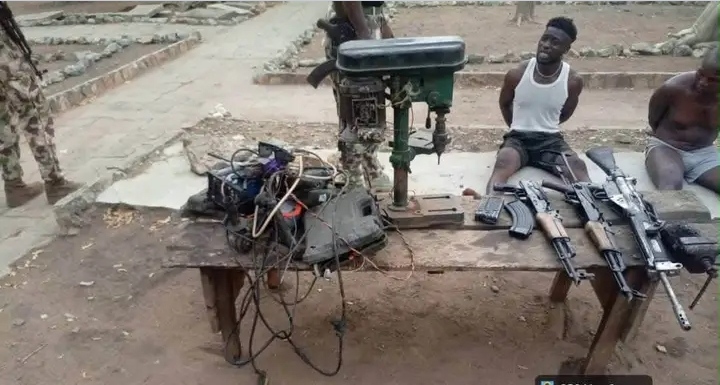
Military forces have dismantled a covert weapons manufacturing hub in a village in Plateau State, arresting two suspects found making sophisticated firearms, the military announced Thursday.

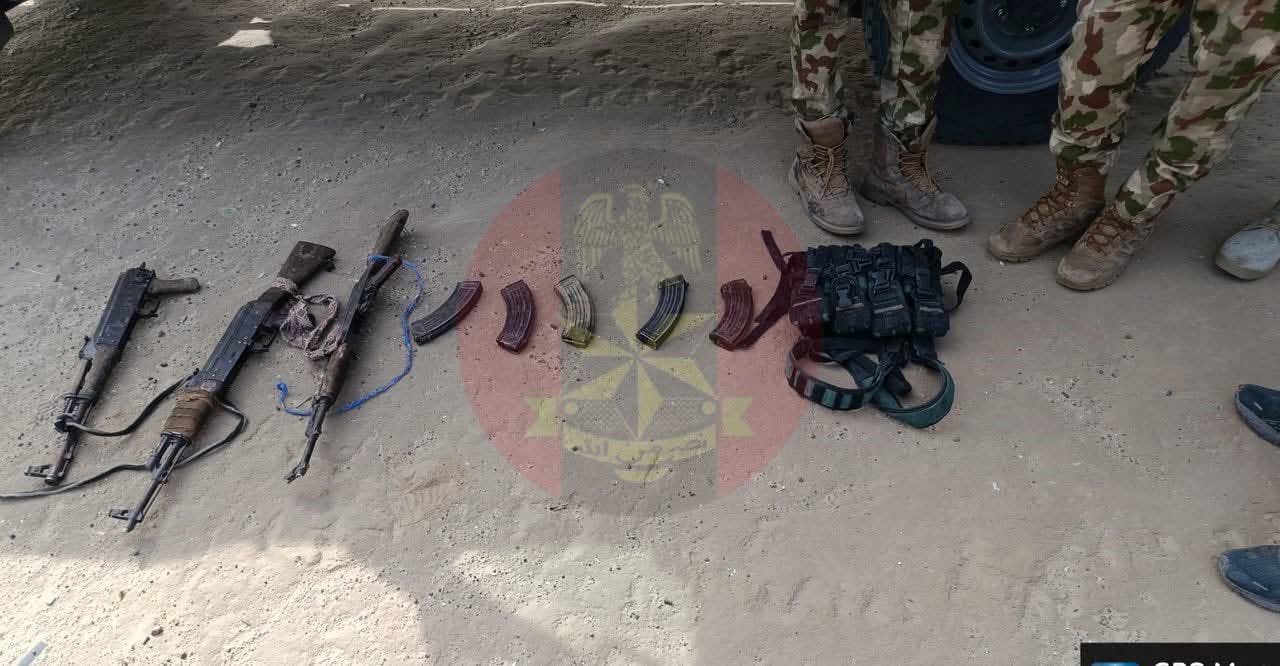
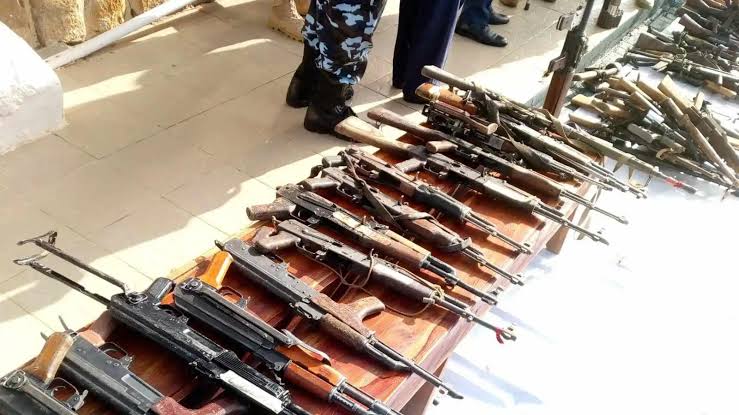
The operation, conducted around 5:00 pm on Wednesday by troops of Operation ENDURING PEACE in Gwandanu Village, Langtang North Local Government Area, led to the seizure of two AK-47 rifles, one G3 rifle, and industrial equipment including welding and drilling machines, generating sets, and a technical toolbox.

In a separate incident the same day in Jema’a Local Government Area of Kaduna State, troops responded to an armed attack on members of the Forest Guards and the Vigilante Group of Nigeria. In coordination with the Forest Guards, security forces pursued the attackers toward the Jaginde Forest axis.

The suspects abandoned a motorcycle and fled into the bush near Ungwar Maruwa upon spotting the approaching troops. One fleeing suspect was arrested, and a search of their hideouts recovered an AK-47 rifle, one AK-49 rifle, a motorcycle, and a sleeping mat.

The two suspects from the Plateau raid are currently in custody as authorities investigate their distribution network and possible links to wider criminal syndicates. Mop-up operations are ongoing to recover additional locally fabricated weapons and intercept other fleeing suspects.

Captain Chinonso Polycarp Oteh, Media Information Officer for the Joint Task Force, said the operations reflect the military’s commitment to restoring peace and stability in the joint operations area by targeting sources of communal violence and other criminal activities. He urged the public to continue providing timely information to assist security efforts.

Top Nigerian Army Commander Killed in Boko Haram Ambush in Borno

By Abdullahi Mukhtar Algasgaini

Nigeria’s military has suffered another devastating loss after a senior army officer was killed in a coordinated attack by Boko Haram insurgents in Borno State.

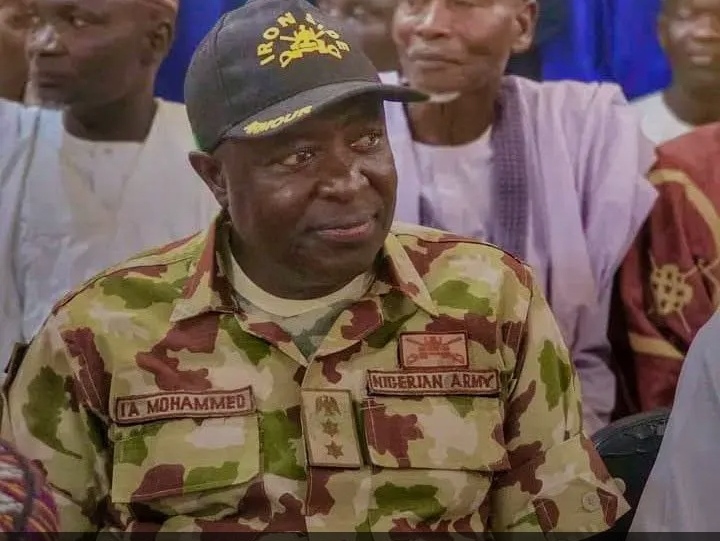
Colonel I.A. Mohammed, Commander of the 242 Battalion, died when his convoy was ambushed by fighters in the Moguno area, near the town of Boron. According to military sources, the troops were reinforcing a military camp under attack when their formation was struck by an improvised explosive device (IED), followed by heavy gunfire from insurgents hidden along the route.

Several other soldiers also lost their lives in the attack. Casualty figures have not been officially released, but a military source confirmed that the death toll includes the commanding officer and other ranks.

Colonel Mohammed’s death marks the fifth loss of a top-ranking military officer in Nigeria in 2026 alone — all within the first four months of the year. The repeated targeting of senior commanders has raised urgent questions about operational security and the resilience of the military’s command structure in the northeast counterinsurgency campaign.

As of press time, the Nigerian Army has not issued an official statement, but an internal security briefing described the incident as a “well-planned ambush with high-grade explosives.”

The insurgency in Borno, which has persisted for over a decade, continues to exact a heavy toll on both combatants and civilians, despite repeated government claims that Boko Haram has been largely defeated.

Dozens Feared Dead After Suspected Military Airstrike Hits Borno/Yobe Border Market

By Sabiu Abdullahi

At least 56 people have been reported dead and several others injured after an airstrike struck a busy weekly market along the border between Borno and Yobe states.

The incident took place on Saturday at Jilli Market, a trading hub situated between Gubio Local Government Area of Borno State and Geidam Local Government Area of Yobe State. The market serves residents from nearby communities, including Gubio, Chiweram, Benisheikh, Gurokayeya and Geidam.

Sources indicated that the strike may have occurred during a military operation aimed at suspected Boko Haram members. The fighter jet was reportedly pursuing insurgents believed to have entered the market to collect levies and gather supplies. However, the target was allegedly missed, with civilians bearing the impact.

Eyewitness accounts suggest heavy casualties. One witness said, “The incident happened around 2:46 p.m. while business activities were ongoing. Four fighter jets carried out the attack, though the fourth jet was not clearly visible. We only heard the sound of explosions.

“I counted 56 corpses myself and helped rescue two injured people, taking them to the hospital. I believe the number of casualties may be higher, as more bodies are still being recovered.”

Medical sources confirmed that several injured victims were taken to the Specialist Hospital in Geidam for treatment.

The councillor representing Fichimaram Ward, Malam Lawan Zanna, also confirmed the attack. He provided a slightly different casualty figure, noting that more victims were brought to hospital following the incident.

“The incident occurred at Jilli village’s weekly market under Fichimaram Ward in Geidam LGA. From the information available to us, it was an airstrike.

“When the jets launched their attack, people panicked and began to run, but the strikes continued. As we speak, over 30 people have been killed.

“More than 20 people were hospitalized in Geidam. Two were referred to the Teaching Hospital in Damaturu. Out of those receiving treatment, nine have died, bringing the death toll to over 30,” he said.

The Special Adviser to the Yobe State Governor on Security Matters, Brigadier General Abdulsalam Dahiru (rtd), acknowledged the development but clarified the location of the incident.

“I have spoken with the chairman of Geidam Local Government, who informed me that Jilli village falls under Gubio LGA of Borno State. You may contact officials in Maiduguri for further details,” he said.

There has been no official response from the Nigerian Air Force as of the time of this report.

Nigerian military neutralise five criminals, discover illegal weapons factory in Cross River

By Sabiu Abdullahi

Troops of the Nigerian Army’s 13 Brigade have neutralised five armed criminals and uncovered an illegal weapons production site in Odonget Community, Obubra Local Government Area of Cross River State.

This is contained in a statement issued by Yemi Sokoya, Major and Assistant Director Army Public Relations, Headquarters 13 Brigade Nigerian Army, on March 13, 2026.

The operation was carried out under the command of Headquarters 82 Division of the Nigerian Army. It followed a recent ambush on troops who had responded to a distress call linked to a communal dispute in the community.

Military sources said the troops continued their follow-up operation between March 12 and March 13, 2026. During this period, soldiers conducted cordon-and-search operations and fighting patrols across several identified locations. The action formed part of efforts to locate those responsible for the earlier attack on security personnel.

On March 13, the troops encountered the armed group again within the area. A gun battle broke out during the encounter. Five of the attackers were neutralised, while others escaped from the scene.

Further search of the surrounding area led to the discovery of an illegal gun manufacturing facility. Authorities believe the site served as a production centre where criminal elements fabricated weapons used in violent activities within the locality.

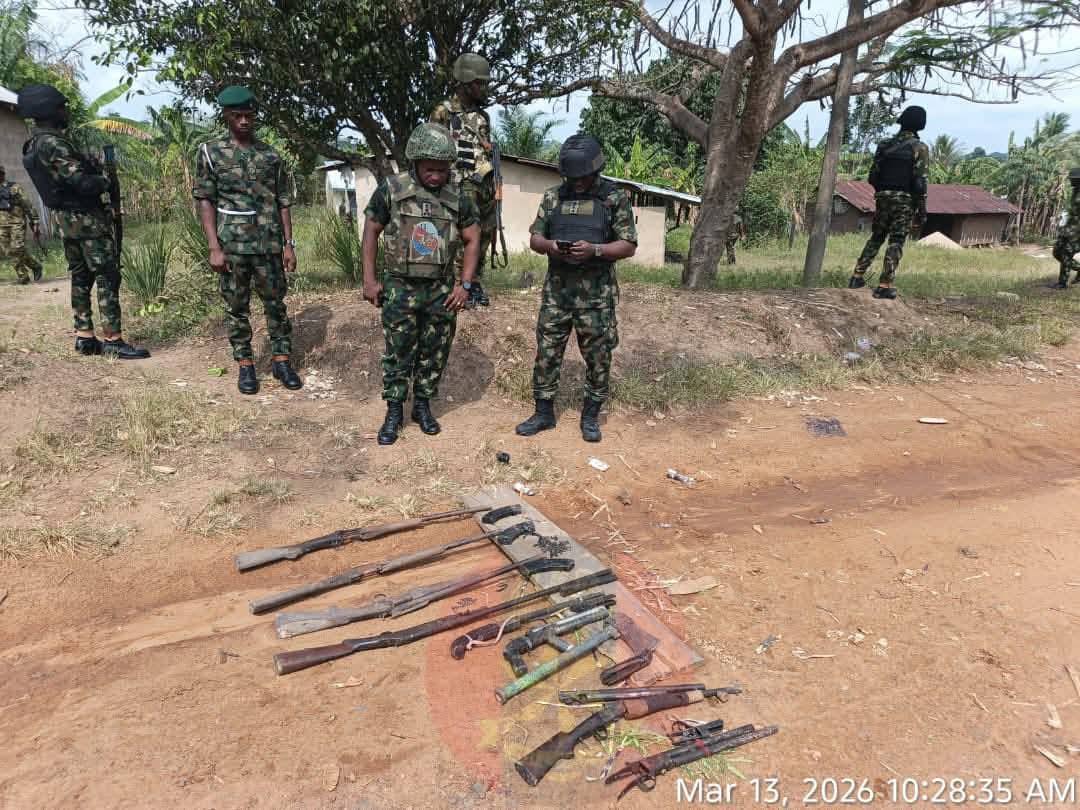
During a detailed search of the facility, troops recovered three AK-47 rifle magazines, 10 locally made firearms and a toolbox that contained equipment used for manufacturing weapons.

The military later destroyed the illegal arms production site to prevent further use by criminal elements.

The Commander of 13 Brigade, Brigadier General Patrick Alimikhena, who led and supervised the operation, praised the troops for their courage and professionalism during the encounter.

He assured residents that the Brigade remains committed to ensuring peace and stability in the area. He also said troops will continue sustained operations, surveillance and patrols to track down fleeing suspects and prevent further threats to law-abiding citizens.

Security authorities also urged members of the public to support ongoing operations by providing timely and credible information that could assist efforts to eliminate criminal activities in the area.

Nigerian military intercept 296 wraps of suspected Cannabis

By Sabiu Abdullahi

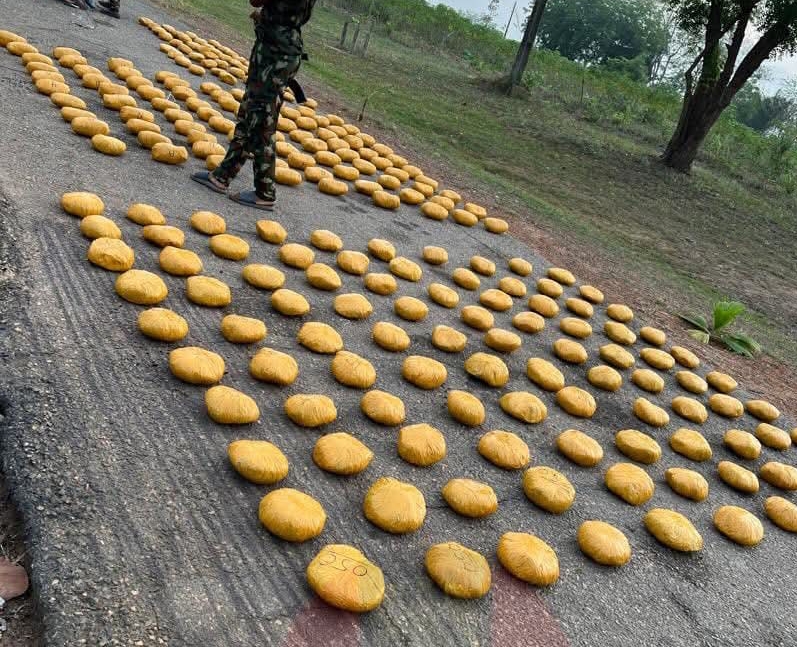
Troops of the 35 Artillery Brigade have intercepted 296 large wraps of substances believed to be Cannabis Sativa along the Abeokuta–Igboora Road in Ogun State.

The operation took place at about 4:30 a.m. on March 1, 2026, after the troops received credible intelligence about the planned movement of suspected illicit drugs along the route. Acting swiftly on the information, the soldiers moved to the area and stopped a motorcycle without a registration number.

During a search, the troops discovered 296 large wraps of substances suspected to be Cannabis Sativa, also known as Indian hemp. The items were hidden inside three large sacks. The suspect reportedly abandoned the motorcycle and escaped into a nearby bush under the cover of darkness.

The seized exhibits have been handed over to the National Drug Law Enforcement Agency (NDLEA), Ogun State Command, for further investigation and necessary action.

The 35 Artillery Brigade reiterated its determination to rid Ogun State of drug trafficking and other criminal activities. The Brigade warned individuals involved in illegal trade to embrace lawful means of livelihood or face the consequences of security operations.

It also reassured residents of Ogun State of the Nigerian Army’s continued commitment to safeguarding lives and property. The Brigade stated that troops will sustain a strong presence across the state to ensure that criminal elements do not operate freely.

The statement was signed by Major IderegHI Samuel Akari, Assistant Director, Army Public Relations, 35 Artillery Brigade, and dated March 2, 2026.

Nigerian soldiers repel terrorist attacks in Borno, neutralise lSWAP fighters

By Sabiu Abdullahi

Troops of Operation HADIN KAI under the Joint Task Force (North East) have foiled coordinated attacks by terrorists in parts of Borno State, recording significant gains against insurgents across several locations.

The military said the attacks, which occurred on the night of February 20, 2026, targeted Limankara and Kukawa. According to the statement, the failed operations by the terrorists show the increasing pressure on their camps, supply routes, and leadership structure. Troops maintained sustained offensives, which forced the attackers to retreat with heavy losses.

In a separate operation, troops of Sector 2 under Operation DESERT SANITY V carried out a targeted mission around Lamusheri Village in Gujba Local Government Area in the early hours of February 22. The area was identified as a key base for launching attacks and storing logistics.

The troops, working alongside members of the Civilian Joint Task Force, engaged the terrorists despite coming under fire. They outmanoeuvred the insurgents and blocked their escape routes. During the operation, 15 terrorists were killed, while several others fled with gunshot wounds. Soldiers destroyed key structures used by the group and set ablaze five tricycles and two vehicles used for operations. They also recovered arms, ammunition, bandoliers, and other items.

On the same night, terrorists attempted to infiltrate the Forward Operating Base in Limankara. Troops responded swiftly and engaged them in a fierce exchange. Reinforcements and air support helped repel the attackers, who fled through the burial ground axis. No casualties or equipment losses were recorded on the side of the troops, while intelligence reports indicated losses among the terrorists.

Also, in Kukawa, terrorists launched a coordinated attack using gun trucks, motorcycles, and fighters on foot from the Alagarno and Jemmu directions. Troops mounted strong resistance and engaged them in a prolonged battle that lasted into the early hours of February 21.

The attackers were eventually forced to withdraw after facing superior firepower and coordinated ground and air operations. Air strikes destroyed one gun truck, killing four fighters. Surveillance later tracked fleeing terrorists on motorcycles, leading to another strike that destroyed five motorcycles and killed 10 more fighters.

After the operation, troops recovered 13 AK-47 rifles, 16 loaded magazines, and three handheld radios used by the insurgents. They also found stretchers, shallow graves, and blood trails left behind.

However, the military confirmed that one soldier lost his life during the encounter, while some equipment was damaged by rocket fire. Injured personnel were evacuated by Nigerian Army helicopters and are reported to be in stable condition.

The military authorities stated that the coordinated operations have further weakened the terrorists and strengthened operational control in the region. The High Command commended the troops for their performance and urged them to maintain the momentum.

Democracy vs. Military Rule: No contest

By Abdullahi Muhammad Yalwa

Sometimes, intellectual masturbation makes people say despicable things. That’s how they say foolish things without actually knowing. If not intellectual premature ejaculation, what else would possibly make an educated person compare democracy with military rule? You can’t compare the two at all. In fact, it’s an insult to real thinking to mix them up without a strong reason as to why and how.

Yes, Nigerians are frustrated with democracy because we’ve suffered under it. Presumably, every Gen Zer born from 1999 to date has suffered, or is suffering, from the discontents of democracy. Corruption, poverty, and bad leaders all strangulate our growth. As such, it’s easy for someone who never lived through military rule — or never thoroughly read about it — to think it was better. Nevertheless, it’s inexcusable to make that comparison in the 21st century. With all the history and information one click away. This is lazy thinking.

Nigeria’s story explains the tension between Democracy and Autocracy. Since independence in 1960, Nigerians have swung between dreams of democracy and military high-handedness. The First Republic, which started in 1963, collapsed into coups by 1966. Then came 30 years of mostly military rule, with a short democratic break from 1979 to 1983.

Within this duration, Gowon fought the Biafran war from 1967 to 1970, which resulted in millions of deaths and the fangs of deadly hunger almost flung Nigeria into an abyss. After Gowon, Buhari came in the 80s with his “War Against Indiscipline” rhetoric. Though some changes were recorded only minimally, his government, too, was a failed experiment. Then, Babangida followed his coup and ruled Nigeria through military rule for almost 10 years. His scandalous cancellation of the 1993 election brought General Abacha, who also killed activists in a cold-blooded manner, abducted critics, and censured opposition. Under Abacha, Nigeria became a global pariah, an outcast because of misrule, corruption, and human rights abuses. So, the soldiers promised order but delivered fear, theft, and failure. Beyond the Gun tirade, a lot of them proved to be nothing but unscrupulous, self-centred, and avaricious.

When democracy returned in 1999, it wasn’t perfect — but it was progress. From Obasanjo to Yar’Adua, Jonathan, Buhari, and now Tinubu, we’ve seen peaceful transitions. That alone is a miracle compared to the blood and chaos of coups, which are primarily scathing and scary.

Democracy works and is better than military rule because it gives people a voice. Under democracy, leaders are elected. The constitution limits their powers, and Citizens can question, join them, or change the government. Nigeria’s record is full of incidents in which the people removed the government despite its resistance. Elections since 1999 have been taking place, even though with low turnout and many flaws.

Furthermore, democracy still allows movements and protests like that of #EndSARS in 2020. As such, people can protest against abuse without the nation collapsing. That’s democracy in action.

Equally, in a democracy, the law stands above all. Rights like speech, movement, and association are still protected despite shortcomings. The media and civic groups expose scandals and corruption. Dan Bello is our standard example here. Leaders feel pressure because they can be voted out. They are still afraid of the people’s might. Similarly, growth comes from debate, not decree. Policies get tested and refined before execution. Sometimes they are reversed after execution because of pressure. All these are happening because of the grace of Democracy.

Now, compare that with military rule. Under soldiers, power is seized by guns, not ballots. A few officers give orders. No dialogue, no accountability, only decrees that replace laws. The constitution goes silent. Many of its parts got scraped and unscripted. Rights become suspended, or mere names on papers. Dissent under the military is punished with the barrels of guns. Abacha’s regime proved it — hidden trials, executions, silence. Thus, there is no right to protest, no matter the height of injustice.

Nevertheless, some people may say the military will bring discipline, build roads, and promote infrastructure. But all of that without justice is short-term. Order without fairness is not peace; it’s fear, which eventually erupts into chaos in disguise. 

We have tested the military. And the reflex is there in history for the discerning minds. Under the generals, Nigeria’s economy sank, institutions died, and corruption deepened. Stability built on fear never lasts. Once soldiers take power, they rarely leave it peacefully. Hence, there is no rotation of government. You only get stuck with whatever you’ve got.

Although Democracy has its flaws, issues like bad elections, corruption, and insecurity remain rampant in our country; nevertheless, it is by far a better option. At least, it gives us freedom to protest, options for dialogue, and hope in change. By contrast, military rule gives us nothing but fear, silence, and graves.

The worst democracy is still better than the best dictatorship. Democracy lets us correct our mistakes. Military rule buries them.

So, all these comparisons and happiness over the aborted coup against Tinubu is nothing but nostalgia from frustrated people who refused to learn better. Democracy is not Nigeria’s problem. Nigeria’s main issue is bad leadership. If only we’d vote for responsible leaders, they’d fix the system, without destroying it. They’d strengthen our votes. Protect our rights. Hold leaders accountable. All these would happen only when democracy grows. Thus, democracy grows, Nigeria grows.

No gun can build what the people can build together.

Abdullahi Muhammad Yalwa, a Law graduate based in Azare, Bauchi State, can be reached at abdullahimuhammadyalwa02@gmail.com.
President Tinubu vows to crush terrorism, boosts military welfare 

By Abdullahi Mukhtar Algasgaini

President Bola Ahmed Tinubu has issued a strong charge to the Nigerian military, urging them to intensify efforts in ending terrorism and banditry while promising improved welfare for troops.  

Speaking to soldiers of the 17 Brigade in Katsina on Friday, Tinubu described the security crisis as a pivotal moment in Nigeria’s history. He called for unwavering resolve in defending the nation’s sovereignty and restoring peace.  

“This is a defining moment,” Tinubu declared. “Nigerians are counting on you to reclaim every inch of our territory. Let the enemies of Nigeria know—their time is up.”  

The President assured troops of better housing, healthcare, timely allowances, and family support. He praised their bravery in combating banditry in Katsina and beyond, stating, “You are the shields of Nigeria, standing between our people and terror.”  

Tinubu’s visit included inaugurating a 24km dual-carriage road and an agricultural mechanisation centre. His message was clear: Nigeria will not surrender to terrorists, and the military will receive full backing to end insecurity.  

“To those who seek to destabilise us,” he warned, “Nigeria will not bow.”

Troops arrest suspected kidnap kingpin, recover arms in Kano

By Uzair Adam 

Troops of the Joint Task Force have arrested a 55-year-old man suspected to be a notorious kidnapper during a security operation in Sumana village, Tundun Wada Local Government Area of Kano State.

The arrest was disclosed in a statement issued to journalists by Capt. Babatunde Zubairu, Assistant Director, Army Public Relations, 3 Brigade, on Tuesday. According to the statement, the suspect was apprehended on April 20.

He was later paraded before the Brigade Commander, Brig.-Gen. Ahmed Tukur, during the commander’s Easter visit to troops of the Forward Operating Base (FOB) in Falgore, Doguwa LGA.

The commander commended the troops for their courage and professionalism, describing the operation as a significant success in the ongoing campaign against criminality in the region.

A cache of arms and other items were recovered during the operation. These include a fabricated AK-47 rifle, one Den gun, nine rounds of 9mm pistol ammunition, a woodland camouflage uniform, a desert camouflage outfit, a camouflage vest, and a Bajaj motorcycle seat suspected to be used for concealing weapons.

Brig.-Gen. Tukur reiterated the Nigerian Army’s commitment to working with other security agencies and local authorities to restore peace and order in troubled areas.

“The army remains dedicated to its mandate of safeguarding lives and properties. We will not relent in our efforts to bring perpetrators of criminal acts to justice,” the statement read.

The suspect is currently in custody and undergoing a preliminary investigation.

Amnesty International slams military over Sokoto airstrike, demands justice

By Uzair Adam

International human rights organization Amnesty International has accused the Nigerian military of attempting to conceal the deaths of civilians in two Sokoto State communities during a December 25 operation targeting Lakurawa terrorists.

The Daily Reality reports that the airstrike, conducted in Gidan Sama and Rumtuwa communities in the Silame Local Government Area, resulted in the deaths of at least 10 citizens.

The Defence Headquarters attributed the fatalities to a secondary explosion at a terrorist logistic base, but Vice President Kashim Shettima apologized to the victims’ families.

The incident adds to a troubling history of military airstrikes unintentionally killing civilians, with Amnesty International estimating a total of 436 civilian deaths over the past eight years.

Amnesty International’s Country Director, Isa Sanusi, condemned the Sokoto bombing and accused the military of disregarding human lives. He called on the Nigerian government to conduct an independent investigation.

“The Nigerian military must hand over all records related to the airstrike to the Attorney General’s office for an impartial investigation,” Sanusi stated. “Failure to hold the military accountable only perpetuates impunity and endangers more lives.”

Sanusi urged President Bola Tinubu to establish an independent inquiry into the incident, ensuring justice for the victims and their families.

He reiterated the need for fair trials and compensation for those affected. Amnesty International also highlighted previous airstrikes in various states, including Borno, Zamfara, and Kaduna, which have collectively claimed hundreds of civilian lives.

Despite repeated assurances to minimize civilian casualties, these incidents continue to occur, raising concerns about the military’s operational protocols and accountability.