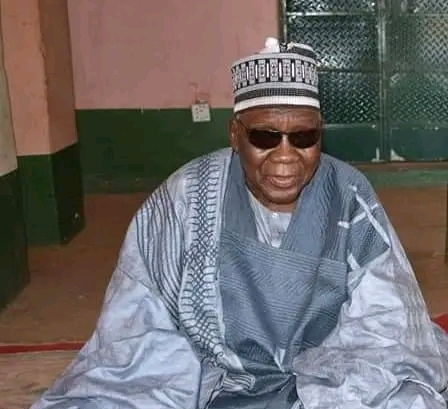
Tribute to an Astute Administrator: The Makinta of Fika Emirate
By Kasim Isa Muhammad
As I try to pen down some sort of tribute to Alhaji Bukar Abubakar, the Makinta of Fika Emirate, I find myself struggling with where exactly to begin because some people are simply too difficult to capture in words. There are people whose lives can easily be summarised by their positions, their accomplishments or the offices they occupied, but there are others whose true worth lies somewhere consequential in the lives they touched, the people they encouraged, the kindness they showed, the sacrifices they made and the memories they left in the hearts of those who were fortunate enough to know them. Alhaji Bukar was one of those rare people. I lived in the same area with him for about twenty years and, during all those years, I came to know him not only as a respected elder or distinguished retired civil servant, but as a neighbour, a gentleman and, above everything else, a good human being. I am not saying that he was flawless because no human being is without shortcomings, but in all the years that I knew him, I never, even in my wildest dreams, got to know a flaw that could diminish the extraordinary impression he left on people. He was indescribably kind, compassionate, accommodating and peaceful. He was, by far, one of the most pleasant people I have ever known, and there was something about his manner that made it difficult to imagine him deliberately hurting another person. He carried his age, experience and status with unprecedented dignity that never made other people feel small. He was simply Alhaji Bukar, a man who had lived enough to understand that the greatest measure of a person’s life is not what he owns or the position he occupies, but the good he leaves behind in the lives of others.
In April last year, when I was a correspondent with Neptune Prime, I had the privilege of interviewing Alhaji Bukar for our Oldies page. It was supposed to be a normal journalistic assignment, another interview, another story, another conversation with an elderly personality whose experiences were worth documenting. But somehow, that thirty-minute conversation became much more than that for me. It stayed with me. It settled somewhere deep in my subconscious and continued to reveal its lessons long after the interview was over. There are conversations we have in life that disappear almost immediately after we leave the room, and there are others that remain with us because something in the person we encountered has touched a part of us that we did not even know needed touching. My conversation with Alhaji Bukar was one of those conversations. I listened to him speak about his life and his career, about how he started as a primary school teacher before rising through the ranks and eventually becoming a distinguished administrator and Rector of the College of Administrative and Business Studies, CABS, in Potiskum Local Government. What struck me most was his work ethic. He was a very, very hardworking man, and there was no pretence about it. His story was a story of persistence, discipline, sacrifice and the determination to keep moving forward regardless of how difficult the road might become. Listening to him made me think exceedingly about the importance of hard work and the power of perseverance. He reminded me that sometimes the only way to succeed is to simply keep going, even when the results are not immediate. That interview instilled in me, perhaps more than he ever realised, the importance of the habit of keep on keeping on. I walked away from that conversation with a renewed determination to work harder, to remain patient with the process and to understand that a person’s beginning does not have to define his ending.
Lo and behold, there is something emotional about remembering that interview because I did not know then that I would one day be writing about him in the past tense. I did not know that the man sitting before me, telling me about his life and experiences, would eventually become someone I would have to remember rather than visit. I did not know that thirty minutes could become such a precious memory. I did not know that I would later wish I had asked more questions, listened more carefully or simply stayed a little longer. That is the cruelty of death. While people are alive, we often assume that there will always be another opportunity. Another visit. Another conversation. Another greeting. Another question. Another chance to say thank you. But death has a way of teaching us that time is not something we own. It is something Allah lends us. And when He decides that the appointed time has come, there is nothing any of us can do to extend it. Now, when I think about Alhaji Bukar, I find myself returning to that brief conversation and appreciating it in a way I could not have appreciated it then. It was only thirty minutes, but those thirty minutes gave me something that has stayed with me.
Alhaji Bukar Abubakar was a distinguished retired civil servant, educator, administrator, philanthropist and farmer, but even those descriptions do not fully capture the breadth of the man he was. His professional life was intriguing because he began as a primary school teacher and continued to rise until he became a college rector. There is something more inspiring about such a great life because it reminds us that greatness does not always begin in grand surroundings. Sometimes it begins in an ordinary classroom, with an ordinary teacher doing extraordinary things through commitment and dedication. He understood the dignity of work and the importance of education, and he carried those values throughout his life. He did not simply teach students and move on; he invested in people. During our interview, he spoke about people he had trained and about folks who had gone on to excel in different walks of life. He seemed very, very interested in the progress of people he had helped, and I found that particularly admirable. Some people measure their success by the offices they occupy, the awards they receive or the material things they accumulate, but Alhaji Bukar seemed to measure his own success by the people who became better because they encountered him. In that sense, his influence was much larger than any office he ever occupied. He was a teacher beyond the classroom. He taught through his actions, his conversations, his generosity and the example he set for those around him.
One of the things that made Alhaji Bukar so extraordinary was the way he embraced people without an iota of discrimination. He did not appear to care about a person’s social status, wealth, background or influence before extending kindness to them. He had an unusually large heart, and people who were vulnerable seemed to have a special place in it. Whenever one visited his house, it was common to see Almajirai around. They came there because they knew they would be welcomed, fed and treated with dignity. Alhaji Bukar used to feed and clothe many Almajirai with his hard-earned money, and his generosity towards them went far beyond providing food. He enrolled many of them in schools and supported their education, giving them an opportunity to acquire knowledge and qualifications that could change the direction of their lives. Some of them eventually earned diplomas through his intervention. Think about that for a moment. A man spends his own hard-earned money to educate children who are not biologically his, children who might otherwise have remained invisible to society, because he believes that they deserve an opportunity. That is not ordinary kindness. That is an unprecedented understanding of humanity. It is an understanding that every child has potential, that poverty should never be a permanent sentence and that one of the greatest things a human being can do is to invest in another human being’s future. Alhaji Bukar saw these children not merely as Almajirai but as human beings deserving of food, clothing, education, respect and hope. That part of his life deserves to be remembered because it tells us more about his character than any title ever could.
I often think about the people whose lives he changed quietly. How many children ate because he gave them food? How many young people went to school because he paid for them? How many families found relief because he intervened at a difficult moment? How many people became successful because, at some point in their lives, Alhaji Bukar decided to believe in them? We may never know the full number. He was not the kind of person who went around announcing his good deeds. He did not need cameras before helping people. He did not require newspaper headlines to validate his generosity. He gave because he believed in giving. He helped because he believed that those who had something should share it with those who had less. That is what makes his philanthropy so beautiful. He helped people without making their vulnerability a spectacle. He gave without humiliating the person receiving. He supported without reminding people that they owed him. And perhaps that is the purest form of philanthropy and the kind that is done because the heart cannot comfortably ignore another person’s need.
Born in 1945, Alhaji Bukar lived through many decades and witnessed a lot of changes. He belonged to a generation that understood hardship in ways that many of us today may never fully understand. Yet rather than allowing life’s difficulties to make him bitter, he seemed to turn them into a source of strength and empathy. His career, his commitment to education, his work as a civil servant, his administrative responsibilities, his farming and his philanthropy all reflected a man who believed in productive living. He understood that life was not simply about taking from society but about contributing to it. He understood that every person has a responsibility to leave something useful behind. Perhaps that is why even after his professional career had ended, he remained active, hardworking and involved in the lives of others. Retirement did not retire his humanity. It did not retire his generosity. It did not retire his desire to see people succeed.
People who worked with him have attested to his peaceful nature, and his neighbours have said much the same thing. Nobody has ever described him to me as someone who enjoyed arguing with people or deliberately creating conflict. He was a man who seemed to understand that peace is itself a form of wealth. He did not need to win every argument. He did not need to prove himself superior to everyone around him. He carried himself with a calmness that reflected maturity. In a life where people are increasingly quick to anger, quick to take offence and quick to turn disagreements into lasting hostility, Alhaji Bukar believed in the beauty of restraint. He seemed to understand that not every provocation deserves a response and that not every disagreement needs to become a war. That peaceful disposition was part of his charm. His neighbours remember it. His colleagues remember it. Those who interacted with him remember it. And when many different people independently describe a person in the same way, there is usually something deeply truthful in that description.
There was also a humility about Alhaji Bukar that I found fundamental. He had achieved enough in his life to justify pride. He had risen from being a teacher to becoming a rector. He had served as an administrator. He had educated and mentored people. He had supported vulnerable children. He had contributed to his community. He had lived a productive life. Yet his achievements never seemed to make him believe that he was better than others. He remained approachable and accessible. He did not allow his experience to create an unnecessary distance between himself and ordinary people. That, to me, is one of the clearest signs of true greatness. A person who has achieved much but remains humble is far more admirable than someone who has achieved little but believes himself to be superior to everyone else. Alhaji Bukar understood that titles are temporary, positions are temporary and worldly recognition is temporary, but character remains.
When I think about his life, I realise that his greatest legacy is probably not something that can be placed in a building or written on a plaque. His greatest legacy is people. The students he trained. The young people he encouraged. The Almajirai he fed and educated. The people who benefited from his generosity. The neighbours who experienced his kindness. The colleagues who worked with him. The people who simply met him at some point and left the encounter feeling better than they had arrived. These people are his monuments. A building can eventually deteriorate. An office can be occupied by someone else. A title can eventually be forgotten. But when you change a person’s life, you become part of that person’s story forever. Alhaji Bukar became part of many people’s stories, and that is why I believe his memory will endure.
Perhaps what I admire most about him is that he exceeded that greatness does not have to be loud. Sometimes greatness is the elderly man who feeds hungry children in his home. Sometimes greatness is the retired administrator who continues to mentor young people. Sometimes greatness is the former rector who remains humble enough to treat an ordinary neighbour with dignity. Sometimes greatness is the man who spends his hard-earned money to send an Almajiri to school. Sometimes greatness is simply the person who lives peacefully with everyone around him and refuses to make other people’s lives more difficult. We live in a time when people often equate greatness with visibility, but Alhaji Bukar taught a different lesson. He showed us that a person can live quietly and still leave an enormous impact.
For me, his life also reinforced the importance of hard work. That thirty-minute interview continues to remind me that progress is rarely accidental. His story from primary school teaching to becoming a rector was a lesson in perseverance. It taught me that one must continue even when the journey is difficult, continue when recognition is slow and continue when the destination seems far away. I think that is one of the reasons his memory has remained so powerful for me. He did not merely tell me about hard work; he had lived it. He was evidence of the very lesson he was sharing. And whenever I find myself becoming tired or discouraged, I remember the story of his life.
Death, however, has a way of making all these memories painful. It is one thing to admire someone while they are alive; it is another thing to suddenly realise that you will never see them again. There is an emptiness that follows death which words cannot completely describe. You begin to remember ordinary things that you never thought would become precious. A greeting. A conversation. A familiar face. The sight of someone sitting in his usual place. The sound of his voice. The knowledge that he was somewhere nearby. Suddenly, all those things become memories, and memories can be both beautiful and painful at the same time. That is how I feel when I think about Alhaji Bukar. I am grateful that I knew him, but I am saddened that I cannot know him for longer.
Yet grief should not make us forget gratitude. We should be grateful that Allah allowed us to share this world with him. We should be grateful for the years he lived, the people he helped and the lessons he left behind. We should be grateful for the students whose lives he influenced, the children he educated, the Almajirai he fed and clothed and the countless people who benefited from his kindness. We should be grateful that we had the privilege of witnessing a man whose life was a practical lessons of service and compassion. His death is painful, but his life was a gift. And perhaps the most appropriate response to a gift is gratitude.
Alhaji Bukar Abubakar, you are gone, but your legacy remains. You may no longer be physically present among us, but the people whose lives you touched remain here to tell your story. The children you supported will remember you. The students you trained will remember you. Your neighbours will remember you. Your colleagues will remember you. Those who sat with you, spoke with you, worked with you or received kindness from you will remember you. Your life has become part of the memories of many people, and that is a form of immortality that death cannot take away.
Your story reminds us that a life does not have to be perfect to be meaningful. It only has to be lived with purpose, compassion and sincerity. You worked hard. You served. You educated. You gave. You encouraged. You embraced people without discrimination. You treated vulnerable children with dignity. You lived peacefully with your neighbours. You left behind children and grandchildren, but you also left behind a much larger family and the people whose lives you touched through your service and generosity. That is why your departure is not simply a family loss. It is a community loss. It is a loss to everyone who believes that kindness, education, service and compassion still matter.
My final words for you are a prayer. May Allah forgive your shortcomings and accept your good deeds. May He reward you for every child you fed, every person you clothed, every student whose education you supported, every young person you encouraged and every life you touched. May He reward you for the good deeds that nobody saw and the acts of generosity that you never publicised. May Allah make your grave spacious and filled with light. May He make your resting place peaceful and beautiful. May He receive you with mercy, pardon your sins, elevate your rank among the righteous and grant you the highest place in Jannatul Firdaus. May the Almighty surround you with His mercy and make every act of kindness you performed in this world a source of continuous reward in the Hereafter.
To your children, grandchildren, relatives, friends, colleagues, students, neighbours and everyone who mourns you, may Allah grant you patience and fortitude. May He comfort your hearts and remind you that although death has taken away the physical presence of Alhaji Bukar, it cannot take away the goodness he planted in the lives of others. May his life continue to inspire you. May his memory continue to unite you. May his example encourage you to live with kindness, humility, hard work and generosity. And may those who loved him understand that the best way to honour a good man is not merely to mourn his death, but to continue the good that he represented while he was alive.
As I think about Alhaji Bukar today, I keep returning to that thirty-minute conversation. I keep thinking about the man who sat before me and spoke about his life with such simplicity. I keep thinking about his career, his work ethic, his compassion and his willingness to help people. I keep thinking about the Almajirai who ate in his house and the young people whose education he supported. I keep thinking about the peaceful man his neighbours knew and the hardworking administrator his colleagues respected. And I realise that perhaps those thirty minutes were a gift. A brief opportunity to sit with a man whose life contained decades of lessons. I did not know then how valuable those moments would become, but I know now. And for that, I will forever be grateful.
Alhaji Bukar Abubakar, the Makinta of Fika Emirate, you lived a life worthy of emulation. You were a hardworking man, a compassionate man, an educator, an administrator, a philanthropist, a farmer, an elder statesman and a peaceful neighbour, but above all, you were a good man. You gave without discrimination. You helped without seeking applause. You educated without asking for recognition. You treated people with dignity. You lived your life in a way that made other people’s