Mai Mala Buni

Souvenir from the Yobe Spelling Bee 2026 (I)

Ali Tijjani Hassan

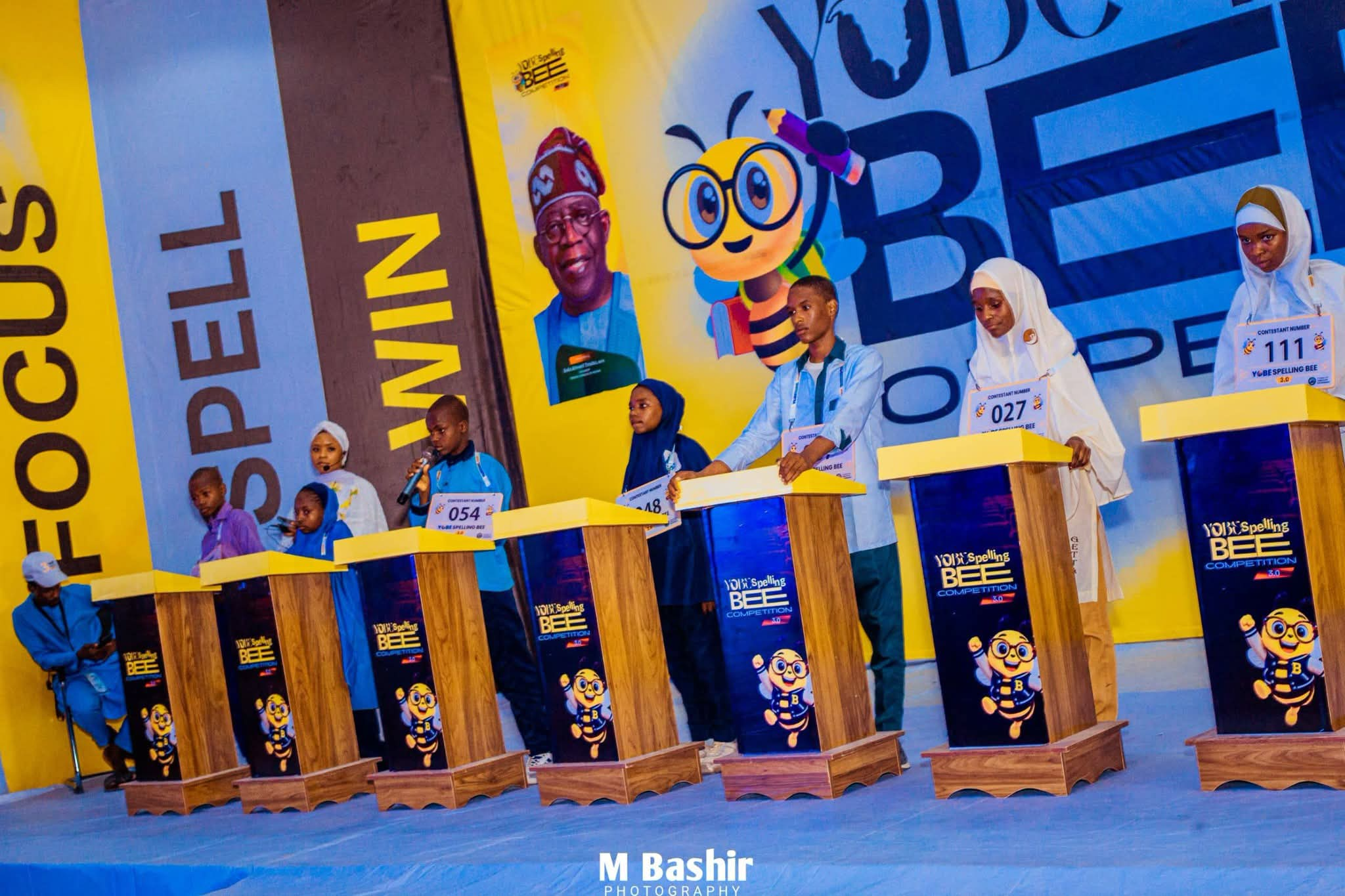
I am in Damaturu to witness the third edition of the Yobe State Spelling Bee Competition, and to be honest, I might not be doing justice to what I witnessed if I wait for decades before telling my unborn children about how Governor Mai Mala Buni, CON, is gradually refining the educational sector in Yobe State during his tenure.

His Excellency, the Deputy Governor of Yobe State, Alhaji Idi Barde Gubana, Wazirin Fune, declared the programme open and encouraged the young participants to do their best and make their communities proud. As he said, and I quote: “Forty-five years back, we were at your level, but today we are at the mantle of leadership and about to exit. You are indeed the leaders of tomorrow, and you are on the right track.” 

The Deputy Governor also appreciated the Secretary to the Yobe State Government, Dr Mohammed Goje, FRSPH, for initiating, sustaining, and continuously improving this remarkable programme. He described it as an epitome of Dr Goje’s foresighted, selfless and transformative leadership in redefining the future of young people across the state.

It gladdened my heart to see some of the finest young brains among us serving as judges and facilitators. Among them was my friend, Shamsiyya Ibrahim Barde, a recent UN guest and UNOCT champion, who served as the lead judge, while Zara Alim Bakari, as the Master of Ceremony.

Then came the preliminary stage, where every participant had the opportunity to step onto the podium and show what they had upstairs. It was one of those experiences you genuinely wish you could record and replay. I saw young and talented teenagers trying to figure out what they could do with their abilities. For me, that is one of the greatest values of the Spelling Bee. Beyond competition, it gives young people a platform to discover, sharpen and showcase their abilities while preparing themselves for a world that will demand excellence from them. 

And, of course, the real drama started when a young man who, by all indications, is my Fulani brother, was asked to spell “Maritime.” My brother tried spelling it three times. The judges disagreed about his alphabet pronunciation, largely because of mother-tongue interference. For those of us in the audience, it became difficult to tell whether the sound he produced in the second syllable was “M” or “N.” As the debate intensified and the young man probably realised that his English-language command was not going to rescue him, he switched to Hausa and asked: Wai ko ba ‘Maritime’ ake nufi ba?”

The entire hall erupted in laughter. That young man single-handedly revived the energy in the room. But beyond the laughter, I admired something about him: confidence. He wasn’t afraid to try the word, even when he wasn’t entirely sure of himself. And sometimes, that confidence to stand before people, try, and keep going despite a barrier is itself a form of education.

Of course, I saw many other vibrant young people who came fully prepared to take the trophy home. Their confidence, composure and command of words were genuinely impressive.

Then came another moment that caught my attention. A young participant with visual impairment appeared on stage and was asked to spell “Senator.” He requested the assistance he needed to participate effectively, explaining that he had been taught to read and interpret words through a system different from what most of us were familiar with. That moment made me appreciate something beyond the competition itself: the preparation that went into making the programme inclusive. It reminded me that education is not truly transformative until it makes room for everyone.

I was equally impressed by the commitment of the organisers and stakeholders. The Secretary to the State Government, Dr Mohammed Goje, alongside members of his team and associates, including Dr Sa’id Ali Kori of Thinklab, Dr Suleiman Dauda of SOLID, Dr Bulama Maina Yaro of the Yobe State Pilot Livestock Development Programme, Dr Babagana Muhammad of Nigeria Food Corporation, and Prof. Sheriff Almuhajir of YMFB, maintained a constant presence throughout the programme despite their various professional and personal commitments. To me, that speaks to the strong commitment to the initiative.

The Yobe State Spelling Bee Competition is becoming more than an academic competition. It is creating a platform where young people can discover their confidence, test their abilities, compete with their peers and begin to imagine themselves in spaces of excellence.

And perhaps the greatest lesson from the competition is one I have always believed: School was never a scam. Give a child the right environment, expose them to opportunities, challenge them intellectually, and you may be watching the early stages of someone who will one day change your community.

The Yobe Spelling Bee is, without doubt, setting a pace for a future trajectory built around education, confidence, talent and the pursuit of excellence among the younger generation of Yobe State. Let’s come back tomorrow to witness what the next session’s “knock-out stage” will offer us. But I believe that many emotional moments would unfold.

Ali Tijjani Hassan writes from Damaturu.
[OPINION]: Higher Salaries, Better Skills, Greater Responsibility: Inside Yobe’s Civil Service Reform Agenda

By Maji Bappa Maina


Government policies become meaningful when the institutions responsible for implementing them have the people, skills and resources required to deliver results.

Roads, hospitals and schools may attract public attention, but their planning, financing, supervision and maintenance depend heavily on the quality of the civil service. For this reason, the welfare and professional development of public servants deserve attention alongside the physical projects through which governments pursue development.

In Yobe State, several initiatives introduced during Governor Mai Mala Buni’s administration provide an opportunity to examine this relationship.

They include salary adjustments, implementation of the ₦70,000 minimum wage, recruitment, professional training and programmes to prepare retiring workers for life after government service.

The latest development came on 17 October 2026, when the state government announced a new monthly salary structure for the Head of Service, Permanent Secretaries, the Auditor-General for the State, the Auditor-General for Local Government and the Accountant-General.

Considered alongside earlier initiatives, the announcement raises an important question: how can improved staff welfare and stronger professional capacity translate into more effective public service?

Beyond the Latest Salary Approval

Under the newly announced structure, the Head of Service will receive ₦1,430,830.75 monthly, while Permanent Secretaries will receive ₦1,203,851.55.

The Auditor-General for the State, Auditor-General for Local Government and Accountant-General will each receive ₦1,114,666.36 monthly.

The figures were disclosed by the Head of Service, Abdullahi Musa Shehu, who called on beneficiaries and other civil servants to demonstrate greater dedication and improve service delivery.

The approval concerns specified senior offices and should not be confused with a general salary increase for every civil servant.

The announcement does not provide the previous salaries, so the percentage increase cannot be calculated from the available information.

Nevertheless, the decision highlights the importance of remuneration in public administration.

Senior officials influence policy implementation, financial management, personnel administration and institutional oversight.

Their conditions of service matter, but so does the quality of their work.

The value of a salary structure should therefore be considered alongside the professional standards, accountability and administrative performance expected from those receiving the remuneration.

A Wider Approach to Remuneration

The latest approval follows other salary-related measures reported during Buni’s administration.

In November 2024, the governor approved a ₦70,000 minimum wage for state civil servants, effective from December that year.

The decision followed recommendations from a state committee established to examine the new minimum wage.

Arrangements involving local government employees were also considered.

In July 2025, reports stated that the government approved the implementation of CONUASS and CONTISS II salary structures for academic and non-academic staff of Yobe State University.

These are separate remuneration arrangements for tertiary education personnel.

Further measures reported in October 2026 covered professional groups, including law officers and judicial personnel.

Adjustments affecting certain health professionals and academic allowances were also announced.

In addition, the government approved employment for 294 medical students on Grade Level 07/2 and 801 allied health science students on Grade Level 05/2, according to published reports.

These initiatives concern different categories of employees and should not be treated as one salary structure.

Collectively, however, they provide a basis for examining how the government approaches remuneration across different parts of the public sector.

Appropriate pay can support morale and help government attract and retain qualified personnel.

Its effectiveness also depends on fair personnel practices, suitable working conditions and opportunities for professional advancement.

Training: Turning Employment into Professional Capacity

Recruitment brings people into government, but employment alone does not prepare workers for every responsibility they will encounter.

New employees need to understand administrative procedures, professional standards and the practical demands of serving within public institutions.

In September 2024, the state organised an orientation programme for 4,000 newly employed civil servants drawn from Yobe’s 178 political wards.

The programme covered communication, teamwork, problem-solving and decision-making, preparing participants for responsibilities across ministries, departments and agencies.

This initiative highlights the connection between recruitment and institutional capacity.

New personnel can help address staffing gaps, but their long-term contribution depends partly on how effectively they are trained, supervised and developed.

In October 2025, another report stated that 149 civil servants travelled to the Administrative Staff College of Nigeria (ASCON), Lagos, for capacity-building courses.

Participants included 48 directors undertaking Advanced Human Resource Management and 69 Ministry of Finance personnel attending Financial Resource Management. Other officials were scheduled for Effective Communication training.

These subjects have practical implications for public administration.

Human resource management affects personnel deployment and supervision, while financial management supports responsible budgeting and expenditure.

Effective communication improves coordination and helps institutions explain decisions clearly.

However, the value of training should ultimately be assessed through its application.

Programmes become meaningful when participants use their knowledge to improve decisions, strengthen procedures and deliver services more effectively.

This requires government institutions to identify their actual training needs, evaluate outcomes and provide opportunities for employees to apply the skills they acquire.

Preparing the Civil Service for the Future

An effective civil service must also prepare for the departure of experienced personnel and ensure that essential knowledge is transferred to succeeding officers.

In October 2024, reports described a government-supported retreat and validation workshop intended to develop a training guide and succession plan for Yobe’s civil service.

The initiative sought to identify capable officers and prepare them for higher responsibilities, while addressing concerns about the absence of formal guidance for these processes.

Succession planning matters because institutions cannot depend entirely on the experience of individuals who may eventually retire or move elsewhere.

Administrative knowledge, established procedures and professional experience must be transferred systematically.

A properly implemented succession plan can help identify training needs, prepare officers for leadership positions and preserve institutional memory.

Its effectiveness, however, depends on fair selection procedures, consistent implementation and regular review.

The broader question is whether such initiatives continue to shape actual personnel development and administrative practice across government institutions.

Retirement Is Part of Workers’ Welfare

Government’s responsibilities towards its workforce extend beyond salaries, promotion and professional development. Retirement preparation is another important dimension.

In October 2026, reports described a five-day programme designed to help retiring civil servants prepare for life after government service.

Its themes included financial independence, retirement planning, entrepreneurship, agriculture and agribusiness.

Retirement can bring significant changes to household finances, particularly when a regular salary ends.

Practical preparation can help workers assess their financial circumstances, consider sustainable business opportunities and plan for their future.

Such programmes can complement formal retirement benefits, although they cannot replace the timely payment of pensions and gratuities.

The wider lesson is that staff welfare should be considered throughout an employee’s career, from recruitment and training to remuneration, retirement preparation and the payment of entitlements.

From Welfare to Public Value

The initiatives discussed here address different but related aspects of civil service development.

Salary adjustments concern remuneration; recruitment expands the workforce; training strengthens professional capacity; and succession planning supports institutional continuity.

Yet an approval or announcement does not, by itself, establish how much an initiative has improved public service delivery.

Recruitment can be assessed against staffing needs and the distribution of personnel.

Training programmes can be evaluated through workplace performance and the application of new skills.

Salary policies can be examined in relation to affordability, fairness and the ability to retain qualified employees.

Succession planning can be assessed through institutional continuity and the preparation of capable officers for greater responsibilities.

Attention must also remain on the conditions in which civil servants work.

Appropriate remuneration is important, but so are adequate operational resources, clear procedures, fair personnel management and credible accountability mechanisms.

Government and its workforce have complementary responsibilities.

Government must provide suitable working conditions and clear expectations, while public officials must uphold professional standards and discharge their duties in the public interest.

Improved welfare should therefore be accompanied by a public service culture that values competence, integrity and measurable results.

The Next Stage of Reform

Governor Buni’s administration has announced measures relating to remuneration, recruitment, training and retirement preparation.

Together, these initiatives provide a basis for examining the development of Yobe’s civil service.

The next step is to ensure consistent implementation, evaluate outcomes and communicate clearly about the reach and effectiveness of these programmes.

The welfare of civil servants matters because government depends on their work.

Their professional development matters because policies require capable people to implement them.

Accountability matters because public institutions must use resources responsibly and serve citizens effectively.

A stronger civil service is not defined by salary figures or the number of employees sent for training alone.

It is reflected in the quality of administration, the responsible management of public resources, the continuity of institutions and the services people receive.

For Yobe State, the lasting significance of these initiatives will depend on how successfully improved welfare and professional development translate into those outcomes.

Maji Bappa Maina, Voice of Development | Leadership and public Insight.

Gashua, who will save you?

By Hamza Muhammad Tasiu

I want to start with a powerful word: Kafkaesque! The meaning? It is when you enter a surreal world in which all your control patterns, plans, and how you have configured your own behaviour begin to fall to pieces. You find yourself against a force that does not lend itself to how you perceive the world. You don’t give up; you don’t lie down and die. You struggle against this with your equipment and whatever you have. But of course, you don’t stand a chance. That’s Kafkaesque as defined by Frederick R. Karl.

Kafkaesque comes from the name of the German author Franz Kafka. The word perfectly describes the cases of most kidney failure patients. The disease starts with back pain, then people go for diagnosis, and dialysis follows (Thank God it is free for Yobe indigenes). Swelling in arms and legs, shortness of breath, and hiccups follow and then comes the expected: slow and painful death. These are some of the things patients go through. 

But what is kidney failure? Kidney failure is a condition in which the kidneys lose the ability to remove waste and balance fluids. In other words, the kidneys have failed. 

Ordinarily, kidney failure should not be a death sentence. Dr. Ibrahim Sulaiman told us that a person can survive on 25% of his total nephrons, the kidney cells. That is, you only need half of one kidney to survive. But for most people, being diagnosed with one kidney failure is like being issued an indirect death certificate.

Most patients diagnosed with kidney disease put everything they can into the fight against the disease, but they stand no chance in most cases. And as the word says, ‘You don’t give up, you don’t lie down and die. You struggle against this with your equipment and whatever you have. But of course, you don’t stand a chance.’ 

Gashua has the highest number of cases of kidney failure in the whole of Yobe State. You could go to the dialysis unit in Yobe State Teaching Hospital and look at a kidney failure patient and ask him, ‘Are you from Gashua?’ The most probable answer? ‘Yes!’ 

As we speak today, hundreds of families are at the mercy of this disease. May we, the healthy ones, be protected from it. We also pray that this crisis comes to an end soon. 

My attempts for writing this short piece are that we may get someone (individuals, NGOs, governments, etc.) who will come to our aid and relieve the pain in my heart. As Neil Gaiman said, ‘Pain shared, my brother, is pain not doubled but halved.’

Hamza Muhammad Tasiu wrote via hamzamtasiu@gmail.com.

Yobe State to distribute over N1 billion worth of learning materials to boost education

By Kassim Isa Muhammad

Yobe State is set to embark on a significant initiative to enhance education by distributing learning materials worth over N1 billion.

The Yobe State Universal Basic Education Board plans to kick off the distribution early next week, encompassing a wide range of educational resources such as books, bags, whiteboards, chalks, markers, phones for teachers, uniforms, textbooks, novels, and various essential materials.

Mallam Isa Shettima, Secretary to the Board, emphasized the proactive nature of the initiative, addressing challenges in the state’s educational sector, while the distribution is inclusive, extending beyond government public schools to include Almajiri schools across the state.

The comprehensive effort, valued at over N1 billion, reflects contributions from UNICEF and other international organizations, coupled with substantial financial investments by the Yobe government.

To ensure fair and effective distribution, the Board plans to visit all 17 local governments in the state. In addition, teachers will receive digital devices to enhance their teaching methodologies.

Dr. Muhammad Sani Idriss, the Commissioner for Basic and Secondary Education, reaffirmed the state government’s commitment to strengthening the educational sector, pledging to overcome challenges and work towards continuous improvements.

The initiative extends its reach to Tsangaya schools, ensuring a comprehensive impact on education in the state.